steering VOLVO XC90 TWIN ENGINE 2018 Owners Manual
[x] Cancel search | Manufacturer: VOLVO, Model Year: 2018, Model line: XC90 TWIN ENGINE, Model: VOLVO XC90 TWIN ENGINE 2018Pages: 686, PDF Size: 17 MB
Page 338 of 686

||DRIVER SUPPORT
336
WARNING
•
The City Safety function is supplementary
driver support intended to help improve
driving safety – it cannot handle all situa-
tions in all traffic, weather and road condi-
tions.
• The City Safety auto-brake function can
prevent a collision or reduce collision
speed, but to ensure full brake perform-
ance the driver should always depress the
brake pedal – even when the car auto-
brakes.
• The warning and steering assistance are
only activated if there is a high risk of col-
lision – you must therefore never wait for
the collision warning or City Safety to
intervene.
• Warnings and brake interventions for
pedestrians and cyclists are disengaged
at vehicle speeds over 80 km/h
(50 mph).
• City Safety does not activate auto-braking
intervention during heavy acceleration.
• City Safety is not a substitute for the driv-
er's attention and judgment. The driver is
always responsible for ensuring the vehi-
cle is driven in a safe manner, at the
appropriate speed, with an appropriate
distance to other vehicles, and in accord-
ance with current traffic rules and regula-
tions. •
The driver is advised to read all sections
in the Owner's Manual that relate to City
Safety to learn about factors such as its
limitations and what the driver should be
aware of before using the system (see
the list of links for all subsections).
Related information
•City Safety parameters and sub-functions
(p. 336)
• Setting a warning distance for City Safety
(p. 338)
• Detecting obstacles with City Safety (p. 339)
• City Safety in crossing traffic (p. 341)
• Limitations of City Safety in crossing traffic
(p. 342)
• City Safety and delayed evasive maneuvers
(p. 343)
• City Safety limitations (p. 344)
• City Safety messages (p. 346) City Safety parameters and sub-
functions
City Safety can help avoid a collision with a vehi-
cle, cyclist or large animal ahead by reducing the
vehicle's speed using its automatic braking func-
tion.
If the difference in speed is greater than the
speeds specified below, the City Safety auto-
brake function cannot prevent a collision, but it
can help mitigate its effects.
Vehicles
City Safety can help prevent a collision with a
vehicle ahead by reducing your vehicle's speed
by up to 60 km/h (37 mph).
Cyclists
City Safety can help prevent a collision with a
cyclist ahead by reducing your vehicle's speed by
up to 50 km/h (30 mph).
Pedestrians
City Safety can help prevent a collision with a
pedestrian ahead by reducing your vehicle's
speed by up to 45 km/h (28 mph).
Page 345 of 686

DRIVER SUPPORT
343
City Safety and delayed evasive
maneuvers
City Safety can assist the driver by automatically
braking the vehicle when it is not possible to
avoid a collision by steering alone.
City Safety assists the driver by periodically
attempting to predict possible "escape routes" to
the sides of the vehicle in the event a slow-mov-
ing or stationary vehicle were to be detected at a
late stage.
Your vehicle (1) cannot detect any potential escape
routes for veering away from the vehicle ahead (2) and
may therefore apply the brakes at an earlier stage.
Own vehicle
Slow-moving/stationary vehicles
City Safety will not intervene to automatically
apply the brakes if it is possible for the driver to
avoid a collision by steering the vehicle. However, if City Safety determines that an eva-
sive maneuver would not be possible due to traf-
fic in the adjacent lane(s), the function can assist
the driver by automatically starting to apply the
brakes at an earlier stage.
WARNING
•
The possibility of City Safety predicting a
certain situation is supplementary driver
support intended to improve driving safety
– it cannot handle all situations in all traf-
fic, weather and road conditions.
• City Safety is not a substitute for the driv-
er's attention and judgment. The driver is
always responsible for ensuring the vehi-
cle is driven in a safe manner, at the
appropriate speed, with an appropriate
distance to other vehicles, and in accord-
ance with current traffic rules and regula-
tions.
Limitations of City Safety during evasive
maneuvers
NOTE The function uses the vehicle's camera unit,
which has some general limitations – see the
section "Camera unit limitations".
NOTE The function uses the vehicle's radar unit,
which has some general limitations – see the
section "Radar unit limitations".
Related information
•
City Safety™ (p. 335)
Page 346 of 686

DRIVER SUPPORT
344City Safety limitations
City Safety functionality may be reduced in cer-
tain situations.
Surroundings
Low objects
Hanging objects, such as flags for overhanging
loads or accessories such as auxiliary lights or
front protective grids that extend beyond the
height of the hood, may limit City Safety function-
ality.
Slippery road conditions
The extended braking distance on slippery roads
may reduce City Safety's capacity to help avoid a
collision. In these types of situations, the Anti-
lock Braking System and Electronic Stability Con-
trol (ESC 77
) will help provide optimal braking
power with maintained stability.
Backlighting
The visual warning signal in the windshield may
be difficult to detect in bright sunlight, if there are
reflections, or if the driver is wearing sunglasses
or not looking straight ahead.
Heat
If the temperature in the passenger compartment
is high due to e.g. bright sunlight, the visual warn-
ing signal in the windshield may be temporarily
disabled.
Camera and radar sensor's field of vision
The camera's field of vision is limited and in cer-
tain situations, it may be unable to detect pedes-
trians, large animals, cyclists or vehicles, or it may
detect them later than expected.
Vehicles that are dirty may be detected later than
clean vehicles, and in dark conditions, motorcy-
cles may be detected late or not at all.
If a text message displayed in the instrument
panel indicates that the camera/radar sensor is
obstructed, it may be difficult for City Safety to
detect pedestrians, large animals, cyclists, vehi-
cles or lane markings in front of the vehicle. City
Safety functionality may therefore be reduced.
Text messages may not be displayed for all situa-
tions in which the windshield sensors are
blocked. The driver must therefore always keep
the windshield in front of the camera/radar sen-
sor clean.
CAUTION Maintenance and replacement of City Safety
components may only be performed by a
workshop – an authorized Volvo workshop is
recommended.
Driver intervention
Backing up
City Safety is temporarily deactivated when the
vehicle is backing up.
Low speed
City Safety is not activated at very low speeds
under 4 km/h (3 mph). The system will therefore
not intervene in situations in which your vehicle is
approaching another vehicle very slowly, such as
when parking.
Active driver
Action by the driver always has priority. City
Safety will therefore not react or will react at a
later stage with a warning or intervention in situa-
tions in which the driver is clearly steering and
operating the accelerator pedal, even if a collision
is unavoidable.
An active and aware driving style may therefore
delay collision warnings and intervention in order
to minimize unnecessary warnings.
77
Electronic Stability Control
Page 348 of 686

DRIVER SUPPORT
346City Safety messages
A number of messages related to City Safety
may be displayed in the instrument panel.
Some examples of symbols and messages are shown in the table below.
Message
Meaning
City Safety
Automatic intervention When City Safety is braking or has activated the automatic braking funct\
ion, one or more symbols may illuminate in
the instrument panel and a text message may be displayed.
City Safety
Reduced functionality Service
required The system is not functioning as intended. Contact a workshop ‒ an authorized Volvo workshop is recommended.A text message can be erased by briefly pressing
the
button in the center of the right-side
steering wheel keypad.
If the message persists: Contact a workshop ‒ an
authorized Volvo workshop is recommended.
Related information
• City Safety™ (p. 335)
Page 354 of 686

DRIVER SUPPORT
* Option/accessory.
352 BLIS messages
A number of messages related to BLIS 85
may
be displayed in the instrument panel.
Some examples of symbols and messages are shown in the table below. Message
Meaning
Blind spot sensor
Service required The system is not functioning as intended. Contact a workshop ‒ an authorized Volvo workshop is recommended.
Blind spot system off
Trailer attached BLIS and CTA have been deactivated because a trailer has been connected \
to the vehicle's electrical system.A text message can be erased by briefly pressing
the
button in the center of the right-side
steering wheel keypad.
If the message persists: Contact a workshop ‒ an
authorized Volvo workshop is recommended.
Related information
• BLIS* (p. 348) 85
Blind Spot Information
Page 358 of 686
DRIVER SUPPORT
* Option/accessory.
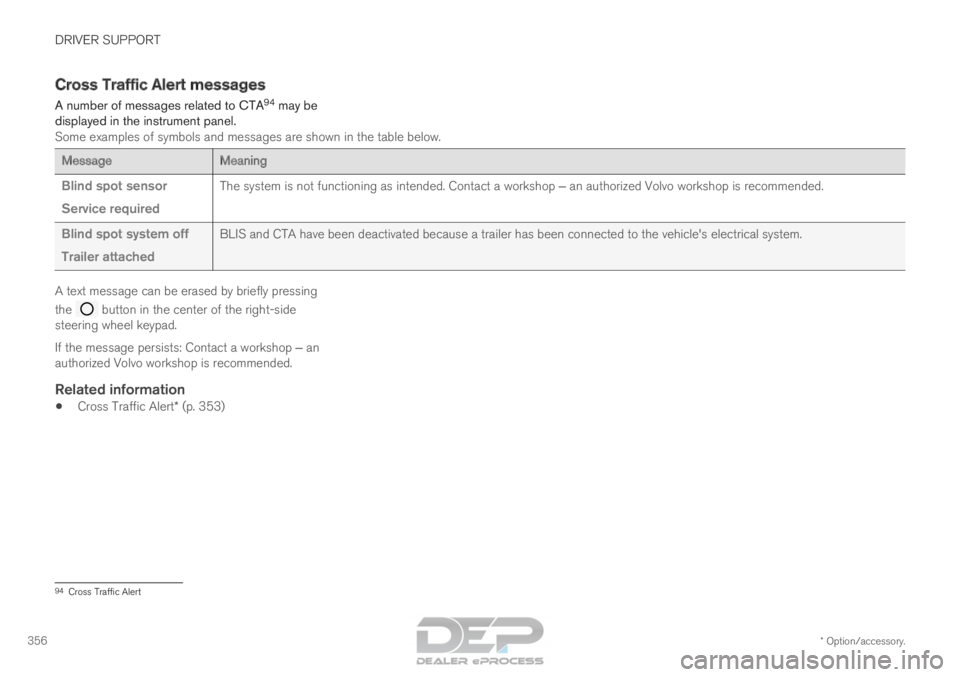
356 Cross Traffic Alert messages
A number of messages related to CTA 94
may be
displayed in the instrument panel.
Some examples of symbols and messages are shown in the table below. Message
Meaning
Blind spot sensor
Service required The system is not functioning as intended. Contact a workshop ‒ an authorized Volvo workshop is recommended.
Blind spot system off
Trailer attached BLIS and CTA have been deactivated because a trailer has been connected \
to the vehicle's electrical system.A text message can be erased by briefly pressing
the
button in the center of the right-side
steering wheel keypad.
If the message persists: Contact a workshop ‒ an
authorized Volvo workshop is recommended.
Related information
• Cross Traffic Alert* (p. 353) 94
Cross Traffic Alert
Page 364 of 686
||DRIVER SUPPORT
* Option/accessory.
362 •
signs partially or fully covered by frost, snow
and/or dirt
• digital road maps 105
that are outdated, incor-
rect or do not contain speed information 106
.
NOTE Certain types of bike carriers that are con-
nected to the trailer socket may be interpre-
ted as a connected trailer by the RSI function.
In such cases, the instrument panel may indi-
cate incorrect speed information.
NOTE
The function uses the vehicle's camera unit,
which has some general limitations – see the
section "Camera unit limitations".
Related information
•
Road Sign Information* (p. 357) Driver Alert Control
The Driver Alert Control (DAC) function is
designed to help capture the driver become
aware of erratic behavior, e.g. if the driver is dis-
tracted or showing signs of fatigue.
The objective of DAC is to detect slowly deterio-
rating driving behavior and is primarily intended to
be used on major roads. The function is not
intended for use in city traffic.
DAC is activated when the vehicle's speed
exceeds 65 km/h (40 mph) and remains active
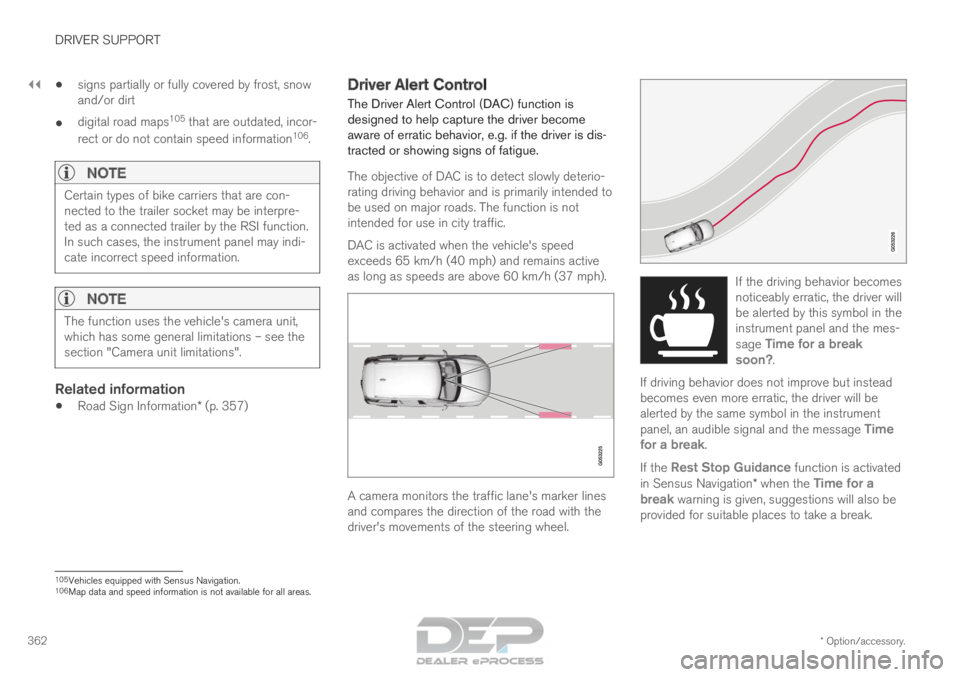
as long as speeds are above 60 km/h (37 mph). A camera monitors the traffic lane's marker lines
and compares the direction of the road with the
driver's movements of the steering wheel. If the driving behavior becomes
noticeably erratic, the driver will
be alerted by this symbol in the
instrument panel and the mes-
sage
Time for a break
soon?.
If driving behavior does not improve but instead
becomes even more erratic, the driver will be
alerted by the same symbol in the instrument
panel, an audible signal and the message Time
for a break. If the Rest Stop Guidance function is activated
in Sensus Navigation* when the Time for a
break warning is given, suggestions will also be provided for suitable places to take a break. 105
Vehicles equipped with Sensus Navigation.
106 Map data and speed information is not available for all areas.
Page 366 of 686
DRIVER SUPPORT
364Selecting guidance to a rest area if
the Driver Alert Control warning has
been given
The Rest Stop Guidance function can be
switched on or off. When the guide is activated, it will automatically
display suggestions for a suitable place to take a
break if the DAC warning is given.
To select Rest Stop Guidance:
1. Tap Settings in the center display's Top
view.
2.
Select My Car IntelliSafe Driver Alert
Control .
3. Select/deselect Rest Stop Guidance to
activate/deactivate the function.
Related information
• Driver Alert Control (p. 362) Driver Alert Control limitations
Driver Alert Control (DAC) functionality may be
reduced in certain situations.
In certain situations, the system may provide a
warning even if it has not detected a change in
driving behavior, e.g.:
• in strong crosswinds
• on grooved road surfaces.
WARNING In certain cases, driving behavior might not be
affected despite the driver's fatigue – when
using the Pilot Assist function – resulting in
the driver not getting a warning from DAC.
It is therefore very important to always stop
and take a break at the slightest sign of fati-
gue, regardless of whether the DAC function
has issued a warning or not.
NOTE
The function uses the vehicle's camera unit,
which has some general limitations – see the
section "Camera unit limitations".
Related information
•
Driver Alert Control (p. 362) Lane Keeping Aid
Lane Keeping Aid (LKA 107
) is designed to
actively steer the vehicle on freeways, highways
and other major roads to help the driver reduce
the risk of the vehicle unintentionally veering out
of the lane.
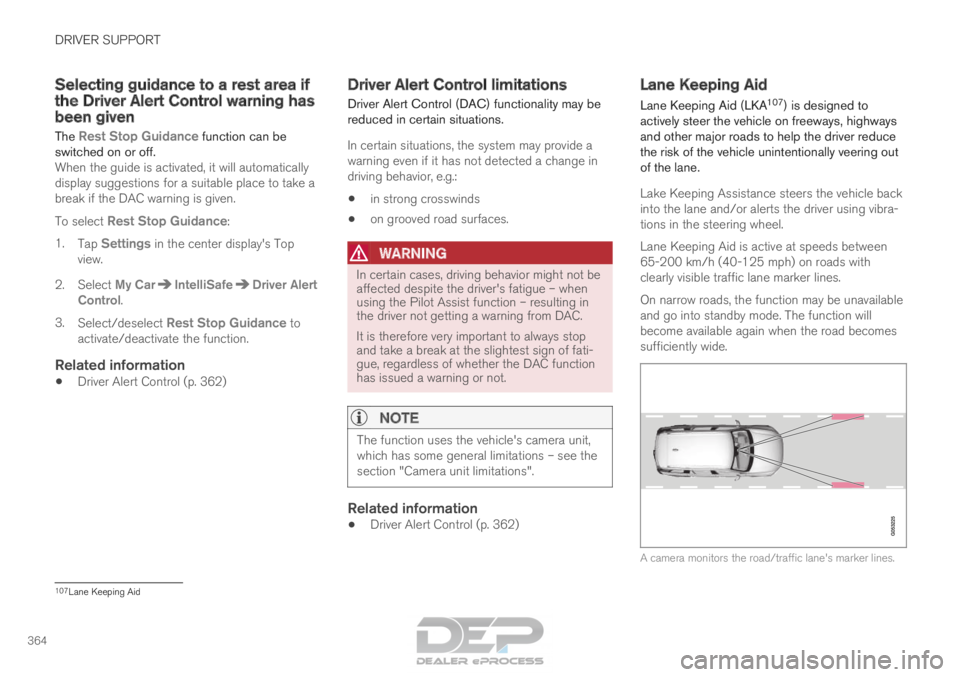
Lake Keeping Assistance steers the vehicle back
into the lane and/or alerts the driver using vibra-
tions in the steering wheel.
Lane Keeping Aid is active at speeds between
65-200 km/h (40-125 mph) on roads with
clearly visible traffic lane marker lines.
On narrow roads, the function may be unavailable
and go into standby mode. The function will
become available again when the road becomes
sufficiently wide. A camera monitors the road/traffic lane's marker lines.
107
Lane Keeping Aid
Page 367 of 686
DRIVER SUPPORT
}}
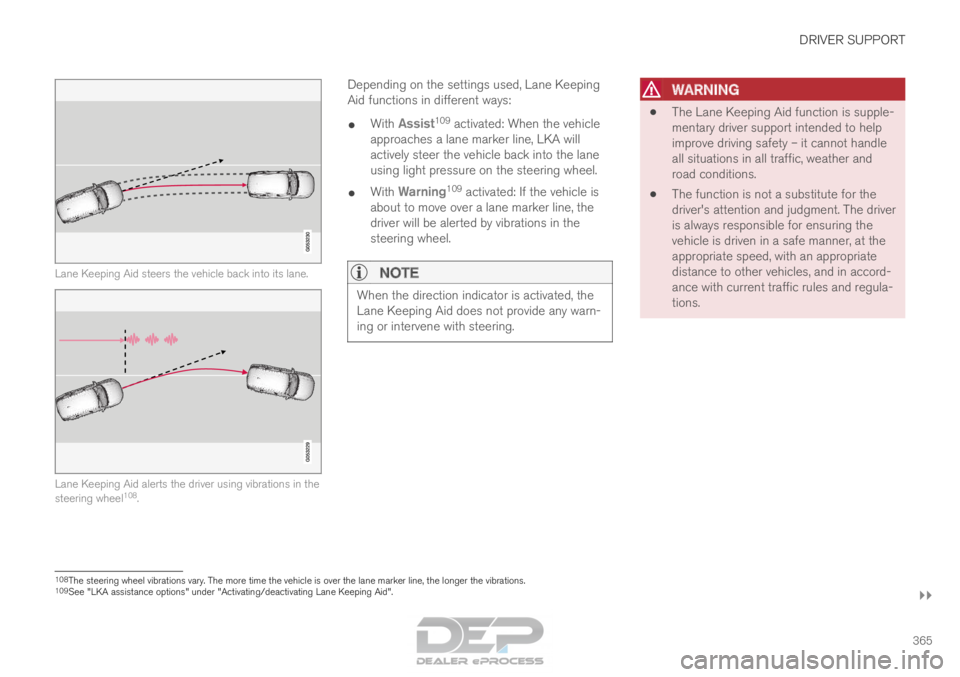
365 Lane Keeping Aid steers the vehicle back into its lane.
Lane Keeping Aid alerts the driver using vibrations in the
steering wheel
108
. Depending on the settings used, Lane Keeping
Aid functions in different ways:
• With
Assist 109
activated: When the vehicle
approaches a lane marker line, LKA will
actively steer the vehicle back into the lane
using light pressure on the steering wheel.
• With
Warning 109
activated: If the vehicle is
about to move over a lane marker line, the
driver will be alerted by vibrations in the
steering wheel.
NOTE When the direction indicator is activated, the
Lane Keeping Aid does not provide any warn-
ing or intervene with steering.
WARNING •
The Lane Keeping Aid function is supple-
mentary driver support intended to help
improve driving safety – it cannot handle
all situations in all traffic, weather and
road conditions.
• The function is not a substitute for the
driver's attention and judgment. The driver
is always responsible for ensuring the
vehicle is driven in a safe manner, at the
appropriate speed, with an appropriate
distance to other vehicles, and in accord-
ance with current traffic rules and regula-
tions. 108
The steering wheel vibrations vary. The more time the vehicle is over th\
e lane marker line, the longer the vibrations.
109 See "LKA assistance options" under "Activating/deactivating Lane Keeping\
Aid".
Page 368 of 686
||DRIVER SUPPORT
366
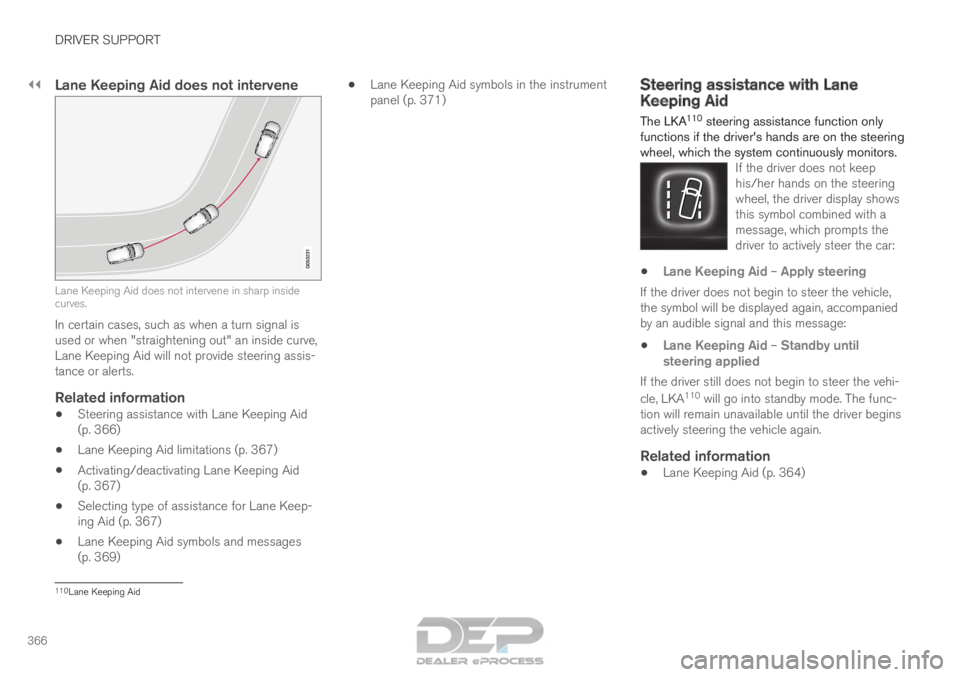
Lane Keeping Aid does not intervene
Lane Keeping Aid does not intervene in sharp inside
curves.
In certain cases, such as when a turn signal is
used or when "straightening out" an inside curve,
Lane Keeping Aid will not provide steering assis-
tance or alerts.
Related information
• Steering assistance with Lane Keeping Aid
(p. 366)
• Lane Keeping Aid limitations (p. 367)
• Activating/deactivating Lane Keeping Aid
(p. 367)
• Selecting type of assistance for Lane Keep-
ing Aid (p. 367)
• Lane Keeping Aid symbols and messages
(p. 369) •
Lane Keeping Aid symbols in the instrument
panel (p. 371) Steering assistance with Lane
Keeping Aid
The LKA
110
steering assistance function only
functions if the driver's hands are on the steering
wheel, which the system continuously monitors. If the driver does not keep
his/her hands on the steering
wheel, the driver display shows
this symbol combined with a
message, which prompts the
driver to actively steer the car: •
Lane Keeping Aid – Apply steering
If the driver does not begin to steer the vehicle,
the symbol will be displayed again, accompanied
by an audible signal and this message:
• Lane Keeping Aid – Standby until
steering applied
If the driver still does not begin to steer the vehi-
cle, LKA 110
will go into standby mode. The func-
tion will remain unavailable until the driver begins
actively steering the vehicle again.
Related information
• Lane Keeping Aid (p. 364) 110
Lane Keeping Aid