service VOLVO XC90 TWIN ENGINE 2018 Workshop Manual
[x] Cancel search | Manufacturer: VOLVO, Model Year: 2018, Model line: XC90 TWIN ENGINE, Model: VOLVO XC90 TWIN ENGINE 2018Pages: 686, PDF Size: 17 MB
Page 409 of 686
HYBRID INFORMATION
}}
407
Charging the hybrid battery
In addition to the conventional fuel tank, your
vehicle is also equipped with a rechargeable
lithium-ion hybrid battery.
The hybrid battery can be recharged using the
charging cable stored in a storage space in the
cargo compartment.
WARNING
The hybrid electrical system in your vehicle
uses high voltage electrical current. Any dam-
age to this system or to the hybrid battery
may result in the danger of overheating, fire,
or serious injury. If the vehicle is involved in a
collision or subjected to flooding, fire, etc.,
have it inspected by a trained and qualified
Volvo service technician. Prior to this inspec-
tion, the vehicle should be parked outdoors at
a safe distance from any building or poten-
tially flammable materials.
The hybrid battery's charging time depends on
the charging current used.
NOTE The capacity of the hybrid battery diminishes
somewhat with age and use, which could
result in increased use of the gasoline engine
and consequently, slightly higher fuel con-
sumption.
WARNING If the hybrid battery needs to be replaced, this
may only be done by Volvo retailer or author-
ized Volvo workshop.
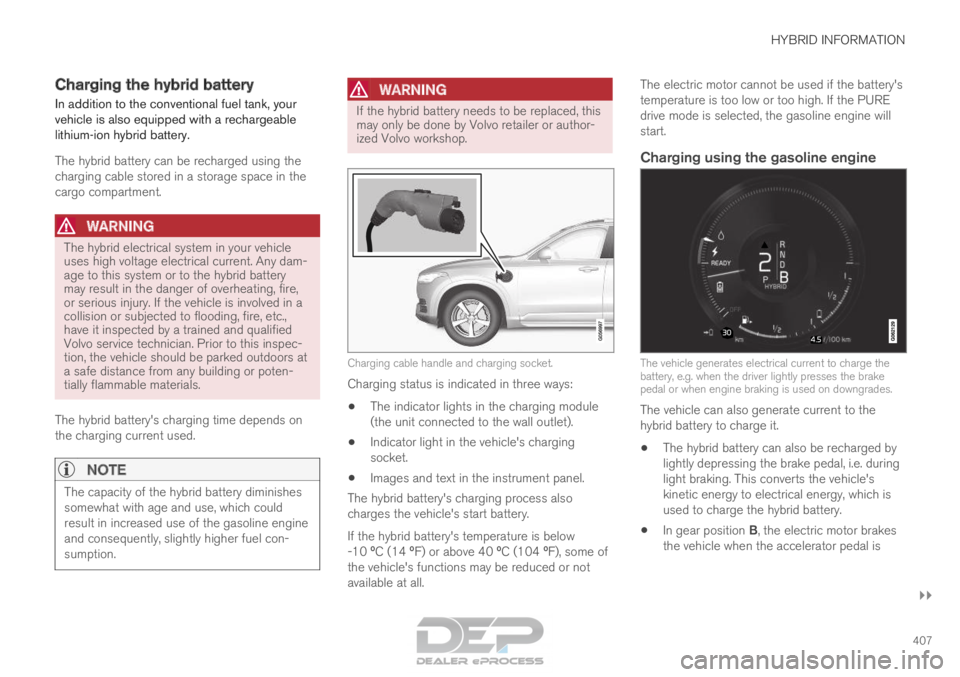
Charging cable handle and charging socket.
Charging status is indicated in three ways:
• The indicator lights in the charging module
(the unit connected to the wall outlet).
• Indicator light in the vehicle's charging
socket.
• Images and text in the instrument panel.
The hybrid battery's charging process also
charges the vehicle's start battery.
If the hybrid battery's temperature is below
-10 ºC (14 ºF) or above 40 ºC (104 ºF), some of
the vehicle's functions may be reduced or not
available at all. The electric motor cannot be used if the battery's
temperature is too low or too high. If the PURE
drive mode is selected, the gasoline engine will
start.
Charging using the gasoline engine
The vehicle generates electrical current to charge the
battery, e.g. when the driver lightly presses the brake
pedal or when engine braking is used on downgrades.
The vehicle can also generate current to the
hybrid battery to charge it.
• The hybrid battery can also be recharged by
lightly depressing the brake pedal, i.e. during
light braking. This converts the vehicle's
kinetic energy to electrical energy, which is
used to charge the hybrid battery.
• In gear position B, the electric motor brakes
the vehicle when the accelerator pedal is
Page 411 of 686
HYBRID INFORMATION
}}
409
Charge cable
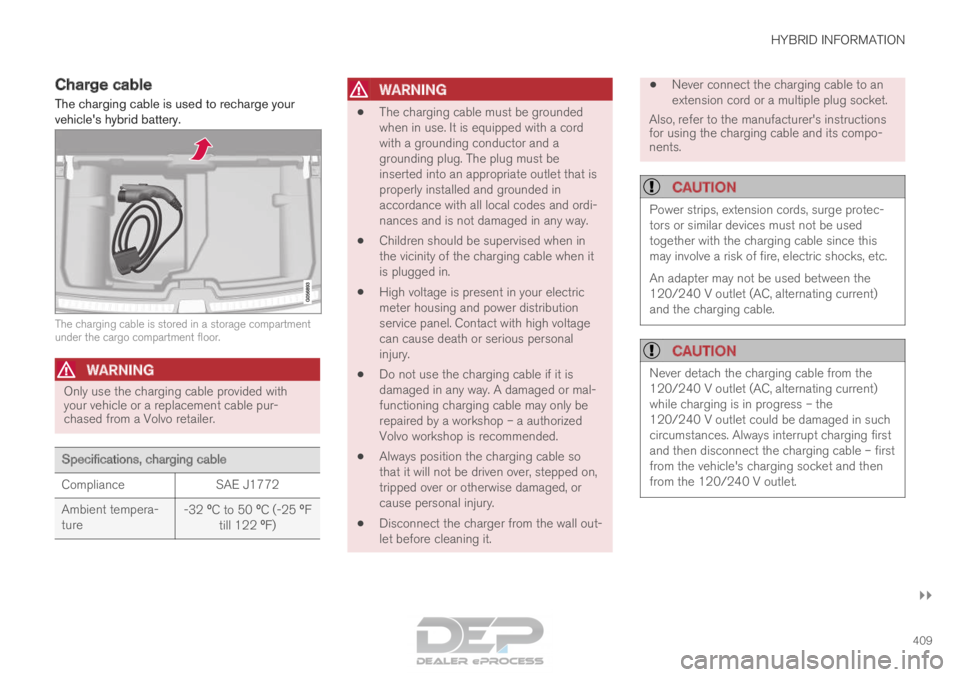
The charging cable is used to recharge your
vehicle's hybrid battery.
The charging cable is stored in a storage compartment
under the cargo compartment floor.
WARNING
Only use the charging cable provided with
your vehicle or a replacement cable pur-
chased from a Volvo retailer.
Specifications, charging cable
Compliance
SAE J1772
Ambient tempera-
ture -32 ºC to 50 ºC (-25 º
F
till 122 ºF)
WARNING •
The charging cable must be grounded
when in use. It is equipped with a cord
with a grounding conductor and a
grounding plug. The plug must be
inserted into an appropriate outlet that is
properly installed and grounded in
accordance with all local codes and ordi-
nances and is not damaged in any way.
• Children should be supervised when in
the vicinity of the charging cable when it
is plugged in.
• High voltage is present in your electric
meter housing and power distribution
service panel. Contact with high voltage
can cause death or serious personal
injury.
• Do not use the charging cable if it is
damaged in any way. A damaged or mal-
functioning charging cable may only be
repaired by a workshop – a authorized
Volvo workshop is recommended.
• Always position the charging cable so
that it will not be driven over, stepped on,
tripped over or otherwise damaged, or
cause personal injury.
• Disconnect the charger from the wall out-
let before cleaning it. •
Never connect the charging cable to an
extension cord or a multiple plug socket.
Also, refer to the manufacturer's instructions
for using the charging cable and its compo-
nents.
CAUTION Power strips, extension cords, surge protec-
tors or similar devices must not be used
together with the charging cable since this
may involve a risk of fire, electric shocks, etc.
An adapter may not be used between the
120/240 V outlet (AC, alternating current)
and the charging cable.
CAUTION
Never detach the charging cable from the
120/240 V outlet (AC, alternating current)
while charging is in progress – the
120/240 V outlet could be damaged in such
circumstances. Always interrupt charging first
and then disconnect the charging cable – first
from the vehicle's charging socket and then
from the 120/240 V outlet.
Page 413 of 686

HYBRID INFORMATION
}}
411
WARNING •
The charging cable's residual current
breaker helps protect the vehicle's charg-
ing system but cannot ensure that an cur-
rent overload will never occur.
• Never use visibly worn or damaged elec-
trical sockets. Doing so could lead to fires
or serious injury.
• Never connect the charging cable to an
extension cord.
• Maintenance or replacement of the hybrid
battery may only be performed by a
trained and qualified Volvo service techni-
cian.
Related information
•Charge cable (p. 409)
• Charging status in the charging cable's
charging module (p. 415) Charging cable temperature
monitoring
To help ensure the vehicle's hybrid battery is reli-
ably charged each time it is connected, charging
is stopped if the temperature in the charging
cable becomes too high and reaches a critical
limit.
CAUTION If charging is often inadvertently interrupted,
have the charging cable and the vehicle's
charging system inspected by a trained and
qualified Volvo service technician.
Related information
•
Charge cable (p. 409) Opening and closing the charging
socket cover
The cover for the hybrid battery's charging
socket opens manually. Unlock the vehicle using the remote key.
Press in the rear edge of the charger door
and release.
Open the door.
Remove the charging socket's protective
cover and secure it in the holder on the
inside of the charger door. Make sure the
cover's rubber stopper is bent downward to
prevent the cover from falling out of the
holder.
Page 414 of 686

||HYBRID INFORMATION
412
CAUTION
Make sure the charging socket's protective
cover is positioned so it does not damage the
paint (in e.g., windy conditions).
Perform the following steps in reverse to close
the charger door.
NOTE
Since the hatch is locked during driving, the
vehicle must be unlocked again to be able to
open the hatch.
Related information
•
Initiating hybrid battery charging (p. 412)
• Stopping hybrid battery charging (p. 418)
• Charging the hybrid battery (p. 407) Initiating hybrid battery charging
The hybrid battery is charged by connecting a
charging cable between the vehicle and a
120/240 V outlet (alternating current).
Only use the charging cable supplied with the
car or a replacement cable recommended by
Volvo.
CAUTION Never connect the charging cable if there is a
risk of a thunderstorm or there is lightning.
WARNING •
The charging cable must be grounded
when in use. It is equipped with a cord
with a grounding conductor and a
grounding plug. The plug must be
inserted into an appropriate outlet that is
properly installed and grounded in
accordance with all local codes and ordi-
nances and is not damaged in any way.
• Children should be supervised when in
the vicinity of the charging cable when it
is plugged in.
• High voltage is present in your electric
meter housing and power distribution
service panel. Contact with high voltage
can cause death or serious personal
injury.
• Do not use the charging cable if it is
damaged in any way. A damaged or mal-
functioning charging cable may only be
repaired by a workshop – a authorized
Volvo workshop is recommended.
• Always position the charging cable so
that it will not be driven over, stepped on,
tripped over or otherwise damaged, or
cause personal injury.
Page 417 of 686
HYBRID INFORMATION
415
Charging status in the charging
cable's charging module
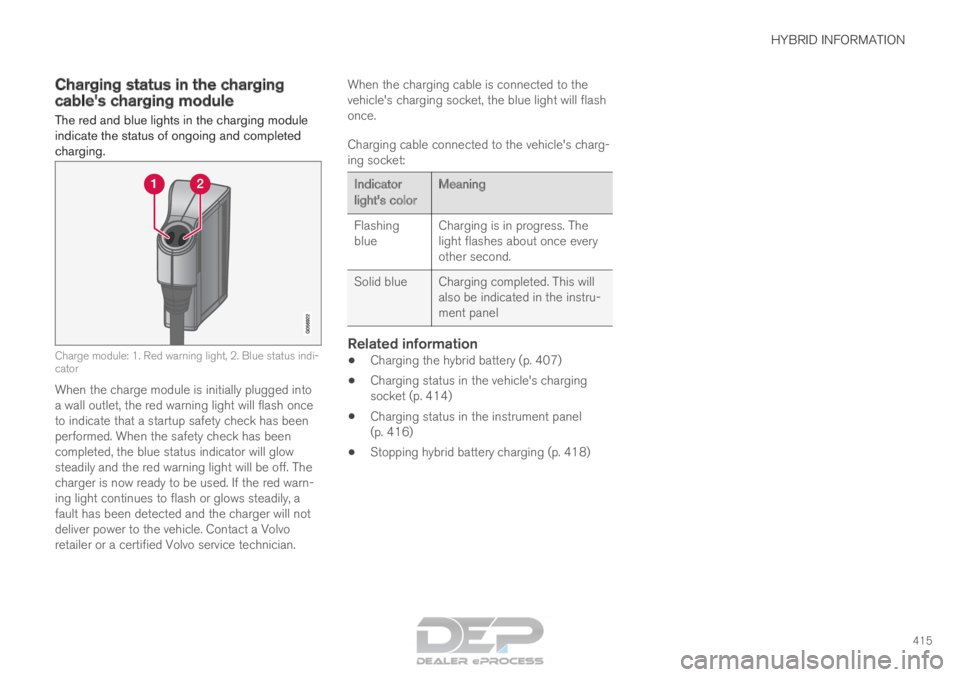
The red and blue lights in the charging module
indicate the status of ongoing and completed
charging. Charge module: 1. Red warning light, 2. Blue status indi-
cator
When the charge module is initially plugged into
a wall outlet, the red warning light will flash once
to indicate that a startup safety check has been
performed. When the safety check has been
completed, the blue status indicator will glow
steadily and the red warning light will be off. The
charger is now ready to be used. If the red warn-
ing light continues to flash or glows steadily, a
fault has been detected and the charger will not
deliver power to the vehicle. Contact a Volvo
retailer or a certified Volvo service technician. When the charging cable is connected to the
vehicle's charging socket, the blue light will flash
once.
Charging cable connected to the vehicle's charg-
ing socket: Indicator
light's color
Meaning
Flashing
blue Charging is in progress. The
light flashes about once every
other second.
Solid blue
Charging completed. This will
also be indicated in the instru-
ment panel
Related information
• Charging the hybrid battery (p. 407)
• Charging status in the vehicle's charging
socket (p. 414)
• Charging status in the instrument panel
(p. 416)
• Stopping hybrid battery charging (p. 418)
Page 421 of 686

HYBRID INFORMATION
}}
419
Twin Engine symbols and messages
in the instrument panel
A number of symbols and messages relating to
the Twin Engine may be displayed in the instru-
ment panel. They may also appear in combina-
tion with general indicator and warning symbols
and disappear when the necessary action has
been taken.Symbol
Message Meaning12 V Battery
Charging fault, service urgent. Drive
to workshop
Battery fault. Contact a workshop
A
to have the battery checked as soon as possible. 12 V Battery
Charging fault Stop safely
Battery fault. Stop the vehicle as soon as possible and contact a worksh\
op
A
to have the battery
checked. 12 V Battery
Fuse failure Service required
Battery fault. Contact a workshop
A
to have the system checked as soon as possible. Hybrid battery
Overheated, stop safely
The hybrid battery's temperature seems to be rising at an abnormal ra\
te. Stop the vehicle and turn
off the engine. Wait at least 5 minutes before driving. Call a workshop
A
or inspect the vehicle to
make sure everything seems normal before continuing to drive. Reduced performance
Max vehicle speed limited
The hybrid battery's charge level is too low for driving at high spee\
ds. Charge the battery as soon as
possible.Hybrid system
Harsh behavior at low speed, vehicle
ok to use
The hybrid system is not functioning properly. Contact a workshop
A
to have the system checked as
soon as possible.
Page 422 of 686

||HYBRID INFORMATION
420
Symbol
Message MeaningHybrid system failure
Service required
The hybrid system is not functioning. Contact a workshop
A
to have the system checked as soon as
possible. Charge cable
Remove before start
Displayed when the driver attempts to start the vehicle with the chargin\
g cable still connected.
Remove the charging cable and close the charger cover.Charge cable
Removed? Turn and hold start knob
7s
Displayed when the driver again attempts to start the vehicle with the c\
harging cable connected.
Disconnect the charging cable or verify that the cable is completely dis\
connected and the charger
cover is closed.A
An authorized Volvo workshop is recommended.
Related information
• Initiating hybrid battery charging (p. 412)
• Stopping hybrid battery charging (p. 418)
• Charging the hybrid battery (p. 407)
• Warning symbols in the instrument panel
(p. 97)
• Indicator symbols in the instrument panel
(p. 94)
• Hybrid gauge (p. 87)
• Hybrid gauge (p. 88)
Page 432 of 686

||STARTING AND DRIVING
430
augment braking. This is indicated in the instru-
ment panel with the pointer down in the red area.
Symbols in the instrument panel
Symbol
Meaning A
B
Check the brake fluid level. If the
level is low, fill brake fluid and
check to determine the reason for
the loss of brake fluid. A
B
Fault in pedal sensor. Symbol
Meaning A
B
Steady glow for 2 seconds after
the engine is started: Automatic
function check.
Steady glow for more than 2 sec-
onds: Fault in the ABS system. The
vehicle's regular brake system is
still working, but without the ABS
function. If the message Brake pedal Cha-
racteristics changed Service
required is displayed, the "Brake-
by-wire" system is not functioning
properly. The brake pedal will go
down further than normal and
greater pressure will be needed on
the pedal to achieve braking effect. A
Canadian models.
B US models.
WARNING •
If both symbols illuminate at the same
time and the brake level is below the MIN
mark in the reservoir or if a brake system-
related message is shown in the instru-
ment panel: DO NOT DRIVE. Have the
vehicle towed to a trained and qualified
Volvo service technician and have the
brake system inspected.
• If both symbols illuminate at the same
time and the brake level is normal (not
below the MIN mark in the reservoir) or if
a brake system-related message is
shown in the instrument panel: drive the
vehicle carefully to an authorized Volvo
workshop and have the brake system
inspected by a trained and qualified Volvo
service technician.
Related information
• Brake Assist System (p. 431)
• Auto-hold brakes (p. 436)
• Hill Start Assist (p. 437)
• Braking on wet roads (p. 431)
• Braking on salted roads (p. 431)
• Maintenance of the brake system (p. 432)
• Brake lights (p. 160)
Page 434 of 686
STARTING AND DRIVING
432Maintenance of the brake system
Regularly check the brake system components
for wear. To keep the vehicle as safe and reliable as possi-
ble, follow the Volvo service schedule specified in
the Warranty and Maintenance Records Informa-
tion booklet. New and replaced brake pads and
brake discs do not provide optimal braking effect
until they are "broken in" by driving a few hun-
dred kilometers (miles). Compensate for the
reduced braking effect by applying greater pres-
sure to the brake pedal. Volvo recommends only
using brake pads approved for your Volvo.
CAUTION The brake system's components should be
regularly checked for wear.
Contact a workshop for advice on how to do
this or let a workshop perform the inspection
- an authorized Volvo workshop is recom-
mended.
Related information
•
Brakes (p. 429) Parking brake
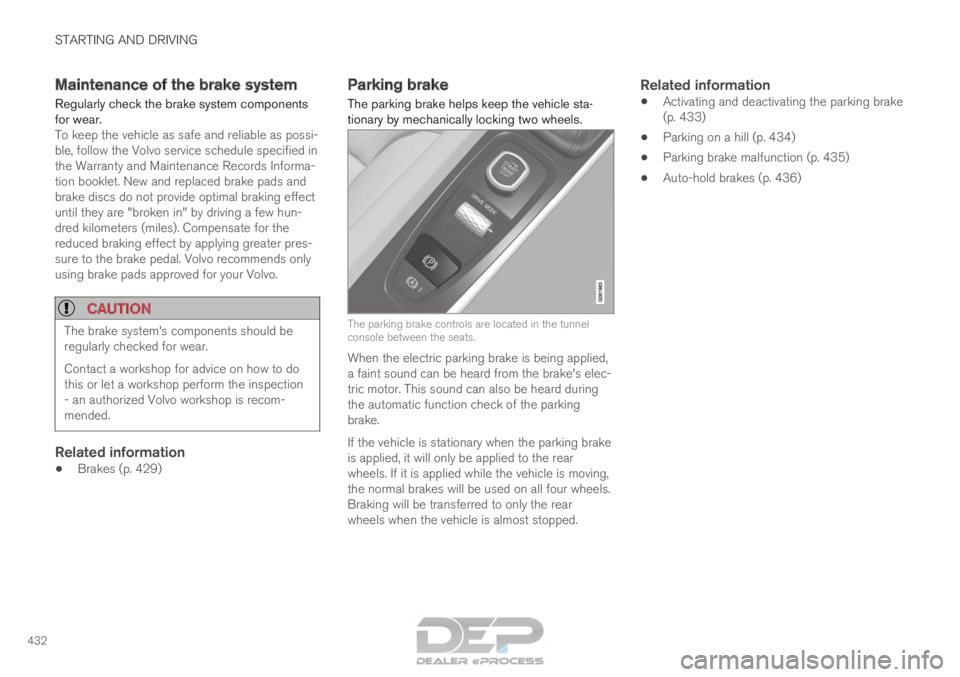
The parking brake helps keep the vehicle sta-
tionary by mechanically locking two wheels.
The parking brake controls are located in the tunnel
console between the seats.
When the electric parking brake is being applied,
a faint sound can be heard from the brake's elec-
tric motor. This sound can also be heard during
the automatic function check of the parking
brake.
If the vehicle is stationary when the parking brake
is applied, it will only be applied to the rear
wheels. If it is applied while the vehicle is moving,
the normal brakes will be used on all four wheels.
Braking will be transferred to only the rear
wheels when the vehicle is almost stopped.
Related information
• Activating and deactivating the parking brake
(p. 433)
• Parking on a hill (p. 434)
• Parking brake malfunction (p. 435)
• Auto-hold brakes (p. 436)
Page 437 of 686

STARTING AND DRIVING
435
Parking brake malfunction
If you are unable to deactivate or activate the
parking brake after several attempts, contact an
authorized Volvo workshop.
A audible warning signal will sound if the parking
brake is applied while the vehicle is being driven.
If the vehicle must be parked before the problem
is rectified, turn the wheels as when parking on
an incline and put the gear selector in P.
Low battery charge levelIf the battery charge level is too low, it will not be
possible to apply or release the parking brake.
Connect an auxiliary battery to the vehicle if the
battery is discharged.
Replacing brake padsDue to the design of the electric parking brake,
the rear brake pads must be replaced by a work-
shop. An authorized Volvo workshop is recom-
mended.
Symbols in the instrument panel Symbol
Meaning A
B
A flashing symbol indicates that a
fault has been detected. See the
message in the instrument panel. A
B
Fault in the brake system. See the
message in the instrument panel. Information message in the instru-
ment panel.
A
Canadian models.
B US models.Related information
• Activating and deactivating the parking brake
(p. 433)
• Start battery (p. 615)
• Volvo's service program (p. 598)