service VOLVO XC90 TWIN ENGINE 2018 Repair Manual
[x] Cancel search | Manufacturer: VOLVO, Model Year: 2018, Model line: XC90 TWIN ENGINE, Model: VOLVO XC90 TWIN ENGINE 2018Pages: 686, PDF Size: 17 MB
Page 453 of 686

STARTING AND DRIVING
}}
451
Symbols and messages in driver display Symbol
Message MeaningSuspension
Deactivated by user
Level control has been switched off manually by the user.Suspension
Temporarily reduced performence
Level control performance has been temporarily reduced due to extensive \
system use. If this
message appears frequently (e.g. several times in one week) contact a \
workshop
A
. Suspension
Service required
A fault has occurred. Visit a workshop
A
as soon as possible. Suspension failure
Stop safely
A critical fault has occurred. Stop safely, and have the car transported\
(raised with all wheels on
the flatbed) to a workshop
A
.
Page 465 of 686

STARTING AND DRIVING
}}
463 1. Press the button on the dashboard.
>
Pressure equalization in the fuel tank cau-
ses a slight delay before the fuel filler
door opens. Fuel tank Fuel lid is
opening will be displayed in the instru- ment panel, followed by Fuel tank Ready for refueling.
NOTE Refueling must be done within approximately
10 minutes of opening the fuel filler door.
After this time, the valve opened by pushing
the button will close and it will no longer be
possible to refuel without the pump's nozzle
switching off.
If the valve is closed before refueling is com-
plete - press the button again and wait until
the driver display shows the message
Fuel
tank Ready for refueling. 2. After refueling, press the fuel filler door
lightly to close it.
Related information
• Refueling (p. 463) Refueling
The fuel tank is equipped with a fuel filling sys-
tem without a cover.Refueling the vehicle at a service
station
Page 466 of 686
||STARTING AND DRIVING
464
Refueling is done as follows.
1. Turn off the engine and open the fuel filler
door.
NOTE Refueling must be done within approximately
10 minutes of opening the fuel filler door.
After this time, the valve opened by pushing
the button will close and it will no longer be
possible to refuel without the pump's nozzle
switching off.
If the valve is closed before refueling is com-
plete - press the button again and wait until
the driver display shows the message
Fuel
tank Ready for refueling. 2. Select a fuel approved for use in the vehicle.
For more information on approved fuels, see
the section on "Gasoline".
3.
Insert the pump's nozzle into the fuel filler
pipe's opening. There are two flaps just
inside the fuel filler pipe and the pump's noz-
zle must push both of these flaps open
before fuel can be added. 4. Avoid overfilling the tank. Do not press the
handle on the filler nozzle again after it has
initially stopped pumping.
> The fuel tank is now filled.
NOTE An over-full tank may overflow in hot weather.
CAUTION
Avoid spilling gasoline during refueling. In
addition to causing damage to the environ-
ment, gasolines containing alcohol can cause
damage to painted surfaces, which may not
be covered under the New Vehicle Limited
Warranty.
Refueling from a fuel containerWhen filling from a fuel container, use the funnel
provided in a foam block under the floor hatch in
the cargo compartment.
1. Open the fuel filler door.
2. Insert the funnel into the fuel filler pipe's
opening. There are two flaps just inside the
fuel filler pipe and the tube section of the
funnel must push both of these flaps open
before fuel can be added.
Related information
• Opening/closing the fuel filler door (p. 462) Fuel
Volvo recommends the use of detergent gaso-
line to control engine deposits.
Deposit control gasoline (gasoline with
detergent additives)
Detergent gasoline is effective in keeping injec-
tors and intake valves clean. Consistent use of
deposit control gasolines will help ensure good
driveability and fuel economy. If you are not sure
whether the gasoline contains deposit control
additives, check with the service station operator.
NOTE
Volvo recommends not using external fuel
injector cleaning systems, e.g. do not add
detergent additives to gasoline before or after
refueling.
Unleaded fuelAll Volvo vehicles have a three-way catalytic con-
verter and must only use unleaded gasoline. US
and Canadian regulations require that pumps
delivering unleaded gasoline are labeled
"UNLEADED". Only the nozzles of these pumps
will fit in your vehicle's fuel filler inlet. It is unlaw-
ful to dispense leaded fuel into a vehicle labeled
"unleaded gasoline only". Leaded gasoline dam-
ages the three-way catalytic converter and the
heated oxygen sensor system. Repeated use of
leaded gasoline will lessen the effectiveness of
Page 467 of 686

STARTING AND DRIVING
}}
465
the emission control system and could result in
loss of emission warranty coverage. State and
local vehicle inspection programs will make
detection of misfueling easier, possibly resulting
in emission test failure for misfueled vehicles.
NOTE
Some U.S. and Canadian gasolines contain an
octane enhancing additive called methyl-
cyclopentadienyl manganese tricarbonyl
(MMT). If such fuels are used, your Emission
Control System performance may be affected,
and the Check Engine Light (malfunction
indicator light) located on your instrument
panel may light. If this occurs, please return
your vehicle to a trained and qualified Volvo
service technician for service.
Gasoline containing alcohol and ethers,
"Oxygenated fuels"
Some fuel suppliers sell gasoline containing
"oxygenates" which are usually alcohols or
ethers. In some areas, state or local laws require
that the service pump be marked indicating use
of alcohols or ethers. However, there are areas in
which the pumps are unmarked. If you are not
sure whether there is alcohol or ethers in the
gasoline you buy, check with the service station
operator. To meet seasonal air quality standards,
some areas require the use of "oxygenated" fuel.
Volvo permits the use of the following "oxygen-
ated" fuels. However, the specified octane ratings
must still be met.
Alcohol - Ethanol
Fuels containing up to 10% ethanol by volume
may be used. Ethanol may also be referred to as
Ethyl alcohol, or "Gasohol".
Ethers - MTBE/ETBE: Fuels containing up to
15% MTBE/ETBE may be used.
MethanolDo not use gasolines containing methanol
(methyl alcohol, wood alcohol). This practice can
result in vehicle performance deterioration and
can damage critical parts in the fuel system. Such
damage may not be covered under the New
Vehicle Limited Warranty.
Related information
•
Octane rating (p. 465)
• Opening/closing the fuel filler door (p. 462)
• Refueling (p. 463)
• Emission controls (p. 467) Octane rating
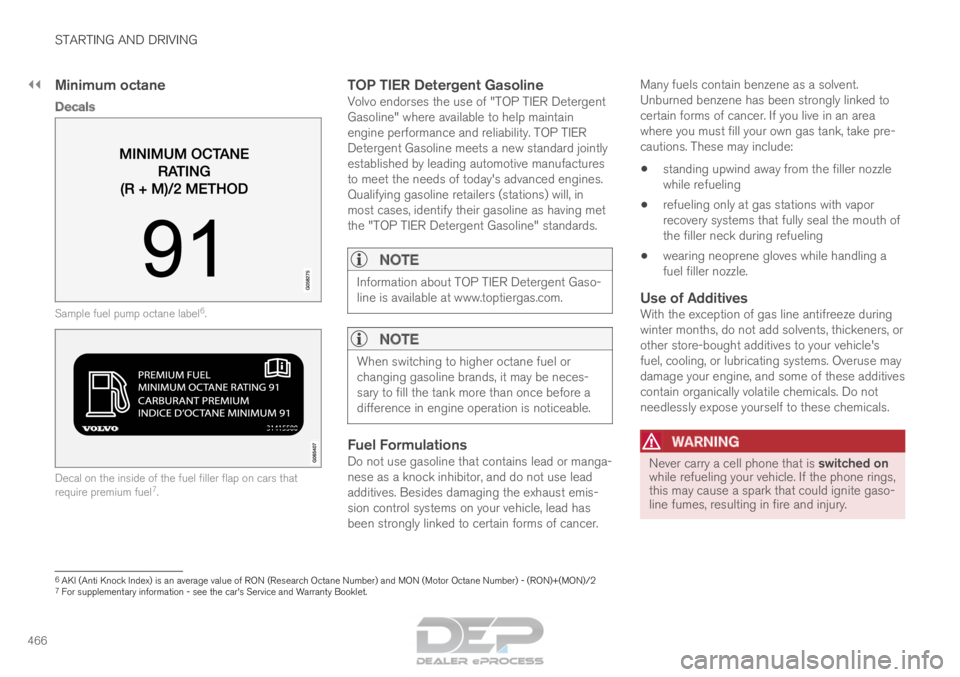
Volvo demands premium fuel (91 octane
6
or
higher) for all T5, T6 and T8 engines. See both
supplied decal examples. 6
AKI (Anti Knock Index) is an average value of RON (Research Octane Nu\
mber) and MON (Motor Octane Number) - (RON)+(MON)/2
Page 468 of 686
||STARTING AND DRIVING
466
Minimum octane
Decals
Sample fuel pump octane label
6
. Decal on the inside of the fuel filler flap on cars that
require premium fuel
7
.TOP TIER Detergent GasolineVolvo endorses the use of "TOP TIER Detergent
Gasoline" where available to help maintain
engine performance and reliability. TOP TIER
Detergent Gasoline meets a new standard jointly
established by leading automotive manufactures
to meet the needs of today's advanced engines.
Qualifying gasoline retailers (stations) will, in
most cases, identify their gasoline as having met
the "TOP TIER Detergent Gasoline" standards.
NOTE Information about TOP TIER Detergent Gaso-
line is available at www.toptiergas.com.
NOTE
When switching to higher octane fuel or
changing gasoline brands, it may be neces-
sary to fill the tank more than once before a
difference in engine operation is noticeable.
Fuel FormulationsDo not use gasoline that contains lead or manga-
nese as a knock inhibitor, and do not use lead
additives. Besides damaging the exhaust emis-
sion control systems on your vehicle, lead has
been strongly linked to certain forms of cancer.Many fuels contain benzene as a solvent.
Unburned benzene has been strongly linked to
certain forms of cancer. If you live in an area
where you must fill your own gas tank, take pre-
cautions. These may include:
•
standing upwind away from the filler nozzle
while refueling
• refueling only at gas stations with vapor
recovery systems that fully seal the mouth of
the filler neck during refueling
• wearing neoprene gloves while handling a
fuel filler nozzle.
Use of AdditivesWith the exception of gas line antifreeze during
winter months, do not add solvents, thickeners, or
other store-bought additives to your vehicle's
fuel, cooling, or lubricating systems. Overuse may
damage your engine, and some of these additives
contain organically volatile chemicals. Do not
needlessly expose yourself to these chemicals.
WARNING Never carry a cell phone that is switched on
while refueling your vehicle. If the phone rings,
this may cause a spark that could ignite gaso-
line fumes, resulting in fire and injury.
6
AKI (Anti Knock Index) is an average value of RON (Research Octane Nu\
mber) and MON (Motor Octane Number) - (RON)+(MON)/2
7 For supplementary information - see the car's Service and Warranty Bo\
oklet.
Page 469 of 686

STARTING AND DRIVING
467
WARNINGCarbon monoxide is a poisonous, colorless,
and odorless gas. It is present in all exhaust
gases. If you ever smell exhaust fumes inside
the vehicle, make sure the passenger com-
partment is ventilated, and immediately return
the vehicle to a trained and qualified Volvo
service technician for correction.
Demanding drivingIn demanding driving conditions, e.g. when driving
in a hot climates, driving with a trailer or driving
for longer periods at higher altitudes (mountain
landscapes) than normal, it is recommended
switching to a higher octane fuel than AKI 91
6
or
changing gasoline brand to take full advantage of
your car's engine capacity and obtain the opti-
mum driving force.
Related information
• Fuel (p. 464)
• Emission controls (p. 467) Emission controls
Three-way catalytic converter
•
Keep your engine properly tuned. Certain
engine malfunctions, particularly involving the
electrical, fuel or distributor ignition systems,
may cause unusually high three-way catalytic
converter temperatures. Do not continue to
operate your vehicle if you detect engine
misfire, noticeable loss of power or other
unusual operating conditions, such as engine
overheating or backfiring. A properly tuned
engine will help avoid malfunctions that
could damage the three-way catalytic con-
verter.
• Do not park your vehicle over combustible
materials, such as grass or leaves, which can
come into contact with the hot exhaust sys-
tem and cause such materials to ignite under
certain wind and weather conditions.
• Excessive starter cranking (in excess of one
minute), or an intermittently firing or flooded
engine can cause three-way catalytic con-
verter or exhaust system overheating.
• Remember that tampering or unauthorized
modifications to the engine, the Engine Con-
trol Module, or the vehicle may be illegal and
can cause three-way catalytic converter or
exhaust system overheating. This includes:
altering fuel injection settings or compo-
nents, altering emission system components or location or removing components, and/or
repeated use of leaded fuel.NOTE Unleaded fuel is required for vehicles with
three-way catalytic converters.
Heated oxygen sensorsThe heated oxygen sensors monitor the oxygen
content of the exhaust gases. Readings are fed
into a control module that continuously monitors
engine functions and controls fuel injection. The
ratio of fuel to air into the engine is continuously
adjusted for efficient combustion to help reduce
harmful emissions.
Related information
•
Octane rating (p. 465)
• Fuel (p. 464) 6
AKI (Anti Knock Index) is an average value of RON (Research Octane Nu\
mber) and MON (Motor Octane Number) - (RON)+(MON)/2
Page 471 of 686
STARTING AND DRIVING
}}
469
Battery drain
The electrical functions in the vehicle drain the
battery to varying degrees. Avoid using ignition
mode II when the engine is switched off. Use
ignition mode I instead, as this uses less electri-
cal current.
Note that certain accessories may also drain
power from the electrical system. Do not use
functions that use a lot of electrical current when
the engine is turned off. Examples of such func-
tions are: • blower
• headlights
• windshield wipers
• audio system (especially at high volume).
If the starter battery voltage is low, a message is
shown in the driver display. The vehicle's energy-
saving function will then turn off or reduce certain
functions, such as the blower and/or the audio
system.
– Charge the battery by starting the engine
and let it run for at least 15 minutes (driving
charges the battery faster than letting the
engine idle).
Related information
• Start battery (p. 615)
• Ignition modes (p. 427) Jump starting using another battery
If the start battery is discharged, current from
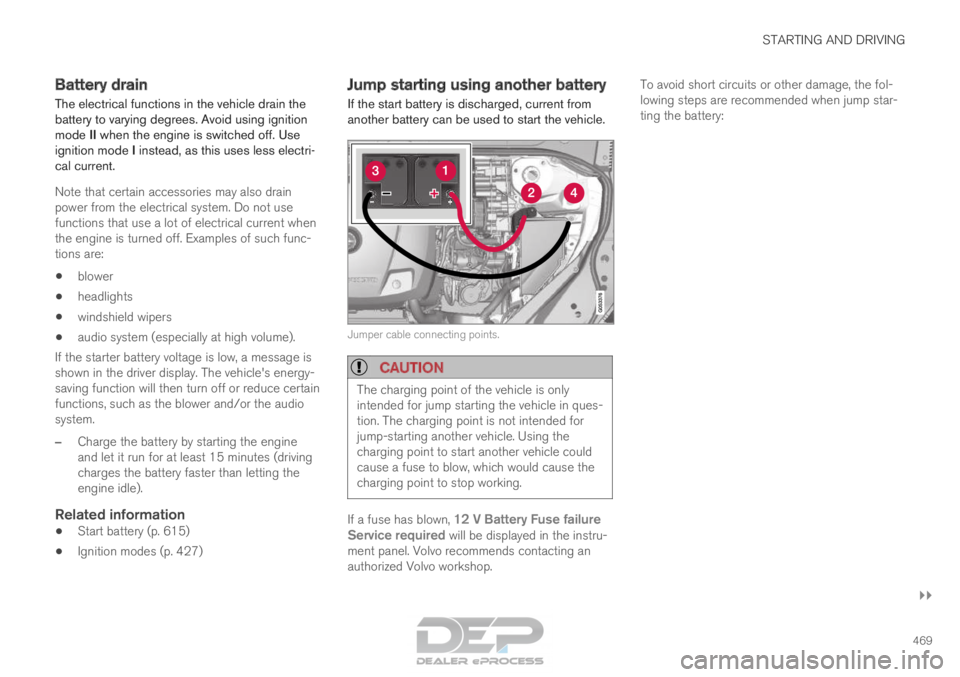
another battery can be used to start the vehicle. Jumper cable connecting points.
CAUTION
The charging point of the vehicle is only
intended for jump starting the vehicle in ques-
tion. The charging point is not intended for
jump-starting another vehicle. Using the
charging point to start another vehicle could
cause a fuse to blow, which would cause the
charging point to stop working.
If a fuse has blown, 12 V Battery Fuse failure
Service required will be displayed in the instru-
ment panel. Volvo recommends contacting an
authorized Volvo workshop. To avoid short circuits or other damage, the fol-
lowing steps are recommended when jump star-
ting the battery:
Page 479 of 686

STARTING AND DRIVING
}}
* Option/accessory. 477Remove the cover - press the marker with
your finger while prying open the opposite
side/corner open with a coin or similar.
>
The cover turns along its center line and
can then be removed. 3. Screw in the towing eyelet until it reaches its
stop. Fasten the eyelet securing by, for exam-
ple, inserting a lug wrench* through it and
using this as a lever.
CAUTION It is important that the towing eye is screwed
in securely as far as possible.
Removing the towing eyelet:
–
After use, unscrew the towing eyelet and
return it to its storage location.
Replace the cover on the bumper.
Related information
• Towing using a towline (p. 476)
• Recovery (p. 477)
• Tool kit (p. 564) Recovery
This section refers to transporting the vehicle
with a tow truck or similar vehicle. Call a professional towing service for assistance.
In certain conditions, the towing eyelet can be
used to pull the vehicle onto a flatbed tow truck.
CAUTION Note that vehicles with Twin Engine must
always be towed raised with all wheels on the
tow truck.
For vehicles equipped with leveling control*:
If the vehicle is equipped with pneumatic suspen-
sion, this feature must be turned off before the
vehicle is lifted onto a tow truck. Turning off the
function in the center display.
1. Tap Settings in the Top view.
2.
Tap My Car Parking Brake and
Suspension .
3. Select Disable Leveling Control.
The vehicle's location and ground clearance
determine if it can be lifted onto a tow truck. If
the incline of the tow truck is too steep or if the
ground clearance under the vehicle is insufficient,
attempting to pull it up may result in damage. In
this case, the vehicle should only be lifted with
the tow truck's lifting equipment.
Page 489 of 686

AUDIO, MEDIA AND INTERNET
}}
* Option/accessory. 487
Sound experience*Recreate the acoustics from the Gothenburg Concert
Hall.
Sound Experience is opened from the center
display's app view and gives access to further
audio settings. The following settings are possi-
ble:
• Studio - the sound can be optimized for
Driver, All and Rear.
• Individual stage - surround sound mode
with settings for intensity and enclosure.
• Concert hall - reproduces the acoustics of
Gothenburg's Concert Hall
Active noise suppression*Some vehicles are equipped with an active noise
suppression function that reduces engine noise
in the passenger compartment using the audio
system. Microphones in the ceiling liner detect distracting noise and the audio system sends out
a counteracting sound to help reduce the unwan-
ted noise.
Microphones in the ceiling lining.
NOTE
Do not cover the vehicle microphones.
Related information
•
Media player (p. 507)
• Voice control settings (p. 148)
• Phone settings (p. 528)
• Audio, media and Internet (p. 486)
• Internet-connected vehicle* (p. 529) Apps
The App view contains applications (apps) that
provide access to certain vehicle services.
Page 490 of 686
||AUDIO, MEDIA AND INTERNET
* Option/accessory.
488 Swipe the center display screen from right to
left
1
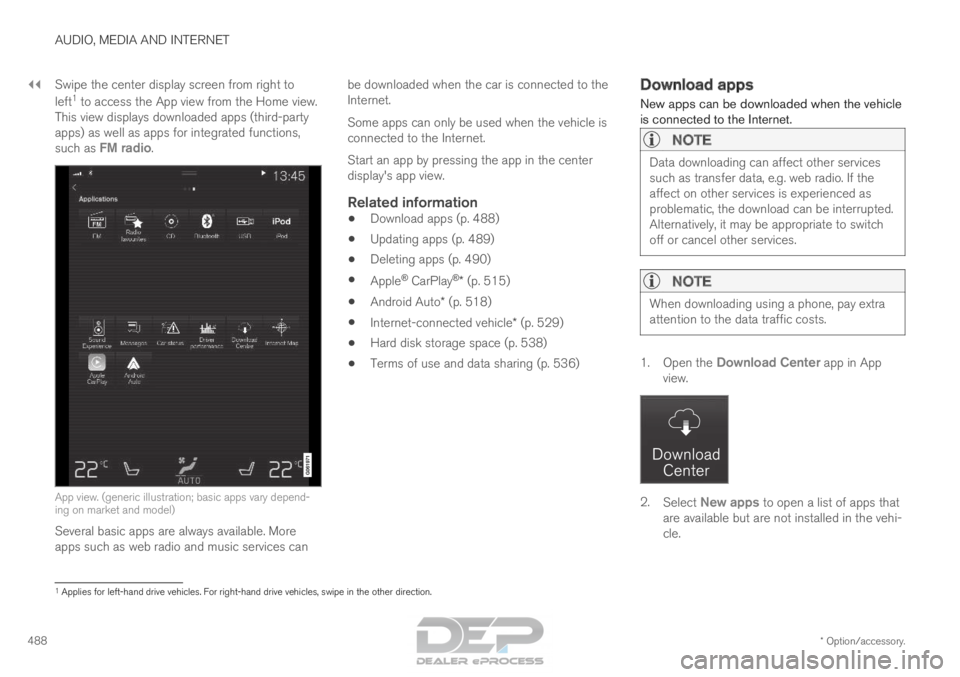
to access the App view from the Home view.
This view displays downloaded apps (third-party
apps) as well as apps for integrated functions,
such as FM radio. App view. (generic illustration; basic apps vary depend-
ing on market and model)
Several basic apps are always available. More
apps such as web radio and music services can be downloaded when the car is connected to the
Internet.
Some apps can only be used when the vehicle is
connected to the Internet.
Start an app by pressing the app in the center
display's app view.
Related information
•
Download apps (p. 488)
• Updating apps (p. 489)
• Deleting apps (p. 490)
• Apple ®
CarPlay ®
* (p. 515)
• Android Auto* (p. 518)
• Internet-connected vehicle* (p. 529)
• Hard disk storage space (p. 538)
• Terms of use and data sharing (p. 536) Download apps
New apps can be downloaded when the vehicle
is connected to the Internet.
NOTE Data downloading can affect other services
such as transfer data, e.g. web radio. If the
affect on other services is experienced as
problematic, the download can be interrupted.
Alternatively, it may be appropriate to switch
off or cancel other services.
NOTE
When downloading using a phone, pay extra
attention to the data traffic costs.
1.
Open the Download Center app in App
view. 2.
Select New apps to open a list of apps that
are available but are not installed in the vehi-
cle. 1
Applies for left-hand drive vehicles. For right-hand drive vehicles, swi\
pe in the other direction.