light VOLVO XC90 TWIN ENGINE 2019 Manual Online
[x] Cancel search | Manufacturer: VOLVO, Model Year: 2019, Model line: XC90 TWIN ENGINE, Model: VOLVO XC90 TWIN ENGINE 2019Pages: 697, PDF Size: 10.33 MB
Page 268 of 697

KEY, LOCKS AND ALARM
* Option/accessory.
266 Automatic locking when driving
The doors and tailgate will automatically lock
when the vehicle begins to move.
Related information
Locking and unlocking from inside the vehi-
cle (p. 262) Opening and closing the power
tailgate*
The tailgate can be opened and closed automat-
ically with the optional power tailgate.OpeningTo open the power tailgate, do one of the follow-
ing:
– Press and hold the button on the
remote key until the tailgate begins to open. –
Press and hold the button on the dash-
board until the tailgate begins to open. –
Press lightly on the tailgate's outside handle.
Page 274 of 697
KEY, LOCKS AND ALARM
* Option/accessory.
272 Activating and deactivating private
locking
Private locking is activated using the function
button in the center display and a PIN code.
NOTE For the valet lock function to be activated the
car must be in at least ignition mode I.
Entering security code before initial useThe first time the function is used, a security
code must be selected. This code can then be
used to deactivate private locking if the selected
PIN code has been lost or forgotten. The security
code functions as a PUK (security) code for all
PIN codes used for private locking.
Save the security code in a safe place.
To create a security code:
1. Tap the button for private locking in Function
view. > A pop-up window will appear. 2.
Enter your security code.
> The security code is saved. The private locking function is now ready for activa-
tion.
If the system has been reset, the above proce-
dure will need to be repeated.
Activating private locking1. Tap the button for private locking in Function view. > A pop-up window will appear.
2.
Enter the code you would like to use to
unlock the glove compartment and the tail-
gate and tap Confirm.
>
The glove compartment and tailgate will
lock. A green indicator light will illuminate
next to the button in Function view to con-
firm locked status.
Deactivating private locking1. Tap the button for private locking in Function view. > A pop-up window will appear.
2.
Enter the code used for locking and tap
Confirm.
>
The glove compartment and tailgate will
unlock. The green indicator light next to
the button in Function view will go out to
confirm unlocked status.
NOTE If you have forgotten or lost your PIN code or
if the PIN code has been entered incorrectly
more than three times, the security code can
be used to deactivate private locking.
NOTE
If private locking is activated and the vehicle
is unlocked using Volvo On Call* or the Volvo
On Call* app, private locking will be deacti-
vated automatically.
Page 275 of 697
KEY, LOCKS AND ALARM
}}
273
Related information
Private Locking (p. 271) Alarm
The alarm emits sound and light signals if any-
one without a valid remote key attempts to break
into the vehicle or interferes with the start battery
or alarm siren.
When armed, the alarm will be triggered if:
the hood, tailgate or any door is opened.
a battery cable is disconnected.
the alarm siren is disconnected.
Alarm signalsThe following occurs if the alarm is triggered:
A siren will sound for 30 seconds or until the
alarm is turned off.
All turn signals will flash for 5 minutes or
until the alarm is turned off.
If the reason the alarm was triggered is not recti-
fied, the alarm cycle will repeat up to 10 times 20
.
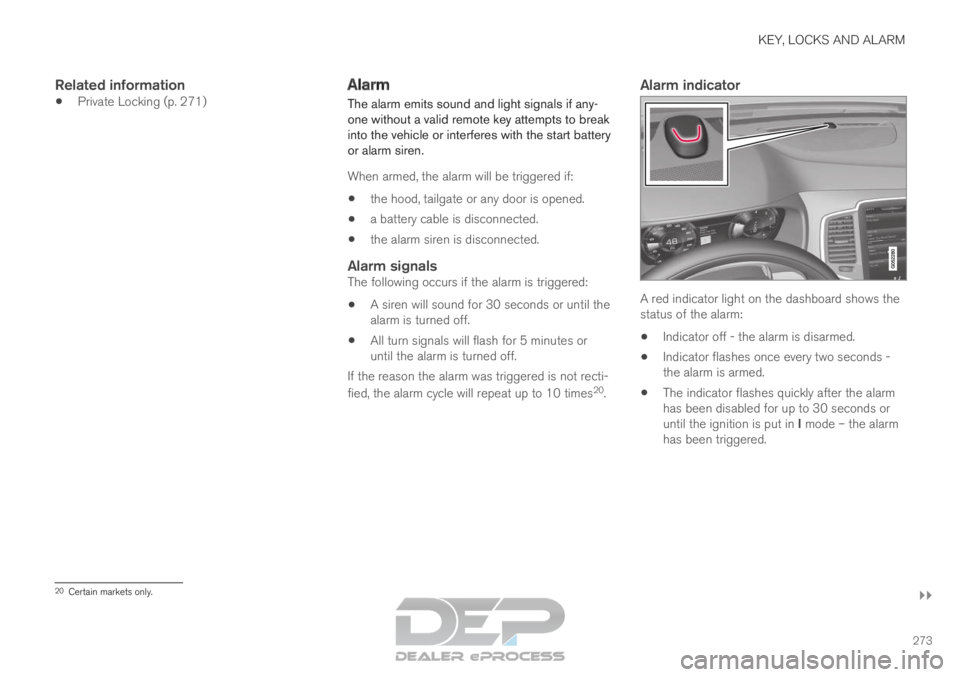
Alarm indicator A red indicator light on the dashboard shows the
status of the alarm:
Indicator off - the alarm is disarmed.
Indicator flashes once every two seconds -
the alarm is armed.
The indicator flashes quickly after the alarm
has been disabled for up to 30 seconds or
until the ignition is put in I mode – the alarm
has been triggered. 20
Certain markets only.
Page 276 of 697
||KEY, LOCKS AND ALARM
* Option/accessory.
274
In the event of alarm system failureIf a problem is detected in the alarm
system, a symbol and the message
Alarm system failure Service
required will appear in the instrument
panel. Contact a workshop - an authorized Volvo
workshop is recommended.
NOTE Do not attempt to repair or alter any of the
components in the alarm system yourself. Any
such attempt could affect the terms and con-
ditions of your insurance policy.
Related information
Arming and disarming the alarm (p. 274) Arming and disarming the alarm
The alarm is armed when the vehicle is locked.
Arming the alarmLock and arm the vehicle by:
pressing the lock button on the remote key .
touch the marked surface on the outside of
the door handle or the rubberized pressure
plate on the tailgate 21
.
If the vehicle is equipped with both keyless lock-
ing/unlocking* and power tailgate*, the button on the lower edge of the tailgate can also
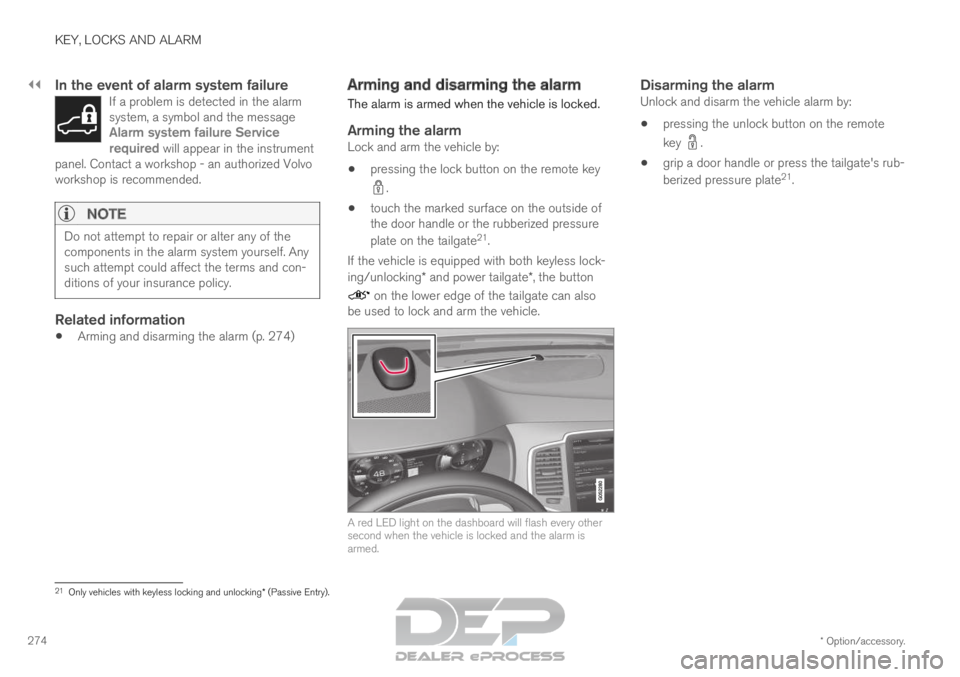
be used to lock and arm the vehicle. A red LED light on the dashboard will flash every other
second when the vehicle is locked and the alarm is
armed.
Disarming the alarmUnlock and disarm the vehicle alarm by:
pressing the unlock button on the remote
key .
grip a door handle or press the tailgate's rub-
berized pressure plate 21
. 21
Only vehicles with keyless locking and unlocking* (Passive Entry).
Page 277 of 697
KEY, LOCKS AND ALARM
275
Disarming the alarm without a functioning
remote key
The vehicle can be unlocked and disarmed even
if the remote key is not functioning, e.g. if the
battery is discharged.
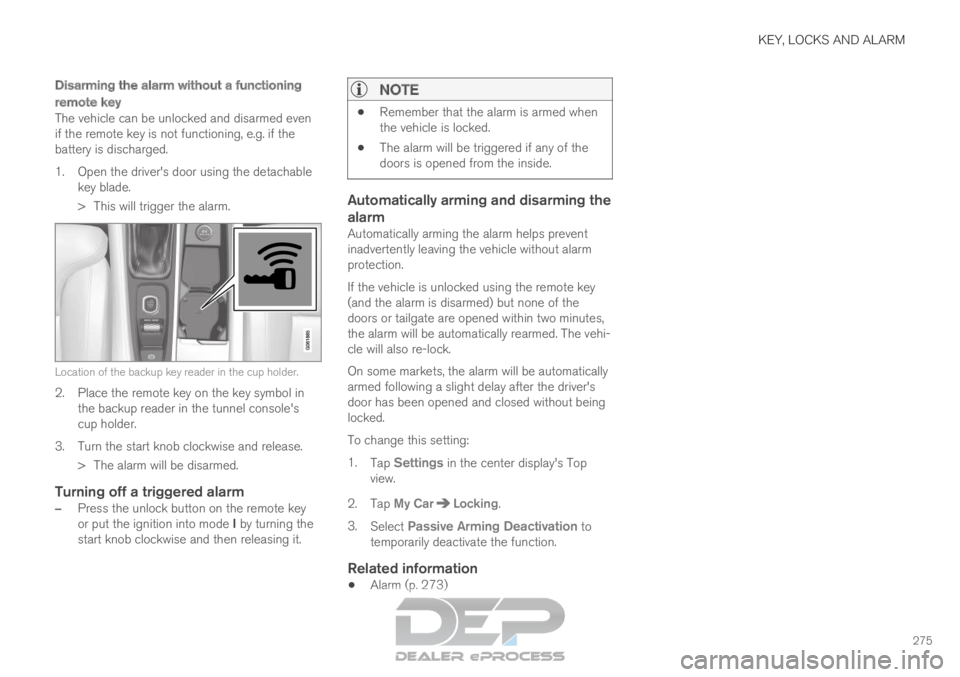
1. Open the driver's door using the detachablekey blade.
> This will trigger the alarm. Location of the backup key reader in the cup holder.
2. Place the remote key on the key symbol in
the backup reader in the tunnel console's
cup holder.
3.
Turn the start knob clockwise and release.
> The alarm will be disarmed.
Turning off a triggered alarm
– Press the unlock button on the remote key
or put the ignition into mode I by turning the
start knob clockwise and then releasing it.
NOTE
Remember that the alarm is armed when
the vehicle is locked.
The alarm will be triggered if any of the
doors is opened from the inside.
Automatically arming and disarming the
alarm
Automatically arming the alarm helps prevent
inadvertently leaving the vehicle without alarm
protection.
If the vehicle is unlocked using the remote key
(and the alarm is disarmed) but none of the
doors or tailgate are opened within two minutes,
the alarm will be automatically rearmed. The vehi-
cle will also re-lock.
On some markets, the alarm will be automatically
armed following a slight delay after the driver's
door has been opened and closed without being
locked.
To change this setting:
1.
Tap Settings in the center display's Top
view.
2.
Tap My Car Locking
.
3. Select Passive Arming Deactivation to
temporarily deactivate the function.
Related information
Alarm (p. 273)
Page 283 of 697
DRIVER SUPPORT
281
Electronic Stability Control Sport
mode
The ESC 7
system is always activated and can-
not be switched off. However, the driver can
select ESC Sport Mode, which offers more
active driving characteristics.
With the ESC Sport Mode sub-function
selected, intervention from ESC is reduced and
more lateral movement is permitted, giving the
driver more control of the vehicle than usual.
When ESC Sport Mode is selected, ESC may
seem to be disabled even though the function
continues to assist the driver.
NOTE When the ESC Sport Mode function is
selected, the trailer stabilizer (TSA 8
) is
switched off. ESC Sport Mode also helps provide maximum
traction if the vehicle gets stuck or is driving on a
loose surface such as deep snow or loose sand.
Related information
Electronic Stability Control (p. 279) Activating/deactivating Sport mode
in Electronic Stability Control
The ESC
9
system is always activated and can-
not be switched off. However, the driver can
select Sport mode, which offers more active
driving characteristics.
Sport mode can be activated/
deactivated in the center dis-
play's Function view. –
Tap the
ESC Sport Mode button in Func-
tion view.
>
Sport mode is activated when the indica-
tor light is green, and deactivated when
the indicator light is gray.
When ESC Sport Mode is activated,
this symbol will illuminate with a steady
glow in the instrument panel. It will
remain on until the driver deactivates
the function or until the engine is turned off. The
ESC system will return to normal mode the next
time the engine is started.
Related information
Electronic Stability Control (p. 279) Electronic Stability Control Sport
mode limitations
There are certain limitations associated with the
ESC 10
system's subfunction ESC Sport Mode
being activated.
The
ESC Sport Mode function cannot be
selected when any of the following functions are
activated:
Speed limiter
Cruise control
Adaptive Cruise Control
Pilot Assist.
Related information
Electronic Stability Control (p. 279) 7
Electronic Stability Control
8 Trailer Stability Assist
9 Electronic Stability Control
10 Electronic Stability Control
Page 284 of 697
DRIVER SUPPORT
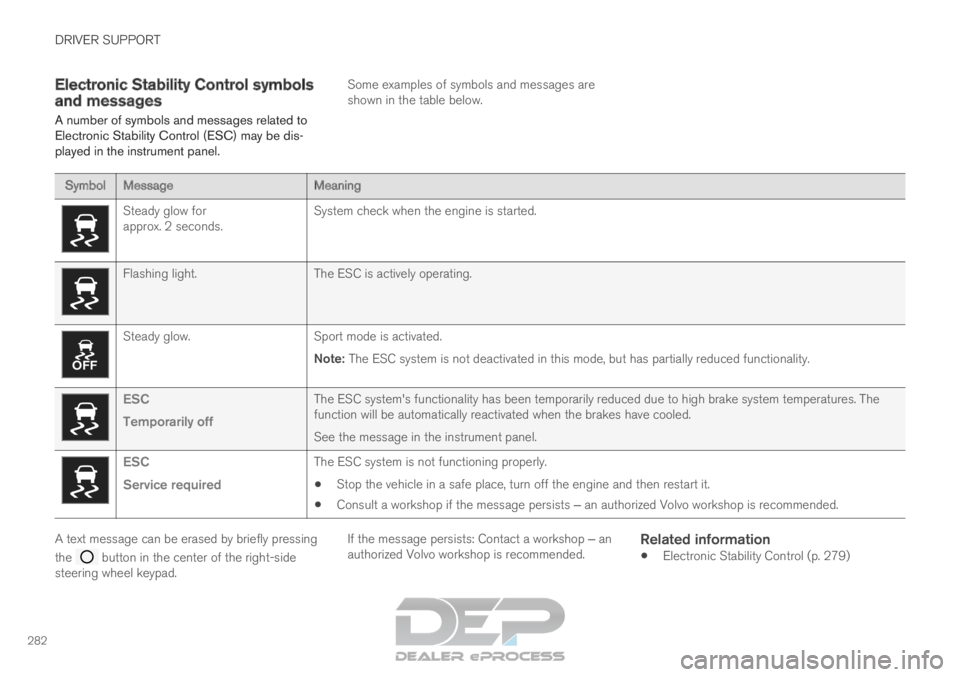
282Electronic Stability Control symbols
and messages
A number of symbols and messages related to
Electronic Stability Control (ESC) may be dis-
played in the instrument panel. Some examples of symbols and messages are
shown in the table below.Symbol
Message MeaningSteady glow for
approx. 2 seconds.
System check when the engine is started.Flashing light.
The ESC is actively operating.Steady glow.
Sport mode is activated.
Note: The ESC system is not deactivated in this mode, but has partially reduc\
ed functionality. ESC
Temporarily off
The ESC system's functionality has been temporarily reduced due to hi\
gh brake system temperatures. The
function will be automatically reactivated when the brakes have cooled.
See the message in the instrument panel.ESC
Service required
The ESC system is not functioning properly.
Stop the vehicle in a safe place, turn off the engine and then restart i\
t.
Consult a workshop if the message persists ‒ an authorized Volvo workshop is recommended. A text message can be erased by briefly pressing
the
button in the center of the right-side
steering wheel keypad. If the message persists: Contact a workshop ‒ an
authorized Volvo workshop is recommended.
Related information
Electronic Stability Control (p. 279)
Page 291 of 697

DRIVER SUPPORT
289
Activating/deactivating Automatic
Speed Limiter
The Automatic Speed Limiter (ASL) is a supple-
ment to the Speed Limiter (SL) and can be acti-
vated/deactivated.
Activating ASLThe Speed Sign Assist but- ton is located in the center dis-
play's Function view. To activate the Automatic Speed Limiter:
1.
Tap the Speed Sign Assist button.
>
ASL will go into standby mode and a
green indicator light will illuminate. A road
sign symbol will be displayed in the center
of the speedometer in the instrument
panel.
2. Pressing the button on the steering
wheel keypad.
>
ASL will be activated and set to the vehi-
cle's current speed.
NOTE
If the Automatic Speed Limiter function is
activated, road sign information is shown
in the driver display even if RSI 19
is not
activated.
To remove road sign information from the
driver display, you must deactivate both
Automatic Speed Limiter and RSI.
When the Automatic Speed Limiter func-
tion is activated but RSI is deactivated, no
warnings are given from RSI. RSI must
also be activated for warnings to be pos-
sible.
Deactivating ASLTo deactivate the Automatic Speed Limiter:
–
Tap the
Speed Sign Assist button in Func-
tion view.
>
ASL will be deactivated, the indicator light
in the button will be GRAY and SL will be
activated instead.
WARNING The vehicle will no longer follow the posted
maximum speed after switching from ASL to
SL – it then only follows the maximum speed
stored in the memory.
Related information
Speed limiter (p. 283)
Automatic Speed Limiter (p. 287)
Activating/deactivating Road Sign Informa-
tion (p. 365) 19
Road Sign Information (RSI)
Page 296 of 697
||DRIVER SUPPORT
294
For vehicles with both CC and ACC
–
Change a set speed by pressing the (1)
or (3) buttons briefly or by pressing and
holding them:
Press briefly: Press briefly: each press
changes the speed in +/- 5 mph
(+/- 5 km/h) increments.
Press and hold: release the button when
the set speed indicator (4) has moved to
the desired speed.
The most recently set speed will be stored.
If speed is increased by depressing the accelera-
tor pedal while pressing the (1) button on
the steering wheel, the vehicle's speed when the
button is pressed will be stored as the set speed.
Temporarily increasing speed using the accelera-
tor pedal, e.g. when passing another vehicle, will
not affect the setting. The vehicle will return to
the set speed when the accelerator pedal is
released.
Using engine braking instead of
applying the brakes
Cruise Control regulates speed by lightly applying
the brakes. On downgrades, it can sometimes be
desirable to roll a bit faster and let speed be
reduced instead by engine braking alone. The
driver can temporarily disengage the Cruise Con-
trol braking function. To disengage CC:
– Press the accelerator pedal about halfway
down and then release it.
>
Cruise Control will automatically disen-
gage the automatic brake function and
speed will only be reduced using the
engine braking function.
How drive mode affects cruise controlThe way the cruise control maintains the vehicle's
speed can vary depending on the selected drive
mode 26
.
Cruise Control Eco Cruise with ECO drive
mode
In the ECO drive mode, cruise control's accelera-
tion and deceleration will be smoother than in
other drive modes to help provide optimal fuel
efficiency and reduced environmental impact.
Because of this, the vehicle's actual speed may
be slightly above or below the set speed.
Cruise Control Dynamic Cruise
With the Dynamic drive mode, cruise control's
acceleration and deceleration will be faster and
more immediate than in other drive modes.
Related information
Cruise control (p. 291)
Drive modes (p. 454) Deactivating and putting Cruise
Control in standby mode
Cruise Control (CC 27
) can be temporarily put
into standby mode and then reactivated.
Deactivating and putting Cruise Control
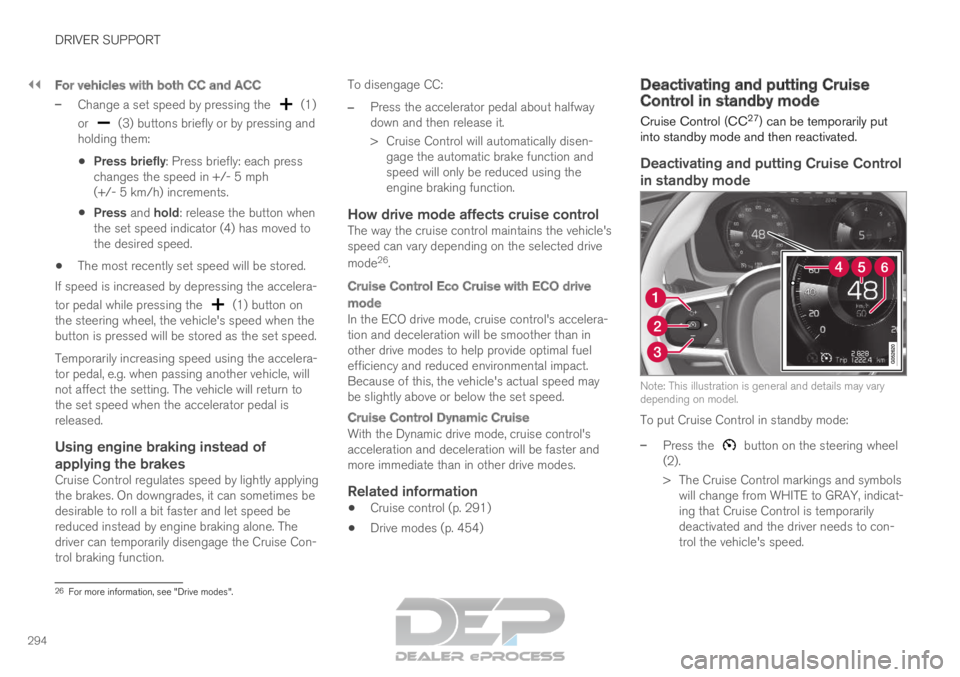
in standby mode Note: This illustration is general and details may vary
depending on model.
To put Cruise Control in standby mode:
–
Press the button on the steering wheel
(2).
>
The Cruise Control markings and symbols
will change from WHITE to GRAY, indicat-
ing that Cruise Control is temporarily
deactivated and the driver needs to con-
trol the vehicle's speed. 26
For more information, see "Drive modes".
Page 299 of 697

DRIVER SUPPORT
}}
* Option/accessory. 297Distance Alert warning light on the windshield
32
.
A warning light will appear on the windshield and
glow steadily if the time interval to the vehicle
ahead is shorter than the set time interval.
NOTE Visual warnings on the windshield may be dif-
ficult to notice in cases of strong sunlight,
reflections, extreme light contrasts, or if the
driver is wearing sunglasses or is not looking
straight ahead.
NOTE
Distance Alert is only available in vehicles
that can display information on the wind-
shield with a head-up display.
Distance Alert is deactivated while Adap-
tive Cruise Control or Pilot Assist is
active.
WARNING Distance Alert only reacts of the time interval
to the vehicle ahead is shorter than the preset
value – vehicle speed is not affected.
Related information
Head-up display for Distance Alert (p. 297)
Activating/deactivating Distance Alert
(p. 298)
Setting a time interval for Distance Alert
(p. 298)
Distance Alert limitations (p. 299) Head-up display for Distance Alert
33
In vehicles equipped with a head-up display*, a
symbol will be displayed on the windshield as
long as the time interval to the vehicle ahead is
shorter than the set time interval. Distance Alert warning symbol on the windshield
34
.
For this to be possible, however, the
Show
Driver Support function must be activated
under Settings in the center display's menus (see
"Head-up display" for instructions). 32
Note: This illustration is general and details may vary depending on mod\
el.
33 The Distance Alert function is only available in vehicles that can displ\
ay information on the windshield with a head-up display.
34 Note: This illustration is general and details may vary depending on mod\
el.