instrument panel VOLVO XC90 TWIN ENGINE 2019 Owners Manual
[x] Cancel search | Manufacturer: VOLVO, Model Year: 2019, Model line: XC90 TWIN ENGINE, Model: VOLVO XC90 TWIN ENGINE 2019Pages: 697, PDF Size: 10.33 MB
Page 456 of 697
STARTING AND DRIVING
* Option/accessory.
454 Starting and stopping the
combustion engine in Twin Engine
vehicles
An advanced control system determines the dis-
tance that the vehicle can be driven on the com-
bustion engine, electric motor, or both at the
same time. When driving on only the electric
motor, the vehicle may automatically start the
combustion engine due to outside circumstan-
ces, e.g. low ambient temperatures. This is com-
pletely normal. The combustion engine will also
always start when the hybrid battery is nearly
fully discharged.
Climate settings at low temperaturesAt low ambient temperatures, the combustion
engine will sometimes start automatically to help
achieve the desired passenger compartment
temperature and air quality. The amount of time
the combustion engine is running can be affec-
ted by:
lowering the temperature
reducing blower speed
activating Pure drive mode.
Using the electric motor in hot or cold
weather
At very low or high ambient temperatures, the
electric motor's driving range and power may be
reduced and affect how often the combustion
engine automatically starts.
Emission control systemTo help ensure that the emission control system
functions optimally, the combustion engine will
run for several minutes after it is started. The
amount of time the combustion engine needs to
be used varies depending on the temperature of
the three-way catalytic converter.
WARNING California Proposition 65
Operating, servicing and maintaining a pas-
senger vehicle can expose you to chemicals
including engine exhaust, carbon monoxide,
phthalates, and lead, which are known to the
State of California to cause cancer and birth
defects or other reproductive harm. To mini-
mize exposure, avoid breathing exhaust, do
not idle the engine except as necessary, serv-
ice your vehicle in a well ventilated area and
wear gloves or wash your hands frequently
when servicing your vehicle. For more infor-
mation go to www.P65Warnings.ca.gov/
passenger-vehicle.
Related information
Drive systems (p. 453)
Economical driving (p. 467)
Using the electric motor only (p. 469)
Drive modes (p. 454) Drive modes
Drive modes affect the vehicle's driving charac-
teristics in different ways to enhance and sim-
plify the driving experience in certain types of sit-
uations.
Drive modes enable easy access to the vehicle's
many functions and settings in different driving
situations. The following systems are adapted to
help optimize driving characteristics in each drive
mode:
Steering
Engine/transmission/all-wheel drive
Brakes
Pneumatic suspension* and shock absorbers
Instrument panel
Climate control settings
Select the drive mode that is best suited to the
current driving conditions. Keep in mind that not
all drive modes are available in all situations.
Page 457 of 697
STARTING AND DRIVING
}}
455
Available drive modes
WARNING Keep in mind that the vehicle does not emit
any engine noise when using the electric
motor and may therefore be difficult to detect
for children, pedestrians, cyclists or animals.
This is particularly true at low speeds, e.g. in
parking lots.
WARNING
Do not leave the vehicle in an unventilated
area with a drive mode activated and the com-
bustion engine switched off. The engine will
start automatically if the charge level in the
hybrid battery is low and the resulting exhaust
gases can be very harmful to people and ani-
mals.
HYBRID
This is the default mode in which the electric
motor and combustion engine work together.
The vehicle starts in Hybrid mode. The control
system uses both the electric motor and the gas-
oline engine - separately or in tandem - and cal-
culates optimal utilization with regard to perform-
ance, fuel consumption and comfort. At high
speeds, ground clearance is automatically low-
ered 3
to reduce air resistance. Driving capacity on
the electric motor alone is determined by factors such as the hybrid battery's charge level, the
need for heat/cooling in the passenger compart-
ment, etc.
If there is sufficient charge in the battery, it is
possible to drive solely on electric power. When
the accelerator pedal is pressed, only the electric
motor will be activated until the battery reaches a
certain charge level. Above this level, the current
in the battery cannot supply the power requested
by the accelerator pedal and the combustion
engine will start.
When the hybrid battery's charge level is low, the
combustion engine will start more frequently to
save the remaining current in the battery. Charge
the hybrid battery from a 120-240 volt outlet
using a charging cable, or activate
Charge in
Function view to reset the option of only using
the electric motor.
This drive mode is designed for low energy con-
sumption with an optimized mix between the
electric motor and gasoline engine, without com-
promising on climate comfort or driving experi-
ence. When faster acceleration is requested by
the driver, the electric driveline will be utilized to
help provide maximum additional power. The
vehicle also monitors the driving conditions and
automatically engages all-wheel drive if neces-
sary. All-wheel drive and extra electric power are
always available regardless of the battery's
charging status.
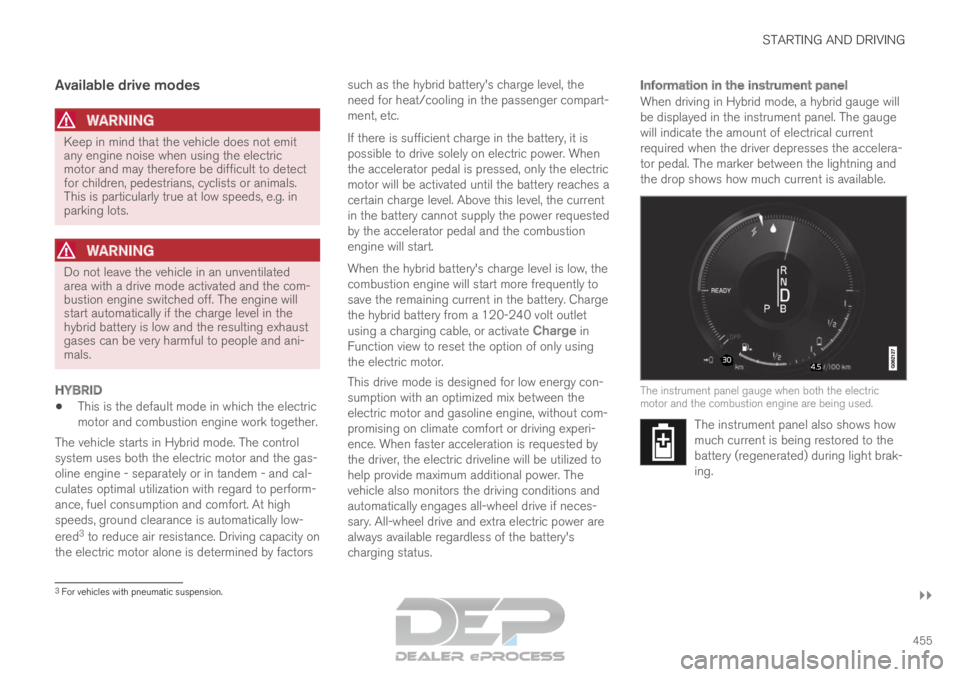
Information in the instrument panel
When driving in Hybrid mode, a hybrid gauge will
be displayed in the instrument panel. The gauge
will indicate the amount of electrical current
required when the driver depresses the accelera-
tor pedal. The marker between the lightning and
the drop shows how much current is available. The instrument panel gauge when both the electric
motor and the combustion engine are being used.
The instrument panel also shows how
much current is being restored to the
battery (regenerated) during light brak-
ing. 3
For vehicles with pneumatic suspension.
Page 458 of 697
||STARTING AND DRIVING
456
PURE
Uses the electric motor only, with the lowest
possible energy consumption and carbon
dioxide emissions.
This drive mode maximizes the use of the hybrid
battery. Ground clearance is lowered 3
to reduce
air resistance and certain climate system func-
tions are reduced to provide the longest possible
driving distance using only electricity.
Pure mode is available when the hybrid battery is
sufficiently charged. Even in Pure mode, the com-
bustion engine will start if the charge level in the
battery gets too low. The combustion engine will
also start
if the vehicle's speed goes above 125 km/h
(78 mph)
if the driver requests more power than the
electric motor can provide
if factors such as cold weather affect the
system or components.
This drive mode is optimized for maximum driving
distance with electric propulsion and is primarily
intended for use in city driving. Pure helps pro-
vide the lowest possible consumption even when
the hybrid battery is fully discharged. ECO climate
is activated to control the climate in the passen-
ger compartment, and in slippery road conditions
slightly more wheel spin may be permitted before
all-wheel drive is automatically activated.
ECO Climate
In Pure mode, ECO climate is automatically acti-
vated in the passenger compartment to help
reduce energy consumption.
NOTE When the
Pure drive mode is activated, set-
tings for certain climate system and electricity
consuming functions are reduced. Some of
these settings can be reset manually, but full
functionality will only be restored by leaving
Pure mode or adapting the Individual drive
mode to full climate system functionality. If condensation forms on the windows, tap the
max defroster button, which will function normally.
OFF ROAD
Maximizes the vehicle's ability to traverse dif-
ficult terrain or poor roads.
In this mode, ground clearance 3
is high, steering
is light, and all-wheel drive and Hill Descent
Control are activated.
This drive mode is only available at low speeds,
up to 40 km/h (25 mph). If this speed is excee-
ded, Off road mode will be cancelled and AWD
mode will be activated instead. All-wheel drive requires both the combustion and
electric motor to be in continuous operation,
which results in higher fuel consumption.
In Off road mode, a compass will be displayed
between the speedometer and the tachometer in
the instrument panel. The permissible speed
range will be shown in the speedometer.
3
For vehicles with pneumatic suspension.
Page 461 of 697
STARTING AND DRIVING
* Option/accessory.459
Related information
Changing drive mode (p. 459)
Economical driving (p. 467)
Energy distribution in hybrid mode using map
data* (p. 460)
Hybrid gauge (p. 87)
General information about Twin Engine
(p. 416) Changing drive mode
Select the drive mode that is best suited to the
current driving conditions.
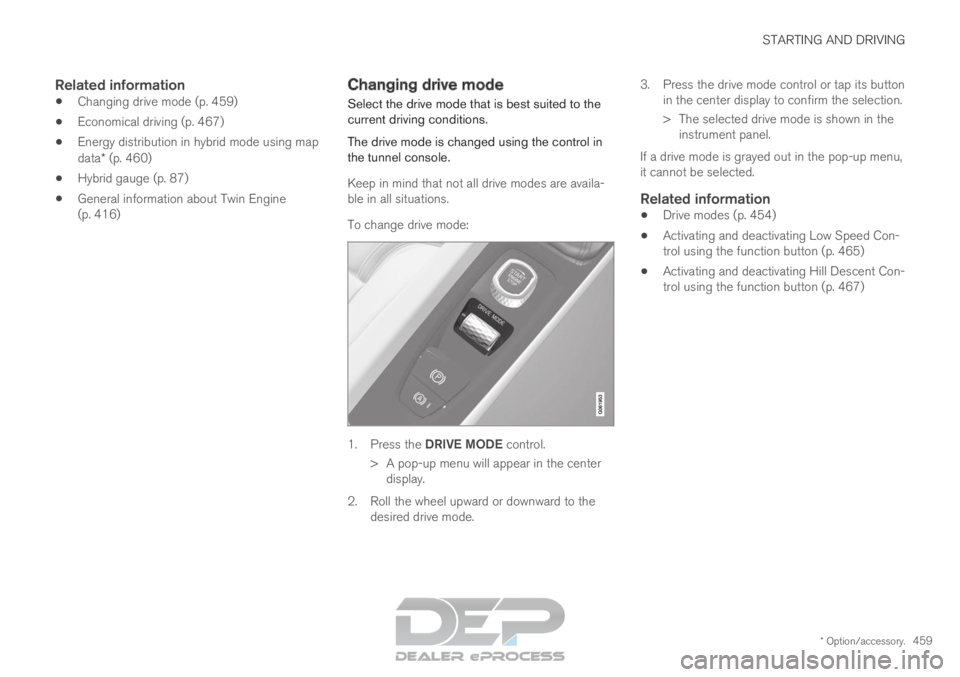
The drive mode is changed using the control in
the tunnel console.
Keep in mind that not all drive modes are availa-
ble in all situations.
To change drive mode: 1.
Press the DRIVE MODE control.
>
A pop-up menu will appear in the center
display.
2. Roll the wheel upward or downward to the desired drive mode. 3. Press the drive mode control or tap its button
in the center display to confirm the selection.
> The selected drive mode is shown in theinstrument panel.
If a drive mode is grayed out in the pop-up menu,
it cannot be selected.
Related information
Drive modes (p. 454)
Activating and deactivating Low Speed Con-
trol using the function button (p. 465)
Activating and deactivating Hill Descent Con-
trol using the function button (p. 467)
Page 463 of 697
STARTING AND DRIVING
}}
* Option/accessory. 461
Leveling control* and suspension
The vehicle's leveling control system adjusts the
suspension and shock absorbers automatically
to help provide good comfort and control while
driving. Leveling can also be controlled manually
to facilitate loading or getting in and out of the
vehicle.
Pneumatic suspension and shock
absorbers
The system is adapted to the selected drive
mode and vehicle speed. The pneumatic suspen-
sion reduces the vehicle's ground clearance at
higher speeds to reduce air resistance and
increase stability. The shock absorbers are nor-
mally set to provide the best possible comfort
and are adjusted continuously according to the
road surface and the vehicle's acceleration, brak-
ing and cornering. The instrument panel indicates
when the suspension level is
being adjusted.The following apply if a door or the tailgate is
opened:
If a door is opened, the level can only be
adjusted upwards.
If the tailgate is open, the level can only be
adjusted downwards.
ParkingWhen parking, make sure that there is adequate
space above and below the vehicle since ground
clearance may vary depending on e.g. ambient temperature, how the vehicle is loaded, if loading
mode is used, which drive mode is selected after
the engine is started, etc.
The level may also be adjusted a period after the
vehicle is parked. This is to compensate for any
height changes that may occur due to tempera-
ture changes in the air springs when the vehicle
cools.
TransportingWhen transporting the vehicle on a ferry, train or
truck, only secure (lash) the vehicle around the
tires, not using any other parts of the chassis.
Changes in the pneumatic suspension may occur
during transport, which could adversely affect the
lashing and result in damage.
Page 470 of 697
||STARTING AND DRIVING
* Option/accessory.
468
Preconditioning
Whenever possible, precondition the vehicle
before driving by connecting the charging
cable to an electrical outlet.
Avoid parking the vehicle somewhere where
the interior will become too hot or too cold
while the vehicle is parked. If possible, park
the vehicle in a climate-controlled garage.
During a short drive after passenger com-
partment preconditioning, turn off the pas-
senger compartment fan or the air condition-
ing in a hot climate.
If preconditioning is not possible when it is
cold outside, use seat and steering wheel
heating first. Avoid heating the entire pas-
senger compartment to reduce the amount
of current being taken from the hybrid bat-
tery.
Driving
Choose the Pure drive mode to help mini-
mize electric power consumption.
Maintain a steady speed and a generous fol-
lowing distance to traffic ahead to minimize
braking. This drive mode has the lowest
power consumption.
Balance energy requirements using the
accelerator pedal. Use the indicator on the
instrument panel to see available electric
power and avoid starting the combustion
engine unnecessarily. The electric motor is more effective than the combustion engine,
especially at low speeds.
When braking is necessary, brake gently
using the brake pedal. This will help recharge
the hybrid battery. A regenerative function is
integrated in the brake pedal and can be
augmented by the electric motor's braking
capacity when the gear selector is in mode
B.
Higher speeds increase energy consumption
- air resistance increases with speed.
Activate the Hold function in the Function
view at high speeds when traveling farther
than is possible using the hybrid battery's
capacity.
Whenever possible, avoid using the Charge
function to charge the hybrid battery. Charg-
ing the battery using the combustion engine
increases fuel consumption and carbon diox-
ide emissions.
In a cold climate, reduce heating of the wind-
shield/rear window, mirrors, seats and the
steering wheel.
Maintain the correct pressure in the tires and
check pressure regularly.
The type of tires used could affect energy
consumption - consult a retailer for advice on
suitable tires.
Remove unnecessary items from the vehicle
- the heavier the load, the higher the fuel
consumption.
Roof loads increase air resistance and
increase fuel consumption. Remove roof
boxes, ski racks, etc. that are not in use.
Avoid driving with the windows open.
Do not keep the vehicle still on an upward
gradient by using the accelerator pedal. Use
the brakes instead.
Related information
Drive-E ‒ purer driving pleasure (p. 27)
Energy distribution in hybrid mode using map
data* (p. 460)
Factors affecting electric motor range
(p. 469)
Using the electric motor only (p. 469)
Hybrid gauge (p. 87)
Checking tire pressure (p. 567)
Page 471 of 697
STARTING AND DRIVING
}}
469
Using the electric motor only
When using the electric motor, Volvo Twin
Engine provides a combination of good fuel
economy, low emissions and high performance.
For energy-efficient driving:
Select the Pure drive mode to help maximize
driving range using only the electric motor.
Balance energy requirements using the
accelerator pedal. Use the indicator on the
instrument panel's hybrid gauge to see avail-
able electric power and avoid starting the
combustion engine unnecessarily.
When braking is necessary, brake gently
using the brake pedal. This will recharge the
hybrid battery.
Activate the
Hold function in the Function
view at high speeds when traveling farther
than is possible using the hybrid battery's
capacity.
Reduce current consumption in the passen-
ger compartment by reducing e.g. fan speed,
electric heating, or air conditioning use.
Also follow the general economical driving advice
regarding speed, tires and load to maximize
range.
Related information
General information about Twin Engine
(p. 416)
Economical driving (p. 467)
Hybrid gauge (p. 87)
Factors affecting electric motor range
(p. 469)
Starting and stopping the combustion engine
in Twin Engine vehicles (p. 454)
"Hold" and "Charge" functions (p. 471) Factors affecting electric motor
range
A number of factors affect the electric motor's
driving range. The ability to achieve a long driv-
ing range varies according to the outside condi-
tions and to how the vehicle is driven.
The certified value for the distance that can be
driven using the electric motor should not be
considered an expected driving range. The actual
range is dependent on a number of factors.
Factors affecting driving rangeThe driver can influence some factors affecting
driving range, but not all.
The longest range is achieved under very favora-
ble conditions when all factors positively influ-
ence range.
Page 473 of 697
STARTING AND DRIVING
471
"Hold" and "Charge" functions
In certain situations, it can be useful to control
the hybrid battery's charge level while driving.
This is possible with the Hold and Charge func-
tions.
Hold and Charge are available in all drive modes. The functions will switch off if Pure drive
mode is activated.
Function buttons for Hold and ChargeThe functions can be activated in the center dis-
play's Function view.
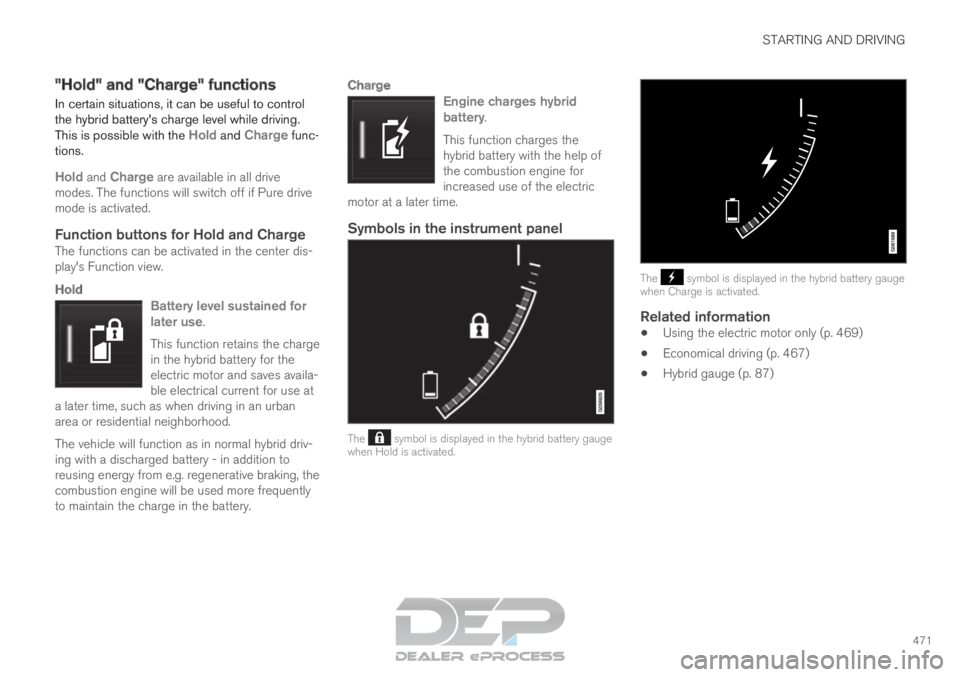
Hold
Battery level sustained for
later use.
This function retains the charge
in the hybrid battery for the
electric motor and saves availa-
ble electrical current for use at
a later time, such as when driving in an urban
area or residential neighborhood.
The vehicle will function as in normal hybrid driv-
ing with a discharged battery - in addition to
reusing energy from e.g. regenerative braking, the
combustion engine will be used more frequently
to maintain the charge in the battery.
Charge
Engine charges hybrid
battery.
This function charges the
hybrid battery with the help of
the combustion engine for
increased use of the electric
motor at a later time.
Symbols in the instrument panel The symbol is displayed in the hybrid battery gauge
when Hold is activated. The symbol is displayed in the hybrid battery gauge
when Charge is activated.
Related information
Using the electric motor only (p. 469)
Economical driving (p. 467)
Hybrid gauge (p. 87)
Page 476 of 697
STARTING AND DRIVING
474Opening/closing the fuel filler door
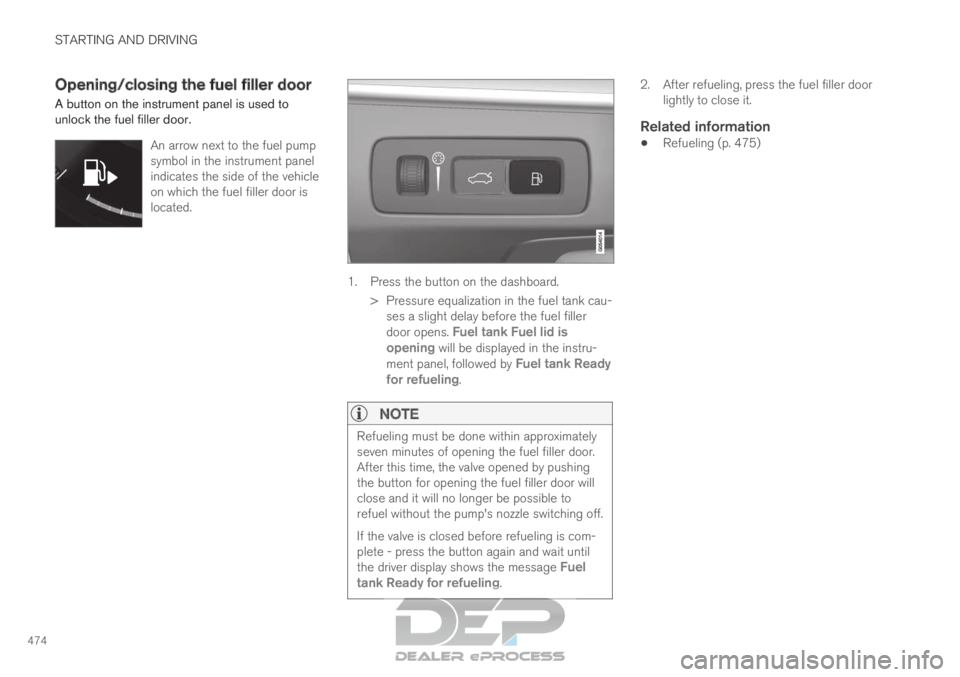
A button on the instrument panel is used to
unlock the fuel filler door.
An arrow next to the fuel pump
symbol in the instrument panel
indicates the side of the vehicle
on which the fuel filler door is
located. 1. Press the button on the dashboard.
>
Pressure equalization in the fuel tank cau-
ses a slight delay before the fuel filler
door opens. Fuel tank Fuel lid is
opening will be displayed in the instru-
ment panel, followed by Fuel tank Ready for refueling.
NOTE Refueling must be done within approximately
seven minutes of opening the fuel filler door.
After this time, the valve opened by pushing
the button for opening the fuel filler door will
close and it will no longer be possible to
refuel without the pump's nozzle switching off.
If the valve is closed before refueling is com-
plete - press the button again and wait until
the driver display shows the message
Fuel
tank Ready for refueling. 2. After refueling, press the fuel filler door
lightly to close it.
Related information
Refueling (p. 475)
Page 478 of 697
||STARTING AND DRIVING
476
WARNING
California Proposition 65
Operating, servicing and maintaining a pas-
senger vehicle can expose you to chemicals
including engine exhaust, carbon monoxide,
phthalates, and lead, which are known to the
State of California to cause cancer and birth
defects or other reproductive harm. To mini-
mize exposure, avoid breathing exhaust, do
not idle the engine except as necessary, serv-
ice your vehicle in a well ventilated area and
wear gloves or wash your hands frequently
when servicing your vehicle. For more infor-
mation go to www.P65Warnings.ca.gov/
passenger-vehicle.
Related information
Opening/closing the fuel filler door (p. 474)
Fuel (p. 476) Fuel
Volvo recommends the use of detergent gaso-
line to control engine deposits.
Deposit control gasoline (gasoline with
detergent additives)
Detergent gasoline is effective in keeping injec-
tors and intake valves clean. Consistent use of
deposit control gasolines will help ensure good
driveability and fuel economy. If you are not sure
whether the gasoline contains deposit control
additives, check with the service station operator.
NOTE Volvo recommends not using external fuel
injector cleaning systems, e.g. do not add
detergent additives to gasoline before or after
refueling.
Unleaded fuelAll Volvo vehicles have a three-way catalytic con-
verter and must only use unleaded gasoline. US
and Canadian regulations require that pumps
delivering unleaded gasoline are labeled
"UNLEADED". Only the nozzles of these pumps
will fit in your vehicle's fuel filler inlet. It is unlaw-
ful to dispense leaded fuel into a vehicle labeled
"unleaded gasoline only". Leaded gasoline dam-
ages the three-way catalytic converter and the
heated oxygen sensor system. Repeated use of
leaded gasoline will lessen the effectiveness ofthe emission control system and could result in
loss of emission warranty coverage. State and
local vehicle inspection programs will make
detection of misfueling easier, possibly resulting
in emission test failure for misfueled vehicles.
NOTE
Some U.S. and Canadian gasolines contain an
octane enhancing additive called methyl-
cyclopentadienyl manganese tricarbonyl
(MMT). If such fuels are used, your Emission
Control System performance may be affected,
and the Check Engine Light (malfunction
indicator light) located on your instrument
panel may light. If this occurs, please return
your vehicle to a trained and qualified Volvo
service technician for service.
Gasoline containing alcohol and ethers,
"Oxygenated fuels"
Some fuel suppliers sell gasoline containing
"oxygenates" which are usually alcohols or
ethers. In some areas, state or local laws require
that the service pump be marked indicating use
of alcohols or ethers. However, there are areas in
which the pumps are unmarked. If you are not
sure whether there is alcohol or ethers in the
gasoline you buy, check with the service station
operator. To meet seasonal air quality standards,
some areas require the use of "oxygenated" fuel.