change VOLVO XC90 TWIN ENGINE 2019 Owners Manual
[x] Cancel search | Manufacturer: VOLVO, Model Year: 2019, Model line: XC90 TWIN ENGINE, Model: VOLVO XC90 TWIN ENGINE 2019Pages: 697, PDF Size: 10.33 MB
Page 581 of 697
WHEELS AND TIRES
}}
* Option/accessory. 579
1.
Clean the contact surfaces between the
wheel and the wheel hub.
2. Lift the wheel into place. Tighten the wheel bolts securely.
Do not grease the wheel bolt threads.
3. Lower the vehicle so that the wheel cannot rotate.
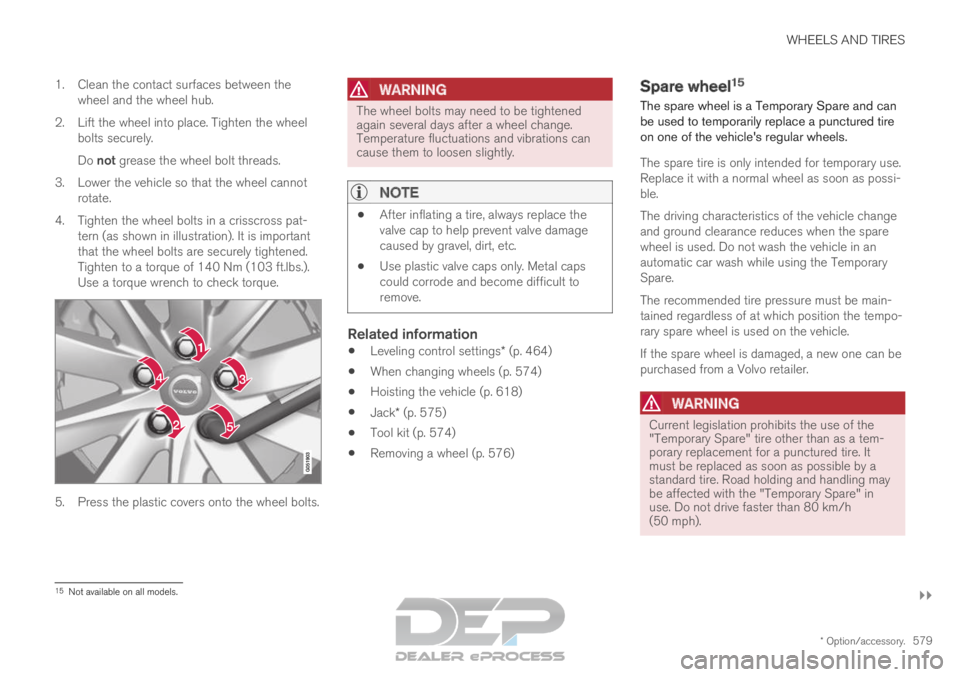
4. Tighten the wheel bolts in a crisscross pat- tern (as shown in illustration). It is important
that the wheel bolts are securely tightened.
Tighten to a torque of 140 Nm (103 ft.lbs.).
Use a torque wrench to check torque. 5. Press the plastic covers onto the wheel bolts.
WARNING The wheel bolts may need to be tightened
again several days after a wheel change.
Temperature fluctuations and vibrations can
cause them to loosen slightly.
NOTE
After inflating a tire, always replace the
valve cap to help prevent valve damage
caused by gravel, dirt, etc.
Use plastic valve caps only. Metal caps
could corrode and become difficult to
remove.
Related information
Leveling control settings* (p. 464)
When changing wheels (p. 574)
Hoisting the vehicle (p. 618)
Jack* (p. 575)
Tool kit (p. 574)
Removing a wheel (p. 576) Spare wheel
15
The spare wheel is a Temporary Spare and can
be used to temporarily replace a punctured tire
on one of the vehicle's regular wheels.
The spare tire is only intended for temporary use.
Replace it with a normal wheel as soon as possi-
ble.
The driving characteristics of the vehicle change
and ground clearance reduces when the spare
wheel is used. Do not wash the vehicle in an
automatic car wash while using the Temporary
Spare.
The recommended tire pressure must be main-
tained regardless of at which position the tempo-
rary spare wheel is used on the vehicle.
If the spare wheel is damaged, a new one can be
purchased from a Volvo retailer.
WARNING Current legislation prohibits the use of the
"Temporary Spare" tire other than as a tem-
porary replacement for a punctured tire. It
must be replaced as soon as possible by a
standard tire. Road holding and handling may
be affected with the "Temporary Spare" in
use. Do not drive faster than 80 km/h
(50 mph).
15
Not available on all models.
Page 600 of 697

LOADING, STORAGE AND PASSENGER COMPARTMENT
* Option/accessory.
598 Sun visors
In the ceiling in front of the driver and front pas-
senger, there are sun visors that can be lowered
and angled to the side as necessary.
The illustration is generic – the design may vary.
The mirror lighting* comes on automatically when
the cover is lifted up.
The mirror frame has a holder for e.g. cards or
tickets.
Related information
Passenger compartment interior (p. 592) Cargo compartment
The vehicle has a flexible cargo compartment
that makes it possible to carry and secure large
objects.
The cargo compartment capacity can be consid-
erably increased by folding down the backrests in
the second and third rows* of seats. To make
loading and unloading easier, the rear section of
the vehicle can be raised and lowered using the
level control function*. Use the load anchoring
eyelets or grocery bag holders to help secure
objects in place, and the retractable cargo com-
partment cover* to help conceal objects in the
cargo compartment.
If the vehicle is equipped with a temporary spare
tire, this is secured to the cargo compartment
floor under the cover. The towing eyelet and tire
sealing system are located under the cargo com-
partment floor.
Related information
Loading recommendations (p. 598)
Grocery bag holders (p. 600)
Load anchoring eyelets (p. 601)
Installing and removing the cargo compart-
ment cover* (p. 601) Loading recommendations
There are a number of things to consider when
carrying loads in or on the vehicle.
Load-carrying capacity is determined by the vehi-
cle's curb weight. The total weight of all passen-
gers and any installed accessories reduces the
vehicle's load-carrying capacity by the corres-
ponding amount.
WARNING The vehicle's driving characteristics change
depending on the weight and position of the
load.
Loading the cargo compartment/trunk
Position objects so they are pressing against
the rear seat backrests.
Distribute the load evenly.
Heavy objects should be positioned as low
as possible. Avoid placing heavy objects on
folded-down seat backrests.
Cover sharp corners with a soft cloth or simi-
lar to help prevent damage to the upholstery.
Use the load anchoring eyelets and tension-
ing straps or similar to secure all objects.
Page 620 of 697
MAINTENANCE AND SERVICE
* Option/accessory.
618 Hoisting the vehicle
When hoisting the vehicle, it is important to
ensure the jack/vehicle hoist is correctly
engaged in the designated attachment points
under the vehicle.
For vehicles with self-leveling*, pneumatic sus-
pension (if installed) must be turned off before
the vehicle is lifted. Turning off the function in the
center display.
WARNING If the vehicle is lifted on a garage jack, the
jack must be placed under one of the four lift-
ing points. Make sure that the vehicle is cor-
rectly positioned on the jack and that it can-
not slide off. Make sure the jack plate has a
rubber pad to help keep the vehicle stable
and prevent damage. Always use axle stands
or similar.
NOTE Volvo recommends only using the jack
intended for your specific vehicle model. If a
jack other than that recommended by Volvo is
used, follow the instructions included with the
equipment.
The vehicle's ordinary jack is only intended to
be used in temporary situations for short peri-
ods of time, such as when changing wheels in
the event of a flat tire. If the vehicle needs to
be lifted more frequently, or for a longer
period of time than for a wheel change, a
garage jack or hoist is recommended. Always
follow the instructions for use provided with
the equipment.
Page 625 of 697
MAINTENANCE AND SERVICE
623
Engine oil
For the recommended service intervals and war-
ranties to be applied, an approved engine oil
must be used. Volvo recommends: If the engine oil is not checked regularly and the
level becomes low, this could cause serious
engine damage.
CAUTION
To satisfy the requirements for the engine's
service intervals, all engines are factory-filled
with a specially adapted synthetic engine oil.
Great care has been put into the choice of oil,
with consideration given to service life, starta-
bility, fuel consumption and environmental
impact.
For the recommended service intervals to
apply, an approved engine oil must be used.
Only use the prescribed oil grade to top off or
change the oil. Otherwise, there is a risk of
the vehicle's service life, startability, fuel con-
sumption and environmental impact being
affected.
Failure to use engine oil of the prescribed
grade and viscosity could cause damage to
engine-related components. Volvo Car Corpo-
ration disclaims warranty liability for such type
of damage.
Volvo recommends entrusting oil changes to
an authorized Volvo workshop.
Volvo uses different systems to warn if the oil
level is too low/high or the oil pressure is low. On
engine variants with an oil pressure sensor, awarning symbol is displayed in the instrument
panel when oil pressure is low . On engine
variants with an oil level sensor, the warn-
ing symbol in the instrument panel and display
messages are used to alert the driver. Some
engine variants have both systems. Contact a
Volvo retailer for more information.
Change the engine oil and oil filter according to
the schedule specified in the Warranty and Main-
tenance Records Information booklet. Oils of a
higher grade than that specified may be used. If
the vehicle is driven in adverse conditions, Volvo
recommends using an oil with a higher grade
than that specified.
Related information
Checking and filling engine oil (p. 624)
Engine oil specifications (p. 672)
Page 626 of 697
MAINTENANCE AND SERVICE
624Checking and filling engine oil
The engine oil level is monitored by an electronic
oil level sensor. Filler pipe
13
.
It may be necessary to top up engine oil between
regularly scheduled services.
No action is necessary with regard to engine oil
level until a message appears in the instrument
panel.
WARNING If this symbol is shown together
with the message
Engine oil level
Service required, visit a workshop – an authorized Volvo workshop is
recommended. The oil level may be too high.
CAUTION If this symbol is shown together
with a message about low oil level,
for example
Engine oil level low
Refill 1 liter, fill only with the indi-
cated volume, e.g. 1 liter (1 quart).
WARNING Do not spill oil on the hot exhaust pipes as
this could cause a fire.
Viewing oil level in the center displayThe oil level can be viewed using the electronic
oil level gauge in the center display once the
vehicle has been started. The oil level should be
checked regularly.
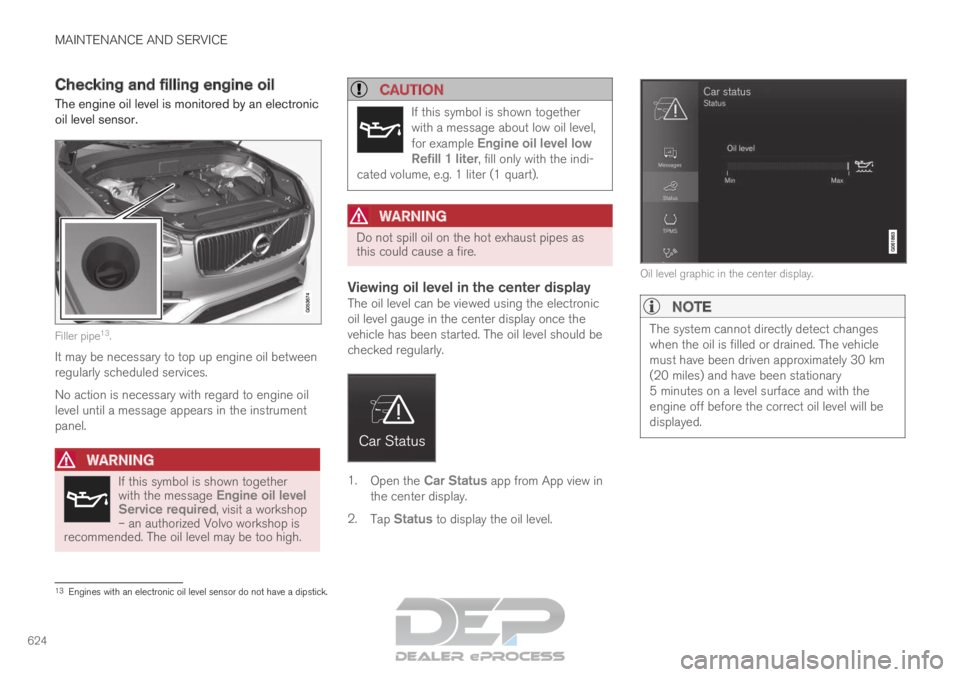
1.
Open the Car Status app from App view in
the center display.
2. Tap Status to display the oil level. Oil level graphic in the center display.NOTE
The system cannot directly detect changes
when the oil is filled or drained. The vehicle
must have been driven approximately 30 km
(20 miles) and have been stationary
5 minutes on a level surface and with the
engine off before the correct oil level will be
displayed.
13
Engines with an electronic oil level sensor do not have a dipstick.
Page 637 of 697
MAINTENANCE AND SERVICE
}}
635
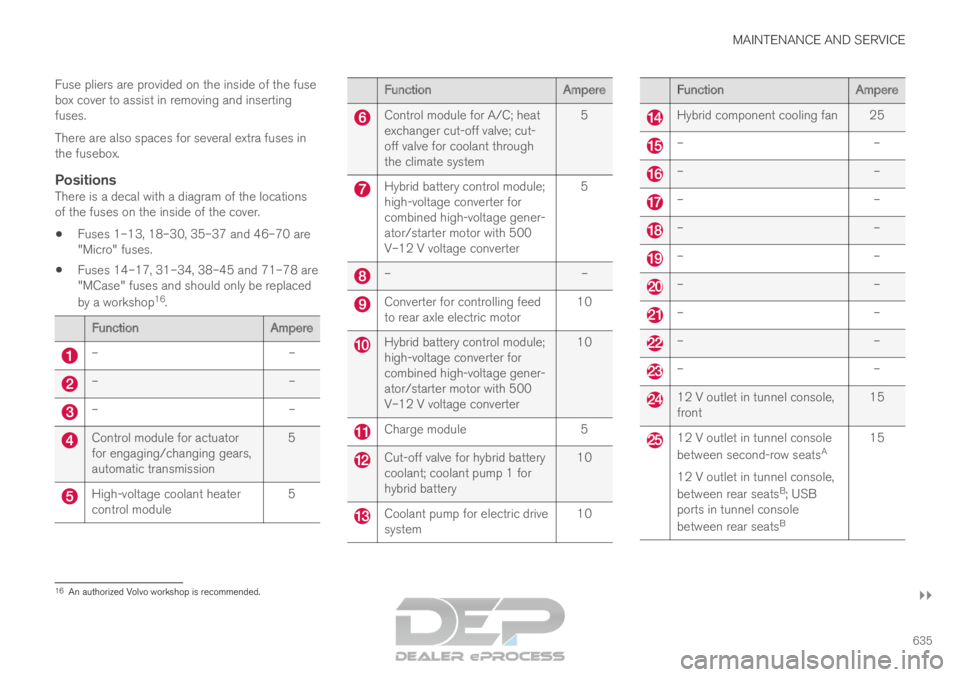
Fuse pliers are provided on the inside of the fuse
box cover to assist in removing and inserting
fuses.
There are also spaces for several extra fuses in
the fusebox.
PositionsThere is a decal with a diagram of the locations
of the fuses on the inside of the cover.
Fuses 1–13, 18–30, 35–37 and 46–70 are
"Micro" fuses.
Fuses 14–17, 31–34, 38–45 and 71–78 are
"MCase" fuses and should only be replaced
by a workshop 16
. Function
Ampere–
––
––
–Control module for actuator
for engaging/changing gears,
automatic transmission
5High-voltage coolant heater
control module
5 Function
Ampere Control module for A/C; heat
exchanger cut-off valve; cut-
off valve for coolant through
the climate system
5 Hybrid battery control module;
high-voltage converter for
combined high-voltage gener-
ator/starter motor with 500
V–12 V voltage converter
5 –
– Converter for controlling feed
to rear axle electric motor
10 Hybrid battery control module;
high-voltage converter for
combined high-voltage gener-
ator/starter motor with 500
V–12 V voltage converter
10 Charge module
5 Cut-off valve for hybrid battery
coolant; coolant pump 1 for
hybrid battery
10 Coolant pump for electric drive
system
10 Function
Ampere Hybrid component cooling fan 25
–
– –
– –
– –
– –
– –
– –
– –
– –
– 12 V outlet in tunnel console,
front
15 12 V outlet in tunnel console
between second-row seats
A
12 V outlet in tunnel console,
between rear seats B
; USB
ports in tunnel console
between rear seats B15
16
An authorized Volvo workshop is recommended.
Page 649 of 697
MAINTENANCE AND SERVICE
}}
647
Cleaning fabric upholstery and
ceiling liner
Only use cleaning agents and car care products
recommended by Volvo. Clean regularly and
treat stains immediately for best results. It is
important to vacuum before using a cleaning
agent.
Fabric upholstery and ceiling linerNever scrape or rub a stain, as this could damage
the upholstery. Never use strong stain removers,
as this could change the color of the upholstery.
Use soapy water or a similar detergent. For more
difficult stains caused by oil, ice cream, shoe pol-
ish, etc., use a stain remover. Consult with your
Volvo retailer.
Related information
Cleaning the interior (p. 645)
Cleaning the center display (p. 645)
Cleaning the seat belt (p. 647)
Cleaning floor mats and inlay mats (p. 647)
Cleaning leather upholstery (p. 648)
Cleaning the leather steering wheel
(p. 649)
Cleaning interior plastic, metal and wood sur-
faces (p. 650) Cleaning the seat belt
Only use cleaning agents and car care products
recommended by Volvo. Clean regularly and
treat stains immediately for best results. It is
important to vacuum before using a cleaning
agent.
Seat beltsUse water and a synthetic soap solution. Spe-
cially designed textile cleaning agents are availa-
ble for purchase at Volvo retailers. Make sure the
belt is dry before it is retracted.
Related information
Cleaning the interior (p. 645)
Cleaning the center display (p. 645)
Cleaning fabric upholstery and ceiling liner
(p. 647)
Cleaning floor mats and inlay mats (p. 647)
Cleaning leather upholstery (p. 648)
Cleaning the leather steering wheel
(p. 649)
Cleaning interior plastic, metal and wood sur-
faces (p. 650) Cleaning floor mats and inlay mats
Only use cleaning agents and car care products
recommended by Volvo. Clean regularly and
treat stains immediately for best results. It is
important to vacuum before using a cleaning
agent.
Inlay mats and floor matsRemove the inlay mats to clean the floor mats
and inlay mats separately. Use a vacuum to
remove dust and dirt. Each inlay mat is secured
into place with pins.
Remove the inlay mat by grasping the inlay mat
at each pin and lifting the mat straight up.
Put the inlay mat back into place by pressing it in
at each pin.
Page 650 of 697
||MAINTENANCE AND SERVICE
* Option/accessory.
648
WARNING
Never use more than one inlay mat at a
time on the driver's floor. If any other type
of floor mat is used, remove the original
mat from the driver's seat floor before
driving. All types of mats must be securely
anchored in the attachment points in the
floor. Make sure the floor mat does not
impede the movement of the brake pedal
or accelerator pedal in any way, as this
could be a serious safety hazard.
Volvo's floor mats are specially manufac-
tured for your vehicle. They must be prop-
erly secured in the attachment points in
the floor to help ensure they cannot slide
and become trapped under the pedals.
After vacuuming, a specially designed textile
cleaning agent should be used to remove stains
on floor mats. Floor mats should be cleaned with
products recommended by Volvo retailers.
Related information
Cleaning the interior (p. 645)
Cleaning the center display (p. 645)
Cleaning fabric upholstery and ceiling liner
(p. 647)
Cleaning the seat belt (p. 647)
Cleaning leather upholstery (p. 648)
Cleaning the leather steering wheel
(p. 649)
Cleaning interior plastic, metal and wood sur-
faces (p. 650) Cleaning leather upholstery
Only use cleaning agents and car care products
recommended by Volvo. Clean regularly and
treat stains immediately for best results. It is
important to vacuum before using a cleaning
agent.
Leather upholstery*Volvo's leather upholstery is treated to protect its
original appearance. Over time, sunlight, grease,
dirt, etc. could break down the protective layer.
This could result in scratches and cracking.
Leather upholstery is a natural product that
changes and acquires a beautiful patina over
time. Regular cleaning and treatments are
required to preserve the qualities and color of the
leather. Volvo offers a comprehensive product,
Volvo Leather Care Kit/Wipes, for cleaning and
treating leather upholstery that, when used as
directed, preserves the leather's protective coa-
ting.
For best results, Volvo recommends cleaning and
applying protective cream one to four times a
year (or more as needed). Volvo Leather Care Kit
951 0251 and Volvo Leather Softener 943
7429 are available for purchase at Volvo retailers.
Page 655 of 697
MAINTENANCE AND SERVICE
653
Automatic car washes
The vehicle should be washed as soon as it
becomes dirty. This makes the vehicle easier to
clean because dirt does not attach as strongly. It
also reduces the risk of scratches and keeps the
vehicle looking new.
An automatic car wash is a fast and easy way to
keep your vehicle clean, but it does not reach all
areas of the vehicle. For best results, Volvo rec-
ommends hand washing your vehicle or supple-
menting automatic car washes with a hand wash.
NOTE
Volvo recommends not washing the vehicle in
an automatic car wash during the first few
months; the paintwork on new vehicles takes
some time to fully harden.
CAUTION
Before driving the vehicle into a car wash,
deactivate the Automatic Braking when Sta-
tionary and Automatic Parking Brake Applica-
tion functions. If the functions are not deacti-
vated, the brake system will seize when the
vehicle is stationary and the vehicle will not be
able to roll.
CAUTION For automatic car washes in which the vehicle
is pulled forward on rolling wheels:
1.
Before washing the vehicle, make sure
that the automatic rain sensor is deacti-
vated. If it is not deactivated and inadver-
tently starts, the wiper arms could be
damaged.
2. To help prevent damage from the auto- matic car wash machinery, make sure
that the door mirrors are folded in, anten-
nas retracted or removed, and any auxili-
ary lights secured.
3. Drive into the automatic car wash.
4. Turn off the "Automatic Braking when Stationary" function using the button
in the tunnel console.
5.
Turn off the "Automatic Parking Brake
Application" function in the center dis-
play's Top view.
6. Turn off the engine by turning the start knob in the tunnel console clockwise.
Hold the knob in position for at least
2 seconds.
The vehicle is now ready for the automatic car
wash.
CAUTION The system will automatically change to P
mode if the above steps are not followed. In P
mode, the wheels are locked, which they
should not be when the vehicle is being
washed in a car wash.
Related information
Cleaning the exterior (p. 650)
Polishing and waxing (p. 651)
Hand washing (p. 651)
High-pressure washing (p. 654)
Cleaning the wiper blades (p. 654)
Cleaning exterior plastic, rubber and trim
components (p. 655)
Cleaning rims (p. 656)
Corrosion protection (p. 656)
Page 661 of 697

MAINTENANCE AND SERVICE
659
Changing rear window wipers
The wiper blades help remove water from the
windshield and rear window. Along with the
washer fluid, they clean the glass and help
improve visibility while driving. The windshield
and rear window wiper blades can be replaced.
Changing rear window wipers Lift the wiper arm from the window and pull the lower
section of the blade to the right.
Grasp the center of the wiper blade and lift it
from the window to the stop position.
NOTE
When the wiper arm is halfway folded out, it
will stop in a locking position that helps pre-
vent the arm from falling back onto the rear
window. The wiper arm must be pulled past
the locking position stop in order to change
the wiper blade.
Grip the lower part of the blade and pull to
the right until the blade loosens from the
arm.3.
Press the new wiper blade until it clicks into
place. Check to make sure the blade is
securely in place.
4. Fold the wiper arm back toward the window.
CAUTION Check the blades regularly. Neglected main-
tenance shortens the life of the blades.
Related information
Using the rain sensor (p. 177)
Using the windshield and headlight washers
(p. 179)
Using automatic rear window wiping when
backing up (p. 181)
Using the rain sensor's memory function
(p. 178)
Using the rear window wiper/washer
(p. 180)
Filling washer fluid (p. 662)
Windshield wipers in the service position
(p. 661)
Replacing windshield wiper blades (p. 660)
Using the windshield wipers (p. 176)
Wiper blades and washer fluid (p. 176)