ESP VOLVO XC90 TWIN ENGINE 2019 Workshop Manual
[x] Cancel search | Manufacturer: VOLVO, Model Year: 2019, Model line: XC90 TWIN ENGINE, Model: VOLVO XC90 TWIN ENGINE 2019Pages: 697, PDF Size: 10.33 MB
Page 383 of 697
DRIVER SUPPORT
}}
381
Run-Off Mitigation with steering
assistance
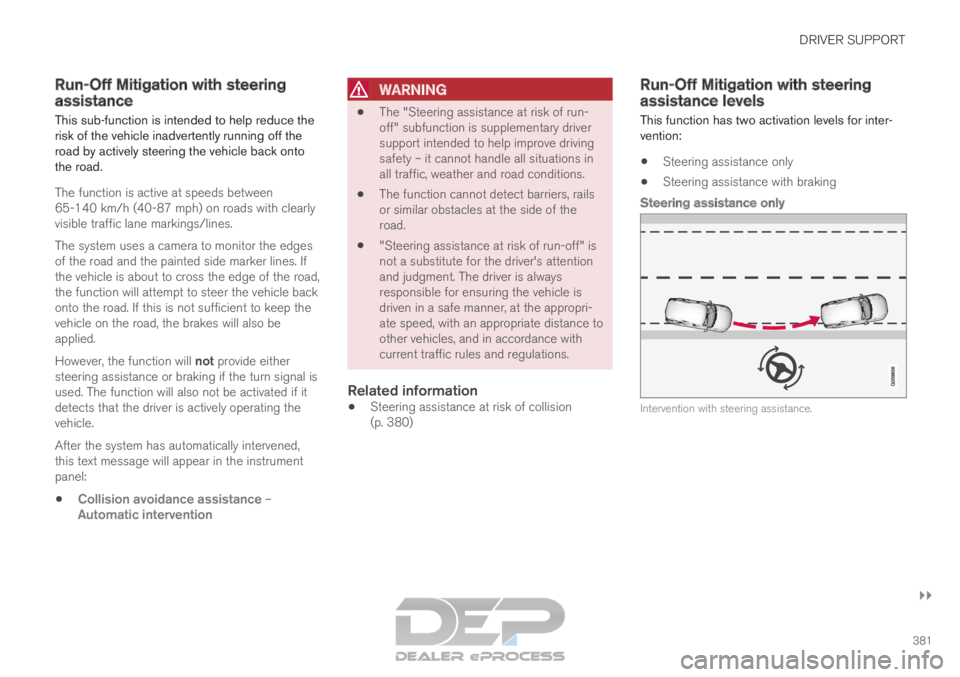
This sub-function is intended to help reduce the
risk of the vehicle inadvertently running off the
road by actively steering the vehicle back onto
the road.
The function is active at speeds between
65-140 km/h (40-87 mph) on roads with clearly
visible traffic lane markings/lines.
The system uses a camera to monitor the edges
of the road and the painted side marker lines. If
the vehicle is about to cross the edge of the road,
the function will attempt to steer the vehicle back
onto the road. If this is not sufficient to keep the
vehicle on the road, the brakes will also be
applied.
However, the function will not provide either
steering assistance or braking if the turn signal is
used. The function will also not be activated if it
detects that the driver is actively operating the
vehicle.
After the system has automatically intervened,
this text message will appear in the instrument
panel: Collision avoidance assistance –
Automatic intervention
WARNING
The "Steering assistance at risk of run-
off" subfunction is supplementary driver
support intended to help improve driving
safety – it cannot handle all situations in
all traffic, weather and road conditions.
The function cannot detect barriers, rails
or similar obstacles at the side of the
road.
"Steering assistance at risk of run-off" is
not a substitute for the driver's attention
and judgment. The driver is always
responsible for ensuring the vehicle is
driven in a safe manner, at the appropri-
ate speed, with an appropriate distance to
other vehicles, and in accordance with
current traffic rules and regulations.
Related information
Steering assistance at risk of collision
(p. 380) Run-Off Mitigation with steering
assistance levels
This function has two activation levels for inter-
vention:
Steering assistance only
Steering assistance with braking
Steering assistance only Intervention with steering assistance.
Page 386 of 697
||DRIVER SUPPORT
* Option/accessory.
384 However, the function will not provide steering
assistance if the turn signal is used. The function
will also not be activated if it detects that the
driver is actively operating the vehicle.
After the system has automatically intervened,
this text message will appear in the instrument
panel:
Collision avoidance assistance –
Automatic intervention
WARNING
The "Steering assistance at risk of head-
on collision" subfunction is supplemen-
tary driver support intended to improve
driving safety – it cannot handle all situa-
tions in all traffic, weather and road condi-
tions.
Pilot Assist is only activated if there is a
high risk of collision – you must therefore
never wait for the function to intervene.
The function is not a substitute for the
driver's attention and judgment. The driver
is always responsible for ensuring the
vehicle is driven in a safe manner, at the
appropriate speed, with an appropriate
distance to other vehicles, and in accord-
ance with current traffic rules and regula-
tions.
Related information
Steering assistance at risk of collision
(p. 380)
Activating/deactivating Steering assistance
during collision risks with oncoming vehicles
(p. 384)
Limitations of steering assistance during col-
lision risks from oncoming traffic (p. 385) Activating/deactivating Steering
assistance during collision risks
with oncoming vehicles
The driver can choose to have this function On
or Off.
Use this button in the center
display's Function view to turn
the function On and Off.
NOTE When the
Collision avoidance assistance
function is deactivated, all subfunctions of the
following are deactivated:
Steering assistance at risk of run-off
Steering assistance at risk of head-on
collision
Steering assistance during collision risks
from behind*
Although it is possible to deactivate the func-
tion, the driver is advised to keep it activated
since it can help improve driving safety in
most cases.
Page 388 of 697
DRIVER SUPPORT
* Option/accessory.
386 Steering assistance during collision
risks from behind*
If you become distracted and do not notice your
vehicle starting to veer out of the lane while
another vehicle is approaching from behind or is
in your vehicle's blind spot, this sub-function can
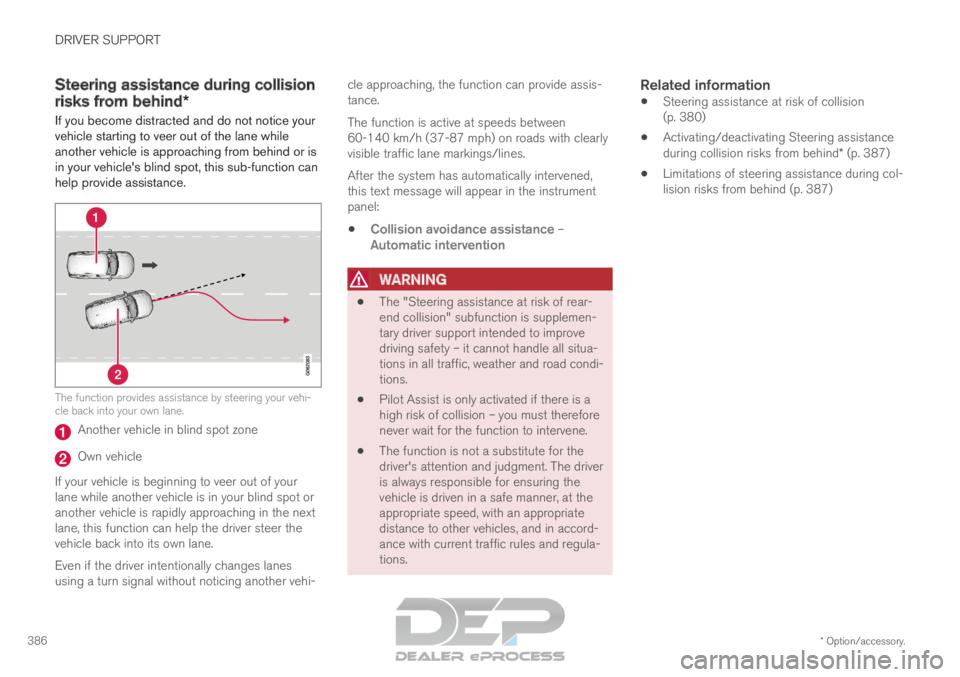
help provide assistance. The function provides assistance by steering your vehi-
cle back into your own lane.
Another vehicle in blind spot zone
Own vehicle
If your vehicle is beginning to veer out of your
lane while another vehicle is in your blind spot or
another vehicle is rapidly approaching in the next
lane, this function can help the driver steer the
vehicle back into its own lane.
Even if the driver intentionally changes lanes
using a turn signal without noticing another vehi- cle approaching, the function can provide assis-
tance.
The function is active at speeds between
60-140 km/h (37-87 mph) on roads with clearly
visible traffic lane markings/lines.
After the system has automatically intervened,
this text message will appear in the instrument
panel:
Collision avoidance assistance –
Automatic intervention
WARNING
The "Steering assistance at risk of rear-
end collision" subfunction is supplemen-
tary driver support intended to improve
driving safety – it cannot handle all situa-
tions in all traffic, weather and road condi-
tions.
Pilot Assist is only activated if there is a
high risk of collision – you must therefore
never wait for the function to intervene.
The function is not a substitute for the
driver's attention and judgment. The driver
is always responsible for ensuring the
vehicle is driven in a safe manner, at the
appropriate speed, with an appropriate
distance to other vehicles, and in accord-
ance with current traffic rules and regula-
tions.
Related information
Steering assistance at risk of collision
(p. 380)
Activating/deactivating Steering assistance
during collision risks from behind* (p. 387)
Limitations of steering assistance during col-
lision risks from behind (p. 387)
Page 392 of 697
DRIVER SUPPORT
* Option/accessory.
390 Park Assist*
The Park Assist function can help the driver
when maneuvering in tight spaces by indicating
distances to obstacles using audible signals and
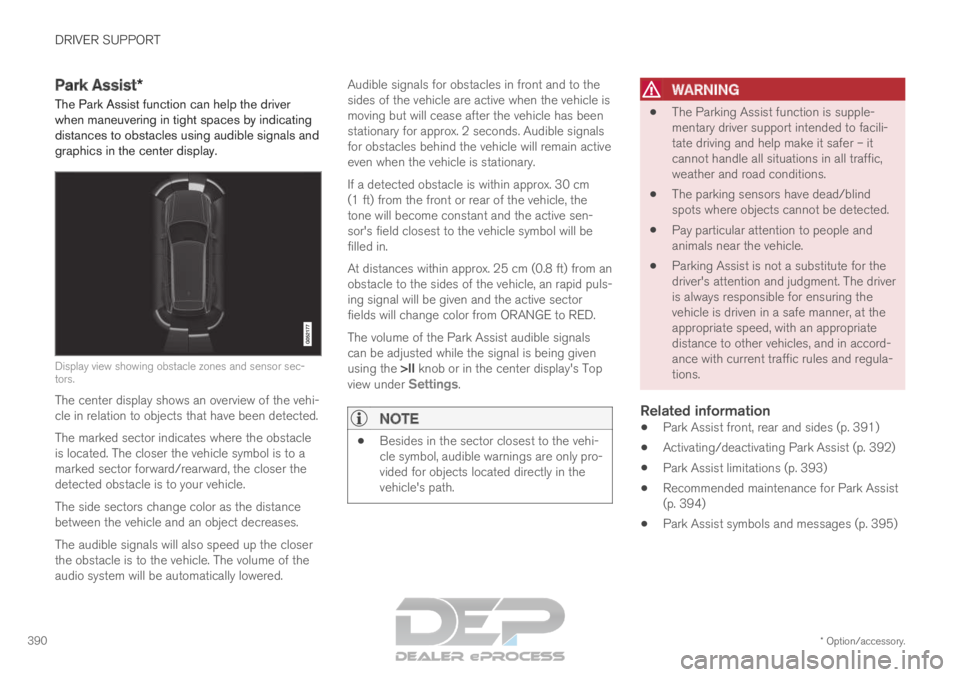
graphics in the center display. Display view showing obstacle zones and sensor sec-
tors.
The center display shows an overview of the vehi-
cle in relation to objects that have been detected.
The marked sector indicates where the obstacle
is located. The closer the vehicle symbol is to a
marked sector forward/rearward, the closer the
detected obstacle is to your vehicle.
The side sectors change color as the distance
between the vehicle and an object decreases.
The audible signals will also speed up the closer
the obstacle is to the vehicle. The volume of the
audio system will be automatically lowered. Audible signals for obstacles in front and to the
sides of the vehicle are active when the vehicle is
moving but will cease after the vehicle has been
stationary for approx. 2 seconds. Audible signals
for obstacles behind the vehicle will remain active
even when the vehicle is stationary.
If a detected obstacle is within approx. 30 cm
(1 ft) from the front or rear of the vehicle, the
tone will become constant and the active sen-
sor's field closest to the vehicle symbol will be
filled in.
At distances within approx. 25 cm (0.8 ft) from an
obstacle to the sides of the vehicle, an rapid puls-
ing signal will be given and the active sector
fields will change color from ORANGE to RED.
The volume of the Park Assist audible signals
can be adjusted while the signal is being given
using the >II knob or in the center display's Top
view under Settings.
NOTE
Besides in the sector closest to the vehi-
cle symbol, audible warnings are only pro-
vided for objects located directly in the
vehicle's path.
WARNING
The Parking Assist function is supple-
mentary driver support intended to facili-
tate driving and help make it safer – it
cannot handle all situations in all traffic,
weather and road conditions.
The parking sensors have dead/blind
spots where objects cannot be detected.
Pay particular attention to people and
animals near the vehicle.
Parking Assist is not a substitute for the
driver's attention and judgment. The driver
is always responsible for ensuring the
vehicle is driven in a safe manner, at the
appropriate speed, with an appropriate
distance to other vehicles, and in accord-
ance with current traffic rules and regula-
tions.
Related information
Park Assist front, rear and sides (p. 391)
Activating/deactivating Park Assist (p. 392)
Park Assist limitations (p. 393)
Recommended maintenance for Park Assist
(p. 394)
Park Assist symbols and messages (p. 395)
Page 398 of 697

DRIVER SUPPORT
* Option/accessory.
396 Park Assist Camera*
The Park Assist Camera can help provide the
driver when maneuvering in tight spaces by alert-
ing the driver to obstacles using the camera
screen and graphics in the center display.
The Park Assist Camera is a support function
that is automatically activated when reverse gear
is engaged. It can also be started manually from
the center display.
Example camera view
114
. Zoom
115
- zoom in/out 360° view
* - activate/deactivate all cameras
PAS
* - activate/deactivate Parking Assist
Lines
- activate/deactivate trajectory lines Towbar
* - activate/deactivate trajectory lines
for towbar* 116 CTA
* - activate/deactivate Cross Traffic Alert
WARNING
The Parking Camera function is supple-
mentary driver support intended to facili-
tate driving and help make it safer – it
cannot handle all situations in all traffic,
weather and road conditions.
The parking cameras have dead/blind
spots where objects cannot be detected.
Pay particular attention to people and
animals near the vehicle.
Objects/obstacles may be closer to the
vehicle than they appear on the screen.
The parking cameras are not a substitute
for the driver's attention and judgment.
The driver is always responsible for
ensuring the vehicle is driven in a safe
manner, at the appropriate speed, with an
appropriate distance to other vehicles,
and in accordance with current traffic
rules and regulations. 114
The illustration is generic - details may vary according to vehicle mode\
l.
115 The trajectory lines will not be displayed when zooming in.
116 Not available in all markets.
Page 408 of 697
DRIVER SUPPORT
* Option/accessory.
406 Park Assist Pilot*
Park Assist Pilot (
PAP 122
) helps the driver pull
into and out of parking spaces.
PAP first checks whether there
is sufficient space and then
steers the car into the space.
The center display uses sym-
bols, graphics and messages to
inform the driver of what steps
need to be taken and when.
WARNING
The PAP function is supplementary driver
support intended to facilitate driving and
help make it safer – it cannot handle all
situations in all traffic, weather and road
conditions.
Pay particular attention to people and
animals near the vehicle.
PAP is not a substitute for the driver's
attention and judgment. The driver is
always responsible for ensuring the vehi-
cle is driven in a safe manner, at the
appropriate speed, with an appropriate
distance to other vehicles, and in accord-
ance with current traffic rules and regula-
tions.
NOTE The PAP function measures the space and
steers the vehicle – the driver's role is to:
keep close watch of the area around the
vehicle
follow the instructions on the center dis-
play
change gears (reverse/forward) – a
"ping" sound indicates when the driver
should change gears
regulate and maintain a safe speed
apply the brakes and stop.
Related information
Types of parking with Park Assist Pilot
(p. 406)
Parking with Park Assist Pilot (p. 408)
Leaving a parking space with Park Assist
Pilot (p. 410)
Park Assist Pilot* limitations (p. 411)
Recommended maintenance for Park Assist
Pilot (p. 413)
Park Assist Pilot* messages (p. 414) Types of parking with Park Assist
Pilot
Park Assist Pilot (PAP 123
) can be used for the
following types of parking. 122
Park Assist Pilot
123 Park Assist Pilot
Page 413 of 697

DRIVER SUPPORT
}}
* Option/accessory. 411
Note that the steering wheel can "spring" back
when the procedure is completed and the driver
may need to turn the steering wheel back to the
maximum position in order to pull out of the park-
ing space.
If PAP determines that the driver can pull out of
the parking space without any extra maneuvers,
the function will be deactivated, even if it seems
as though the vehicle is not completely out of the
parking space.
Related information
Park Assist Pilot* (p. 406) Park Assist Pilot* limitations
Park Assist Pilot PAP 125
may not be able to
detect all conditions in all situations and func-
tionality may therefore be limited.
WARNING
The PAP function is supplementary driver
support intended to facilitate driving and
help make it safer – it cannot handle all
situations in all traffic, weather and road
conditions.
Pay particular attention to people and
animals near the vehicle.
Bear in mind that the front end of the
vehicle may swing out towards oncoming
traffic during the parking maneuver.
Objects situated higher than the detec-
tion area of the sensors are not included
when the parking maneuver is calculated,
which could cause PAP to swing into the
parking space too early. Such parking
spaces should be avoided for this reason.
PAP is not a substitute for the driver's
attention and judgment. The driver is
always responsible for ensuring the vehi-
cle is driven in a safe manner, at the
appropriate speed, with an appropriate
distance to other vehicles, and in accord-
ance with current traffic rules and regula-
tions.
The driver should be aware of the following limi-
tations for Park Assist Pilot: 125
Park Assist Pilot
Page 414 of 697

||DRIVER SUPPORT
412
The parking sequence is cancelledA parking sequence will be cancelled if:
the driver moves the steering wheel
the vehicle's speed exceeds 7 km/h (4 mph)
the driver taps
Cancel in the center display
when the anti-lock brakes or the Electronic
stability control are engaged - e.g. when a
wheel loses grip on a slippery road
when the power steering works at reduced
power - e.g. during cooling due to overheat-
ing (see section "Speed-dependent steering
force").
A message in the center display will explain why
the parking sequence was cancelled.
CAUTION Under certain circumstances, PAP may not be
able to find parking spaces – one reason may
be that the sensors are disrupted by external
sound sources that emit the same ultrasonic
frequencies that the system works with.
Examples of such sources include horns, wet
tires on asphalt, pneumatic brakes, exhaust
noise from motorcycles, etc.
NOTE Dirt, ice and snow covering the sensors
reduce their function and can make measure-
ment impossible.
Driver responsibilityThe driver should keep in mind that PAP is a
parking aid ‒ not an infallible fully automatic sys-
tem. The driver must always be prepared to take
control and cancel a parking sequence if neces-
sary.
There are a number of things to keep in mind
when parking, including:
The driver is always responsible for determin-
ing if the space suggested by PAP is suita-
ble for parking.
Do not use PAP when using snow chains or
a temporary spare tire.
Do not use PAP if there are any objects pro-
truding from the vehicle.
Heavy rain or snowfall may inhibit PAP's abil-
ity to accurately measure a parking space.
While searching and measuring the parking
space, PAP may be unable to detect objects
located far into the space.
PAP may not suggest parking spaces on
narrow streets if it does not detect sufficient
space for maneuvering the vehicle.
Use approved tires 126
inflated to the correct
tire pressure because this affects PAP's abil-
ity to provide parking assistance.
PAP's function is based on the way the vehi-
cles are parked behind and in front of your
parking space. If they are, for example,
parked too close to the curb, there is a risk
that your vehicle's tires or wheel rims could
be damaged by the curb during the parking
procedure.
Perpendicular parking spaces may not be
detected or may be suggested unnecessarily
if a parked vehicle is sticking out more than
other parked vehicles.
PAP is intended to provide parking assis-
tance on straight streets, not sections of
street with sharp curves or bends. Always
make sure that your vehicle is parallel to rel-
evant parking spaces when PAP is measur-
ing the parking space.
CAUTION Switching to another approved wheel and/or
tire dimension could change the tire circum-
ference, which would then require the PAP
system to be updated. Consult a workshop –
an authorized Volvo workshop is recom-
mended.
126
"Approved tires" refers to tires of the same type and make as the vehicl\
e's original, factory-installed tires.
Page 418 of 697
HYBRID INFORMATION
416General information about Twin
Engine
Twin Engine vehicles are driven just like any
other vehicle, but certain functions differ from a
vehicle powered exclusively by gasoline. The
electric motor powers the vehicle primarily at low
speeds; the gasoline engine is used at higher
speeds or during more active driving.
The instrument panel displays Twin Engine-spe-
cific information - charging information, selected
drive mode, distance to discharged battery and
hybrid battery charge level.
Different drive modes can be selected while driv-
ing, e.g. electric power only or, if more power is
needed, a combination of electric and gasoline
power. The vehicle calculates the optimal combi-
nation of driveability, driving experience, environ-
mental impact and fuel economy for the selected
drive mode.
In order to function optimally, the hybrid battery
(and its electrical drive systems) and the gasoline
engine (and its drive systems) must be at the
correct operating temperature. Battery capacity
can be considerably reduced if the battery is too
cold or too hot. Preconditioning prepares the
vehicle's drive systems and passenger compart-
ment before driving to help reduce both wear and
energy consumption. It also helps increase the
hybrid battery's range.
The hybrid battery which powers the electric
motor is recharged using the charging cable. It can also be recharged during light braking and
through engine braking in gear position B. The
combustion engine can also help recharge the
hybrid battery.
Important
No electrical current
Keep in mind that if there is no electrical current
to the vehicle, i.e. the ignition is switched off or
the start battery is discharged, certain functions
such as brakes, power steering, etc. will not work.
WARNING If the vehicle does not have electrical current
and both the electric motor and the gasoline
engine are switched off, the brakes cannot be
used to stop the vehicle.
Towing not permitted
Never tow a Twin Engine vehicle behind another
vehicle, as this could damage the electric motor.
Exterior engine noise
WARNING
Please be aware that there is no sound from
the engine when the vehicle is being powered
by the electric motor and it may be difficult to
detect by children, pedestrians, cyclists and
animals. This is especially true at low speeds.
High-voltage electrical current
WARNING A number of electrical components in Twin
Engine Plug-in Hybrid vehicles use high-volt-
age current and can be extremely dangerous
if handled incorrectly. These components and
any orange wiring in the vehicle may only be
handled by trained and qualified Volvo service
technicians.
Do not touch anything that is not clearly descri-
bed in this Owner's Manual.
Related information
Charging the hybrid battery (p. 417)
Hybrid gauge (p. 87)
Drive modes (p. 454)
Starting and stopping preconditioning
(p. 233)
Hybrid battery (p. 631)
Factors affecting electric motor range
(p. 469)
Page 437 of 697

STARTING AND DRIVING
}}
435
In some situations, such as in cold weather or if
the hybrid battery's charge level is too low, the
gasoline engine will start instead.
The vehicle should not be started with the charg-
ing cable connected. However, if the cable can-
not be pulled out or if the vehicle incorrectly
detects a cable that is not connected, the vehicle
can be started using an override procedure:
1.
Press the brake pedal and turn the start
knob clockwise.
2. Charge cable Remove before start will
appear in the instrument panel.
3.
Turn the start knob clockwise again.
4. Removed? Turn and hold start knob 7s
will appear. Turn the knob clockwise and hold
it for 7 seconds to start the vehicle. Location of the backup reader in the tunnel console. If the
Vehicle key not found message is shown
in the instrument panel at start, place the remote
key at the backup reader and then make a new
start attempt.
NOTE When the remote key is placed in the backup
reader, make sure that no other vehicle keys,
metal objects or electronic devices (e.g. cellu-
lar phones, tablets, laptops or chargers) are in
the backup reader. Multiple vehicle keys close
to each other in the backup reader can dis-
rupt their functionality.
If Vehicle start System check, wait is dis-
played in the instrument panel while attempting
to start the vehicle, wait until the message disap-
pears and try again to start the vehicle.
CAUTION If the engine has not responded after 3
attempts – wait for 3 minutes before starting
a new attempt. Starting capability increases if
the starter battery is given time to recover.
NOTE
The vehicle cannot be started if the hybrid
battery is discharged.
WARNING Never remove the remote control key from
the vehicle while driving.
WARNING
Always remove the remote key from the
passenger compartment when you leave
the vehicle and make sure the ignition is
in mode 0.
Always put the gear selector in P and
apply the parking brake before leaving
the vehicle. Never leave the vehicle unsu-
pervised while the engine is running.
Always open the garage door fully and
make sure that ventilation is very good
before starting the engine in a garage.
The exhaust fumes produced by the vehi-
cle contain carbon monoxide, which is
invisible and odorless but very toxic.
NOTE With a cold start, idling speed may be consid-
erably higher than normal for certain engine
types. This is done to get the emissions sys-
tem up to normal operating temperature as
quickly as possible, which minimizes exhaust
emissions and protects the environment.