lock VOLVO XC90 TWIN ENGINE HYBRID 2017 User Guide
[x] Cancel search | Manufacturer: VOLVO, Model Year: 2017, Model line: XC90 TWIN ENGINE HYBRID, Model: VOLVO XC90 TWIN ENGINE HYBRID 2017Pages: 584, PDF Size: 14.2 MB
Page 79 of 584
SAFETY
}}
77
WARNING
•Keep the following points in mind withrespect to the OWS system. Failure tofollow these instructions could adverselyaffect the system's function and result inserious injury to the occupant of the frontpassenger's seat:
•The full weight of the front seat passen-ger should always be on the seat cushion.The passenger should never lift him/herself off the seat cushion using thearmrest in the door or the center console,by pressing the feet on the floor, by sit-ting on the edge of the seat cushion, orby pressing against the backrest in a waythat reduces pressure on the seat cush-ion. This could cause OWS to disable thefront, passenger's side airbag.
WARNING
•Do not place any type of object on thefront passenger's seat in such a way thatjamming, pressing, or squeezing occursbetween the object and the front seat,other than as a direct result of the correctuse of the Automatic Locking Retractor/Emergency Locking Retractor (ALR/ELR)seat belt.
•No objects should be placed under thefront passenger's seat. This could inter-fere with the OWS system's function.
Related information
•Airbag system (p. 71)Side impact airbags
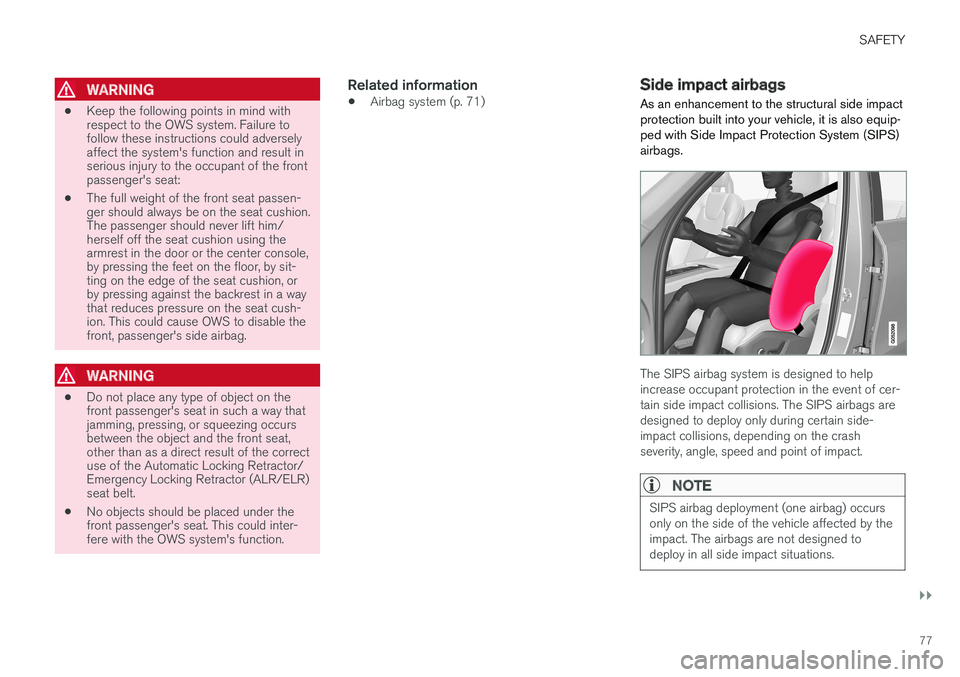
As an enhancement to the structural side impactprotection built into your vehicle, it is also equip-ped with Side Impact Protection System (SIPS)airbags.
The SIPS airbag system is designed to helpincrease occupant protection in the event of cer-tain side impact collisions. The SIPS airbags aredesigned to deploy only during certain side-impact collisions, depending on the crashseverity, angle, speed and point of impact.
NOTE
SIPS airbag deployment (one airbag) occursonly on the side of the vehicle affected by theimpact. The airbags are not designed todeploy in all side impact situations.
Page 82 of 584
SAFETY
80
Starting or moving a vehicle insafety mode
If Safety mode has been set, it may be possibleto start and move the vehicle, for example, if it isblocking traffic.
Starting the vehicle in safety mode
1. Check the vehicle for damage, particularly forfuel leakage or the smell of gasoline fumes.
If the damage to the vehicle is minor andthere is no fuel leakage/fumes, you mayattempt to start the engine and move thevehicle.
WARNING
If you smell gasoline fumes or detect fuelleakage while Safety mode See Owner'smanual is displayed in the instrument panel,do not attempt to start the vehicle. Leavethe vehicle immediately.
2.Turn the start knob to STOP and release it.
3.Try to start the vehicle.
>Vehicle start System check, wait willbe displayed in the instrument panel whilethe vehicle's electrical system attempts toreset to normal mode. This may take up toa minute.
4.When Vehicle start System check, wait isno longer displayed, try to start the vehicleagain.
WARNING
If the message Safety mode See Owner'smanual is still displayed, the vehicle shouldnot be driven and must be towed (lifted onto aflatbed tow truck. The vehicle may never betowed with the wheels on the ground). Con-cealed faults may make the vehicle difficult tocontrol.
Moving the vehicle after safety mode
has been set
If the message Normal mode The vehicle isnow in normal mode is displayed, the vehiclemay be moved carefully from its present positionif, for example, it is blocking traffic.
It should, however, not be moved farther thanis absolutely necessary.
WARNING
After Safety mode has been set, the vehicleshould not be driven or towed (pulled on theground by another vehicle). It must be trans-ported on a flatbed tow truck to a trained andqualified Volvo service technician for inspec-tion/repairs.
Related information
•Safety mode (p. 79)
•Towing recommendations (p. 389)
Page 84 of 584
||
SAFETY
* Option/accessory, for more information, see Introduction.82
WARNING
•Do not use child safety seats or childbooster cushions/backrests in the frontpassenger's seat. We also recommendthat children under 4 feet 7 inches(140 cm) in height who have outgrownthese devices sit in the rear seat with theseat belt fastened.
•Sedan models: Keep vehicle doors andtrunk locked and keep remote controlsout of a child
Page 86 of 584
||
SAFETY
84
WARNING
•When not in use, keep the child restraintsystem secured or remove it from thepassenger compartment to help prevent itfrom injuring passengers in the event of asudden stop or collision.
•A small child's head represents a consid-erable part of its total weight and its neckis still very weak. Volvo recommends thatchildren up to age 4 travel, properlyrestrained, facing rearward. In addition,Volvo recommends that children shouldride rearward facing, properly restrained,as long as possible.
Automatic Locking Retractor/
Emergency Locking Retractor (ALR/
ELR)
To make child seat installation easier, each seatbelt (except for the driver's belt) is equipped witha locking mechanism to help keep the seat belttaut.
When attaching the seat belt to a child seat:
1. Attach the seat belt to the child seat accord-ing to the child seat manufacturer's instruc-tions.
2. Pull the seat belt out as far as possible.
3. Insert the seat belt latch plate into the buckle(lock) in the usual way.
4. Release the seat belt and pull it taut aroundthe child seat.
A sound from the seat belt retractor will be audi-ble at this time and is normal. The belt will nowbe locked in place. This function is automaticallydisabled when the seat belt is unlocked and thebelt is fully retracted.
WARNING
Do not use child safety seats or child boostercushions/backrests in the front passenger'sseat. We also recommend that children whohave outgrown these devices sit in the rearseat with the seat belt properly fastened.
Child restraint registration and recalls
Child restraints could be recalled for safety rea-sons. You must register your child restraint to bereached in a recall. To stay informed about childsafety seat recalls, be sure to fill out and returnthe registration card that comes with new childrestraints.
Child restraint recall information is readily availa-ble in both the U.S. and Canada. For recall infor-mation in the U.S., call the U.S. Government'sAuto Safety Hotline at 1-800-424-9393 or go tohttp://www-odi.nhtsa.dot.gov/cars/problems/recalls/register/childseat/index.cfm. In Canada,visit Transport Canada's Child Safety website athttp://www.tc.gc.ca/roadsafety/childsafety/menu.htm.
Infant seats
Suitable child restraints should always be usedwhen children (depending on their age/size) areseated in the vehicle.
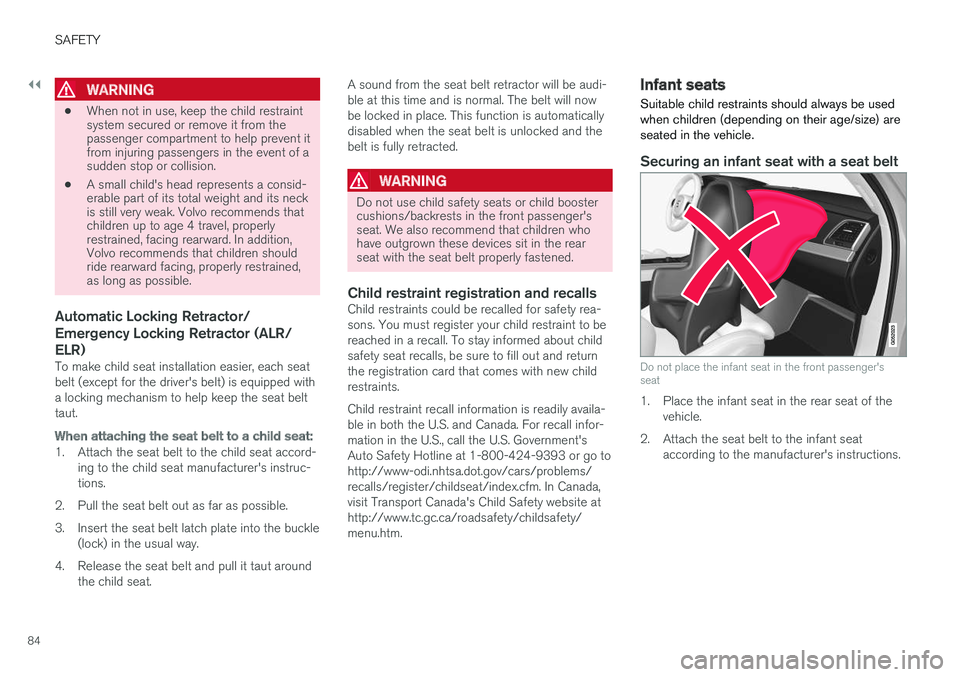
Securing an infant seat with a seat belt
Do not place the infant seat in the front passenger'sseat
1. Place the infant seat in the rear seat of thevehicle.
2.Attach the seat belt to the infant seataccording to the manufacturer's instructions.
Page 87 of 584
SAFETY
}}
85
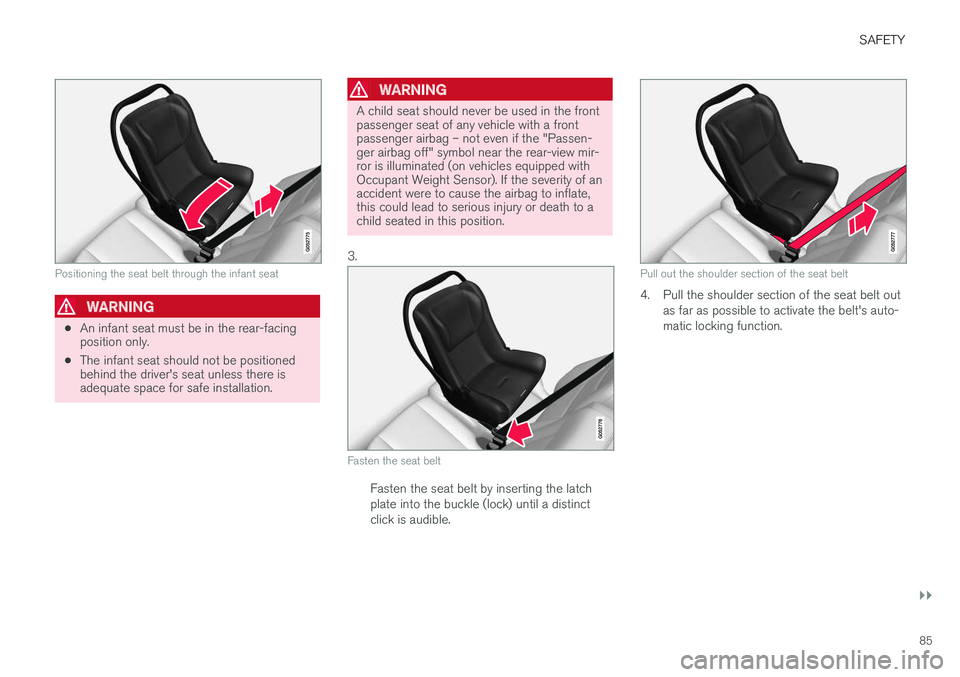
Positioning the seat belt through the infant seat
WARNING
•An infant seat must be in the rear-facingposition only.
•The infant seat should not be positionedbehind the driver's seat unless there isadequate space for safe installation.
WARNING
A child seat should never be used in the frontpassenger seat of any vehicle with a frontpassenger airbag – not even if the "Passen-ger airbag off" symbol near the rear-view mir-ror is illuminated (on vehicles equipped withOccupant Weight Sensor). If the severity of anaccident were to cause the airbag to inflate,this could lead to serious injury or death to achild seated in this position.
3.
Fasten the seat belt
Fasten the seat belt by inserting the latchplate into the buckle (lock) until a distinctclick is audible.
Pull out the shoulder section of the seat belt
4. Pull the shoulder section of the seat belt outas far as possible to activate the belt's auto-matic locking function.
Page 88 of 584
||
SAFETY
86
NOTE
The locking retractor will automaticallyrelease when the seat belt is unbuckled andallowed to retract fully.
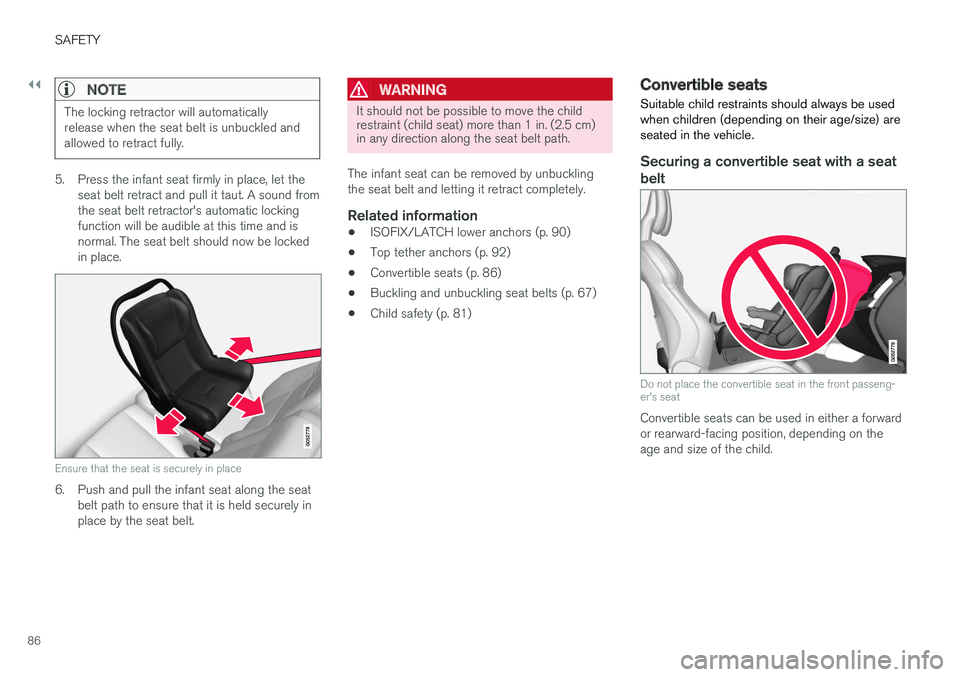
5. Press the infant seat firmly in place, let theseat belt retract and pull it taut. A sound fromthe seat belt retractor's automatic lockingfunction will be audible at this time and isnormal. The seat belt should now be lockedin place.
Ensure that the seat is securely in place
6. Push and pull the infant seat along the seatbelt path to ensure that it is held securely inplace by the seat belt.
WARNING
It should not be possible to move the childrestraint (child seat) more than 1 in. (2.5 cm)in any direction along the seat belt path.
The infant seat can be removed by unbucklingthe seat belt and letting it retract completely.
Related information
•ISOFIX/LATCH lower anchors (p. 90)
•Top tether anchors (p. 92)
•Convertible seats (p. 86)
•Buckling and unbuckling seat belts (p. 67)
•Child safety (p. 81)
Convertible seats
Suitable child restraints should always be usedwhen children (depending on their age/size) areseated in the vehicle.
Securing a convertible seat with a seat
belt
Do not place the convertible seat in the front passeng-er's seat
Convertible seats can be used in either a forwardor rearward-facing position, depending on theage and size of the child.
Page 89 of 584
SAFETY
}}
87
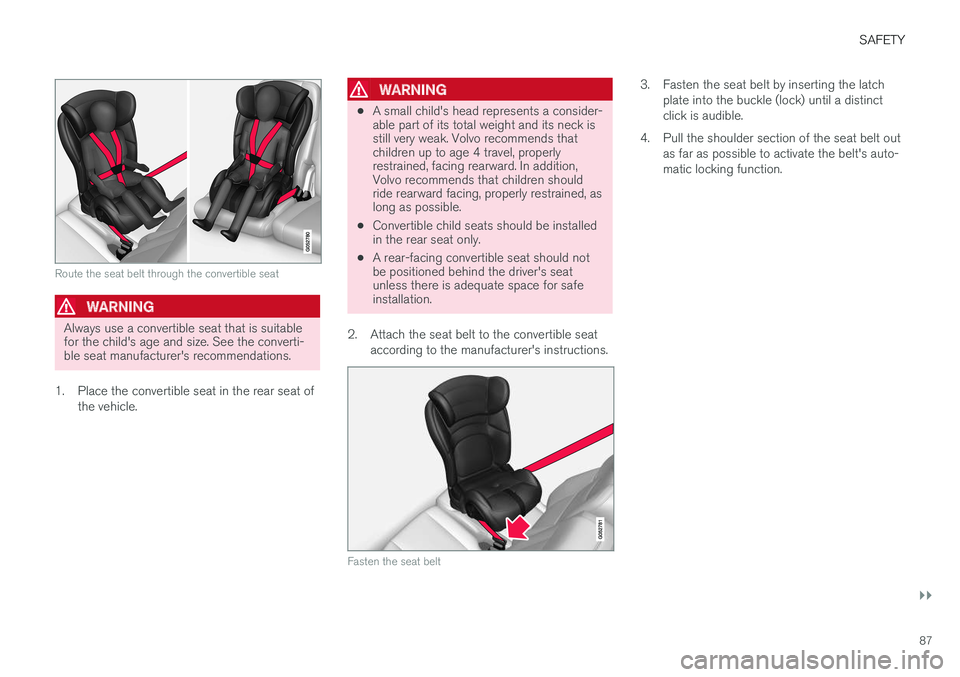
Route the seat belt through the convertible seat
WARNING
Always use a convertible seat that is suitablefor the child's age and size. See the converti-ble seat manufacturer's recommendations.
1.Place the convertible seat in the rear seat ofthe vehicle.
WARNING
•A small child's head represents a consider-able part of its total weight and its neck isstill very weak. Volvo recommends thatchildren up to age 4 travel, properlyrestrained, facing rearward. In addition,Volvo recommends that children shouldride rearward facing, properly restrained, aslong as possible.
•Convertible child seats should be installedin the rear seat only.
•A rear-facing convertible seat should notbe positioned behind the driver's seatunless there is adequate space for safeinstallation.
2.Attach the seat belt to the convertible seataccording to the manufacturer's instructions.
Fasten the seat belt
3. Fasten the seat belt by inserting the latchplate into the buckle (lock) until a distinctclick is audible.
4.Pull the shoulder section of the seat belt outas far as possible to activate the belt's auto-matic locking function.
Page 90 of 584
||
SAFETY
88
NOTE
The locking retractor will automaticallyrelease when the seat belt is unbuckled andallowed to retract fully.
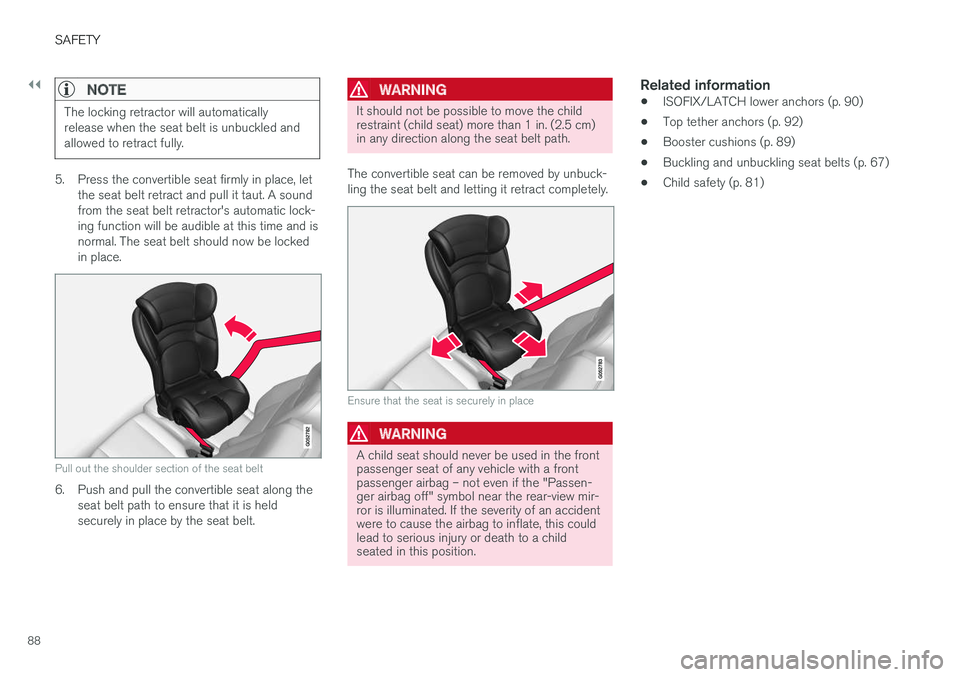
5. Press the convertible seat firmly in place, letthe seat belt retract and pull it taut. A soundfrom the seat belt retractor's automatic lock-ing function will be audible at this time and isnormal. The seat belt should now be lockedin place.
Pull out the shoulder section of the seat belt
6. Push and pull the convertible seat along theseat belt path to ensure that it is heldsecurely in place by the seat belt.
WARNING
It should not be possible to move the childrestraint (child seat) more than 1 in. (2.5 cm)in any direction along the seat belt path.
The convertible seat can be removed by unbuck-ling the seat belt and letting it retract completely.
Ensure that the seat is securely in place
WARNING
A child seat should never be used in the frontpassenger seat of any vehicle with a frontpassenger airbag – not even if the "Passen-ger airbag off" symbol near the rear-view mir-ror is illuminated. If the severity of an accidentwere to cause the airbag to inflate, this couldlead to serious injury or death to a childseated in this position.
Related information
•ISOFIX/LATCH lower anchors (p. 90)
•Top tether anchors (p. 92)
•Booster cushions (p. 89)
•Buckling and unbuckling seat belts (p. 67)
•Child safety (p. 81)
Page 91 of 584
SAFETY
* Option/accessory, for more information, see Introduction.89
Booster cushions
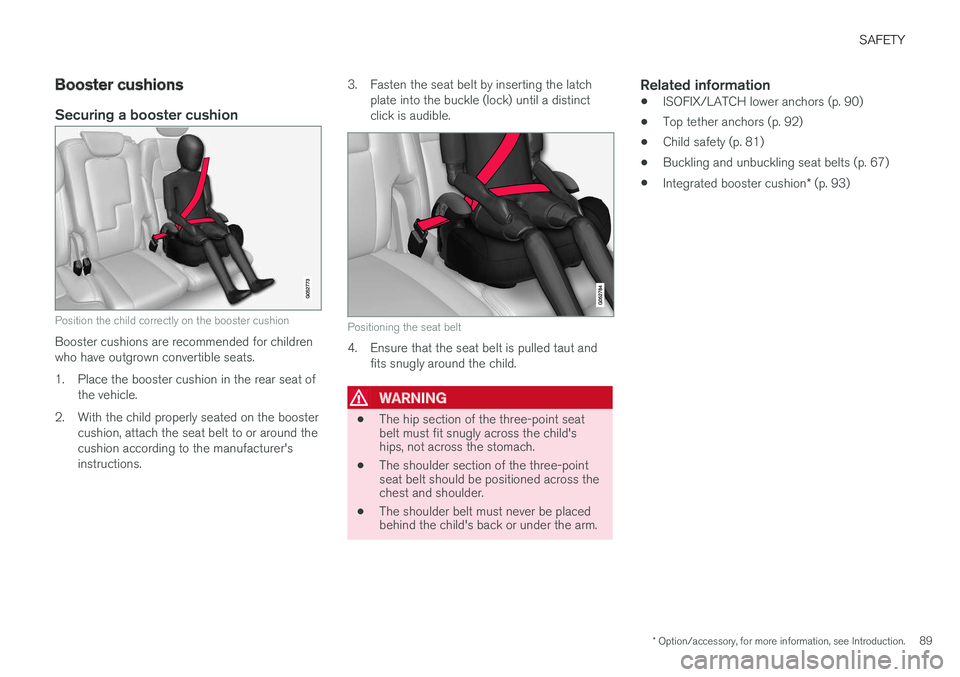
Securing a booster cushion
Position the child correctly on the booster cushion
Booster cushions are recommended for childrenwho have outgrown convertible seats.
1.Place the booster cushion in the rear seat ofthe vehicle.
2. With the child properly seated on the boostercushion, attach the seat belt to or around thecushion according to the manufacturer'sinstructions.
3. Fasten the seat belt by inserting the latchplate into the buckle (lock) until a distinctclick is audible.
Positioning the seat belt
4. Ensure that the seat belt is pulled taut andfits snugly around the child.
WARNING
•The hip section of the three-point seatbelt must fit snugly across the child'ships, not across the stomach.
•The shoulder section of the three-pointseat belt should be positioned across thechest and shoulder.
•The shoulder belt must never be placedbehind the child's back or under the arm.
Related information
•ISOFIX/LATCH lower anchors (p. 90)
•Top tether anchors (p. 92)
•Child safety (p. 81)
•Buckling and unbuckling seat belts (p. 67)
•Integrated booster cushion* (p. 93)
Page 94 of 584
||
SAFETY
92
Related information
•Child restraints (p. 83)
•ISOFIX/LATCH lower anchors (p. 90)
•Occupant weight sensor (p. 74)
Top tether anchors
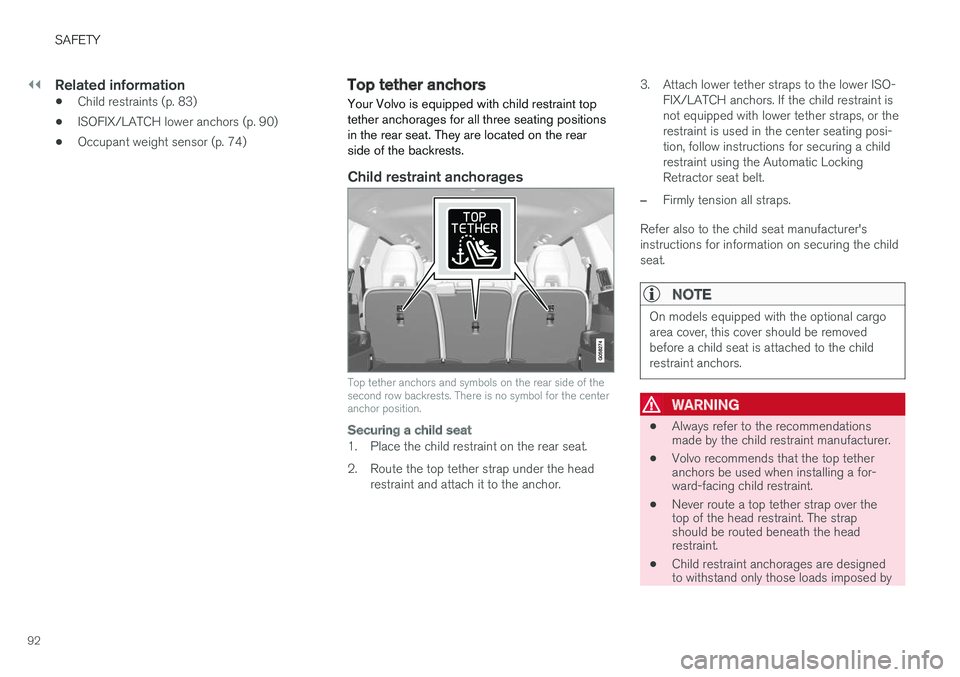
Your Volvo is equipped with child restraint toptether anchorages for all three seating positionsin the rear seat. They are located on the rearside of the backrests.
Child restraint anchorages
Top tether anchors and symbols on the rear side of thesecond row backrests. There is no symbol for the centeranchor position.
Securing a child seat
1. Place the child restraint on the rear seat.
2. Route the top tether strap under the headrestraint and attach it to the anchor.
3. Attach lower tether straps to the lower ISO-FIX/LATCH anchors. If the child restraint isnot equipped with lower tether straps, or therestraint is used in the center seating posi-tion, follow instructions for securing a childrestraint using the Automatic LockingRetractor seat belt.
–Firmly tension all straps.
Refer also to the child seat manufacturer'sinstructions for information on securing the childseat.
NOTE
On models equipped with the optional cargoarea cover, this cover should be removedbefore a child seat is attached to the childrestraint anchors.
WARNING
•Always refer to the recommendationsmade by the child restraint manufacturer.
•Volvo recommends that the top tetheranchors be used when installing a for-ward-facing child restraint.
•Never route a top tether strap over thetop of the head restraint. The strapshould be routed beneath the headrestraint.
•Child restraint anchorages are designedto withstand only those loads imposed by