fuel YAMAHA FX HO 2014 Owners Manual
[x] Cancel search | Manufacturer: YAMAHA, Model Year: 2014, Model line: FX HO, Model: YAMAHA FX HO 2014Pages: 114, PDF Size: 5.13 MB
Page 3 of 114

with the requirements of Directive 94/25/EC, as amended by Directive 200\
3/44/EC
Name of Engine Manufactu")
Important manual information
EJU37596
Declaration of Conformity for Personal Watercraft (PWC)
with the requirements of Directive 94/25/EC, as amended by Directive 200\
3/44/EC
Name of Engine Manufacturer: YAMAHA MOTOR CO., LTD.
Name / Title:H. Yamaji / President of YAMAHA MOTOR EUROPE N.V.
Address:
2500 Shingai, Iwata, Shizuoka 438-8501, Japan
Name of Authorised Representative: YAMAHA MOTOR EUROPE N.V.
Address: Koolhovenlaan 101, 1119 NC Schiphole-Rijk, The Netherlands
Name of Notified Body for exhaust and noise emission assessment: Luxcontrol SA
Address: 1. avenue des Terres Rouges BP 349, Esch-sur-Alzette, L-4004. Luxembourg\
Name of Notified Body for exhaust and noise emission assessment: SNCH
FB1800A-N / FX Cruiser HO, FB1800-N / FX HO 0882
0499
ID Number:
ID Number:
Address: 11, route de Luxembourg BP 32, Sandweiler, L-5230. Luxembourg
US-YAMA1001 I 314
Conformity assessment module used:
for construction:
for exhaust emissions:
for noise emissions:
DESCRIPTION OF CRAFT
DESCRIPTION OF ENGINE A
A
Craft model Identification Number, starting from :
Model name / Commercial name : C
Design Category : Other Community Directives applied
Directive 2004/108/EC relating to electromagnetic compatibility (EMC).\
CISPR 12
Directive 2006/42/EC relating to Machinery. Standards
EN 61000-6-2
D
Aa
AaB+C
B+CB+D
B+D B+E
B+EB+F
B+FG
G
GH
H
H
Engine Type:
PWC engine Combustion cycle:
4 stroke
Fuel Type:
Petrol
ESSENTIAL REQUIREMENTS
IDENTIFICATION OF ENGINE COVERED BY THIS DECLARATION OF CONFORMITY
Name of engine model
6CR Name / ID number of Notified Body
SNCH / 0499
EC Type–examination certificate number
SNCH*92/25*2003/44*0044*01
(identification of the person empowered to sign on behalf of the engine\
manufacturer or his authorised representative)
Signature and title:(or an equivalent marking)Date and place of issue:1st / September / 2013, Schiphol-Rijk, The Netherlands
Essential requirements
standardsother normative
document / method technical filePlease specify in more detail
(* = mandatory standard)
I.A design and construction EN ISO 13590
I.B exhaust emission *EN ISO 8178-1
I.C noise emission *EN ISO 14509
*
*
This declaration of conformity is issued under the sole responsibility o\
f the PWC manufacturer. I declare on behalf of the PWC
manufacturer that the craft model and engine(s) mentioned above compli\
es (comply) with all applicable essential
requirements in the way specified and is (are) in conformity with the \
type(s) for which above mentioned EC type-examination
certificate(s) has (have) been issued.
UF2T72E0.book Page 1 Monday, July 22, 2013 2:26 PM
Page 5 of 114
Table of contents
General and important labels ........... 1Identification numbers .................... 1
Primary Identification (PRI-ID)
number............................................ 1
Craft Identification Number (CIN) ....... 1
Engine serial number.......................... 1
Manufactured date label .................... 2
Model information ........................... 2
Builder’s plate .................................... 2
Important labels .............................. 4
Warning labels.................................... 5
Other labels ........................................ 9
Safety information ........................... 11 Limitations on who may operate the watercraft ............................. 11
Cruising limitations ........................ 12
Operation requirements ................ 13
Recommended equipment ........... 15
Hazard information........................ 16
Watercraft characteristics ............. 16
Water-skiing .................................. 18
Safe boating rules ......................... 19
Enjoy your watercraft responsibly ................................. 20
Description....................................... 21 Watercraft glossary ....................... 21
Location of main components ...... 22
Control function operation ............. 26 Watercraft control functions ......... 26
Remote control transmitter .............. 26
Yamaha Security System ................. 27
Engine stop switch .......................... 28
Engine shut-off switch .................... 28
Start switch ..................................... 28
Throttle lever .................................... 29
Steering system ............................... 29
Adjustable tilt steering system ......... 30
Cooling water pilot outlet ................. 30
Water separator................................ 31
Watercraft operation ...................... 32Watercraft operation functions ..... 32
Shift system...................................... 32
Quick Shift Trim System
(Q.S.T.S.) ....................................... 33
Watercraft operation modes ......... 35
Low RPM Mode ............................... 35
No-wake mode ................................. 36
Cruise assist ..................................... 37
Instrument operation ...................... 40Multifunction information center ... 40
Analog speedometer/tachometer..... 40
Information display ........................... 41
Equipment operation ...................... 46Equipment..................................... 46
Seats ................................................ 46
Handgrip........................................... 47
Reboarding grip................................ 47
Reboarding step ............................... 47
Bow eye............................................ 48
Stern eyes ........................................ 48
Cleat ................................................. 48
Pull-up cleats (FX Cruiser HO).......... 49
Storage compartments .................... 49
Fire extinguisher holder and cover ... 54
Operation and handling
requirements ................................... 55Fuel requirements ......................... 55
Fuel................................................... 55
Engine oil requirements ................ 57
Engine oil .......................................... 57
Draining the bilge water ................ 58
Draining the bilge water on land....... 58
Draining the bilge water on water .... 59
UF2T72E0.book Page 1 Monday, July 22, 2013 2:26 PM
Page 26 of 114
Safety information
20
EJU30992
Enjoy your watercraft responsibly
You share the areas you enjoy when riding
your watercraft with others and with nature.
So your enjoyment includes a responsibility
to treat these other people, and the lands,
waters, and wildlife with respect and courte-
sy.
Whenever and wherever you ride, think of
yourself as the guest of those around you.
Remember, for example, that the sound of
your watercraft may be music to you, but it
could be just noise to others. And the exciting
splash of your wake can make waves others
won’t enjoy.
Avoid riding close to shoreline homes and
waterfowl nesting areas or other wildlife ar-
eas, and keep a respectful distance from fish-
ermen, other boats, swimmers, and
populated beaches. When travel in areas like
these is unavoidable, ride slowly and obey all
laws.
Proper maintenance is necessary to ensure
that the exhaust emission and sound levels of
your watercraft will continue to be within reg-
ulated limits. You have the responsibility to
make sure that the recommended mainte-
nance in this owner’s/operator’s manual is
carried out.
Remember, pollution can be harmful to the
environment. Do not refuel or add oil where a
spill could cause damage to nature. Remove
your watercraft from the water and move it
away from the shoreline before refueling. Dis-
pose of water and any fuel and oil residue in
the engine compartment according to local
regulations. And keep your surroundings
pleasant for the people and wildlife that share
the waterways: don’t litter. When you ride responsibly, with respect and
courtesy for others, you help ensure that our
waterways stay open for the enjoyment of a
variety of recreational opportunities.
UF2T72E0.book Page 20 Monday, July 22, 2013 2:26 PM
Page 27 of 114
Description
21
EJU40303
Watercraft glossary
Trolling speed
“Trolling” is the lowest maneuvering speed. You are applying little or no throttle. The water-
craft is down in the water, and there is no wake.
Sub-planing speed
“Sub-planing” is a medium speed. The bow of the watercraft is slightly up from the water sur-
face, but you are still traveling through the water. There is a wake.
Planing speed
“Planing” is a faster speed. The watercraft is more level and is skimming on top of the water.
There is a wake.
Bow
The front end of the watercraft.
Stern
The rear end of the watercraft.
Starboard
The right side of the watercraft when facing forward.
Port
The left side of the watercraft when facing forward.
Bilge water
Water that has collected in the engine compartment.
Yamaha Engine Management System (YEMS) YEMS is an integrated, computerized management system that controls and adjusts ignition
timing, fuel injection, engine diagnostics, and the off-throttle steering (OTS) system.
UF2T72E0.book Page 21 Monday, July 22, 2013 2:26 PM
Page 28 of 114
Description
22
EJU31012
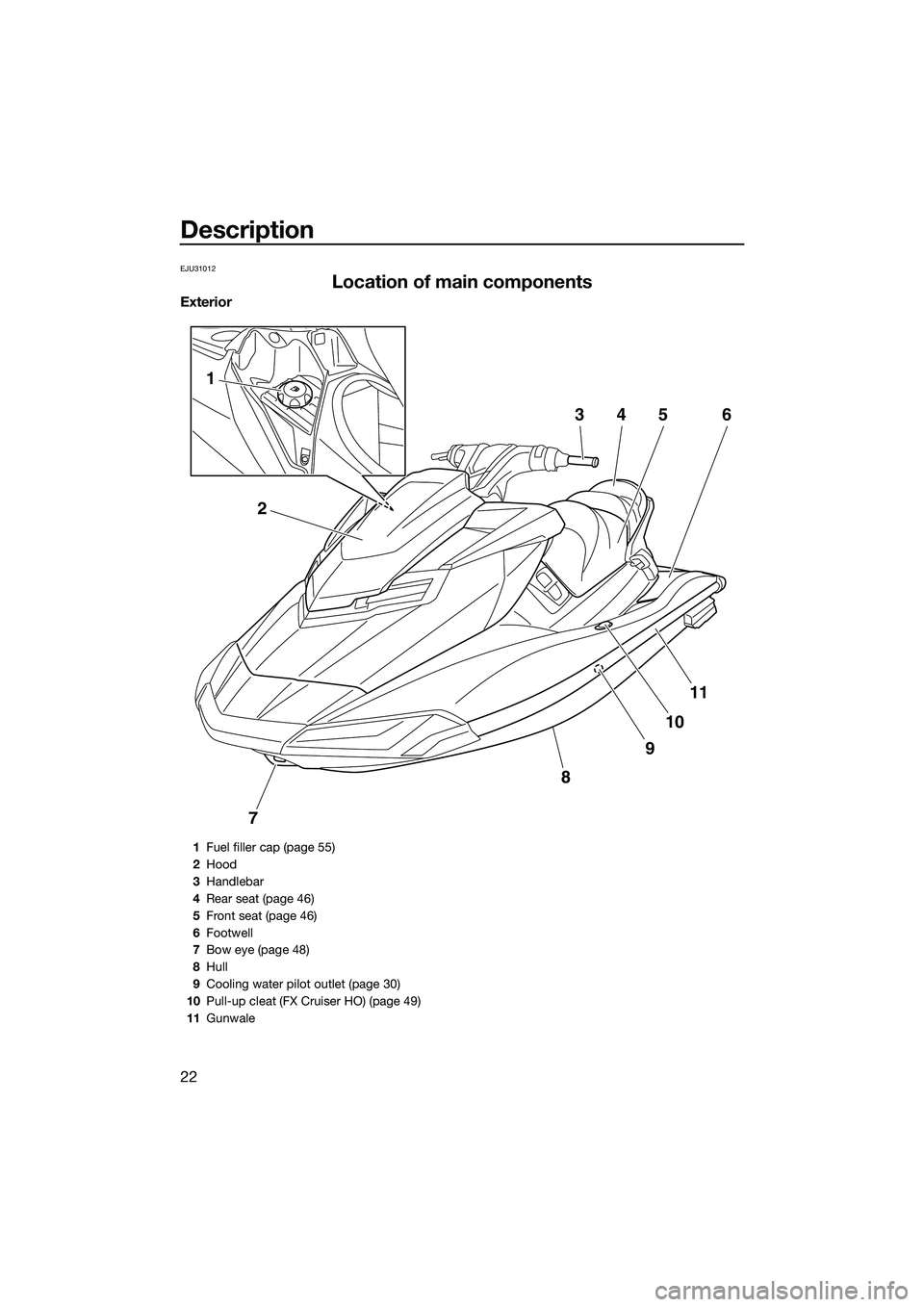
Location of main components
Exterior
7
8
9
10
11
2
1
3456
1Fuel filler cap (page 55)
2 Hood
3 Handlebar
4 Rear seat (page 46)
5 Front seat (page 46)
6 Footwell
7 Bow eye (page 48)
8 Hull
9 Cooling water pilot outlet (page 30)
10 Pull-up cleat (FX Cruiser HO) (page 49)
11 Gunwale
UF2T72E0.book Page 22 Monday, July 22, 2013 2:26 PM
Page 31 of 114
Description
25
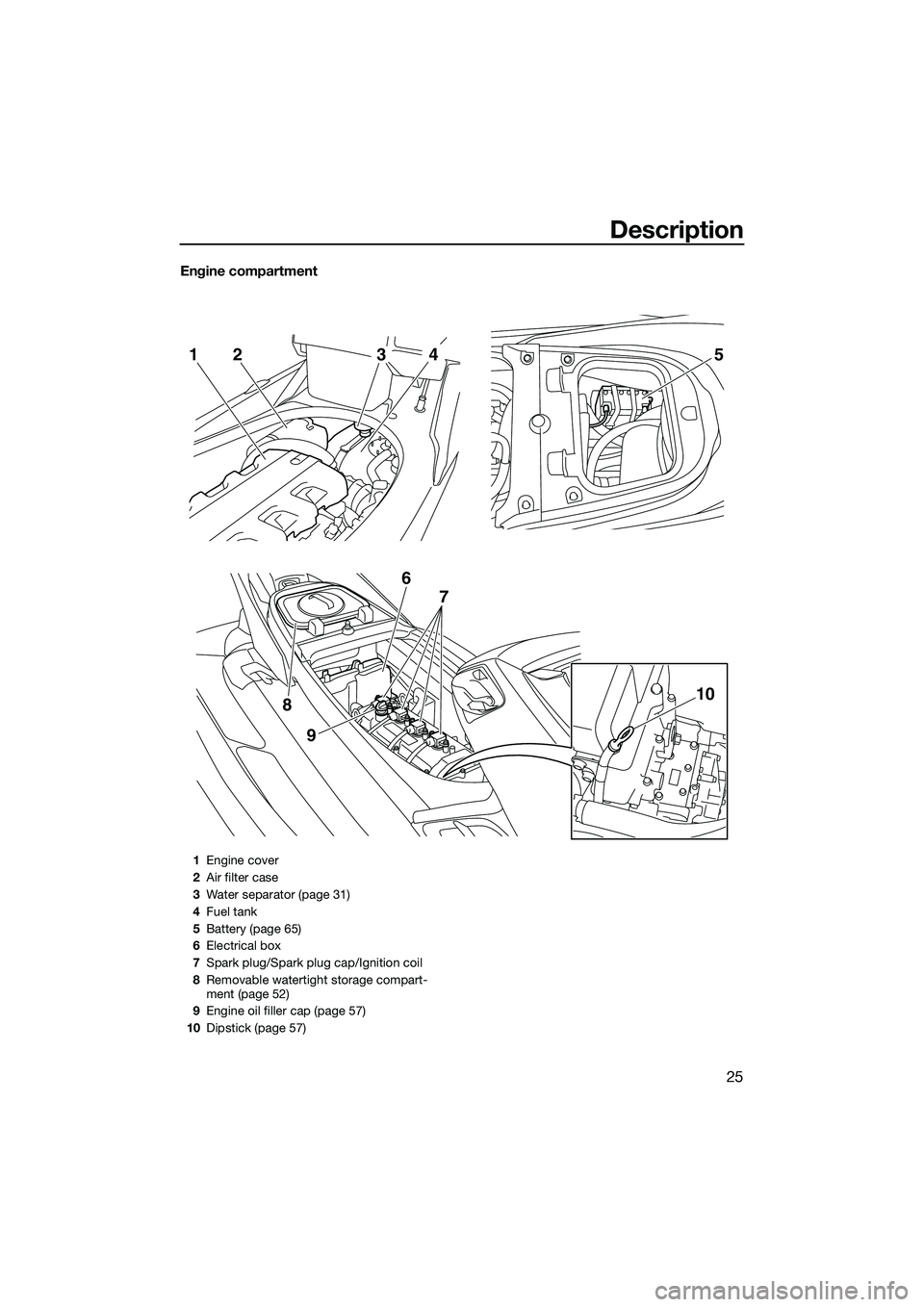
Engine compartment
52143
9
8
6 7
10
1Engine cover
2 Air filter case
3 Water separator (page 31)
4 Fuel tank
5 Battery (page 65)
6 Electrical box
7 Spark plug/Spark plug cap/Ignition coil
8 Removable watertight storage compart-
ment (page 52)
9 Engine oil filler cap (page 57)
10 Dipstick (page 57)
UF2T72E0.book Page 25 Monday, July 22, 2013 2:26 PM
Page 37 of 114
Control function operation
31
TIP:
It will take about 60 seconds for the water
to reach the outlet after the engine is start-
ed.
Water discharge may not be constant
when the engine is running at idling speed.
If this occurs, apply a little throttle to make
sure that water discharges properly.
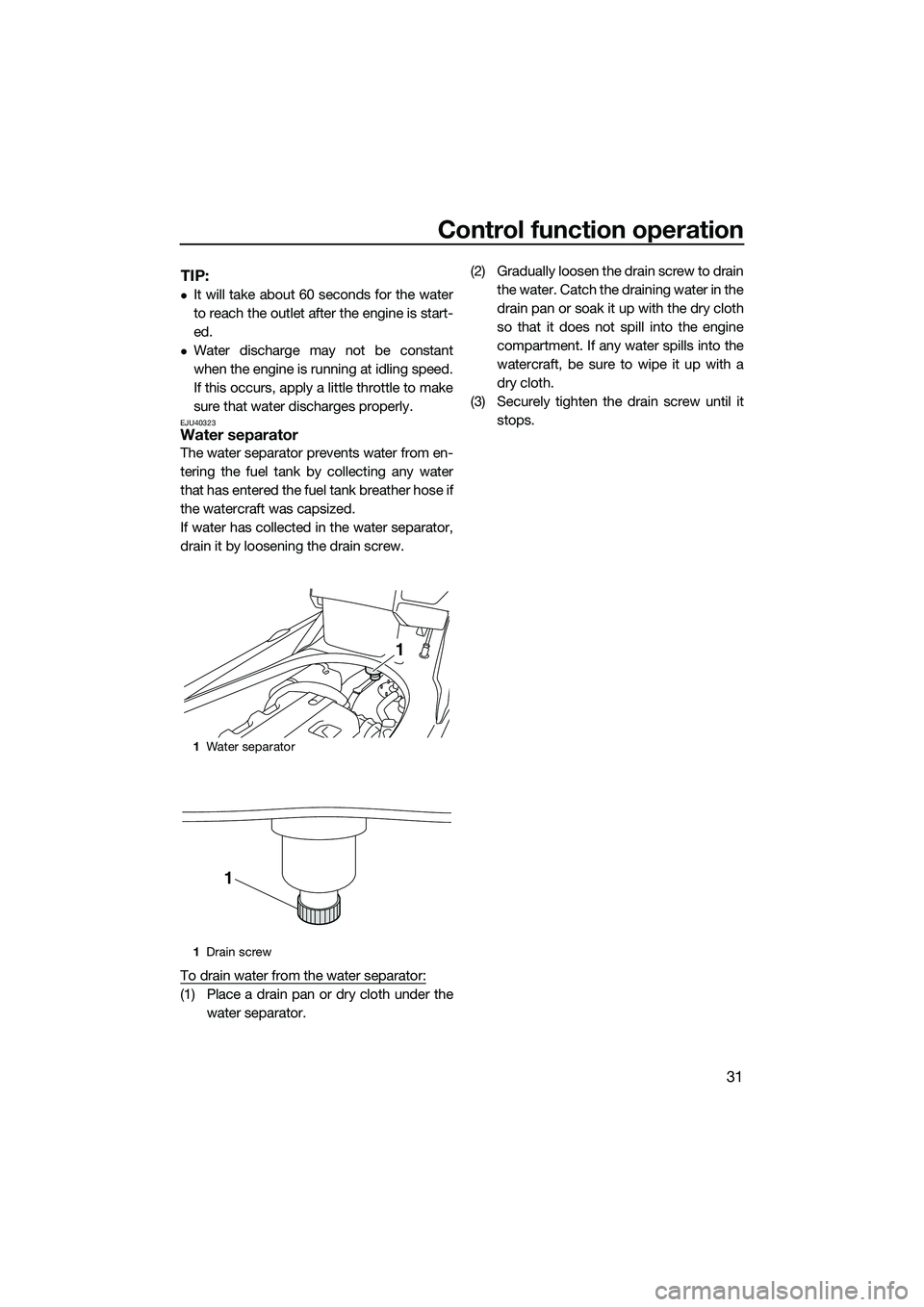
EJU40323Water separator
The water separator prevents water from en-
tering the fuel tank by collecting any water
that has entered the fuel tank breather hose if
the watercraft was capsized.
If water has collected in the water separator,
drain it by loosening the drain screw.
To drain water from the water separator:
(1) Place a drain pan or dry cloth under thewater separator. (2) Gradually loosen the drain screw to drain
the water. Catch the draining water in the
drain pan or soak it up with the dry cloth
so that it does not spill into the engine
compartment. If any water spills into the
watercraft, be sure to wipe it up with a
dry cloth.
(3) Securely tighten the drain screw until it stops.
1Water separator
1 Drain screw
1
1
UF2T72E0.book Page 31 Monday, July 22, 2013 2:26 PM
Page 47 of 114
Instrument operation
41
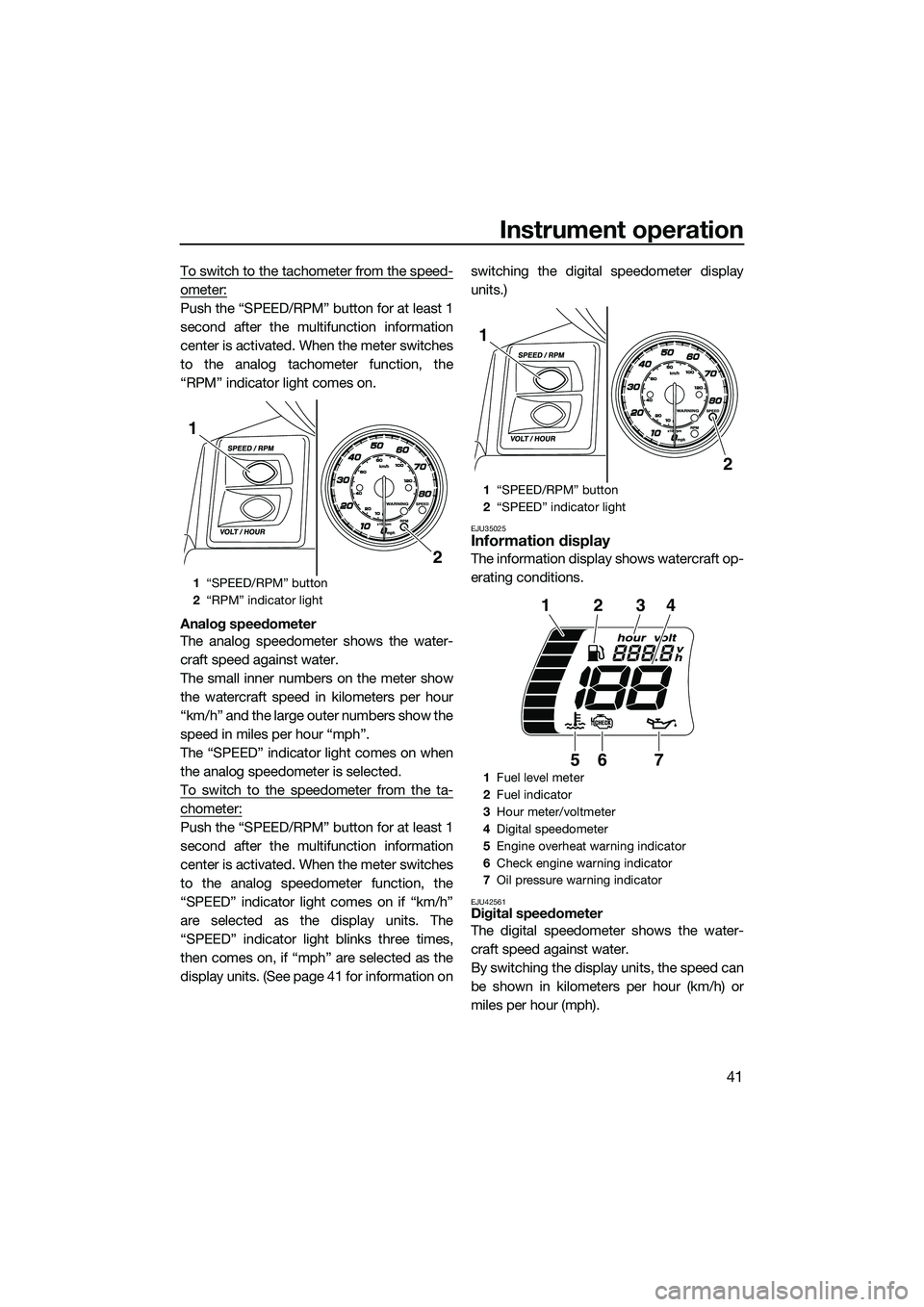
To switch to the tachometer from the speed-
ometer:
Push the “SPEED/RPM” button for at least 1
second after the multifunction information
center is activated. When the meter switches
to the analog tachometer function, the
“RPM” indicator light comes on.
Analog speedometer
The analog speedometer shows the water-
craft speed against water.
The small inner numbers on the meter show
the watercraft speed in kilometers per hour
“km/h” and the large outer numbers show the
speed in miles per hour “mph”.
The “SPEED” indicator light comes on when
the analog speedometer is selected.
To switch to the speedometer from the ta-
chometer:
Push the “SPEED/RPM” button for at least 1
second after the multifunction information
center is activated. When the meter switches
to the analog speedometer function, the
“SPEED” indicator light comes on if “km/h”
are selected as the display units. The
“SPEED” indicator light blinks three times,
then comes on, if “mph” are selected as the
display units. (See page 41 for information onswitching the digital speedometer display
units.)
EJU35025Information display
The information display shows watercraft op-
erating conditions.
EJU42561Digital speedometer
The digital speedometer shows the water-
craft speed against water.
By switching the display units, the speed can
be shown in kilometers per hour (km/h) or
miles per hour (mph).
1
“SPEED/RPM” button
2 “RPM” indicator light
2
1
1“SPEED/RPM” button
2 “SPEED” indicator light
1 Fuel level meter
2 Fuel indicator
3 Hour meter/voltmeter
4 Digital speedometer
5 Engine overheat warning indicator
6 Check engine warning indicator
7 Oil pressure warning indicator
2
1
123
567
4
UF2T72E0.book Page 41 Monday, July 22, 2013 2:26 PM
Page 49 of 114
Instrument operation
43
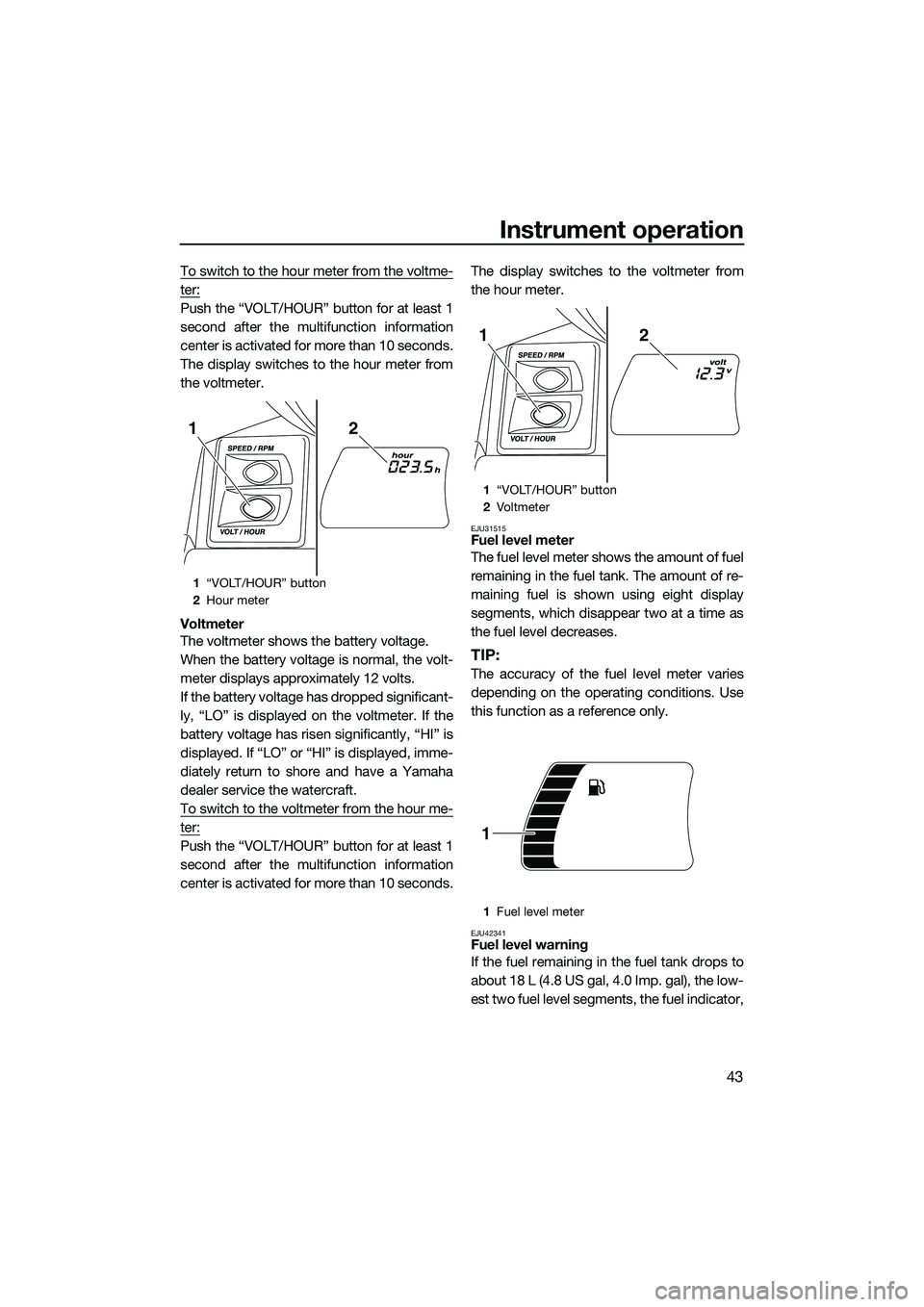
To switch to the hour meter from the voltme-
ter:
Push the “VOLT/HOUR” button for at least 1
second after the multifunction information
center is activated for more than 10 seconds.
The display switches to the hour meter from
the voltmeter.
Voltmeter
The voltmeter shows the battery voltage.
When the battery voltage is normal, the volt-
meter displays approximately 12 volts.
If the battery voltage has dropped significant-
ly, “LO” is displayed on the voltmeter. If the
battery voltage has risen significantly, “HI” is
displayed. If “LO” or “HI” is displayed, imme-
diately return to shore and have a Yamaha
dealer service the watercraft.
To switch to the voltmeter from the hour me-
ter:
Push the “VOLT/HOUR” button for at least 1
second after the multifunction information
center is activated for more than 10 seconds.The display switches to the voltmeter from
the hour meter.
EJU31515Fuel level meter
The fuel level meter shows the amount of fuel
remaining in the fuel tank. The amount of re-
maining fuel is shown using eight display
segments, which disappear two at a time as
the fuel level decreases.
TIP:
The accuracy of the fuel level meter varies
depending on the operating conditions. Use
this function as a reference only.
EJU42341Fuel level warning
If the fuel remaining in the fuel tank drops to
about 18 L (4.8 US gal, 4.0 Imp. gal), the low-
est two fuel level segments, the fuel indicator,
1
“VOLT/HOUR” button
2 Hour meter
21
1“VOLT/HOUR” button
2 Vo l t m et e r
1 Fuel level meter
21
1
UF2T72E0.book Page 43 Monday, July 22, 2013 2:26 PM
Page 50 of 114
Instrument operation
44
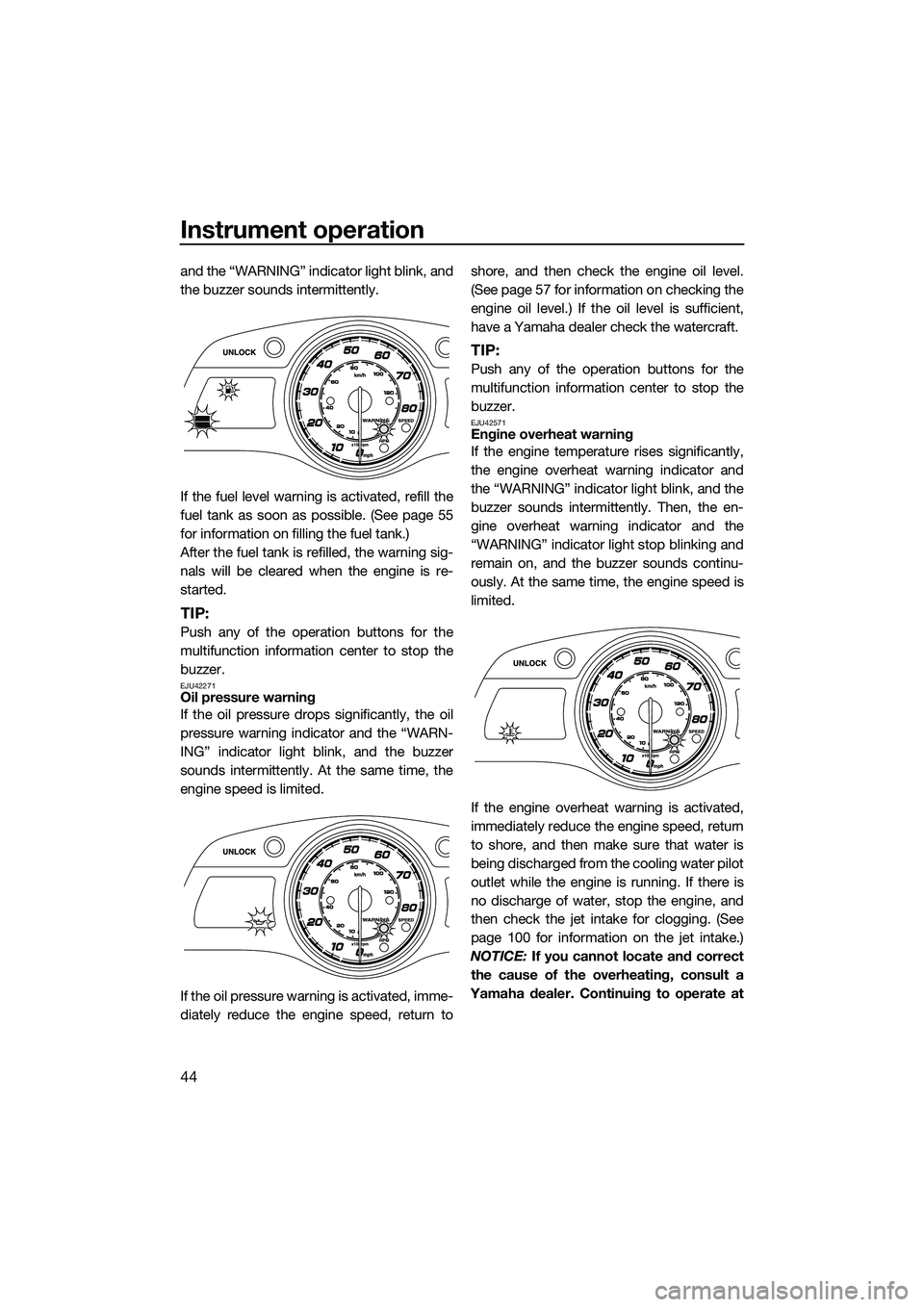
and the “WARNING” indicator light blink, and
the buzzer sounds intermittently.
If the fuel level warning is activated, refill the
fuel tank as soon as possible. (See page 55
for information on filling the fuel tank.)
After the fuel tank is refilled, the warning sig-
nals will be cleared when the engine is re-
started.
TIP:
Push any of the operation buttons for the
multifunction information center to stop the
buzzer.
EJU42271Oil pressure warning
If the oil pressure drops significantly, the oil
pressure warning indicator and the “WARN-
ING” indicator light blink, and the buzzer
sounds intermittently. At the same time, the
engine speed is limited.
If the oil pressure warning is activated, imme-
diately reduce the engine speed, return toshore, and then check the engine oil level.
(See page 57 for information on checking the
engine oil level.) If the oil level is sufficient,
have a Yamaha dealer check the watercraft.
TIP:
Push any of the operation buttons for the
multifunction information center to stop the
buzzer.
EJU42571Engine overheat warning
If the engine temperature rises significantly,
the engine overheat warning indicator and
the “WARNING” indicator light blink, and the
buzzer sounds intermittently. Then, the en-
gine overheat warning indicator and the
“WARNING” indicator light stop blinking and
remain on, and the buzzer sounds continu-
ously. At the same time, the engine speed is
limited.
If the engine overheat warning is activated,
immediately reduce the engine speed, return
to shore, and then make sure that water is
being discharged from the cooling water pilot
outlet while the engine is running. If there is
no discharge of water, stop the engine, and
then check the jet intake for clogging. (See
page 100 for information on the jet intake.)
NOTICE: If you cannot locate and correct
the cause of the overheating, consult a
Yamaha dealer. Continuing to operate at
UF2T72E0.book Page 44 Monday, July 22, 2013 2:26 PM