light YAMAHA GIGGLE50 2007 User Guide
[x] Cancel search | Manufacturer: YAMAHA, Model Year: 2007, Model line: GIGGLE50, Model: YAMAHA GIGGLE50 2007Pages: 72, PDF Size: 1.05 MB
Page 30 of 72

5-1
1
2
3
4
5
6
7
8
9
OPERATION AND IMPORTANT RIDING POINTS
EAU15942
OPERATION AND IMPORTANT RIDING POINTS
EAU15980
EWA10870
w● ●● ●
●
Become thoroughly familiar with
all operating controls and their
functions before riding. Consult
a Yamaha dealer regarding any
control or function that you do
not thoroughly understand.
● ●● ●
●
Never start the engine or oper-
ate it in a closed area for any
length of time. Exhaust fumes
are poisonous, and inhaling
them can cause loss of con-
sciousness and death within a
short time. Always make sure
that there is adequate ventila-
tion.
● ●● ●
●
For safety, always start the en-
gine with the centerstand down.
Starting the engine
EAUT2250
Starting the engine
ECA10250
cCSee page 5-3 for engine break-in in-
structions prior to operating the ve-
hicle for the first time.1. Turn the key to “ON”.
ECAT1070
cCThe engine trouble warning light and
coolant temperature warning light
should come on for a few seconds,
then go off. If these warning lights
do not go off, have a Yamaha dealer
check their electrical circuits.2. Close the throttle completely.
3. Start the engine by pushing the
start switch while applying the front
or rear brake.NOTE:
If the engine does not start, release the
start switch, wait a few seconds, and
then try again. Each starting attempt
should be as short as possible to pre-serve the battery. Do not crank the en-
gine more than 5 seconds on any one
attempt. If the engine does not start with
the starter motor, try using the
kickstarter.
ECA11040
cCFor maximum engine life, never ac-
celerate hard when the engine is
cold!
15P-F8199-E0_ch5.pmd2007/06/13, 11:17 1
Page 36 of 72
6-4
1
2
3
4
5
6
7
8
9
EAU17226
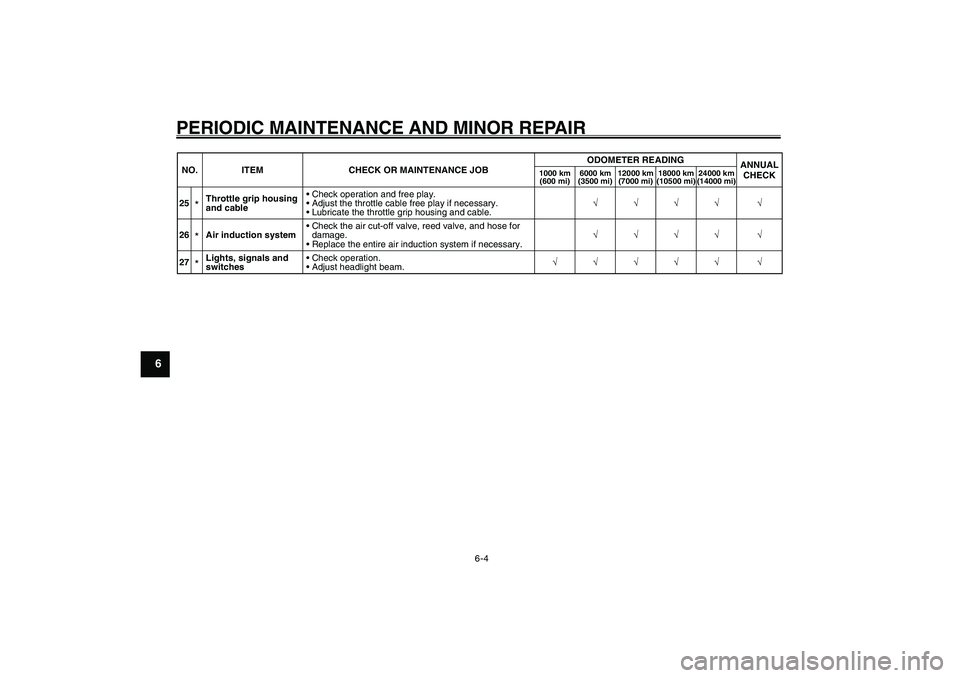
PERIODIC MAINTENANCE AND MINOR REPAIR25
*Throttle grip housing
and cable• Check operation and free play.
• Adjust the throttle cable free play if necessary.
• Lubricate the throttle grip housing and cable.———— —
26*Air induction system• Check the air cut-off valve, reed valve, and hose for
damage.
• Replace the entire air induction system if necessary.———— —
27*Lights, signals and
switches• Check operation.
• Adjust headlight beam.————— — NO. ITEM CHECK OR MAINTENANCE JOBODOMETER READING
ANNUAL
CHECK
1000 km
(600 mi)6000 km
(3500 mi)12000 km
(7000 mi)18000 km
(10500 mi)24000 km
(14000 mi)
15P-F8199-E0_ch6.pmd2007/06/21, 11:09 4
Page 38 of 72

6-6
1
2
3
4
5
6
7
8
9
EAU17226
PERIODIC MAINTENANCE AND MINOR REPAIRPanel CTo remo
ve the panel
ZAUM00**
1
1. Panel C1. Open the seat. (See page 3-9.)
2. Remove the screws, and then take
the panel off.To install the panel
Place the panel in the original position,
and then install the screws.
EAUT2070
Checking the spark plugThe spark plug is an important engine
component, which is easy to check.
Since heat and deposits will cause any
spark plug to slowly erode, the spark
plug should be removed and checked
in accordance with the periodic main-
tenance and lubrication chart. In addi-
tion, the condition of the spark plug can
reveal the condition of the engine.
To remove the spark plug
1. Remove panel A. (See page 6-5.)
2. Remove the spark plug cap.ZAUM00**
1
1. Spark plug wrench
Spark plug, checking
3. Remove the spark plug as shown,
with a spark plug wrench available
at a Yamaha dealer.
To check the spark plug
1. Check that the porcelain insulator
around the center electrode of the
spark plug is a medium-to-light tan
(the ideal color when the vehicle is
ridden normally).
NOTE:
If the spark plug shows a distinctly dif-
ferent color, the engine could be oper-
ating improperly. Do not attempt to di-
agnose such problems yourself. In-
stead, have a Yamaha dealer check the
vehicle.2. Check the spark plug for electrode
erosion and excessive carbon or
other deposits, and replace it if
necessary.Specified spark plug:
CR7E (NGK)
15P-F8199-E0_ch6.pmd2007/06/21, 11:09 6
Page 39 of 72

6-7
1
2
3
4
5
6
7
8
9
EAU17226
PERIODIC MAINTENANCE AND MINOR REPAIR
To install the spark plug
1. Measure the spark plug gap with a
wire thickness gauge and, if nec-
essary, adjust the gap to specifi-
cation.Spark plug gap:
0.7 ~ 0.8 mm (0.028 ~ 0.031 in)2. Clean the surface of the spark plug
gasket and its mating surface, and
then wipe off any grime from the
spark plug threads.
3. Install the spark plug with the spark
plug wrench, and then tighten it to
the specified torque.Tightening torque:
Spark plug:
NOTE:
If a torque wrench is not available when
installing a spark plug, a good estimate
of the correct torque is 1/4~1/2 turn past
finger tight. However, the spark plug
should be tightened to the specified
torque as soon as possible.
4. Install the spark plug cap.
5. Install the panel.
EAUT1460
Engine oil and oil strainerThe engine oil level should be checked
before each ride. In addition, the oil must
be changed and the oil strainer cleaned
at the intervals specified in the periodic
maintenance and lubrication chart.
To check the engine oil level
1. Place the vehicle on the
centerstand.NOTE:
Make sure that the vehicle is positioned
straight up when checking the oil level.
A slight tilt to the side can result in a
false reading.2. Start the engine, warm it up for sev-
eral minutes, and then turn it off. Engine oil
15P-F8199-E0_ch6.pmd2007/06/21, 11:09 7
Page 42 of 72
6-10
1
2
3
4
5
6
7
8
9
EAU17226
PERIODIC MAINTENANCE AND MINOR REPAIRZAUM00**
1
2
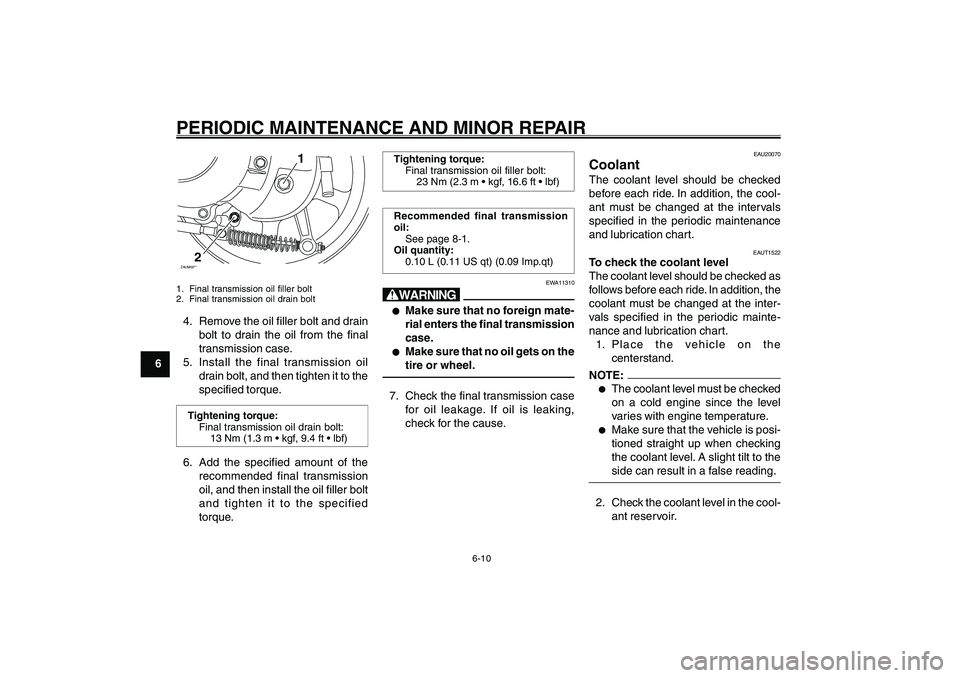
1. Final transmission oil filler bolt
2. Final transmission oil drain bolt4. Remove the oil filler bolt and drain
bolt to drain the oil from the final
transmission case.
5. Install the final transmission oil
drain bolt, and then tighten it to the
specified torque.Tightening torque:
Final transmission oil drain bolt:
6. Add the specified amount of the
recommended final transmission
oil, and then install the oil filler bolt
and tighten it to the specified
torque.
Tightening torque:
Final transmission oil filler bolt:
Recommended final transmission
oil:
See page 8-1.
Oil quantity:
0.10 L (0.11 US qt) (0.09 Imp.qt)
EWA11310
w● ●● ●
●
Make sure that no foreign mate-
rial enters the final transmission
case.
● ●● ●
●
Make sure that no oil gets on the
tire or wheel.
7. Check the final transmission case
for oil leakage. If oil is leaking,
check for the cause.
EAU20070
CoolantThe coolant level should be checked
before each ride. In addition, the cool-
ant must be changed at the intervals
specified in the periodic maintenance
and lubrication chart. Coolant
EAUT1522
To check the coolant level
The coolant level should be checked as
follows before each ride. In addition, the
coolant must be changed at the inter-
vals specified in the periodic mainte-
nance and lubrication chart.
1. Place the vehicle on the
centerstand.NOTE:●
The coolant level must be checked
on a cold engine since the level
varies with engine temperature.
●
Make sure that the vehicle is posi-
tioned straight up when checking
the coolant level. A slight tilt to the
side can result in a false reading.
2. Check the coolant level in the cool-
ant reservoir.
15P-F8199-E0_ch6.pmd2007/06/21, 11:09 10
Page 54 of 72
6-22
1
2
3
4
5
6
7
8
9
EAU17226
PERIODIC MAINTENANCE AND MINOR REPAIR
ZAUM00**
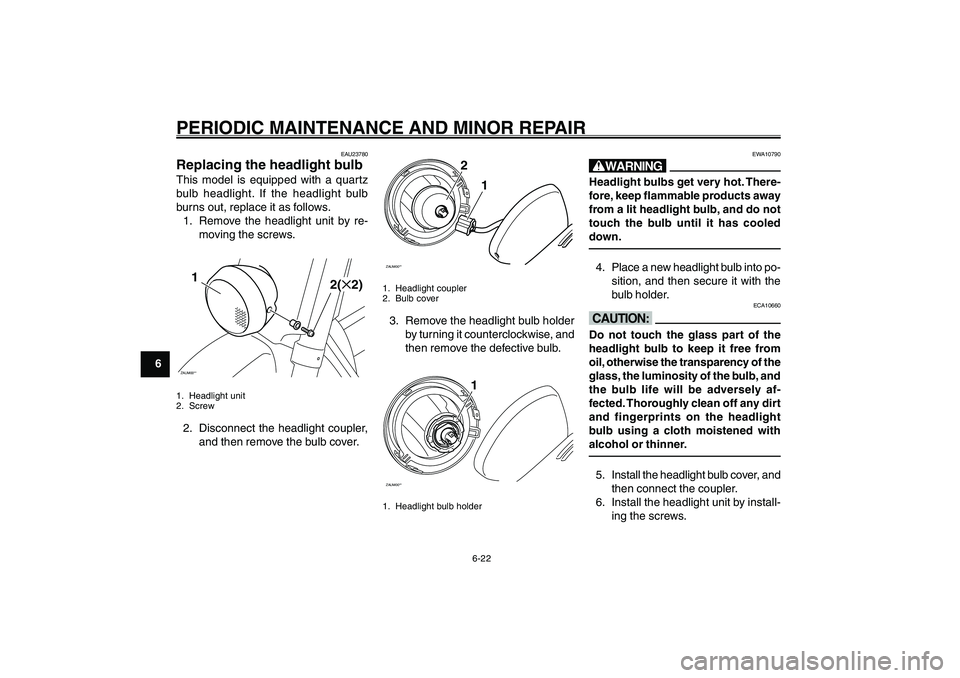
2
1
1. Headlight coupler
2. Bulb cover3. Remove the headlight bulb holder
by turning it counterclockwise, and
then remove the defective bulb.ZAUM00**
1
1. Headlight bulb holder
EWA10790
wHeadlight bulbs get very hot. There-
fore, keep flammable products away
from a lit headlight bulb, and do not
touch the bulb until it has cooled
down.4. Place a new headlight bulb into po-
sition, and then secure it with the
bulb holder.
ECA10660
cCDo not touch the glass part of the
headlight bulb to keep it free from
oil, otherwise the transparency of the
glass, the luminosity of the bulb, and
the bulb life will be adversely af-
fected. Thoroughly clean off any dirt
and fingerprints on the headlight
bulb using a cloth moistened with
alcohol or thinner.5. Install the headlight bulb cover, and
then connect the coupler.
6. Install the headlight unit by install-
ing the screws.
EAU23780
Replacing the headlight bulbThis model is equipped with a quartz
bulb headlight. If the headlight bulb
burns out, replace it as follows.
1. Remove the headlight unit by re-
moving the screws.ZAUM00**1
2(✕2)
1. Headlight unit
2. Screw2. Disconnect the headlight coupler,
and then remove the bulb cover. Headlight bulb, replacing
15P-F8199-E0_ch6.pmd2007/06/21, 11:09 22
Page 55 of 72
6-23
1
2
3
4
5
6
7
8
9
EAU17226
PERIODIC MAINTENANCE AND MINOR REPAIR
EAU24131
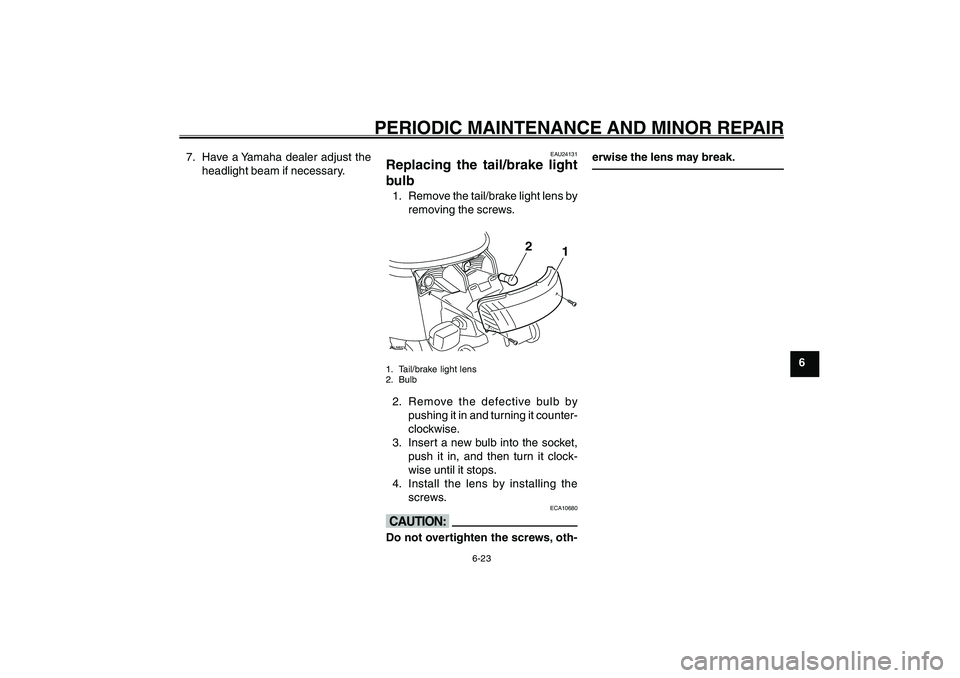
Replacing the tail/brake light
bulb1. Remove the tail/brake light lens by
removing the screws.ZAUM00**
1
2
1. Tail/brake light lens
2. Bulb2. Remove the defective bulb by
pushing it in and turning it counter-
clockwise.
3. Insert a new bulb into the socket,
push it in, and then turn it clock-
wise until it stops.
4. Install the lens by installing the
screws.
ECA10680
cCDo not overtighten the screws, oth- Tail/brake light bulb, replacing
erwise the lens may break.
7. Have a Yamaha dealer adjust the
headlight beam if necessary.
15P-F8199-E0_ch6.pmd2007/06/21, 11:09 23
Page 56 of 72

6-24
1
2
3
4
5
6
7
8
9
EAU17226
PERIODIC MAINTENANCE AND MINOR REPAIR
RearZAUM00**
1
2
1. Turn signal light lens
2. Bulb2. Remove the defective bulb by
pushing it in and turning it counter-
clockwise.
3. Insert a new bulb into the socket,
push it in, and then turn it clock-
wise until it stops.
4. Install the lens by installing the
screw.
ECA11190
cCDo not overtighten the screw, other-
wise the lens may break.
Turn signal light bulb, replacing
Troubleshooting
EAU25880
TroubleshootingAlthough Yamaha scooters receive a
thorough inspection before shipment
from the factory, trouble may occur dur-
ing operation. Any problem in the fuel,
compression, or ignition systems, for
example, can cause poor starting and
loss of power.
The following troubleshooting charts
represent quick and easy procedures
for checking these vital systems your-
self. However, should your scooter re-
quire any repair, take it to a Yamaha
dealer, whose skilled technicians have
the necessary tools, experience, and
know-how to service the scooter prop-
erly.
Use only genuine Yamaha replacement
par ts. Imitation par ts may look like
Yamaha parts, but they are often infe-
rior, have a shorter service life and can
lead to expensive repair bills.
EAU24202
Replacing a turn signal light
bulb1. Remove the turn signal light lens
by removing the screw.
FrontZAUM00**
2
1
1. Turn signal light lens
2. Bulb
15P-F8199-E0_ch6.pmd2007/06/21, 11:09 24
Page 59 of 72
7-1
1
2
3
4
5
6
7
8
9
SCOOTER CARE AND STORAGE
Care
EAU25991
SCOOTER CARE AND STORAGE
EAU26091
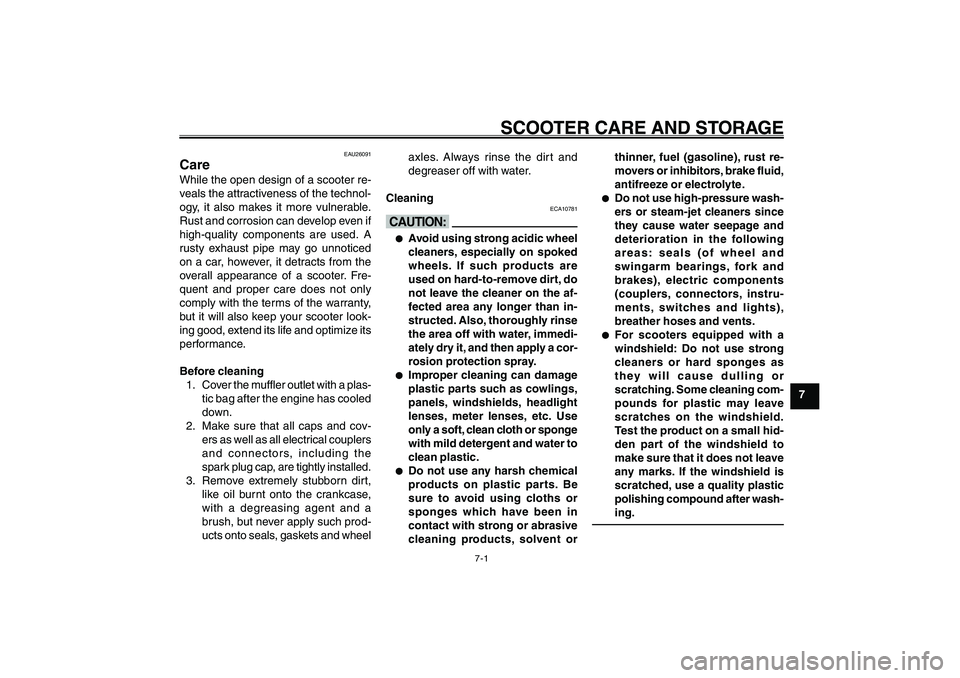
CareWhile the open design of a scooter re-
veals the attractiveness of the technol-
ogy, it also makes it more vulnerable.
Rust and corrosion can develop even if
high-quality components are used. A
rusty exhaust pipe may go unnoticed
on a car, however, it detracts from the
overall appearance of a scooter. Fre-
quent and proper care does not only
comply with the terms of the warranty,
but it will also keep your scooter look-
ing good, extend its life and optimize its
performance.
Before cleaning
1. Cover the muffler outlet with a plas-
tic bag after the engine has cooled
down.
2. Make sure that all caps and cov-
ers as well as all electrical couplers
and connectors, including the
spark plug cap, are tightly installed.
3. Remove extremely stubborn dirt,
like oil burnt onto the crankcase,
with a degreasing agent and a
brush, but never apply such prod-
ucts onto seals, gaskets and wheelaxles. Always rinse the dirt and
degreaser off with water.
Cleaning
ECA10781
cC● ●● ●
●
Avoid using strong acidic wheel
cleaners, especially on spoked
wheels. If such products are
used on hard-to-remove dirt, do
not leave the cleaner on the af-
fected area any longer than in-
structed. Also, thoroughly rinse
the area off with water, immedi-
ately dry it, and then apply a cor-
rosion protection spray.
● ●● ●
●
Improper cleaning can damage
plastic parts such as cowlings,
panels, windshields, headlight
lenses, meter lenses, etc. Use
only a soft, clean cloth or sponge
with mild detergent and water to
clean plastic.
● ●● ●
●
Do not use any harsh chemical
products on plastic parts. Be
sure to avoid using cloths or
sponges which have been in
contact with strong or abrasive
cleaning products, solvent orthinner, fuel (gasoline), rust re-
movers or inhibitors, brake fluid,
antifreeze or electrolyte.
● ●● ●
●
Do not use high-pressure wash-
ers or steam-jet cleaners since
they cause water seepage and
deterioration in the following
areas: seals (of wheel and
swingarm bearings, fork and
brakes), electric components
(couplers, connectors, instru-
ments, switches and lights),
breather hoses and vents.
● ●● ●
●
For scooters equipped with a
windshield: Do not use strong
cleaners or hard sponges as
they will cause dulling or
scratching. Some cleaning com-
pounds for plastic may leave
scratches on the windshield.
Test the product on a small hid-
den part of the windshield to
make sure that it does not leave
any marks. If the windshield is
scratched, use a quality plastic
polishing compound after wash-
ing.
15P-F8199-E0_ch7.pmd2007/06/13, 11:18 1
Page 64 of 72
8-2
1
2
3
4
5
6
7
8
9
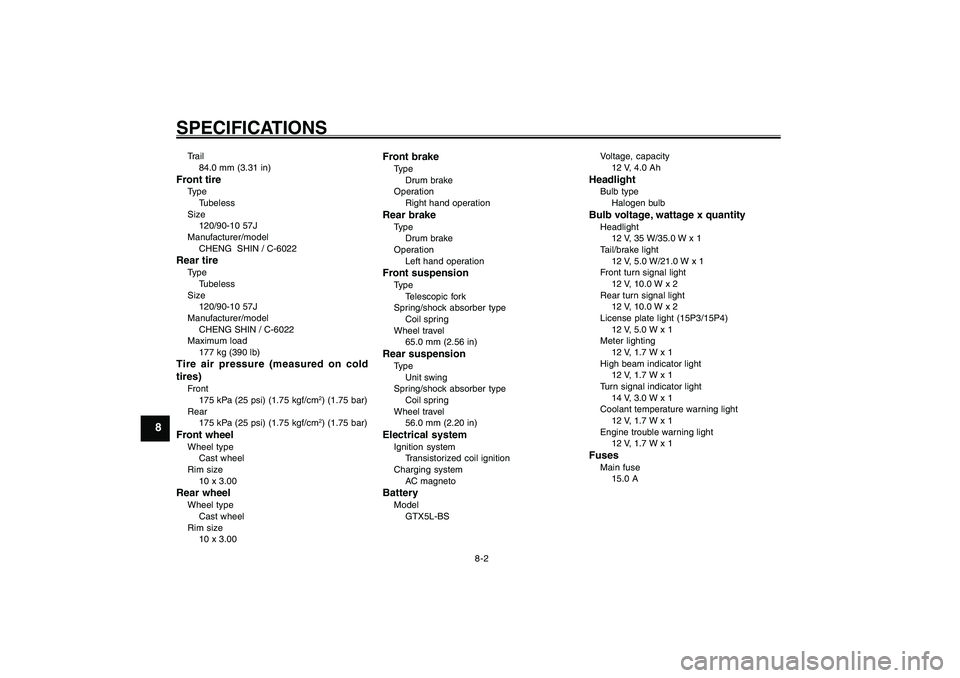
SPECIFICATIONSTrail
84.0 mm (3.31 in)Front tireType
Tubeless
Size
120/90-10 57J
Manufacturer/model
CHENG SHIN / C-6022Rear tireType
Tubeless
Size
120/90-10 57J
Manufacturer/model
CHENG SHIN / C-6022
Maximum load
177 kg (390 lb)Tire air pressure (measured on cold
tires)Front
175 kPa (25 psi) (1.75 kgf/cm
2) (1.75 bar)
Rear
175 kPa (25 psi) (1.75 kgf/cm2) (1.75 bar)
Front wheelWheel type
Cast wheel
Rim size
10 x 3.00Rear wheelWheel type
Cast wheel
Rim size
10 x 3.00
Front brakeType
Drum brake
Operation
Right hand operationRear brakeType
Drum brake
Operation
Left hand operationFront suspensionType
Telescopic fork
Spring/shock absorber type
Coil spring
Wheel travel
65.0 mm (2.56 in)Rear suspensionType
Unit swing
Spring/shock absorber type
Coil spring
Wheel travel
56.0 mm (2.20 in)Electrical systemIgnition system
Transistorized coil ignition
Charging system
AC magnetoBatteryModel
GTX5L-BSVoltage, capacity
12 V, 4.0 Ah
HeadlightBulb type
Halogen bulbBulb voltage, wattage x quantityHeadlight
12 V, 35 W/35.0 W x 1
Tail/brake light
12 V, 5.0 W/21.0 W x 1
Front turn signal light
12 V, 10.0 W x 2
Rear turn signal light
12 V, 10.0 W x 2
License plate light (15P3/15P4)
12 V, 5.0 W x 1
Meter lighting
12 V, 1.7 W x 1
High beam indicator light
12 V, 1.7 W x 1
Turn signal indicator light
14 V, 3.0 W x 1
Coolant temperature warning light
12 V, 1.7 W x 1
Engine trouble warning light
12 V, 1.7 W x 1FusesMain fuse
15.0 A
15P-F8199-E0_ch8.pmd2007/07/18, 12:26 2