maintenance YAMAHA GIGGLE50 2007 Owner's Manual
[x] Cancel search | Manufacturer: YAMAHA, Model Year: 2007, Model line: GIGGLE50, Model: YAMAHA GIGGLE50 2007Pages: 72, PDF Size: 1.05 MB
Page 50 of 72

6-18
1
2
3
4
5
6
7
8
9
EAU17226
PERIODIC MAINTENANCE AND MINOR REPAIRCenterstand, checking and lubricating
Front fork, checking
EAU23271
Checking the front forkThe condition and operation of the front
fork must be checked as follows at the
intervals specified in the periodic main-
tenance and lubrication chart.
To check the condition
EWA10750
wSecurely support the motorcycle so
that there is no danger of it falling
over.Check the inner tubes for scratches,
damage and excessive oil leakage.
To check the operation
1. Place the motorcycle on a level sur-
face and hold it in an upright posi-
tion.
2. While applying the front brake,
push down hard on the handlebars
several times to check if the front
fork compresses and rebounds
smoothly.
ZAUM00**
ECA10590
cCIf any damage is found or the front
fork does not operate smoothly, have
a Yamaha dealer check or repair it.
EAU23191
Checking and lubricating the
centerstandThe operation of the centerstand should
be checked before each ride, and the
pivots and metal-to-metal contact sur-
faces should be lubricated if necessary.
EWA11300
wIf the centerstand does not move up
and down smoothly, have a Yamaha
dealer check or repair it.Recommended lubricant:
Lithium-soap-based grease (all-pur-
pose grease)
15P-F8199-E0_ch6.pmd2007/06/21, 11:09 18
Page 51 of 72
6-19
1
2
3
4
5
6
7
8
9
EAU17226
PERIODIC MAINTENANCE AND MINOR REPAIR
ZAUM00**
EAU23290
Checking the wheel bearingsThe front and rear wheel bearings must
be checked at the intervals specified in
the periodic maintenance and lubrica-
tion chart. If there is play in the wheel
hub or if the wheel does not turn
smoothly, have a Yamaha dealer check
the wheel bearings. Steering, checking
Wheel bearings, checking
EAU23280
Checking the steeringWorn or loose steering bearings may
cause danger. Therefore, the operation
of the steering must be checked as fol-
lows at the intervals specified in the
periodic maintenance and lubrication
char t.
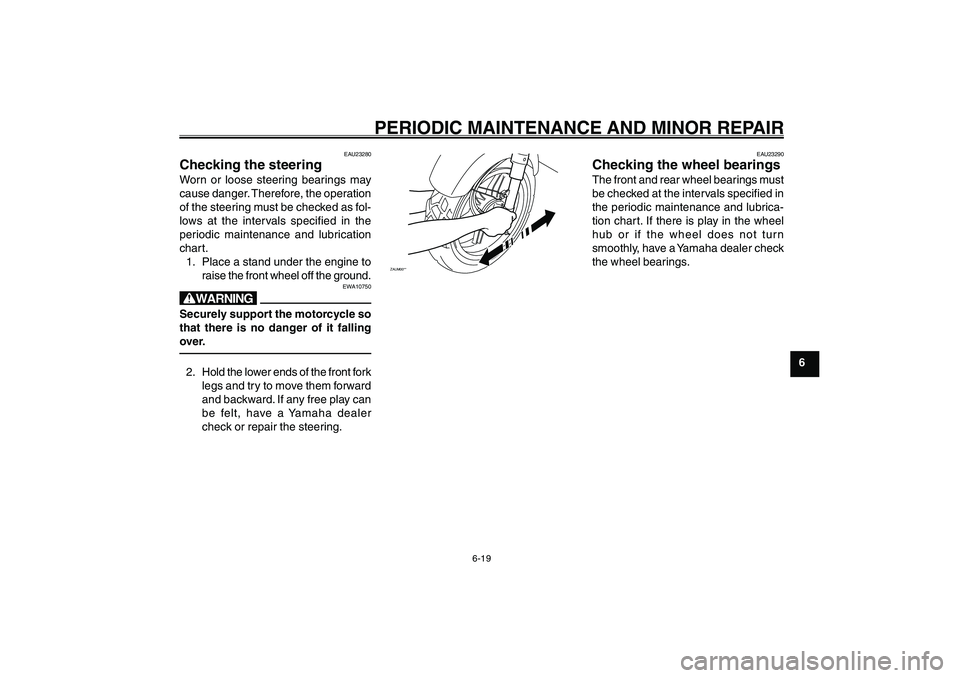
1. Place a stand under the engine to
raise the front wheel off the ground.
EWA10750
wSecurely support the motorcycle so
that there is no danger of it falling
over.2. Hold the lower ends of the front fork
legs and try to move them forward
and backward. If any free play can
be felt, have a Yamaha dealer
check or repair the steering.
15P-F8199-E0_ch6.pmd2007/06/21, 11:09 19
Page 52 of 72
6-20
1
2
3
4
5
6
7
8
9
EAU17226
PERIODIC MAINTENANCE AND MINOR REPAIR
dangerous since it contains sul-
furic acid, which causes severe
burns. Avoid any contact with
skin, eyes or clothing and always
shield your eyes when working
near batteries. In case of contact,
administer the following FIRST
AID.
EXTERNAL: Flush with
plenty of water.
INTERNAL: Drink large
quantities of water or milk
and immediately call a
physician.
EYES: Flush with water for
15 minutes and seek prompt
medical attention.
● ●● ●
●
Batteries produce explosive hy-
drogen gas. Therefore, keep
sparks, flames, cigarettes, etc.,
away from the battery and pro-
vide sufficient ventilation when
charging it in an enclosed space.
● ●● ●
●
KEEP THIS AND ALL BATTER-
IES OUT OF THE REACH OF
CHILDREN.
To charge the battery
Have a Yamaha dealer charge the bat-
tery as soon as possible if it seems to
have discharged. Keep in mind that the
battery tends to discharge more quickly
if the vehicle is equipped with optional
electrical accessories.
To store the battery
1. If the vehicle will not be used for
more than one month, remove the
battery, fully charge it, and then
place it in a cool, dry place.
2. If the battery will be stored for more
than two months, check it at least
once a month and fully charge it if
necessary.
3. Fully charge the battery before in-
stallation.
4. Before installation, make sure that
the battery leads are properly con-
nected to the battery terminals.
ECAT1051
cC● ●● ●
●
Always keep the battery
charged. Storing a discharged
battery can cause permanent
battery damage.
EAUT1853
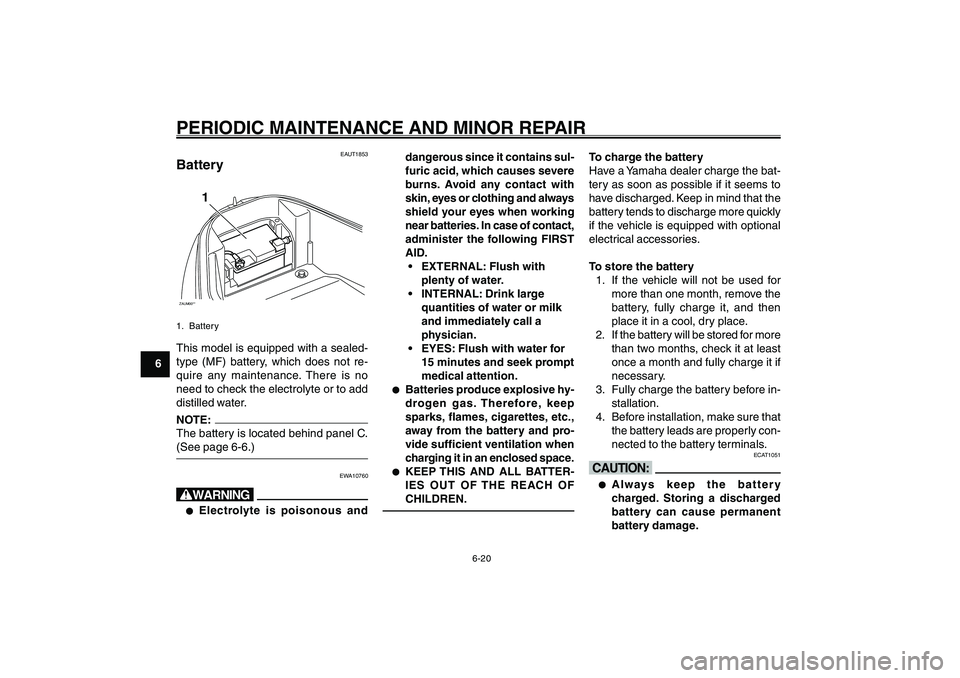
BatteryZAUM00**
1
1. BatteryThis model is equipped with a sealed-
type (MF) battery, which does not re-
quire any maintenance. There is no
need to check the electrolyte or to add
distilled water.NOTE:
The battery is located behind panel C.
(See page 6-6.)
EWA10760
w● ●● ●
●
Electrolyte is poisonous and Battery
15P-F8199-E0_ch6.pmd2007/06/21, 11:09 20
Page 53 of 72
6-21
1
2
3
4
5
6
7
8
9
EAU17226
PERIODIC MAINTENANCE AND MINOR REPAIR
EAUT2021
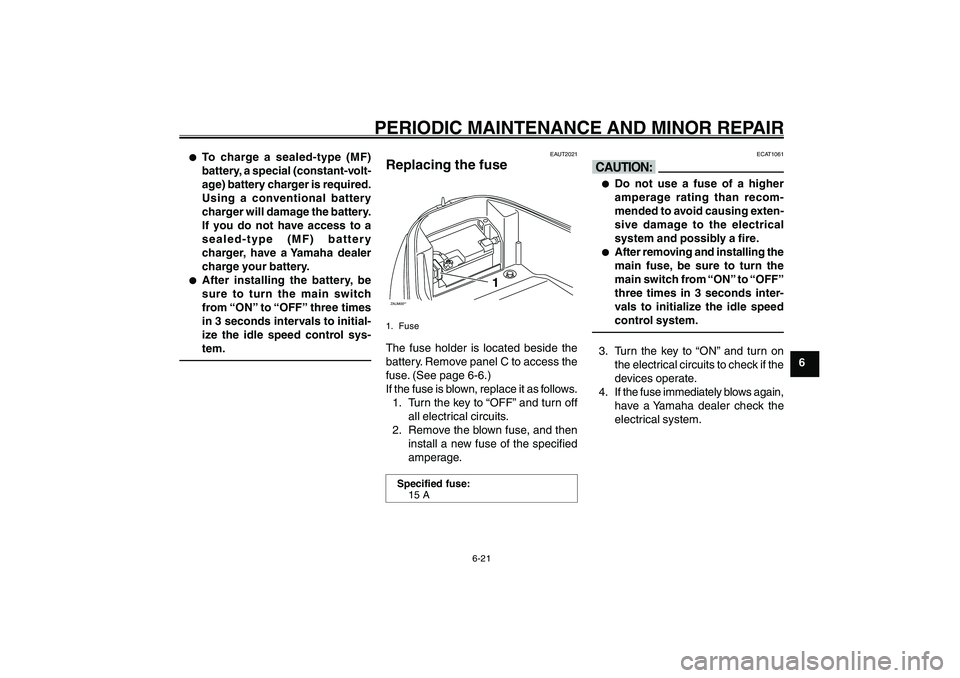
Replacing the fuseZAUM00**
1
1. FuseThe fuse holder is located beside the
battery. Remove panel C to access the
fuse. (See page 6-6.)
If the fuse is blown, replace it as follows.
1. Turn the key to “OFF” and turn off
all electrical circuits.
2. Remove the blown fuse, and then
install a new fuse of the specified
amperage.Specified fuse:
15 A
Fuse, replacing
ECAT1061
cC● ●● ●
●
Do not use a fuse of a higher
amperage rating than recom-
mended to avoid causing exten-
sive damage to the electrical
system and possibly a fire.
● ●● ●
●
After removing and installing the
main fuse, be sure to turn the
main switch from “ON” to “OFF”
three times in 3 seconds inter-
vals to initialize the idle speed
control system.
3. Turn the key to “ON” and turn on
the electrical circuits to check if the
devices operate.
4. If the fuse immediately blows again,
have a Yamaha dealer check the
electrical system.
● ●● ●
●
To charge a sealed-type (MF)
battery, a special (constant-volt-
age) battery charger is required.
Using a conventional battery
charger will damage the battery.
If you do not have access to a
sealed-type (MF) battery
charger, have a Yamaha dealer
charge your battery.
● ●● ●
●
After installing the battery, be
sure to turn the main switch
from “ON” to “OFF” three times
in 3 seconds intervals to initial-
ize the idle speed control sys-
tem.
15P-F8199-E0_ch6.pmd2007/06/21, 11:09 21
Page 54 of 72
6-22
1
2
3
4
5
6
7
8
9
EAU17226
PERIODIC MAINTENANCE AND MINOR REPAIR
ZAUM00**
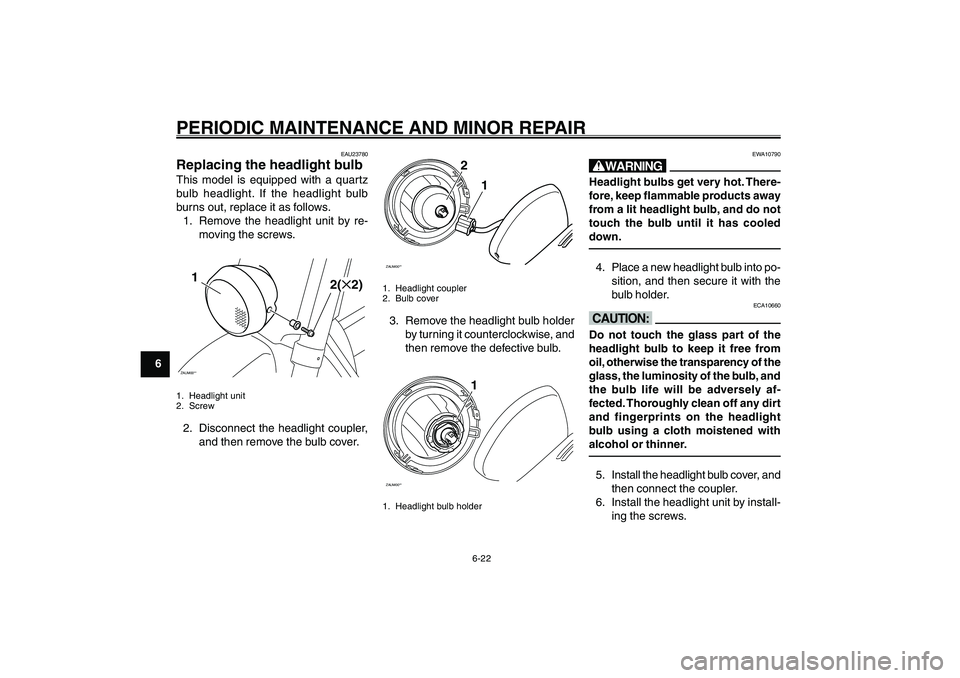
2
1
1. Headlight coupler
2. Bulb cover3. Remove the headlight bulb holder
by turning it counterclockwise, and
then remove the defective bulb.ZAUM00**
1
1. Headlight bulb holder
EWA10790
wHeadlight bulbs get very hot. There-
fore, keep flammable products away
from a lit headlight bulb, and do not
touch the bulb until it has cooled
down.4. Place a new headlight bulb into po-
sition, and then secure it with the
bulb holder.
ECA10660
cCDo not touch the glass part of the
headlight bulb to keep it free from
oil, otherwise the transparency of the
glass, the luminosity of the bulb, and
the bulb life will be adversely af-
fected. Thoroughly clean off any dirt
and fingerprints on the headlight
bulb using a cloth moistened with
alcohol or thinner.5. Install the headlight bulb cover, and
then connect the coupler.
6. Install the headlight unit by install-
ing the screws.
EAU23780
Replacing the headlight bulbThis model is equipped with a quartz
bulb headlight. If the headlight bulb
burns out, replace it as follows.
1. Remove the headlight unit by re-
moving the screws.ZAUM00**1
2(✕2)
1. Headlight unit
2. Screw2. Disconnect the headlight coupler,
and then remove the bulb cover. Headlight bulb, replacing
15P-F8199-E0_ch6.pmd2007/06/21, 11:09 22
Page 55 of 72
6-23
1
2
3
4
5
6
7
8
9
EAU17226
PERIODIC MAINTENANCE AND MINOR REPAIR
EAU24131
Replacing the tail/brake light
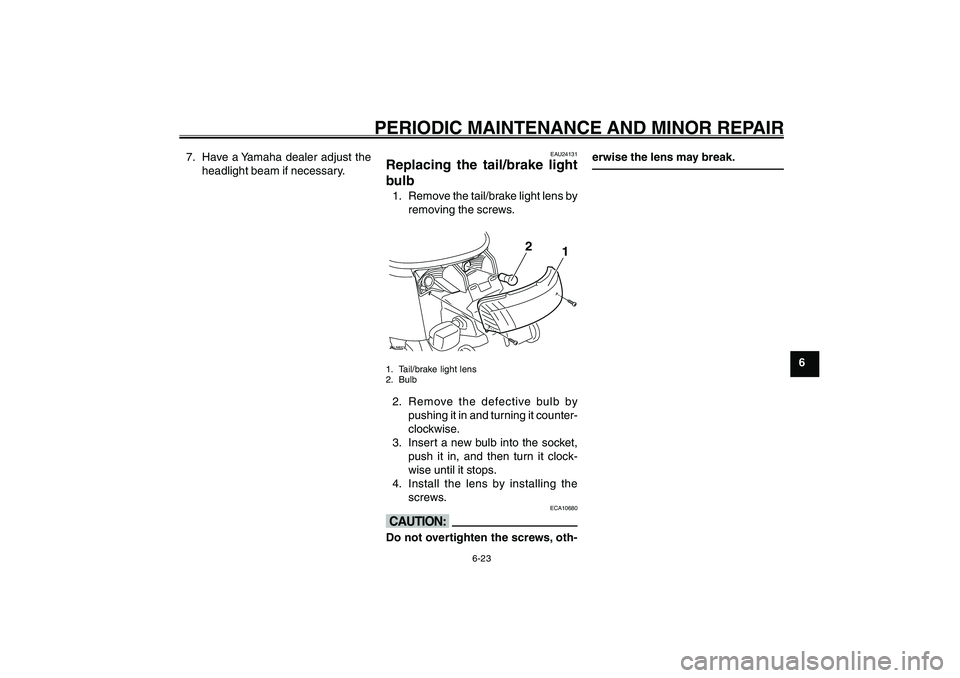
bulb1. Remove the tail/brake light lens by
removing the screws.ZAUM00**
1
2
1. Tail/brake light lens
2. Bulb2. Remove the defective bulb by
pushing it in and turning it counter-
clockwise.
3. Insert a new bulb into the socket,
push it in, and then turn it clock-
wise until it stops.
4. Install the lens by installing the
screws.
ECA10680
cCDo not overtighten the screws, oth- Tail/brake light bulb, replacing
erwise the lens may break.
7. Have a Yamaha dealer adjust the
headlight beam if necessary.
15P-F8199-E0_ch6.pmd2007/06/21, 11:09 23
Page 56 of 72

6-24
1
2
3
4
5
6
7
8
9
EAU17226
PERIODIC MAINTENANCE AND MINOR REPAIR
RearZAUM00**
1
2
1. Turn signal light lens
2. Bulb2. Remove the defective bulb by
pushing it in and turning it counter-
clockwise.
3. Insert a new bulb into the socket,
push it in, and then turn it clock-
wise until it stops.
4. Install the lens by installing the
screw.
ECA11190
cCDo not overtighten the screw, other-
wise the lens may break.
Turn signal light bulb, replacing
Troubleshooting
EAU25880
TroubleshootingAlthough Yamaha scooters receive a
thorough inspection before shipment
from the factory, trouble may occur dur-
ing operation. Any problem in the fuel,
compression, or ignition systems, for
example, can cause poor starting and
loss of power.
The following troubleshooting charts
represent quick and easy procedures
for checking these vital systems your-
self. However, should your scooter re-
quire any repair, take it to a Yamaha
dealer, whose skilled technicians have
the necessary tools, experience, and
know-how to service the scooter prop-
erly.
Use only genuine Yamaha replacement
par ts. Imitation par ts may look like
Yamaha parts, but they are often infe-
rior, have a shorter service life and can
lead to expensive repair bills.
EAU24202
Replacing a turn signal light
bulb1. Remove the turn signal light lens
by removing the screw.
FrontZAUM00**
2
1
1. Turn signal light lens
2. Bulb
15P-F8199-E0_ch6.pmd2007/06/21, 11:09 24
Page 57 of 72
6-25
1
2
3
4
5
6
7
8
9
EAU17226
PERIODIC MAINTENANCE AND MINOR REPAIR
Troubleshooting charts
EAU42700
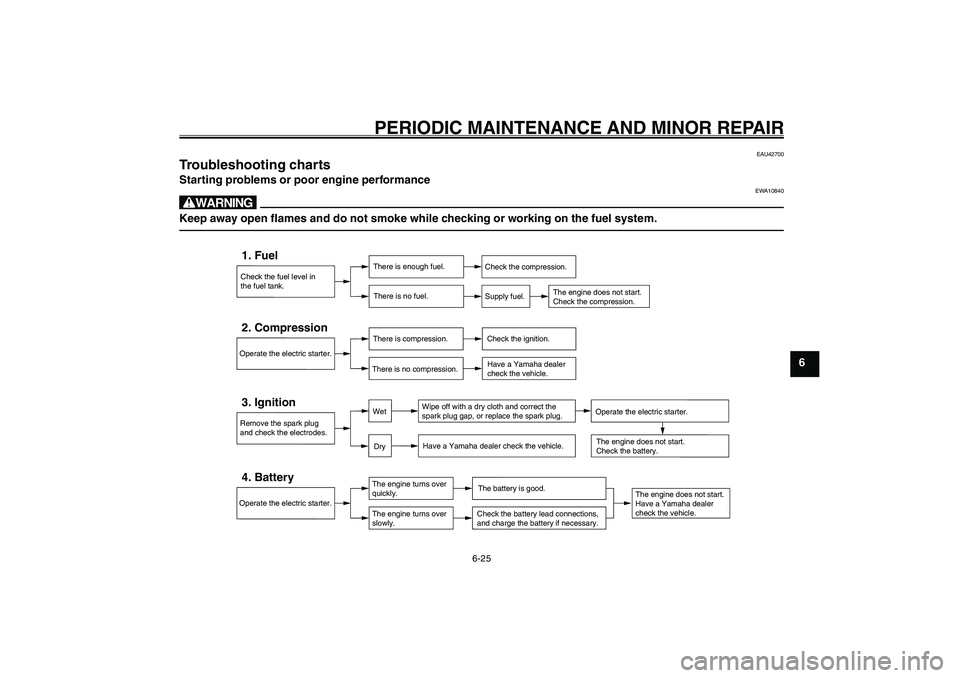
Troubleshooting chartsStarting problems or poor engine performance
EWA10840
wKeep away open flames and do not smoke while checking or working on the fuel system.
Check the fuel level in
the fuel tank.1. Fuel
There is enough fuel.
There is no fuel.
Check the compression.
Supply fuel.
The engine does not start.
Check the compression.
Operate the electric starter.2. Compression
There is compression.
There is no compression.
Check the ignition.
Have a Yamaha dealer
check the vehicle.
Remove the spark plug
and check the electrodes.3. Ignition
Wipe off with a dry cloth and correct the
spark plug gap, or replace the spark plug.
Have a Yamaha dealer check the vehicle.
The engine does not start.
Have a Yamaha dealer
check the vehicle.
The engine does not start.
Check the battery.
Operate the electric starter.4. Battery
The engine turns over
quickly.
The engine turns over
slowly.
The battery is good.Check the battery lead connections,
and charge the battery if necessary.
DryWet
Operate the electric starter.
15P-F8199-E0_ch6.pmd2007/06/21, 11:09 25
Page 58 of 72
6-26
1
2
3
4
5
6
7
8
9
EAU17226
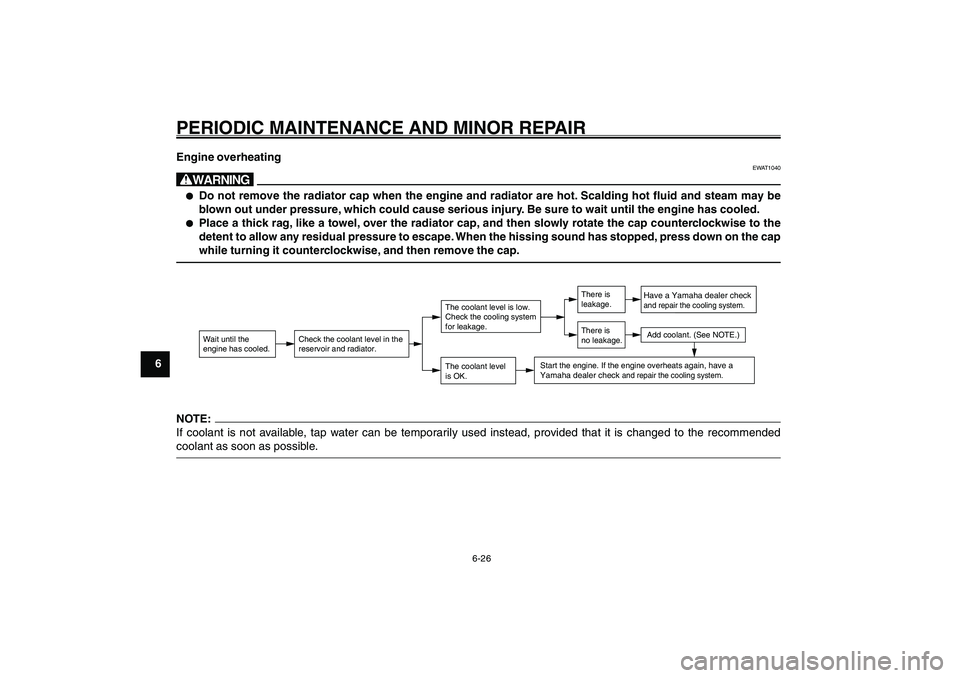
PERIODIC MAINTENANCE AND MINOR REPAIREngine overheating
EWAT1040
w● ●● ●
●
Do not remove the radiator cap when the engine and radiator are hot. Scalding hot fluid and steam may be
blown out under pressure, which could cause serious injury. Be sure to wait until the engine has cooled.
● ●● ●
●
Place a thick rag, like a towel, over the radiator cap, and then slowly rotate the cap counterclockwise to the
detent to allow any residual pressure to escape. When the hissing sound has stopped, press down on the cap
while turning it counterclockwise, and then remove the cap.
NOTE:
If coolant is not available, tap water can be temporarily used instead, provided that it is changed to the recommended
coolant as soon as possible.
Wait until the
engine has cooled.
Check the coolant level in the
reservoir and radiator.
The coolant level
is OK.The coolant level is low.
Check the cooling system
for leakage.
Have a Yamaha dealer checkand repair the cooling system.Add coolant. (See NOTE.)
Start the engine. If the engine overheats again,
have a
Yamaha dealer check
and repair the cooling system.
There is
leakage.
There is
no leakage.
15P-F8199-E0_ch6.pmd2007/06/21, 11:09 26
Page 67 of 72
INDEX
AAcceleration and deceleration ................. 5-2
Air filter element, replacing .................... 6-12BBattery.................................................... 6-20
Brake lever free play, adjusting .............. 6-15
Brake lever, front ...................................... 3-6
Brake lever, rear ....................................... 3-6
Brake levers, lubricating......................... 6-17
Brake shoes, checking ........................... 6-16
Braking..................................................... 5-2CCare .......................................................... 7-1
Catalytic converter ................................... 3-8
Centerstand, checking and lubricating .. 6-18
Coolant................................................... 6-10
Coolant temperature warning light ........... 3-3DDimmer switch.......................................... 3-5EEngine break-in........................................ 5-3
Engine oil................................................. 6-7
Engine trouble warning light .................... 3-3FFinal transmission oil............................... 6-9
Front fork, checking............................... 6-18
Fuel .......................................................... 3-7
Fuel gauge............................................... 3-4
Fuel tank cap........................................... 3-6
Fuse, replacing ...................................... 6-21HHandlebar switches .................................. 3-5
Headlight bulb, replacing....................... 6-22
Helmet holder........................................... 3-9High beam indicator light ......................... 3-3
Horn switch .............................................. 3-5
IIdentification numbers.............................. 9-1
Indicator and warning lights ..................... 3-2KKey identification number ......................... 9-1
Keyhole cover ........................................... 3-2
Kickstarter ................................................ 3-8LLuggage hook.......................................... 3-9MMain switch/steering lock ......................... 3-1
Maintenance, periodic .............................. 6-1
Model label............................................... 9-2PPanels, removing and installing............... 6-5
Parking..................................................... 5-3
Part locations........................................... 2-1
Periodic maintenance and lubrication
chart ....................................................... 6-2
Pre-operation check list ........................... 4-2RRear brake lever free play, adjusting ..... 6-16SSafe-riding points ..................................... 1-4
Safety information .................................... 1-1
Seat.......................................................... 3-9
Spark plug, checking ............................... 6-6
Specifications........................................... 8-1
Speedometer unit..................................... 3-4
Start switch .............................................. 3-5
Starting off ................................................ 5-2
Starting the engine ................................... 5-1Steering, checking ................................. 6-19
Storage ..................................................... 7-3
Storage compartment ............................ 3-10
TTail/brake light bulb, replacing................ 6-23
Throttle cable free play, checking .......... 6-12
Throttle grip and cable, checking and
lubricating............................................ 6-17
Tires ....................................................... 6-13
Troubleshooting...................................... 6-24
Troubleshooting charts ........................... 6-25
Turn signal indicator light......................... 3-3
Turn signal light bulb, replacing............. 6-24
Turn signal switch ..................................... 3-5VValve clearance ...................................... 6-12
Vehicle identification number ................... 9-1WWheel bearings, checking ...................... 6-19
Wheels................................................... 6-15
15P-F8199-E0_ch9ind.pmd2007/06/16, 16:02 3