fuel YAMAHA GIGGLE50 2007 Owners Manual
[x] Cancel search | Manufacturer: YAMAHA, Model Year: 2007, Model line: GIGGLE50, Model: YAMAHA GIGGLE50 2007Pages: 72, PDF Size: 1.05 MB
Page 6 of 72
1
2
3
4
5
6
7
8
9
EAU10210
TABLE OF CONTENTSSAFETY INFORMATION ................... 1-1
Fur ther safe-riding points ............... 1-4
DESCRIPTION ................................... 2-1
Left view ......................................... 2-1
Right view ....................................... 2-2
Controls and instruments ............... 2-3
INSTRUMENT AND CONTROL FUNC-
TIONS ................................................ 3-1
Main switch/steering lock ............... 3-1
Keyhole cover ................................. 3-2
Indicator and warning lights ........... 3-2
Speedometer unit ........................... 3-4
Fuel gauge ...................................... 3-4
Handlebar switches ........................ 3-5
Front brake lever ............................. 3-6
Rear brake lever ............................. 3-6
Fuel tank cap .................................. 3-6
Fuel .................................................3-7
Catalytic converter .......................... 3-8
Kickstarter....................................... 3-8
Seat ................................................3-9
Luggage hook ................................. 3-9
Helmet holder ................................. 3-9
Storage compartment ................... 3-10
PRE-OPERATION CHECKS ............. 4-1
Pre-operation check list .................. 4-2OPERATION AND IMPORTANT RIDING
POINTS .............................................. 5-1
Star ting the engine ......................... 5-1
Star ting off ...................................... 5-2
Acceleration and deceleration ........ 5-2
Braking........................................... 5-2
Engine break-in .............................. 5-3
Parking........................................... 5-3
PERIODIC MAINTENANCE AND MINOR
REPAIR .............................................. 6-1
Periodic maintenance and lubrication
chart............................................ 6-2
Removing and installing panels ..... 6-5
Checking the spark plug ................. 6-6
Engine oil and oil strainer ............... 6-7
Final transmission oil ...................... 6-9
Coolant......................................... 6-10
Replacing the air filter element ..... 6-12
Checking the throttle cable free
play............................................ 6-12
Valve clearance ............................ 6-12
Tires.............................................. 6-13
Cast wheels .................................. 6-15
Adjusting the brake lever free
play............................................ 6-15
Adjusting the rear brake lever free
play............................................ 6-16
Checking the front and rear brake
shoes......................................... 6-16Checking and lubricating the throttle
grip and cable ............................ 6-17
Lubricating the front and rear brake
levers......................................... 6-17
Checking and lubricating the
centerstand............................... 6-18
Checking the front fork ................. 6-18
Checking the steering ................... 6-19
Checking the wheel bearings ....... 6-19
Battery.......................................... 6-20
Replacing the fuse ........................ 6-21
Replacing the headlight bulb ........ 6-22
Replacing the tail/brake light bulb 6-23
Replacing a turn signal light bulb . 6-24
Troubleshooting............................ 6-24
Troubleshooting charts ................. 6-25
SCOOTER CARE AND STORAGE ... 7-1
Care ................................................ 7-1
Storage ........................................... 7-3
SPECIFICATIONS ............................. 8-1
CONSUMER INFORMATION ............ 9-1
Identification numbers .................... 9-1
15P-F8199-E0_ch0.pmd2007/06/13, 11:15 5
Page 10 of 72
1-3
1
2
3
4
5
6
7
8
9
EAU10220
Q QQ Q
Q
SAFETY INFORMATION
When loading within this weight limit,
keep the following in mind:
8Cargo and accessory weight should
be kept as low and close to the
scooter as possible. Make sure to
distribute the weight as evenly as
possible on both sides of the
scooter to minimize imbalance or
instability.
8Shifting weights can create a sud-
den imbalance. Make sure that ac-
cessories and cargo are securely
attached to the scooter before riding.
Check accessory mounts and
cargo restraints frequently.
8Never attach any large or heavy
items to the handlebar, front fork,
or front fender. Such items can cre-
ate unstable handling or a slow
steering response.Accessories
Genuine Yamaha accessories have
been specifically designed for use on
this scooter. Since Yamaha cannot test
all other accessories that may be avail-
able, you must personally be responsible
for the proper selection, installation and
use of non-Yamaha accessories. Useextreme caution when selecting and in-
stalling any accessories.
Keep the following guidelines in mind,
as well as those provided under “Load-
ing” when mounting accessories.
8Never install accessories or carry
cargo that would impair the perfor-
mance of your scooter. Carefully
inspect the accessory before us-
ing it to make sure that it does not
in any way reduce ground clear-
ance or cornering clearance, limit
suspension travel, steering travel
or control operation, or obscure
lights or reflectors.
9Accessories fitted to the
handlebar or the front fork area
can create instability due to
improper weight distribution or
aerodynamic changes. If
accessories are added to the
handlebar or front fork area,
they must be as lightweight as
possible and should be kept to
a minimum.
9Bulky or large accessories may
seriously affect the stability of
the scooter due to aerodynamic
effects. Wind may attempt tolift the scooter, or the scooter
may become unstable in cross
winds. These accessories may
also cause instability when
passing or being passed by
large vehicles.
9Certain accessories can
displace the operator from his
or her normal riding position.
This improper position limits
the freedom of movement of
the operator and may limit
control ability, therefore, such
accessories are not recom-
mended.
8Use caution when adding electrical
accessories. If electrical accesso-
ries exceed the capacity of the
scooter’s electrical system an elec-
tric failure could result, which could
cause a dangerous loss of lights or
engine power.
Gasoline and exhaust gas
8GASOLINE IS HIGHLY FLAM-
MABLE:
9Always turn the engine off
when refueling.
15P-F8199-E0_ch1.pmd2007/06/20, 14:20 3
Page 11 of 72

1-4
1
2
3
4
5
6
7
8
9
EAU10220
Q QQ Q
Q
SAFETY INFORMATION
9Take care not to spill any
gasoline on the engine or
exhaust system when refueling.
9Never refuel while smoking or
in the vicinity of an open flame.
8Never start the engine or let it run
for any length of time in a closed
area. The exhaust fumes are poi-
sonous and may cause loss of con-
sciousness and death within a
short time. Always operate your
scooter in an area that has adequate
ventilation.
8Always turn the engine off before
leaving the scooter unattended and
remove the key from the main
switch. When parking the scooter,
note the following:
9The engine and exhaust
system may be hot, therefore,
park the scooter in a place
where pedestrians or children
are not likely to touch these hot
areas.
9Do not park the scooter on a
slope or soft ground, otherwise
it may fall over.
9Do not park the scooter near a
flammable source (e.g., akerosene heater, or near an
open flame), otherwise it could
catch fire.
8If you should swallow any gasoline,
inhale a lot of gasoline vapor, or
allow gasoline to get into your eyes,
see your doctor immediately. If any
gasoline spills on your skin or cloth-
ing, immediately wash the affected
area with soap and water and
change your clothes. Safe-riding points
EAUT2030
Further safe-riding points8Make sure to signal clearly when
making turns.
8Braking can be extremely difficult
on a wet road. Avoid hard braking,
because the scooter could slide.
Apply the brakes slowly when stop-
ping on a wet surface.
8Slow down as you approach a cor-
ner or turn. Once you have com-
pleted a turn, accelerate slowly.
8Be careful when passing parked
cars. A driver might not see you and
open a door in your path.
8Railroad crossings, streetcar rails,
iron plates on road construction
sites, and manhole covers become
extremely slippery when wet. Slow
down and cross them with caution.
Keep the scooter upright, otherwise
it could slide out from under you.
8The brake lining could get wet when
you wash the scooter. After wash-
ing the scooter, check the brakes
before riding.
8Always wear a helmet, gloves, trou-
sers (tapered around the cuff and
ankle so they do not flap), and a
15P-F8199-E0_ch1.pmd2007/06/20, 14:20 4
Page 14 of 72
2-1
1
2
3
4
5
6
7
8
9
DESCRIPTION
EAU10400
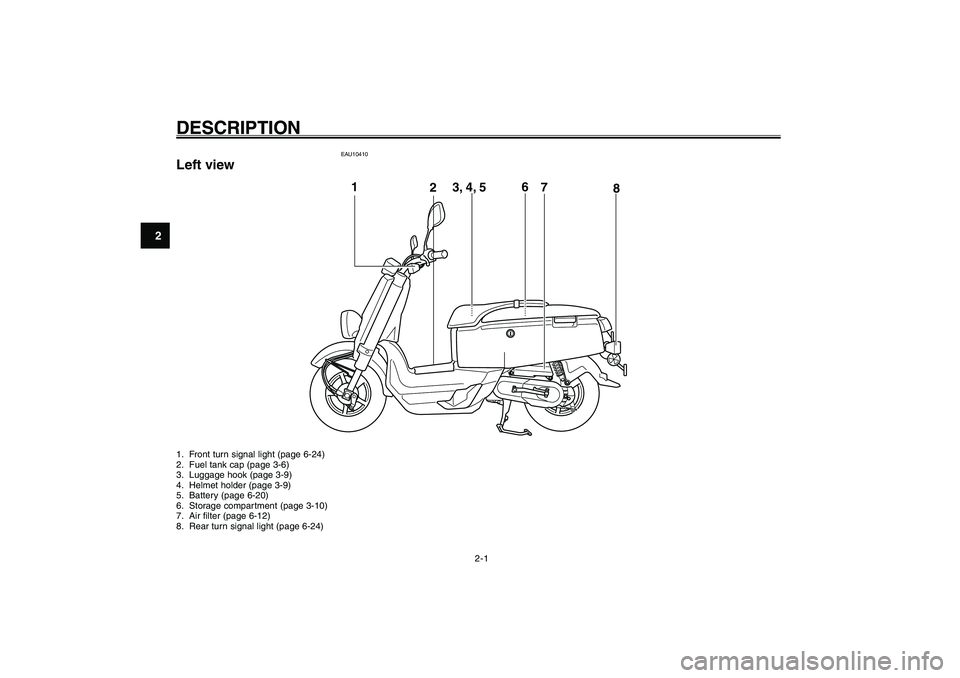
DESCRIPTIONPart locations
EAU10410
Left view1. Front turn signal light (page 6-24)
2. Fuel tank cap (page 3-6)
3. Luggage hook (page 3-9)
4. Helmet holder (page 3-9)
5. Battery (page 6-20)
6. Storage compartment (page 3-10)
7. Air filter (page 6-12)
8. Rear turn signal light (page 6-24)
1
23, 4, 56
8
7
15P-F8199-E0_ch2.pmd2007/06/13, 11:16 1
Page 16 of 72
2-3
1
2
3
4
5
6
7
8
9
DESCRIPTION
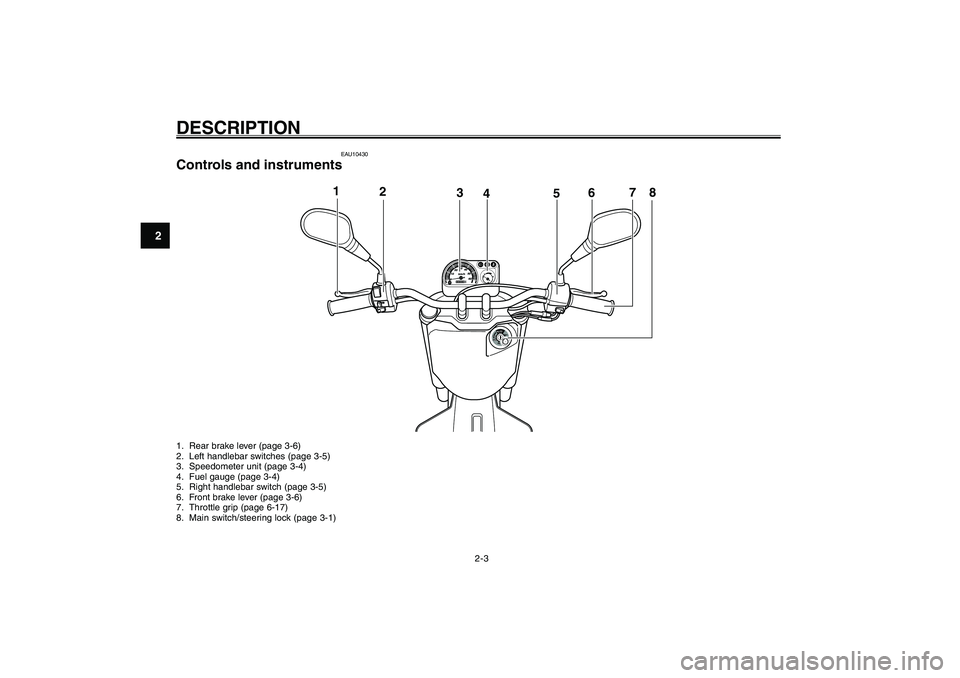
EAU10430
Controls and instruments1. Rear brake lever (page 3-6)
2. Left handlebar switches (page 3-5)
3. Speedometer unit (page 3-4)
4. Fuel gauge (page 3-4)
5. Right handlebar switch (page 3-5)
6. Front brake lever (page 3-6)
7. Throttle grip (page 6-17)
8. Main switch/steering lock (page 3-1)
1
2
3
4
5
6
7
8
15P-F8199-E0_ch2.pmd2007/06/13, 11:16 3
Page 20 of 72
3-4
1
2
3
4
5
6
7
8
9
INSTRUMENT AND CONTROL FUNCTIONSSpeedometer unit
Fuel gauge
EAUT2310
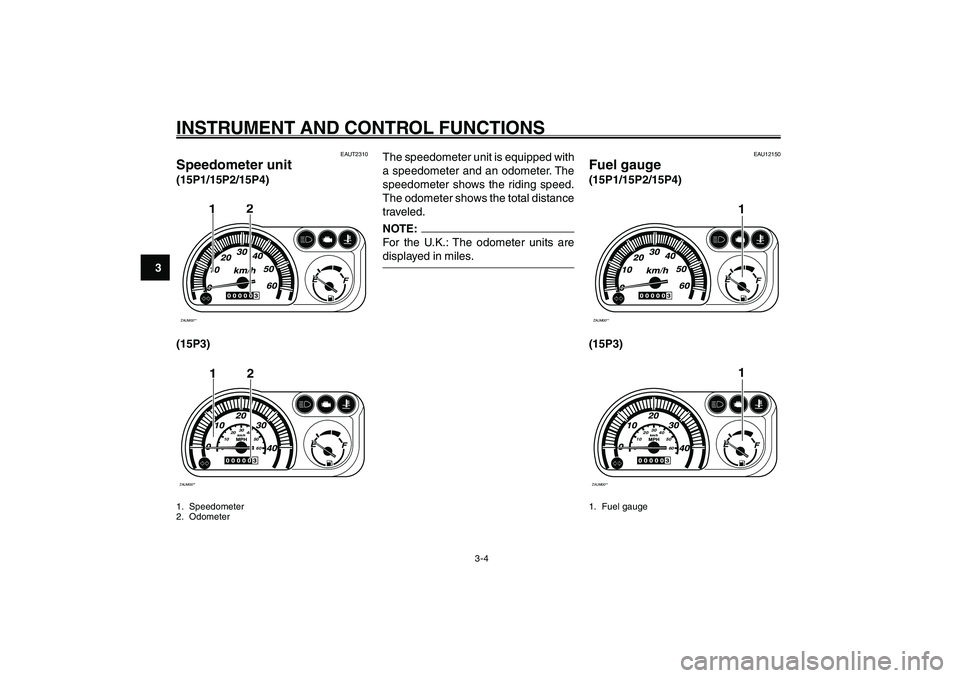
Speedometer unit(15P1/15P2/15P4)ZAUM00**
2
1
(15P3)ZAUM00**
2
0102030
40
50
60
1
1. Speedometer
2. Odometer
The speedometer unit is equipped with
a speedometer and an odometer. The
speedometer shows the riding speed.
The odometer shows the total distance
traveled.NOTE:
For the U.K.: The odometer units are
displayed in miles.
EAU12150
Fuel gauge(15P1/15P2/15P4)ZAUM00**
1
(15P3)ZAUM00**
1
0102030
40
50
60
1. Fuel gauge
15P-F8199-E0_ch3.pmd2007/06/20, 14:21 4
Page 21 of 72
3-5
1
2
3
4
5
6
7
8
9
INSTRUMENT AND CONTROL FUNCTIONS
The fuel gauge indicates the amount of
fuel in the fuel tank. The needle moves
towards “E” (Empty) as the fuel level
decreases. When the needle reaches
the red line, refuel as soon as possible.NOTE:
Do not allow the fuel tank to empty it-
self completely.
EAU12347
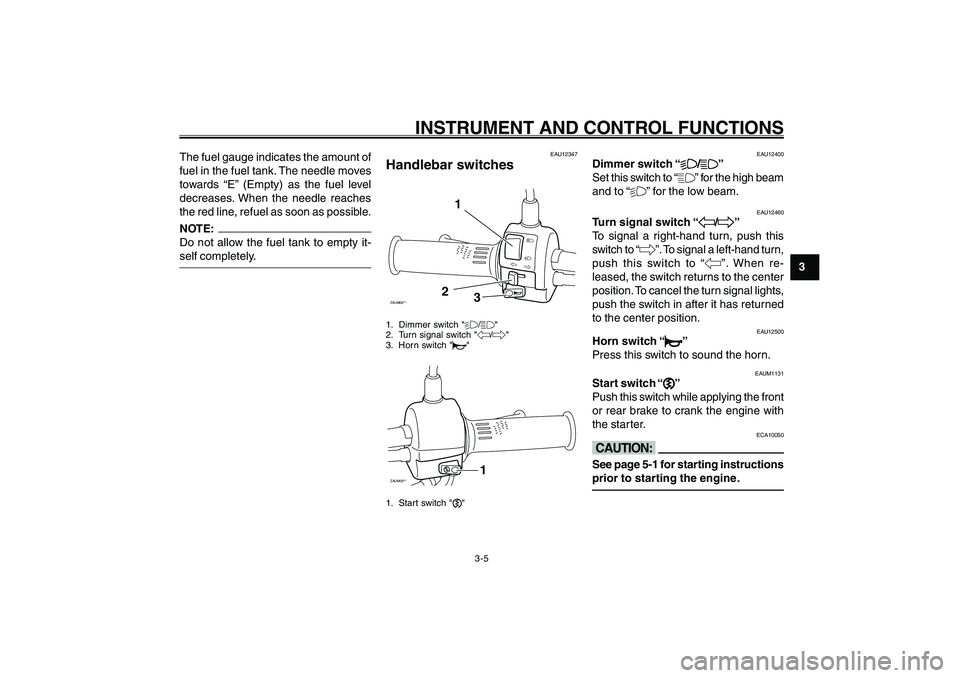
Handlebar switchesZAUM00**
1
2
3
1. Dimmer switch "%/&"
2. Turn signal switch "4/6"
3. Horn switch "*"ZAUM00**
1
1. Start switch ","
Handlebar switches
Dimmer switch
Turn signal switch
Horn switch
Start switch
EAU12400
Dimmer switch “
% %% %
%/
& && &
&”
Set this switch to “&” for the high beam
and to “%” for the low beam.
EAU12460
Turn signal switch “
4 44 4
4/
6 66 6
6”
To signal a right-hand turn, push this
switch to “6”. To signal a left-hand turn,
push this switch to “4”. When re-
leased, the switch returns to the center
position. To cancel the turn signal lights,
push the switch in after it has returned
to the center position.
EAU12500
Horn switch “
* ** *
*”
Press this switch to sound the horn.
EAUM1131
Start switch “
, ,, ,
,”
Push this switch while applying the front
or rear brake to crank the engine with
the starter.
ECA10050
cCSee page 5-1 for starting instructions
prior to starting the engine.
15P-F8199-E0_ch3.pmd2007/06/20, 14:21 5
Page 22 of 72
3-6
1
2
3
4
5
6
7
8
9
INSTRUMENT AND CONTROL FUNCTIONSBrake lever, front
Brake lever, rear
Fuel tank cap
EAU12950
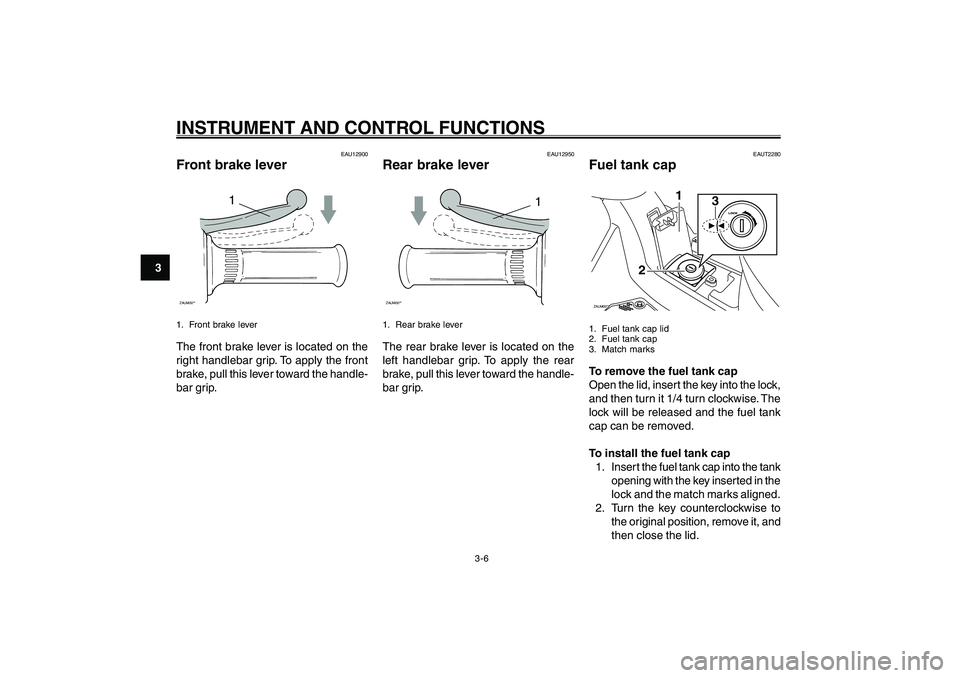
Rear brake lever
1
ZAUM00**1. Rear brake leverThe rear brake lever is located on the
left handlebar grip. To apply the rear
brake, pull this lever toward the handle-
bar grip.
EAUT2280
Fuel tank capZAUM00**
3
1
2
1. Fuel tank cap lid
2. Fuel tank cap
3. Match marksTo remove the fuel tank cap
Open the lid, insert the key into the lock,
and then turn it 1/4 turn clockwise. The
lock will be released and the fuel tank
cap can be removed.
To install the fuel tank cap
1. Inser t the fuel tank cap into the tank
opening with the key inserted in the
lock and the match marks aligned.
2. Turn the key counterclockwise to
the original position, remove it, and
then close the lid.
EAU12900
Front brake lever
1
ZAUM00**1. Front brake leverThe front brake lever is located on the
right handlebar grip. To apply the front
brake, pull this lever toward the handle-
bar grip.
15P-F8199-E0_ch3.pmd2007/06/20, 14:21 6
Page 23 of 72
3-7
1
2
3
4
5
6
7
8
9
INSTRUMENT AND CONTROL FUNCTIONS
EAU13211
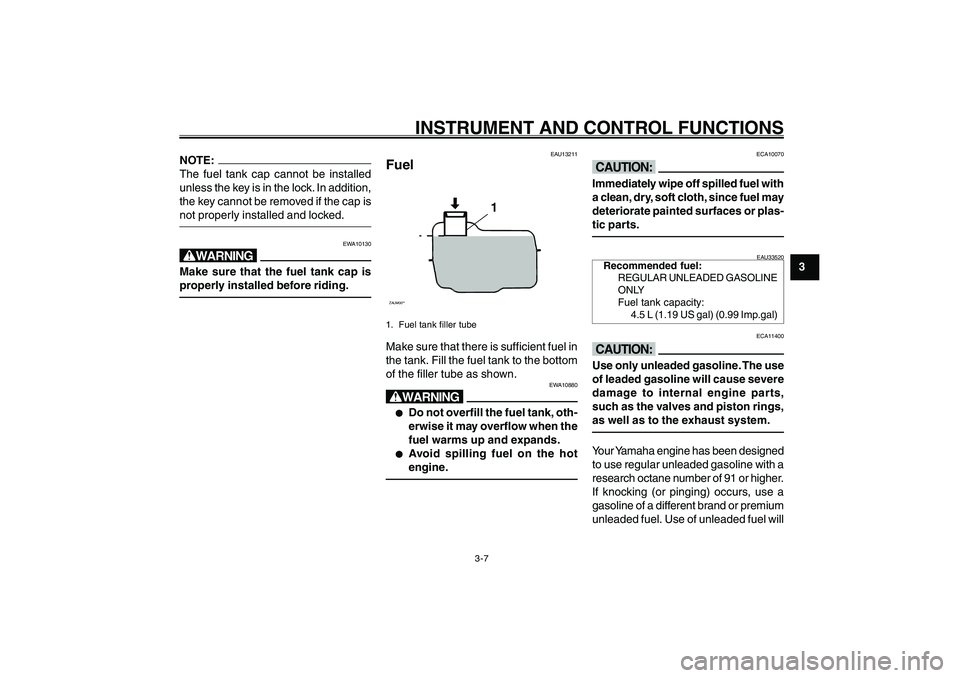
FuelZAUM00**
1
1. Fuel tank filler tubeMake sure that there is sufficient fuel in
the tank. Fill the fuel tank to the bottom
of the filler tube as shown.
EWA10880
w● ●● ●
●
Do not overfill the fuel tank, oth-
erwise it may overflow when the
fuel warms up and expands.
● ●● ●
●
Avoid spilling fuel on the hot
engine.
Fuel
ECA10070
cCImmediately wipe off spilled fuel with
a clean, dry, soft cloth, since fuel may
deteriorate painted surfaces or plas-
tic parts.
EAU33520
Recommended fuel:
REGULAR UNLEADED GASOLINE
ONLY
Fuel tank capacity:
4.5 L (1.19 US gal) (0.99 Imp.gal)
ECA11400
cCUse only unleaded gasoline. The use
of leaded gasoline will cause severe
damage to internal engine parts,
such as the valves and piston rings,
as well as to the exhaust system.Your Yamaha engine has been designed
to use regular unleaded gasoline with a
research octane number of 91 or higher.
If knocking (or pinging) occurs, use a
gasoline of a different brand or premium
unleaded fuel. Use of unleaded fuel will
NOTE:
The fuel tank cap cannot be installed
unless the key is in the lock. In addition,
the key cannot be removed if the cap is
not properly installed and locked.
EWA10130
wMake sure that the fuel tank cap is
properly installed before riding.
15P-F8199-E0_ch3.pmd2007/06/20, 14:21 7
Page 28 of 72
4-2
1
2
3
4
5
6
7
8
9
PRE-OPERATION CHECKS
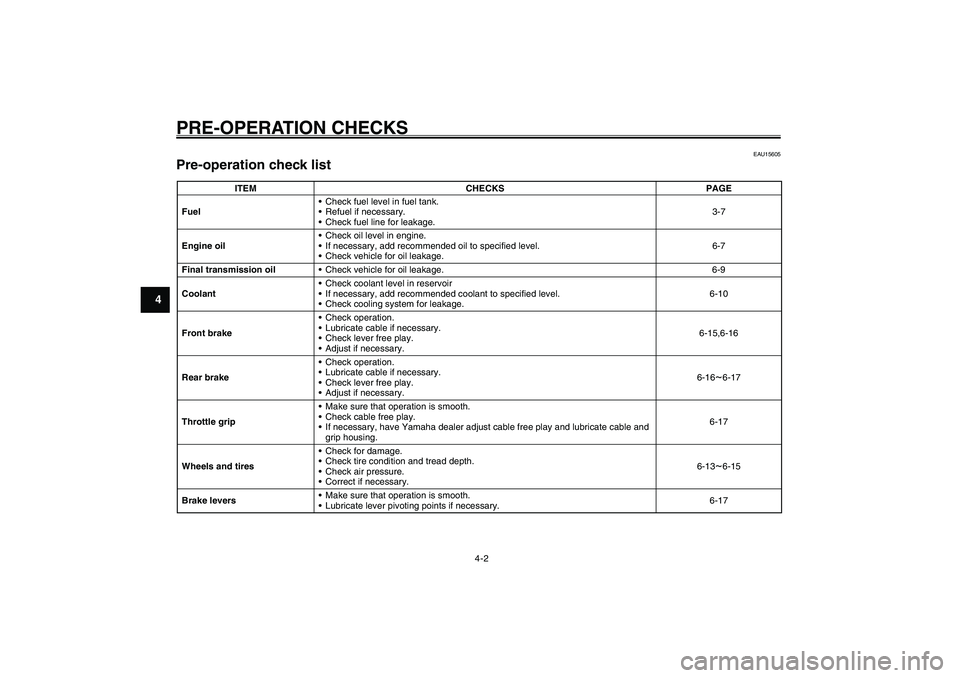
EAU15605
Pre-operation check listPre-operation check list
ITEM CHECKS PAGE
Fuel• Check fuel level in fuel tank.
• Refuel if necessary.
• Check fuel line for leakage.3-7
Engine oil• Check oil level in engine.
• If necessary, add recommended oil to specified level.
• Check vehicle for oil leakage.6-7
Final transmission oil• Check vehicle for oil leakage. 6-9
Coolant• Check coolant level in reservoir
• If necessary, add recommended coolant to specified level.
• Check cooling system for leakage.6-10
Front brake• Check operation.
• Lubricate cable if necessary.
• Check lever free play.
• Adjust if necessary.6-15,6-16
Rear brake• Check operation.
• Lubricate cable if necessary.
• Check lever free play.
• Adjust if necessary.6-16
~6-17
Throttle grip• Make sure that operation is smooth.
• Check cable free play.
• If necessary, have Yamaha dealer adjust cable free play and lubricate cable and
grip housing.6-17
Wheels and tires• Check for damage.
• Check tire condition and tread depth.
• Check air pressure.
• Correct if necessary.6-13~6-15
Brake levers• Make sure that operation is smooth.
• Lubricate lever pivoting points if necessary.6-1
7
15P-F8199-E0_ch4.pmd2007/06/13, 11:16 2