length YAMAHA GIGGLE50 2007 Owners Manual
[x] Cancel search | Manufacturer: YAMAHA, Model Year: 2007, Model line: GIGGLE50, Model: YAMAHA GIGGLE50 2007Pages: 72, PDF Size: 1.05 MB
Page 11 of 72

1-4
1
2
3
4
5
6
7
8
9
EAU10220
Q QQ Q
Q
SAFETY INFORMATION
9Take care not to spill any
gasoline on the engine or
exhaust system when refueling.
9Never refuel while smoking or
in the vicinity of an open flame.
8Never start the engine or let it run
for any length of time in a closed
area. The exhaust fumes are poi-
sonous and may cause loss of con-
sciousness and death within a
short time. Always operate your
scooter in an area that has adequate
ventilation.
8Always turn the engine off before
leaving the scooter unattended and
remove the key from the main
switch. When parking the scooter,
note the following:
9The engine and exhaust
system may be hot, therefore,
park the scooter in a place
where pedestrians or children
are not likely to touch these hot
areas.
9Do not park the scooter on a
slope or soft ground, otherwise
it may fall over.
9Do not park the scooter near a
flammable source (e.g., akerosene heater, or near an
open flame), otherwise it could
catch fire.
8If you should swallow any gasoline,
inhale a lot of gasoline vapor, or
allow gasoline to get into your eyes,
see your doctor immediately. If any
gasoline spills on your skin or cloth-
ing, immediately wash the affected
area with soap and water and
change your clothes. Safe-riding points
EAUT2030
Further safe-riding points8Make sure to signal clearly when
making turns.
8Braking can be extremely difficult
on a wet road. Avoid hard braking,
because the scooter could slide.
Apply the brakes slowly when stop-
ping on a wet surface.
8Slow down as you approach a cor-
ner or turn. Once you have com-
pleted a turn, accelerate slowly.
8Be careful when passing parked
cars. A driver might not see you and
open a door in your path.
8Railroad crossings, streetcar rails,
iron plates on road construction
sites, and manhole covers become
extremely slippery when wet. Slow
down and cross them with caution.
Keep the scooter upright, otherwise
it could slide out from under you.
8The brake lining could get wet when
you wash the scooter. After wash-
ing the scooter, check the brakes
before riding.
8Always wear a helmet, gloves, trou-
sers (tapered around the cuff and
ankle so they do not flap), and a
15P-F8199-E0_ch1.pmd2007/06/20, 14:20 4
Page 30 of 72

5-1
1
2
3
4
5
6
7
8
9
OPERATION AND IMPORTANT RIDING POINTS
EAU15942
OPERATION AND IMPORTANT RIDING POINTS
EAU15980
EWA10870
w● ●● ●
●
Become thoroughly familiar with
all operating controls and their
functions before riding. Consult
a Yamaha dealer regarding any
control or function that you do
not thoroughly understand.
● ●● ●
●
Never start the engine or oper-
ate it in a closed area for any
length of time. Exhaust fumes
are poisonous, and inhaling
them can cause loss of con-
sciousness and death within a
short time. Always make sure
that there is adequate ventila-
tion.
● ●● ●
●
For safety, always start the en-
gine with the centerstand down.
Starting the engine
EAUT2250
Starting the engine
ECA10250
cCSee page 5-3 for engine break-in in-
structions prior to operating the ve-
hicle for the first time.1. Turn the key to “ON”.
ECAT1070
cCThe engine trouble warning light and
coolant temperature warning light
should come on for a few seconds,
then go off. If these warning lights
do not go off, have a Yamaha dealer
check their electrical circuits.2. Close the throttle completely.
3. Start the engine by pushing the
start switch while applying the front
or rear brake.NOTE:
If the engine does not start, release the
start switch, wait a few seconds, and
then try again. Each starting attempt
should be as short as possible to pre-serve the battery. Do not crank the en-
gine more than 5 seconds on any one
attempt. If the engine does not start with
the starter motor, try using the
kickstarter.
ECA11040
cCFor maximum engine life, never ac-
celerate hard when the engine is
cold!
15P-F8199-E0_ch5.pmd2007/06/13, 11:17 1
Page 63 of 72
8-1
1
2
3
4
5
6
7
8
9
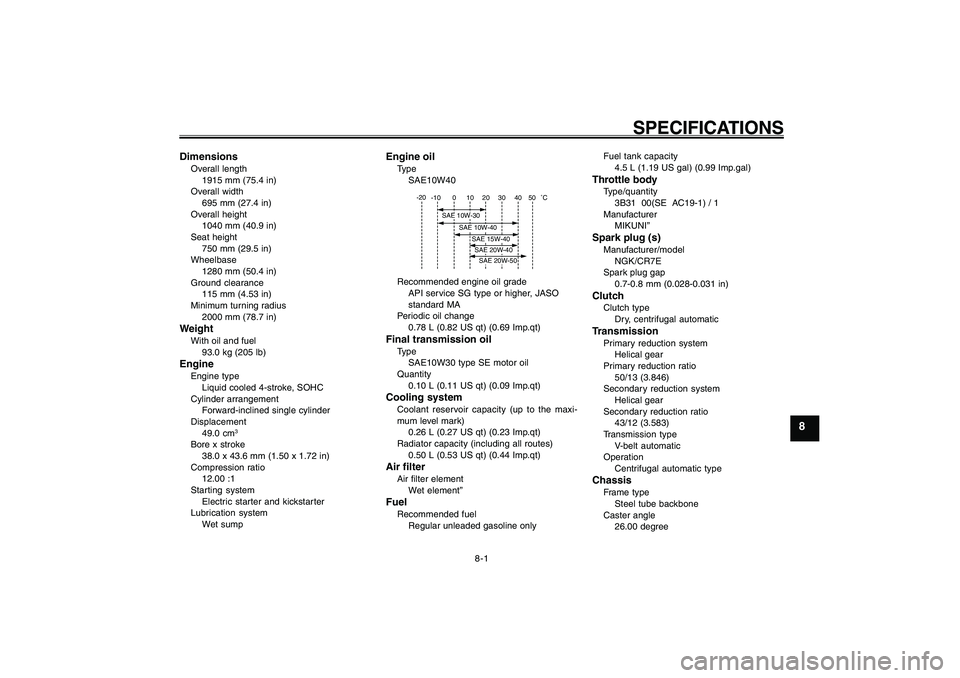
SPECIFICATIONS
Specifications
EAU26320
SPECIFICATIONS
DimensionsOverall length
1915 mm (75.4 in)
Overall width
695 mm (27.4 in)
Overall height
1040 mm (40.9 in)
Seat height
750 mm (29.5 in)
Wheelbase
1280 mm (50.4 in)
Ground clearance
115 mm (4.53 in)
Minimum turning radius
2000 mm (78.7 in)WeightWith oil and fuel
93.0 kg (205 lb)EngineEngine type
Liquid cooled 4-stroke, SOHC
Cylinder arrangement
Forward-inclined single cylinder
Displacement
49.0 cm
3
Bore x stroke
38.0 x 43.6 mm (1.50 x 1.72 in)
Compression ratio
12.00 :1
Starting system
Electric starter and kickstarter
Lubrication system
Wet sump
Engine oilType
SAE10W40
-10 0 10 20 30
40 -20
50
˚C
SAE 10W-30
SAE 10W-40
SAE 15W-40SAE 20W-40SAE 20W-50
Recommended engine oil grade
API service SG type or higher, JASO
standard MA
Periodic oil change
0.78 L (0.82 US qt) (0.69 Imp.qt)Final transmission oilType
SAE10W30 type SE motor oil
Quantity
0.10 L (0.11 US qt) (0.09 Imp.qt)Cooling systemCoolant reservoir capacity (up to the maxi-
mum level mark)
0.26 L (0.27 US qt) (0.23 Imp.qt)
Radiator capacity (including all routes)
0.50 L (0.53 US qt) (0.44 Imp.qt)Air filterAir filter element
Wet element”FuelRecommended fuel
Regular unleaded gasoline onlyFuel tank capacity
4.5 L (1.19 US gal) (0.99 Imp.gal)
Throttle bodyType/quantity
3B31 00(SE AC19-1) / 1
Manufacturer
MIKUNI”Spark plug (s)Manufacturer/model
NGK/CR7E
Spark plug gap
0.7-0.8 mm (0.028-0.031 in)ClutchClutch type
Dry, centrifugal automaticTransmissionPrimary reduction system
Helical gear
Primary reduction ratio
50/13 (3.846)
Secondary reduction system
Helical gear
Secondary reduction ratio
43/12 (3.583)
Transmission type
V-belt automatic
Operation
Centrifugal automatic typeChassisFrame type
Steel tube backbone
Caster angle
26.00 degree
15P-F8199-E0_ch8.pmd2007/07/18, 12:26 1