wheel YAMAHA GIGGLE50 2007 Owners Manual
[x] Cancel search | Manufacturer: YAMAHA, Model Year: 2007, Model line: GIGGLE50, Model: YAMAHA GIGGLE50 2007Pages: 72, PDF Size: 1.05 MB
Page 6 of 72
1
2
3
4
5
6
7
8
9
EAU10210
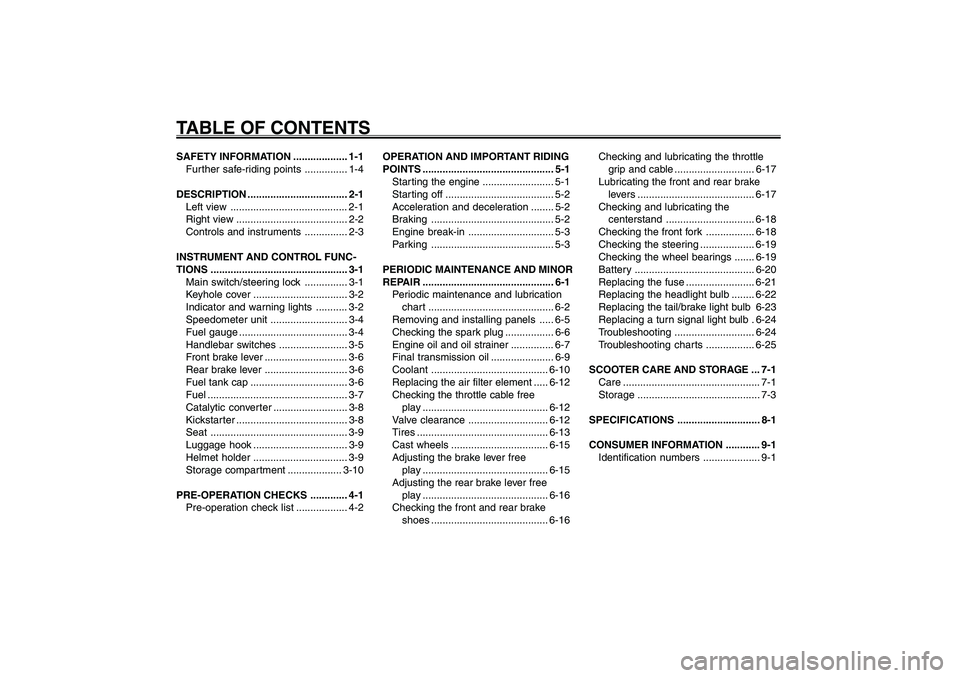
TABLE OF CONTENTSSAFETY INFORMATION ................... 1-1
Fur ther safe-riding points ............... 1-4
DESCRIPTION ................................... 2-1
Left view ......................................... 2-1
Right view ....................................... 2-2
Controls and instruments ............... 2-3
INSTRUMENT AND CONTROL FUNC-
TIONS ................................................ 3-1
Main switch/steering lock ............... 3-1
Keyhole cover ................................. 3-2
Indicator and warning lights ........... 3-2
Speedometer unit ........................... 3-4
Fuel gauge ...................................... 3-4
Handlebar switches ........................ 3-5
Front brake lever ............................. 3-6
Rear brake lever ............................. 3-6
Fuel tank cap .................................. 3-6
Fuel .................................................3-7
Catalytic converter .......................... 3-8
Kickstarter....................................... 3-8
Seat ................................................3-9
Luggage hook ................................. 3-9
Helmet holder ................................. 3-9
Storage compartment ................... 3-10
PRE-OPERATION CHECKS ............. 4-1
Pre-operation check list .................. 4-2OPERATION AND IMPORTANT RIDING
POINTS .............................................. 5-1
Star ting the engine ......................... 5-1
Star ting off ...................................... 5-2
Acceleration and deceleration ........ 5-2
Braking........................................... 5-2
Engine break-in .............................. 5-3
Parking........................................... 5-3
PERIODIC MAINTENANCE AND MINOR
REPAIR .............................................. 6-1
Periodic maintenance and lubrication
chart............................................ 6-2
Removing and installing panels ..... 6-5
Checking the spark plug ................. 6-6
Engine oil and oil strainer ............... 6-7
Final transmission oil ...................... 6-9
Coolant......................................... 6-10
Replacing the air filter element ..... 6-12
Checking the throttle cable free
play............................................ 6-12
Valve clearance ............................ 6-12
Tires.............................................. 6-13
Cast wheels .................................. 6-15
Adjusting the brake lever free
play............................................ 6-15
Adjusting the rear brake lever free
play............................................ 6-16
Checking the front and rear brake
shoes......................................... 6-16Checking and lubricating the throttle
grip and cable ............................ 6-17
Lubricating the front and rear brake
levers......................................... 6-17
Checking and lubricating the
centerstand............................... 6-18
Checking the front fork ................. 6-18
Checking the steering ................... 6-19
Checking the wheel bearings ....... 6-19
Battery.......................................... 6-20
Replacing the fuse ........................ 6-21
Replacing the headlight bulb ........ 6-22
Replacing the tail/brake light bulb 6-23
Replacing a turn signal light bulb . 6-24
Troubleshooting............................ 6-24
Troubleshooting charts ................. 6-25
SCOOTER CARE AND STORAGE ... 7-1
Care ................................................ 7-1
Storage ........................................... 7-3
SPECIFICATIONS ............................. 8-1
CONSUMER INFORMATION ............ 9-1
Identification numbers .................... 9-1
15P-F8199-E0_ch0.pmd2007/06/13, 11:15 5
Page 9 of 72
1-2
1
2
3
4
5
6
7
8
9
EAU10220
Q QQ Q
Q
SAFETY INFORMATION
9Always signal before turning or
changing lanes. Make sure that
other motorists can see you.
8The posture of the operator and
passenger is important for proper
control.
9The operator should keep both
hands on the handlebar and
both feet on the footboard
during operation to maintain
control of the scooter.
9The passenger should always
hold onto the operator, the seat
strap or grab bar, if equipped,
with both hands and keep both
feet on the passenger foot-
rests.
9Never carry a passenger unless
he or she can firmly place both
feet on the passenger foot-
rests.
8Never ride under the influence of
alcohol or other drugs.
8This scooter is designed for on-road
use only. It is not suitable for off-
road use.
Protective apparel
The majority of fatalities from scooteraccidents are the result of head injuries.
The use of a safety helmet is the single
most critical factor in the prevention or
reduction of head injuries.
8Always wear an approved helmet.
8Wear a face shield or goggles. Wind
in your unprotected eyes could con-
tribute to an impairment of vision
which could delay seeing a hazard.
8The use of a jacket, substantial
shoes, trousers, gloves, etc., is
effective in preventing or reducing
abrasions or lacerations.
8Never wear loose-fitting clothes,
otherwise they could catch on the
control levers or wheels and cause
injury or an accident.
8Never touch the engine or exhaust
system during or after operation.
They become very hot and can
cause burns. Always wear protec-
tive clothing that covers your legs,
ankles, and feet.
8Passengers should also observe
the above precautions.
Modifications
Modifications made to this scooter not
approved by Yamaha, or the removal oforiginal equipment, may render the
scooter unsafe for use and may cause
severe personal injury. Modifications
may also make your scooter illegal to
use.
Loading and accessories
Adding accessories or cargo to your
scooter can adversely affect stability
and handling if the weight distribution of
the scooter is changed. To avoid the
possibility of an accident, use extreme
caution when adding cargo or accesso-
ries to your scooter. Use extra care when
riding a scooter that has added cargo or
accessories. Here are some general
guidelines to follow if loading cargo or
adding accessories to your scooter:
Loading
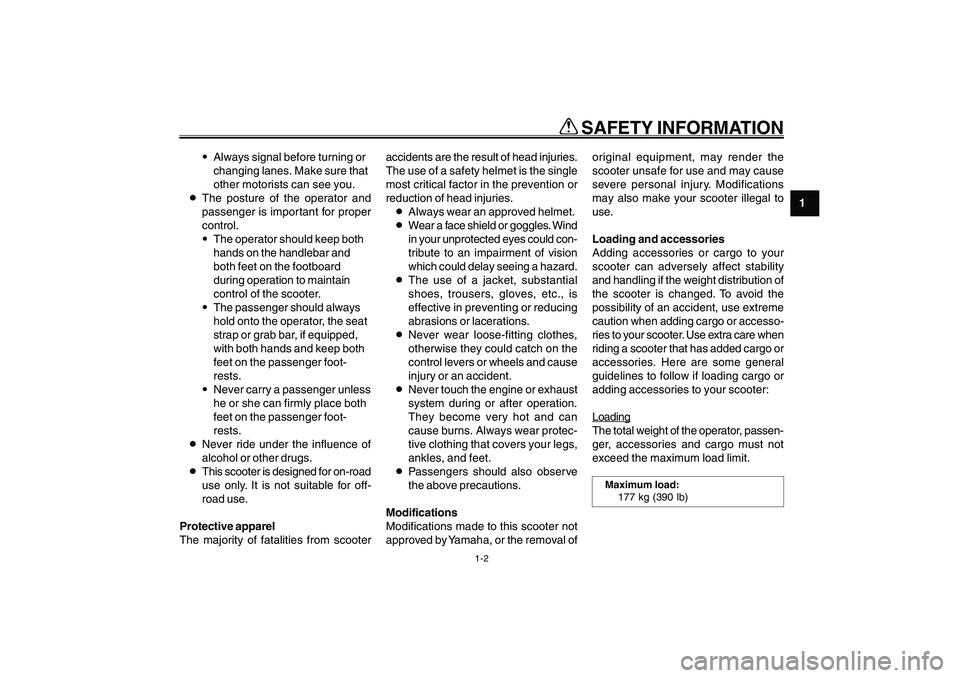
The total weight of the operator, passen-
ger, accessories and cargo must not
exceed the maximum load limit.
Maximum load:
177 kg (390 lb)
15P-F8199-E0_ch1.pmd2007/06/20, 14:20 2
Page 28 of 72
4-2
1
2
3
4
5
6
7
8
9
PRE-OPERATION CHECKS
EAU15605
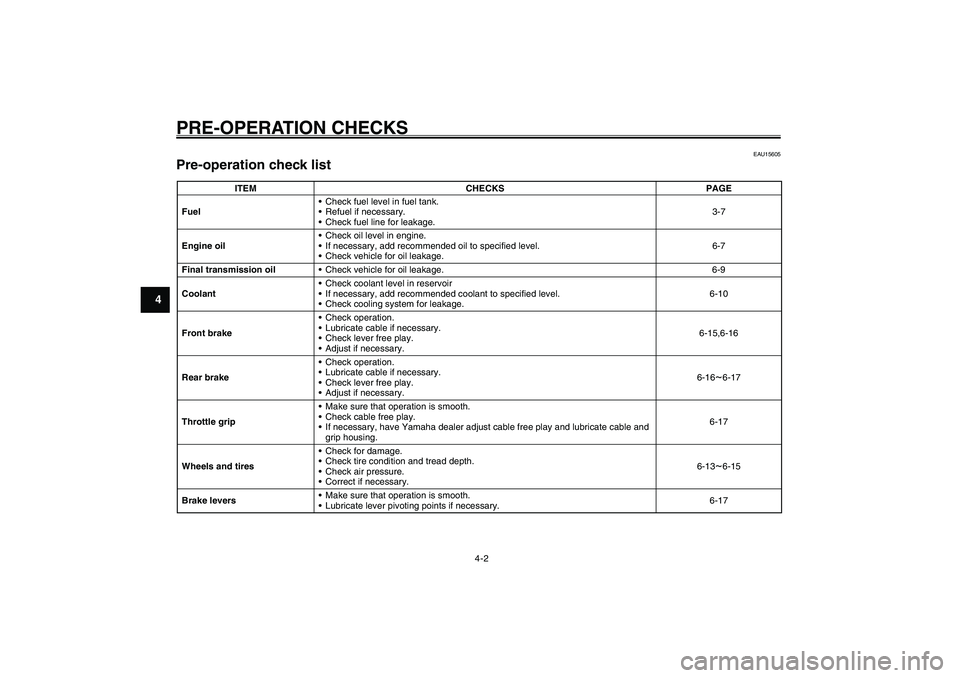
Pre-operation check listPre-operation check list
ITEM CHECKS PAGE
Fuel• Check fuel level in fuel tank.
• Refuel if necessary.
• Check fuel line for leakage.3-7
Engine oil• Check oil level in engine.
• If necessary, add recommended oil to specified level.
• Check vehicle for oil leakage.6-7
Final transmission oil• Check vehicle for oil leakage. 6-9
Coolant• Check coolant level in reservoir
• If necessary, add recommended coolant to specified level.
• Check cooling system for leakage.6-10
Front brake• Check operation.
• Lubricate cable if necessary.
• Check lever free play.
• Adjust if necessary.6-15,6-16
Rear brake• Check operation.
• Lubricate cable if necessary.
• Check lever free play.
• Adjust if necessary.6-16
~6-17
Throttle grip• Make sure that operation is smooth.
• Check cable free play.
• If necessary, have Yamaha dealer adjust cable free play and lubricate cable and
grip housing.6-17
Wheels and tires• Check for damage.
• Check tire condition and tread depth.
• Check air pressure.
• Correct if necessary.6-13~6-15
Brake levers• Make sure that operation is smooth.
• Lubricate lever pivoting points if necessary.6-1
7
15P-F8199-E0_ch4.pmd2007/06/13, 11:16 2
Page 34 of 72
6-2
1
2
3
4
5
6
7
8
9
EAU17226
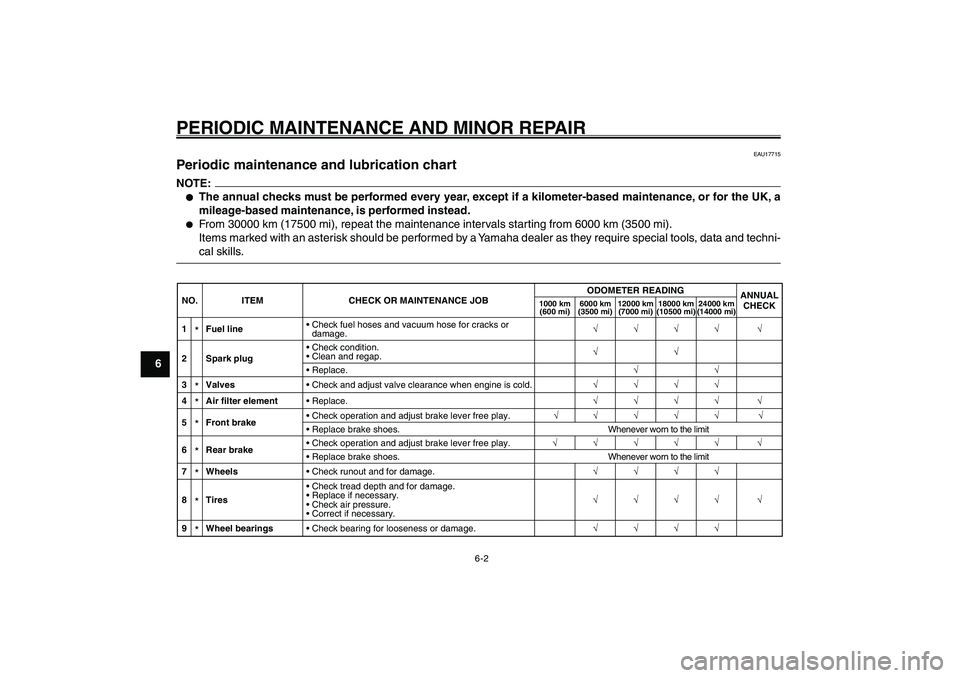
PERIODIC MAINTENANCE AND MINOR REPAIRPeriodic maintenance and lubrication chart
ANNUAL
CHECK
1000 km
(600 mi)6000 km
(3500 mi)12000 km
(7000 mi)18000 km
(10500 mi)24000 km
(14000 mi)
1
*Fuel line• Check fuel hoses and vacuum hose for cracks or
damage.———— —
2 Spark plug• Check condition.
• Clean and regap.——
• Replace.——
3*Valves• Check and adjust valve clearance when engine is cold.————
4*Air filter element• Replace.———— —
5*Front brake• Check operation and adjust brake lever free play.—— — — — —
• Replace brake shoes. Whenever worn to the limit
6*Rear brake• Check operation and adjust brake lever free play.————— —
• Replace brake shoes. Whenever worn to the limit
7*Wheels• Check runout and for damage.————
8*Tires• Check tread depth and for damage.
• Replace if necessary.
• Check air pressure.
• Correct if necessary.———— —
9*Wheel bearings• Check bearing for looseness or damage.————
EAU17715
Periodic maintenance and lubrication chartNOTE:● ●● ●
●
The annual checks must be performed every year, except if a kilometer-based maintenance, or for the UK, a
mileage-based maintenance, is performed instead.
●
From 30000 km (17500 mi), repeat the maintenance intervals starting from 6000 km (3500 mi).
Items marked with an asterisk should be performed by a Yamaha dealer as they require special tools, data and techni-
cal skills.
15P-F8199-E0_ch6.pmd2007/06/21, 11:09 2
Page 42 of 72
6-10
1
2
3
4
5
6
7
8
9
EAU17226
PERIODIC MAINTENANCE AND MINOR REPAIRZAUM00**
1
2
1. Final transmission oil filler bolt
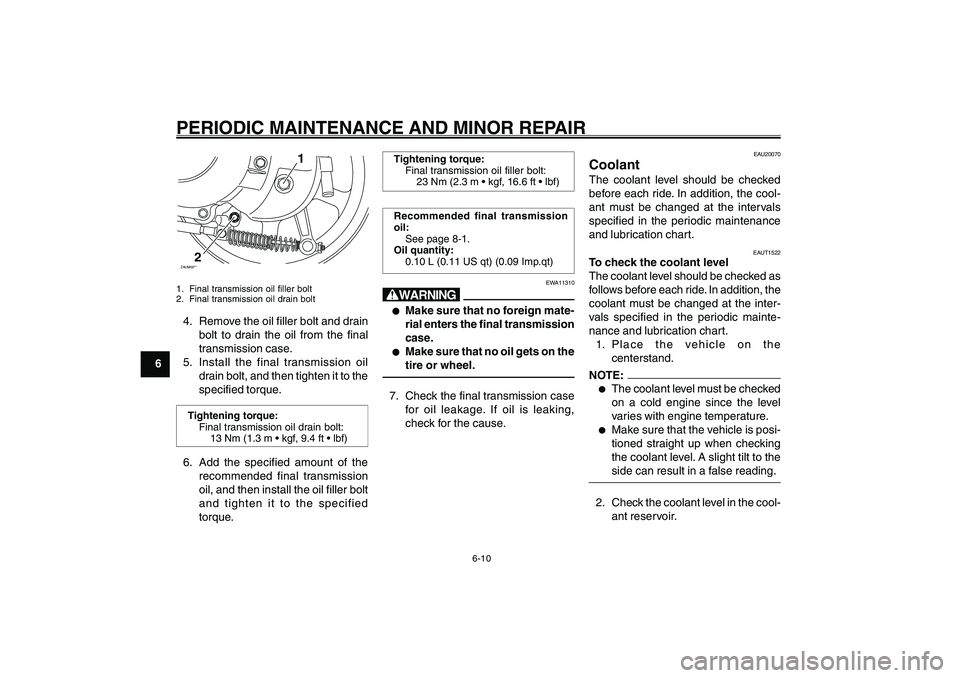
2. Final transmission oil drain bolt4. Remove the oil filler bolt and drain
bolt to drain the oil from the final
transmission case.
5. Install the final transmission oil
drain bolt, and then tighten it to the
specified torque.Tightening torque:
Final transmission oil drain bolt:
6. Add the specified amount of the
recommended final transmission
oil, and then install the oil filler bolt
and tighten it to the specified
torque.
Tightening torque:
Final transmission oil filler bolt:
Recommended final transmission
oil:
See page 8-1.
Oil quantity:
0.10 L (0.11 US qt) (0.09 Imp.qt)
EWA11310
w● ●● ●
●
Make sure that no foreign mate-
rial enters the final transmission
case.
● ●● ●
●
Make sure that no oil gets on the
tire or wheel.
7. Check the final transmission case
for oil leakage. If oil is leaking,
check for the cause.
EAU20070
CoolantThe coolant level should be checked
before each ride. In addition, the cool-
ant must be changed at the intervals
specified in the periodic maintenance
and lubrication chart. Coolant
EAUT1522
To check the coolant level
The coolant level should be checked as
follows before each ride. In addition, the
coolant must be changed at the inter-
vals specified in the periodic mainte-
nance and lubrication chart.
1. Place the vehicle on the
centerstand.NOTE:●
The coolant level must be checked
on a cold engine since the level
varies with engine temperature.
●
Make sure that the vehicle is posi-
tioned straight up when checking
the coolant level. A slight tilt to the
side can result in a false reading.
2. Check the coolant level in the cool-
ant reservoir.
15P-F8199-E0_ch6.pmd2007/06/21, 11:09 10
Page 46 of 72
6-14
1
2
3
4
5
6
7
8
9
EAU17226
PERIODIC MAINTENANCE AND MINOR REPAIRTire inspectionZAUM00**
1
2
1. Tire tread depth
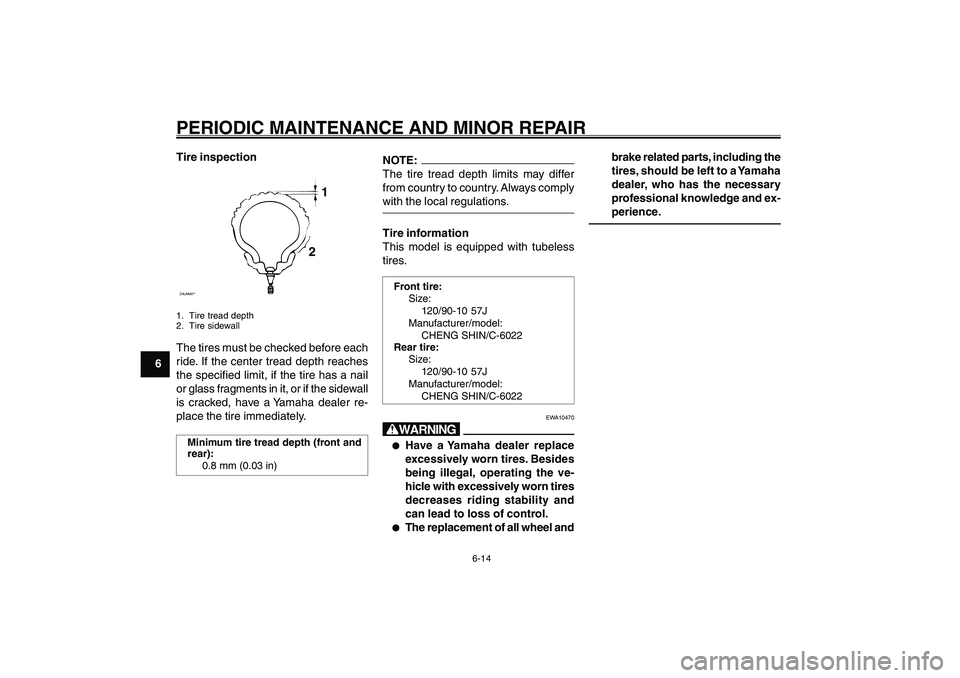
2. Tire sidewallThe tires must be checked before each
ride. If the center tread depth reaches
the specified limit, if the tire has a nail
or glass fragments in it, or if the sidewall
is cracked, have a Yamaha dealer re-
place the tire immediately.Minimum tire tread depth (front and
rear):
0.8 mm (0.03 in)
NOTE:
The tire tread depth limits may differ
from country to country. Always comply
with the local regulations.Tire information
This model is equipped with tubeless
tires.Front tire:
Size:
120/90-10 57J
Manufacturer/model:
CHENG SHIN/C-6022
Rear tire:
Size:
120/90-10 57J
Manufacturer/model:
CHENG SHIN/C-6022
EWA10470
w● ●● ●
●
Have a Yamaha dealer replace
excessively worn tires. Besides
being illegal, operating the ve-
hicle with excessively worn tires
decreases riding stability and
can lead to loss of control.
● ●● ●
●
The replacement of all wheel andbrake related parts, including the
tires, should be left to a Yamaha
dealer, who has the necessary
professional knowledge and ex-
perience.
15P-F8199-E0_ch6.pmd2007/06/21, 11:09 14
Page 47 of 72
6-15
1
2
3
4
5
6
7
8
9
EAU17226
PERIODIC MAINTENANCE AND MINOR REPAIR
Wheels
Brake lever free play, adjusting
EAU22130
Adjusting the brake lever free
play
1
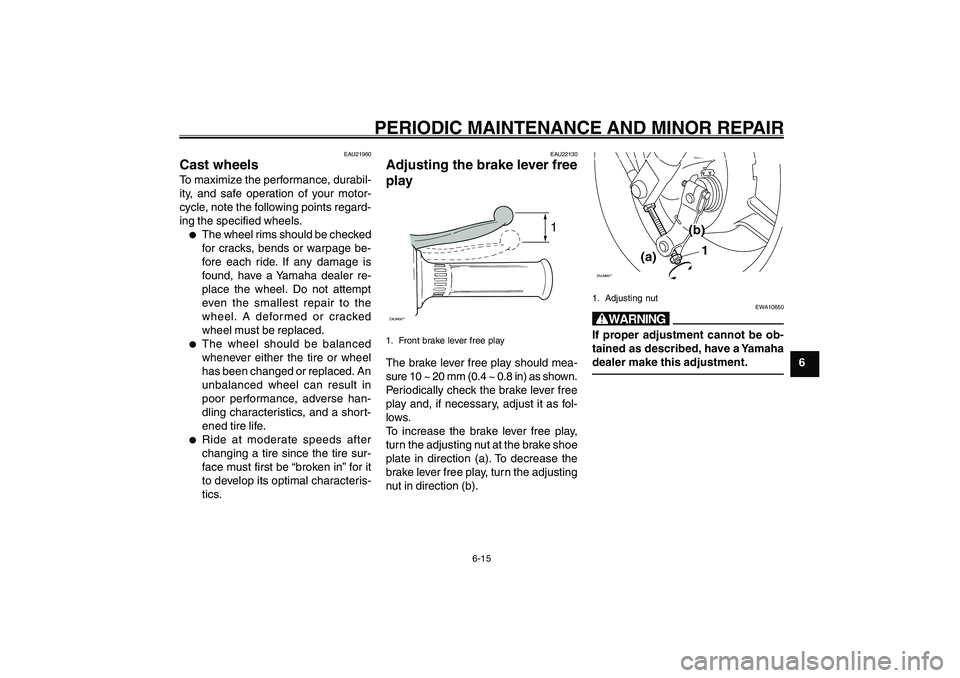
ZAUM00**1. Front brake lever free playThe brake lever free play should mea-
sure 10 ~ 20 mm (0.4 ~ 0.8 in) as shown.
Periodically check the brake lever free
play and, if necessary, adjust it as fol-
lows.
To increase the brake lever free play,
turn the adjusting nut at the brake shoe
plate in direction (a). To decrease the
brake lever free play, turn the adjusting
nut in direction (b).
ZAUM00**
1
(b)
(a)
1. Adjusting nut
EWA10650
wIf proper adjustment cannot be ob-
tained as described, have a Yamaha
dealer make this adjustment.
EAU21960
Cast wheelsTo maximize the performance, durabil-
ity, and safe operation of your motor-
cycle, note the following points regard-
ing the specified wheels.●
The wheel rims should be checked
for cracks, bends or warpage be-
fore each ride. If any damage is
found, have a Yamaha dealer re-
place the wheel. Do not attempt
even the smallest repair to the
wheel. A deformed or cracked
wheel must be replaced.
●
The wheel should be balanced
whenever either the tire or wheel
has been changed or replaced. An
unbalanced wheel can result in
poor performance, adverse han-
dling characteristics, and a short-
ened tire life.
●
Ride at moderate speeds after
changing a tire since the tire sur-
face must first be “broken in” for it
to develop its optimal characteris-
tics.
15P-F8199-E0_ch6.pmd2007/06/21, 11:09 15
Page 51 of 72
6-19
1
2
3
4
5
6
7
8
9
EAU17226
PERIODIC MAINTENANCE AND MINOR REPAIR
ZAUM00**
EAU23290
Checking the wheel bearingsThe front and rear wheel bearings must
be checked at the intervals specified in
the periodic maintenance and lubrica-
tion chart. If there is play in the wheel
hub or if the wheel does not turn
smoothly, have a Yamaha dealer check
the wheel bearings. Steering, checking
Wheel bearings, checking
EAU23280
Checking the steeringWorn or loose steering bearings may
cause danger. Therefore, the operation
of the steering must be checked as fol-
lows at the intervals specified in the
periodic maintenance and lubrication
char t.
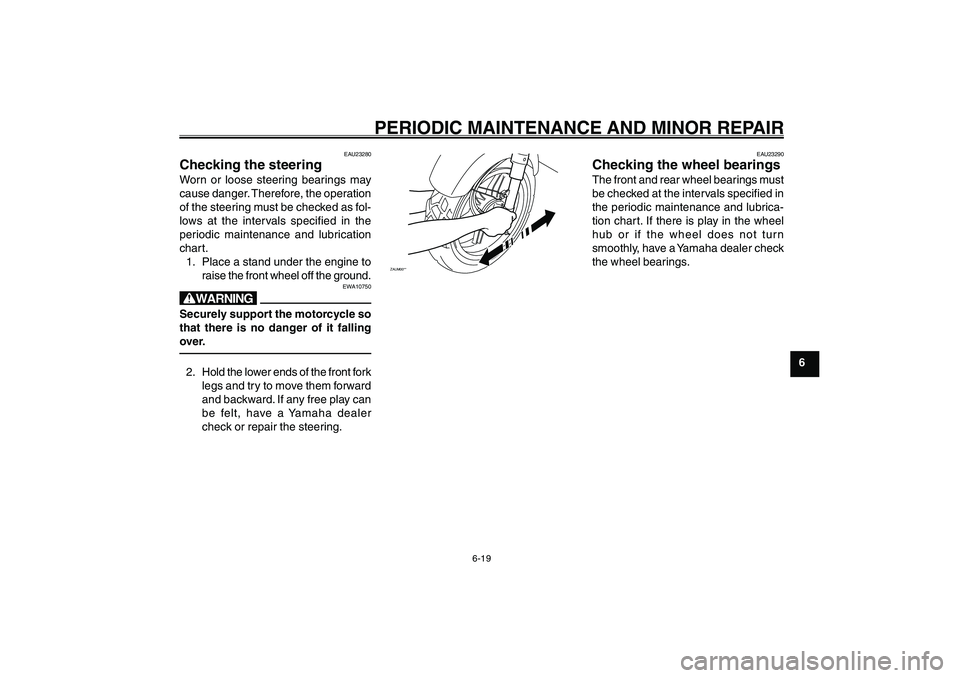
1. Place a stand under the engine to
raise the front wheel off the ground.
EWA10750
wSecurely support the motorcycle so
that there is no danger of it falling
over.2. Hold the lower ends of the front fork
legs and try to move them forward
and backward. If any free play can
be felt, have a Yamaha dealer
check or repair the steering.
15P-F8199-E0_ch6.pmd2007/06/21, 11:09 19
Page 59 of 72
7-1
1
2
3
4
5
6
7
8
9
SCOOTER CARE AND STORAGE
Care
EAU25991
SCOOTER CARE AND STORAGE
EAU26091
CareWhile the open design of a scooter re-
veals the attractiveness of the technol-
ogy, it also makes it more vulnerable.
Rust and corrosion can develop even if
high-quality components are used. A
rusty exhaust pipe may go unnoticed
on a car, however, it detracts from the
overall appearance of a scooter. Fre-
quent and proper care does not only
comply with the terms of the warranty,
but it will also keep your scooter look-
ing good, extend its life and optimize its
performance.
Before cleaning
1. Cover the muffler outlet with a plas-
tic bag after the engine has cooled
down.
2. Make sure that all caps and cov-
ers as well as all electrical couplers
and connectors, including the
spark plug cap, are tightly installed.
3. Remove extremely stubborn dirt,
like oil burnt onto the crankcase,
with a degreasing agent and a
brush, but never apply such prod-
ucts onto seals, gaskets and wheelaxles. Always rinse the dirt and
degreaser off with water.
Cleaning
ECA10781
cC● ●● ●
●
Avoid using strong acidic wheel
cleaners, especially on spoked
wheels. If such products are
used on hard-to-remove dirt, do
not leave the cleaner on the af-
fected area any longer than in-
structed. Also, thoroughly rinse
the area off with water, immedi-
ately dry it, and then apply a cor-
rosion protection spray.
● ●● ●
●
Improper cleaning can damage
plastic parts such as cowlings,
panels, windshields, headlight
lenses, meter lenses, etc. Use
only a soft, clean cloth or sponge
with mild detergent and water to
clean plastic.
● ●● ●
●
Do not use any harsh chemical
products on plastic parts. Be
sure to avoid using cloths or
sponges which have been in
contact with strong or abrasive
cleaning products, solvent orthinner, fuel (gasoline), rust re-
movers or inhibitors, brake fluid,
antifreeze or electrolyte.
● ●● ●
●
Do not use high-pressure wash-
ers or steam-jet cleaners since
they cause water seepage and
deterioration in the following
areas: seals (of wheel and
swingarm bearings, fork and
brakes), electric components
(couplers, connectors, instru-
ments, switches and lights),
breather hoses and vents.
● ●● ●
●
For scooters equipped with a
windshield: Do not use strong
cleaners or hard sponges as
they will cause dulling or
scratching. Some cleaning com-
pounds for plastic may leave
scratches on the windshield.
Test the product on a small hid-
den part of the windshield to
make sure that it does not leave
any marks. If the windshield is
scratched, use a quality plastic
polishing compound after wash-
ing.
15P-F8199-E0_ch7.pmd2007/06/13, 11:18 1
Page 62 of 72
7-4
1
2
3
4
5
6
7
8
9
SCOOTER CARE AND STORAGE4. Lubricate all control cables and the
pivoting points of all levers and
pedals as well as of the sidestand/
centerstand.
5. Check and, if necessary, correct
the tire air pressure, and then lift
the scooter so that both of its
wheels are off the ground. Alterna-
tively, turn the wheels a little every
month in order to prevent the tires
from becoming degraded in one
spot.
6. Cover the muffler outlet with a plas-
tic bag to prevent moisture from en-
tering it.
7. Remove the battery and fully
charge it. Store it in a cool, dry
place and charge it once a month.
Do not store the battery in an ex-
cessively cold or warm place [less
than 0 °C (30 °F) or more than 30
°C (90 °F)]. For more information
on storing the battery, see page 6-
20.NOTE:
Make any necessary repairs before
storing the scooter.
15P-F8199-E0_ch7.pmd2007/06/13, 11:18 4