check engine YAMAHA NMAX 125 2020 User Guide
[x] Cancel search | Manufacturer: YAMAHA, Model Year: 2020, Model line: NMAX 125, Model: YAMAHA NMAX 125 2020Pages: 114, PDF Size: 10.63 MB
Page 50 of 114
Instrument and control functions
6-16
6Confirm the gasoline pump nozzle
has the same fuel identification
mark.
Gasohol
There are two types of gasohol: gaso-
hol containing ethanol and that con-
taining methanol. Gasohol containing
ethanol can be used if the ethanol con-
tent does not exceed 10% (E10). Gas-
ohol containing methanol is not
recommended by Yamaha because it
can cause damage to the fuel system
or vehicle performance problems.NOTICE
ECA11401
Use only unleaded gasoline. The use
of leaded gasoline will cause severe
damage to internal engine parts,
such as the valves and piston rings,
as well as to the exhaust system.
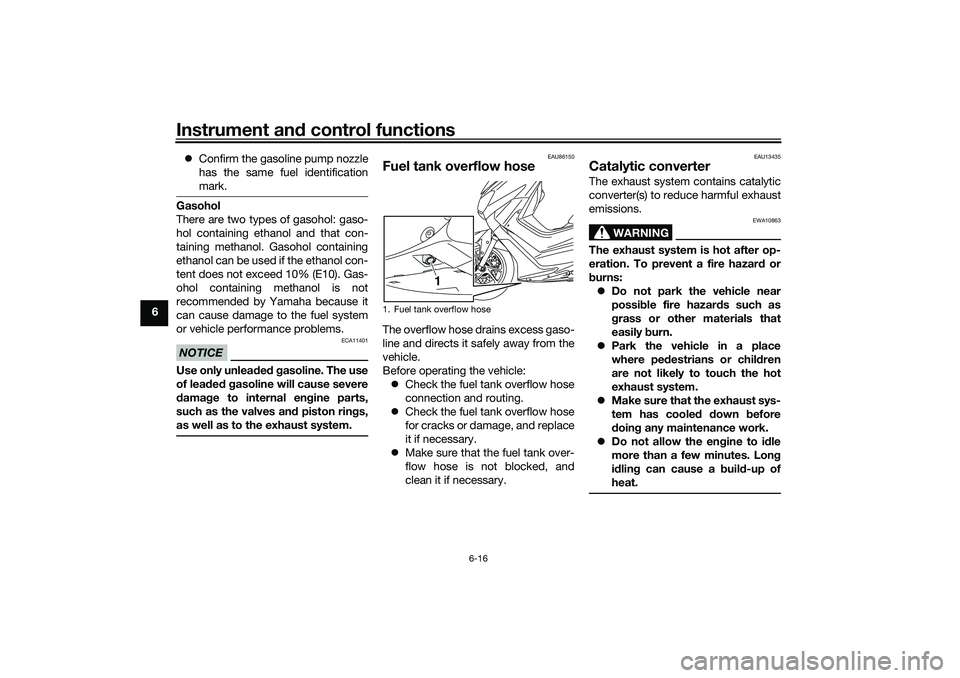
EAU86150
Fuel tank overflow hoseThe overflow hose drains excess gaso-
line and directs it safely away from the
vehicle.
Before operating the vehicle:
Check the fuel tank overflow hose
connection and routing.
Check the fuel tank overflow hose
for cracks or damage, and replace
it if necessary.
Make sure that the fuel tank over-
flow hose is not blocked, and
clean it if necessary.
EAU13435
Catalytic converterThe exhaust system contains catalytic
converter(s) to reduce harmful exhaust
emissions.
WARNING
EWA10863
The exhaust system is hot after op-
eration. To prevent a fire hazard or
burns:
Do not park the vehicle near
possible fire hazards such as
grass or other materials that
easily burn.
Park the vehicle in a place
where pedestrians or children
are not likely to touch the hot
exhaust system.
Make sure that the exhaust sys-
tem has cooled down before
doing any maintenance work.
Do not allow the engine to idle
more than a few minutes. Long
idling can cause a build-up of
heat.
1. Fuel tank overflow hose
1
UBALE0E0.book Page 16 Wednesday, September 30, 2020 1:37 PM
Page 58 of 114
For your safety – pre-operation checks
7-1
7
EAU1559B
Inspect your vehicle each time you use it to make sure the vehicle is in safe operating condition. Always follow the inspection
and maintenance procedures and schedules described in the Owner’s Manual.
WARNING
EWA11152
Failure to inspect or maintain the vehicle properly increases the possibility of an accident or equipment damage.
Do not operate the vehicle if you find any problem. If a problem cannot be corrected by the procedures provided in
this manual, have the vehicle inspected by a Yamaha dealer.Before using this vehicle, check the following points:
ITEM CHECKS PAGE
Fuel• Check fuel level in fuel tank.
• Refuel if necessary.
• Check fuel line for leakage.
• Check fuel tank overflow hose for obstructions, cracks or damage, and check
hose connection.6-15, 6-16
Engine oil• Check oil level in engine.
• If necessary, add recommended oil to specified level.
• Check vehicle for oil leakage.9-11
Final transmission oil• Check vehicle for oil leakage. 9-13
Coolant• Check coolant level in reservoir.
• If necessary, add recommended coolant to specified level.
• Check cooling system for leakage.9-15
Front brake• Check operation.
• If soft or spongy, have Yamaha dealer bleed hydraulic system.
• Check brake pads for wear.
• Replace if necessary.
• Check fluid level in reservoir.
• If necessary, add specified brake fluid to specified level.
• Check hydraulic system for leakage.9-21, 9-22, 9-23
UBALE0E0.book Page 1 Wednesday, September 30, 2020 1:37 PM
Page 60 of 114
Operation and important riding points
8-1
8
EAU15952
Read the Owner’s Manual carefully to
become familiar with all controls. If
there is a control or function you do not
understand, ask your Yamaha dealer.
WARNING
EWA10272
Failure to familiarize yourself with
the controls can lead to loss of con-
trol, which could cause an accident
or injury.
EAU16842
Engine break-inThere is never a more important period
in the life of your engine than the period
between 0 and 1600 km (1000 mi). For
this reason, you should read the fol-
lowing material carefully.
Since the engine is brand new, do not
put an excessive load on it for the first
1600 km (1000 mi). The various parts in
the engine wear and polish themselves
to the correct operating clearances.
During this period, prolonged full-throt-
tle operation or any condition that
might result in engine overheating
must be avoided.
EAUM2012
0–1000 km (0–600 mi)
Avoid prolonged operation above 1/3
throttle. NOTICE: After 1000 km (600
mi) of operation, be sure to replace
the engine oil and final transmission
oil.
[ECA11662]
1000–1600 km (600–1000 mi)
Avoid prolonged operation above 1/2
throttle.1600 km (1000 mi) and beyond
The vehicle can now be operated nor-
mally.
NOTICE
ECA10271
If any engine trouble should occur
during the engine break-in period,
immediately have a Yamaha dealer
check the vehicle.
UBALE0E0.book Page 1 Wednesday, September 30, 2020 1:37 PM
Page 61 of 114
Operation and important riding points
8-2
8
EAU86741
Starting the engineThe ignition circuit cut-off system will
enable starting only when the side-
stand is up.
To start the engine1. Turn the main switch on.
2. Confirm the indicator and warning
light(s) come on for a few sec-
onds, and then go off. (See page
6-1.)TIPDo not start the engine if the en-
gine trouble warning light remains
on.
The ABS warning light should
come on and stay on until the ve-
hicle reaches a speed of 10 km/h
(6 mi/h).NOTICE
ECA24110
If a warning or indicator light does
not work as described above, have a
Yamaha dealer check the vehicle.3. Close the throttle completely.
4. While applying the front or rear
brake, push the start switch.5. Release the start switch when the
engine starts, or after 5 seconds.
Wait 10 seconds before pressing
the switch again to allow battery
voltage to restore.
NOTICE
ECA11043
For maximum engine life, never ac-
celerate hard when the engine is
cold!
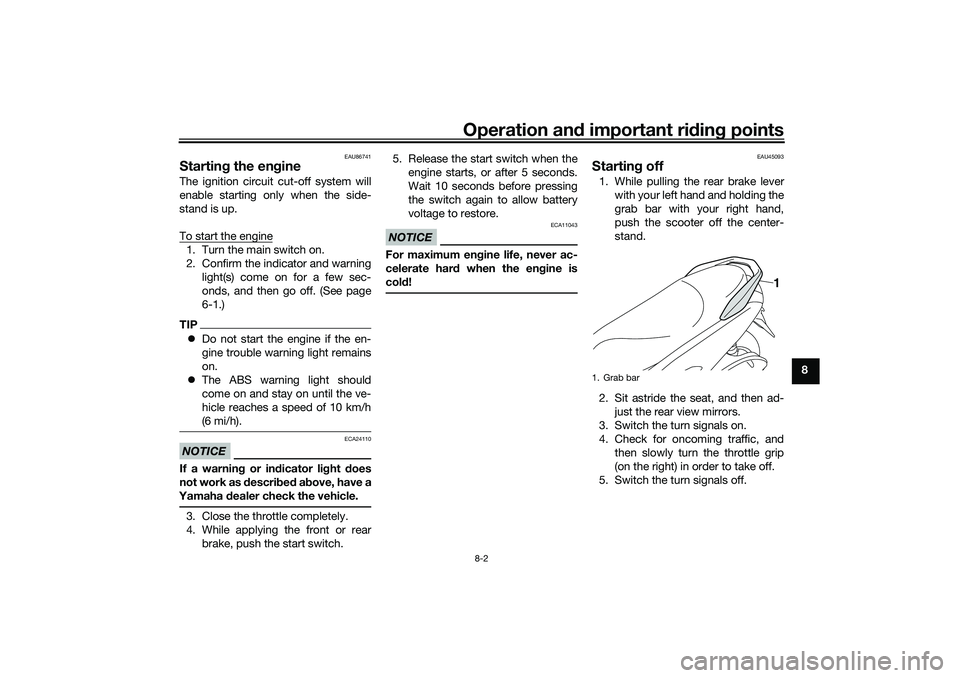
EAU45093
Starting off1. While pulling the rear brake lever
with your left hand and holding the
grab bar with your right hand,
push the scooter off the center-
stand.
2. Sit astride the seat, and then ad-
just the rear view mirrors.
3. Switch the turn signals on.
4. Check for oncoming traffic, and
then slowly turn the throttle grip
(on the right) in order to take off.
5. Switch the turn signals off.1. Grab bar
1
UBALE0E0.book Page 2 Wednesday, September 30, 2020 1:37 PM
Page 65 of 114
Periodic maintenance and adjustment
9-2
9
EAU71021
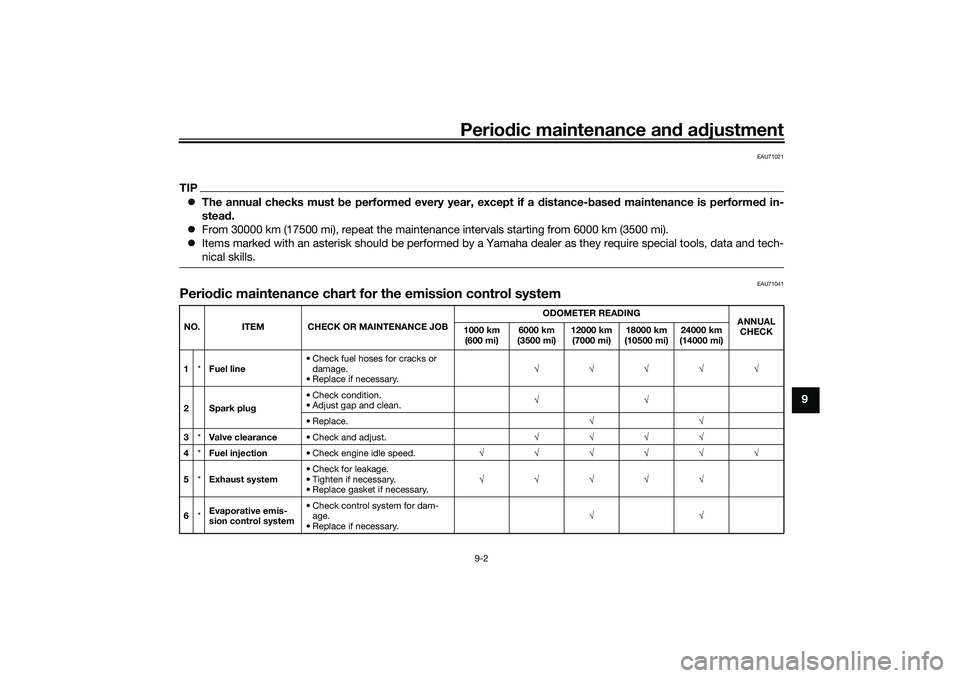
TIPThe annual checks must be performed every year, except if a distance-based maintenance is performed in-
stead.
From 30000 km (17500 mi), repeat the maintenance intervals starting from 6000 km (3500 mi).
Items marked with an asterisk should be performed by a Yamaha dealer as they require special tools, data and tech-
nical skills.
EAU71041
Periodic maintenance chart for the emission control systemNO. ITEM CHECK OR MAINTENANCE JOBODOMETER READING
ANNUAL
CHECK 1000 km
(600 mi)6000 km
(3500 mi)12000 km
(7000 mi)18000 km
(10500 mi)24000 km
(14000 mi)
1*Fuel line• Check fuel hoses for cracks or
damage.
• Replace if necessary.√√√√√
2 Spark plug• Check condition.
• Adjust gap and clean.√√
•Replace.√√
3*Valve clearance• Check and adjust.√√√√
4*Fuel injection• Check engine idle speed.√√√√√√
5*Exhaust system• Check for leakage.
• Tighten if necessary.
• Replace gasket if necessary.√√√√√
6*Evaporative emis-
sion control system• Check control system for dam-
age.
• Replace if necessary.√√
UBALE0E0.book Page 2 Wednesday, September 30, 2020 1:37 PM
Page 68 of 114
Periodic maintenance and adjustment
9-5
9
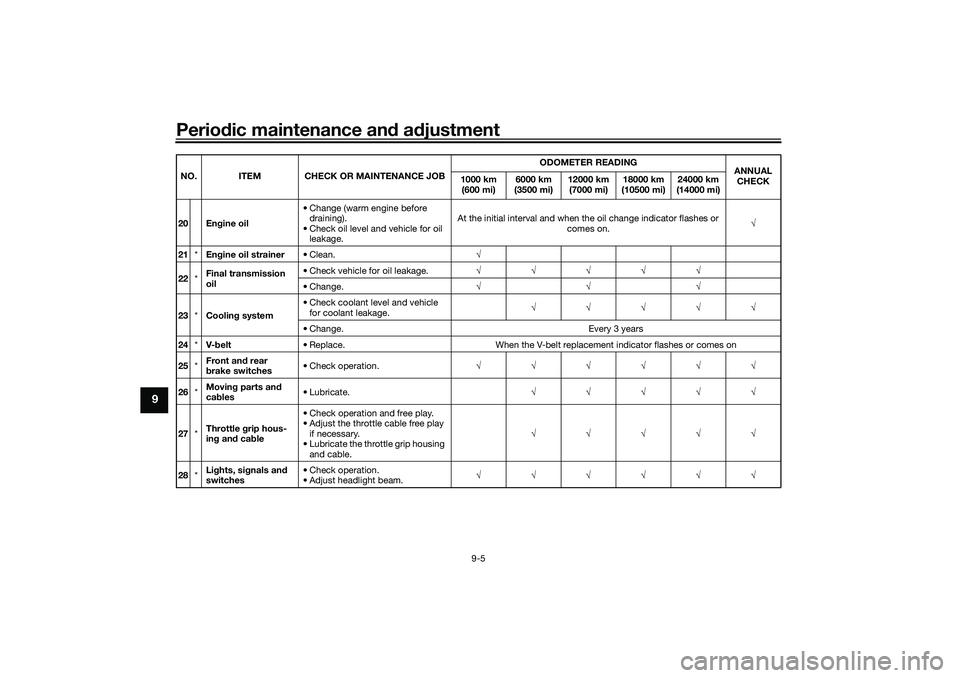
20 Engine oil• Change (warm engine before
draining).
• Check oil level and vehicle for oil
leakage.At the initial interval and when the oil change indicator flashes or
comes on.√
21*Engine oil strainer• Clean.√
22*Final transmission
oil• Check vehicle for oil leakage.√√√√√
• Change.√√√
23*Cooling system• Check coolant level and vehicle
for coolant leakage.√√√√√
• Change. Every 3 years
24*V-belt• Replace. When the V-belt replacement indicator flashes or comes on
25*Front and rear
brake switches• Check operation.√√√√√√
26*Moving parts and
cables• Lubricate.√√√√√
27*Throttle grip hous-
ing and cable• Check operation and free play.
• Adjust the throttle cable free play
if necessary.
• Lubricate the throttle grip housing
and cable.√√√√√
28*Lights, signals and
switches• Check operation.
• Adjust headlight beam.√√√√√√ NO. ITEM CHECK OR MAINTENANCE JOBODOMETER READING
ANNUAL
CHECK 1000 km
(600 mi)6000 km
(3500 mi)12000 km
(7000 mi)18000 km
(10500 mi)24000 km
(14000 mi)
UBALE0E0.book Page 5 Wednesday, September 30, 2020 1:37 PM
Page 69 of 114
Periodic maintenance and adjustment
9-6
9
EAU72790
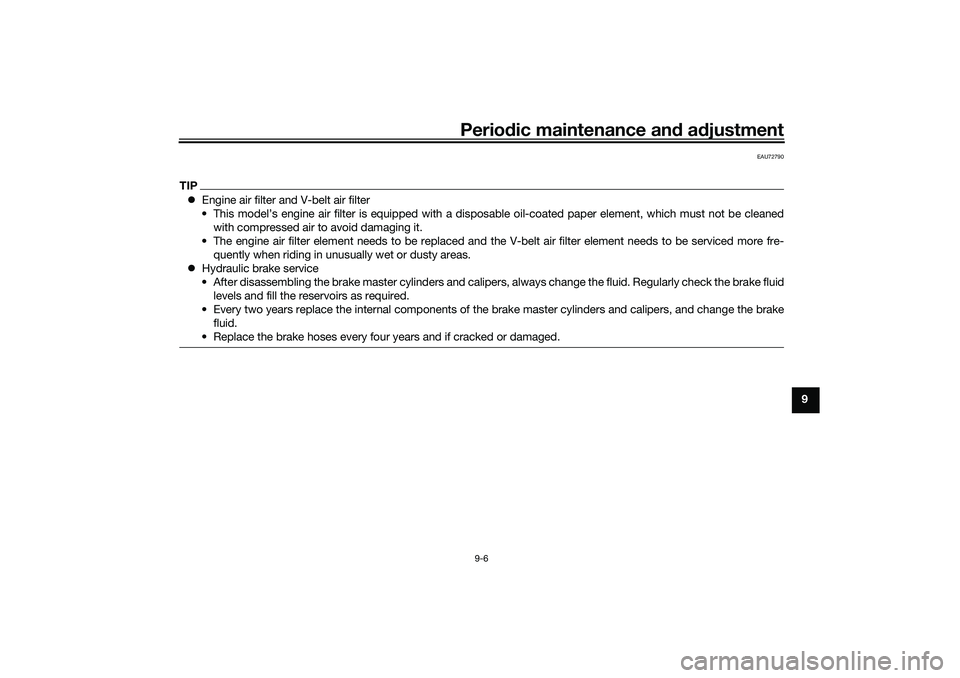
TIPEngine air filter and V-belt air filter
• This model’s engine air filter is equipped with a disposable oil-coated paper element, which must not be cleaned
with compressed air to avoid damaging it.
• The engine air filter element needs to be replaced and the V-belt air filter element needs to be serviced more fre-
quently when riding in unusually wet or dusty areas.
Hydraulic brake service
• After disassembling the brake master cylinders and calipers, always change the fluid. Regularly check the brake fluid
levels and fill the reservoirs as required.
• Every two years replace the internal components of the brake master cylinders and calipers, and change the brake
fluid.
• Replace the brake hoses every four years and if cracked or damaged.
UBALE0E0.book Page 6 Wednesday, September 30, 2020 1:37 PM
Page 72 of 114
Periodic maintenance and adjustment
9-9
92. Install the windshield by installing
the screws.
EAU67161
Checking the spark plugThe spark plug is an important engine
component, which is easy to check.
Since heat and deposits will cause any
spark plug to slowly erode, the spark
plug should be removed and checked
in accordance with the periodic main-
tenance and lubrication chart. In addi-
tion, the condition of the spark plug
can reveal the condition of the engine.
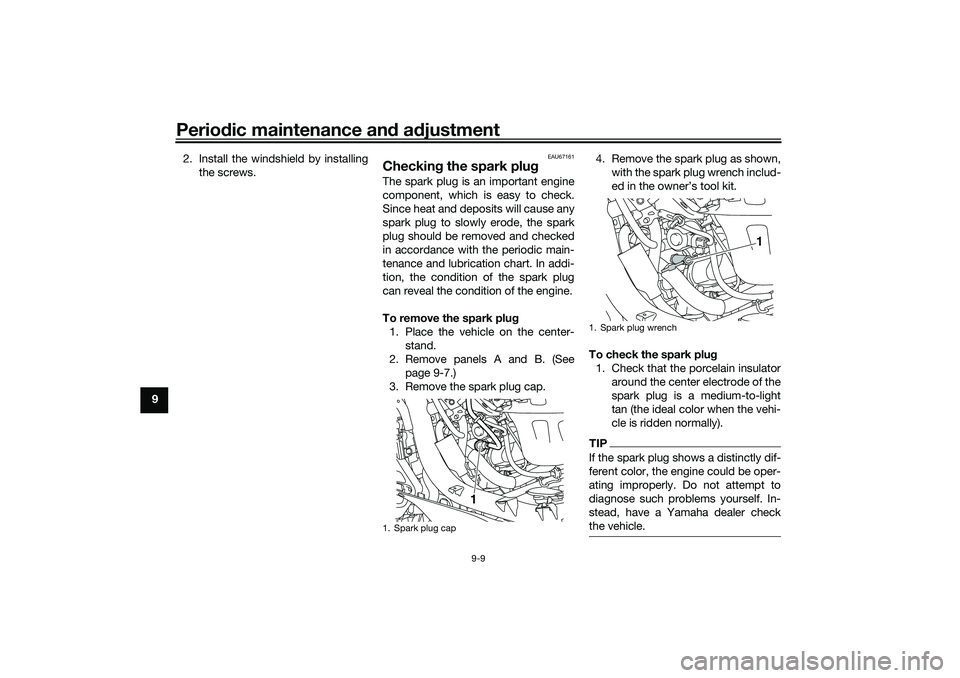
To remove the spark plug
1. Place the vehicle on the center-
stand.
2. Remove panels A and B. (See
page 9-7.)
3. Remove the spark plug cap.4. Remove the spark plug as shown,
with the spark plug wrench includ-
ed in the owner’s tool kit.
To check the spark plug
1. Check that the porcelain insulator
around the center electrode of the
spark plug is a medium-to-light
tan (the ideal color when the vehi-
cle is ridden normally).
TIPIf the spark plug shows a distinctly dif-
ferent color, the engine could be oper-
ating improperly. Do not attempt to
diagnose such problems yourself. In-
stead, have a Yamaha dealer check
the vehicle.
1. Spark plug cap
1
1. Spark plug wrench
1
UBALE0E0.book Page 9 Wednesday, September 30, 2020 1:37 PM
Page 74 of 114
Periodic maintenance and adjustment
9-11
9
EAU36112
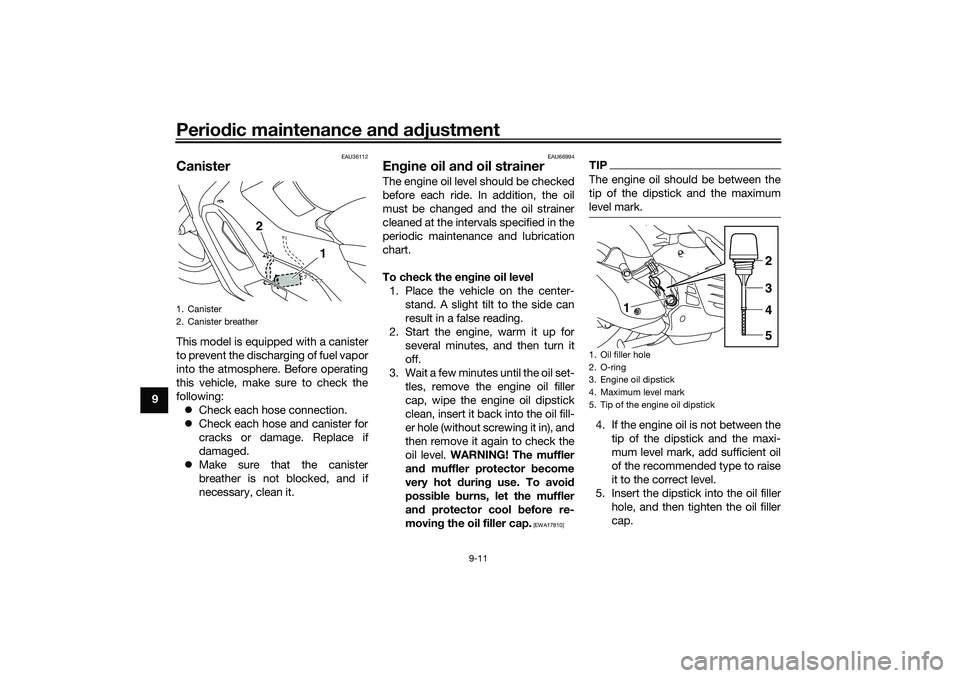
CanisterThis model is equipped with a canister
to prevent the discharging of fuel vapor
into the atmosphere. Before operating
this vehicle, make sure to check the
following:
Check each hose connection.
Check each hose and canister for
cracks or damage. Replace if
damaged.
Make sure that the canister
breather is not blocked, and if
necessary, clean it.
EAU66994
Engine oil and oil strainerThe engine oil level should be checked
before each ride. In addition, the oil
must be changed and the oil strainer
cleaned at the intervals specified in the
periodic maintenance and lubrication
chart.
To check the engine oil level
1. Place the vehicle on the center-
stand. A slight tilt to the side can
result in a false reading.
2. Start the engine, warm it up for
several minutes, and then turn it
off.
3. Wait a few minutes until the oil set-
tles, remove the engine oil filler
cap, wipe the engine oil dipstick
clean, insert it back into the oil fill-
er hole (without screwing it in), and
then remove it again to check the
oil level. WARNING! The muffler
and muffler protector become
very hot during use. To avoid
possible burns, let the muffler
and protector cool before re-
moving the oil filler cap.
[EWA17810]
TIPThe engine oil should be between the
tip of the dipstick and the maximum
level mark.4. If the engine oil is not between the
tip of the dipstick and the maxi-
mum level mark, add sufficient oil
of the recommended type to raise
it to the correct level.
5. Insert the dipstick into the oil filler
hole, and then tighten the oil filler
cap.
1. Canister
2. Canister breather
2
1
1. Oil filler hole
2. O-ring
3. Engine oil dipstick
4. Maximum level mark
5. Tip of the engine oil dipstick
3245
1
UBALE0E0.book Page 11 Wednesday, September 30, 2020 1:37 PM
Page 75 of 114
Periodic maintenance and adjustment
9-12
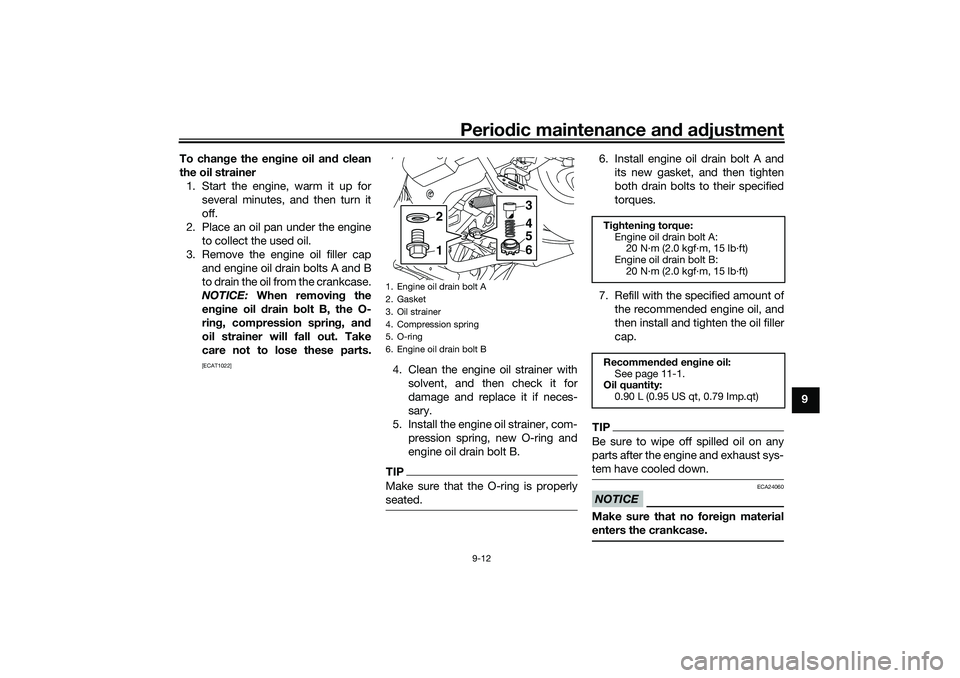
9 To change the engine oil and clean
the oil strainer
1. Start the engine, warm it up for
several minutes, and then turn it
off.
2. Place an oil pan under the engine
to collect the used oil.
3. Remove the engine oil filler cap
and engine oil drain bolts A and B
to drain the oil from the crankcase.
NOTICE: When removing the
engine oil drain bolt B, the O-
ring, compression spring, and
oil strainer will fall out. Take
care not to lose these parts.
[ECAT1022]
4. Clean the engine oil strainer with
solvent, and then check it for
damage and replace it if neces-
sary.
5. Install the engine oil strainer, com-
pression spring, new O-ring and
engine oil drain bolt B.TIPMake sure that the O-ring is properly
seated.
6. Install engine oil drain bolt A and
its new gasket, and then tighten
both drain bolts to their specified
torques.
7. Refill with the specified amount of
the recommended engine oil, and
then install and tighten the oil filler
cap.TIPBe sure to wipe off spilled oil on any
parts after the engine and exhaust sys-
tem have cooled down.NOTICE
ECA24060
Make sure that no foreign material
enters the crankcase.
1. Engine oil drain bolt A
2. Gasket
3. Oil strainer
4. Compression spring
5. O-ring
6. Engine oil drain bolt B
23
4
5
6
1
Tightening torque:
Engine oil drain bolt A:
20 N·m (2.0 kgf·m, 15 lb·ft)
Engine oil drain bolt B:
20 N·m (2.0 kgf·m, 15 lb·ft)
Recommended engine oil:
See page 11-1.
Oil quantity:
0.90 L (0.95 US qt, 0.79 Imp.qt)
UBALE0E0.book Page 12 Wednesday, September 30, 2020 1:37 PM