check engine YAMAHA NMAX 125 2020 Owner's Manual
[x] Cancel search | Manufacturer: YAMAHA, Model Year: 2020, Model line: NMAX 125, Model: YAMAHA NMAX 125 2020Pages: 114, PDF Size: 10.63 MB
Page 76 of 114
Periodic maintenance and adjustment
9-13
98. Start the engine, and then let it idle
for several minutes while checking
it for oil leakage. If oil is leaking,
immediately turn the engine off
and check for the cause.
9. Turn the engine off, and then
check the oil level and correct it if
necessary.
10. Reset the oil change tripmeter and
oil change indicator “OIL”. (See
page 6-7 for reset procedures.)
EAU85450
Why YamalubeYAMALUBE oil is a Genuine YAMAHA
Part born of the engineers’ passion
and belief that engine oil is an impor-
tant liquid engine component. We form
teams of specialists in the fields of me-
chanical engineering, chemistry, elec-
tronics and track testing, and have
them develop the engine together with
the oil it will use. Yamalube oils take full
advantage of the base oil’s qualities
and blend in the ideal balance of addi-
tives to make sure the final oil clears
our performance standards. Thus,
Yamalube mineral, semisynthetic and
synthetic oils have their own distinct
characters and value. Yamaha’s expe-
rience gained over many years of re-
search and development into oil since
the 1960’s helps make Yamalube the
best choice for your Yamaha engine.
EAU67822
Final transmission oilThe final transmission case must be
checked for oil leakage before each
ride. If any leakage is found, have a
Yamaha dealer check and repair your
motorcycle. In addition, the final trans-
mission oil must be changed as follows
at the intervals specified in the periodic
maintenance and lubrication chart.
1. Start the engine and warm up the
final transmission oil by riding the
motorcycle for several minutes.
2. Stop the engine and then place
the motorcycle on the center-
stand.
3. Place an oil pan under the final
transmission case to collect the
used oil.
4. Remove the final transmission oil
filler cap and its O-ring from the fi-
nal transmission case.
UBALE0E0.book Page 13 Wednesday, September 30, 2020 1:37 PM
Page 78 of 114
Periodic maintenance and adjustment
9-15
9
EAU20071
CoolantThe coolant level should be checked
before each ride. In addition, the cool-
ant must be changed at the intervals
specified in the periodic maintenance
and lubrication chart.
EAUN2930
To check the coolant level
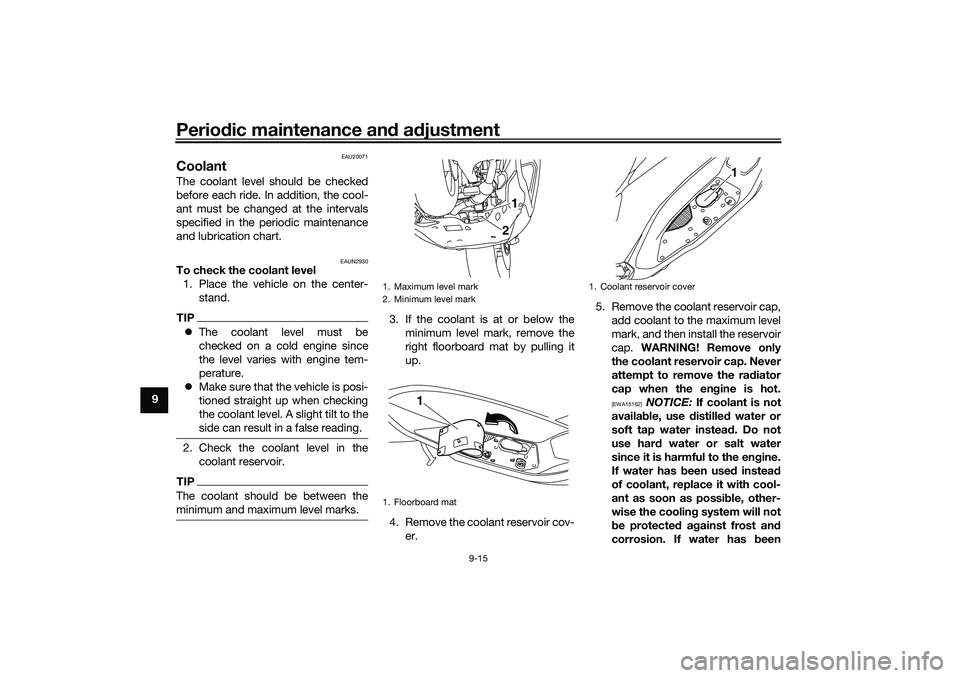
1. Place the vehicle on the center-
stand.TIPThe coolant level must be
checked on a cold engine since
the level varies with engine tem-
perature.
Make sure that the vehicle is posi-
tioned straight up when checking
the coolant level. A slight tilt to the
side can result in a false reading.2. Check the coolant level in the
coolant reservoir.TIPThe coolant should be between the
minimum and maximum level marks.
3. If the coolant is at or below the
minimum level mark, remove the
right floorboard mat by pulling it
up.
4. Remove the coolant reservoir cov-
er.5. Remove the coolant reservoir cap,
add coolant to the maximum level
mark, and then install the reservoir
cap. WARNING! Remove only
the coolant reservoir cap. Never
attempt to remove the radiator
cap when the engine is hot.
[EWA15162]
NOTICE: If coolant is not
available, use distilled water or
soft tap water instead. Do not
use hard water or salt water
since it is harmful to the engine.
If water has been used instead
of coolant, replace it with cool-
ant as soon as possible, other-
wise the cooling system will not
be protected against frost and
corrosion. If water has been
1. Maximum level mark
2. Minimum level mark
1. Floorboard mat
1
2
1
1. Coolant reservoir cover
1
UBALE0E0.book Page 15 Wednesday, September 30, 2020 1:37 PM
Page 79 of 114
Periodic maintenance and adjustment
9-16
9 added to the coolant, have a
Yamaha dealer check the anti-
freeze content of the coolant as
soon as possible, otherwise the
effectiveness of the coolant will
be reduced.
[ECA10473]
6. Install the coolant reservoir cover.
7. Place the right floorboard mat in
the original position and push it
downward to secure it.
EAU33032
Changing the coolant
The coolant must be changed at the in-
tervals specified in the periodic main-
tenance and lubrication chart. Have a
Yamaha dealer change the coolant.
WARNING! Never attempt to remove
the radiator cap when the engine is
hot.
[EWA10382]EAU67174
Air filter and V-belt case air fil-
ter elementsThe air filter element should be re-
placed and the V-belt case air filter el-
ement should be cleaned at the
intervals specified in the periodic main-
tenance and lubrication chart. Service
the air filter elements more frequently if
you are riding in unusually wet or dusty
areas. The air filter check hose and V-
belt case air filter check hose must be
frequently checked and cleaned if nec-
essary.
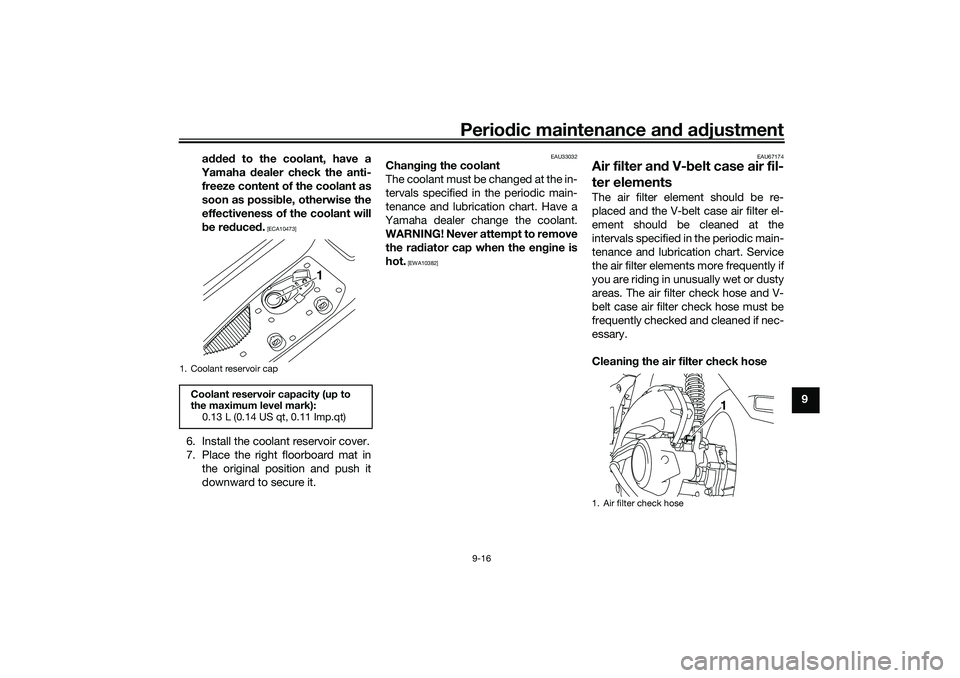
Cleaning the air filter check hose
1. Coolant reservoir capCoolant reservoir capacity (up to
the maximum level mark):
0.13 L (0.14 US qt, 0.11 Imp.qt)
1
1. Air filter check hose
1
UBALE0E0.book Page 16 Wednesday, September 30, 2020 1:37 PM
Page 80 of 114
Periodic maintenance and adjustment
9-17
91. Check the hose on the rear side of
the air filter case for accumulated
dirt or water.
2. If dirt or water is visible, remove
the hose from the clamp, clean it,
and then install it.
TIPIf dirt or water was found in the check
hose, be sure to check the air filter ele-
ment for excessive dirt or damage and
replace it if necessary.Replacing the air filter element
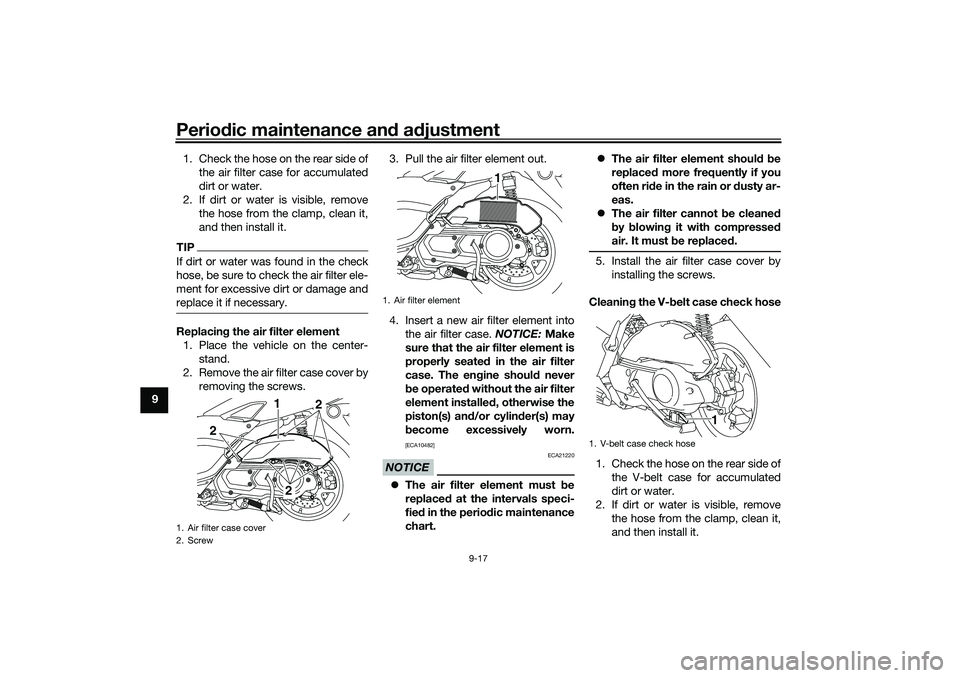
1. Place the vehicle on the center-
stand.
2. Remove the air filter case cover by
removing the screws.3. Pull the air filter element out.
4. Insert a new air filter element into
the air filter case. NOTICE: Make
sure that the air filter element is
properly seated in the air filter
case. The engine should never
be operated without the air filter
element installed, otherwise the
piston(s) and/or cylinder(s) may
become excessively worn.
[ECA10482]
NOTICE
ECA21220
The air filter element must be
replaced at the intervals speci-
fied in the periodic maintenance
chart.The air filter element should be
replaced more frequently if you
often ride in the rain or dusty ar-
eas.
The air filter cannot be cleaned
by blowing it with compressed
air. It must be replaced.
5. Install the air filter case cover by
installing the screws.
Cleaning the V-belt case check hose
1. Check the hose on the rear side of
the V-belt case for accumulated
dirt or water.
2. If dirt or water is visible, remove
the hose from the clamp, clean it,
and then install it.
1. Air filter case cover
2. Screw
21
2
2
1. Air filter element
11
1. V-belt case check hose
1
UBALE0E0.book Page 17 Wednesday, September 30, 2020 1:37 PM
Page 82 of 114
Periodic maintenance and adjustment
9-19
9
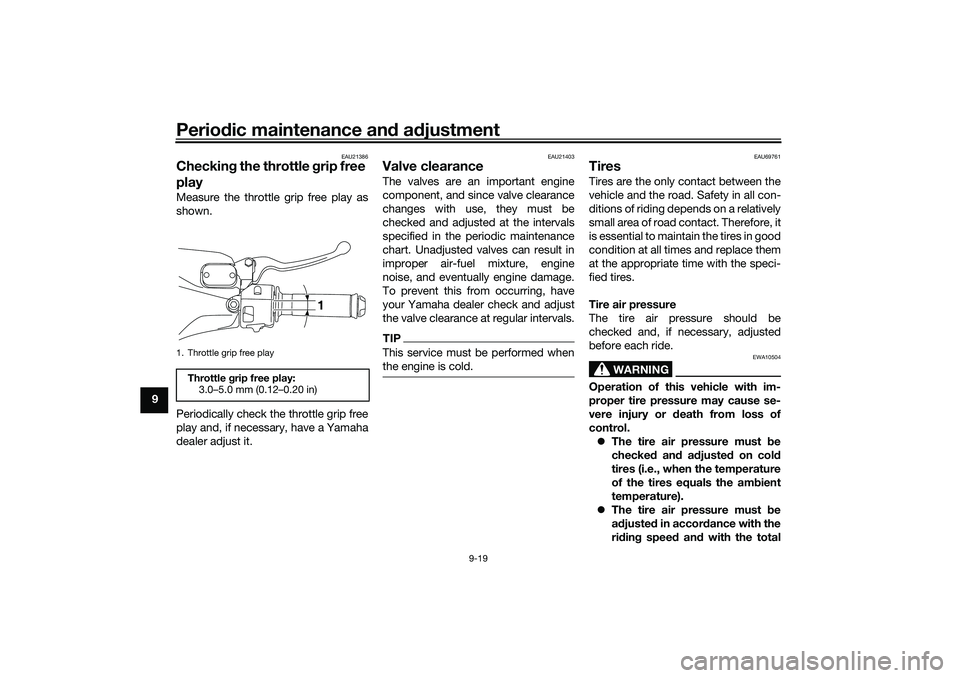
EAU21386
Checking the throttle grip free
playMeasure the throttle grip free play as
shown.
Periodically check the throttle grip free
play and, if necessary, have a Yamaha
dealer adjust it.
EAU21403
Valve clearanceThe valves are an important engine
component, and since valve clearance
changes with use, they must be
checked and adjusted at the intervals
specified in the periodic maintenance
chart. Unadjusted valves can result in
improper air-fuel mixture, engine
noise, and eventually engine damage.
To prevent this from occurring, have
your Yamaha dealer check and adjust
the valve clearance at regular intervals.TIPThis service must be performed when
the engine is cold.
EAU69761
TiresTires are the only contact between the
vehicle and the road. Safety in all con-
ditions of riding depends on a relatively
small area of road contact. Therefore, it
is essential to maintain the tires in good
condition at all times and replace them
at the appropriate time with the speci-
fied tires.
Tire air pressure
The tire air pressure should be
checked and, if necessary, adjusted
before each ride.
WARNING
EWA10504
Operation of this vehicle with im-
proper tire pressure may cause se-
vere injury or death from loss of
control.
The tire air pressure must be
checked and adjusted on cold
tires (i.e., when the temperature
of the tires equals the ambient
temperature).
The tire air pressure must be
adjusted in accordance with the
riding speed and with the total
1. Throttle grip free playThrottle grip free play:
3.0–5.0 mm (0.12–0.20 in)
1
UBALE0E0.book Page 19 Wednesday, September 30, 2020 1:37 PM
Page 97 of 114
Periodic maintenance and adjustment
9-34
9 If the smart key system does not work
after checking the above items, have a
Yamaha dealer check the smart key
system.
TIPSee Emergency mode on page 9-38
for information on starting the engine
without the smart key.
EAU76843
Stop and Start System trouble-
shooting
If a problem occurs, check the follow-
ing before taking the vehicle to a
Yamaha dealer.
The Stop and Start System indicator
light does not come on.
1. Is the main switch turned on?
2. Is the Stop and Start System
switch set to “ ”?
3. Was the engine warmed up suffi-
ciently after starting?
4. After the engine was warmed up,
was the engine left idling for a cer-
tain period of time?
5. Did the vehicle travel at a speed of
10 km/h or higher?Even if the preceding conditions are
met, the Stop and Start System may
not activate in order to preserve bat-
tery power. In this case, continue to
drive the vehicle.
In addition, the Stop and Start System
indicator light does not come on if the
engine trouble warning light is on.
If the Stop and Start System indicator
light still does not come on after you
checked the preceding conditions,
have a Yamaha dealer check the vehi-
cle as soon as possible.
The Stop and Start System indicator
light comes on, but the engine does
not stop automatically.
1. Was the vehicle stopped com-
pletely?
The engine may not stop automat-
ically until the vehicle is stopped
for a certain period of time. Try
bringing the vehicle to a complete
stop.
2. Is the throttle grip turned?
The engine does not stop auto-
matically if the throttle grip is not in
the fully closed position.Turn the throttle grip to the fully
closed position.
If the engine still does not stop auto-
matically after you checked the pre-
ceding conditions, have a Yamaha
dealer check the vehicle as soon as
possible.
After the engine was stopped by the
Stop and Start System, the engine
does not restart even if the throttle
grip is turned.
1. Is the Stop and Start System
switch set to “ ”?
If the Stop and Start System
switch is set to “ ” while the Stop
and Start System is activated, the
Stop and Start System will be
turned off.
2. Was the sidestand operated?
When the sidestand is lowered,
the Stop and Start System is de-
activated.
3. Was the engine left stopped by
the Stop and Start System for a
long period of time?
A
AA
UBALE0E0.book Page 34 Wednesday, September 30, 2020 1:37 PM
Page 98 of 114
Periodic maintenance and adjustment
9-35
9If the engine is left stopped by the
Stop and Start System for a long
period of time, the battery could
become discharged.
If the engine still does not restart after
you checked the preceding conditions,
have a Yamaha dealer check the vehi-
cle as soon as possible.
UBALE0E0.book Page 35 Wednesday, September 30, 2020 1:37 PM
Page 99 of 114
Periodic maintenance and adjustment
9-36
9
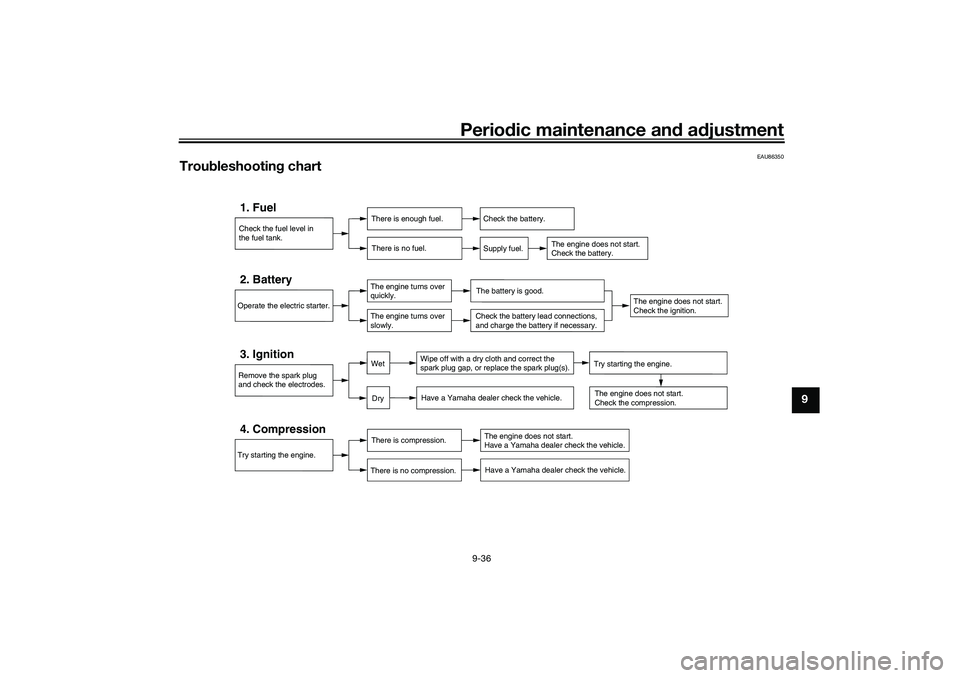
EAU86350
Troubleshooting chart
Check the fuel level in
the fuel tank.1. Fuel
There is enough fuel.
There is no fuel.
Check the battery.
Supply fuel.
The engine does not start.
Check the battery.
Try starting the engine.4. Compression
There is compression.
There is no compression.
The engine does not start.
Have a Yamaha dealer check the vehicle.Have a Yamaha dealer check the vehicle.
Remove the spark plug
and check the electrodes.3. Ignition
Wipe off with a dry cloth and correct the
spark plug gap, or replace the spark plug(s).
Have a Yamaha dealer check the vehicle.
The engine does not start.
Check the compression.
Operate the electric starter.2. Battery
The engine turns over
quickly.
The engine turns over
slowly.
The battery is good.
DryWet
Try starting the engine. Check the battery lead connections,
and charge the battery if necessary.
The engine does not start.
Check the ignition.
UBALE0E0.book Page 36 Wednesday, September 30, 2020 1:37 PM
Page 100 of 114
Periodic maintenance and adjustment
9-37
9
EAU86420
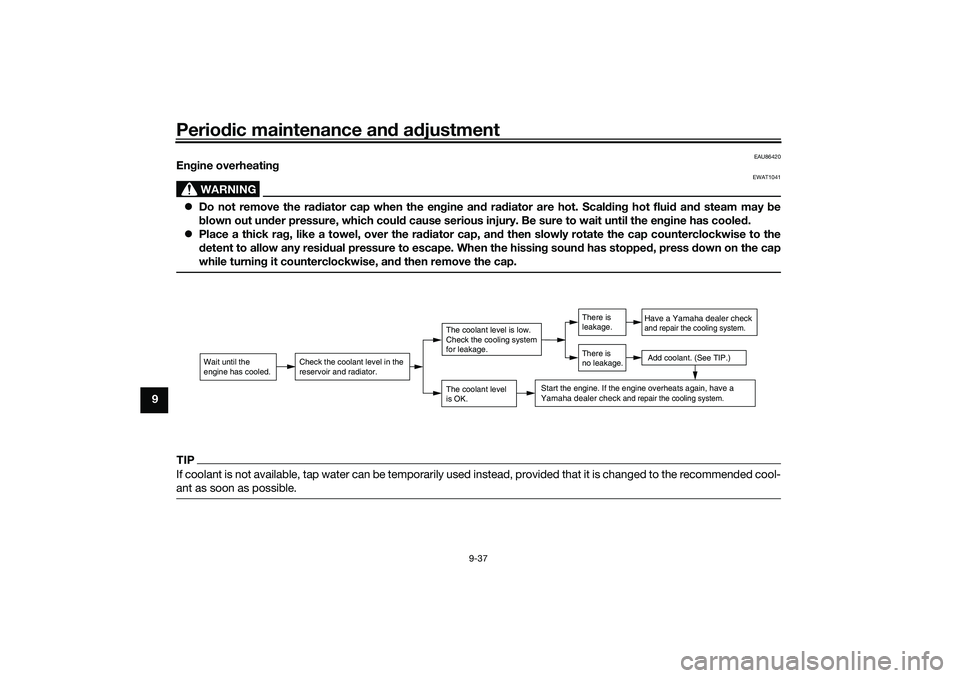
Engine overheating
WARNING
EWAT1041
Do not remove the radiator cap when the engine and radiator are hot. Scalding hot fluid and steam may be
blown out under pressure, which could cause serious injury. Be sure to wait until the engine has cooled.
Place a thick rag, like a towel, over the radiator cap, and then slowly rotate the cap counterclockwise to the
detent to allow any residual pressure to escape. When the hissing sound has stopped, press down on the cap
while turning it counterclockwise, and then remove the cap.TIPIf coolant is not available, tap water can be temporarily used instead, provided that it is changed to the recommended cool-
ant as soon as possible.
Wait until the
engine has cooled.
Check the coolant level in the
reservoir and radiator.
The coolant level
is OK.The coolant level is low.
Check the cooling system
for leakage.
Have a Yamaha dealer checkand repair the cooling system.Add coolant. (See TIP.)
Start the engine. If the engine overheats again,
have a
Yamaha dealer check
and repair the cooling system.
There is
leakage.
There is
no leakage.
UBALE0E0.book Page 37 Wednesday, September 30, 2020 1:37 PM
Page 106 of 114
Motorcycle care and storage
10-4
101. Make all necessary repairs and
perform any outstanding mainte-
nance.
2. Follow all instructions in the Care
section of this chapter.
3. Fill up the fuel tank, adding fuel
stabilizer according to product in-
structions. Run the engine for 5
minutes to distribute treated fuel
through the fuel system.
4. For vehicles equipped with a fuel
cock: Turn the fuel cock lever to
the off position.
5. For vehicles with a carburetor: To
prevent fuel deposits from build-
ing up, drain the fuel in the carbu-
retor float chamber into a clean
container. Retighten the drain bolt
and pour the fuel back into the fuel
tank.
6. Use a quality engine fogging oil
according to product instructions
to protect internal engine compo-
nents from corrosion. If engine
fogging oil is not available, per-
form the following steps for each
cylinder:
a. Remove the spark plug cap
and spark plug.b. Pour a teaspoonful of engine
oil into the spark plug bore.
c. Install the spark plug cap onto
the spark plug, and then place
the spark plug on the cylinder
head so that the electrodes are
grounded. (This will limit spark-
ing during the next step.)
d. Turn the engine over several
times with the starter. (This will
coat the cylinder wall with oil.)
WARNING! To prevent dam-
age or injury from sparking,
make sure to ground the
spark plug electrodes while
turning the engine over.
[EWA10952]
e. Remove the spark plug cap
from the spark plug, and then
install the spark plug and the
spark plug cap.
7. Lubricate all control cables, piv-
ots, levers and pedals, as well as
the sidestand and centerstand (if
equipped).
8. Check and correct the tire air
pressure, and then lift the vehicle
so that all wheels are off the
ground. Otherwise, turn thewheels a little once a month in or-
der to prevent the tires from be-
coming degraded in one spot.
9. Cover the muffler outlet with a
plastic bag to prevent moisture
from entering it.
10. Remove the battery and fully
charge it, or attach a maintenance
charger to keep the battery opti-
mally charged. NOTICE: Confirm
that the battery and its charger
are compatible. Do not charge a
VRLA battery with a convention-
al charger.
[ECA26330]
TIPIf the battery will be removed,
charge it once a month and store
it in a temperate location between
0-30 °C (32-90 °F).
See page 9-28 for more informa-
tion on charging and storing the
battery.
UBALE0E0.book Page 4 Wednesday, September 30, 2020 1:37 PM