light YAMAHA SR125 2000 User Guide
[x] Cancel search | Manufacturer: YAMAHA, Model Year: 2000, Model line: SR125, Model: YAMAHA SR125 2000Pages: 78, PDF Size: 8.59 MB
Page 38 of 78

PERIODIC MAINTENANCE AND MINOR REPAIR
6-8
6
EAU01093*
Engine oilOil level inspection
1. Place the motorcycle on the cen-
terstand. Warm up the engine for
several minutes.NOTE:@ Be sure the motorcycle is positioned
straight up when checking the oil level.
A slight tilt toward the side can result in
false readings. @
2. With the engine stopped, check
the oil level through the level win-
dow located at the lower part of
the right side crankcase cover.NOTE:@ Wait a few minutes until the oil level
settles before checking. @3. The oil level should be between
the maximum level and minimum
level marks. If the level is low, fill
the engine with sufficient oil to
raise it to the specified level.Engine oil replacement and oil filter
element cleaning
1. Warm up the engine for a few min-
utes.
2. Stop the engine. Place an oil pan
under the engine and remove the
oil filler cap.
3. Remove the drain bolt and drain
the oil.
EC000070*
CAUTION:@ When removing the oil drain bolt,
the O-ring, compression spring, and
oil strainer will fall out. Take care not
to lose these parts. @
1. Oil level window
2. Maximum level mark
3. Minimum level mark
1. Engine oil drain bolt A
E_3mw.book Page 8 Monday, February 5, 2001 9:54 AM
Page 48 of 78
PERIODIC MAINTENANCE AND MINOR REPAIR
6-18
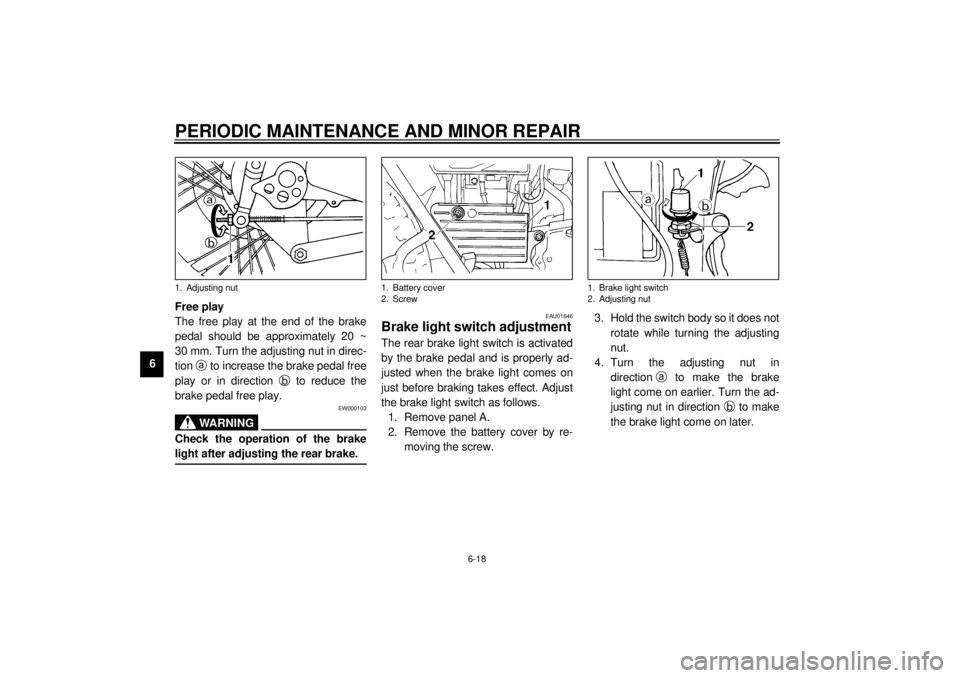
6Free play
The free play at the end of the brake
pedal should be approximately 20 ~
30 mm. Turn the adjusting nut in direc-
tion
a to increase the brake pedal free
play or in direction
b to reduce the
brake pedal free play.
EW000103
WARNING
@ Check the operation of the brake
light after adjusting the rear brake. @
EAU01646
Brake light switch adjustmentThe rear brake light switch is activated
by the brake pedal and is properly ad-
justed when the brake light comes on
just before braking takes effect. Adjust
the brake light switch as follows.
1. Remove panel A.
2. Remove the battery cover by re-
moving the screw.3. Hold the switch body so it does not
rotate while turning the adjusting
nut.
4. Turn the adjusting nut in
direction
a to make the brake
light come on earlier. Turn the ad-
justing nut in direction
b to make
the brake light come on later.
1. Adjusting nut
1. Battery cover
2. Screw
1. Brake light switch
2. Adjusting nut
E_3mw.book Page 18 Monday, February 5, 2001 9:54 AM
Page 52 of 78

PERIODIC MAINTENANCE AND MINOR REPAIR
6-22
6
EAU01533
Drive chain slack adjustment1. Loosen the rear brake adjusting
nut.
2. Loosen the wheel axle nut.3. To tighten the chain, turn the chain
adjusting plates in direction
a.
To loosen the chain, turn the chain
adjusting plates in direction
b and
push the wheel forward. Turn each
chain adjusting plate to exactly the
same position to maintain correct
axle alignment.
EC000096
CAUTION:@ Too little chain slack will overload
the engine and other vital parts.
Keep the slack within the specified
limits. @
4. Tighten the wheel axle nut to the
specified torque.
5. Adjust the brake pedal free play.
EW000103
WARNING
@ Check the operation of the brake
light after adjusting the rear brake. @
1. Adjusting nut
1. Axle nut
2. Chain adjusting plate
Tightening torque:
Wheel axle nut:
65 Nm (6.5 m·kg)
E_3mw.book Page 22 Monday, February 5, 2001 9:54 AM
Page 59 of 78
PERIODIC MAINTENANCE AND MINOR REPAIR
6-29
6
EAU03003
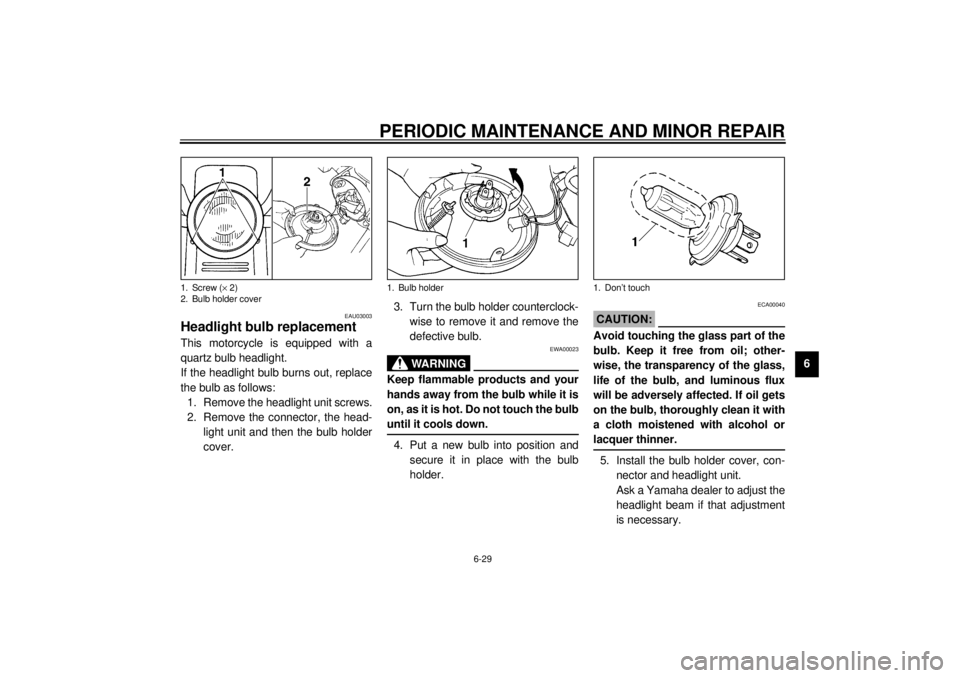
Headlight bulb replacementThis motorcycle is equipped with a
quartz bulb headlight.
If the headlight bulb burns out, replace
the bulb as follows:
1. Remove the headlight unit screws.
2. Remove the connector, the head-
light unit and then the bulb holder
cover.3. Turn the bulb holder counterclock-
wise to remove it and remove the
defective bulb.
EWA00023
WARNING
@ Keep flammable products and your
hands away from the bulb while it is
on, as it is hot. Do not touch the bulb
until it cools down. @4. Put a new bulb into position and
secure it in place with the bulb
holder.
ECA00040
CAUTION:@ Avoid touching the glass part of the
bulb. Keep it free from oil; other-
wise, the transparency of the glass,
life of the bulb, and luminous flux
will be adversely affected. If oil gets
on the bulb, thoroughly clean it with
a cloth moistened with alcohol or
lacquer thinner. @5. Install the bulb holder cover, con-
nector and headlight unit.
Ask a Yamaha dealer to adjust the
headlight beam if that adjustment
is necessary.
1. Screw (´ 2)
2. Bulb holder cover
1. Bulb holder
1. Don’t touch
E_3mw.book Page 29 Monday, February 5, 2001 9:54 AM
Page 60 of 78
PERIODIC MAINTENANCE AND MINOR REPAIR
6-30
6
EAU00855*
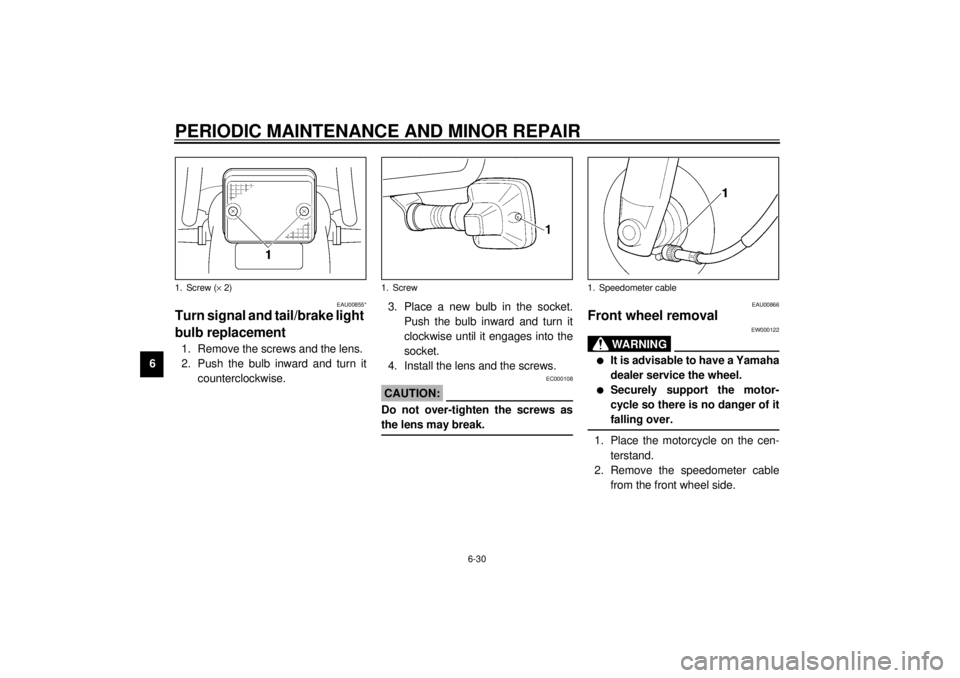
Turn signal and tail/brake light
bulb replacement1. Remove the screws and the lens.
2. Push the bulb inward and turn it
counterclockwise.3. Place a new bulb in the socket.
Push the bulb inward and turn it
clockwise until it engages into the
socket.
4. Install the lens and the screws.
EC000108
CAUTION:@ Do not over-tighten the screws as
the lens may break. @
EAU00866
Front wheel removal
EW000122
WARNING
@ l
It is advisable to have a Yamaha
dealer service the wheel.
l
Securely support the motor-
cycle so there is no danger of it
falling over.
@1. Place the motorcycle on the cen-
terstand.
2. Remove the speedometer cable
from the front wheel side.
1. Screw (´ 2)
1. Screw
1. Speedometer cable
E_3mw.book Page 30 Monday, February 5, 2001 9:54 AM
Page 63 of 78

PERIODIC MAINTENANCE AND MINOR REPAIR
6-33
6
EAU01723*
Rear wheel installation1. Install the rear wheel and the axle.
2. Install the axle nut and let the
motorcycle down.
3. Insert the brake rod into the brake
cam lever and install the brake
pedal free play adjusting nut.
4. Install the brake torque rod bolt
and tighten to the specified tight-
ening torque. Then install a new
cotter pin.
5. Adjust the drive chain free play.
(See page 6-22.)
6. Tighten the axle nut to the speci-
fied tightening torque.7. Adjust the rear brake pedal height
and free play. (See page 6-17.)
EW000103
WARNING
@ Check the operation of the brake
light after adjusting the rear brake. @
EAU01008
TroubleshootingAlthough Yamaha motorcycles receive
a rigid inspection before shipment from
the factory, trouble may occur during
operation.
Any problem in the fuel, compression,
or ignition systems can cause poor
starting and loss of power. The trouble-
shooting chart describes a quick, easy
procedure for making checks.
If your motorcycle requires any repair,
bring it to a Yamaha dealer. The skilled
technicians at a Yamaha dealership
have the tools, experience, and know-
how to properly service your motor-
cycle. Use only genuine Yamaha parts
on your motorcycle. Imitation parts may
look like Yamaha parts, but they are of-
ten inferior. Consequently, they have a
shorter service life and can lead to ex-
pensive repair bills. Specified torque:
Brake torque rod bolt:
25 Nm (2.5 m·kg)
Specified torque:
Axle nut:
65 Nm (6.5 m·kg)
E_3mw.book Page 33 Monday, February 5, 2001 9:54 AM
Page 66 of 78
MOTORCYCLE CARE AND STORAGE
7-2
7
ECA00010
CAUTION:@ l
Avoid using strong acidic wheel
cleaners, especially on spoked
wheels. If you do use such
products for hard-to-remove
dirt, do not leave it on any long-
er than instructed, then thor-
oughly rinse it off with water,
immediately dry the area and
apply a corrosion protection
spray.
l
Improper cleaning can damage
windshields, cowlings, panels
and other plastic parts. Use
only a soft, clean cloth or
sponge with mild detergent and
water to clean plastic.
l
Do not use any harsh chemical
products on plastic parts. Be
sure to avoid using cloths or
sponges which have been in
contact with strong or abrasive
cleaning products, solvent or
thinner, fuel (gasoline), rust re-
movers or inhibitors, brake flu-
id, antifreeze or electrolyte.
l
Do not use high-pressure wash-
ers or steam-jet cleaners since
they cause water seepage and
deterioration in the following ar-
eas: seals (of wheel bearings,
swingarm bearings, forks and
brakes), electric components
(couplers, connectors, instru-
ments, switches and lights),
breather hoses and vents.
l
For motorcycles equipped with
a windshield: Do not use strong
cleaners or hard sponges as
they will cause dulling or
scratching. Some cleaning
compounds for plastic may
leave scratches on the wind-
shield. Test the product on a
small hidden part of the wind-
shield to make sure they do not
leave any marks. If the wind-
shield is scratched, use a quali-
ty plastic polishing compound
after washing.
@
E_3mw.book Page 2 Monday, February 5, 2001 9:54 AM
Page 72 of 78

SPECIFICATIONS
8-3
8
Maximum load* 160 kg
Air pressure (cold tire)
Up to 90 kg load*
Front 175 kPa (1.75 kg/cm
2, 1.75 bar)
Rear 200 kPa (2.00 kg/cm2, 2.00 bar)
90 kg load ~ maximum load*
Front 175 kPa (1.75 kg/cm2, 1.75 bar)
Rear 225 kPa (2.25 kg/cm2, 2.25 bar)
*Load is total weight of cargo, rider, passenger and accessories
Wheels
Front
Type Spoke
Size 17 ´ 1.60
Rear
Type Spoke
Size 16 ´ 1.85
Brakes
Front
Type Single disc brake
Operation Right hand operation
Fluid DOT 4 or DOT 3
Rear
Type Drum brake
Operation Right foot operationSuspension
Front
Ty p e Te l e s c o p i c f o r k
Rear
Type Swingarm
Shock absorbers
Front Coil spring / oil damper
Rear Coil spring / oil damper
Wheel travel
Front 120 mm
Rear 76 mm
Electrical system
Ignition system C.D.I.
Charging system
Type C.D.I. magneto
Standard output 14 V, 9 A @ 5,000 r/min
Battery
Type 12N7-3B-1
Voltage, capacity 12 V, 7 AH
Headlight typeQuartz bulb (halogen)
E_3mw.book Page 3 Monday, February 5, 2001 9:54 AM
Page 73 of 78

SPECIFICATIONS
8-4
8
Bulb voltage, wattage ´ quantity
Headlight 12 V, 60/55 W ´ 1
Auxiliary light 12 V, 4 W ´ 1
Tail/brake light 12 V, 5/21 W ´ 1
Turn signal light 12 V, 21 W ´ 4
Meter light 14 V, 3 W ´ 1
Neutral indicator light 12 V, 1.7 W ´ 1
High beam indicator light 12 V, 1.7 W ´ 1
Turn indicator light 12 V, 1.7 W ´ 1
Fuse20 A
E_3mw.book Page 4 Monday, February 5, 2001 9:54 AM