cooling YAMAHA SUPERJET 2013 User Guide
[x] Cancel search | Manufacturer: YAMAHA, Model Year: 2013, Model line: SUPERJET, Model: YAMAHA SUPERJET 2013Pages: 78, PDF Size: 3.29 MB
Page 60 of 78
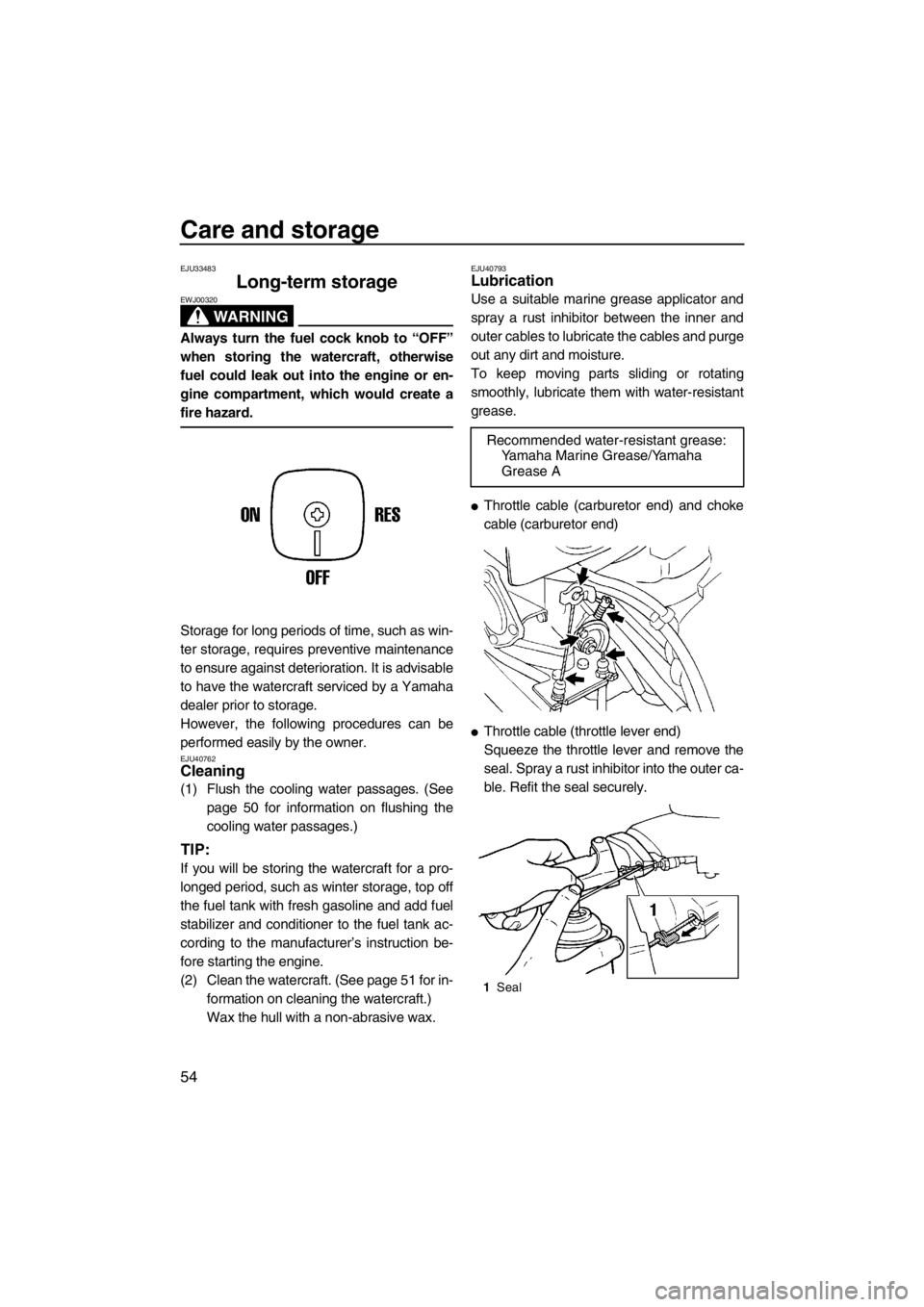
Care and storage
54
EJU33483
Long-term storage
WARNING
EWJ00320
Always turn the fuel cock knob to “OFF”
when storing the watercraft, otherwise
fuel could leak out into the engine or en-
gine compartment, which would create a
fire hazard.
Storage for long periods of time, such as win-
ter storage, requires preventive maintenance
to ensure against deterioration. It is advisable
to have the watercraft serviced by a Yamaha
dealer prior to storage.
However, the following procedures can be
performed easily by the owner.
EJU40762Cleaning
(1) Flush the cooling water passages. (Seepage 50 for information on flushing the
cooling water passages.)
TIP:
If you will be storing the watercraft for a pro-
longed period, such as winter storage, top off
the fuel tank with fresh gasoline and add fuel
stabilizer and conditioner to the fuel tank ac-
cording to the manufacturer’s instruction be-
fore starting the engine.
(2) Clean the watercraft. (See page 51 for in-formation on cleaning the watercraft.)
Wax the hull with a non-abrasive wax.
EJU40793Lubrication
Use a suitable marine grease applicator and
spray a rust inhibitor between the inner and
outer cables to lubricate the cables and purge
out any dirt and moisture.
To keep moving parts sliding or rotating
smoothly, lubricate them with water-resistant
grease.
●Throttle cable (carburetor end) and choke
cable (carburetor end)
●Throttle cable (throttle lever end)
Squeeze the throttle lever and remove the
seal. Spray a rust inhibitor into the outer ca-
ble. Refit the seal securely.
Recommended water-resistant grease:Yamaha Marine Grease/Yamaha
Grease A
1 Seal
UF2F75E0.book Page 54 Thursday, July 5, 2012 8:50 AM
Page 69 of 78

Specifications
63
EJU34542
Specifications
Watercraft capacity:
Maximum people on board:1 person
Dimensions:
Length:2240 mm (88.2 in)
Width:
680 mm (26.8 in)
Height: 660 mm (26.0 in)
Dry weight: 139 kg (306 lb)
Performance:
Maximum output (according to ISO 8665/SAE
J1228):48.5 kW@6250 r/min
Maximum fuel consumption:
29.0 L/h (7.7 US gal/h, 6.4 Imp.gal/h)
Cruising range at full throttle: 0.62 hour
Trolling speed: 1300 ±50 r/min
Engine:
Engine type:
2-stroke
Number of cylinders: 2
Engine displacement:
701 cm³
Bore & stroke: 81.0 × 68.0 mm (3.19 × 2.68 in)
Compression ratio: 7.2 : 1
Lubrication system:
Pre-mixed fuel and oil
Cooling system: Water
Starting system: Electric
Ignition system:
C.D.I.
Spark plug: BR7HS
Spark plug gap: 0.6–0.7 mm (0.024–0.028 in)
Battery capacity:
12 V, 19 Ah Charging system:
Flywheel magneto
Drive unit:
Propulsion system:
Jet pump
Jet pump type: Axial flow, single stage
Impeller rotation: Counterclockwise
Jet thrust nozzle angle:
P1: 14.4+14.4°
P2: 17.3+17.3°
Fuel and oil:
Recommended fuel:Regular unleaded gasoline
Minimum octane rating (PON): 86
Minimum octane rating (RON): 90
Recommended engine oil:
YAMALUBE 2-W or TC-W3 outboard motor oil or equivalent
Fuel mixing ratio (fuel to oil):
50 :1
Fuel tank total capacity: 18 L (4.8 US gal, 4.0 Imp.gal)
Fuel tank reserve capacity: 5.5 L (1.5 US gal, 1.2 Imp.gal)
UF2F75E0.book Page 63 Thursday, July 5, 2012 8:50 AM
Page 76 of 78

Index
2-stroke engine oil .................................... 28
A
After removing the watercraft from the water ..................................................... 49
B
Battery care .............................................. 51
Battery checks.......................................... 36
Battery, jumping ....................................... 67
Beaching the watercraft ........................... 49
Bilge water check ..................................... 36
Bilge water, draining................................. 30
Bilge water, draining on water .................. 30
Boarding and starting in deep water ........ 47
Boarding and starting in shallow water .... 46
Bow rope hole .......................................... 25
C
Capsized watercraft ................................. 48
Carburetor, adjusting................................ 62
Choke cable, adjusting ............................. 61
Choke knob .............................................. 21
Cleaning ................................................... 54
Cleaning the watercraft ............................ 51
Cooling water pilot outlet .......................... 21
Cooling water pilot outlet check ............... 39
Craft Identification Number (CIN) ............... 1
Cruising limitations ..................................... 9
E
Emergency procedures ............................ 66
Engine break-in ........................................ 32
Engine compartment check...................... 35
Engine idling speed, adjusting ................. 62
Engine overheat warning system ............. 22
Engine serial number ................................. 1
Engine shut-off cord (lanyard) check ....... 38
Engine shut-off switch .............................. 19
Engine stop switch ................................... 19
Engine unit check ..................................... 36
Enjoy your watercraft responsibly ............ 15
Equipment ................................................ 24
F
Fire extinguisher check ............................ 39
Fire extinguisher container ....................... 26
Fire extinguisher container checks........... 39
Flushing the cooling water passages ....... 50 Fuel .......................................................... 28
Fuel and engine oil requirements ............. 28
Fuel cock knob ......................................... 21
Fuel filter, checking .................................. 61
Fuel level check ....................................... 35
Fuel system checks .................................. 35
Fuel tank, filling ........................................ 29
Fuse, replacing ......................................... 67
G
Getting to know your watercraft ............... 40
Glossary, watercraft ................................. 16
H
Hazard information ................................... 13
Hood ......................................................... 24
Hood check .............................................. 39
Hull and deck check ................................. 39
I
Identification numbers ................................ 1
J
Jet intake and impeller, cleaning .............. 66
Jet intake checks ...................................... 39
Jet thrust nozzle angle, adjusting ............. 57
Jumper cables, connecting ...................... 67
L
Labels, important ........................................ 3
Labels, other .............................................. 7
Labels, warning .......................................... 4
Launching the watercraft .......................... 41
Learning to operate your watercraft ......... 40
Leaving the watercraft .............................. 43
Limitations on who may operate the
watercraft ................................................ 8
Long-term storage .................................... 54
Lubrication................................................ 54
Lubrication points ..................................... 61
M
Main components, location of .................. 17
Maintenance ............................................. 56
Manufactured date label ............................. 2
Mixing fuel and oil .................................... 28
O
Operating in weeded areas ...................... 49
Operating positions .................................. 40
Operating the watercraft ........................... 43
Operating your watercraft ......................... 40
UF2F75E0.book Page 1 Thursday, July 5, 2012 8:50 AM