cooling YAMAHA SUPERJET 2013 Owners Manual
[x] Cancel search | Manufacturer: YAMAHA, Model Year: 2013, Model line: SUPERJET, Model: YAMAHA SUPERJET 2013Pages: 78, PDF Size: 3.29 MB
Page 5 of 78

Table of contents
General and important labels ........... 1Identification numbers .................... 1
Primary Identification (PRI-ID)
number ........................................... 1
Craft Identification Number (CIN) ...... 1
Engine serial number ........................ 1
Manufactured date label .................... 2
Important labels .............................. 3
Warning labels ................................... 4
Other labels ....................................... 7
Safety information ............................. 8 Limitations on who may operate the watercraft .............................. 8
Cruising limitations ......................... 9
Operation requirements ............... 10
Recommended equipment ........... 12
Hazard information ....................... 13
Watercraft characteristics ............. 13
Safe boating rules ........................ 14
Enjoy your watercraft responsibly ................................ 15
Description....................................... 16 Watercraft glossary ...................... 16
Location of main components ...... 17
Control function operation ............. 19 Watercraft control functions ......... 19
Engine stop switch .......................... 19
Engine shut-off switch ..................... 19
Start switch ...................................... 19
Throttle lever ................................... 20
Steering system ............................... 20
Steering pole ................................... 20
Fuel cock knob ................................ 21
Choke knob ..................................... 21
Cooling water pilot outlet ................. 21
Water separator ............................... 22
Engine overheat warning system .... 22
Equipment operation ...................... 24Equipment .................................... 24
Hood ................................................ 24
Bow rope hole ................................. 25
Stern rope hole ................................ 25
Storage pouch ................................. 25
Fire extinguisher container .............. 26
Operation and handling
requirements ................................... 28Fuel and engine oil requirements ............................. 28
Fuel ................................................. 28
2-stroke engine oil ........................... 28
Mixing fuel and oil ............................ 28
Filling the fuel tank .......................... 29
Draining the bilge water ............... 30
Draining the bilge water on water .... 30
Transporting ................................. 31
First-time operation ........................ 32 Engine break-in ............................ 32
Pre-operation checks ..................... 33
Pre-operation checklist .................... 33
Pre-operation check points .......... 35
Pre-launch checks ........................... 35
Post-launch checks ......................... 39
Operation ......................................... 40 Operating your watercraft ............ 40
Getting to know your watercraft ....... 40
Learning to operate your
watercraft ..................................... 40
Operating positions ......................... 40
Launching the watercraft ................. 41
Starting the engine on water ........... 41
Stopping the engine ........................ 43
Leaving the watercraft ..................... 43
Operating the watercraft .................. 43
Turning the watercraft ..................... 43
Stopping the watercraft ................... 45
Starting off ....................................... 45
UF2F75E0.book Page 1 Thursday, July 5, 2012 8:50 AM
Page 6 of 78

Table of contents
Capsized watercraft ......................... 48
Beaching the watercraft ................... 49
Operating in weeded areas ............. 49
After removing the watercraft from the water ...................................... 49
Care and storage ............................. 50Post-operation care ...................... 50
Flushing the cooling water
passages ...................................... 50
Cleaning the watercraft ................... 51
Battery care ..................................... 51
Long-term storage ........................ 54
Cleaning .......................................... 54
Lubrication ....................................... 54
Rustproofing .................................... 55
Maintenance..................................... 56 Maintenance ................................. 56
Tool kit ............................................. 56
Adjusting the steering friction .......... 56
Adjusting the jet thrust nozzle
angle ............................................ 57
Periodic maintenance chart ............. 59
Checking the spark plugs ................ 60
Lubrication points ............................ 61
Checking the fuel filter ..................... 61
Adjusting the choke cable ............... 61
Adjusting the carburetor .................. 62
Specifications .................................. 63 Specifications ................................ 63
Trouble recovery ............................. 64 Troubleshooting ........................... 64
Troubleshooting chart ...................... 64
Emergency procedures ................ 66
Cleaning the jet intake and
impeller ........................................ 66
Jumping the battery ......................... 67
Replacing the fuse ........................... 67
Towing the watercraft ...................... 68
Submerged watercraft ..................... 68
UF2F75E0.book Page 2 Thursday, July 5, 2012 8:50 AM
Page 23 of 78
Description
17
EJU31011
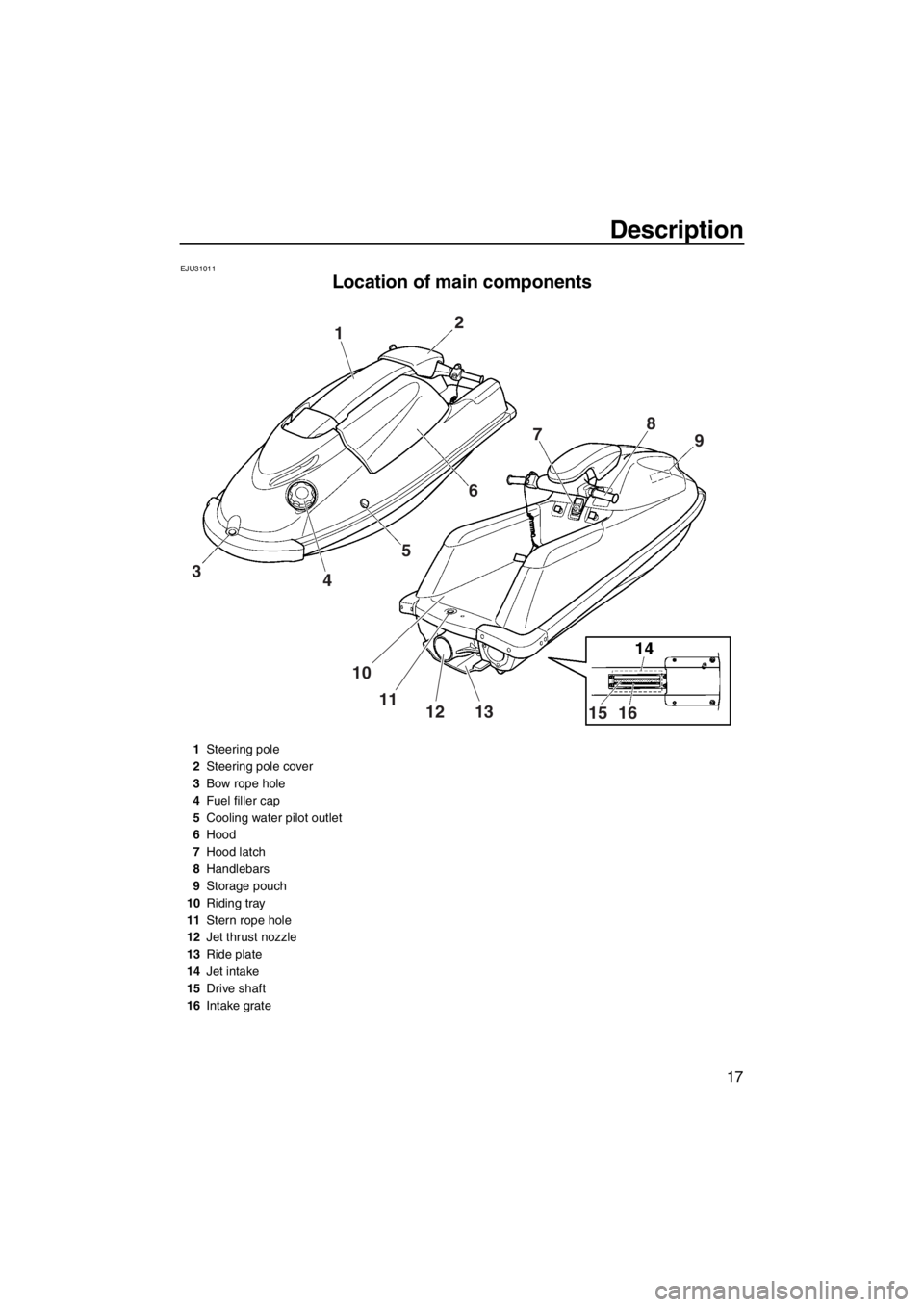
Location of main components
2
1
3 456
7
8
9
10 11 12 13 15 16
1Steering pole
2 Steering pole cover
3 Bow rope hole
4 Fuel filler cap
5 Cooling water pilot outlet
6 Hood
7 Hood latch
8 Handlebars
9 Storage pouch
10 Riding tray
11 Stern rope hole
12 Jet thrust nozzle
13 Ride plate
14 Jet intake
15 Drive shaft
16 Intake grate
UF2F75E0.book Page 17 Thursday, July 5, 2012 8:50 AM
Page 27 of 78
Control function operation
21
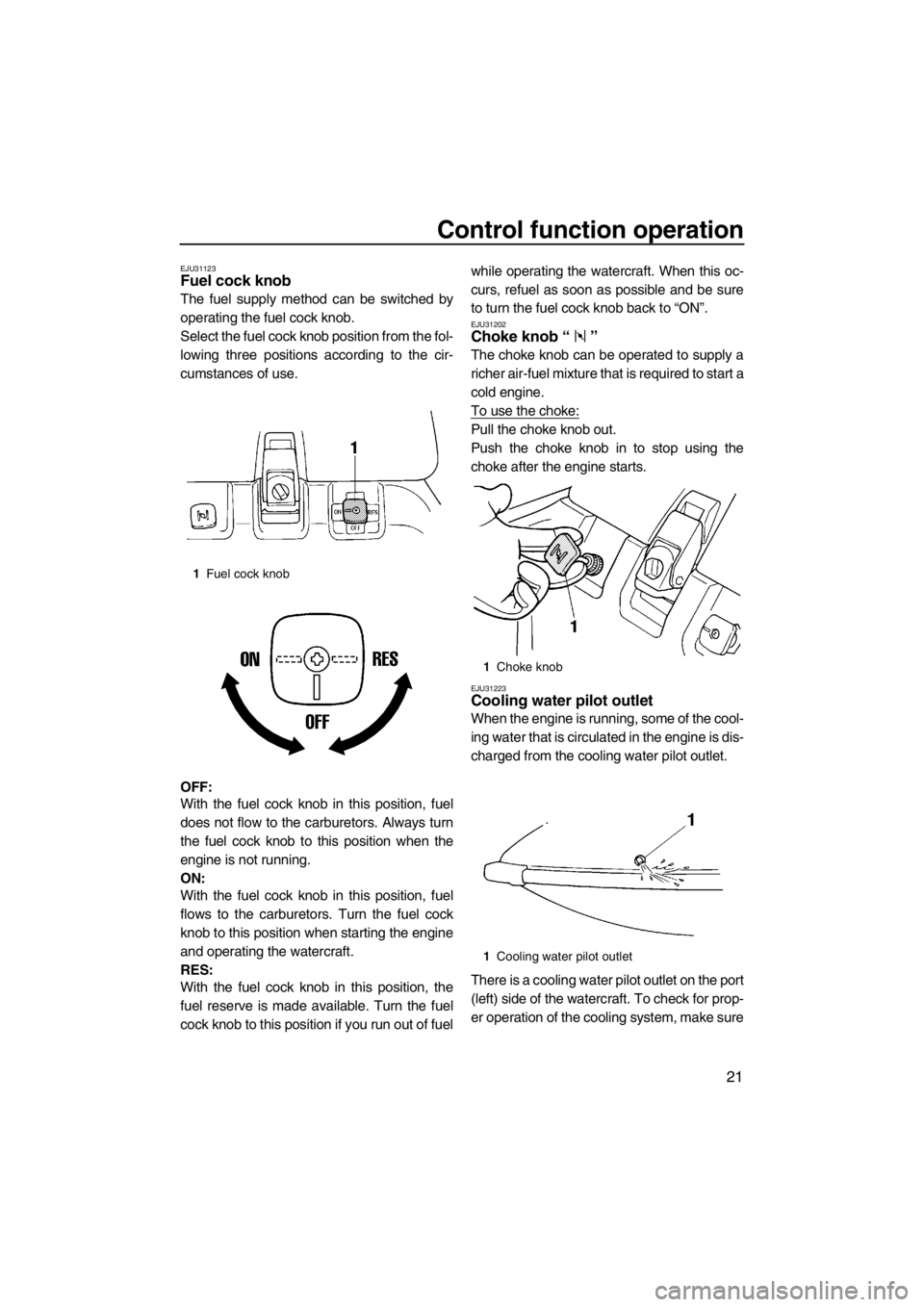
EJU31123Fuel cock knob
The fuel supply method can be switched by
operating the fuel cock knob.
Select the fuel cock knob position from the fol-
lowing three positions according to the cir-
cumstances of use.
OFF:
With the fuel cock knob in this position, fuel
does not flow to the carburetors. Always turn
the fuel cock knob to this position when the
engine is not running.
ON:
With the fuel cock knob in this position, fuel
flows to the carburetors. Turn the fuel cock
knob to this position when starting the engine
and operating the watercraft.
RES:
With the fuel cock knob in this position, the
fuel reserve is made available. Turn the fuel
cock knob to this position if you run out of fuelwhile operating the watercraft. When this oc-
curs, refuel as soon as possible and be sure
to turn the fuel cock knob back to “ON”.
EJU31202Choke knob “ ”
The choke knob can be operated to supply a
richer air-fuel mixture that is required to start a
cold engine.
To use the choke:
Pull the choke knob out.
Push the choke knob in to stop using the
choke after the engine starts.
EJU31223Cooling water pilot outlet
When the engine is running, some of the cool-
ing water that is circulated in the engine is dis-
charged from the cooling water pilot outlet.
There is a cooling water pilot outlet on the port
(left) side of the watercraft. To check for prop-
er operation of the cooling system, make sure
1
Fuel cock knob
1Choke knob
1 Cooling water pilot outlet
UF2F75E0.book Page 21 Thursday, July 5, 2012 8:50 AM
Page 29 of 78
Control function operation
23
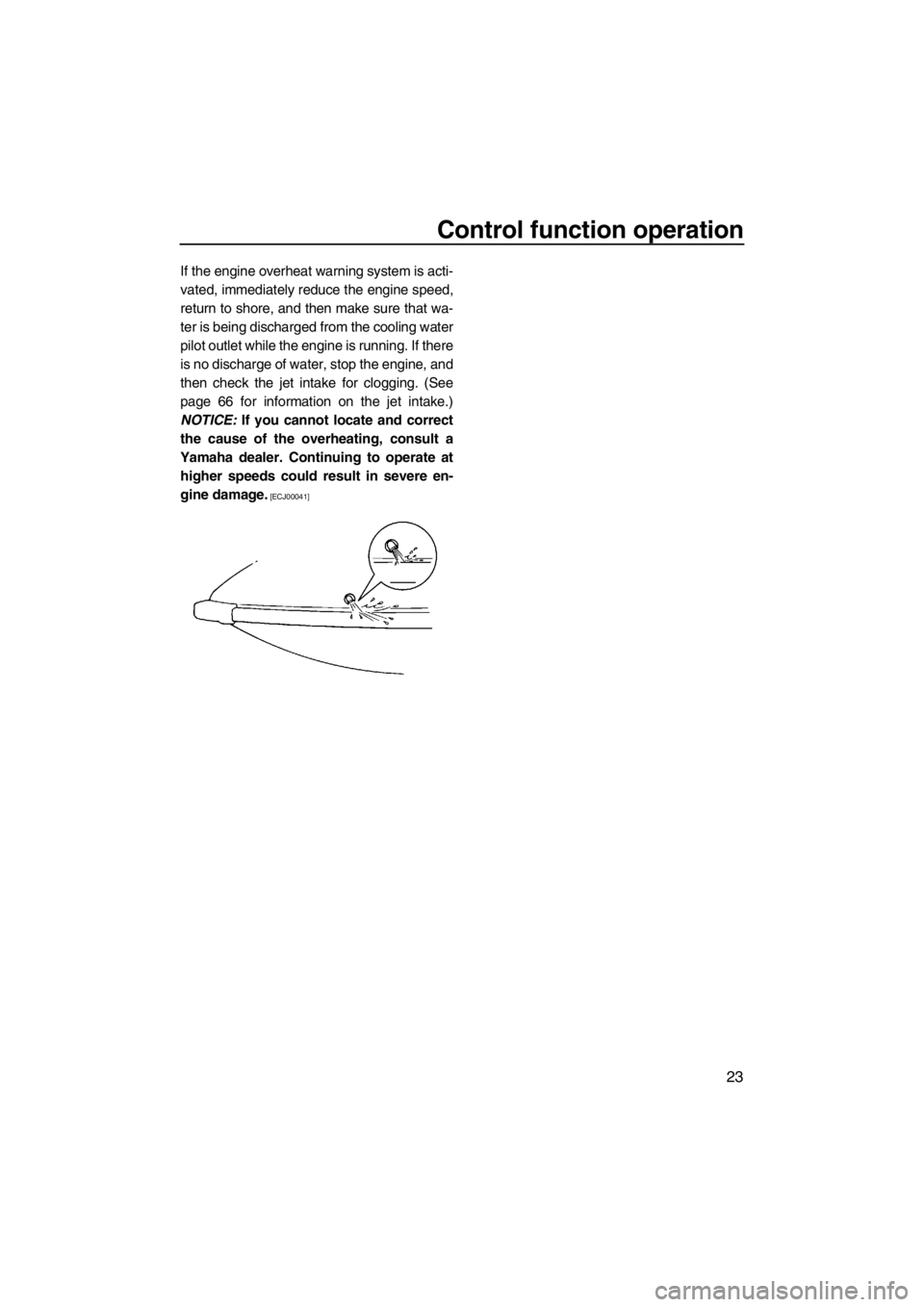
If the engine overheat warning system is acti-
vated, immediately reduce the engine speed,
return to shore, and then make sure that wa-
ter is being discharged from the cooling water
pilot outlet while the engine is running. If there
is no discharge of water, stop the engine, and
then check the jet intake for clogging. (See
page 66 for information on the jet intake.)
NOTICE: If you cannot locate and correct
the cause of the overheating, consult a
Yamaha dealer. Continuing to operate at higher speeds could result in severe en-
gine damage.
[ECJ00041]
UF2F75E0.book Page 23 Thursday, July 5, 2012 8:50 AM
Page 39 of 78

Pre-operation checks
33
EJU31981
WARNING
EWJ00411
Failure to inspect or maintain the watercraft properly increases the possibility of an ac-
cident or damage to the watercraft. Do not operate the watercraft if you find any prob-
lem. If a problem cannot be corrected by the procedures provided in this manual, have
the watercraft inspected by a Yamaha dealer.
EJU41232Pre-operation checklist
Before using this watercraft, be sure to perform the checks in the following checklist.
ITEM ROUTINEPAGE
PRE-LAUNCH CHECKS
Engine compartment Ventilate the engine compartment.
Check inside the engine compartment for damage.
35
Fuel system Check the fuel system for leakage.
Check the fuel level in the fuel tank.
35
Water separator Check the water separator for water. 36
Engine unit Check the exterior of the engine unit for damage. 36
Bilge water Check the engine compartment for bilge water. 36
Battery Check the battery connections and electrolyte level. 36
Steering system Check the steering system for proper operation. 36
Throttle lever Check the throttle lever for proper operation.
Check the throttle lever free play.
37
Engine shut-off cord (lan-
yard) Check the engine shut-off cord (lanyard) for dam-
age.
38
Switches Check the start switch, engine stop switch, and en-
gine shut-off switch for proper operation.
38
Storage pouch Check the storage pouch for damage and water.
Check that the storage pouch is securely installed.
38
Fire extinguisher container Check the fire extinguisher container for damage. 39
Fire extinguisher Check the condition of the fire extinguisher. 39
Safety equipment Check that safety equipment meeting the applicable
regulations is on board.
39
Hull and deck Check the hull and deck for damage. 39
Jet intake Check the jet intake for damage and clogging. 39
Hood Check that the hood is securely closed. 39
POST-LAUNCH CHECKS
Cooling water pilot outlet Check that water is discharged from the cooling wa-
ter pilot outlet while the engine is running.
39
UF2F75E0.book Page 33 Thursday, July 5, 2012 8:50 AM
Page 45 of 78
Pre-operation checks
39
pouch is securely installed. (See page 25 for
information on the storage pouch.)
EJU41071Fire extinguisher container checks
Make sure that the fire extinguisher container
is not damaged and is securely held in place.
(See page 26 for information on the fire extin-
guisher container.)
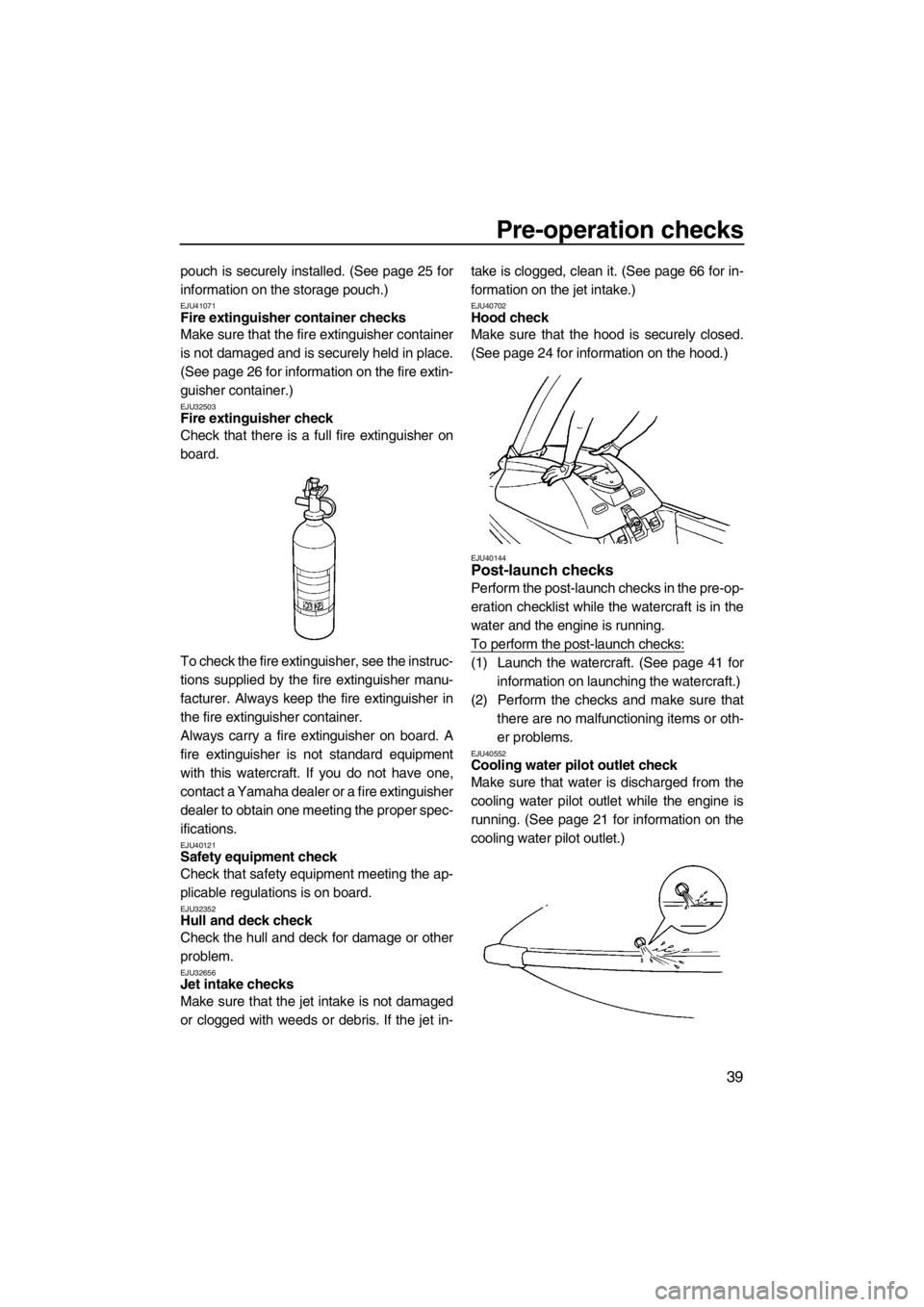
EJU32503Fire extinguisher check
Check that there is a full fire extinguisher on
board.
To check the fire extinguisher, see the instruc-
tions supplied by the fire extinguisher manu-
facturer. Always keep the fire extinguisher in
the fire extinguisher container.
Always carry a fire extinguisher on board. A
fire extinguisher is not standard equipment
with this watercraft. If you do not have one,
contact a Yamaha dealer or a fire extinguisher
dealer to obtain one meeting the proper spec-
ifications.
EJU40121Safety equipment check
Check that safety equipment meeting the ap-
plicable regulations is on board.
EJU32352Hull and deck check
Check the hull and deck for damage or other
problem.
EJU32656Jet intake checks
Make sure that the jet intake is not damaged
or clogged with weeds or debris. If the jet in-take is clogged, clean it. (See page 66 for in-
formation on the jet intake.)
EJU40702Hood check
Make sure that the hood is securely closed.
(See page 24 for information on the hood.)
EJU40144Post-launch checks
Perform the post-launch checks in the pre-op-
eration checklist while the watercraft is in the
water and the engine is running.
To perform the post-launch checks:
(1) Launch the watercraft. (See page 41 for
information on launching the watercraft.)
(2) Perform the checks and make sure that there are no malfunctioning items or oth-
er problems.
EJU40552Cooling water pilot outlet check
Make sure that water is discharged from the
cooling water pilot outlet while the engine is
running. (See page 21 for information on the
cooling water pilot outlet.)
UF2F75E0.book Page 39 Thursday, July 5, 2012 8:50 AM
Page 55 of 78

Operation
49
see “Towing the watercraft” on page 68
or “Submerged watercraft” on page 68.)
NOTICE: Do not run the engine at full
throttle for at least 1 minute after the
engine has been restarted. Bilge water
in the engine compartment can splash
into the engine, which can result in se-
vere damage.
[ECJ00553]
EJU33302
Beaching the watercraft
To beach the watercraft:
(1) Make sure that there are no boats, swim- mers, or obstacles near the beach.
(2) Release the throttle lever to reduce speed about 90 m (300 ft) before you
reach the intended beaching area.
(3) Slowly approach the beach and stop the engine just before reaching land.
WARNING! You need throttle to steer. Shutting the engine off can cause you
to hit an obstacle you are attempting
to avoid. A collision could result in se-
vere injury or death.
[EWJ00601] NOTICE:
Never run the engine in water that is
less than 60 cm (2 ft) deep from the
bottom of the watercraft, otherwise
pebbles or sand could be sucked into
the jet intake, causing impeller dam-
age and engine overheating.
[ECJ00472]
(4) Get off the watercraft and pull it up on the beach.
EJU37193Operating in weeded areas
Always avoid using your watercraft in areas
where weed growth is thick. If operating in
weeded areas is unavoidable, alternately
squeeze the throttle lever and relax your grip
on the throttle lever to vary the engine speed.
Weeds tend to become clogged more when
operating at a steady speed and at trolling
speed. If weeds may have clogged the intake area, clean the jet intake. (See page 66 for in-
formation on the jet intake.)
EJU41060After removing the watercraft from the
water
NOTICE
ECJ01360
Do not run the engine for more than 15
seconds on land without supplying water,
otherwise the engine could overheat.
After operating and removing the watercraft
from the water, promptly discharge the re-
maining water from the cooling water passag-
es.
To discharge water from the cooling water
passages:
(1) Make sure that the area around the wa-
tercraft is clear, and then start the engine.
(2) Discharge the remaining water out of the cooling water passages by alternately
squeezing and releasing the throttle lever
quickly for 10 to 15 seconds.
(3) Stop the engine.
UF2F75E0.book Page 49 Thursday, July 5, 2012 8:50 AM
Page 56 of 78
Care and storage
50
EJU41191
Post-operation care
WARNING
EWJ00320
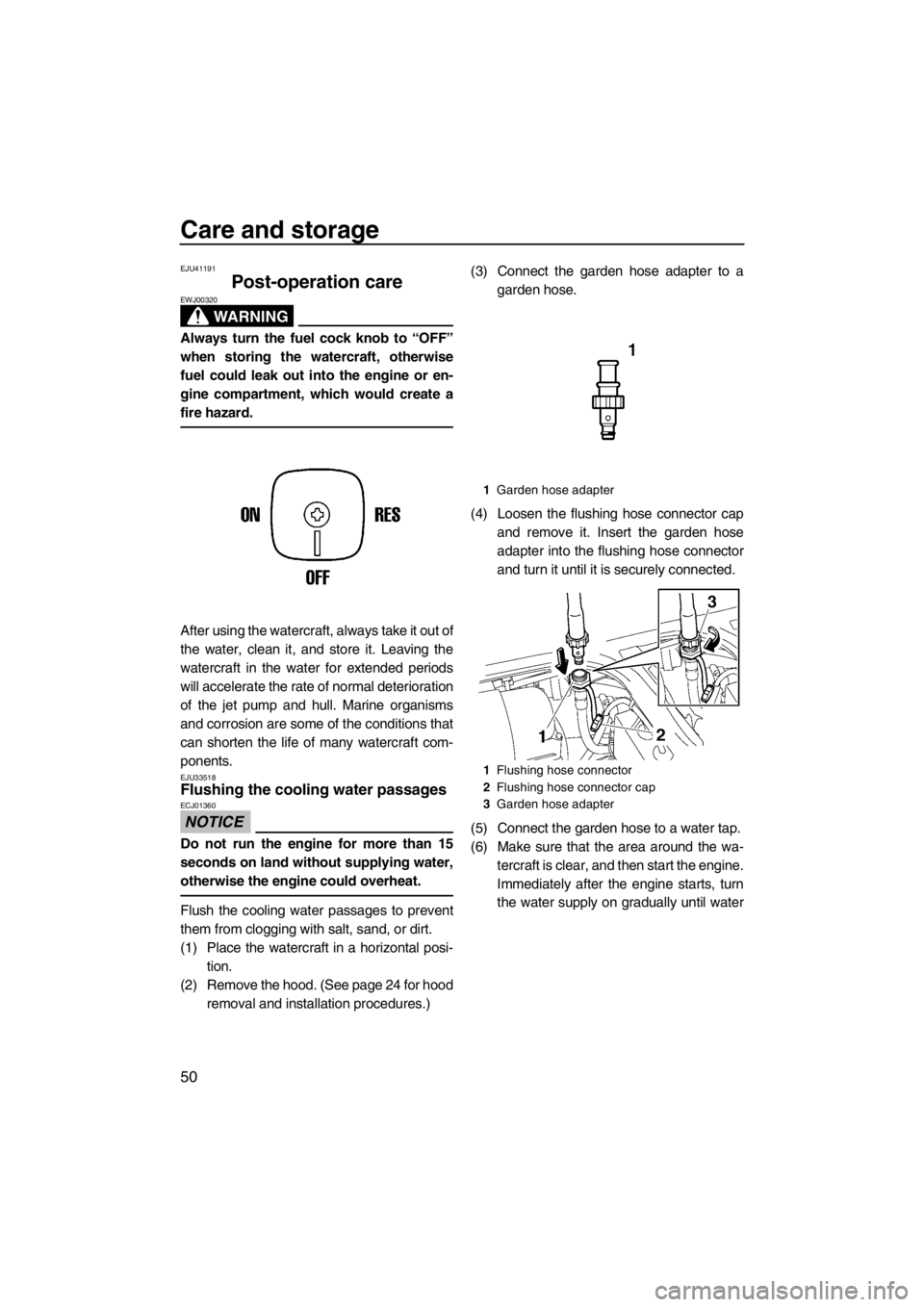
Always turn the fuel cock knob to “OFF”
when storing the watercraft, otherwise
fuel could leak out into the engine or en-
gine compartment, which would create a
fire hazard.
After using the watercraft, always take it out of
the water, clean it, and store it. Leaving the
watercraft in the water for extended periods
will accelerate the rate of normal deterioration
of the jet pump and hull. Marine organisms
and corrosion are some of the conditions that
can shorten the life of many watercraft com-
ponents.
EJU33518Flushing the cooling water passages
NOTICE
ECJ01360
Do not run the engine for more than 15
seconds on land without supplying water,
otherwise the engine could overheat.
Flush the cooling water passages to prevent
them from clogging with salt, sand, or dirt.
(1) Place the watercraft in a horizontal posi-tion.
(2) Remove the hood. (See page 24 for hood removal and installation procedures.) (3) Connect the garden hose adapter to a
garden hose.
(4) Loosen the flushing hose connector cap and remove it. Insert the garden hose
adapter into the flushing hose connector
and turn it until it is securely connected.
(5) Connect the garden hose to a water tap.
(6) Make sure that the area around the wa- tercraft is clear, and then start the engine.
Immediately after the engine starts, turn
the water supply on gradually until water
1Garden hose adapter
1 Flushing hose connector
2 Flushing hose connector cap
3 Garden hose adapter
UF2F75E0.book Page 50 Thursday, July 5, 2012 8:50 AM
Page 57 of 78
Care and storage
51
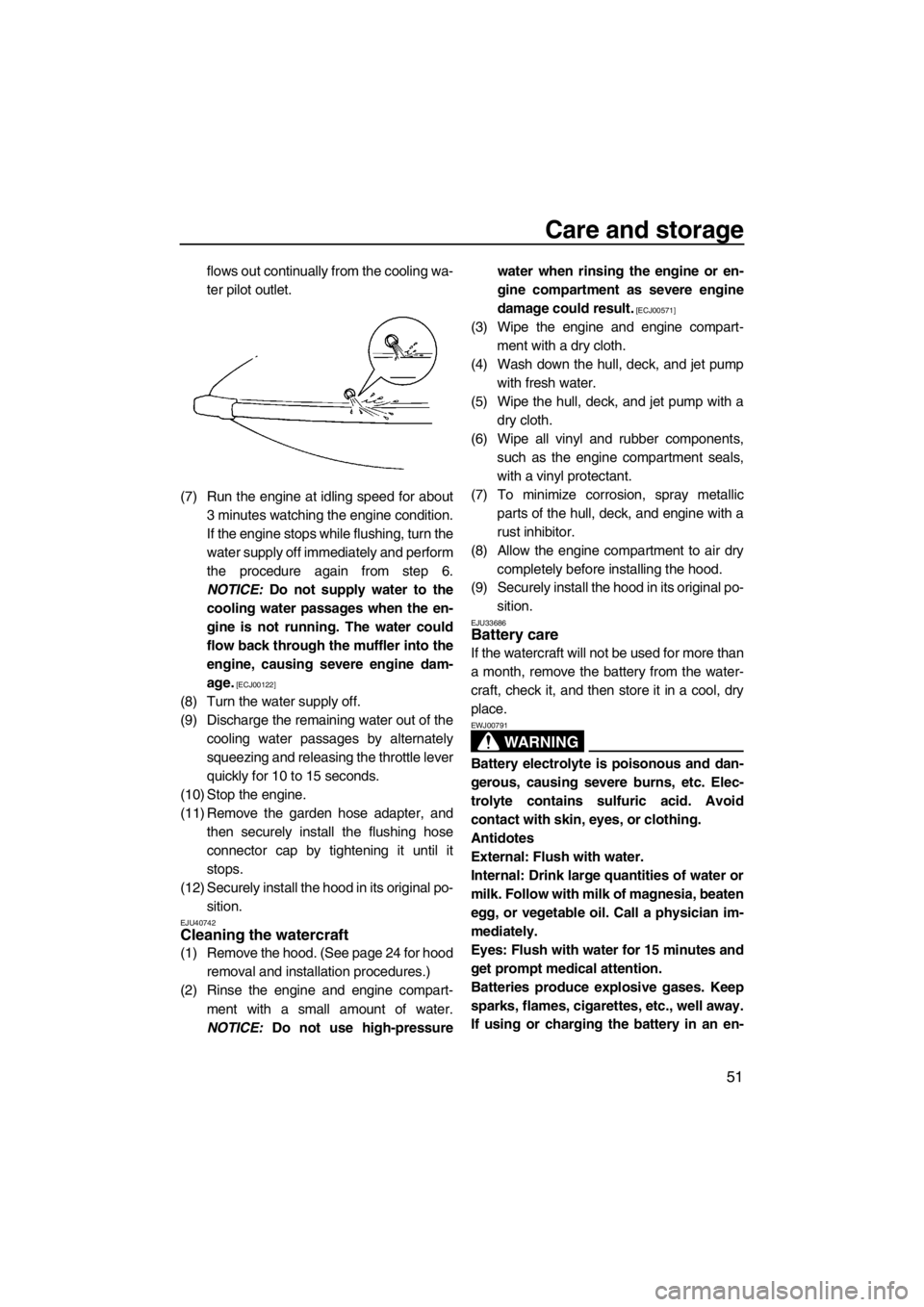
flows out continually from the cooling wa-
ter pilot outlet.
(7) Run the engine at idling speed for about 3 minutes watching the engine condition.
If the engine stops while flushing, turn the
water supply off immediately and perform
the procedure again from step 6.
NOTICE: Do not supply water to the
cooling water passages when the en-
gine is not running. The water could
flow back through the muffler into the
engine, causing severe engine dam-
age.
[ECJ00122]
(8) Turn the water supply off.
(9) Discharge the remaining water out of the cooling water passages by alternately
squeezing and releasing the throttle lever
quickly for 10 to 15 seconds.
(10) Stop the engine.
(11) Remove the garden hose adapter, and then securely install the flushing hose
connector cap by tightening it until it
stops.
(12) Securely install the hood in its original po- sition.
EJU40742Cleaning the watercraft
(1) Remove the hood. (See page 24 for hoodremoval and installation procedures.)
(2) Rinse the engine and engine compart-
ment with a small amount of water.
NOTICE: Do not use high-pressure water when rinsing the engine or en-
gine compartment as severe engine
damage could result.
[ECJ00571]
(3) Wipe the engine and engine compart-
ment with a dry cloth.
(4) Wash down the hull, deck, and jet pump with fresh water.
(5) Wipe the hull, deck, and jet pump with a dry cloth.
(6) Wipe all vinyl and rubber components, such as the engine compartment seals,
with a vinyl protectant.
(7) To minimize corrosion, spray metallic parts of the hull, deck, and engine with a
rust inhibitor.
(8) Allow the engine compartment to air dry completely before installing the hood.
(9) Securely install the hood in its original po- sition.
EJU33686Battery care
If the watercraft will not be used for more than
a month, remove the battery from the water-
craft, check it, and then store it in a cool, dry
place.
WARNING
EWJ00791
Battery electrolyte is poisonous and dan-
gerous, causing severe burns, etc. Elec-
trolyte contains sulfuric acid. Avoid
contact with skin, eyes, or clothing.
Antidotes
External: Flush with water.
Internal: Drink large quantities of water or
milk. Follow with milk of magnesia, beaten
egg, or vegetable oil. Call a physician im-
mediately.
Eyes: Flush with water for 15 minutes and
get prompt medical attention.
Batteries produce explosive gases. Keep
sparks, flames, cigarettes, etc., well away.
If using or charging the battery in an en-
UF2F75E0.book Page 51 Thursday, July 5, 2012 8:50 AM