steering YAMAHA SUPERJET 2013 User Guide
[x] Cancel search | Manufacturer: YAMAHA, Model Year: 2013, Model line: SUPERJET, Model: YAMAHA SUPERJET 2013Pages: 78, PDF Size: 3.29 MB
Page 42 of 78
Pre-operation checks
36
Add fuel if necessary. (See page 29 for infor-
mation on filling the fuel tank.)
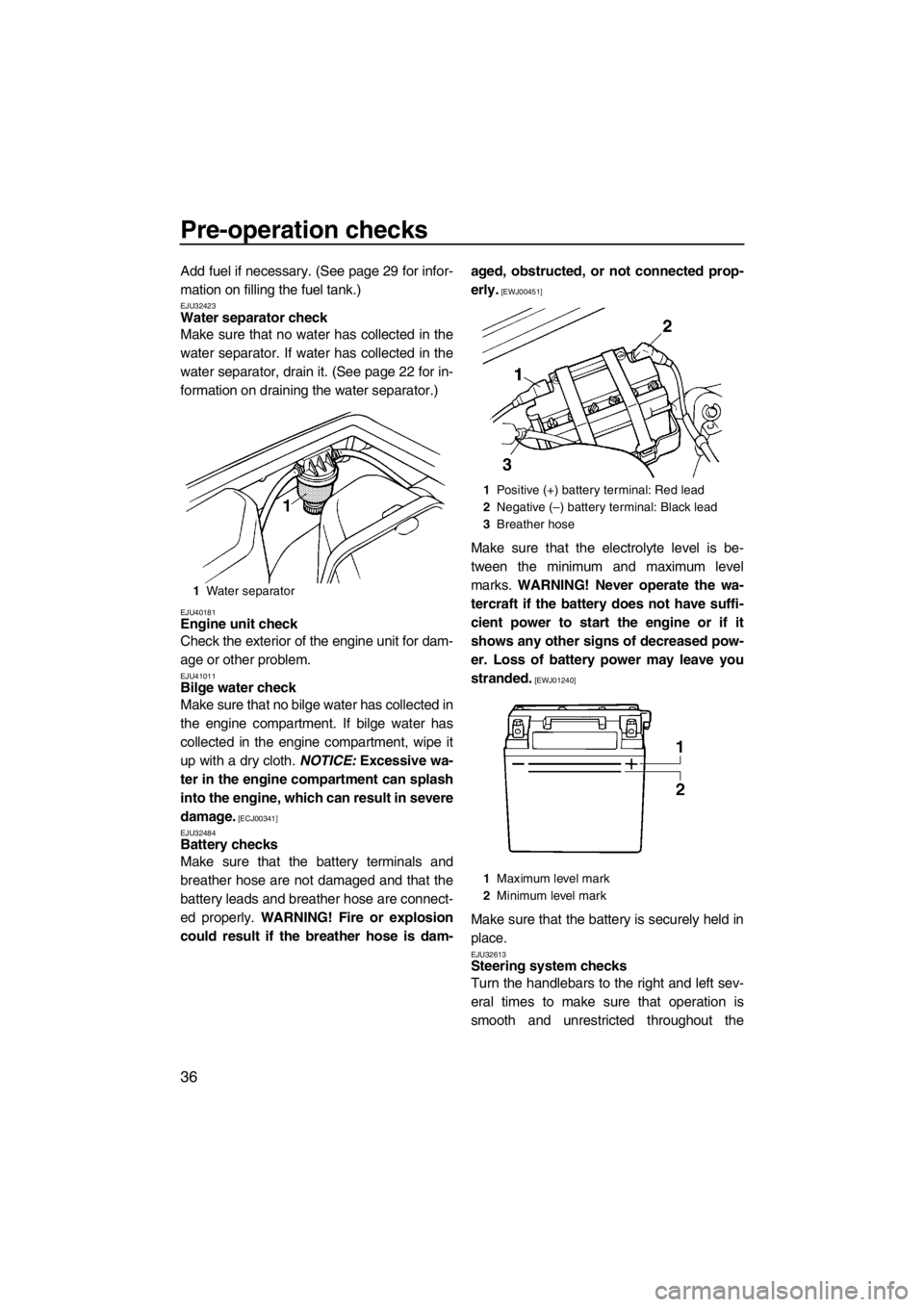
EJU32423Water separator check
Make sure that no water has collected in the
water separator. If water has collected in the
water separator, drain it. (See page 22 for in-
formation on draining the water separator.)
EJU40181Engine unit check
Check the exterior of the engine unit for dam-
age or other problem.
EJU41011Bilge water check
Make sure that no bilge water has collected in
the engine compartment. If bilge water has
collected in the engine compartment, wipe it
up with a dry cloth. NOTICE: Excessive wa-
ter in the engine compartment can splash
into the engine, which can result in severe
damage.
[ECJ00341]
EJU32484
Battery checks
Make sure that the battery terminals and
breather hose are not damaged and that the
battery leads and breather hose are connect-
ed properly. WARNING! Fire or explosion
could result if the breather hose is dam- aged, obstructed, or not connected prop-
erly.
[EWJ00451]
Make sure that the electrolyte level is be-
tween the minimum and maximum level
marks.
WARNING! Never operate the wa-
tercraft if the battery does not have suffi-
cient power to start the engine or if it
shows any other signs of decreased pow-
er. Loss of battery power may leave you
stranded.
[EWJ01240]
Make sure that the battery is securely held in
place.
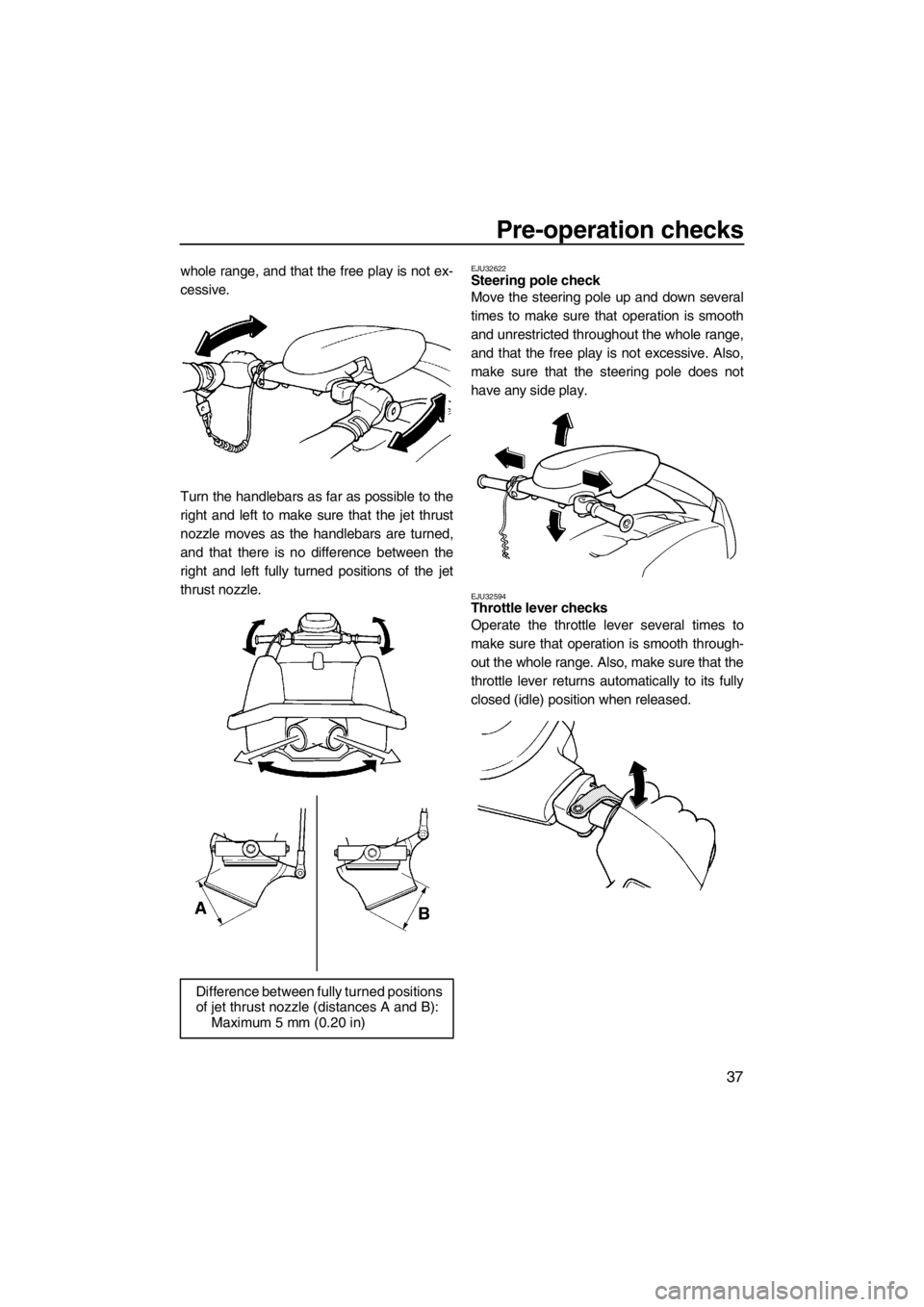
EJU32613Steering system checks
Turn the handlebars to the right and left sev-
eral times to make sure that operation is
smooth and unrestricted throughout the
1 Water separator
1Positive (+) battery terminal: Red lead
2 Negative (–) battery terminal: Black lead
3 Breather hose
1 Maximum level mark
2 Minimum level mark
UF2F75E0.book Page 36 Thursday, July 5, 2012 8:50 AM
Page 43 of 78
Pre-operation checks
37
whole range, and that the free play is not ex-
cessive.
Turn the handlebars as far as possible to the
right and left to make sure that the jet thrust
nozzle moves as the handlebars are turned,
and that there is no difference between the
right and left fully turned positions of the jet
thrust nozzle.EJU32622Steering pole check
Move the steering pole up and down several
times to make sure that operation is smooth
and unrestricted throughout the whole range,
and that the free play is not excessive. Also,
make sure that the steering pole does not
have any side play.
EJU32594Throttle lever checks
Operate the throttle lever several times to
make sure that operation is smooth through-
out the whole range. Also, make sure that the
throttle lever returns automatically to its fully
closed (idle) position when released.
Difference between fully turned positions
of jet thrust nozzle (distances A and B): Maximum 5 mm (0.20 in)
UF2F75E0.book Page 37 Thursday, July 5, 2012 8:50 AM
Page 49 of 78
Operation
43
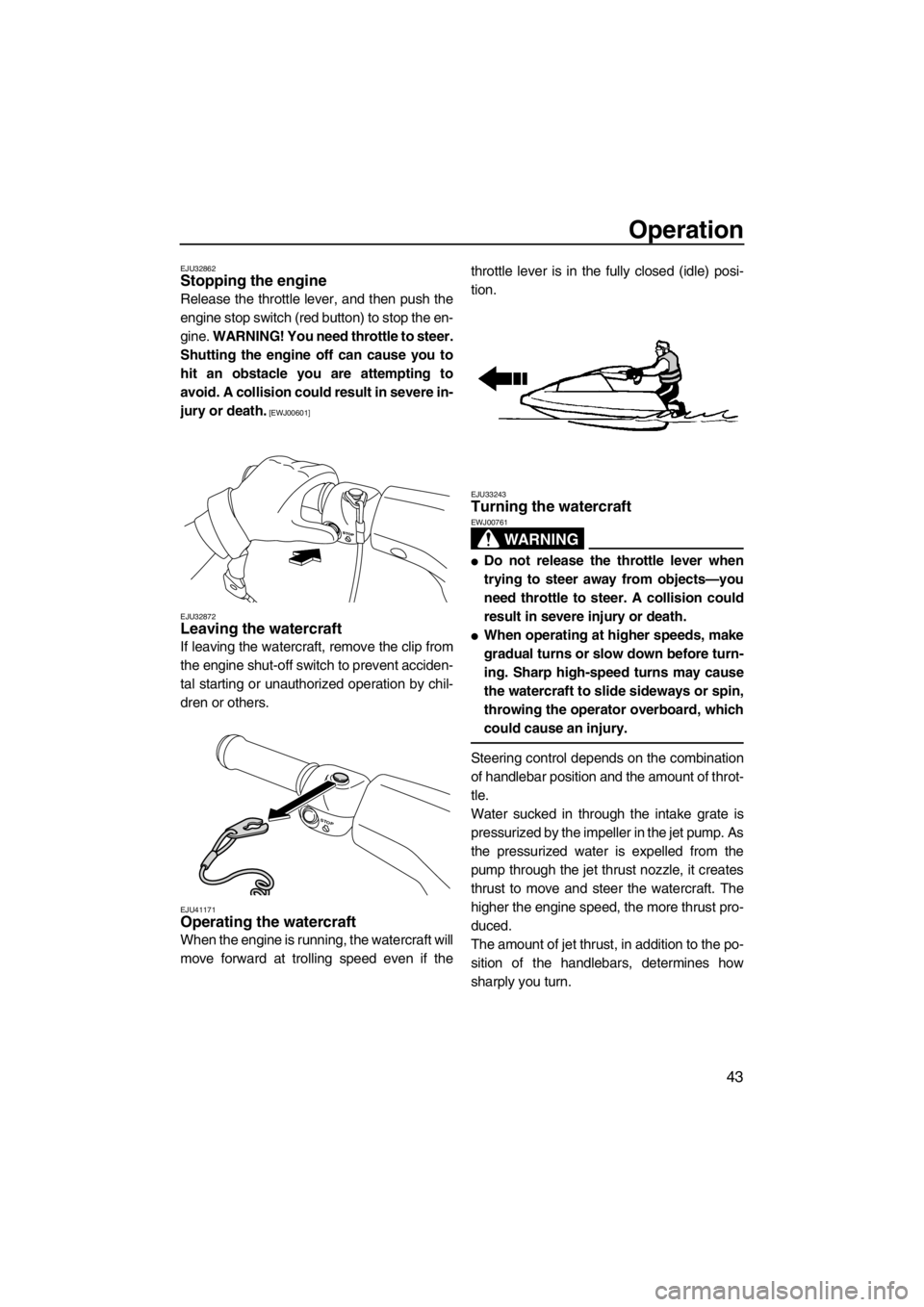
EJU32862Stopping the engine
Release the throttle lever, and then push the
engine stop switch (red button) to stop the en-
gine. WARNING! You need throttle to steer.
Shutting the engine off can cause you to
hit an obstacle you are attempting to
avoid. A collision could result in severe in-
jury or death.
[EWJ00601]
EJU32872
Leaving the watercraft
If leaving the watercraft, remove the clip from
the engine shut-off switch to prevent acciden-
tal starting or unauthorized operation by chil-
dren or others.
EJU41171Operating the watercraft
When the engine is running, the watercraft will
move forward at trolling speed even if the throttle lever is in the fully closed (idle) posi-
tion.
EJU33243Turning the watercraft
WARNING
EWJ00761
●Do not release the throttle lever when
trying to steer away from objects—you
need throttle to steer. A collision could
result in severe injury or death.
●When operating at higher speeds, make
gradual turns or slow down before turn-
ing. Sharp high-speed turns may cause
the watercraft to slide sideways or spin,
throwing the operator overboard, which
could cause an injury.
Steering control depends on the combination
of handlebar position and the amount of throt-
tle.
Water sucked in through the intake grate is
pressurized by the impeller in the jet pump. As
the pressurized water is expelled from the
pump through the jet thrust nozzle, it creates
thrust to move and steer the watercraft. The
higher the engine speed, the more thrust pro-
duced.
The amount of jet thrust, in addition to the po-
sition of the handlebars, determines how
sharply you turn.
STOP
UF2F75E0.book Page 43 Thursday, July 5, 2012 8:50 AM
Page 61 of 78
Care and storage
55
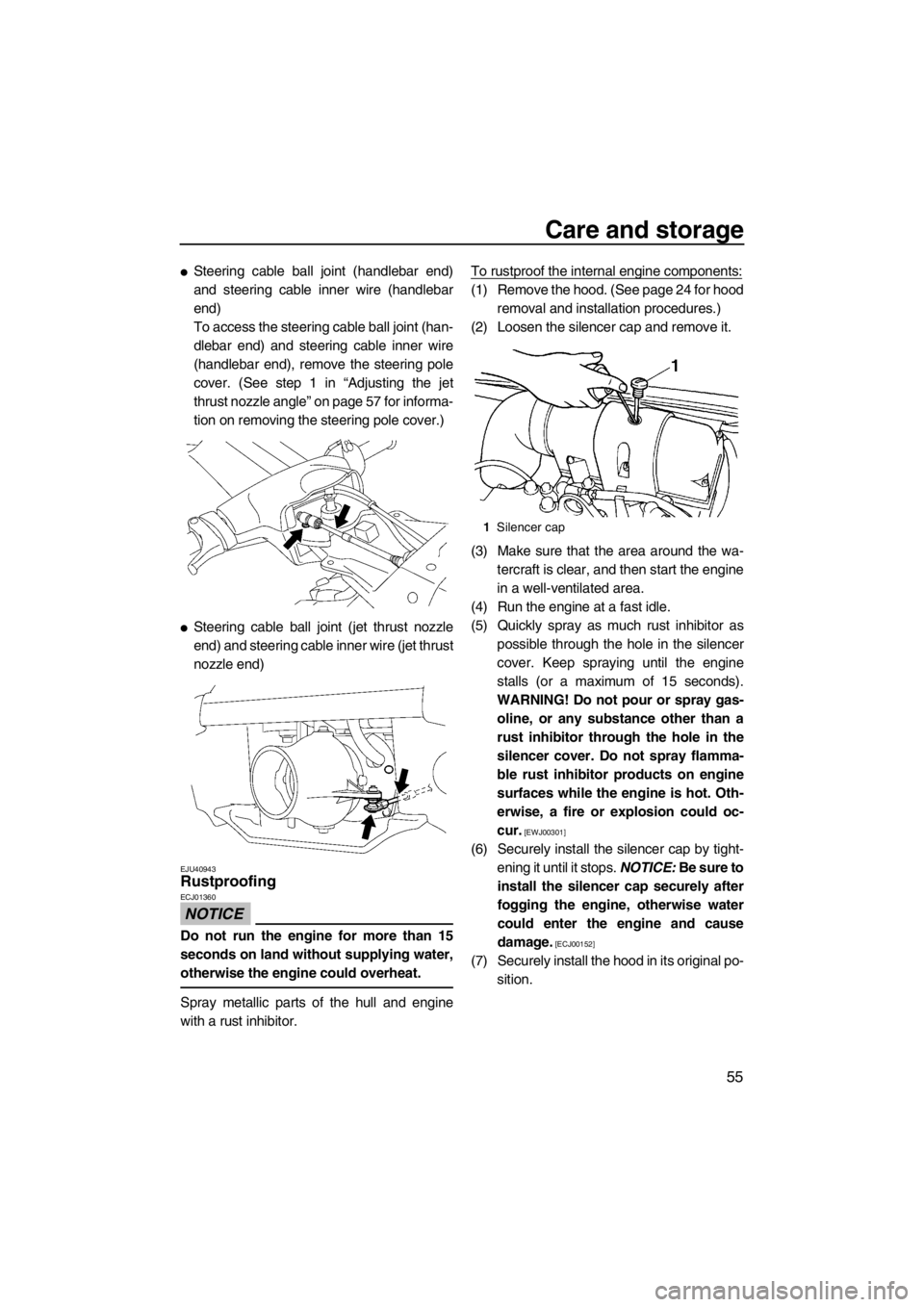
●Steering cable ball joint (handlebar end)
and steering cable inner wire (handlebar
end)
To access the steering cable ball joint (han-
dlebar end) and steering cable inner wire
(handlebar end), remove the steering pole
cover. (See step 1 in “Adjusting the jet
thrust nozzle angle” on page 57 for informa-
tion on removing the steering pole cover.)
●Steering cable ball joint (jet thrust nozzle
end) and steering cable inner wire (jet thrust
nozzle end)
EJU40943Rustproofing
NOTICE
ECJ01360
Do not run the engine for more than 15
seconds on land without supplying water,
otherwise the engine could overheat.
Spray metallic parts of the hull and engine
with a rust inhibitor.To rustproof the internal engine components:
(1) Remove the hood. (See page 24 for hood
removal and installation procedures.)
(2) Loosen the silencer cap and remove it.
(3) Make sure that the area around the wa- tercraft is clear, and then start the engine
in a well-ventilated area.
(4) Run the engine at a fast idle.
(5) Quickly spray as much rust inhibitor as possible through the hole in the silencer
cover. Keep spraying until the engine
stalls (or a maximum of 15 seconds).
WARNING! Do not pour or spray gas- oline, or any substance other than a
rust inhibitor through the hole in the
silencer cover. Do not spray flamma-
ble rust inhibitor products on engine
surfaces while the engine is hot. Oth-
erwise, a fire or explosion could oc-
cur.
[EWJ00301]
(6) Securely install the silencer cap by tight- ening it until it stops. NOTICE: Be sure to
install the silencer cap securely after
fogging the engine, otherwise water
could enter the engine and cause
damage.
[ECJ00152]
(7) Securely install the hood in its original po- sition.
1Silencer cap
UF2F75E0.book Page 55 Thursday, July 5, 2012 8:50 AM
Page 62 of 78
Maintenance
56
EJU33768
Maintenance
Periodic checks and lubrication will keep your
watercraft in the safest and most efficient con-
dition possible. Therefore, make sure to carry
out the periodic maintenance. Safety is an ob-
ligation of the watercraft owner. Proper main-
tenance must be carried out to keep the
exhaust emission and sound levels within the
regulated limits. The most important points of
watercraft inspection and lubrication are ex-
plained on the following pages.
See a Yamaha dealer for genuine Yamaha re-
placement parts and optional accessories de-
signed for your watercraft.
Remember, failures that are the result of the
installation of parts or accessories which are
not qualitatively equivalent to genuine
Yamaha parts are not covered by the limited warranty.
Maintenance, replacement, or repair of the
emission control devices and system may
be performed by any marine SI engine re-
pair establishment or individual. Warranty
repair, however, must be performed at an
authorized Yamaha marine dealership.
WARNING
EWJ00311
Be sure to turn off the engine when you
perform maintenance unless otherwise
specified. If you are not familiar with ma-
chine servicing, this work should be done
by a Yamaha dealer or other qualified me-
chanic.
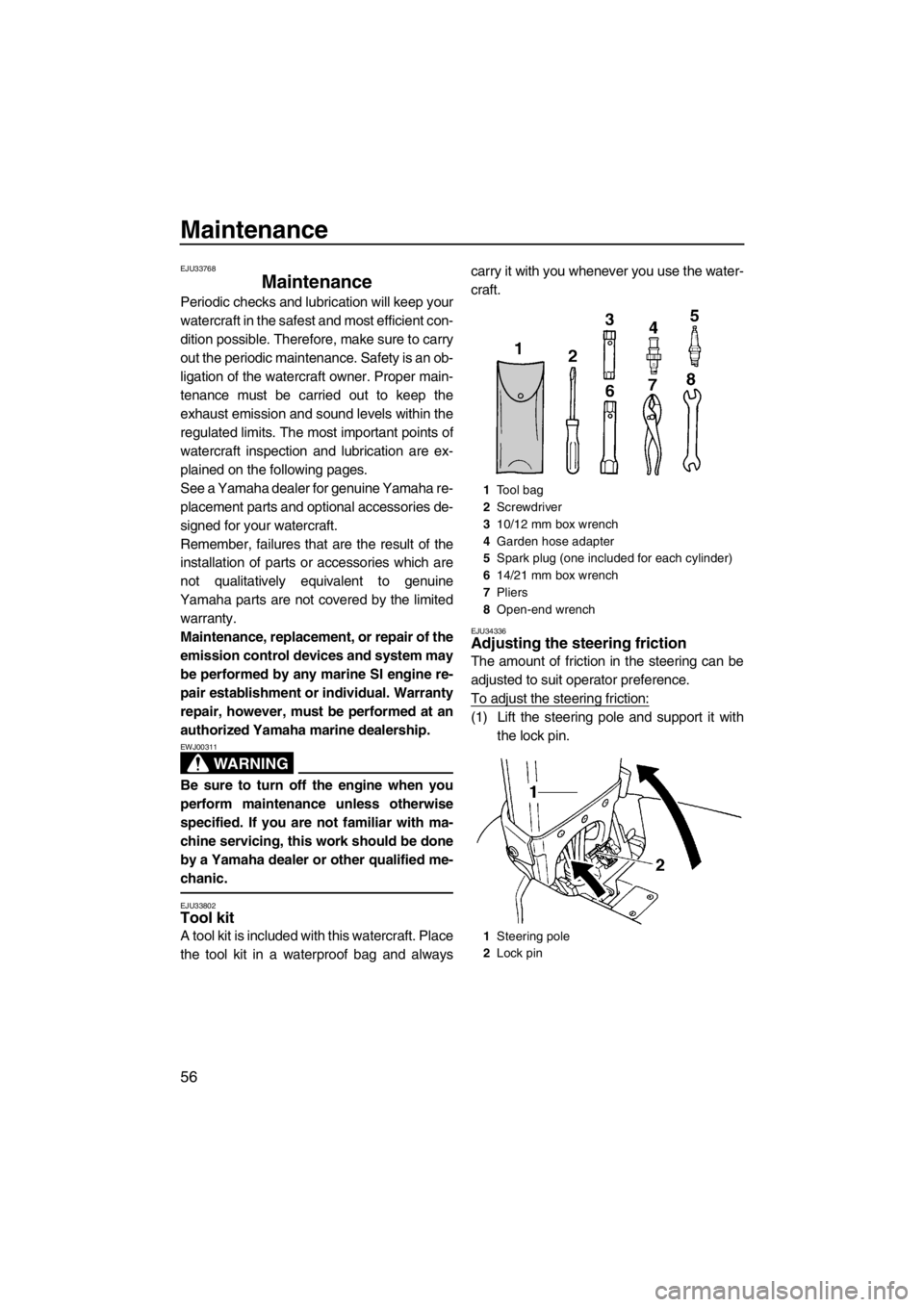
EJU33802Tool kit
A tool kit is included with this watercraft. Place
the tool kit in a waterproof bag and always carry it with you whenever you use the water-
craft.
EJU34336Adjusting the steering friction
The amount of friction in the steering can be
adjusted to suit operator preference.
To adjust the steering friction:
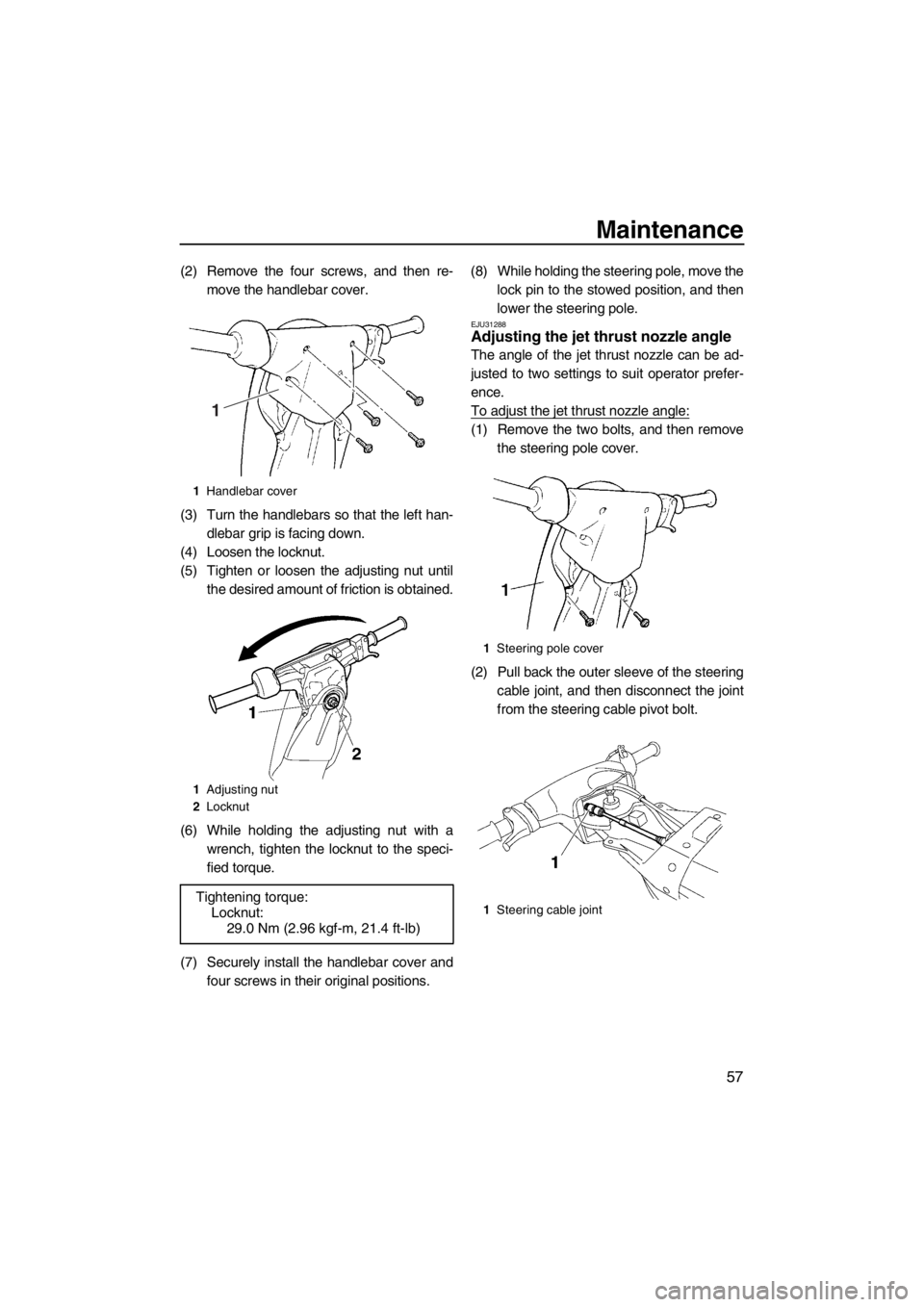
(1) Lift the steering pole and support it with
the lock pin.
1Tool bag
2 Screwdriver
3 10/12 mm box wrench
4 Garden hose adapter
5 Spark plug (one included for each cylinder)
6 14/21 mm box wrench
7 Pliers
8 Open-end wrench
1 Steering pole
2 Lock pin
UF2F75E0.book Page 56 Thursday, July 5, 2012 8:50 AM
Page 63 of 78
Maintenance
57
(2) Remove the four screws, and then re-move the handlebar cover.
(3) Turn the handlebars so that the left han- dlebar grip is facing down.
(4) Loosen the locknut.
(5) Tighten or loosen the adjusting nut until the desired amount of friction is obtained.
(6) While holding the adjusting nut with a wrench, tighten the locknut to the speci-
fied torque.
(7) Securely install the handlebar cover and four screws in their original positions. (8) While holding the steering pole, move the
lock pin to the stowed position, and then
lower the steering pole.
EJU31288Adjusting the jet thrust nozzle angle
The angle of the jet thrust nozzle can be ad-
justed to two settings to suit operator prefer-
ence.
To adjust the jet thrust nozzle angle:
(1) Remove the two bolts, and then removethe steering pole cover.
(2) Pull back the outer sleeve of the steering cable joint, and then disconnect the joint
from the steering cable pivot bolt.
1Handlebar cover
1 Adjusting nut
2 Locknut
Tightening torque:
Locknut:29.0 Nm (2.96 kgf-m, 21.4 ft-lb)
1
1Steering pole cover
1 Steering cable joint
UF2F75E0.book Page 57 Thursday, July 5, 2012 8:50 AM
Page 64 of 78
Maintenance
58
(3) Remove the steering cable pivot bolt.
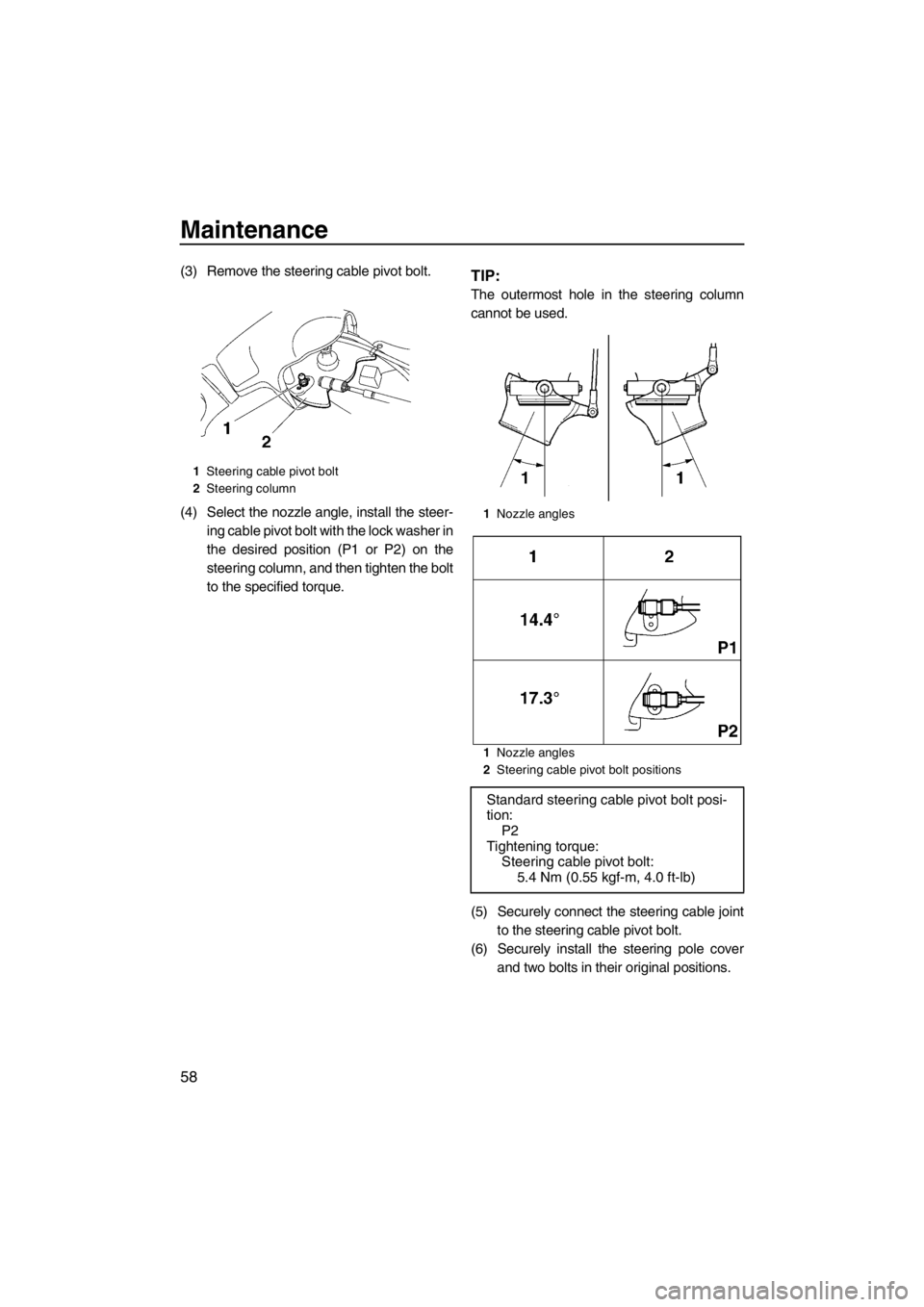
(4) Select the nozzle angle, install the steer-ing cable pivot bolt with the lock washer in
the desired position (P1 or P2) on the
steering column, and then tighten the bolt
to the specified torque.TIP:
The outermost hole in the steering column
cannot be used.
(5) Securely connect the steering cable jointto the steering cable pivot bolt.
(6) Securely install the steering pole cover and two bolts in their original positions.
1Steering cable pivot bolt
2 Steering column
1Nozzle angles
1 Nozzle angles
2 Steering cable pivot bolt positions
Standard steering cable pivot bolt posi-
tion:
P2
Tightening torque: Steering cable pivot bolt: 5.4 Nm (0.55 kgf-m, 4.0 ft-lb)
UF2F75E0.book Page 58 Thursday, July 5, 2012 8:50 AM
Page 65 of 78

Maintenance
59
EJU40830Periodic maintenance chart
The periodic maintenance chart gives general guidelines for periodic maintenance. Have a
Yamaha dealer perform the checks in the following chart. However, maintenance may need to be performed more frequently depending on your operating conditions. If you have any ques-
tions, consult a Yamaha dealer.
This “ ” mark indicates maintenance that you may do yourself.
This “ ” mark indicates items to be checked and serviced by a Yamaha dealer.
Item OperationInitial
Thereafter every
Page
10
hours 50 hours
100
hours 200
hours
6
months 12
months 12
months 24
months
Spark plugs Check, clean, replace 60
Lubrication points Lubricate 54
Intermediate hous-
ing Lubricate
61
Fuel system Check —
Fuel filter Check
61
Check, replace —
Fuel tank Check, clean —
Carburetor Check, adjust —
Engine idling
speed Check, adjust
62
Carburetor throt-
tle shaft Check
—
Bilge strainer Clean —
Impeller Check —
Jet thrust nozzle
angle Check, adjust
—
Handlebar pivot
shaft Check, adjust
—
Steering friction Check, adjust —
Throttle cable Check, adjust —
Choke cable Check, adjust 61
Battery Check, charge —
Rubber coupling Check —
Engine mount Check —
UF2F75E0.book Page 59 Thursday, July 5, 2012 8:50 AM
Page 75 of 78

Trouble recovery
69
compartment. Then, have a Yamaha dealer
service the watercraft as soon as possible.
(1) Remove the watercraft from the water,and then remove the hood.
(2) Turn the fuel cock knob to “OFF”.
(3) Turn the watercraft over far enough to drain the bilge water from the engine
compartment. NOTICE: Turning the wa-
tercraft on its side with the hood re-
moved could cause damage to the
steering pole. Use two people to pro-
vide enough support to make sure
that the steering pole is not damaged.
[ECJ00701]
(4) Turn the watercraft upright again.
(5) Have the watercraft serviced by a Yamaha dealer as soon as possible.
NOTICE: Be sure to have a Yamaha
dealer inspect the watercraft. Other-
wise, serious engine damage could re-
sult.
[ECJ00791]
UF2F75E0.book Page 69 Thursday, July 5, 2012 8:50 AM
Page 77 of 78

Index
Operation requirements ........................... 10
P
Periodic maintenance chart...................... 59
Post-launch checks .................................. 39
Post-operation care .................................. 50
Pre-launch checks.................................... 35
Pre-operation check points ...................... 35
Pre-operation checklist............................. 33
Primary Identification (PRI-ID) number ...... 1
R
Recommended equipment ....................... 12
Rustproofing ............................................. 55
S
Safe boating rules .................................... 14
Safety equipment check ........................... 39
Spark plugs, checking .............................. 60
Start switch............................................... 19
Starting off ................................................ 45
Starting the engine on water .................... 41
Steering friction, adjusting ........................ 56
Steering pole ............................................ 20
Steering pole check.................................. 37
Steering system ....................................... 20
Steering system checks ........................... 36
Stern rope hole......................................... 25
Stopping the engine ................................. 43
Stopping the watercraft ............................ 45
Storage pouch .......................................... 25
Storage pouch checks.............................. 38
Submerged watercraft .............................. 68
Switch checks .......................................... 38
T
Throttle lever ............................................ 20
Throttle lever checks ................................ 37
Tool kit...................................................... 56
Towing the watercraft ............................... 68
Transporting ............................................. 31
Troubleshooting ....................................... 64
Troubleshooting chart .............................. 64
Turning the watercraft .............................. 43
W
Water separator ....................................... 22
Water separator check ............................. 36
Watercraft characteristics......................... 13
Watercraft control functions ..................... 19
UF2F75E0.book Page 2 Thursday, July 5, 2012 8:50 AM