steering YAMAHA SUPERJET 2013 Owners Manual
[x] Cancel search | Manufacturer: YAMAHA, Model Year: 2013, Model line: SUPERJET, Model: YAMAHA SUPERJET 2013Pages: 78, PDF Size: 3.29 MB
Page 5 of 78

Table of contents
General and important labels ........... 1Identification numbers .................... 1
Primary Identification (PRI-ID)
number ........................................... 1
Craft Identification Number (CIN) ...... 1
Engine serial number ........................ 1
Manufactured date label .................... 2
Important labels .............................. 3
Warning labels ................................... 4
Other labels ....................................... 7
Safety information ............................. 8 Limitations on who may operate the watercraft .............................. 8
Cruising limitations ......................... 9
Operation requirements ............... 10
Recommended equipment ........... 12
Hazard information ....................... 13
Watercraft characteristics ............. 13
Safe boating rules ........................ 14
Enjoy your watercraft responsibly ................................ 15
Description....................................... 16 Watercraft glossary ...................... 16
Location of main components ...... 17
Control function operation ............. 19 Watercraft control functions ......... 19
Engine stop switch .......................... 19
Engine shut-off switch ..................... 19
Start switch ...................................... 19
Throttle lever ................................... 20
Steering system ............................... 20
Steering pole ................................... 20
Fuel cock knob ................................ 21
Choke knob ..................................... 21
Cooling water pilot outlet ................. 21
Water separator ............................... 22
Engine overheat warning system .... 22
Equipment operation ...................... 24Equipment .................................... 24
Hood ................................................ 24
Bow rope hole ................................. 25
Stern rope hole ................................ 25
Storage pouch ................................. 25
Fire extinguisher container .............. 26
Operation and handling
requirements ................................... 28Fuel and engine oil requirements ............................. 28
Fuel ................................................. 28
2-stroke engine oil ........................... 28
Mixing fuel and oil ............................ 28
Filling the fuel tank .......................... 29
Draining the bilge water ............... 30
Draining the bilge water on water .... 30
Transporting ................................. 31
First-time operation ........................ 32 Engine break-in ............................ 32
Pre-operation checks ..................... 33
Pre-operation checklist .................... 33
Pre-operation check points .......... 35
Pre-launch checks ........................... 35
Post-launch checks ......................... 39
Operation ......................................... 40 Operating your watercraft ............ 40
Getting to know your watercraft ....... 40
Learning to operate your
watercraft ..................................... 40
Operating positions ......................... 40
Launching the watercraft ................. 41
Starting the engine on water ........... 41
Stopping the engine ........................ 43
Leaving the watercraft ..................... 43
Operating the watercraft .................. 43
Turning the watercraft ..................... 43
Stopping the watercraft ................... 45
Starting off ....................................... 45
UF2F75E0.book Page 1 Thursday, July 5, 2012 8:50 AM
Page 6 of 78

Table of contents
Capsized watercraft ......................... 48
Beaching the watercraft ................... 49
Operating in weeded areas ............. 49
After removing the watercraft from the water ...................................... 49
Care and storage ............................. 50Post-operation care ...................... 50
Flushing the cooling water
passages ...................................... 50
Cleaning the watercraft ................... 51
Battery care ..................................... 51
Long-term storage ........................ 54
Cleaning .......................................... 54
Lubrication ....................................... 54
Rustproofing .................................... 55
Maintenance..................................... 56 Maintenance ................................. 56
Tool kit ............................................. 56
Adjusting the steering friction .......... 56
Adjusting the jet thrust nozzle
angle ............................................ 57
Periodic maintenance chart ............. 59
Checking the spark plugs ................ 60
Lubrication points ............................ 61
Checking the fuel filter ..................... 61
Adjusting the choke cable ............... 61
Adjusting the carburetor .................. 62
Specifications .................................. 63 Specifications ................................ 63
Trouble recovery ............................. 64 Troubleshooting ........................... 64
Troubleshooting chart ...................... 64
Emergency procedures ................ 66
Cleaning the jet intake and
impeller ........................................ 66
Jumping the battery ......................... 67
Replacing the fuse ........................... 67
Towing the watercraft ...................... 68
Submerged watercraft ..................... 68
UF2F75E0.book Page 2 Thursday, July 5, 2012 8:50 AM
Page 23 of 78
Description
17
EJU31011
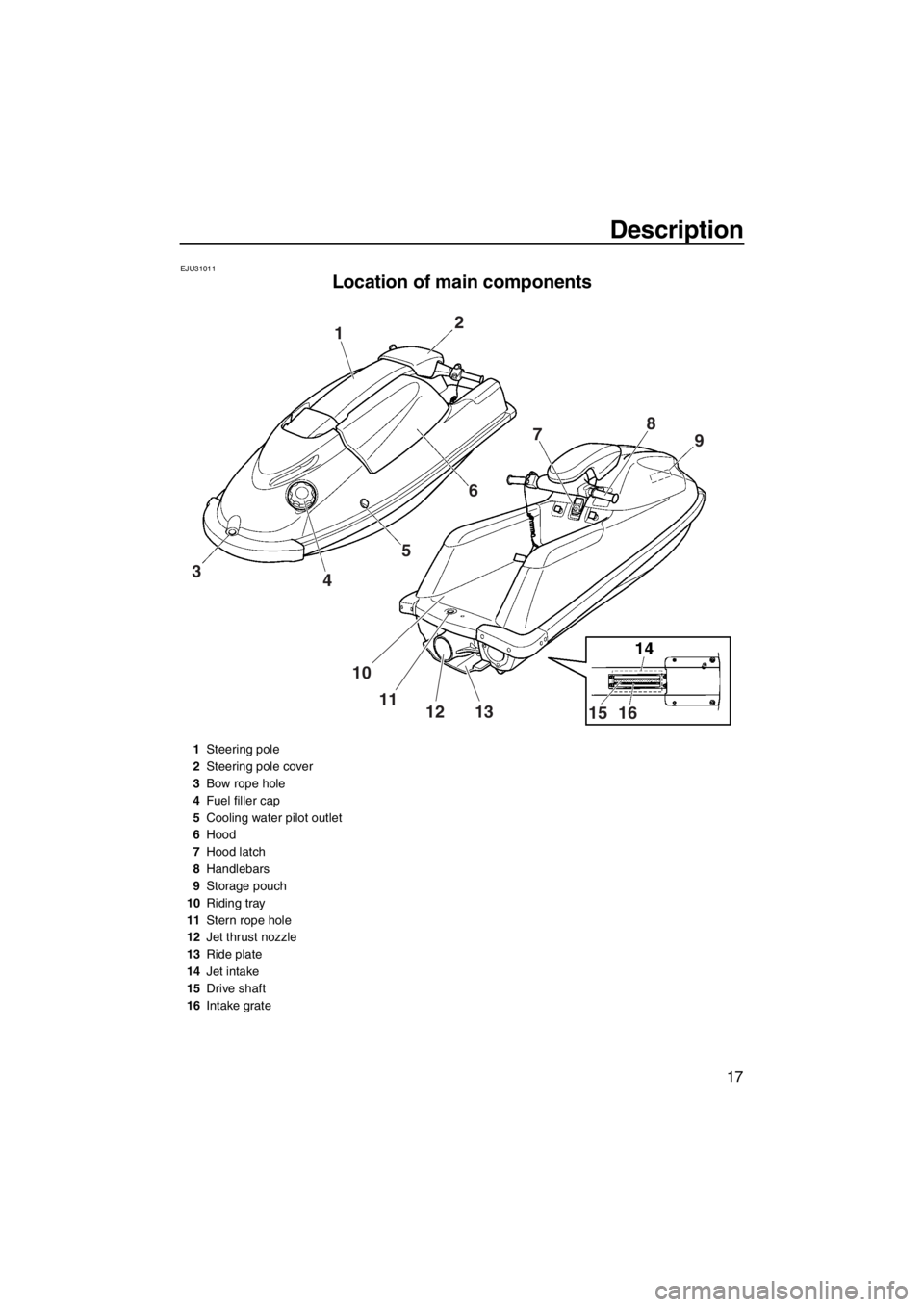
Location of main components
2
1
3 456
7
8
9
10 11 12 13 15 16
1Steering pole
2 Steering pole cover
3 Bow rope hole
4 Fuel filler cap
5 Cooling water pilot outlet
6 Hood
7 Hood latch
8 Handlebars
9 Storage pouch
10 Riding tray
11 Stern rope hole
12 Jet thrust nozzle
13 Ride plate
14 Jet intake
15 Drive shaft
16 Intake grate
UF2F75E0.book Page 17 Thursday, July 5, 2012 8:50 AM
Page 26 of 78
![YAMAHA SUPERJET 2013 Owners Manual Control function operation
20
will not start. Also, the starter motor could
be damaged.
[ECJ01040]
The engine will not start when the clip is re-
moved from the engine shut-off switch.
EJU31211Thrott](/img/51/51292/w960_51292-25.png "YAMAHA SUPERJET 2013 Owners Manual Control function operation
20
will not start. Also, the starter motor could
be damaged.
[ECJ01040]
The engine will not start when the clip is re-
moved from the engine shut-off switch.
EJU31211Thrott")
Control function operation
20
will not start. Also, the starter motor could
be damaged.
[ECJ01040]
The engine will not start when the clip is re-
moved from the engine shut-off switch.
EJU31211Throttle lever
The throttle lever increases the engine speed
when the lever is squeezed.
The throttle lever returns automatically to its
fully closed (idle) position when released.
EJU35932Steering system
By turning the handlebars in the direction you
wish to travel, the angle of the jet thrust nozzleis changed, and the direction of the watercraft
is changed accordingly.
Since the strength of the jet thrust determines
the speed and degree of a turn, throttle must
always be applied when attempting a turn, ex-
cept at trolling speed.
The angle of the jet thrust nozzle can be ad-
justed to suit operat
or preference. (See page
57 for information on adjusting the jet thrust
nozzle angle.)
EJU31272Steering pole
The steering pole can be moved up or down
to change the height of the handlebars.
1 Start switch
1 Throttle lever
START
1
1Handlebar
2 Jet thrust nozzle
UF2F75E0.book Page 20 Thursday, July 5, 2012 8:50 AM
Page 30 of 78
Equipment operation
24
EJU40333
Equipment EJU31056Hood
The hood is removable.
Remove the hood to access the engine com-
partment.
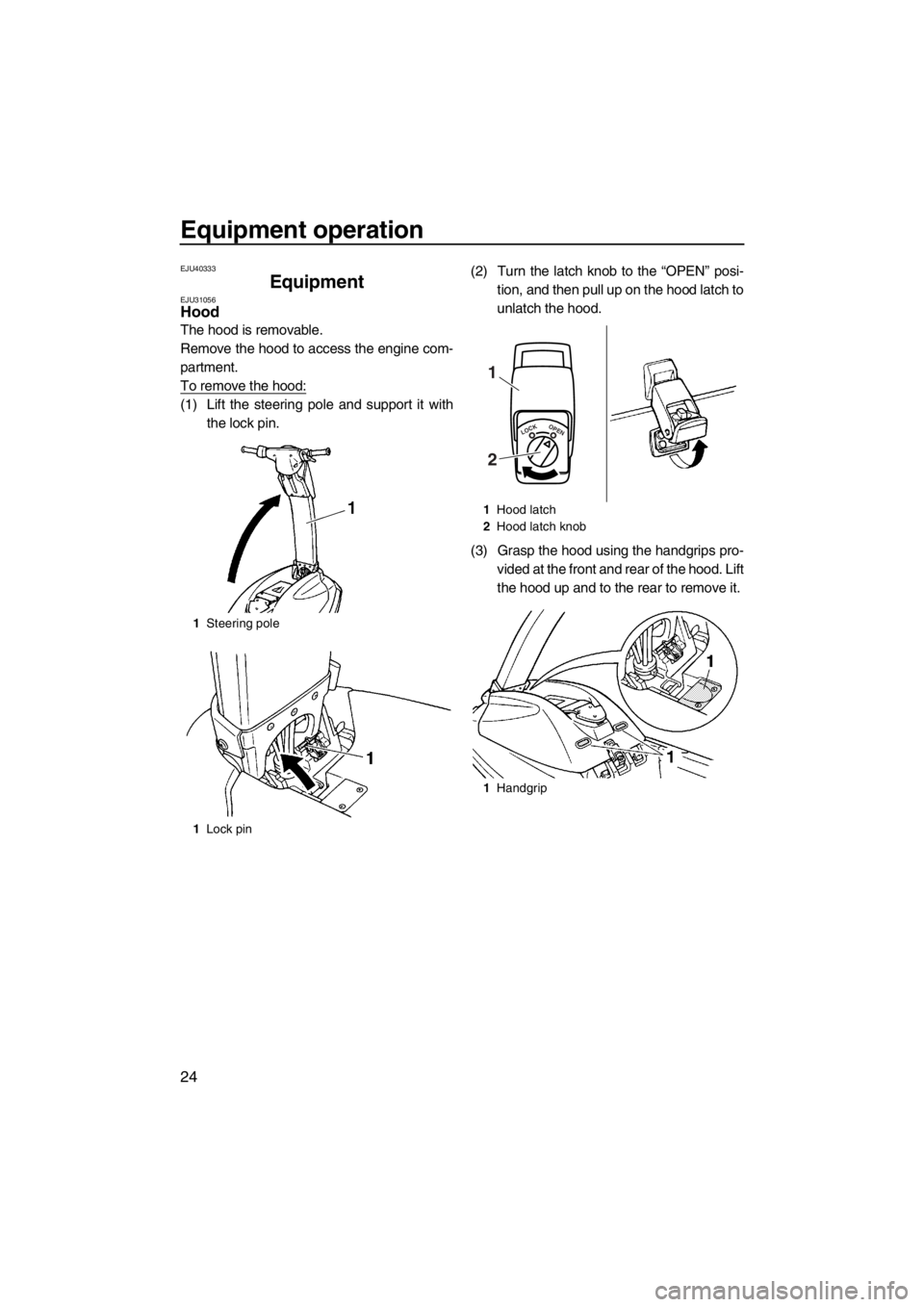
To remove the hood:
(1) Lift the steering pole and support it withthe lock pin. (2) Turn the latch knob to the “OPEN” posi-
tion, and then pull up on the hood latch to
unlatch the hood.
(3) Grasp the hood using the handgrips pro- vided at the front and rear of the hood. Lift
the hood up and to the rear to remove it.
1Steering pole
1 Lock pin
1Hood latch
2 Hood latch knob
1 Handgrip
LOC KOPEN
1
2
UF2F75E0.book Page 24 Thursday, July 5, 2012 8:50 AM
Page 31 of 78
Equipment operation
25
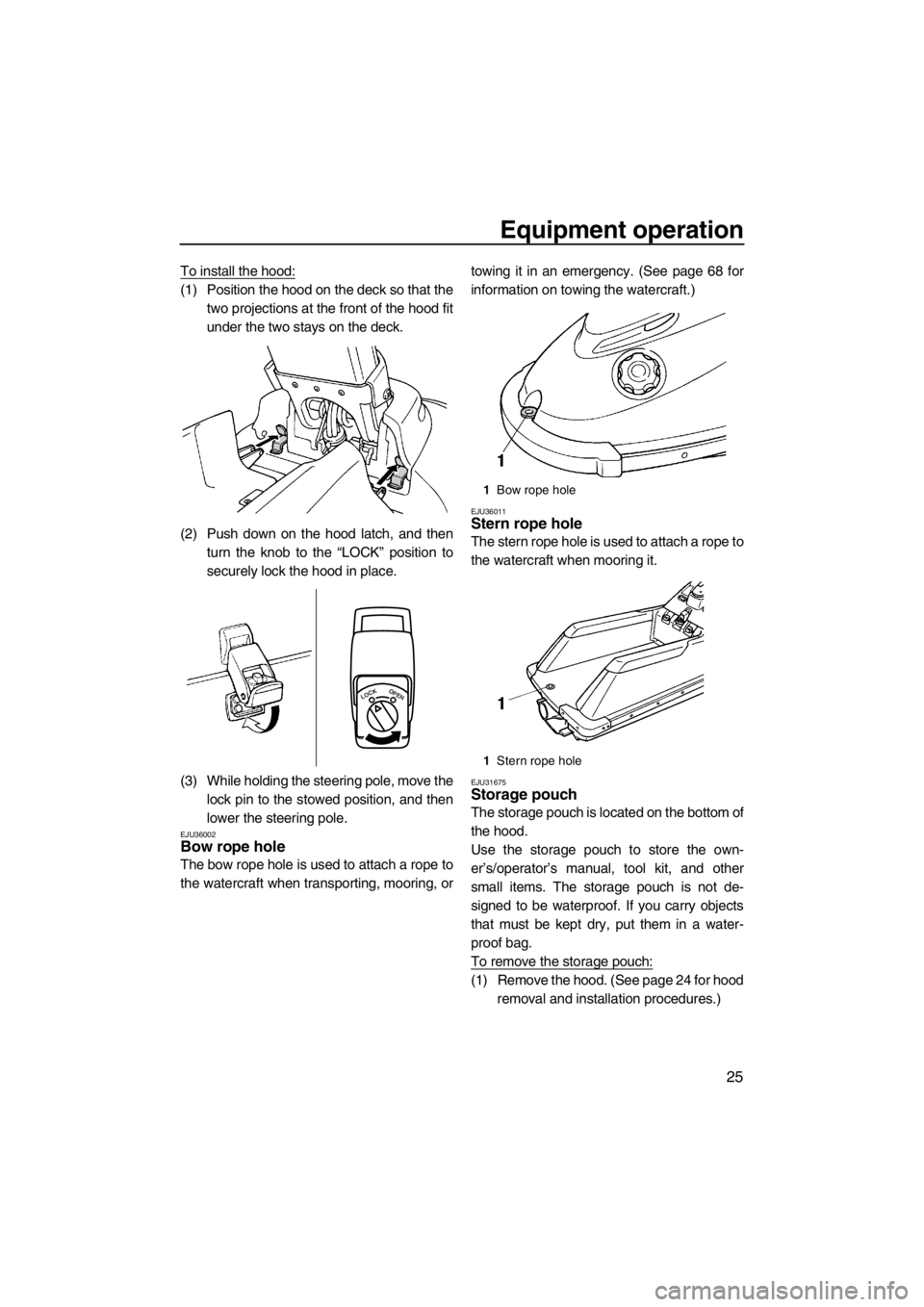
To install the hood:
(1) Position the hood on the deck so that thetwo projections at the front of the hood fit
under the two stays on the deck.
(2) Push down on the hood latch, and then turn the knob to the “LOCK” position to
securely lock the hood in place.
(3) While holding the steering pole, move the lock pin to the stowed position, and then
lower the steering pole.
EJU36002Bow rope hole
The bow rope hole is used to attach a rope to
the watercraft when transporting, mooring, or towing it in an emergency. (See page 68 for
information on towing the watercraft.)
EJU36011Stern rope hole
The stern rope hole is used to attach a rope to
the watercraft when mooring it.
EJU31675Storage pouch
The storage pouch is located on the bottom of
the hood.
Use the storage pouch to store the own-
er’s/operator’s manual, tool kit, and other
small items. The storage pouch is not de-
signed to be waterproof. If you carry objects
that must be kept dry, put them in a water-
proof bag.
To remove the storage pouch:
(1) Remove the hood. (See page 24 for hood
removal and installation procedures.)
LOCKOPEN
1 Bow rope hole
1 Stern rope hole
UF2F75E0.book Page 25 Thursday, July 5, 2012 8:50 AM
Page 32 of 78
Equipment operation
26
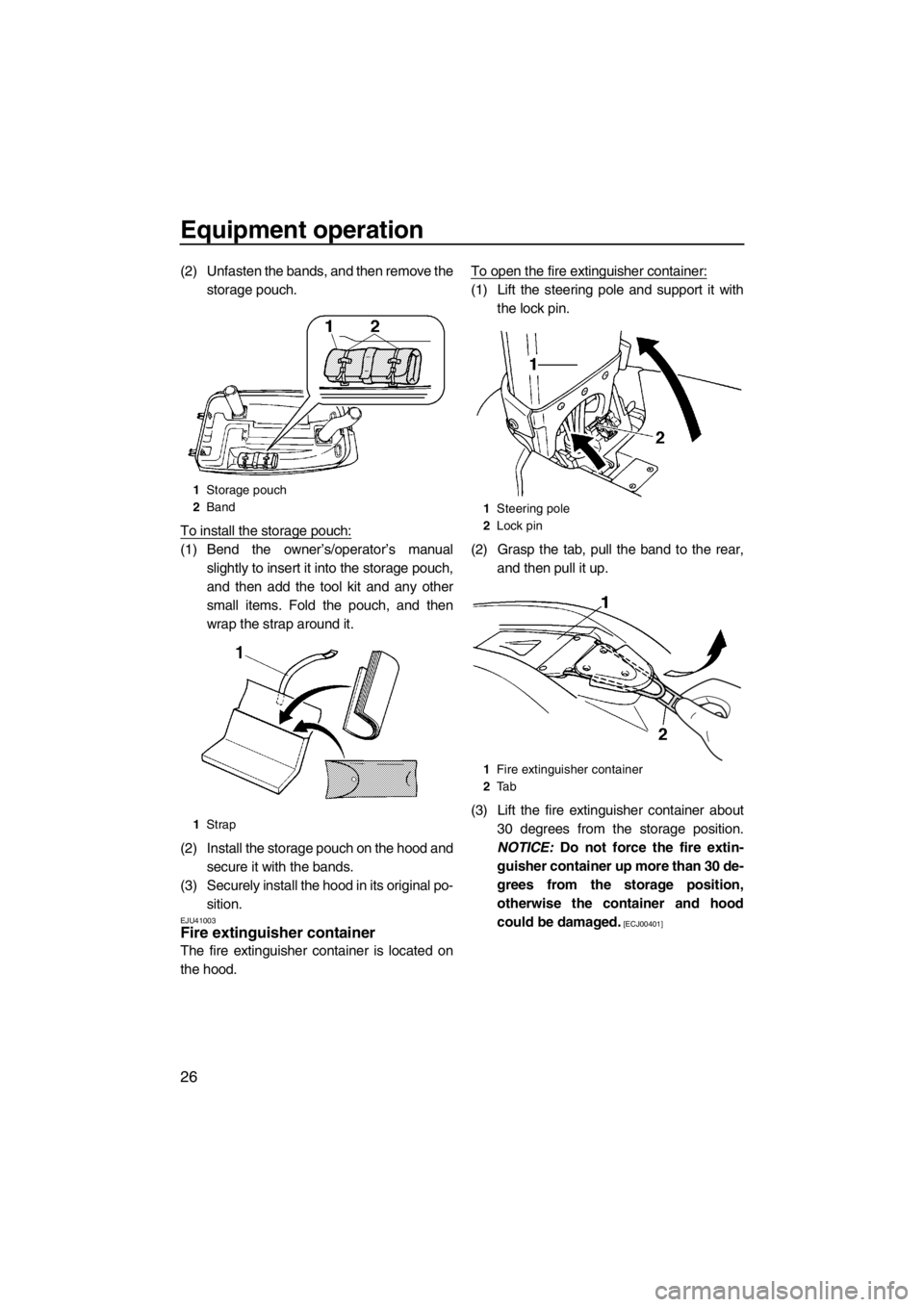
(2) Unfasten the bands, and then remove thestorage pouch.
To install the storage pouch:
(1) Bend the owner’s/operator’s manual slightly to insert it into the storage pouch,
and then add the tool kit and any other
small items. Fold the pouch, and then
wrap the strap around it.
(2) Install the storage pouch on the hood and secure it with the bands.
(3) Securely install the hood in its original po- sition.
EJU41003Fire extinguisher container
The fire extinguisher container is located on
the hood. To open the fire extinguisher container:
(1) Lift the steering pole and support it with
the lock pin.
(2) Grasp the tab, pull the band to the rear, and then pull it up.
(3) Lift the fire extinguisher container about 30 degrees from the storage position.
NOTICE: Do not force the fire extin-
guisher container up more than 30 de-
grees from the storage position,
otherwise the container and hood
could be damaged.
[ECJ00401]
1 Storage pouch
2 Band
1 Strap
1Steering pole
2 Lock pin
1 Fire extinguisher container
2 Ta b
UF2F75E0.book Page 26 Thursday, July 5, 2012 8:50 AM
Page 33 of 78
Equipment operation
27
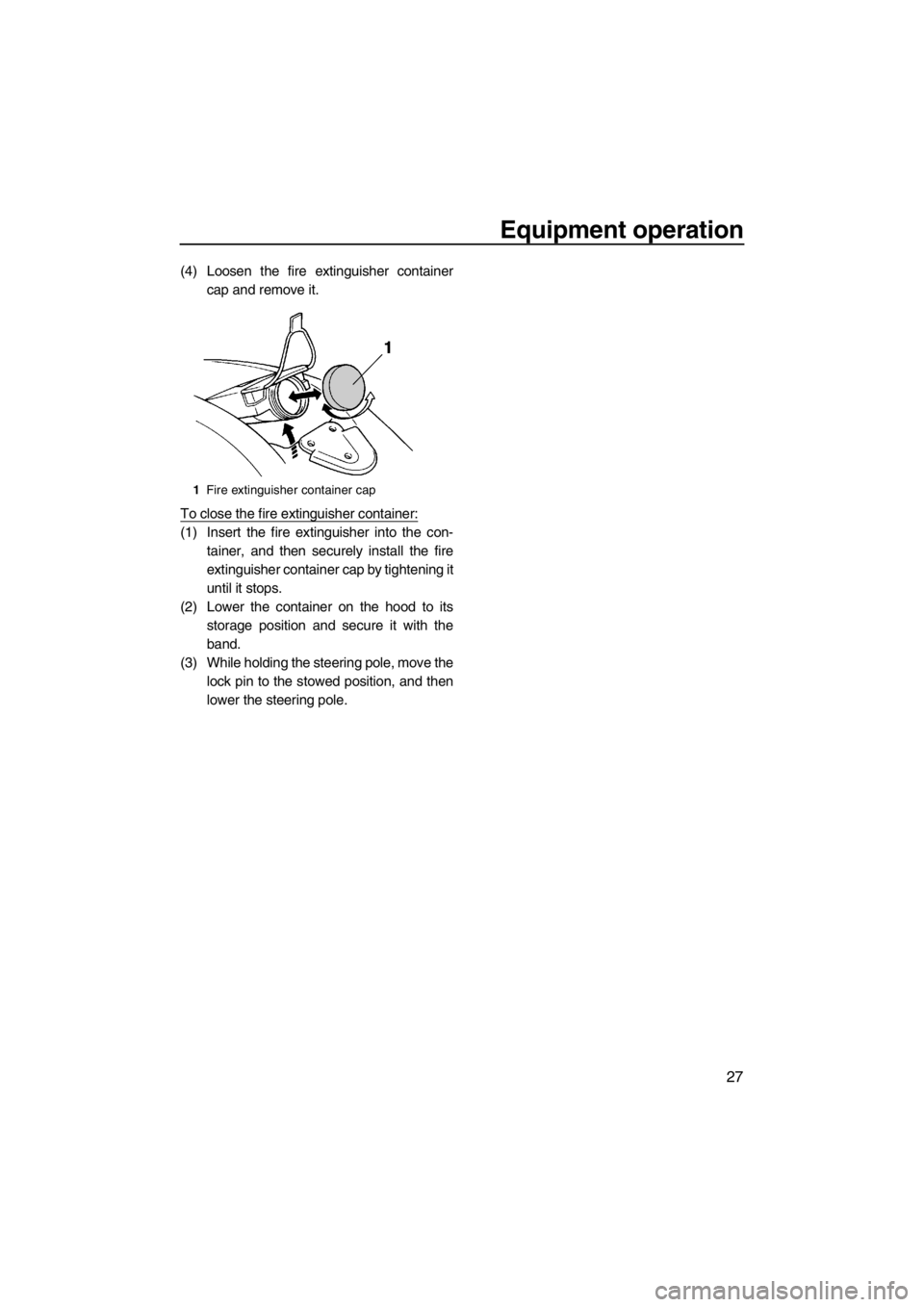
(4) Loosen the fire extinguisher containercap and remove it.
To close the fire extinguisher container:
(1) Insert the fire extinguisher into the con- tainer, and then securely install the fire
extinguisher container cap by tightening it
until it stops.
(2) Lower the container on the hood to its storage position and secure it with the
band.
(3) While holding the steering pole, move the lock pin to the stowed position, and then
lower the steering pole.
1Fire extinguisher container cap
UF2F75E0.book Page 27 Thursday, July 5, 2012 8:50 AM
Page 37 of 78
Operation and handling requirements
31
EJU33423
Transporting
WARNING
EWJ00750
Always turn the fuel cock knob to “OFF”
when transporting the watercraft, other-
wise fuel could leak out into the engine or
engine compartment, which would create
a fire hazard.
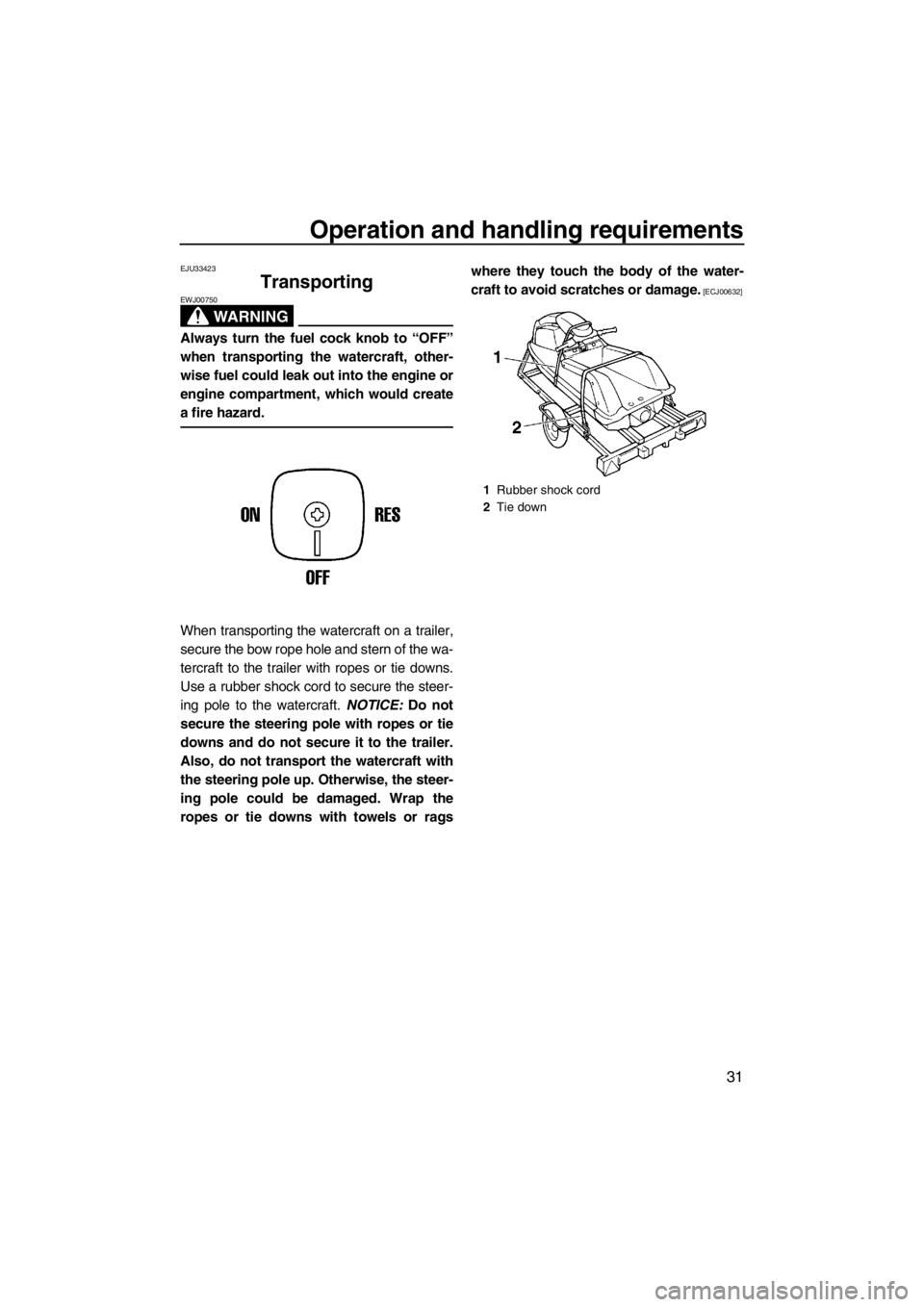
When transporting the watercraft on a trailer,
secure the bow rope hole and stern of the wa-
tercraft to the trailer with ropes or tie downs.
Use a rubber shock cord to secure the steer-
ing pole to the watercraft. NOTICE: Do not
secure the steering pole with ropes or tie
downs and do not secure it to the trailer.
Also, do not transport the watercraft with
the steering pole up. Otherwise, the steer-
ing pole could be damaged. Wrap the
ropes or tie downs with towels or rags where they touch the body of the water-
craft to avoid scratches or damage.
[ECJ00632]
1
Rubber shock cord
2 Tie down
UF2F75E0.book Page 31 Thursday, July 5, 2012 8:50 AM
Page 39 of 78

Pre-operation checks
33
EJU31981
WARNING
EWJ00411
Failure to inspect or maintain the watercraft properly increases the possibility of an ac-
cident or damage to the watercraft. Do not operate the watercraft if you find any prob-
lem. If a problem cannot be corrected by the procedures provided in this manual, have
the watercraft inspected by a Yamaha dealer.
EJU41232Pre-operation checklist
Before using this watercraft, be sure to perform the checks in the following checklist.
ITEM ROUTINEPAGE
PRE-LAUNCH CHECKS
Engine compartment Ventilate the engine compartment.
Check inside the engine compartment for damage.
35
Fuel system Check the fuel system for leakage.
Check the fuel level in the fuel tank.
35
Water separator Check the water separator for water. 36
Engine unit Check the exterior of the engine unit for damage. 36
Bilge water Check the engine compartment for bilge water. 36
Battery Check the battery connections and electrolyte level. 36
Steering system Check the steering system for proper operation. 36
Throttle lever Check the throttle lever for proper operation.
Check the throttle lever free play.
37
Engine shut-off cord (lan-
yard) Check the engine shut-off cord (lanyard) for dam-
age.
38
Switches Check the start switch, engine stop switch, and en-
gine shut-off switch for proper operation.
38
Storage pouch Check the storage pouch for damage and water.
Check that the storage pouch is securely installed.
38
Fire extinguisher container Check the fire extinguisher container for damage. 39
Fire extinguisher Check the condition of the fire extinguisher. 39
Safety equipment Check that safety equipment meeting the applicable
regulations is on board.
39
Hull and deck Check the hull and deck for damage. 39
Jet intake Check the jet intake for damage and clogging. 39
Hood Check that the hood is securely closed. 39
POST-LAUNCH CHECKS
Cooling water pilot outlet Check that water is discharged from the cooling wa-
ter pilot outlet while the engine is running.
39
UF2F75E0.book Page 33 Thursday, July 5, 2012 8:50 AM