water pump YAMAHA SUPERJET 2013 Owners Manual
[x] Cancel search | Manufacturer: YAMAHA, Model Year: 2013, Model line: SUPERJET, Model: YAMAHA SUPERJET 2013Pages: 78, PDF Size: 3.29 MB
Page 19 of 78
Safety information
13
EJU30850
Hazard information
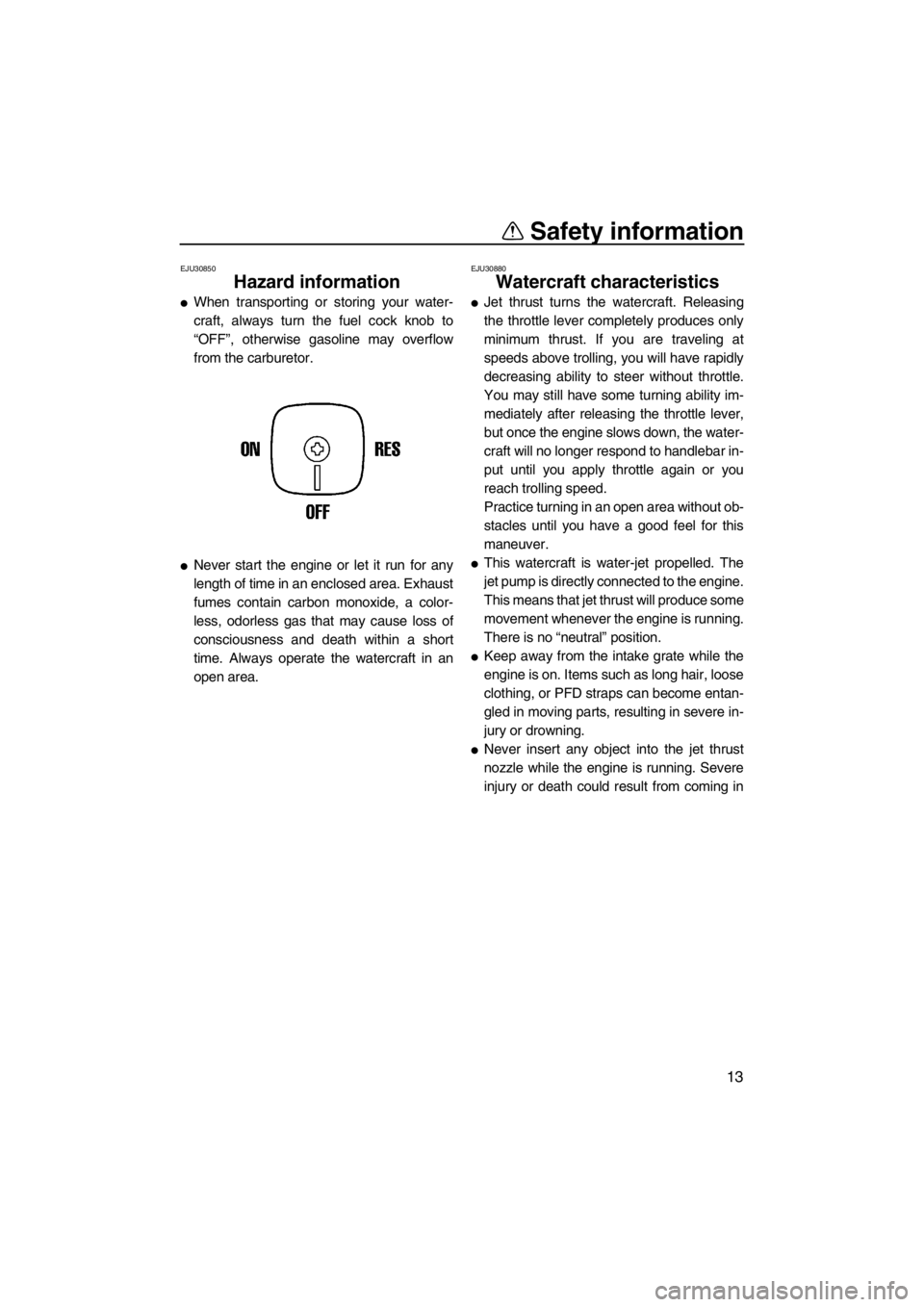
●When transporting or storing your water-
craft, always turn the fuel cock knob to
“OFF”, otherwise gasoline may overflow
from the carburetor.
●Never start the engine or let it run for any
length of time in an enclosed area. Exhaust
fumes contain carbon monoxide, a color-
less, odorless gas that may cause loss of
consciousness and death within a short
time. Always operate the watercraft in an
open area.
EJU30880
Watercraft characteristics
●Jet thrust turns the watercraft. Releasing
the throttle lever completely produces only
minimum thrust. If you are traveling at
speeds above trolling, you will have rapidly
decreasing ability to steer without throttle.
You may still have some turning ability im-
mediately after releasing the throttle lever,
but once the engine slows down, the water-
craft will no longer respond to handlebar in-
put until you apply throttle again or you
reach trolling speed.
Practice turning in an open area without ob-
stacles until you have a good feel for this
maneuver.
●This watercraft is water-jet propelled. The
jet pump is directly connected to the engine.
This means that jet thrust will produce some
movement whenever the engine is running.
There is no “neutral” position.
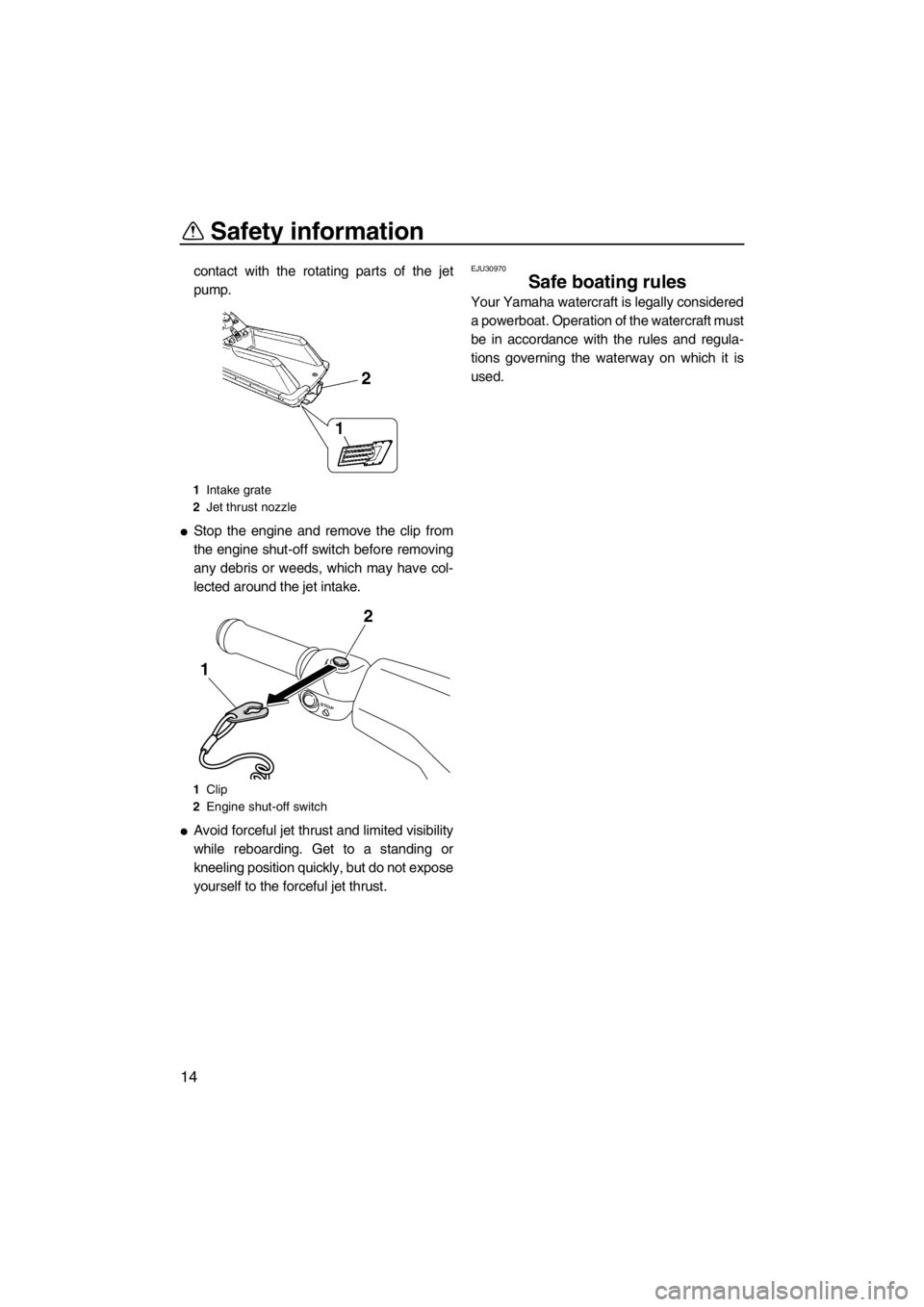
●Keep away from the intake grate while the
engine is on. Items such as long hair, loose
clothing, or PFD straps can become entan-
gled in moving parts, resulting in severe in-
jury or drowning.
●Never insert any object into the jet thrust
nozzle while the engine is running. Severe
injury or death could result from coming in
UF2F75E0.book Page 13 Thursday, July 5, 2012 8:50 AM
Page 20 of 78
Safety information
14
contact with the rotating parts of the jet
pump.
●Stop the engine and remove the clip from
the engine shut-off switch before removing
any debris or weeds, which may have col-
lected around the jet intake.
●Avoid forceful jet thrust and limited visibility
while reboarding. Get to a standing or
kneeling position quickly, but do not expose
yourself to the forceful jet thrust.
EJU30970
Safe boating rules
Your Yamaha watercraft is legally considered
a powerboat. Operation of the watercraft must
be in accordance with the rules and regula-
tions governing the waterway on which it is
used.
1Intake grate
2 Jet thrust nozzle
1 Clip
2 Engine shut-off switch
STOP
2
1
UF2F75E0.book Page 14 Thursday, July 5, 2012 8:50 AM
Page 34 of 78
Operation and handling requirements
28
EJU31792
Fuel and engine oil requirements
EJU31833Fuel
WARNING
EWJ00282
●Gasoline and gasoline vapors are ex-
tremely flammable. To avoid fires and
explosions and to reduce the risk of in-
jury when refueling, follow these in-
structions.
●Gasoline is poisonous and can cause in-
jury or death. Handle gasoline with care.
Never siphon gasoline by mouth. If you
should swallow some gasoline, inhale a
lot of gasoline vapor, or get some gaso-
line in your eyes, see your doctor imme-
diately. If gasoline spills on your skin,
wash with soap and water. If gasoline
spills on your clothing, change your
clothes.
NOTICE
ECJ00321
●Do not use leaded gasoline. Leaded gas-
oline can seriously damage the engine.
●Avoid getting water and contaminants in
the fuel tank. Contaminated fuel can
cause poor performance and engine
damage. Use only fresh gasoline that
has been stored in clean containers.
Gasohol
There are two types of gasohol: gasohol con-
taining ethanol and that containing methanol. Gasohol containing ethanol can be used if
ethanol content does not exceed 10% and the
fuel meets the minimum octane ratings. E-85
is a fuel blend containing 85% ethanol and
therefore must not be used in this watercraft.
All ethanol blends containing more than 10%
ethanol can cause fuel system damage or en-
gine performance problems.
Yamaha does not recommend gasohol con- taining methanol because it can cause fuel
system damage and engine performance
problems.
EJU318722-stroke engine oil
If YAMALUBE 2-W engine oil is not available,
another 2-stroke engine oil with an NMMA-
certified TC-W3 rating may be used.
EJU31902Mixing fuel and oil
NOTICE
ECJ00331
Make sure that the gasoline and oil are
thoroughly mixed in the correct ratio, oth-
erwise severe engine damage could re-
sult.
To mix gasoline and engine oil:
(1) Pour 2-stroke engine oil into a clean con- tainer, and then add gasoline.
Recommended fuel: Regular unleaded gasoline with a
minimum octane rating of
86
(Pump octane number) = (R + M)/2
90 (Research octane number)
Recommended engine oil:YAMALUBE 2-W or TC-W3 outboard
motor oil or equivalent
Fuel-to-oil ratios (gasoline to oil) Break-in period (first two tankfuls): 25:1
After break-in: 50 :1
UF2F75E0.book Page 28 Thursday, July 5, 2012 8:50 AM
Page 36 of 78
Operation and handling requirements
30
EJU40021
Draining the bilge water
NOTICE
ECJ01301
Do not run the engine at full throttle when
bilge water remains in the engine compart-
ment. The bilge water can splash into the
engine, which can result in severe dam-
age.
EJU40921Draining the bilge water on water
A small quantity of bilge water will remain in
the engine compartment even after the bilge
water is drained on water. To completely re-
move the bilge water, remove the watercraft
from the water and wipe up any remaining
moisture in the engine compartment with a
dry cloth.
Jet vacuum bilge draining system
While the watercraft is operating, bilge water
in the engine compartment is drawn in by the
vacuum that is generated in the jet pump and
discharged from the watercraft through the jet
thrust nozzle.
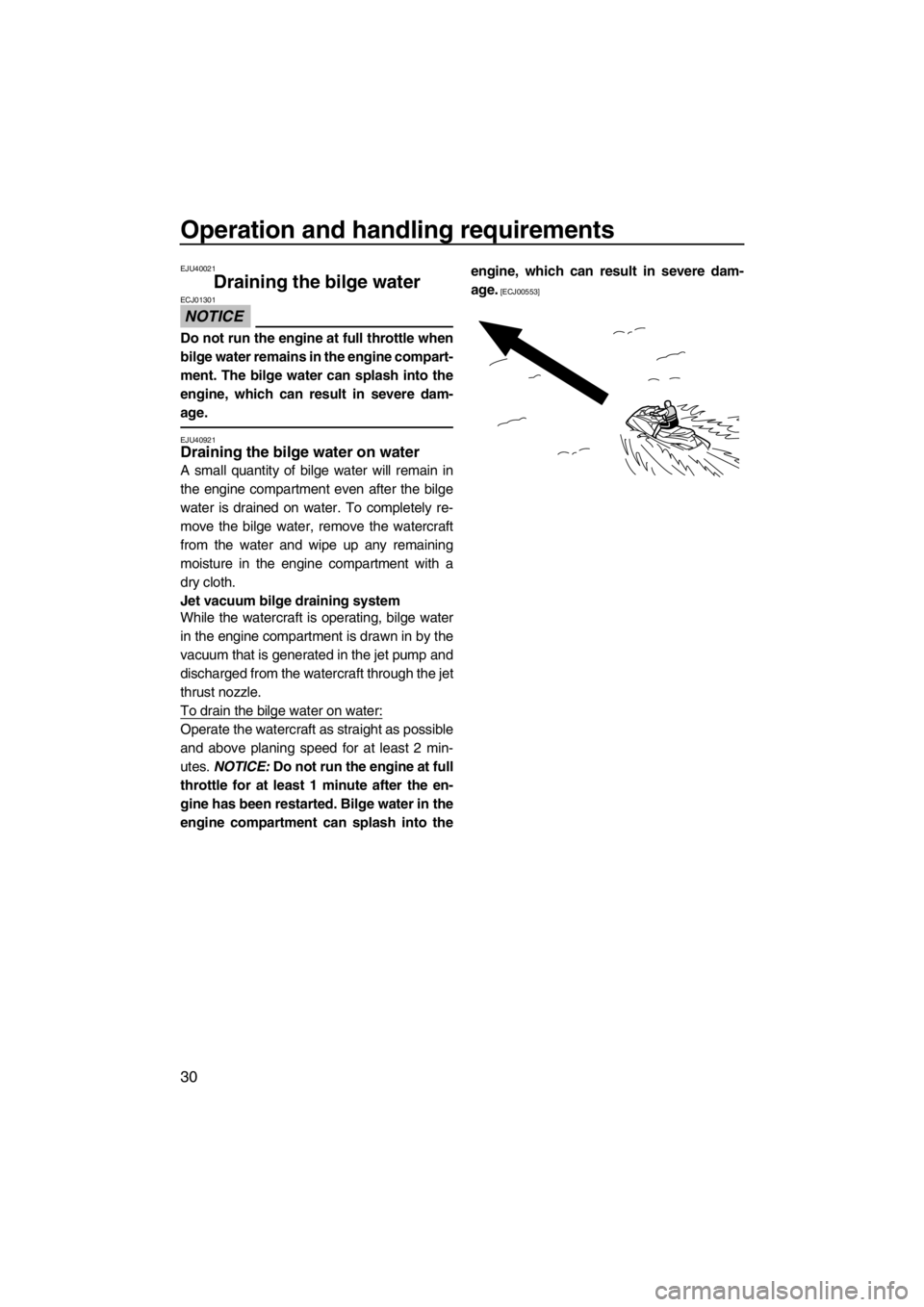
To drain the bilge water on water:
Operate the watercraft as straight as possible
and above planing speed for at least 2 min-
utes. NOTICE: Do not run the engine at full
throttle for at least 1 minute after the en-
gine has been restarted. Bilge water in the
engine compartment can splash into the engine, which can result in severe dam-
age.
[ECJ00553]
UF2F75E0.book Page 30 Thursday, July 5, 2012 8:50 AM
Page 49 of 78
Operation
43
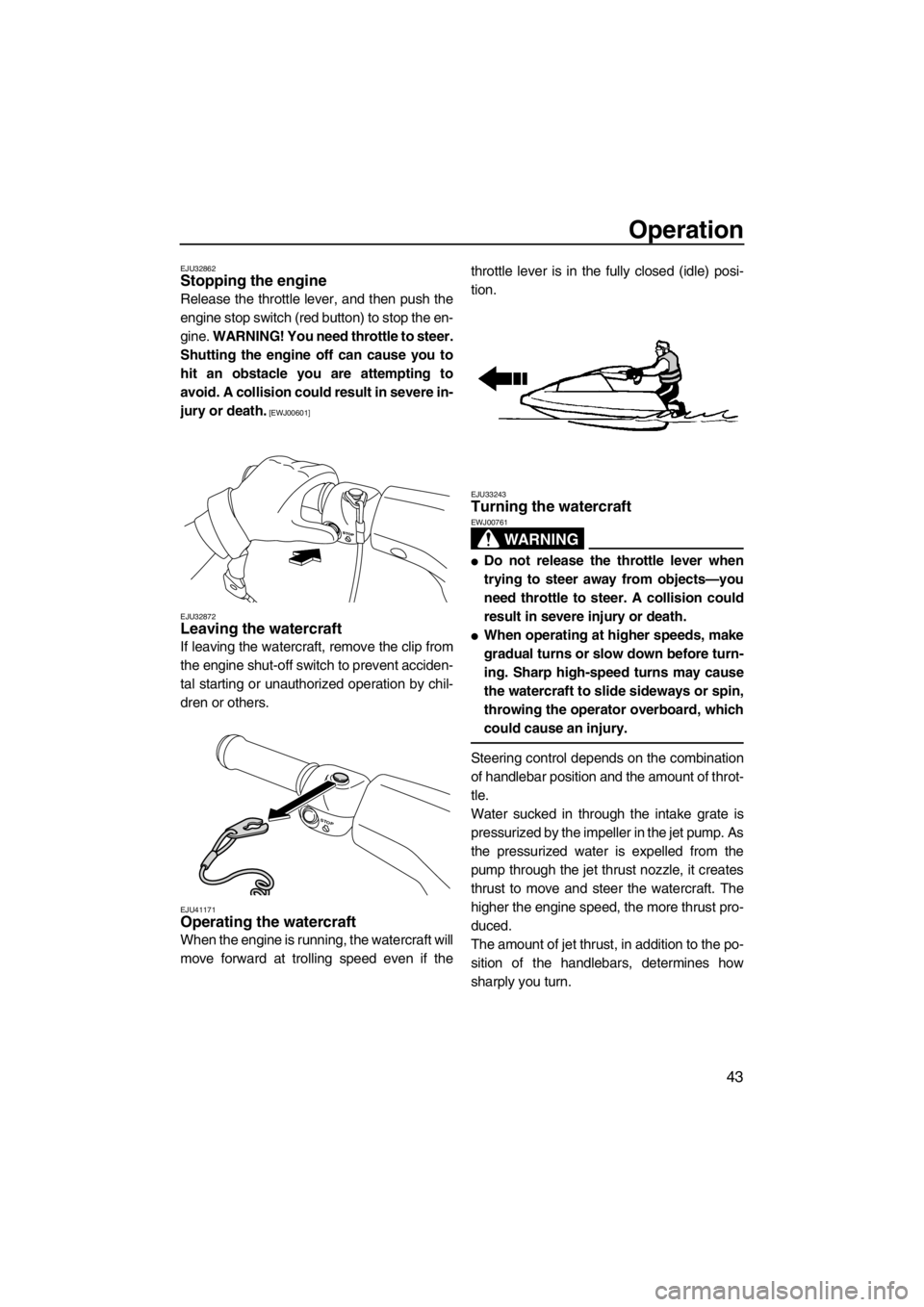
EJU32862Stopping the engine
Release the throttle lever, and then push the
engine stop switch (red button) to stop the en-
gine. WARNING! You need throttle to steer.
Shutting the engine off can cause you to
hit an obstacle you are attempting to
avoid. A collision could result in severe in-
jury or death.
[EWJ00601]
EJU32872
Leaving the watercraft
If leaving the watercraft, remove the clip from
the engine shut-off switch to prevent acciden-
tal starting or unauthorized operation by chil-
dren or others.
EJU41171Operating the watercraft
When the engine is running, the watercraft will
move forward at trolling speed even if the throttle lever is in the fully closed (idle) posi-
tion.
EJU33243Turning the watercraft
WARNING
EWJ00761
●Do not release the throttle lever when
trying to steer away from objects—you
need throttle to steer. A collision could
result in severe injury or death.
●When operating at higher speeds, make
gradual turns or slow down before turn-
ing. Sharp high-speed turns may cause
the watercraft to slide sideways or spin,
throwing the operator overboard, which
could cause an injury.
Steering control depends on the combination
of handlebar position and the amount of throt-
tle.
Water sucked in through the intake grate is
pressurized by the impeller in the jet pump. As
the pressurized water is expelled from the
pump through the jet thrust nozzle, it creates
thrust to move and steer the watercraft. The
higher the engine speed, the more thrust pro-
duced.
The amount of jet thrust, in addition to the po-
sition of the handlebars, determines how
sharply you turn.
STOP
UF2F75E0.book Page 43 Thursday, July 5, 2012 8:50 AM
Page 56 of 78
Care and storage
50
EJU41191
Post-operation care
WARNING
EWJ00320
Always turn the fuel cock knob to “OFF”
when storing the watercraft, otherwise
fuel could leak out into the engine or en-
gine compartment, which would create a
fire hazard.
After using the watercraft, always take it out of
the water, clean it, and store it. Leaving the
watercraft in the water for extended periods
will accelerate the rate of normal deterioration
of the jet pump and hull. Marine organisms
and corrosion are some of the conditions that
can shorten the life of many watercraft com-
ponents.
EJU33518Flushing the cooling water passages
NOTICE
ECJ01360
Do not run the engine for more than 15
seconds on land without supplying water,
otherwise the engine could overheat.
Flush the cooling water passages to prevent
them from clogging with salt, sand, or dirt.
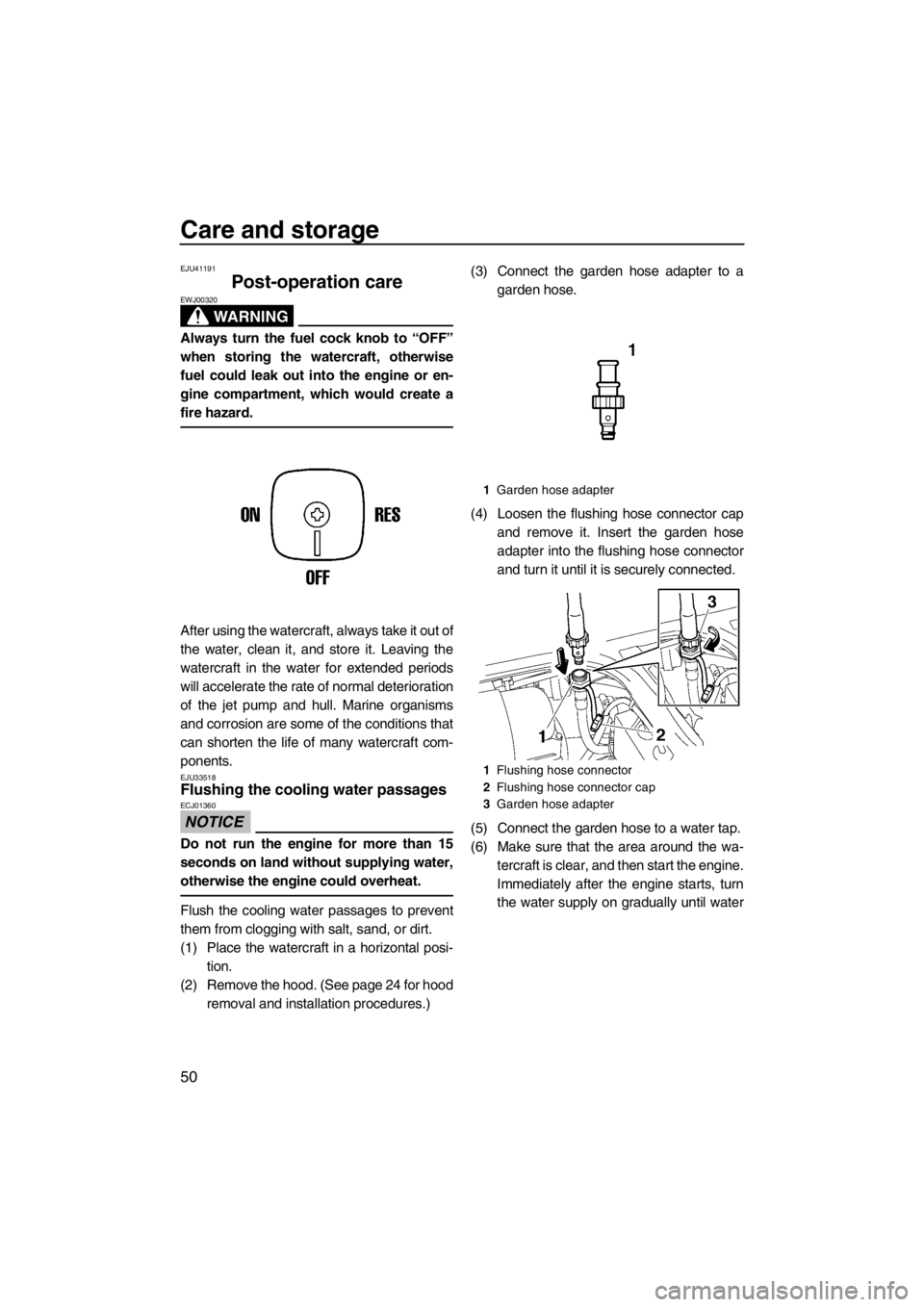
(1) Place the watercraft in a horizontal posi-tion.
(2) Remove the hood. (See page 24 for hood removal and installation procedures.) (3) Connect the garden hose adapter to a
garden hose.
(4) Loosen the flushing hose connector cap and remove it. Insert the garden hose
adapter into the flushing hose connector
and turn it until it is securely connected.
(5) Connect the garden hose to a water tap.
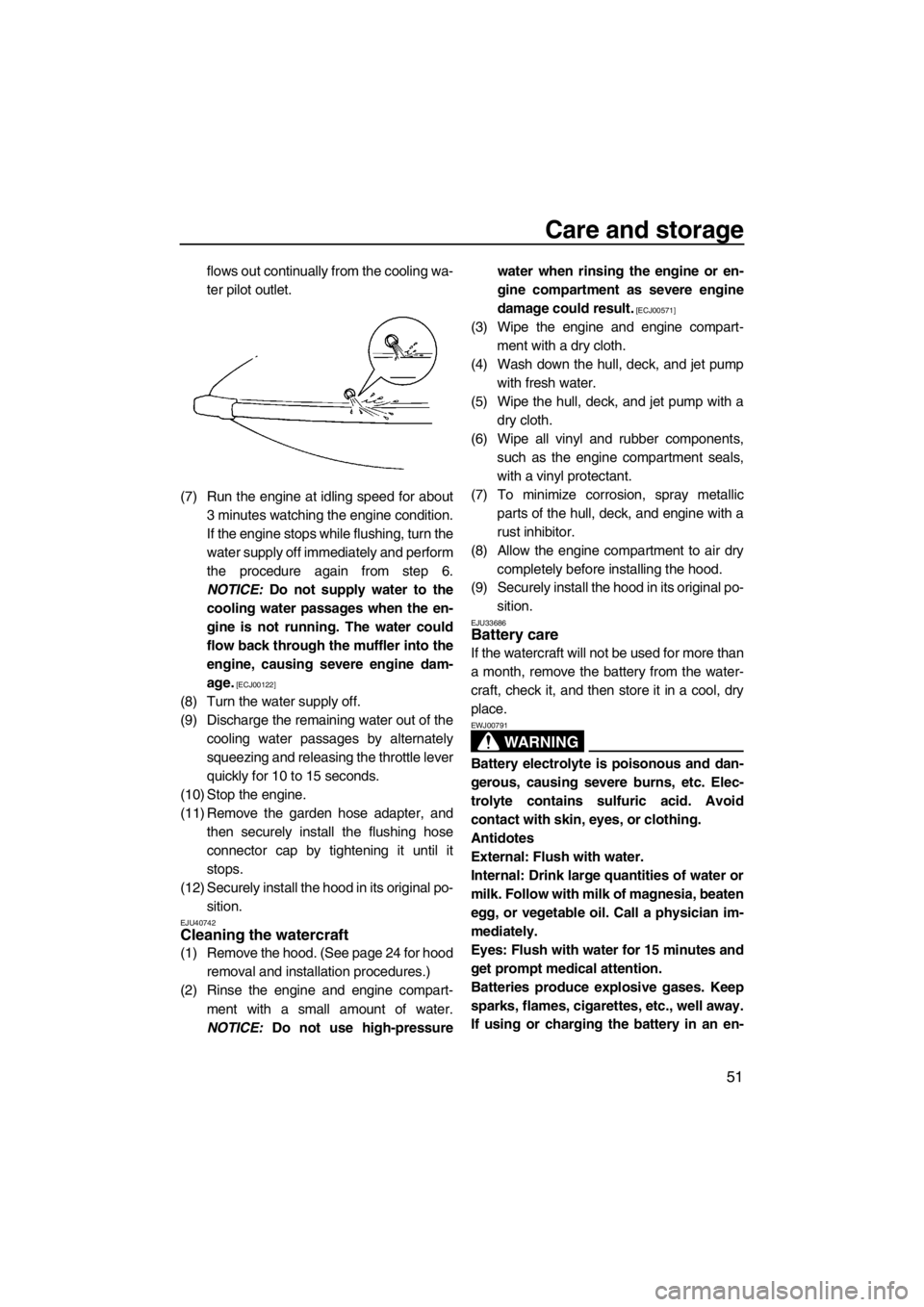
(6) Make sure that the area around the wa- tercraft is clear, and then start the engine.
Immediately after the engine starts, turn
the water supply on gradually until water
1Garden hose adapter
1 Flushing hose connector
2 Flushing hose connector cap
3 Garden hose adapter
UF2F75E0.book Page 50 Thursday, July 5, 2012 8:50 AM
Page 57 of 78
Care and storage
51
flows out continually from the cooling wa-
ter pilot outlet.
(7) Run the engine at idling speed for about 3 minutes watching the engine condition.
If the engine stops while flushing, turn the
water supply off immediately and perform
the procedure again from step 6.
NOTICE: Do not supply water to the
cooling water passages when the en-
gine is not running. The water could
flow back through the muffler into the
engine, causing severe engine dam-
age.
[ECJ00122]
(8) Turn the water supply off.
(9) Discharge the remaining water out of the cooling water passages by alternately
squeezing and releasing the throttle lever
quickly for 10 to 15 seconds.
(10) Stop the engine.
(11) Remove the garden hose adapter, and then securely install the flushing hose
connector cap by tightening it until it
stops.
(12) Securely install the hood in its original po- sition.
EJU40742Cleaning the watercraft
(1) Remove the hood. (See page 24 for hoodremoval and installation procedures.)
(2) Rinse the engine and engine compart-
ment with a small amount of water.
NOTICE: Do not use high-pressure water when rinsing the engine or en-
gine compartment as severe engine
damage could result.
[ECJ00571]
(3) Wipe the engine and engine compart-
ment with a dry cloth.
(4) Wash down the hull, deck, and jet pump with fresh water.
(5) Wipe the hull, deck, and jet pump with a dry cloth.
(6) Wipe all vinyl and rubber components, such as the engine compartment seals,
with a vinyl protectant.
(7) To minimize corrosion, spray metallic parts of the hull, deck, and engine with a
rust inhibitor.
(8) Allow the engine compartment to air dry completely before installing the hood.
(9) Securely install the hood in its original po- sition.
EJU33686Battery care
If the watercraft will not be used for more than
a month, remove the battery from the water-
craft, check it, and then store it in a cool, dry
place.
WARNING
EWJ00791
Battery electrolyte is poisonous and dan-
gerous, causing severe burns, etc. Elec-
trolyte contains sulfuric acid. Avoid
contact with skin, eyes, or clothing.
Antidotes
External: Flush with water.
Internal: Drink large quantities of water or
milk. Follow with milk of magnesia, beaten
egg, or vegetable oil. Call a physician im-
mediately.
Eyes: Flush with water for 15 minutes and
get prompt medical attention.
Batteries produce explosive gases. Keep
sparks, flames, cigarettes, etc., well away.
If using or charging the battery in an en-
UF2F75E0.book Page 51 Thursday, July 5, 2012 8:50 AM
Page 69 of 78

Specifications
63
EJU34542
Specifications
Watercraft capacity:
Maximum people on board:1 person
Dimensions:
Length:2240 mm (88.2 in)
Width:
680 mm (26.8 in)
Height: 660 mm (26.0 in)
Dry weight: 139 kg (306 lb)
Performance:
Maximum output (according to ISO 8665/SAE
J1228):48.5 kW@6250 r/min
Maximum fuel consumption:
29.0 L/h (7.7 US gal/h, 6.4 Imp.gal/h)
Cruising range at full throttle: 0.62 hour
Trolling speed: 1300 ±50 r/min
Engine:
Engine type:
2-stroke
Number of cylinders: 2
Engine displacement:
701 cm³
Bore & stroke: 81.0 × 68.0 mm (3.19 × 2.68 in)
Compression ratio: 7.2 : 1
Lubrication system:
Pre-mixed fuel and oil
Cooling system: Water
Starting system: Electric
Ignition system:
C.D.I.
Spark plug: BR7HS
Spark plug gap: 0.6–0.7 mm (0.024–0.028 in)
Battery capacity:
12 V, 19 Ah Charging system:
Flywheel magneto
Drive unit:
Propulsion system:
Jet pump
Jet pump type: Axial flow, single stage
Impeller rotation: Counterclockwise
Jet thrust nozzle angle:
P1: 14.4+14.4°
P2: 17.3+17.3°
Fuel and oil:
Recommended fuel:Regular unleaded gasoline
Minimum octane rating (PON): 86
Minimum octane rating (RON): 90
Recommended engine oil:
YAMALUBE 2-W or TC-W3 outboard motor oil or equivalent
Fuel mixing ratio (fuel to oil):
50 :1
Fuel tank total capacity: 18 L (4.8 US gal, 4.0 Imp.gal)
Fuel tank reserve capacity: 5.5 L (1.5 US gal, 1.2 Imp.gal)
UF2F75E0.book Page 63 Thursday, July 5, 2012 8:50 AM
Page 72 of 78
Trouble recovery
66
EJU34623
Emergency procedures EJU34634Cleaning the jet intake and impeller
WARNING
EWJ00782
Before attempting to remove weeds or de-
bris from the jet intake or impeller area,
shut the engine off and remove the clip
from the engine shut-off switch. Severe in-
jury or death could result from coming in
contact with the rotating parts of the jet
pump.
If weeds or debris gets caught in the jet intake
or impeller, cavitation can occur, causing jet
thrust to decrease even though engine speed
rises. If this condition is allowed to continue,
the engine will overheat and may seize.
NOTICE: If weeds or debris gets caught in
the jet intake, do not operate the watercraft
above trolling speed until they have been
removed.
[ECJ00653]
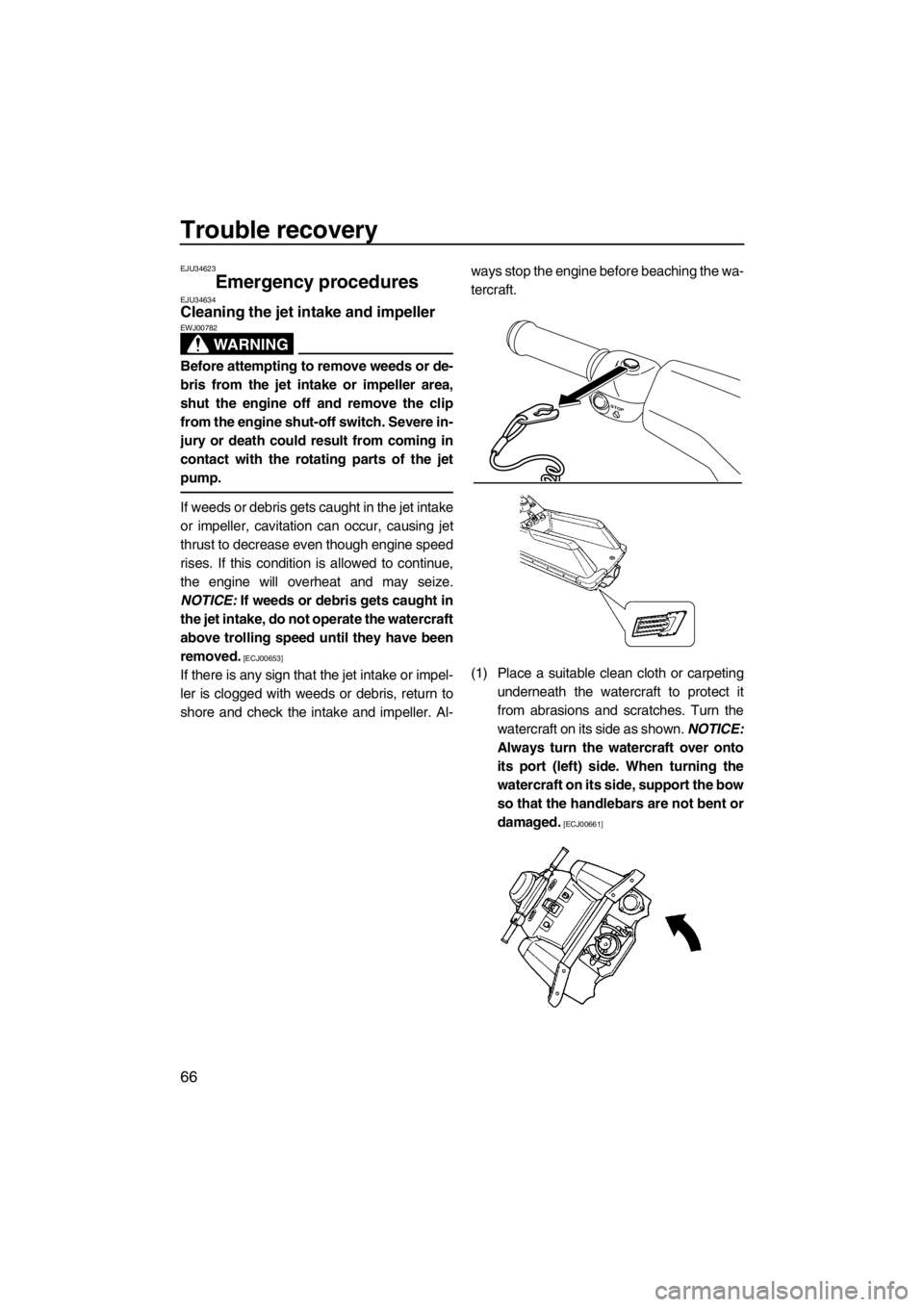
If there is any sign that the jet intake or impel-
ler is clogged with weeds or debris, return to
shore and check the intake and impeller. Al- ways stop the engine before beaching the wa-
tercraft.
(1) Place a suitable clean cloth or carpeting
underneath the watercraft to protect it
from abrasions and scratches. Turn the
watercraft on its side as shown. NOTICE:
Always turn the watercraft over onto
its port (left) side. When turning the
watercraft on its side, support the bow
so that the handlebars are not bent or
damaged.
[ECJ00661]
STOP
UF2F75E0.book Page 66 Thursday, July 5, 2012 8:50 AM
Page 73 of 78
Trouble recovery
67
(2) Remove any weeds or debris fromaround the jet intake, drive shaft, impel-
ler, jet pump housing, and jet thrust noz-
zle.
If debris is difficult to remove, consult a
Yamaha dealer.
EJU34641Jumping the battery
If the watercraft battery has run down, the en-
gine can be started using a 12-volt booster
battery and jumper cables.
EJU34653Connecting the jumper cables
WARNING
EWJ01250
To avoid battery explosion and serious
damage to the electrical system:
●Do not reverse the polarity of the jumper
cables when connecting to the batteries.
●Do not connect the negative (–) jumper
cable to the negative (–) terminal of the
watercraft battery.
●Do not touch the positive (+) jumper ca-
ble to the negative (–) jumper cable.
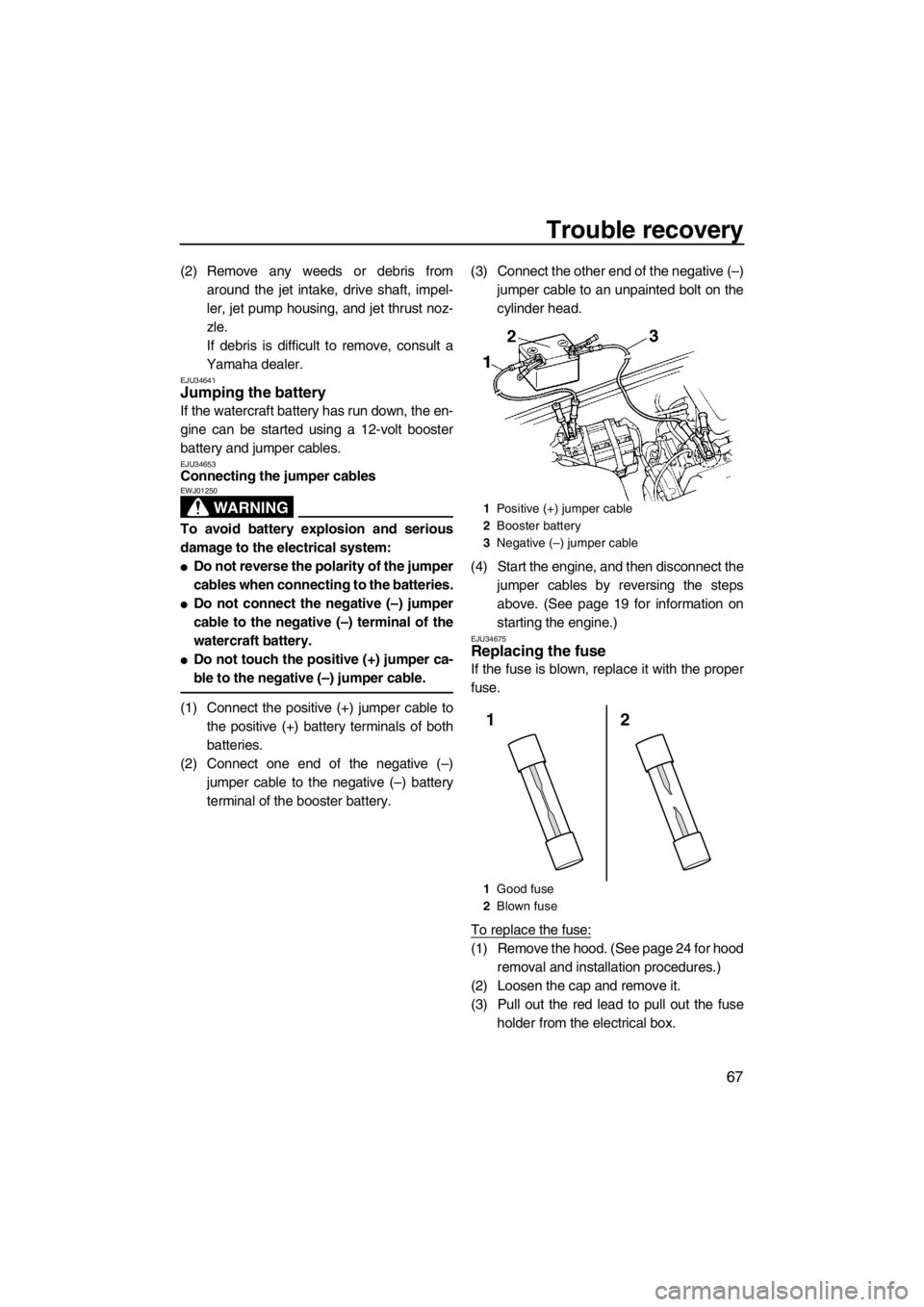
(1) Connect the positive (+) jumper cable to the positive (+) battery terminals of both
batteries.
(2) Connect one end of the negative (–) jumper cable to the negative (–) battery
terminal of the booster battery. (3) Connect the other end of the negative (–)
jumper cable to an unpainted bolt on the
cylinder head.
(4) Start the engine, and then disconnect the jumper cables by reversing the steps
above. (See page 19 for information on
starting the engine.)
EJU34675Replacing the fuse
If the fuse is blown, replace it with the proper
fuse.
To replace the fuse:
(1) Remove the hood. (See page 24 for hoodremoval and installation procedures.)
(2) Loosen the cap and remove it.
(3) Pull out the red lead to pull out the fuse
holder from the electrical box.
1Positive (+) jumper cable
2 Booster battery
3 Negative (–) jumper cable
1 Good fuse
2 Blown fuse
2
1
UF2F75E0.book Page 67 Thursday, July 5, 2012 8:50 AM