light YAMAHA TMAX 2002 User Guide
[x] Cancel search | Manufacturer: YAMAHA, Model Year: 2002, Model line: TMAX, Model: YAMAHA TMAX 2002Pages: 102, PDF Size: 1.67 MB
Page 36 of 102

4-2
PRE-OPERATION CHECKS
4
Throttle grip•Make sure that operation is smooth.
•Check free play.
•If necessary, have Yamaha dealer make adjustment or lubricate.6-22, 6-29
Wheels and tires•Check for damage.
•Check tire condition and tread depth.
•Check air pressure.
•Correct if necessary.6-23–6-25
Brake levers•Make sure that operation is smooth.
•Lubricate lever pivoting points if necessary.6-29
Centerstand, sidestand•Make sure that operation is smooth.
•Lubricate pivots if necessary.6-29–6-30
Chassis fasteners•Make sure that all nuts, bolts and screws are properly tightened.
•Tighten if necessary.—
Instruments, lights, signals
and switches•Check operation.
•Correct if necessary.3-2–3-8, 6-35–6-36
Sidestand switch•Check operation of ignition circuit cut-off system.
•If system is defective, have Yamaha dealer check vehicle.3-14–3-16 ITEM CHECKS PAGENOTE:
Pre-operation checks should be made each time the scooter is used. Such an inspection can be accomplished in a very
short time; and the added safety it assures is more than worth the time involved.
EWA00033
wIf any item in the Pre-operation check list is not working properly, have it inspected and repaired before operat-
ing the scooter.
5GJ-9-E1 9/4/01 1:27 PM Page 35
Page 41 of 102

5-3
OPERATION AND IMPORTANT RIDING POINTS
5
EAU00435
BrakingBraking1. Close the throttle completely.
2. Apply both front and rear brakes
simultaneously while gradually
increasing the pressure.
EW000057
w8Avoid braking hard or sudden-
ly (especially when leaning
over to one side), otherwise
the scooter may skid or over-
turn.
8Railroad crossings, streetcar
rails, iron plates on road con-
struction sites, and manhole
covers become extremely slip-
pery when wet. Therefore,
slow down when approaching
such areas and cross them
with caution.
8Keep in mind that braking on a
wet road is much more diffi-
cult.
8Ride slowly down a hill, as
braking downhill can be very
difficult.
EAU03093
Tips for reducing fuel
consumptionFuel consumption, tips for reducingFuel consumption depends largely on
your riding style. Consider the follow-
ing tips to reduce fuel consumption:
8Thoroughly warm up the engine.
8Avoid high engine speeds during
acceleration.
8Avoid high engine speeds with
no load on the engine.
8Turn the engine off instead of let-
ting it idle for an extended length
of time (e.g., in traffic jams, at
traffic lights or at railroad cross-
ings).
5GJ-9-E1 9/4/01 1:27 PM Page 40
Page 44 of 102
PERIODIC MAINTENANCE AND MINOR REPAIR
Owner’s tool kit ..................................................... 6-1
Periodic maintenance and lubrication chart .......... 6-3
Removing and installing cowlings and panels ...... 6-6
Checking the spark plugs ..................................... 6-9
Engine oil and oil filter cartridge .......................... 6-12
Chain drive oil ..................................................... 6-15
Coolant ............................................................... 6-17
Cleaning the air filter element ............................. 6-19
Adjusting the carburetors .................................... 6-21
Adjusting the engine idling speed ....................... 6-21
Adjusting the throttle cable free play ................... 6-22
Adjusting the valve clearance ............................. 6-22
Tires .................................................................... 6-23
Cast wheels ........................................................ 6-25
Front and rear brake levers ................................ 6-25
Checking the front and rear brake pads ............. 6-26
Checking the brake fluid level ............................. 6-27
Changing the brake fluid ..................................... 6-28
Checking and lubricating the throttle grip
and cable .......................................................... 6-29
Lubricating the front and rear brake levers ......... 6-29
Checking and lubricating the centerstand and
sidestand .......................................................... 6-29
Checking the front fork ........................................ 6-30Checking the steering ......................................... 6-31
Checking the wheel bearings .............................. 6-31
Battery ................................................................ 6-32
Replacing the fuses ............................................ 6-34
Replacing a headlight bulb ................................. 6-35
Troubleshooting .................................................. 6-36
Troubleshooting charts ....................................... 6-37
6
5GJ-9-E1 9/4/01 1:27 PM Page 43
Page 49 of 102
6-5
PERIODIC MAINTENANCE AND MINOR REPAIR
6
EAU03884
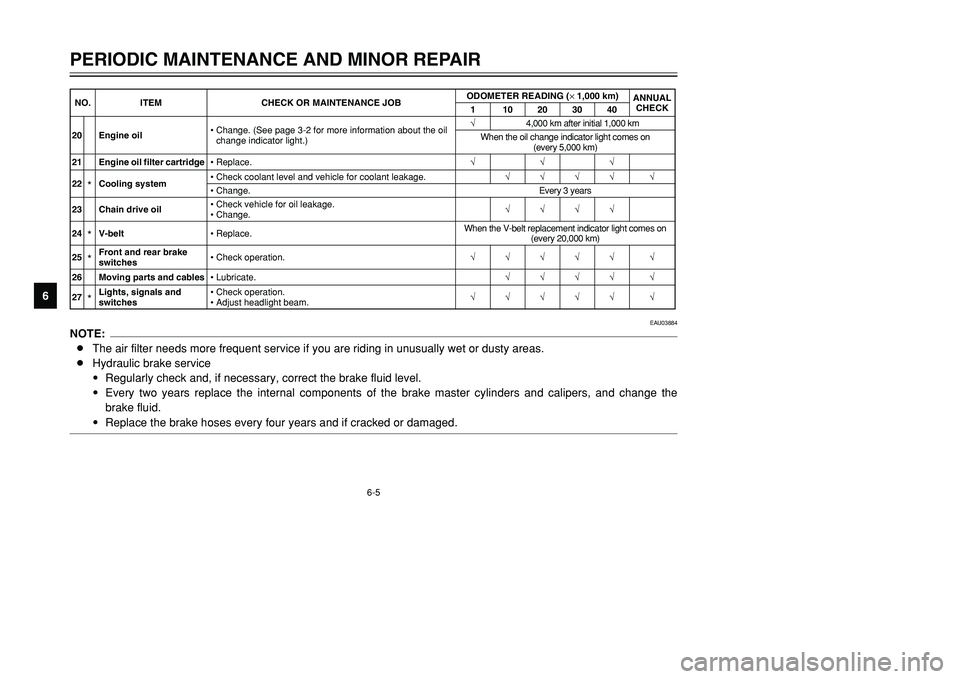
NOTE:
8The air filter needs more frequent service if you are riding in unusually wet or dusty areas.
8Hydraulic brake service
9Regularly check and, if necessary, correct the brake fluid level.
9Every two years replace the internal components of the brake master cylinders and calipers, and change the
brake fluid.
9Replace the brake hoses every four years and if cracked or damaged.20 Engine oil•Change. (See page 3-2 for more information about the oil
change indicator light.)√4,000 km after initial 1,000 km
When the oil change indicator light comes on
(every 5,000 km)
21 Engine oil filter cartridge•Replace.√√√
22
*Cooling system•Check coolant level and vehicle for coolant leakage.√√√√ √
•Change.Every 3 years
23 Chain drive oil•Check vehicle for oil leakage.
•Change.√√√√
24*V-belt•Replace.When the V-belt replacement indicator light comes on
(every 20,000 km)
25*Front and rear brake
switches•Check operation.√√√√√ √
26 Moving parts and cables•Lubricate.√√√√ √
27*Lights, signals and
switches•Check operation.
•Adjust headlight beam.√√√√√ √ NO. ITEM CHECK OR MAINTENANCE JOBODOMETER READING (× 1,000 km)
ANNUAL
CHECK
1 10203040
5GJ-9-E1 9/4/01 1:27 PM Page 48
Page 55 of 102

6-11
PERIODIC MAINTENANCE AND MINOR REPAIR
6To check the spark plugs
1. Check that the porcelain insula-
tor around the center electrode
on each spark plug is a medium-
to-light tan (the ideal color when
the scooter is ridden normally).
2. Check that all spark plugs
installed in the engine have the
same color.
NOTE:
If any spark plug shows a distinctly
different color, the engine could be
defective. Do not attempt to diagnose
such problems yourself. Instead,
have a Yamaha dealer check the
scooter.3. Check each spark plug for elec-
trode erosion and excessive car-
bon or other deposits, and
replace it if necessary.
NOTE:
If a torque wrench is not available
when installing a spark plug, a good
estimate of the correct torque is
1/4–1/2 turn past finger tight.
However, the spark plug should be
tightened to the specified torque as
soon as possible.4. Install the spark plug cap. To install a spark plug
1. Measure the spark plug gap with
a wire thickness gauge and, if
necessary, adjust the gap to
specification.
2. Clean the surface of the spark
plug gasket and its mating sur-
face, and then wipe off any grime
from the spark plug threads.
3. Install the spark plug with the
spark plug wrench, and then
tighten it to the specified torque.
a
a. Spark plug gap
Specified spark plug:
CR7E (NGK)
Spark plug gap:
0.7–0.8 mm
Tightening torque:
Spark plug:
12.5 Nm (1.25 m·kgf)
5GJ-9-E1 9/4/01 1:27 PM Page 54
Page 56 of 102
6-12
PERIODIC MAINTENANCE AND MINOR REPAIR
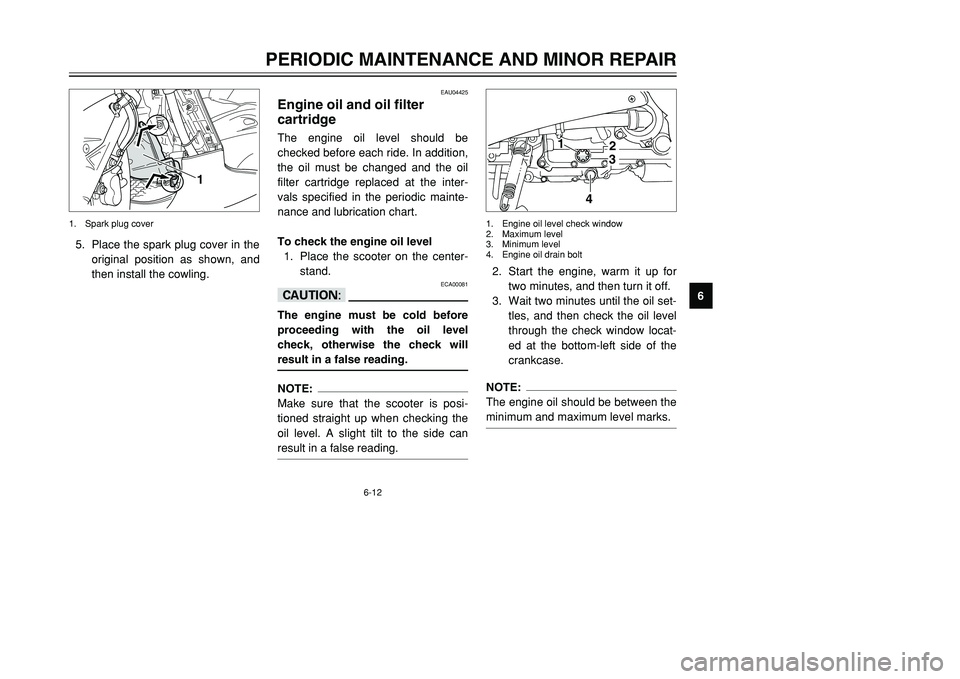
6 5. Place the spark plug cover in the
original position as shown, and
then install the cowling.
1
1. Spark plug cover
2. Start the engine, warm it up for
two minutes, and then turn it off.
3. Wait two minutes until the oil set-
tles, and then check the oil level
through the check window locat-
ed at the bottom-left side of the
crankcase.NOTE:
The engine oil should be between the
minimum and maximum level marks.
32
1
4
1. Engine oil level check window
2. Maximum level
3. Minimum level
4. Engine oil drain bolt
EAU04425
Engine oil and oil filter
cartridgeEngine oil and oil filter cartridgeThe engine oil level should be
checked before each ride. In addition,
the oil must be changed and the oil
filter cartridge replaced at the inter-
vals specified in the periodic mainte-
nance and lubrication chart.
To check the engine oil level
1. Place the scooter on the center-
stand.
ECA00081
cCThe engine must be cold before
proceeding with the oil level
check, otherwise the check will
result in a false reading.NOTE:
Make sure that the scooter is posi-
tioned straight up when checking the
oil level. A slight tilt to the side can
result in a false reading.
5GJ-9-E1 9/4/01 1:27 PM Page 55
Page 59 of 102

6-15
PERIODIC MAINTENANCE AND MINOR REPAIR
6To reset the oil change indicator
light
1. Turn the key to “ON”.
2. Hold the reset button pushed for
two to five seconds.
3. Release the reset button, and
the oil change indicator light will
go off.
1
1. Reset button “Oil Change”
EAU04253
Chain drive oilChain drive oilThe chain drive oil should be
changed as follows at the intervals
specified in the periodic maintenance
and lubrication chart.
1. Remove panel F. (See page 6-8
for panel removal and installation
procedures.)
2. Place an oil pan under the chain
drive case to collect the used oil.
3. Remove the oil filler cap and
drain bolt to drain the oil from the
chain drive case.
1
2
1. Chain drive oil filler cap
2. Chain drive oil drain bolt
NOTE:
If the engine oil is changed before the
oil change indicator light comes on
(i.e. before the periodic oil change
interval has been reached), the indi-
cator light must be reset after the oil
change for the next periodic oil
change to be indicated at the correct
time. To reset the oil change indicator
light before the periodic oil change
interval has been reached, follow the
above procedure, but note that the
indicator light will come on for 1.4
seconds after releasing the reset but-
ton, otherwise repeat the procedure.
5GJ-9-E1 9/4/01 1:27 PM Page 58
Page 61 of 102
6-17
PERIODIC MAINTENANCE AND MINOR REPAIR
6
EAU03850
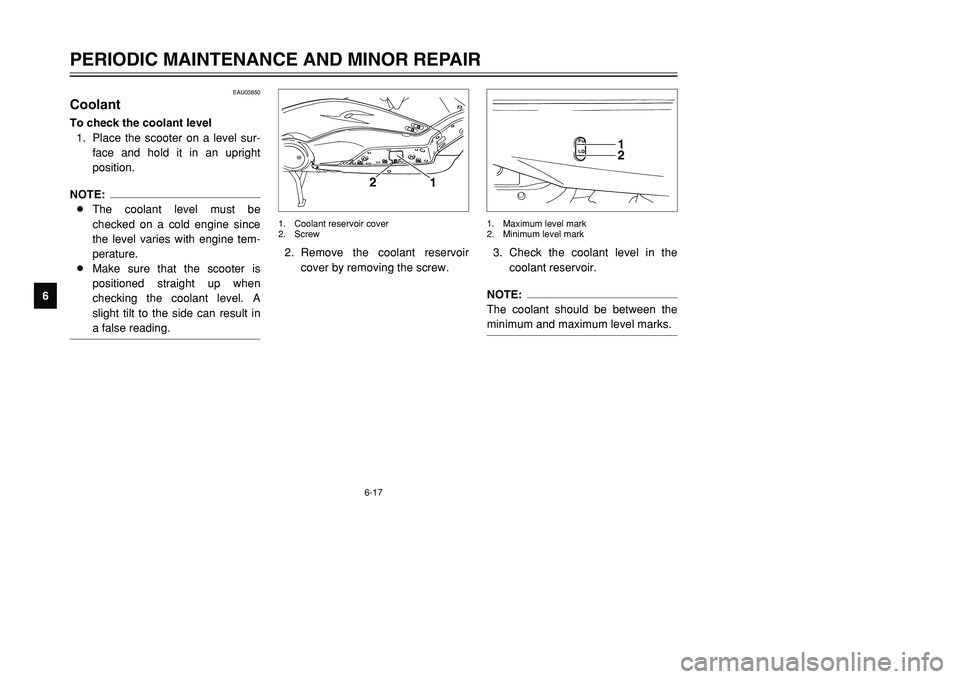
CoolantCoolantTo check the coolant level
1. Place the scooter on a level sur-
face and hold it in an upright
position.NOTE:
8The coolant level must be
checked on a cold engine since
the level varies with engine tem-
perature.
8Make sure that the scooter is
positioned straight up when
checking the coolant level. A
slight tilt to the side can result in
a false reading.
3. Check the coolant level in the
coolant reservoir.NOTE:
The coolant should be between the
minimum and maximum level marks.
12
1. Maximum level mark
2. Minimum level mark
2. Remove the coolant reservoir
cover by removing the screw.
1
2
1. Coolant reservoir cover
2. Screw
5GJ-9-E1 9/4/01 1:27 PM Page 60
Page 64 of 102

6-20
PERIODIC MAINTENANCE AND MINOR REPAIR
6
1
1. Air filter element
EC000082
cC8Make sure that the air filter ele-
ment is properly seated in the
air filter case.
8The engine should never be
operated without the air filter
element installed, otherwise
the pistons and/or cylinders
may become excessively
worn.6. Install the air filter case cover by
installing the screws.
7. Install the windshield and the
cowling. 4. Lightly tap the air filter element to
remove most of the dust and dirt,
and then blow the remaining dirt
out with compressed air as
shown. If the air filter element is
damaged, replace it.
5. Insert the air filter element into
the air filter case.
5GJ-9-E1 9/4/01 1:27 PM Page 63
Page 78 of 102

6-34
PERIODIC MAINTENANCE AND MINOR REPAIR
6
EAU04404
Replacing the fusesFuses, replacingThe main fuse box is located beside
the battery and can be accessed as
follows:
1. Open the seat. (See page 3-11
for seat opening and closing pro-
cedures.)
2. Remove the battery cover. (See
page 6-32 for battery cover
removal procedures.)
1
1. Battery
If a fuse is blown, replace it as fol-
lows.
1. Turn the key to “OFF” and turn
off the electrical circuit in ques-
tion.
2. Remove the blown fuse, and
then install a new fuse of the
specified amperage.
7
123456
1. Signaling system fuse
2. Headlight fuse
3. Ignition fuse
4. Radiator fan fuse
5. Hazard fuse
6. Clock fuse
7. Spare fuse (×2)
3. Disconnect the negative battery
lead, and then lift the battery as
shown.
The fuse box, which contains the
fuses for the individual circuits, is
located under the battery cover and
can be accessed as follows.
1. Open the seat. (See page 3-11
for seat opening and closing pro-
cedures.)
2. Remove the battery cover by
removing the screws.
12
3
1. Negative battery lead
2. Main fuse box
3. Fuse box
5GJ-9-E1 9/4/01 1:27 PM Page 77