brake YAMAHA TMAX 2002 Owners Manual
[x] Cancel search | Manufacturer: YAMAHA, Model Year: 2002, Model line: TMAX, Model: YAMAHA TMAX 2002Pages: 102, PDF Size: 1.67 MB
Page 10 of 102

1-2
Q
GIVE SAFETY THE RIGHT OF WAY
1
EAU03099
Further safe-riding pointsSafe-riding points8Be sure to signal clearly when making turns.
8Braking can be extremely difficult on a wet road. Avoid hard braking, because the scooter could
slide. Apply the brakes slowly when stopping on a wet surface.
8Slow down as you approach a corner or turn. Once you have completed a turn, accelerate slowly.
8Be careful when passing parked cars. A driver might not see you and open a door in your path.
8Railroad crossings, streetcar rails, iron plates on road construction sites, and manhole covers
become extremely slippery when wet. Slow down and cross them with caution. Keep the scooter
upright, otherwise it could slide out from under you.
8The brake pads could get wet when you wash the scooter. After washing the scooter, check the
brakes before riding.
8Always wear a helmet, gloves, trousers (tapered around the cuff and ankle so they do not flap),
and a bright colored jacket.
8Do not carry too much luggage on the scooter. An overloaded scooter is unstable.
5GJ-9-E1 9/4/01 1:27 PM Page 9
Page 15 of 102

2-3
DESCRIPTION
2
1. Rear brake lever (page 3-9)
2. Left handlebar switches (page 3-6)
3. Clock (page 3-5)
4. Speedometer unit (page 3-3)
5. Coolant temperature gauge (page 3-4)6. Fuel gauge (page 3-4)
7. Right handlebar switches (page 3-7)
8. Front brake lever (page 3-9)
9. Throttle grip (page 6-22, 6-29)
10. Main switch/steering lock (page 3-1)
4
3
2
5
6
7
8
1
109
Controls and instruments
5GJ-9-E1 9/4/01 1:27 PM Page 14
Page 16 of 102
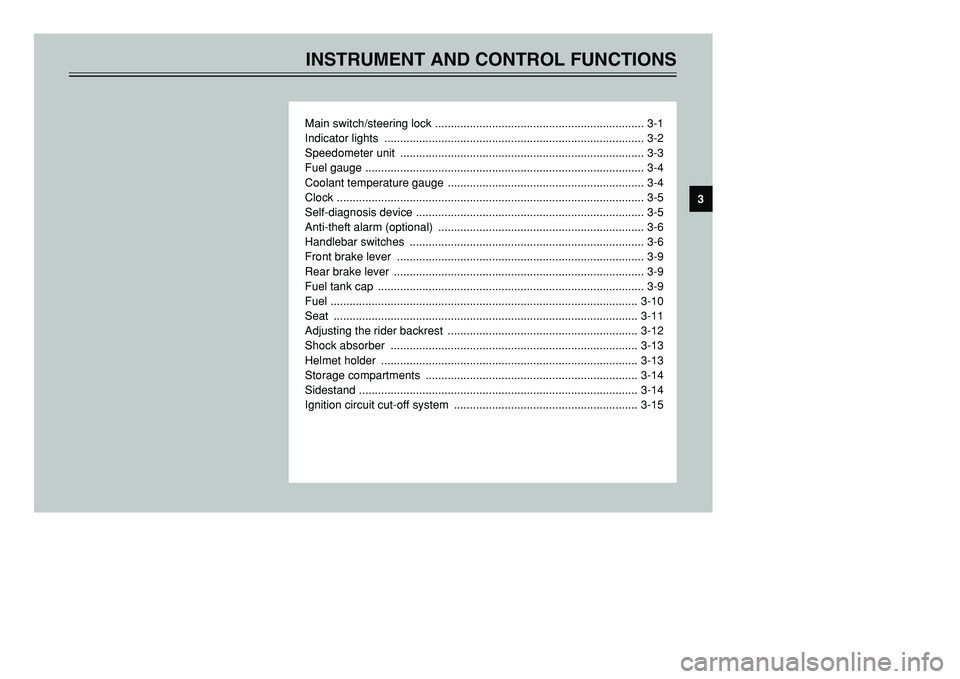
INSTRUMENT AND CONTROL FUNCTIONSMain switch/steering lock .................................................................. 3-1
Indicator lights .................................................................................. 3-2
Speedometer unit ............................................................................. 3-3
Fuel gauge ........................................................................................ 3-4
Coolant temperature gauge .............................................................. 3-4
Clock ................................................................................................. 3-5
Self-diagnosis device ........................................................................ 3-5
Anti-theft alarm (optional) ................................................................. 3-6
Handlebar switches .......................................................................... 3-6
Front brake lever .............................................................................. 3-9
Rear brake lever ............................................................................... 3-9
Fuel tank cap .................................................................................... 3-9
Fuel ................................................................................................. 3-10
Seat ................................................................................................ 3-11
Adjusting the rider backrest ............................................................ 3-12
Shock absorber .............................................................................. 3-13
Helmet holder ................................................................................. 3-13
Storage compartments ................................................................... 3-14
Sidestand ........................................................................................ 3-14
Ignition circuit cut-off system .......................................................... 3-15
3
5GJ-9-E1 9/4/01 1:27 PM Page 15
Page 23 of 102

3-7
EAU03889
Turn signal switch “4/6”Turn signal switchTo signal a right-hand turn, push this
switch to “6”. To signal a left-hand
turn, push this switch to “4”. When
released, the switch returns to the
center position. To cancel the turn
signal lights, push the switch in after
it has returned to the center position.
EAU00129
Horn switch “*”Horn switchPress this switch to sound the horn.
EAU03801
Start switch “,”Start switchWith the sidestand up, push this
switch while applying the front or rear
brake to crank the engine with the
starter.
EC000005
cCSee page 5-1 for starting instruc-
tions prior to starting the engine.
INSTRUMENT AND CONTROL FUNCTIONS
3
12
34
5
1. Pass switch “PASS”
2. Dimmer switch “&/%”
3. Turn signal switch “4/6”
4. Horn switch “*”
5. Hazard switch “0”
EAU03890
Engine stop switch “#/$”Engine stop switchSet this switch to “#” before starting
the engine. Set this switch to “$” to
stop the engine in case of an emer-
gency, such as when the scooter
overturns or when the throttle cable is
stuck.
EAU03898
Light switch “9/
'
/:”
Light switchSet this switch to “
'
” to turn on the
auxiliary light, meter lighting and tail-
light. Set the switch to “:” to turn on
the headlight also. Set the switch to
“9” to turn off all the lights.
123
1. Engine stop switch “#/$”
2. Light switch “9/
'
/:”
3. Start switch “,”
5GJ-9-E1 9/4/01 1:27 PM Page 22
Page 25 of 102

3-9
EAU03882
Front brake leverBrake lever, frontThe front brake lever is located on
the right handlebar grip. To apply the
front brake, pull this lever toward the
handlebar grip.INSTRUMENT AND CONTROL FUNCTIONS
3
1
1. Front brake lever
EAU00163
Rear brake leverBrake lever, rearThe rear brake lever is located on the
left handlebar grip. To apply the rear
brake, pull this lever toward the han-
dlebar grip.
1
1. Rear brake lever
EAU03881
Fuel tank capFuel tank capTo remove the fuel tank cap
1. Open the lid by pulling the lever
up.
2. Insert the key into the lock and
turn it clockwise. The lock will be
released and the fuel tank cap
can be removed.
1
1. Lid
5GJ-9-E1 9/4/01 1:27 PM Page 24
Page 31 of 102
3-15
EW000044
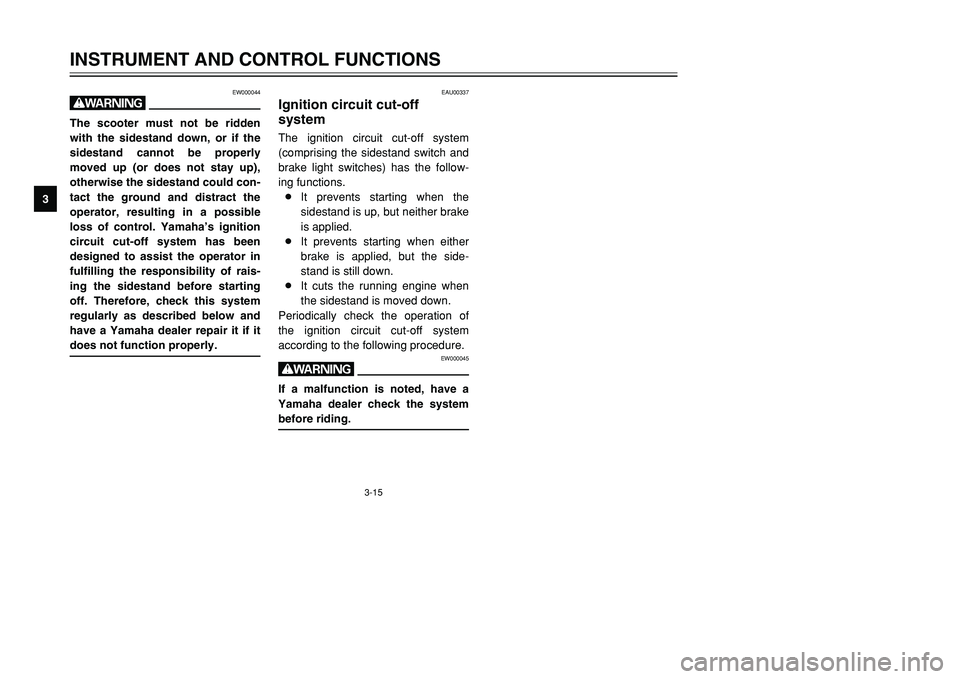
wThe scooter must not be ridden
with the sidestand down, or if the
sidestand cannot be properly
moved up (or does not stay up),
otherwise the sidestand could con-
tact the ground and distract the
operator, resulting in a possible
loss of control. Yamaha’s ignition
circuit cut-off system has been
designed to assist the operator in
fulfilling the responsibility of rais-
ing the sidestand before starting
off. Therefore, check this system
regularly as described below and
have a Yamaha dealer repair it if it
does not function properly.
EAU00337
Ignition circuit cut-off
systemIgnition circuit cut-off systemThe ignition circuit cut-off system
(comprising the sidestand switch and
brake light switches) has the follow-
ing functions.
8It prevents starting when the
sidestand is up, but neither brake
is applied.
8It prevents starting when either
brake is applied, but the side-
stand is still down.
8It cuts the running engine when
the sidestand is moved down.
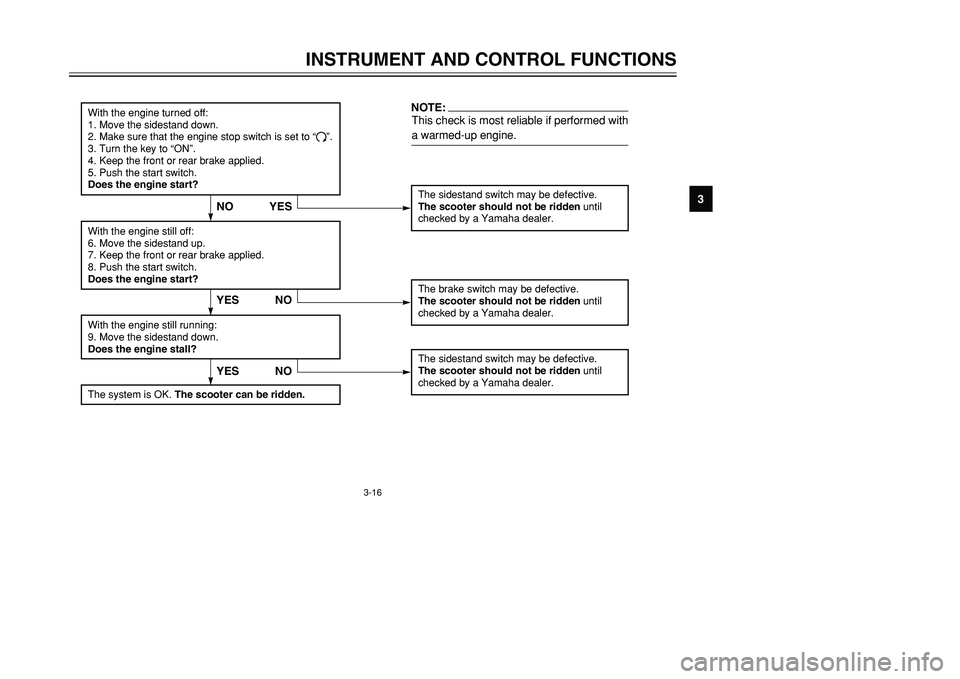
Periodically check the operation of
the ignition circuit cut-off system
according to the following procedure.
EW000045
wIf a malfunction is noted, have a
Yamaha dealer check the system
before riding.
INSTRUMENT AND CONTROL FUNCTIONS
3 5GJ-9-E1 9/4/01 1:27 PM Page 30
Page 32 of 102
3-16
INSTRUMENT AND CONTROL FUNCTIONS
3
The sidestand switch may be defective.The scooter should not be ridden until
checked by a Yamaha dealer.
YES NO
With the engine turned off:
1. Move the sidestand down.
2. Make sure that the engine stop switch is set to “#”.
3. Turn the key to “ON”.
4. Keep the front or rear brake applied.
5. Push the start switch.
Does the engine start?
The brake switch may be defective.
The scooter should not be ridden until
checked by a Yamaha dealer.
With the engine still off:
6. Move the sidestand up.
7. Keep the front or rear brake applied.
8. Push the start switch.
Does the engine start?With the engine still running:
9. Move the sidestand down.
Does the engine stall?
The sidestand switch may be defective.
The scooter should not be ridden until
checked by a Yamaha dealer.NOTE:This check is most reliable if performed with
a warmed-up engine.
YES NO
The system is OK. The scooter can be ridden.
YES NO
5GJ-9-E1 9/4/01 1:27 PM Page 31
Page 35 of 102
4-1
EAU01114
PRE-OPERATION CHECKS
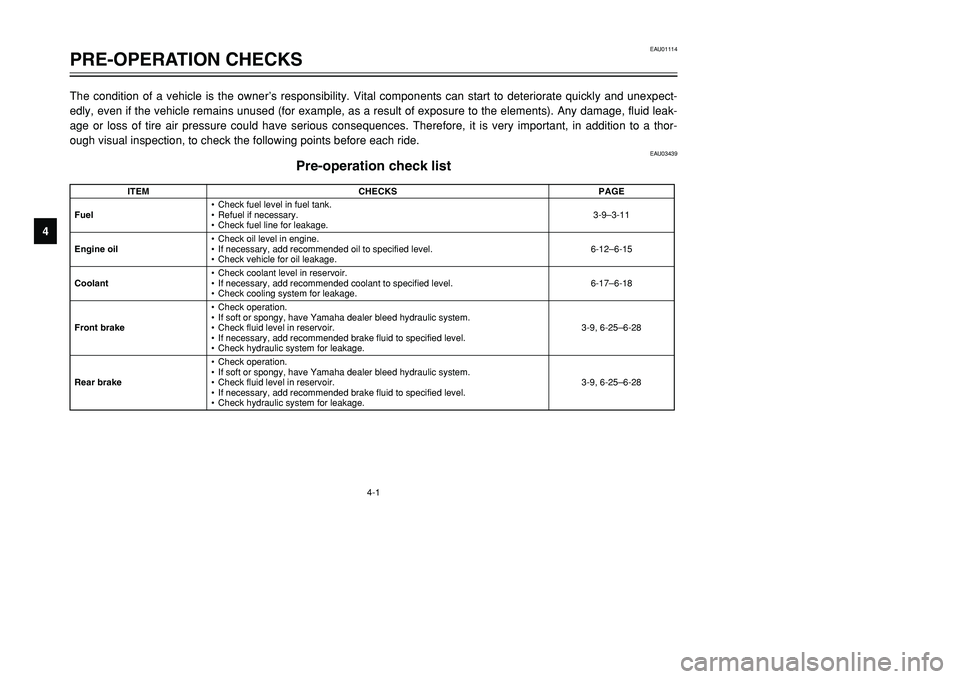
4The condition of a vehicle is the owner’s responsibility. Vital components can start to deteriorate quickly and unexpect-
edly, even if the vehicle remains unused (for example, as a result of exposure to the elements). Any damage, fluid leak-
age or loss of tire air pressure could have serious consequences. Therefore, it is very important, in addition to a thor-
ough visual inspection, to check the following points before each ride.
EAU03439
Pre-operation check list
Pre-operation check list
ITEM CHECKS PAGE
Fuel•Check fuel level in fuel tank.
•Refuel if necessary.
•Check fuel line for leakage.3-9–3-11
Engine oil•Check oil level in engine.
•If necessary, add recommended oil to specified level.
•Check vehicle for oil leakage.6-12–6-15
Coolant•Check coolant level in reservoir.
•If necessary, add recommended coolant to specified level.
•Check cooling system for leakage.6-17–6-18
Front brake•Check operation.
•If soft or spongy, have Yamaha dealer bleed hydraulic system.
•Check fluid level in reservoir.
•If necessary, add recommended brake fluid to specified level.
•Check hydraulic system for leakage.3-9, 6-25–6-28
Rear brake•Check operation.
•If soft or spongy, have Yamaha dealer bleed hydraulic system.
•Check fluid level in reservoir.
•If necessary, add recommended brake fluid to specified level.
•Check hydraulic system for leakage.3-9, 6-25–6-28
5GJ-9-E1 9/4/01 1:27 PM Page 34
Page 36 of 102

4-2
PRE-OPERATION CHECKS
4
Throttle grip•Make sure that operation is smooth.
•Check free play.
•If necessary, have Yamaha dealer make adjustment or lubricate.6-22, 6-29
Wheels and tires•Check for damage.
•Check tire condition and tread depth.
•Check air pressure.
•Correct if necessary.6-23–6-25
Brake levers•Make sure that operation is smooth.
•Lubricate lever pivoting points if necessary.6-29
Centerstand, sidestand•Make sure that operation is smooth.
•Lubricate pivots if necessary.6-29–6-30
Chassis fasteners•Make sure that all nuts, bolts and screws are properly tightened.
•Tighten if necessary.—
Instruments, lights, signals
and switches•Check operation.
•Correct if necessary.3-2–3-8, 6-35–6-36
Sidestand switch•Check operation of ignition circuit cut-off system.
•If system is defective, have Yamaha dealer check vehicle.3-14–3-16 ITEM CHECKS PAGENOTE:
Pre-operation checks should be made each time the scooter is used. Such an inspection can be accomplished in a very
short time; and the added safety it assures is more than worth the time involved.
EWA00033
wIf any item in the Pre-operation check list is not working properly, have it inspected and repaired before operat-
ing the scooter.
5GJ-9-E1 9/4/01 1:27 PM Page 35
Page 39 of 102
5-1
EAU00372
OPERATION AND IMPORTANT RIDING POINTS
5
EAU03981
w8Become thoroughly familiar
with all operating controls and
their functions before riding.
Consult a Yamaha dealer
regarding any control or func-
tion that you do not thorough-
ly understand.
8Never start the engine or oper-
ate it in a closed area for any
length of time. Exhaust fumes
are poisonous, and inhaling
them can cause loss of con-
sciousness and death within a
short time. Always make sure
that there is adequate ventila-
tion.
8For safety, always start the
engine with the centerstand
down.
8When the centerstand is down
and the engine is idling, keep
your hands and feet away from
the rear wheel.
EAU03843
Starting the engineStarting the engine
EC000046
cCSee page 5-4 for engine break-in
instructions prior to operating the
vehicle for the first time.In order for the ignition circuit cut-off
system to enable starting, the side-
stand must be up.
EW000054
w8Before starting the engine,
check the function of the igni-
tion circuit cut-off system
according to the procedure
described on page 3-16.
8Never ride with the sidestand
down.
1. Turn the key to “ON” and make
sure that the engine stop switch
is set to “#”.
2. Close the throttle completely.
3. Start the engine by pushing the
start switch while applying the
front or rear brake.NOTE:
If the engine does not start, release
the start switch, wait a few seconds,
and then try again. Each starting
attempt should be as short as possi-
ble to preserve the battery. Do not
crank the engine more than 10 sec-
onds on any one attempt. If the
engine does not start, try with the
throttle open 1/8 turn.
ECA00045
cCFor maximum engine life, never
accelerate hard when the engine is
cold!
5GJ-9-E1 9/4/01 1:27 PM Page 38