check oil YAMAHA TRICITY 2017 User Guide
[x] Cancel search | Manufacturer: YAMAHA, Model Year: 2017, Model line: TRICITY, Model: YAMAHA TRICITY 2017Pages: 92, PDF Size: 3.43 MB
Page 65 of 92
Periodic maintenance and adjustment
6-22
6
EAU40262
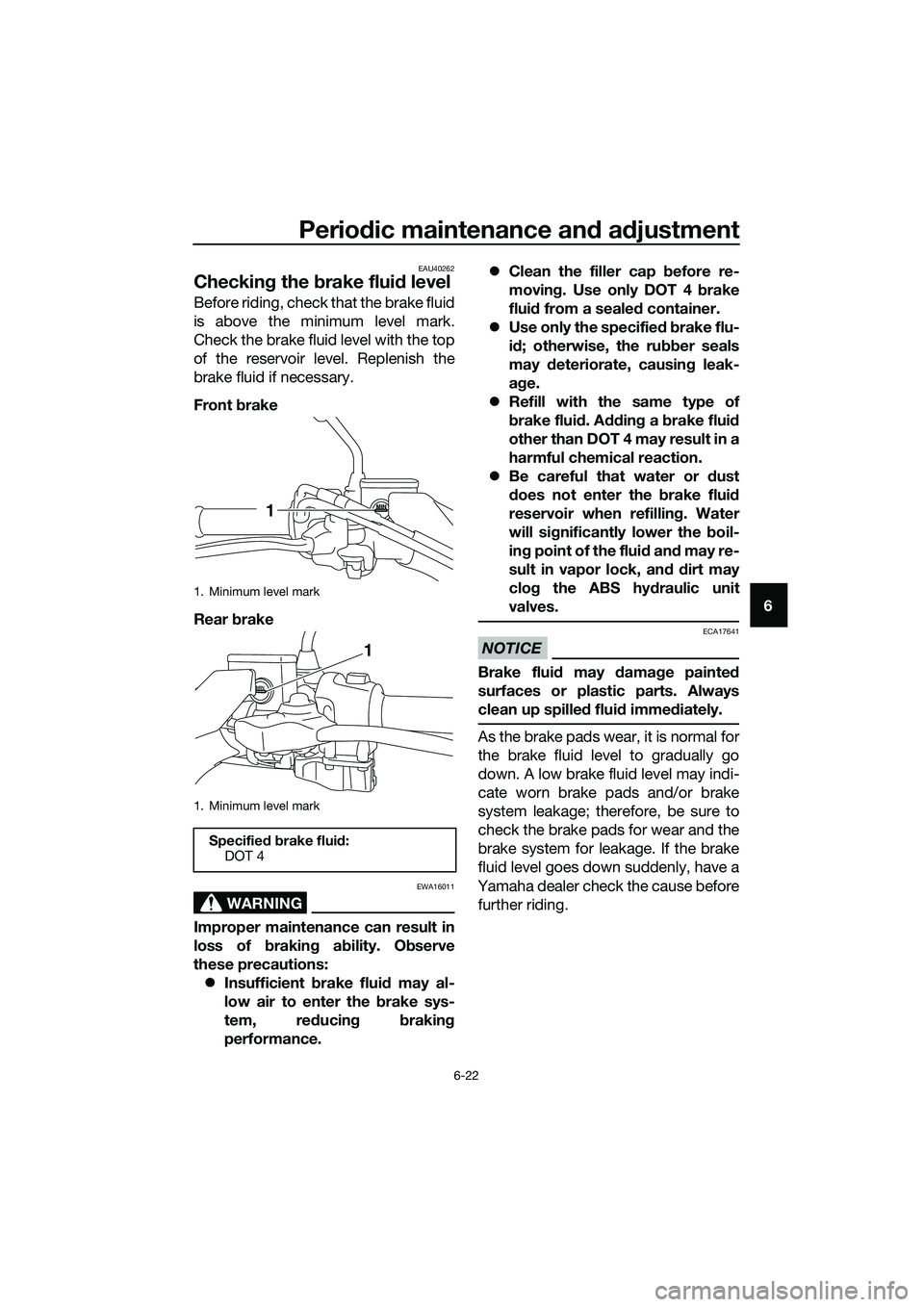
Checking the brake fluid level
Before riding, check that the brake fluid
is above the minimum level mark.
Check the brake fluid level with the top
of the reservoir level. Replenish the
brake fluid if necessary.
Front brake
Rear brake
WARNING
EWA16011
Improper maintenance can result in
loss of braking ability. Observe
these precautions:
zInsufficient brake fluid may al-
low air to enter the brake sys-
tem, reducing braking
performance.zClean the filler cap before re-
moving. Use only DOT 4 brake
fluid from a sealed container.
zUse only the specified brake flu-
id; otherwise, the rubber seals
may deteriorate, causing leak-
age.
zRefill with the same type of
brake fluid. Adding a brake fluid
other than DOT 4 may result in a
harmful chemical reaction.
zBe careful that water or dust
does not enter the brake fluid
reservoir when refilling. Water
will significantly lower the boil-
ing point of the fluid and may re-
sult in vapor lock, an
d dirt may
clog the ABS hydraulic unit
valves.
NOTICE
ECA17641
Brake fluid may damage painted
surfaces or plastic parts. Always
clean up spilled fluid immediately.
As the brake pads wear, it is normal for
the brake fluid level to gradually go
down. A low brake fluid level may indi-
cate worn brake pads and/or brake
system leakage; therefore, be sure to
check the brake pads for wear and the
brake system for leakage. If the brake
fluid level goes down suddenly, have a
Yamaha dealer check the cause before
further riding.
1. Minimum level mark
1. Minimum level mark
Specified brake fluid:
DOT 4
1
1
UBR7E0E0.book Page 22 Tuesday, October 25, 2016 2:44 PM
Page 66 of 92
Periodic maintenance and adjustment
6-23
6
EAU22733
Changing the brake fluid
Have a Yamaha dealer change the
brake fluid at the intervals specified in
the periodic maintenance and lubrica-
tion chart. In addition, have the oil seals
of the master cylinders and calipers as
well as the brake hoses replaced at the
intervals listed below or whenever they
are damaged or leaking.
zOil seals: Replace every two
years.
zBrake hoses: Replace every four
years.
EAUU0311
Checking the V-belt
The V-belt must be checked and re-
placed by a Yamaha dealer at the inter-
vals specified in the periodic
maintenance and lubrication chart.
UBR7E0E0.book Page 23 Tuesday, October 25, 2016 2:44 PM
Page 69 of 92
Periodic maintenance and adjustment
6-26
6
EAU23273
Checking the front fork
The condition and operation of the
front fork must be checked as follows
at the intervals specified in the periodic
maintenance and lubrication chart.
To check the condition
Check the inner tubes for scratches,
damage and excessive oil leakage.
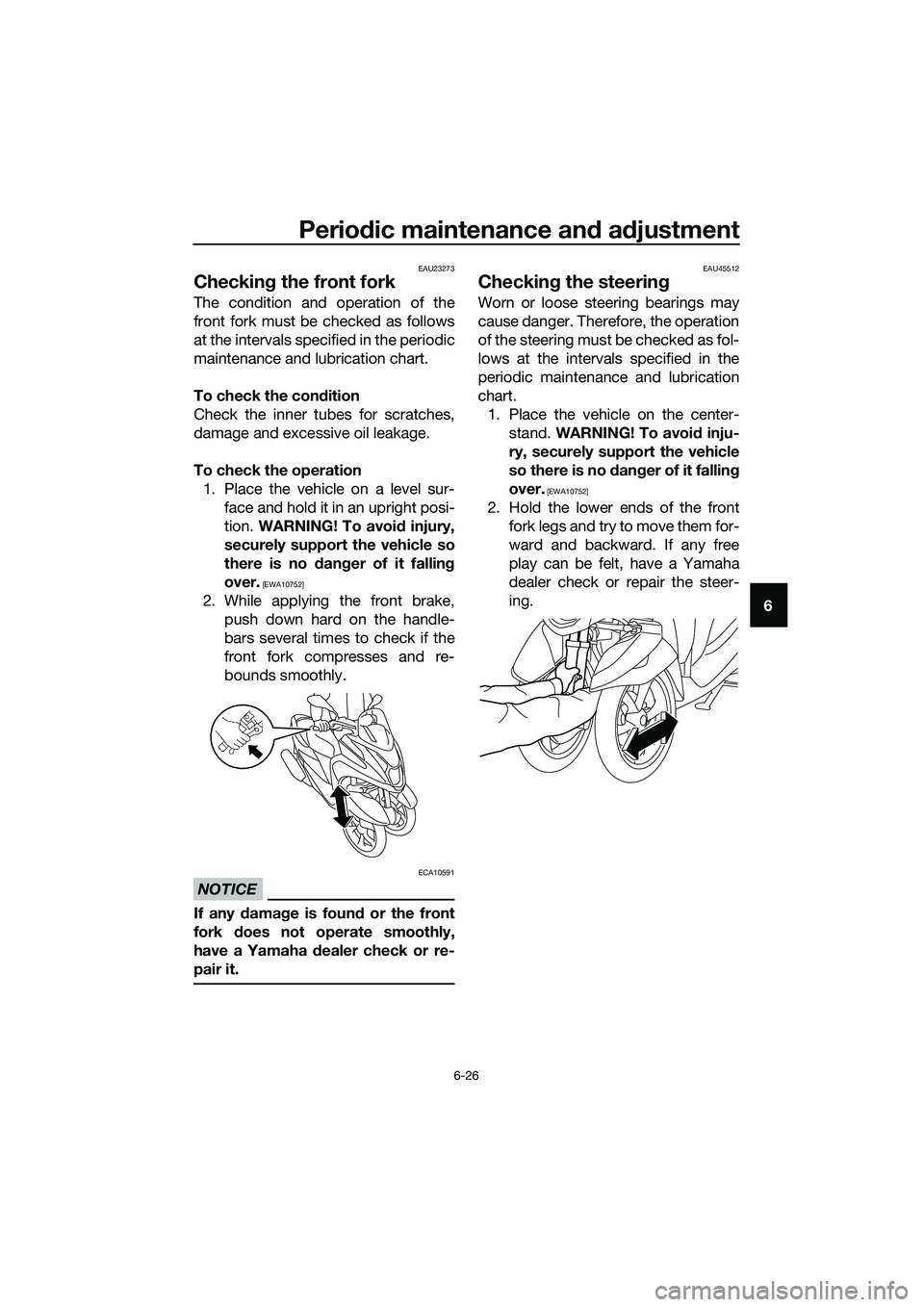
To check the operation
1. Place the vehicle on a level sur-
face and hold it in an upright posi-
tion. WARNING! To avoid injury,
securely support the vehicle so
there is no danger of it falling
over.
[EWA10752]
2. While applying the front brake,
push down hard on the handle-
bars several times to check if the
front fork compresses and re-
bounds smoothly.
NOTICE
ECA10591
If any damage is found or the front
fork does not operate smoothly,
have a Yamaha dealer check or re-
pair it.
EAU45512
Checking the steering
Worn or loose steering bearings may
cause danger. Therefore, the operation
of the steering must be checked as fol-
lows at the intervals specified in the
periodic maintenance and lubrication
chart.
1. Place the vehicle on the center-
stand. WARNING! To avoid inju-
ry, securely support the vehicle
so there is no danger of it falling
over.
[EWA10752]
2. Hold the lower ends of the front
fork legs and try to move them for-
ward and backward. If any free
play can be felt, have a Yamaha
dealer check or repair the steer-
ing.
UBR7E0E0.book Page 26 Tuesday, October 25, 2016 2:44 PM
Page 84 of 92
Vehicle care and storage
7-5
7head so that the electrodes are
grounded. (This will limit spark-
ing during the next step.)
d. Turn the engine over several
times with the starter. (This will
coat the cylinder wall with oil.)
e. Remove the spark plug cap
from the spark plug, and then
install the spark plug and the
spark plug cap. WARNING! To
prevent damage or injury
from sparking, make sure to
ground the spark plug elec-
trodes while turning the en-
gine over.
[EWA10952]
4. Lubricate all control cables and
the pivoting points of all levers and
pedals as well as of the side-
stand/centerstand.
5. Check and, if necessary, correct
the tire air pressure, and then lift
the vehicle so that both of its
wheels are off the ground. Alterna-
tively, turn the wheels a little every
month in order to prevent the tires
from becoming degraded in one
spot.
6. Cover the muffler outlet with a
plastic bag to prevent moisture
from entering it.
7. Remove the battery and fully
charge it. Store it in a cool, dry
place and charge it once a month.
Do not store the battery in an ex-
cessively cold or warm place [less
than 0 °C (30 °F) or more than 30
°C (90 °F)]. For more information
on storing the battery, see page
6-28.
TIP
Make any necessary repairs before
storing the vehicle.
UBR7E0E0.book Page 5 Tuesday, October 25, 2016 2:44 PM
Page 90 of 92
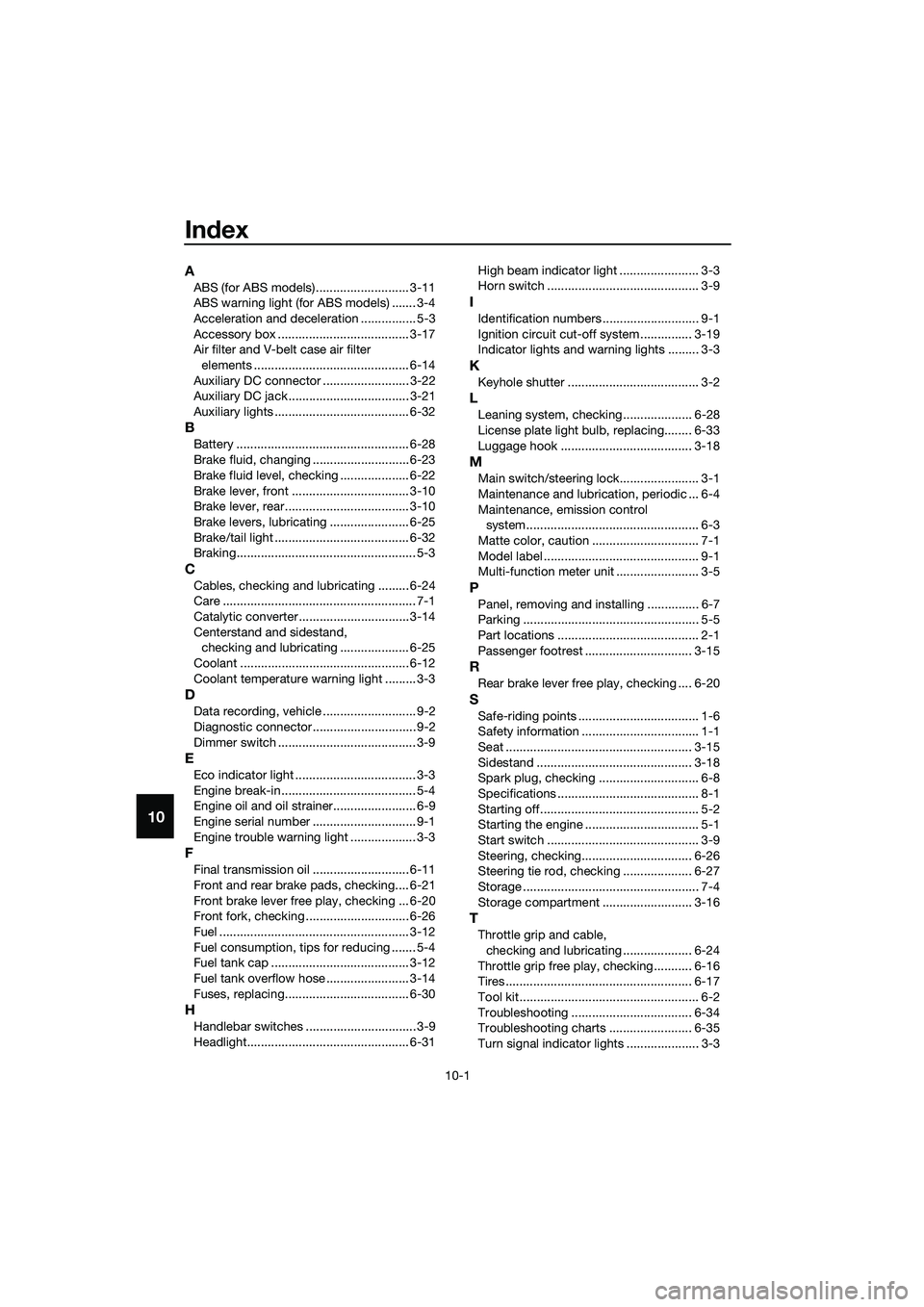
10-1
10
Index
A
ABS (for ABS models) ........................... 3-11
ABS warning light (for ABS models) ....... 3-4
Acceleration and deceleration ................ 5-3
Accessory box ...................................... 3-17
Air filter and V-belt case air filter
elements ............................................. 6-14
Auxiliary DC connector ......................... 3-22
Auxiliary DC jack ................................... 3-21
Auxiliary lights ....................................... 6-32
B
Battery .................................................. 6-28
Brake fluid, changing ............................ 6-23
Brake fluid level, checking .................... 6-22
Brake lever, front .................................. 3-10
Brake lever, rear.................................... 3-10
Brake levers, lubricating ....................... 6-25
Brake/tail light ....................................... 6-32
Braking.................................................... 5-3
C
Cables, checking and lubricating ......... 6-24
Care ........................................................ 7-1
Catalytic converter ................................ 3-14
Centerstand and sidestand,
checking and lubricating .................... 6-25
Coolant ................................................. 6-12
Coolant temperature warning light ......... 3-3
D
Data recording, vehicle ........................... 9-2
Diagnostic connector.............................. 9-2
Dimmer switch ........................................ 3-9
E
Eco indicator light ................................... 3-3
Engine break-in....................................... 5-4
Engine oil and oil strainer........................ 6-9
Engine serial number .............................. 9-1
Engine trouble warning light ................... 3-3
F
Final transmission oil ............................ 6-11
Front and rear brake pads, checking.... 6-21
Front brake lever free play, checking ... 6-20
Front fork, checking .............................. 6-26
Fuel ....................................................... 3-12
Fuel consumption, tips for reducing ....... 5-4
Fuel tank cap ........................................ 3-12
Fuel tank overflow hose ........................ 3-14
Fuses, replacing.................................... 6-30
H
Handlebar switches ................................ 3-9
Headlight............................................... 6-31High beam indicator light ....................... 3-3
Horn switch ............................................ 3-9
I
Identification numbers ............................ 9-1
Ignition circuit cut-off system............... 3-19
Indicator lights and warning lights ......... 3-3
K
Keyhole shutter ...................................... 3-2
L
Leaning system, checking .................... 6-28
License plate light bulb, replacing........ 6-33
Luggage hook ...................................... 3-18
M
Main switch/steering lock....................... 3-1
Maintenance and lubrication, periodic ... 6-4
Maintenance, emission control
system.................................................. 6-3
Matte color, caution ............................... 7-1
Model label ............................................. 9-1
Multi-function meter unit ........................ 3-5
P
Panel, removing and installing ............... 6-7
Parking ................................................... 5-5
Part locations ......................................... 2-1
Passenger footrest ............................... 3-15
R
Rear brake lever free play, checking .... 6-20
S
Safe-riding points ................................... 1-6
Safety information .................................. 1-1
Seat ...................................................... 3-15
Sidestand ............................................. 3-18
Spark plug, checking ............................. 6-8
Specifications ......................................... 8-1
Starting off.............................................. 5-2
Starting the engine ................................. 5-1
Start switch ............................................ 3-9
Steering, checking................................ 6-26
Steering tie rod, checking .................... 6-27
Storage ................................................... 7-4
Storage compartment .......................... 3-16
T
Throttle grip and cable,
checking and lubricating .................... 6-24
Throttle grip free play, checking........... 6-16
Tires ...................................................... 6-17
Tool kit.................................................... 6-2
Troubleshooting ................................... 6-34
Troubleshooting charts ........................ 6-35
Turn signal indicator lights ..................... 3-3
UBR7E0E0.book Page 1 Tuesday, October 25, 2016 2:44 PM