seat adjustment YAMAHA TRICITY 2017 Owners Manual
[x] Cancel search | Manufacturer: YAMAHA, Model Year: 2017, Model line: TRICITY, Model: YAMAHA TRICITY 2017Pages: 92, PDF Size: 3.43 MB
Page 5 of 92
Table of contents
Safety information............................1-1
Further safe-riding points ................1-6
Description........................................2-1
Left view ..........................................2-1
Right view........................................2-2
Controls and instruments ................2-3
Instrument and control functions....3-1
Main switch/steering lock ...............3-1
Keyhole shutter ...............................3-2
Indicator lights and warning
lights ............................................3-3
Multi-function meter unit .................3-5
Handlebar switches.........................3-9
Front brake lever ...........................3-10
Rear brake lever ............................3-10
ABS (for ABS models) ...................3-11
Fuel tank cap.................................3-12
Fuel................................................3-12
Fuel tank overflow hose ................3-14
Catalytic converter ........................3-14
Seat ...............................................3-15
Passenger footrest ........................3-15
Storage compartment ...................3-16
Accessory box...............................3-17
Luggage hook ...............................3-18
Sidestand ......................................3-18
Ignition circuit cut-off system........3-19
Auxiliary DC jack ..........................3-21
Auxiliary DC connector .................3-22
For your safety – pre-operation
checks...............................................4-1
Operation and important riding
points.................................................5-1
Starting the engine ..........................5-1
Starting off.......................................5-2
Acceleration and deceleration.........5-3
Braking ............................................5-3
Tips for reducing fuel
consumption ................................5-4
Engine break-in ...............................5-4
Parking ............................................5-5Periodic maintenance and
adjustment........................................ 6-1
Owner’s tool kit ............................... 6-2
Periodic maintenance chart for the
emission control system.............. 6-3
General maintenance and
lubrication chart........................... 6-4
Removing and installing the
panel ............................................ 6-7
Checking the spark plug ................. 6-8
Engine oil and oil strainer................ 6-9
Final transmission oil .................... 6-11
Coolant ......................................... 6-12
Air filter and V-belt case air filter
elements .................................... 6-14
Checking the throttle grip
free play ..................................... 6-16
Valve clearance ............................. 6-17
Tires .............................................. 6-17
Cast wheels .................................. 6-19
Checking the front brake lever
free play ..................................... 6-20
Checking the rear brake lever
free play ..................................... 6-20
Checking the front and rear
brake pads................................. 6-21
Checking the brake fluid level....... 6-22
Changing the brake fluid............... 6-23
Checking the V-belt ...................... 6-23
Checking and lubricating the
cables ........................................ 6-24
Checking and lubricating the
throttle grip and cable ............... 6-24
Lubricating the front and rear
brake levers ............................... 6-25
Checking and lubricating the
centerstand and sidestand ........ 6-25
Checking the front fork ................. 6-26
Checking the steering ................... 6-26
Checking the wheel bearings ....... 6-27
Checking the steering tie rod........ 6-27
Checking the leaning system ........ 6-28
Battery .......................................... 6-28
Replacing the fuses ...................... 6-30
Headlight....................................... 6-31
Auxiliary lights ............................... 6-32
UBR7E0E0.book Page 1 Tuesday, October 25, 2016 2:44 PM
Page 45 of 92
Periodic maintenance and adjustment
6-2
6
EAU17303
Emission controls not only function to
ensure cleaner air, but are also vital to
proper engine operation and maximum
performance. In the following periodic
maintenance charts, the services relat-
ed to emissions control are grouped
separately. These services require
specialized data, knowledge, and
equipment. Maintenance, replace-
ment, or repair of the emission control
devices and systems may be per-
formed by any repair establishment or
individual that is certified (if applicable).
Yamaha dealers are trained and
equipped to perform these particular
services.
EAU39692
Owner’s tool kit
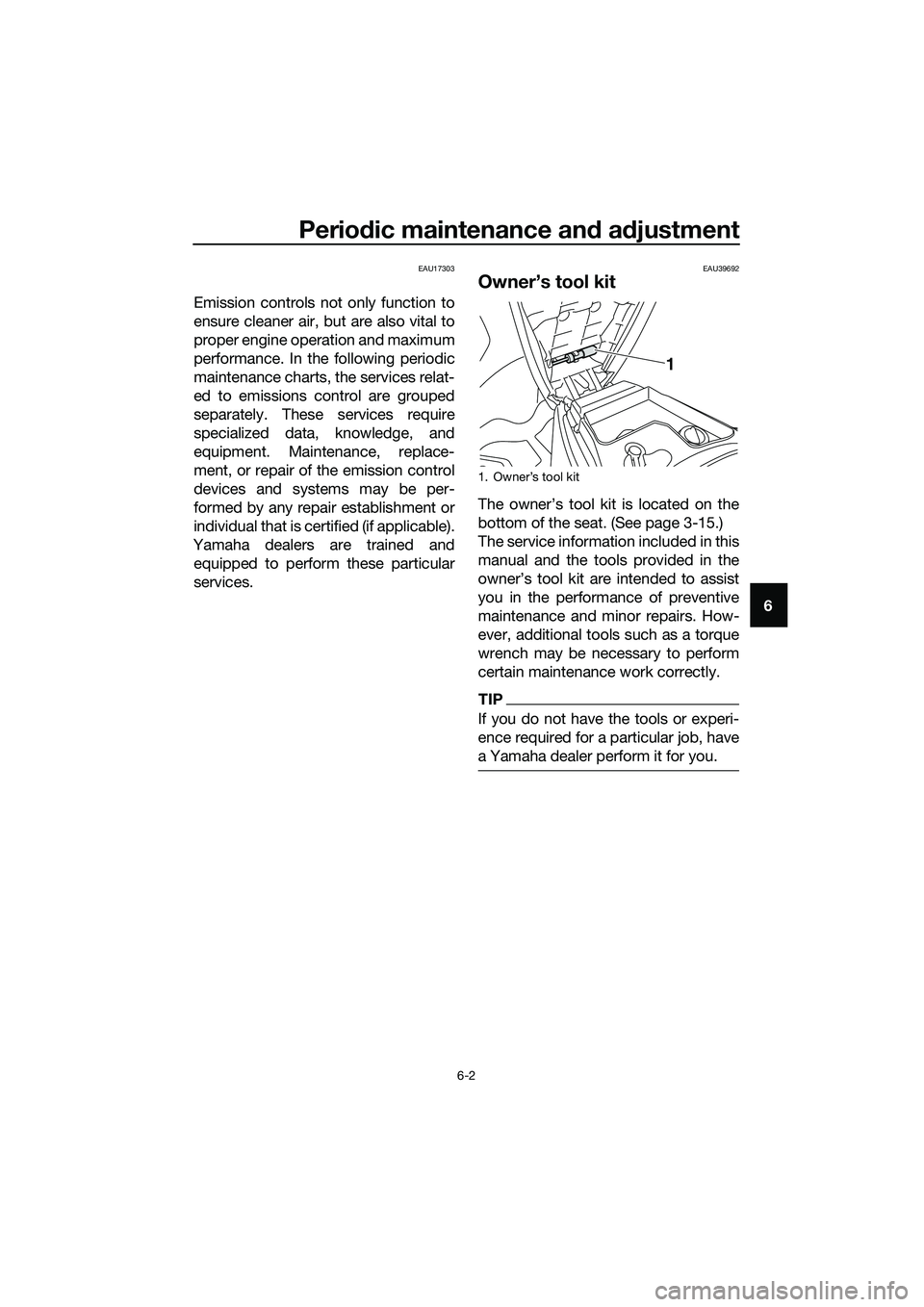
The owner’s tool kit is located on the
bottom of the seat. (See page 3-15.)
The service information included in this
manual and the tools provided in the
owner’s tool kit are intended to assist
you in the performance of preventive
maintenance and minor repairs. How-
ever, additional tools such as a torque
wrench may be necessary to perform
certain maintenance work correctly.
TIP
If you do not have the tools or experi-
ence required for a particular job, have
a Yamaha dealer perform it for you.
1.
1
UBR7E0E0.book Page 2 Tuesday, October 25, 2016 2:44 PM
Page 50 of 92
Periodic maintenance and adjustment
6-7
6
EAU18752
Removing and installing the
panel
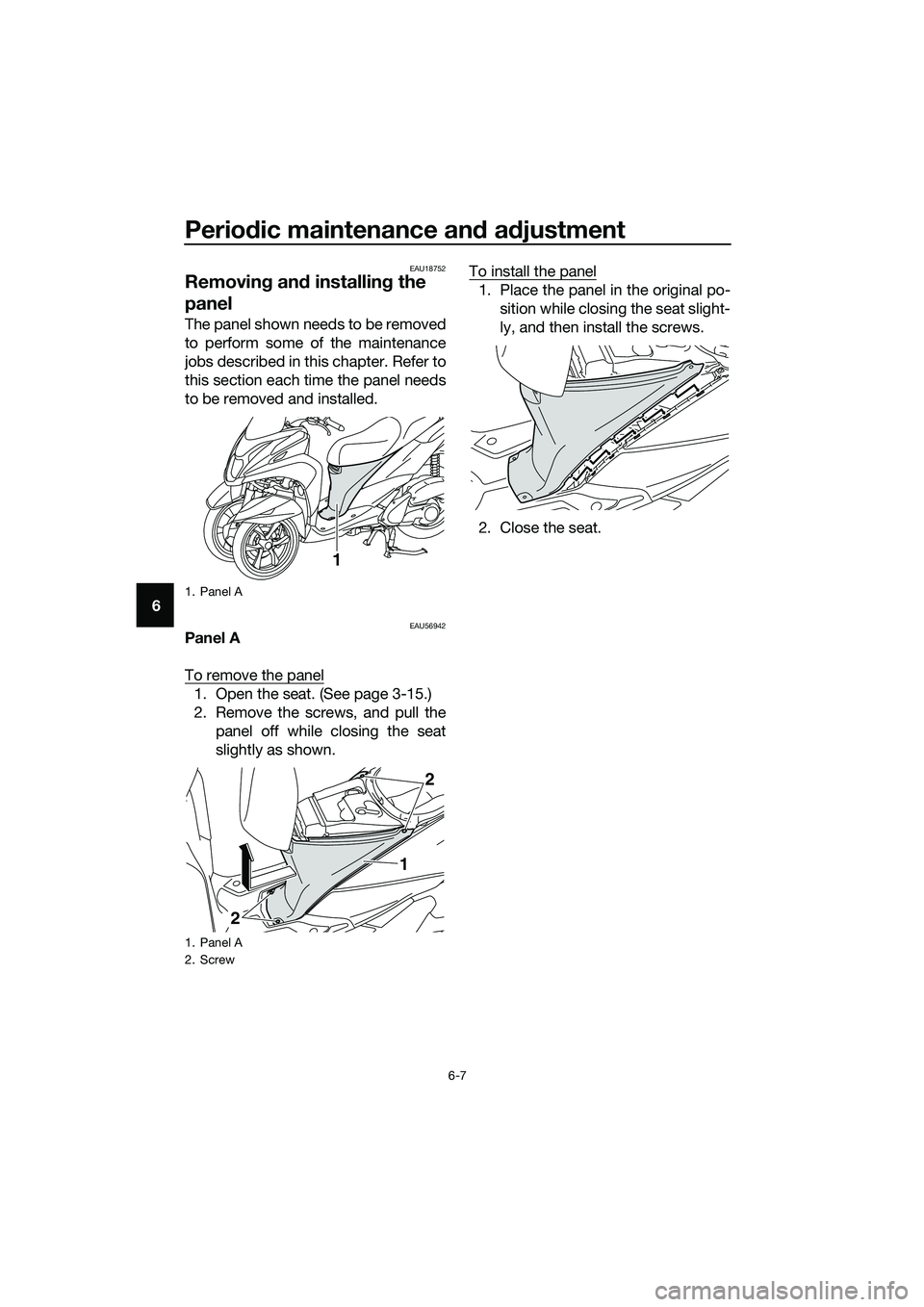
The panel shown needs to be removed
to perform some of the maintenance
jobs described in this chapter. Refer to
this section each time the panel needs
to be removed and installed.
EAU56942Panel A
To remove the panel
1. Open the seat. (See page 3-15.)
2. Remove the screws, and pull the
panel off while closing the seat
slightly as shown.To install the panel
1. Place the panel in the original po-
sition while closing the seat slight-
ly, and then install the screws.
2. Close the seat.
1. Panel A
1. Panel A
2. Screw
1
1
2
2
UBR7E0E0.book Page 7 Tuesday, October 25, 2016 2:44 PM
Page 53 of 92
Periodic maintenance and adjustment
6-10
6 4. If the engine oil is not between the
tip of the dipstick and the maxi-
mum level mark, add sufficient oil
of the recommended type to raise
it to the correct level.
5. Check the O-ring for damage, and
replace it if necessary.
6. Insert the dipstick into the oil filler
hole, and then tighten the oil filler
cap.
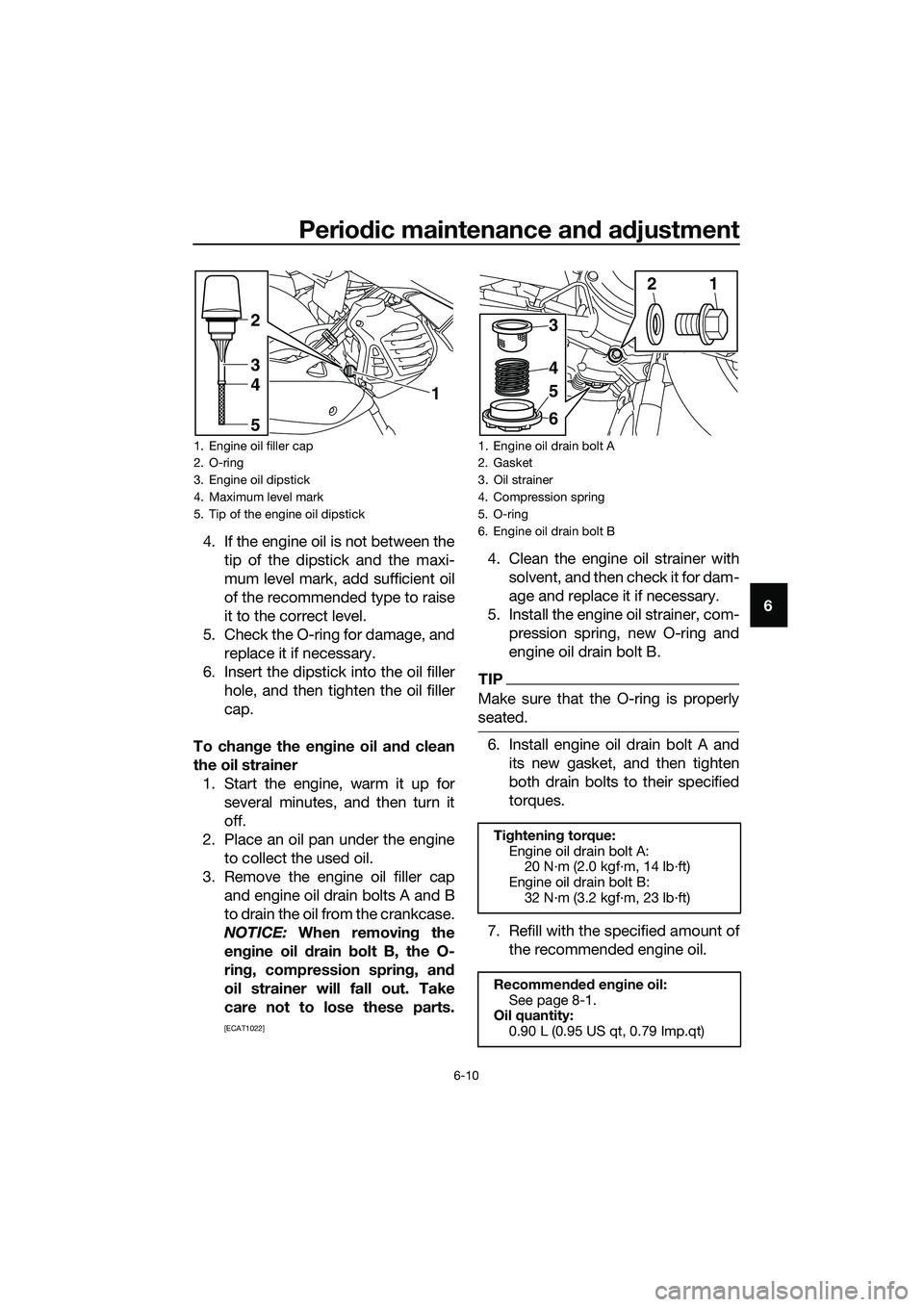
To change the engine oil and clean
the oil strainer
1. Start the engine, warm it up for
several minutes, and then turn it
off.
2. Place an oil pan under the engine
to collect the used oil.
3. Remove the engine oil filler cap
and engine oil drain bolts A and B
to drain the oil from the crankcase.
NOTICE: When removing the
engine oil drain bolt B, the O-
ring, compression spring, and
oil strainer will fall out. Take
care not to lose these parts.
[ECAT1022]
4. Clean the engine oil strainer with
solvent, and then check it for dam-
age and replace it if necessary.
5. Install the engine oil strainer, com-
pression spring, new O-ring and
engine oil drain bolt B.
TIP
Make sure that the O-ring is properly
seated.
6. Install engine oil drain bolt A and
its new gasket, and then tighten
both drain bolts to their specified
torques.
7. Refill with the specified amount of
the recommended engine oil.
1. Engine oil filler cap
2. O-ring
3. Engine oil dipstick
4. Maximum level mark
5. Tip of the engine oil dipstick
1
3
2
4
5
1. Engine oil drain bolt A
2. Gasket
3. Oil strainer
4. Compression spring
5. O-ring
6. Engine oil drain bolt B
Tightening torque:
Engine oil drain bolt A:
20 N·m (2.0 kgf·m, 14 lb·ft)
Engine oil drain bolt B:
32 N·m (3.2 kgf·m, 23 lb·ft)
Recommended engine oil:
See page 8-1.
Oil quantity:
0.90 L (0.95 US qt, 0.79 Imp.qt)
1
3
4
5
6
2
UBR7E0E0.book Page 10 Tuesday, October 25, 2016 2:44 PM
Page 57 of 92
Periodic maintenance and adjustment
6-14
6
EAU67174
Air filter and V-belt case air fil-
ter elements
The air filter element should be re-
placed and the V-belt case air filter el-
ement should be cleaned at the
intervals specified in the periodic main-
tenance and lubrication chart. Service
the air filter elements more frequently if
you are riding in unusually wet or dusty
areas. The air filter check hose and V-
belt case air filter check hose must be
frequently checked and cleaned if nec-
essary.
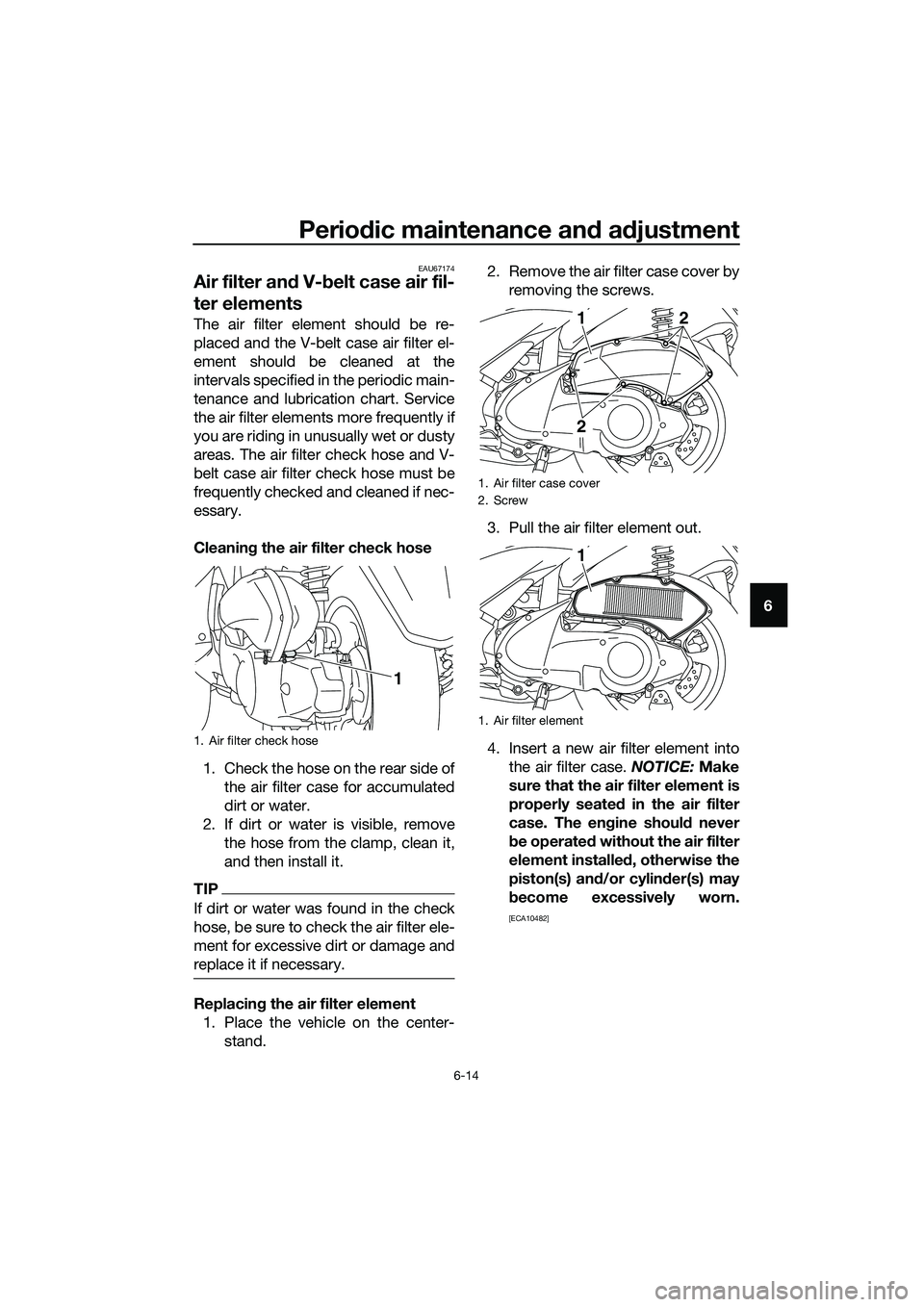
Cleaning the air filter check hose
1. Check the hose on the rear side of
the air filter case for accumulated
dirt or water.
2. If dirt or water is visible, remove
the hose from the clamp, clean it,
and then install it.
TIP
If dirt or water was found in the check
hose, be sure to check the air filter ele-
ment for excessive dirt or damage and
replace it if necessary.
Replacing the air filter element
1. Place the vehicle on the center-
stand.2. Remove the air filter case cover by
removing the screws.
3. Pull the air filter element out.
4. Insert a new air filter element into
the air filter case. NOTICE: Make
sure that the air filter element is
properly seated in the air filter
case. The engine should never
be operated without the air filter
element installed, otherwise the
piston(s) and/or cylinder(s) may
become excessively worn.
[ECA10482]
1. Air filter check hose
1
1. Air filter case cover
2. Screw
1. Air filter element
2
21
1
UBR7E0E0.book Page 14 Tuesday, October 25, 2016 2:44 PM
Page 73 of 92
Periodic maintenance and adjustment
6-30
6
EAU74670
Replacing the fuses
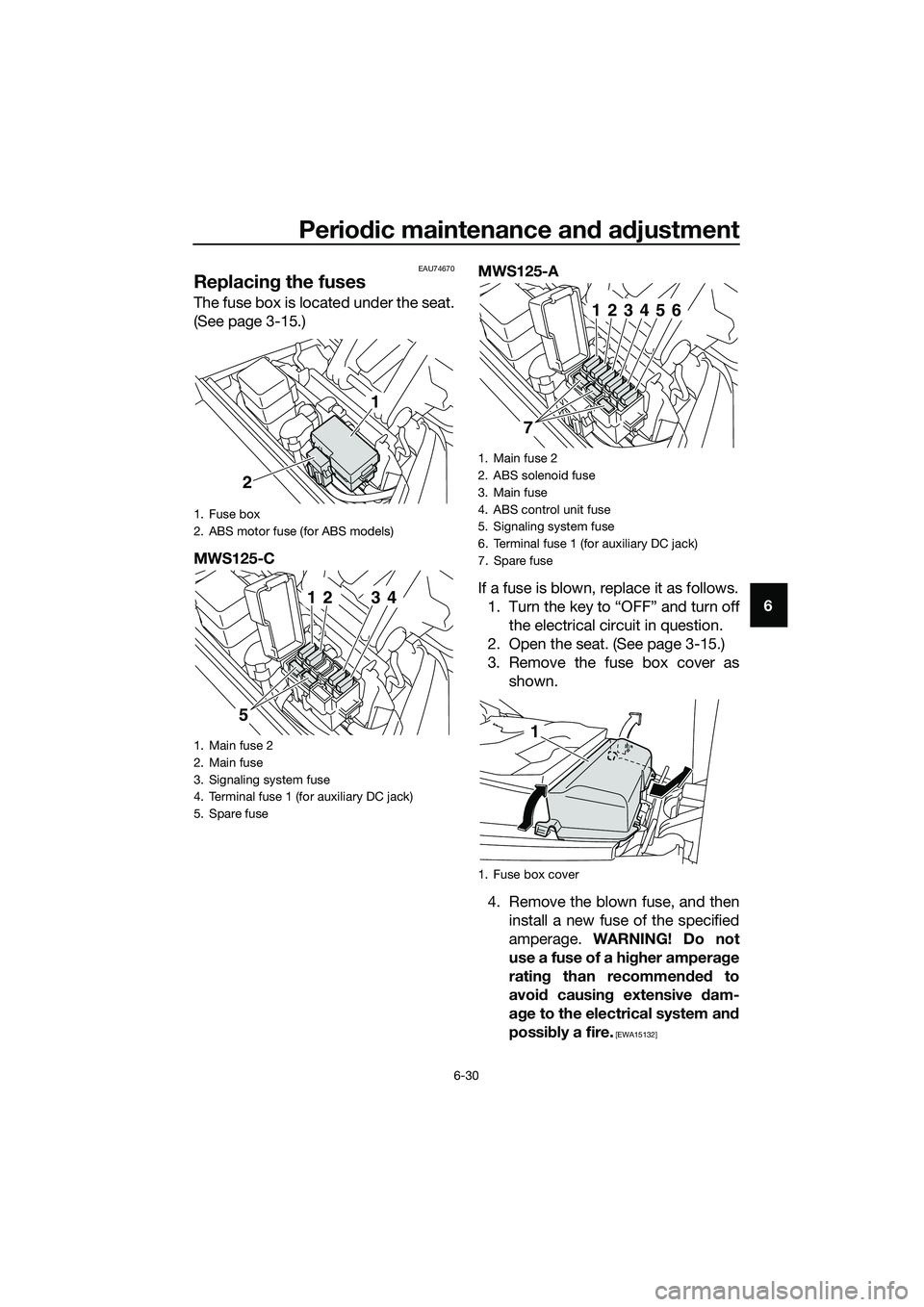
The fuse box is located under the seat.
(See page 3-15.)
MWS125-CMWS125-A
If a fuse is blown, replace it as follows.
1. Turn the key to “OFF” and turn off
the electrical circuit in question.
2. Open the seat. (See page 3-15.)
3. Remove the fuse box cover as
shown.
4. Remove the blown fuse, and then
install a new fuse of the specified
amperage. WARNING! Do not
use a fuse of a higher amperage
rating than recommended to
avoid causing extensive dam-
age to the electrical system and
possibly a fire.
[EWA15132]
1. Fuse box
2. ABS motor fuse (for ABS models)
1. Main fuse 2
2. Main fuse
3. Signaling system fuse
4. Terminal fuse 1 (for auxiliary DC jack)
5. Spare fuse
2
1
51
234
1. Main fuse 2
2. ABS solenoid fuse
3. Main fuse
4. ABS control unit fuse
5. Signaling system fuse
6. Terminal fuse 1 (for auxiliary DC jack)
7. Spare fuse
1. Fuse box cover
71
23456
1
UBR7E0E0.book Page 30 Tuesday, October 25, 2016 2:44 PM
Page 74 of 92
Periodic maintenance and adjustment
6-31
65. Turn the key to “ON” and turn on
the electrical circuit in question to
check if the device operates.
6. If the fuse immediately blows
again, have a Yamaha dealer
check the electrical system.
7. Install the fuse box cover, and
then close the seat.
EAU62850
Headlight
This model is equipped with an LED-
type headlight.
If a headlight does not come on, have
a Yamaha dealer check its electrical
circuit.
NOTICE
ECA16581
Do not affix any type of tinted film or
stickers to the headlight lens.
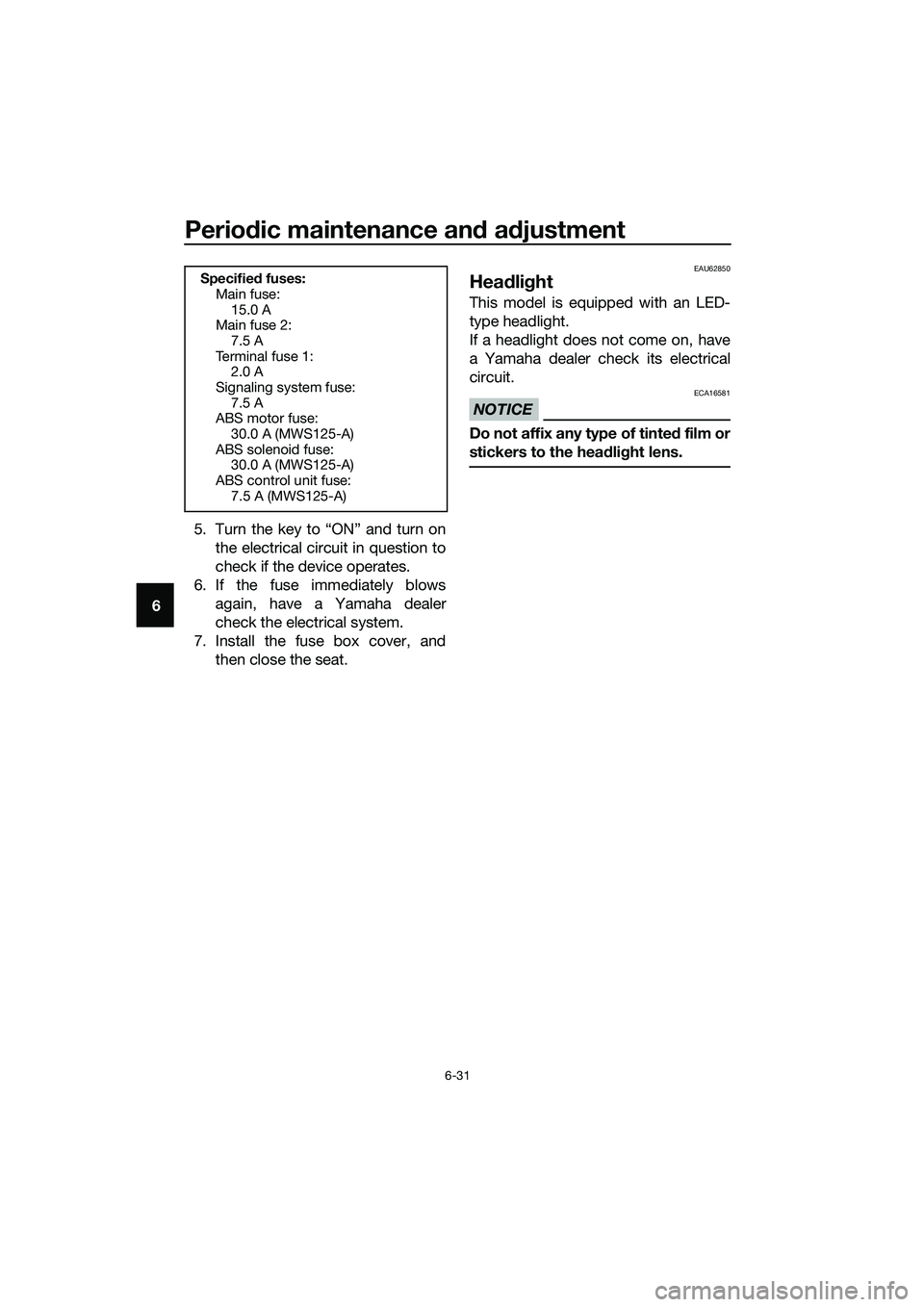
Specified fuses:
Main fuse:
15.0 A
Main fuse 2:
7.5 A
Te r m i n a l f u s e 1 :
2.0 A
Signaling system fuse:
7.5 A
ABS motor fuse:
30.0 A (MWS125-A)
ABS solenoid fuse:
30.0 A (MWS125-A)
ABS control unit fuse:
7.5 A (MWS125-A)
UBR7E0E0.book Page 31 Tuesday, October 25, 2016 2:44 PM