wheel YAMAHA TRICITY 2017 Owners Manual
[x] Cancel search | Manufacturer: YAMAHA, Model Year: 2017, Model line: TRICITY, Model: YAMAHA TRICITY 2017Pages: 92, PDF Size: 3.43 MB
Page 5 of 92
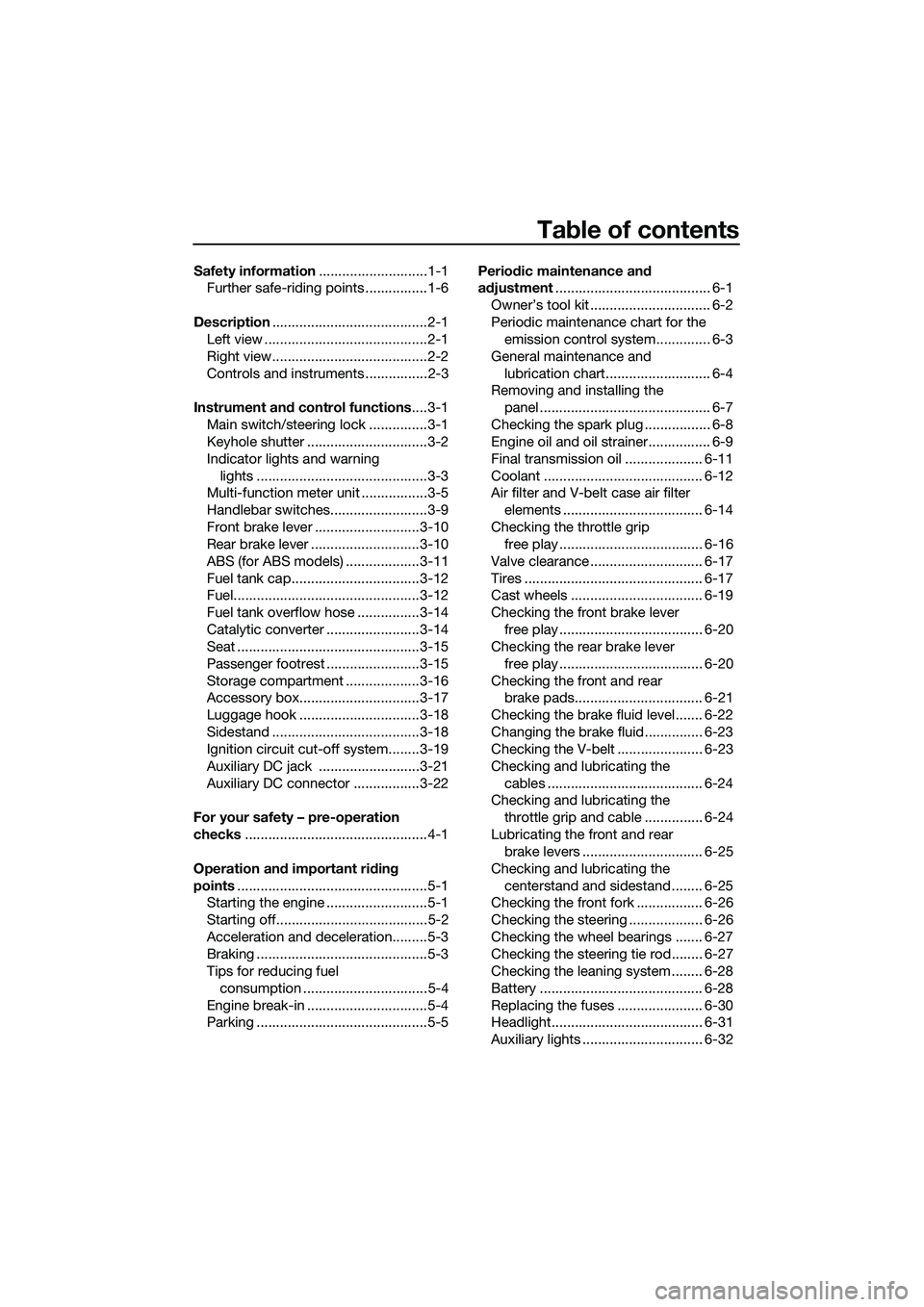
Table of contents
Safety information............................1-1
Further safe-riding points ................1-6
Description........................................2-1
Left view ..........................................2-1
Right view........................................2-2
Controls and instruments ................2-3
Instrument and control functions....3-1
Main switch/steering lock ...............3-1
Keyhole shutter ...............................3-2
Indicator lights and warning
lights ............................................3-3
Multi-function meter unit .................3-5
Handlebar switches.........................3-9
Front brake lever ...........................3-10
Rear brake lever ............................3-10
ABS (for ABS models) ...................3-11
Fuel tank cap.................................3-12
Fuel................................................3-12
Fuel tank overflow hose ................3-14
Catalytic converter ........................3-14
Seat ...............................................3-15
Passenger footrest ........................3-15
Storage compartment ...................3-16
Accessory box...............................3-17
Luggage hook ...............................3-18
Sidestand ......................................3-18
Ignition circuit cut-off system........3-19
Auxiliary DC jack ..........................3-21
Auxiliary DC connector .................3-22
For your safety – pre-operation
checks...............................................4-1
Operation and important riding
points.................................................5-1
Starting the engine ..........................5-1
Starting off.......................................5-2
Acceleration and deceleration.........5-3
Braking ............................................5-3
Tips for reducing fuel
consumption ................................5-4
Engine break-in ...............................5-4
Parking ............................................5-5Periodic maintenance and
adjustment........................................ 6-1
Owner’s tool kit ............................... 6-2
Periodic maintenance chart for the
emission control system.............. 6-3
General maintenance and
lubrication chart........................... 6-4
Removing and installing the
panel ............................................ 6-7
Checking the spark plug ................. 6-8
Engine oil and oil strainer................ 6-9
Final transmission oil .................... 6-11
Coolant ......................................... 6-12
Air filter and V-belt case air filter
elements .................................... 6-14
Checking the throttle grip
free play ..................................... 6-16
Valve clearance ............................. 6-17
Tires .............................................. 6-17
Cast wheels .................................. 6-19
Checking the front brake lever
free play ..................................... 6-20
Checking the rear brake lever
free play ..................................... 6-20
Checking the front and rear
brake pads................................. 6-21
Checking the brake fluid level....... 6-22
Changing the brake fluid............... 6-23
Checking the V-belt ...................... 6-23
Checking and lubricating the
cables ........................................ 6-24
Checking and lubricating the
throttle grip and cable ............... 6-24
Lubricating the front and rear
brake levers ............................... 6-25
Checking and lubricating the
centerstand and sidestand ........ 6-25
Checking the front fork ................. 6-26
Checking the steering ................... 6-26
Checking the wheel bearings ....... 6-27
Checking the steering tie rod........ 6-27
Checking the leaning system ........ 6-28
Battery .......................................... 6-28
Replacing the fuses ...................... 6-30
Headlight....................................... 6-31
Auxiliary lights ............................... 6-32
UBR7E0E0.book Page 1 Tuesday, October 25, 2016 2:44 PM
Page 7 of 92
1-1
1
Safety information
EAU60750
Be a Responsible Owner
As the vehicle’s owner, you are re-
sponsible for the safe and proper oper-
ation of your vehicle.
This is a leaning multi-wheel vehicle.
The safe use and operation of this ve-
hicle is dependent upon the use of
proper riding techniques as well as the
expertise of the operator. Every opera-
tor should know the following require-
ments before riding this vehicle.
He or she should:
zObtain thorough instructions from
a competent source on all aspects
of this vehicle’s operation.
zObserve the warnings and mainte-
nance requirements in this Own-
er’s Manual.
zObtain qualified training in safe
and proper riding techniques.
zObtain professional technical ser-
vice as indicated in this Owner’s
Manual and/or when made neces-
sary by mechanical conditions.
zNever operate a vehicle without
proper training or instruction. Take
a training course. Beginners
should receive training from a cer-
tified instructor. Contact a
Yamaha dealer to find out about
the training courses nearest you.
Safe Riding
Perform the pre-operation checks
each time you use the vehicle to make
sure it is in safe operating condition.
Failure to inspect or maintain the vehi-
cle properly increases the possibility of
an accident or equipment damage.
See page 4-1 for a list of pre-operationchecks.
zThis vehicle is designed to carry
the operator and a passenger.
zThe failure of motorists to detect
and recognize scooters and mo-
torcycles in traffic is the predomi-
nating cause of automobile and
such smaller vehicle accidents.
Many accidents have been
caused by an automobile driver
who did not see the smaller vehi-
cle. Making yourself conspicuous
appears to be very effective in re-
ducing the chance of this type of
accident.
Therefore:
• Wear a brightly colored jacket.
• Use extra caution when you are
approaching and passing
through intersections, since in-
tersections are the most likely
places for such smaller vehicle
accidents to occur.
• Ride where other motorists can
see you. Avoid riding in another
motorist’s blind spot.
• Never maintain a vehicle with-
out proper knowledge. Contact
a Yamaha dealer to inform you
on basic vehicle maintenance.
Certain maintenance can only
be carried out by certified staff.
zMany accidents involve inexperi-
enced operators. In fact, many op-
erators who have been involved in
accidents do not even have a cur-
rent driver’s license.
• Make sure that you are qualified
and that you only lend your ve-
hicle to other qualified opera-
tors.
UBR7E0E0.book Page 1 Tuesday, October 25, 2016 2:44 PM
Page 8 of 92
Safety information
1-2
1• Know your skills and limits.
Staying within your limits may
help you to avoid an accident.
• We recommend that you prac-
tice riding your vehicle where
there is no traffic until you have
become thoroughly familiar with
the vehicle and all of its con-
trols.
zMany accidents have been
caused by error of the vehicle op-
erator. A typical error made by the
operator is veering wide on a turn
due to excessive speed or under-
cornering (insufficient lean angle
for the speed).
• Always obey the speed limit and
never travel faster than warrant-
ed by road and traffic condi-
tions.
• Always signal before turning or
changing lanes. Make sure that
other motorists can see you.
zThe posture of the operator and
passenger is important for proper
control.
• The operator should keep both
hands on the handlebar and
both feet on the operator foot-
rests during operation to main-
tain control of the vehicle.
• The passenger should always
hold onto the operator, the seat
strap or grab bar, if equipped,
with both hands and keep both
feet on the passenger footrests.
Never carry a passenger unless
he or she can firmly place both
feet on the passenger footrests.
zNever ride under the influence of
alcohol or other drugs.zThis vehicle is designed for on-
road use only. It is not suitable for
off-road use.
Protective Apparel
The majority of fatalities from scooter
and motorcycle accidents are the re-
sult of head injuries. The use of a safety
helmet is the single most critical factor
in the prevention or reduction of head
injuries.
zAlways wear an approved helmet.
zWear a face shield or goggles.
Wind in your unprotected eyes
could contribute to an impairment
of vision that could delay seeing a
hazard.
zThe use of a jacket, substantial
shoes, trousers, gloves, etc., is ef-
fective in preventing or reducing
abrasions or lacerations.
zNever wear loose-fitting clothes,
otherwise they could catch on the
control levers or wheels and cause
injury or an accident.
zAlways wear protective clothing
that covers your legs, ankles, and
feet. The engine or exhaust sys-
tem become very hot during or af-
ter operation and can cause
burns.
zA passenger should also observe
the above precautions.
Avoid Carbon Monoxide Poisoning
All engine exhaust contains carbon
monoxide, a deadly gas. Breathing
carbon monoxide can cause head-
aches, dizziness, drowsiness, nausea,
confusion, and eventually death.
UBR7E0E0.book Page 2 Tuesday, October 25, 2016 2:44 PM
Page 11 of 92
Safety information
1-5
1 Aftermarket Tires and Rims
The tires and rims that came with your
vehicle were designed to match the
performance capabilities and to pro-
vide the best combination of handling,
braking, and comfort. Other tires, rims,
sizes, and combinations may not be
appropriate. Refer to page 6-17 for tire
specifications and more information on
replacing your tires.
Transporting the Vehicle
Be sure to observe the following in-
structions before transporting the vehi-
cle in another vehicle.
zRemove all loose items from the
vehicle.
zPoint the front wheels straight
ahead on the trailer or in the truck
bed, and choke it in a rail to pre-
vent movement.
zSecure the vehicle with tie-downs
or suitable straps that are at-
tached to solid parts of the vehi-
cle, such as the frame or upper
front fork triple clamp (and not, for
example, to rubber-mounted han-
dlebars or turn signals, or parts
that could break). Choose the lo-
cation for the straps carefully so
the straps will not rub against
painted surfaces during transport.
zThe suspension should be com-
pressed somewhat by the tie-
downs, if possible, so that the ve-
hicle will not bounce excessively
during transport.
EAU60590
Further safe-riding points
zBe sure to signal clearly when
making turns.
zBraking can be extremely difficult
on a wet road. Avoid hard braking,
because the vehicle could slide.
Apply the brakes slowly when
stopping on a wet surface.
zSlow down as you approach a
corner or turn. Once you have
completed a turn, accelerate
slowly.
zBe careful when passing parked
cars. A driver might not see you
and open a door in your path.
zRailroad crossings, streetcar rails,
iron plates on road construction
sites, and manhole covers be-
come extremely slippery when
wet. Slow down and cross them
with caution. Keep the vehicle up-
right, otherwise it could slide out
from under you.
zThe brake pads or linings could
get wet when you wash the vehi-
cle. After washing the vehicle,
check the brakes before riding.
zAlways wear a helmet, gloves,
trousers (tapered around the cuff
and ankle so they do not flap), and
a brightly colored jacket.
zDo not carry too much luggage on
the vehicle. An overloaded vehicle
is unstable. Use a strong cord to
secure any luggage to the carrier
(if equipped). A loose load will af-
fect the stability of the vehicle and
could divert your attention from
the road. (See page 1-3.)
UBR7E0E0.book Page 5 Tuesday, October 25, 2016 2:44 PM
Page 18 of 92
Instrument and control functions
3-4
3If the warning light does not come on
initially when the key is turned to “ON”,
or if the warning light remains on, have
a Yamaha dealer check the vehicle.
EAUU1961ABS warning light “ ” (for ABS
models)
In normal operation, the ABS warning
light comes on when the main switch is
turned on, and goes off after traveling
at a speed of 10 km/h (6 mi/h) or high-
er.
If the ABS warning light:
zdoes not come on when the main
switch is turned on
zcomes on or flashes while riding
zdoes not go off after traveling at a
speed of 10 km/h (6 mi/h) or high-
er
The ABS may not work correctly. If any
of the above occurs, have a Yamaha
dealer check the system as soon as
possible. (See page 3-11 for an expla-
nation of the ABS.)
WARNING
EWA16041
If the ABS warning light does not go
off after traveling at a speed of 10
km/h (6 mi/h) or higher, or if the
warning light comes on or flashes
while riding, the brake system re-
verts to conventional braking. If ei-
ther of the above occurs, or if the
warning light does not come on at
all, use extra caution to avoid possi-
ble wheel lock during emergency
braking. Have a Yamaha dealer
check the brake system and electri-
cal circuits as soon as possible.
TIP
The ABS warning light may come on
while accelerating the engine with the
vehicle on its centerstand, but this
does not indicate a malfunction.
ABS
UBR7E0E0.book Page 4 Tuesday, October 25, 2016 2:44 PM
Page 25 of 92
Instrument and control functions
3-11
3
EAU70900
ABS (for ABS models)
Your leaning multi-wheel vehicle’s ABS
(Anti-lock Brake System) features an
electronic control system, which acts
on each of the front and rear brakes in-
dependently.
Operate the brakes with ABS as you
would conventional brakes. If the ABS
is activated, a pulsating sensation may
be felt at the brake levers. In this situa-
tion, continue to apply the brakes and
let the ABS work; do not “pump” the
brakes as this will reduce braking ef-
fectiveness.
WARNING
EWA16051
Always keep a sufficient distance
from the vehicle ahead to match the
riding speed even with ABS.
zThe ABS performs best with
long braking distances.
zOn certain surfaces, such as
rough or gravel roads, the brak-
ing distance may be longer with
the ABS than without.
The ABS is monitored by an ECU,
which will revert the system to conven-
tional braking if a malfunction occurs.
TIP
zThe ABS performs a self-diagno-
sis test each time the vehicle first
starts off after the key is turned to
“ON” and the vehicle has traveled
at a speed of 10 km/h (6 mi/h) or
higher. During this test, a “click-
ing” noise can be heard from the
front of the vehicle, and if either
brake lever is even slightly ap-
plied, a vibration can be felt at the
lever, but these do not indicate a
malfunction.zThis ABS has a test mode which
allows the owner to experience
the pulsation at the brake levers
when the ABS is operating. How-
ever, special tools are required, so
please consult your Yamaha deal-
er.
NOTICE
ECA20100
Be careful not to damage the wheel
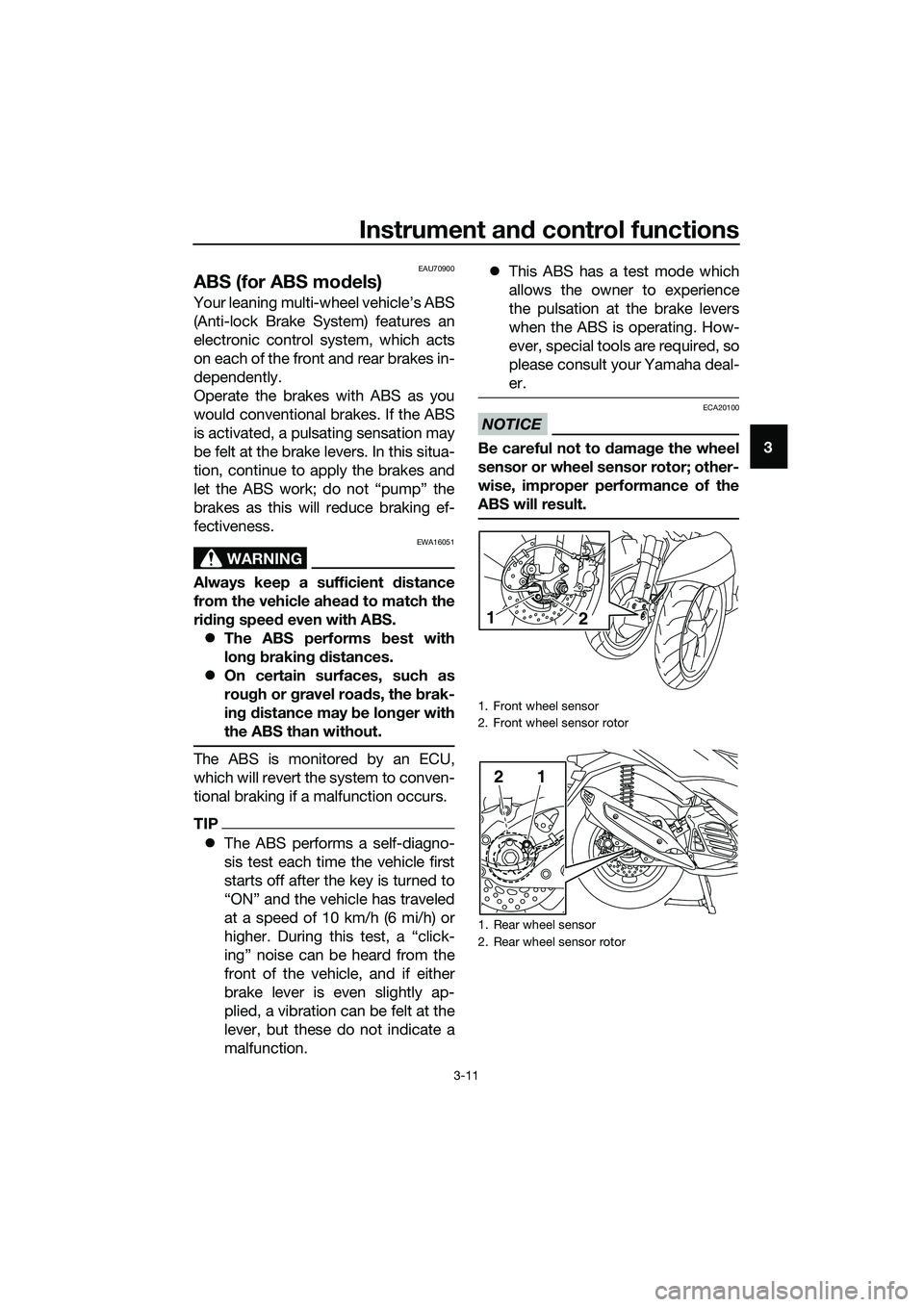
sensor or wheel sensor rotor; other-
wise, improper performance of the
ABS will result.
1. Front wheel sensor
2. Front wheel sensor rotor
1. Rear wheel sensor
2. Rear wheel sensor rotor
12
12
UBR7E0E0.book Page 11 Tuesday, October 25, 2016 2:44 PM
Page 38 of 92
For your safety – pre-operation checks
4-2
4
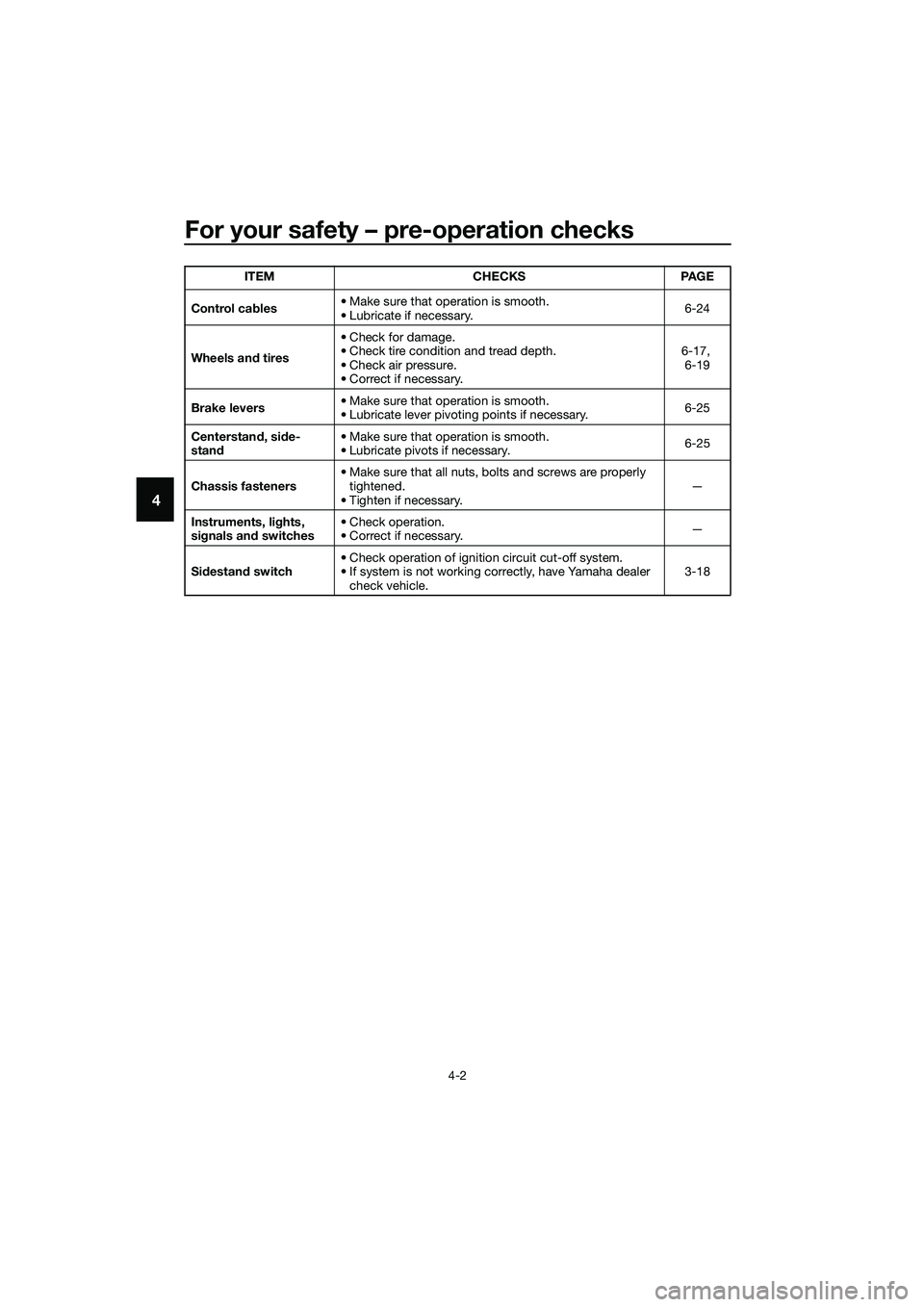
Control cables• Make sure that operation is smooth.
• Lubricate if necessary.6-24
Wheels and tires•Check for damage.
• Check tire condition and tread depth.
• Check air pressure.
• Correct if necessary.6-17,
6-19
Brake levers• Make sure that operation is smooth.
• Lubricate lever pivoting points if necessary.6-25
Centerstand, side-
stand• Make sure that operation is smooth.
• Lubricate pivots if necessary.6-25
Chassis fasteners• Make sure that all nuts, bolts and screws are properly
tightened.
• Tighten if necessary.—
Instruments, lights,
signals and switches• Check operation.
• Correct if necessary.—
Sidestand switch • Check operation of ignition circuit cut-off system.
• If system is not working correctly, have Yamaha dealer
check vehicle.3-18 ITEM CHECKS PAGE
UBR7E0E0.book Page 2 Tuesday, October 25, 2016 2:44 PM
Page 47 of 92
Periodic maintenance and adjustment
6-4
6
EAU74600
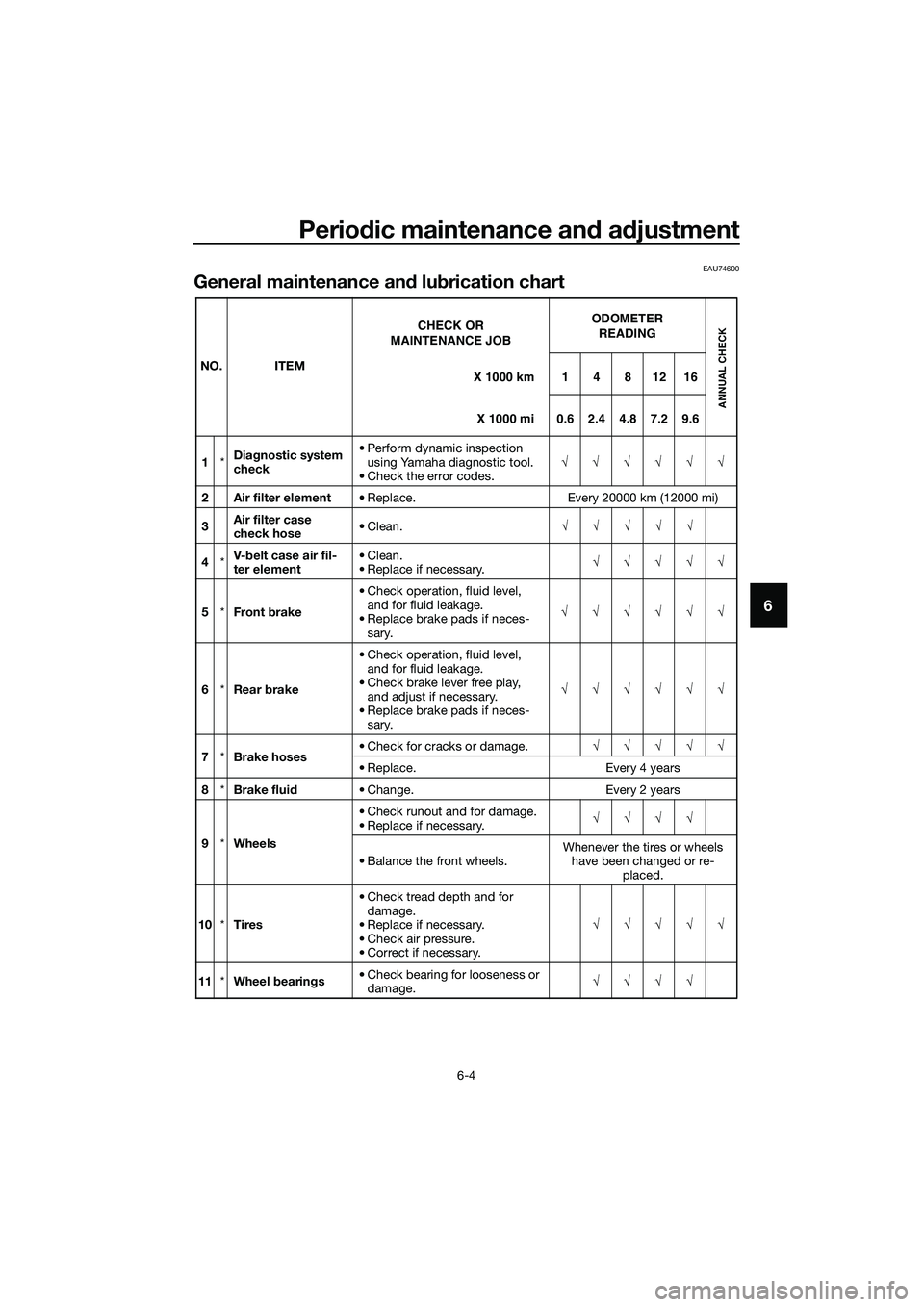
General maintenance and lubrication chart
NO. ITEM
1*Diagnostic system
check• Perform dynamic inspection
using Yamaha diagnostic tool.
• Check the error codes.√√√√√√
2 Air filter element• Replace. Every 20000 km (12000 mi)
3Air filter case
check hose• Clean.√√√√√
4*V-belt case air fil-
ter element• Clean.
• Replace if necessary.√√√√√
5*Front brake• Check operation, fluid level,
and for fluid leakage.
• Replace brake pads if neces-
sary.√√√√√√
6*Rear brake• Check operation, fluid level,
and for fluid leakage.
• Check brake lever free play,
and adjust if necessary.
• Replace brake pads if neces-
sary.√√√√√√
7*Brake hoses• Check for cracks or damage.√√√√√
• Replace. Every 4 years
8*Brake fluid• Change. Every 2 years
9*Wheels• Check runout and for damage.
• Replace if necessary.√√√√
• Balance the front wheels.Whenever the tires or wheels
have been changed or re-
placed.
10*Tires• Check tread depth and for
damage.
• Replace if necessary.
• Check air pressure.
• Correct if necessary.√√√√√
11*Wheel bearings• Check bearing for looseness or
damage.√√√√X 1000 km CHECK OR
MAINTENANCE JOB
X 1000 mi
ODOMETER
READING
ANNUAL CHECK
1481216
0.62.44.87.29.6
UBR7E0E0.book Page 4 Tuesday, October 25, 2016 2:44 PM
Page 55 of 92
Periodic maintenance and adjustment
6-12
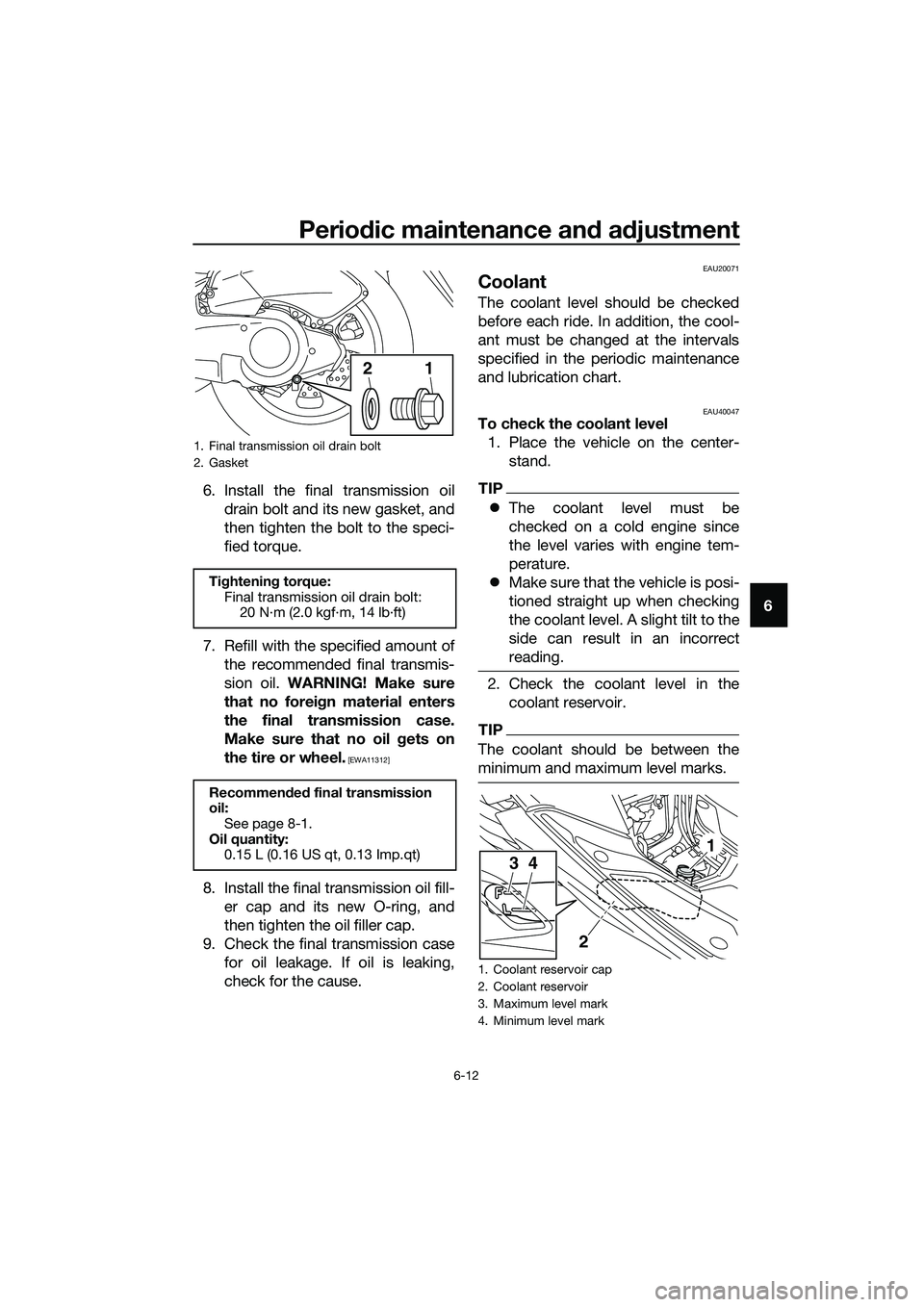
6 6. Install the final transmission oil
drain bolt and its new gasket, and
then tighten the bolt to the speci-
fied torque.
7. Refill with the specified amount of
the recommended final transmis-
sion oil. WARNING! Make sure
that no foreign material enters
the final transmission case.
Make sure that no oil gets on
the tire or wheel.
[EWA11312]
8. Install the final transmission oil fill-
er cap and its new O-ring, and
then tighten the oil filler cap.
9. Check the final transmission case
for oil leakage. If oil is leaking,
check for the cause.
EAU20071
Coolant
The coolant level should be checked
before each ride. In addition, the cool-
ant must be changed at the intervals
specified in the periodic maintenance
and lubrication chart.
EAU40047To check the coolant level
1. Place the vehicle on the center-
stand.
TIP
zThe coolant level must be
checked on a cold engine since
the level varies with engine tem-
perature.
zMake sure that the vehicle is posi-
tioned straight up when checking
the coolant level. A slight tilt to the
side can result in an incorrect
reading.
2. Check the coolant level in the
coolant reservoir.
TIP
The coolant should be between the
minimum and maximum level marks.
1. Final transmission oil drain bolt
2. Gasket
Tightening torque:
Final transmission oil drain bolt:
20 N·m (2.0 kgf·m, 14 lb·ft)
Recommended final transmission
oil:
See page 8-1.
Oil quantity:
0.15 L (0.16 US qt, 0.13 Imp.qt)
12
1. Coolant reservoir cap
2. Coolant reservoir
3. Maximum level mark
4. Minimum level mark
34
2
1
UBR7E0E0.book Page 12 Tuesday, October 25, 2016 2:44 PM
Page 61 of 92
Periodic maintenance and adjustment
6-18
6
WARNING
EWA10512
Never overload your vehicle. Opera-
tion of an overloaded vehicle could
cause an accident.
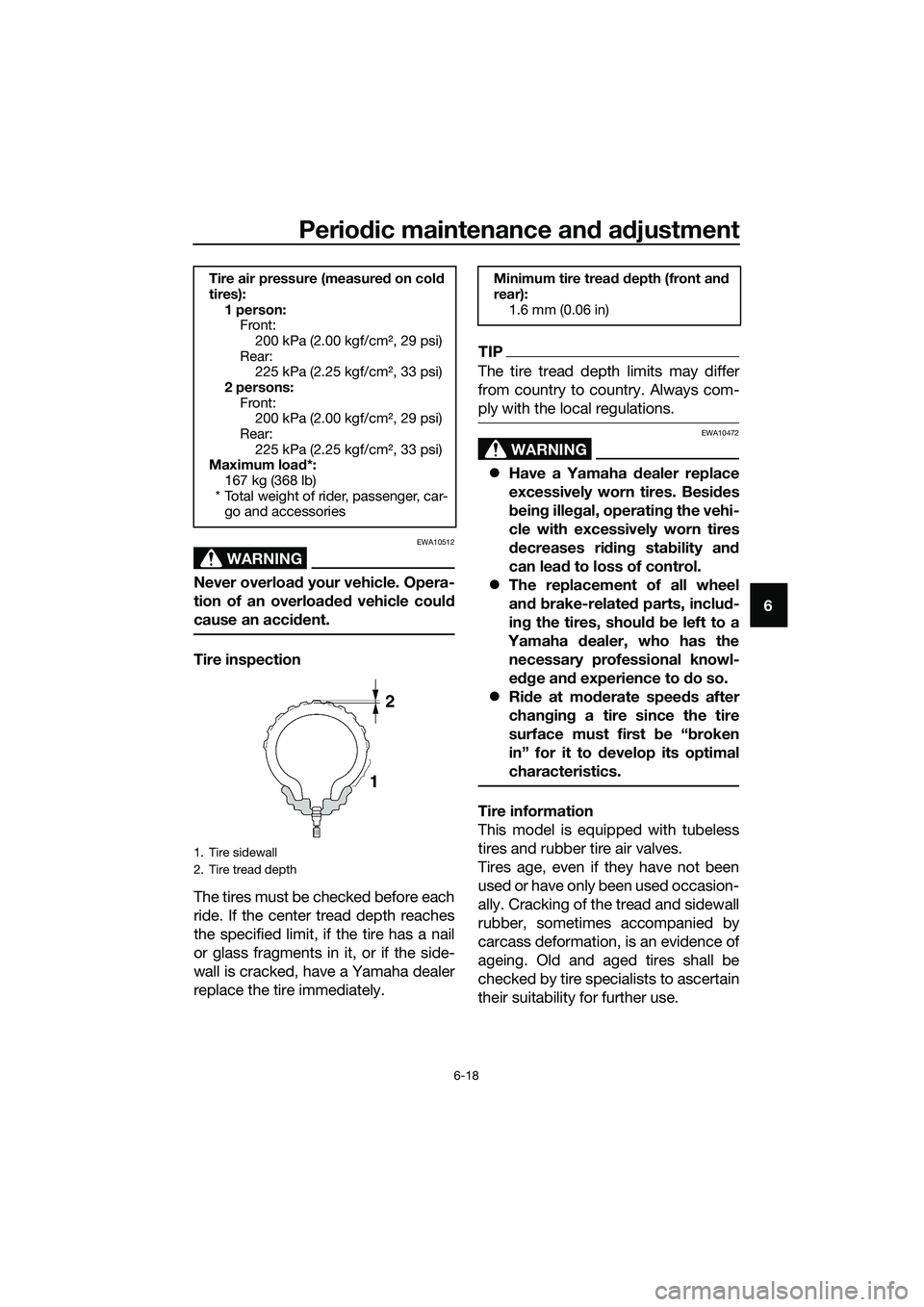
Tire inspection
The tires must be checked before each
ride. If the center tread depth reaches
the specified limit, if the tire has a nail
or glass fragments in it, or if the side-
wall is cracked, have a Yamaha dealer
replace the tire immediately.
TIP
The tire tread depth limits may differ
from country to country. Always com-
ply with the local regulations.
WARNING
EWA10472
zHave a Yamaha dealer replace
excessively worn tires. Besides
being illegal, operating the vehi-
cle with excessively worn tires
decreases riding stability and
can lead to loss of control.
zThe replacement of all wheel
and brake-related parts, includ-
ing the tires, should be left to a
Yamaha dealer, who has the
necessary professional knowl-
edge and experience to do so.
zRide at moderate speeds after
changing a tire since the tire
surface must first be “broken
in” for it to develop its optimal
characteristics.
Tire information
This model is equipped with tubeless
tires and rubber tire air valves.
Tires age, even if they have not been
used or have only been used occasion-
ally. Cracking of the tread and sidewall
rubber, sometimes accompanied by
carcass deformation, is an evidence of
ageing. Old and aged tires shall be
checked by tire specialists to ascertain
their suitability for further use.
Tire air pressure (measured on cold
tires):
1 person:
Front:
200 kPa (2.00 kgf/cm², 29 psi)
Rear:
225 kPa (2.25 kgf/cm², 33 psi)
2 persons:
Front:
200 kPa (2.00 kgf/cm², 29 psi)
Rear:
225 kPa (2.25 kgf/cm², 33 psi)
Maximum load*:
167 kg (368 lb)
* Total weight of rider, passenger, car-
go and accessories
1. Tire sidewall
2. Tire tread depth
Minimum tire tread depth (front and
rear):
1.6 mm (0.06 in)
UBR7E0E0.book Page 18 Tuesday, October 25, 2016 2:44 PM