brake YAMAHA WR 250F 2010 User Guide
[x] Cancel search | Manufacturer: YAMAHA, Model Year: 2010, Model line: WR 250F, Model: YAMAHA WR 250F 2010Pages: 232, PDF Size: 13.94 MB
Page 55 of 232
2-24
CABLE ROUTING DIAGRAM
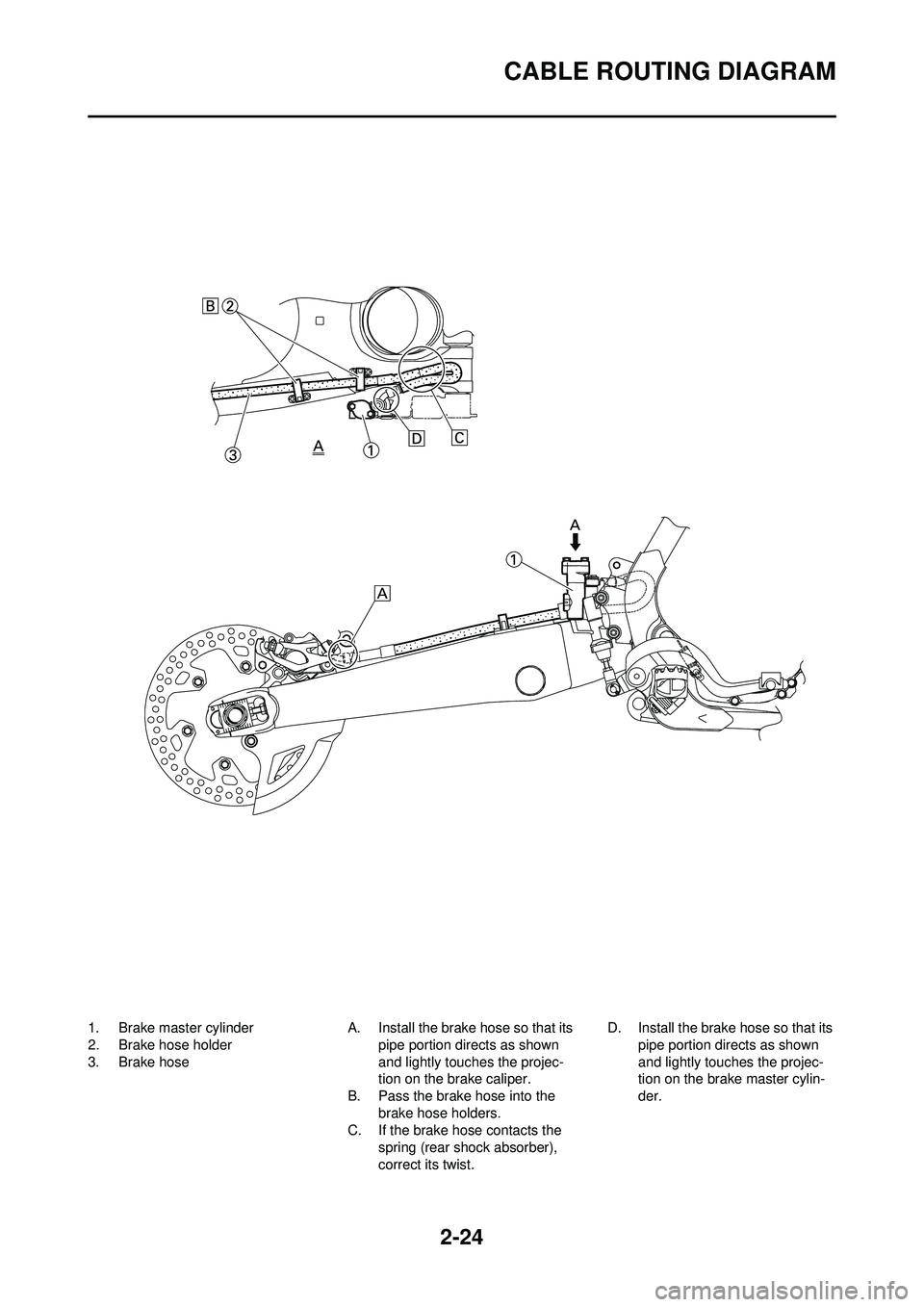
1. Brake master cylinder
2. Brake hose holder
3. Brake hoseA. Install the brake hose so that its
pipe portion directs as shown
and lightly touches the projec-
tion on the brake caliper.
B. Pass the brake hose into the
brake hose holders.
C. If the brake hose contacts the spring (rear shock absorber),
correct its twist. D. Install the brake
hose so that its
pipe portion directs as shown
and lightly touches the projec-
tion on the brake master cylin-
der.
Page 58 of 232
2-27
CABLE ROUTING DIAGRAM
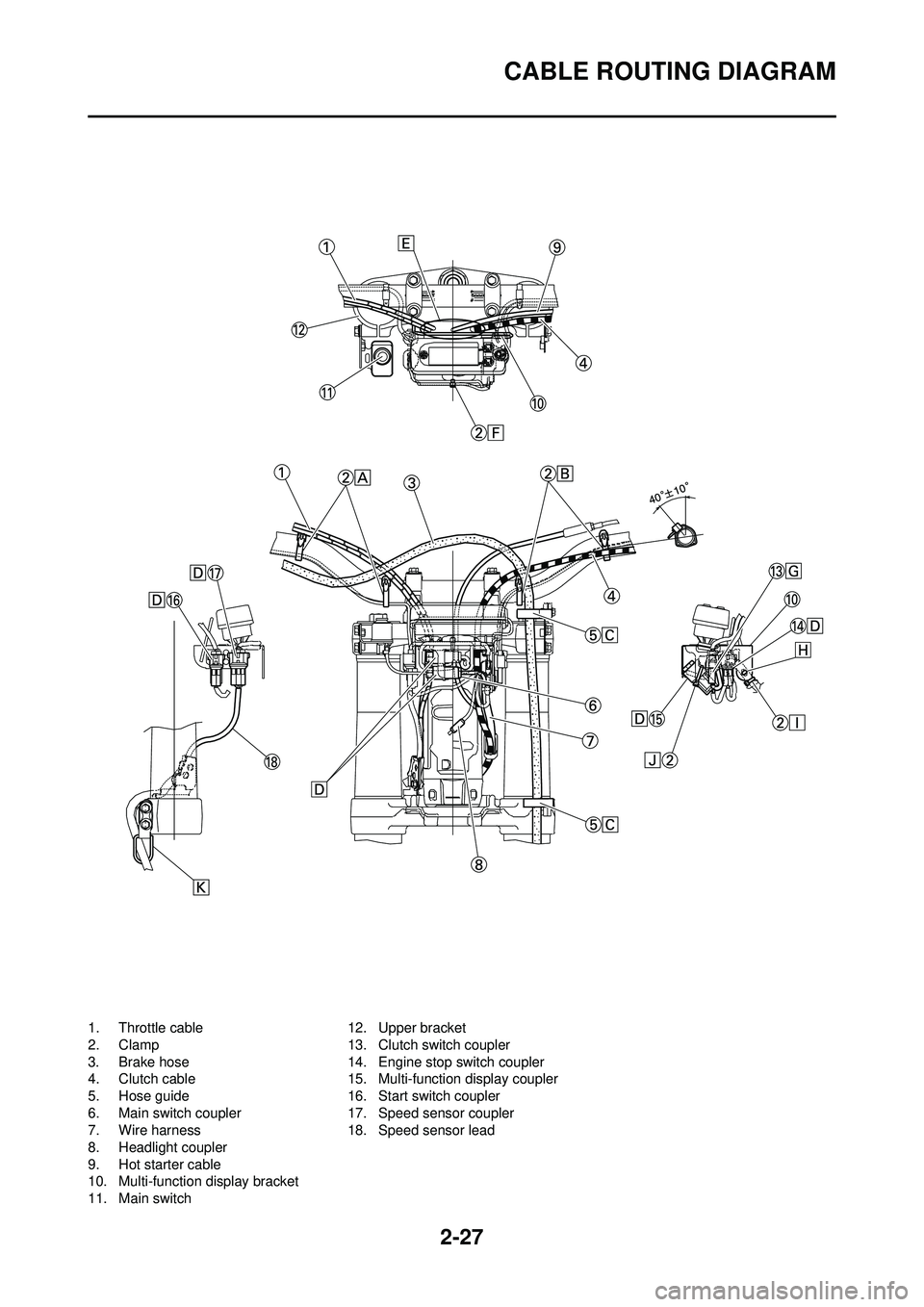
1. Throttle cable
2. Clamp
3. Brake hose
4. Clutch cable
5. Hose guide
6. Main switch coupler
7. Wire harness
8. Headlight coupler
9. Hot starter cable
10. Multi-function display bracket
11. Main switch12. Upper bracket
13. Clutch switch coupler
14. Engine stop switch coupler
15. Multi-function display coupler
16. Start switch coupler
17. Speed sensor coupler
18. Speed sensor lead
Page 59 of 232
2-28
CABLE ROUTING DIAGRAM
A. Fasten the start switch lead to the handlebar with the plastic
bands.
B. Fasten the engine stop switch
lead and clutch switch lead to
the handlebar with the plastic
bands.
C. Pass the brake hose through the hose guides.
D. Secure the coupler by inserting
it into the multi-function display
bracket.
E. Pass the throttle cables, clutch
cable and hot starter cable be-
tween the upper bracket and
multi-function display bracket.
F. Fasten the multi-function display leads to the bracket. Cut off the
tie end.
G. Secure the coupler by pushing it into the hole in the multi-function
display bracket.
H. Secure the wire harness clip by pushing it into the hole in the
multi-function display bracket on
the inside.
I. Fasten the wire harness to the multi-function display bracket.
Cut off the tie end.
J. Fasten the main switch lead (wire harness side) to the multi-
function display br acket. Locate
the clamp end facing toward the
lower side of the frame and cut
off the tie end.
K. Pass the speed sensor lead through the guide on the outside
of the front fork.
Page 61 of 232
3-2
GENERAL MAINTENANCE AND LUBRICATION CHART (ForCanada)
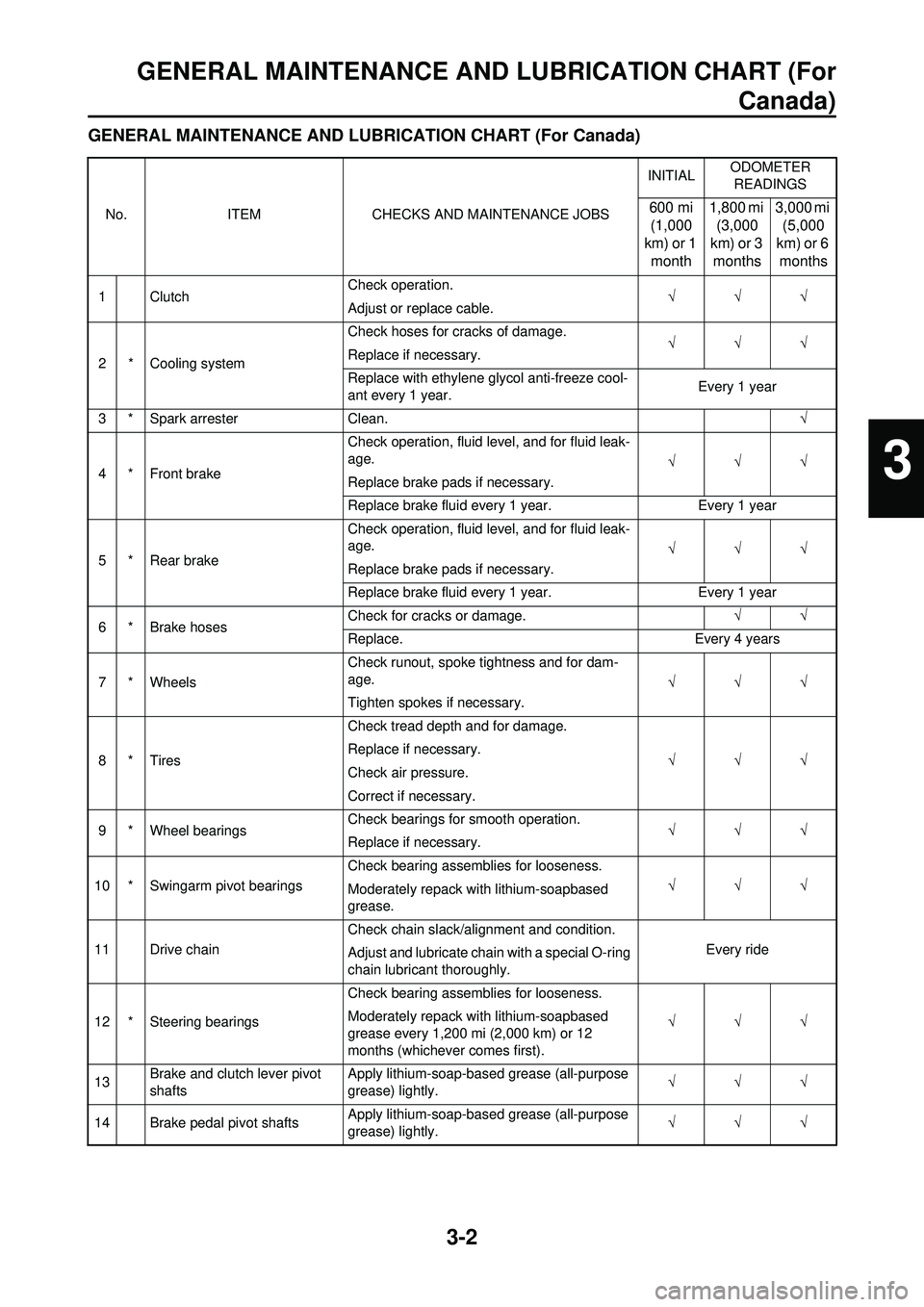
GENERAL MAINTENANCE AND LUBRICATION CHART (For Canada)
No.ITEM CHECKS AND MAINTENANCE JOBS INITIAL
ODOMETER
READINGS600 mi (1,000
km) or 1
month 1,800 mi
(3,000
km) or 3
months 3,000 mi
(5,000
km) or 6
months
1 Clutch Check operation.
√√√
Adjust or replace cable.
2 * Cooling system Check hoses for cracks of damage.
√√√
Replace if necessary.
Replace with ethylene glycol anti-freeze cool-
ant every 1 year. Every 1 year
3 * Spark arrester Clean. √
4 * Front brake Check operation, fluid level, and for fluid leak-
age.
√√√
Replace brake pads if necessary.
Replace brake fluid every 1 year. Every 1 year
5 * Rear brake Check operation, fluid level, and for fluid leak-
age.
√√√
Replace brake pads if necessary.
Replace brake fluid every 1 year. Every 1 year
6 * Brake hoses Check for cracks or damage.
√√
Replace. Every 4 years
7 * Wheels Check runout, spoke tightness and for dam-
age.
√√√
Tighten spokes if necessary.
8*Tires Check tread depth and for damage.
√√√
Replace if necessary.
Check air pressure.
Correct if necessary.
9 * Wheel bearings Check bearings for smooth operation.
√√√
Replace if necessary.
10 * Swingarm pivot bearings Check bearing assemblies for looseness.
√√√
Moderately repack with lithium-soapbased
grease.
11 Drive chain Check chain slack/alignment and condition.
Every ride
Adjust and lubricate chain with a special O-ring
chain lubricant thoroughly.
12 * Steering bearings Check bearing assemblies for looseness.
√√√
Moderately repack with lithium-soapbased
grease every 1,200 mi (2,000 km) or 12
months (whichever comes first).
13 Brake and clutch lever pivot
shafts Apply lithium-soap-bas
ed grease (all-purpose
grease) lightly. √√√
14 Brake pedal pivot shafts Apply lithium-soap-bas
ed grease (all-purpose
grease) lightly. √√√
3
Page 62 of 232
3-3
MAINTENANCE INTERVALS FOR COMPETITION USE
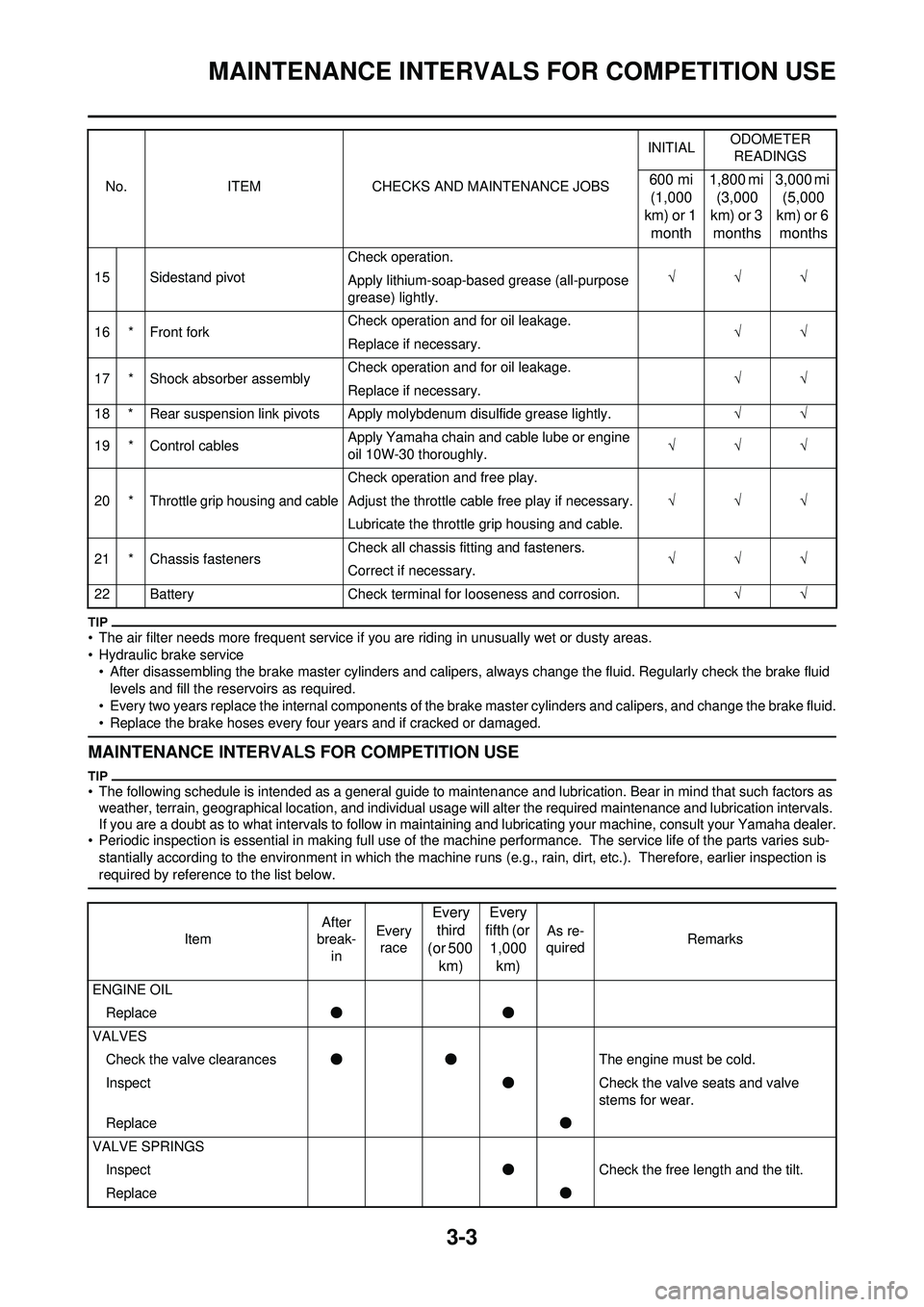
• The air filter needs more frequent service if you are riding in unusually wet or dusty areas.
• Hydraulic brake service • After disassembling the brake master cylinders and calipers, always change the fluid. Regularly check the brake fluid
levels and fill the reservoirs as required.
• Every two years replace the internal components of the brake master cylinders and calipers, and change the brake fluid.
• Replace the brake hoses every four years and if cracked or damaged.
MAINTENANCE INTERVALS FOR COMPETITION USE
• The following schedule is intended as a general guide to mainten ance and lubrication. Bear in mind that such factors as
weather, terrain, geographical location, and individual usage will alter the required maintenance and lubrication intervals.
If you are a doubt as to what intervals to follow in mainta ining and lubricating your machine, consult your Yamaha dealer.
• Periodic inspection is essential in making full use of the ma chine performance. The service life of the parts varies sub-
stantially according to the environment in which the machine runs (e.g., rain, dirt, etc.). Therefore, earlier inspection is
required by reference to the list below.
15 Sidestand pivot Check operation.
√√√
Apply lithium-soap-bas ed grease (all-purpose
grease) lightly.
16 * Front fork Check operation and for oil leakage.
√√
Replace if necessary.
17 * Shock absorber assembly Check operation and for oil leakage.
√√
Replace if necessary.
18 * Rear suspension link pivots Apply molybdenum disulfide grease lightly. √√
19 * Control cables Apply Yamaha chain and cable lube or engine
oil 10W-30 thoroughly. √√√
20 * Throttle grip housing and cable Check operation and free play.
√√√
Adjust the throttle cable free play if necessary.
Lubricate the throttle grip housing and cable.
21 * Chassis fasteners Check all chassis fitting and fasteners.
√√√
Correct if necessary.
22 Battery Check terminal for looseness and corrosion. √√
No. ITEM CHECKS AND MAINTENANCE JOBS
INITIAL
ODOMETER
READINGS
600 mi (1,000
km) or 1
month 1,800 mi
(3,000
km) or 3
months 3,000 mi
(5,000
km) or 6
months
Item After
break-
in Every
race
Every third
(or 500
km) Every
fifth (or 1,000
km)
As re-
quired Remarks
ENGINE OIL Replace ●●
VALVES Check the valve clearances ●● The engine must be cold.
Inspect ●Check the valve seats and valve
stems for wear.
Replace ●
VALVE SPRINGS Inspect ●Check the free length and the tilt.
Replace ●
Page 64 of 232
3-5
MAINTENANCE INTERVALS FOR COMPETITION USE
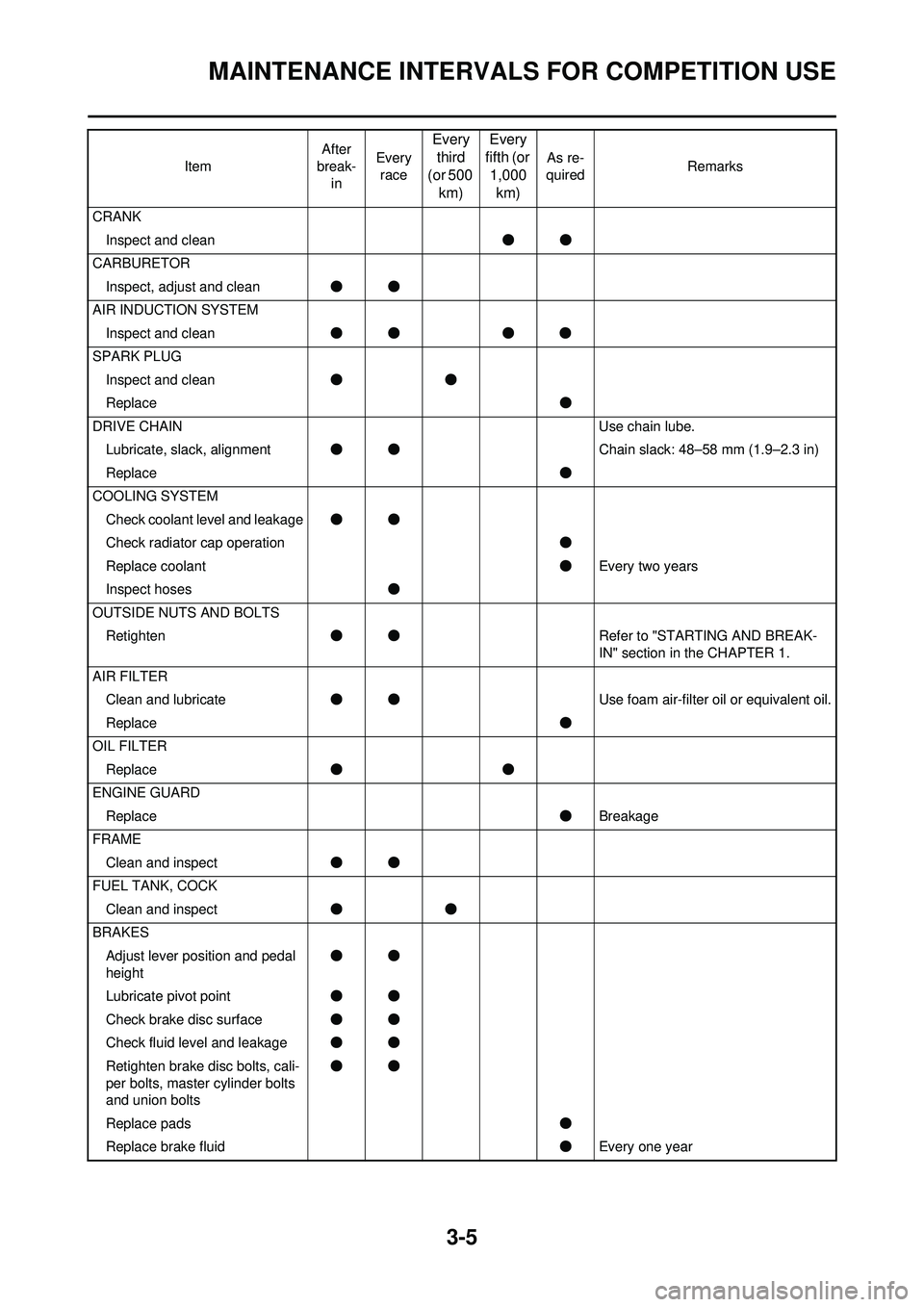
CRANKInspect and clean ●●
CARBURETOR Inspect, adjust and clean ●●
AIR INDUCTION SYSTEM Inspect and clean ●● ●●
SPARK PLUG Inspect and clean ●●
Replace ●
DRIVE CHAIN Use chain lube.
Lubricate, slack, alignment ●● Chain slack: 48–58 mm (1.9–2.3 in)
Replace ●
COOLING SYSTEM Check coolant level and leakage ●●
Check radiator cap operation ●
Replace coolant ●Every two years
Inspect hoses ●
OUTSIDE NUTS AND BOLTS Retighten ●● Refer to "STARTING AND BREAK-
IN" section in the CHAPTER 1.
AIR FILTER Clean and lubricate ●● Use foam air-filter oil or equivalent oil.
Replace ●
OIL FILTER Replace ●●
ENGINE GUARD Replace ●Breakage
FRAME Clean and inspect ●●
FUEL TANK, COCK Clean and inspect ●●
BRAKES Adjust lever position and pedal
height ●●
Lubricate pivot point ●●
Check brake disc surface ●●
Check fluid level and leakage ●●
Retighten brake disc bolts, cali-
per bolts, master cylinder bolts
and union bolts ●●
Replace pads ●
Replace brake fluid ●Every one year
Item
After
break- in Every
race
Every third
(or 500 km) Every
fifth (or
1,000 km)
As re-
quired Remarks
Page 66 of 232
3-7
PRE-OPERATION INSPECTION AND MAINTENANCE
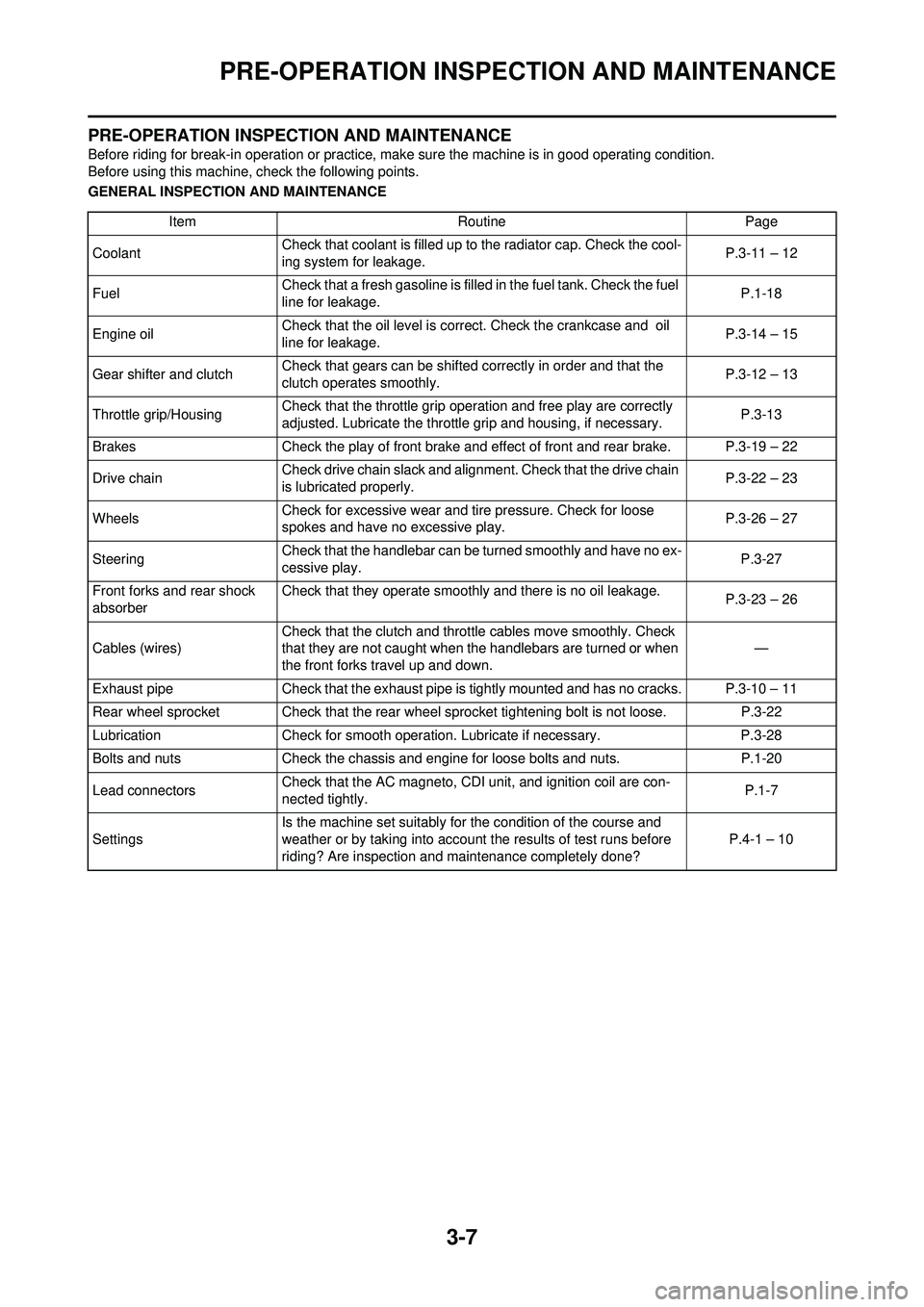
PRE-OPERATION INSPECTION AND MAINTENANCE
Before riding for break-in operation or practice, make sure the machine is in good operating condition.
Before using this machine, check the following points.
GENERAL INSPECTION AND MAINTENANCEItem RoutinePage
Coolant Check that coolant is filled up to the radiator cap. Check the cool-
ing system for leakage. P.3-11 – 12
Fuel Check that a fresh gasoline is filled in the fuel tank. Check the fuel
line for leakage.
P.1-18
Engine oil Check that the oil level is corre
ct. Check the crankcase and oil
line for leakage. P.3-14 – 15
Gear shifter and clutch Check that gears can be shifted correctly in order and that the
clutch operates smoothly. P.3-12 – 13
Throttle grip/Housing Check that the throttle grip operation and free play are correctly
adjusted. Lubricate the throttle grip and housing, if necessary.
P.3-13
Brakes Check the play of front brake and ef fect of front and rear brake. P.3-19 – 22
Drive chain Check drive chain slack and alignment. Check that the drive chain
is lubricated properly. P.3-22 – 23
Wheels Check for excessive wear and ti
re pressure. Check for loose
spokes and have no excessive play. P.3-26 – 27
Steering Check that the handlebar can be turned smoothly and have no ex-
cessive play.
P.3-27
Front forks and rear shock
absorber Check that they operate smoothly and there is no oil leakage.
P.3-23 – 26
Cables (wires) Check that the clutch and throttle cables move smoothly. Check
that they are not caught when the handlebars are turned or when
the front forks travel up and down. —
Exhaust pipe Check that the exhaust pipe is tightly mount ed and has no cracks. P.3-10 – 11
Rear wheel sprocket Check that the rear wheel sprocket tightening bolt is not loose. P.3-22
Lubrication Check for smooth operation. Lubricate if necessary. P.3-28
Bolts and nuts Check the chassis and engine for loose bolts and nuts. P.1-20
Lead connectors Check that the AC magneto, CDI unit, and ignition coil are con-
nected tightly. P.1-7
Settings Is the machine set suitably for the condition of the course and
weather or by taking into account the results of test runs before
riding? Are inspection and maintenance completely done? P.4-1 – 10
Page 78 of 232
3-19
CHASSIS
CLEANING THE SPARK
ARRESTER (For USA)
• Be sure the exhaust pipe and si-lencer are cool before cleaning
the spark arrester.
• Do not start the engine when cleaning the exhaust system.
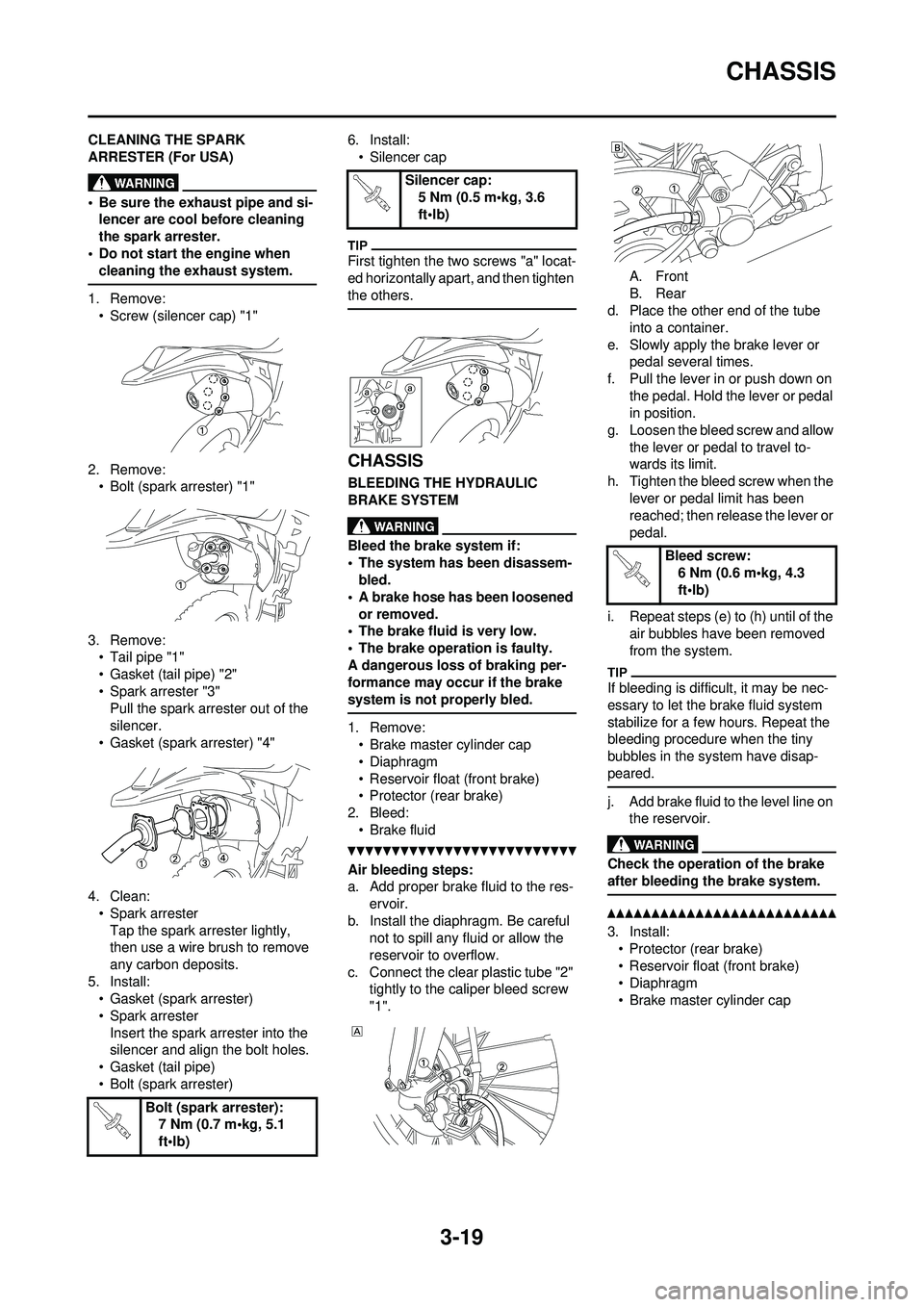
1. Remove:• Screw (silencer cap) "1"
2. Remove: • Bolt (spark arrester) "1"
3. Remove: • Tail pipe "1"
• Gasket (tail pipe) "2"
• Spark arrester "3"Pull the spark arrester out of the
silencer.
• Gasket (spark arrester) "4"
4. Clean: • Spark arrester
Tap the spark arrester lightly,
then use a wire brush to remove
any carbon deposits.
5. Install: • Gasket (spark arrester)
• Spark arresterInsert the spark arrester into the
silencer and align the bolt holes.
• Gasket (tail pipe)
• Bolt (spark arrester) 6. Install:
• Silencer cap
First tighten the two screws "a" locat-
ed horizontally apart, and then tighten
the others.
CHASSIS
BLEEDING THE HYDRAULIC
BRAKE SYSTEM
Bleed the brake system if:
• The system has been disassem-bled.
• A brake hose has been loosened
or removed.
• The brake fluid is very low.
• The brake operation is faulty.
A dangerous loss of braking per-
formance may occur if the brake
system is not properly bled.
1. Remove: • Brake master cylinder cap
• Diaphragm
• Reservoir float (front brake)
• Protector (rear brake)
2. Bleed: •Brake fluid
Air bleeding steps:
a. Add proper brake fluid to the res- ervoir.
b. Install the diaphragm. Be careful not to spill any fluid or allow the
reservoir to overflow.
c. Connect the clear plastic tube "2" tightly to the caliper bleed screw
"1". A. Front
B. Rear
d. Place the other end of the tube
into a container.
e. Slowly apply the brake lever or pedal several times.
f. Pull the lever in or push down on
the pedal. Hold the lever or pedal
in position.
g. Loosen the bleed screw and allow
the lever or pedal to travel to-
wards its limit.
h. Tighten the bleed screw when the
lever or pedal limit has been
reached; then release the lever or
pedal.
i. Repeat steps (e) to (h) until of the air bubbles have been removed
from the system.
If bleeding is difficult, it may be nec-
essary to let the brake fluid system
stabilize for a few hours. Repeat the
bleeding procedure when the tiny
bubbles in the system have disap-
peared.
j. Add brake fluid to the level line on the reservoir.
Check the operation of the brake
after bleeding the brake system.
3. Install:
• Protector (rear brake)
• Reservoir float (front brake)
• Diaphragm
• Brake master cylinder cap
Bolt (spark arrester): 7 Nm (0.7 m•kg, 5.1
ft•lb)
Silencer cap:5 Nm (0.5 m•kg, 3.6
ft•lb)
Bleed screw:
6 Nm (0.6 m•kg, 4.3
ft•lb)
Page 79 of 232
3-20
CHASSIS
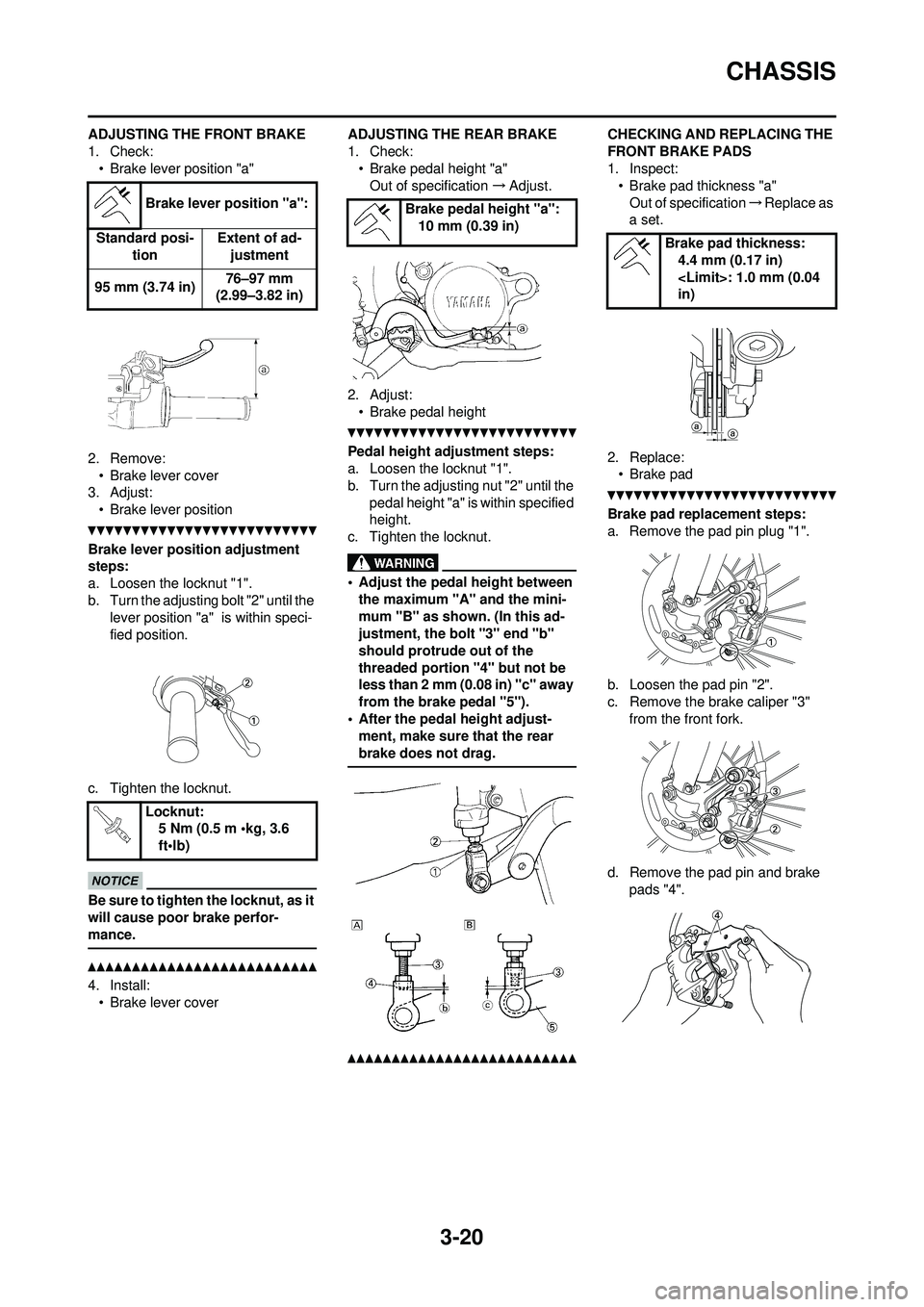
ADJUSTING THE FRONT BRAKE
1. Check:• Brake lever position "a"
2. Remove: • Brake lever cover
3. Adjust: • Brake lever position
Brake lever position adjustment
steps:
a. Loosen the locknut "1".
b. Turn the adjusting bolt "2" until the lever position "a" is within speci-
fied position.
c. Tighten the locknut.
Be sure to tighten the locknut, as it
will cause poor brake perfor-
mance.
4. Install: • Brake lever cover ADJUSTING THE REAR BRAKE
1. Check:
• Brake pedal height "a"Out of specification →Adjust.
2. Adjust: • Brake pedal height
Pedal height adjustment steps:
a. Loosen the locknut "1".
b. Turn the adjusting nut "2" until the pedal height "a" is within specified
height.
c. Tighten the locknut.
• Adjust the pedal height between the maximum "A" and the mini-
mum "B" as shown. (In this ad-
justment, the bolt "3" end "b"
should protrude out of the
threaded portion "4" but not be
less than 2 mm (0.08 in) "c" away
from the brake pedal "5").
• After the pedal height adjust- ment, make sure that the rear
brake does not drag.
CHECKING AND REPLACING THE
FRONT BRAKE PADS
1. Inspect:• Brake pad thickness "a"
Out of specification →Replace as
a set.
2. Replace: • Brake pad
Brake pad replacement steps:
a. Remove the pad pin plug "1".
b. Loosen the pad pin "2".
c. Remove the brake caliper "3" from the front fork.
d. Remove the pad pin and brake pads "4".
Brake lever position "a":
Standard posi- tion Extent of ad-
justment
95 mm (3.74 in) 76–97 mm
(2.99–3.82 in)
Locknut: 5 Nm (0.5 m •kg, 3.6
ft•lb)
Brake pedal height "a":
10 mm (0.39 in)
Brake pad thickness: 4.4 mm (0.17 in)
in)
Page 80 of 232
3-21
CHASSIS
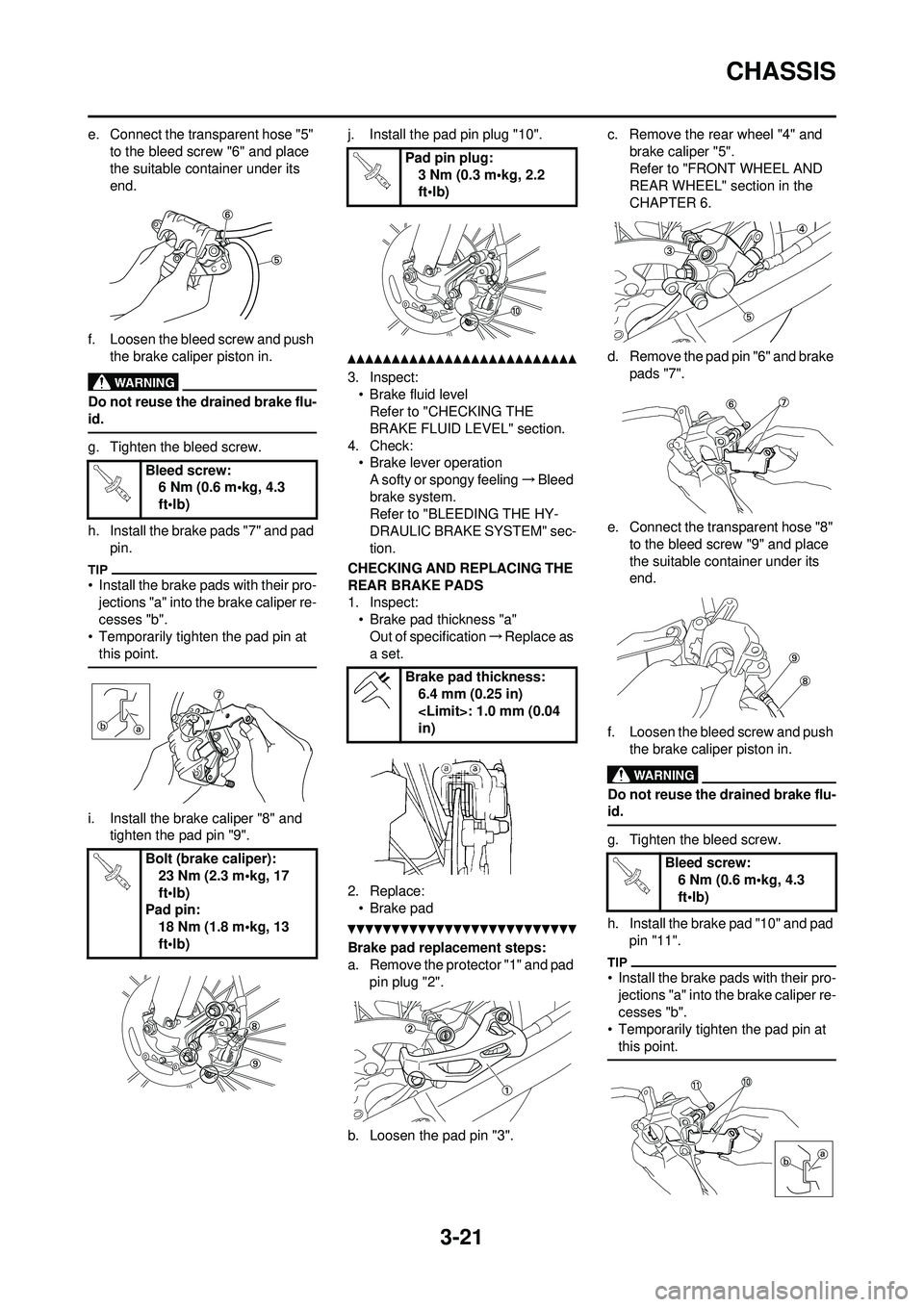
e. Connect the transparent hose "5" to the bleed screw "6" and place
the suitable container under its
end.
f. Loosen the bleed screw and push the brake caliper piston in.
Do not reuse the drained brake flu-
id.
g. Tighten the bleed screw.
h. Install the brake pads "7" and pad pin.
• Install the brake pads with their pro-
jections "a" into the brake caliper re-
cesses "b".
• Temporarily tighten the pad pin at
this point.
i. Install the brake caliper "8" and tighten the pad pin "9". j. Install the pad pin plug "10".
3. Inspect:
• Brake fluid levelRefer to "CHECKING THE
BRAKE FLUID LEVEL" section.
4. Check: • Brake lever operationA softy or spongy feeling →Bleed
brake system.
Refer to "BL EEDING THE HY-
DRAULIC BRAKE SYSTEM" sec-
tion.
CHECKING AND REPLACING THE
REAR BRAKE PADS
1. Inspect: • Brake pad thickness "a"Out of specification →Replace as
a set.
2. Replace: •Brake pad
Brake pad replacement steps:
a. Remove the protector "1" and pad pin plug "2".
b. Loosen the pad pin "3". c. Remove the rear wheel "4" and
brake caliper "5".
Refer to "FRONT WHEEL AND
REAR WHEEL" section in the
CHAPTER 6.
d. Remove the pad pin "6" and brake pads "7".
e. Connect the transparent hose "8" to the bleed screw "9" and place
the suitable container under its
end.
f. Loosen the bleed screw and push the brake caliper piston in.
Do not reuse the drained brake flu-
id.
g. Tighten the bleed screw.
h. Install the brake pad "10" and pad pin "11".
• Install the brake pads with their pro-jections "a" into the brake caliper re-
cesses "b".
• Temporarily tighten the pad pin at
this point.
Bleed screw: 6 Nm (0.6 m•kg, 4.3
ft•lb)
Bolt (brake caliper): 23 Nm (2.3 m•kg, 17
ft•lb)
Pad pin:
18 Nm (1.8 m•kg, 13
ft•lb)
Pad pin plug:3 Nm (0.3 m•kg, 2.2
ft•lb)
Brake pad thickness: 6.4 mm (0.25 in)
in)
Bleed screw: 6 Nm (0.6 m•kg, 4.3
ft•lb)