engine oil YAMAHA WR 250F 2015 Owner's Manual
[x] Cancel search | Manufacturer: YAMAHA, Model Year: 2015, Model line: WR 250F, Model: YAMAHA WR 250F 2015Pages: 430, PDF Size: 14.14 MB
Page 105 of 430
PERIODIC MAINTENANCE
3-1
EAS2GB2076
PERIODIC MAINTENANCE
EAS2GB2077INTRODUCTION
This chapter includes all information necessary to perform recommended checks and adjustments.
If followed, these preventive maintenance procedures will ensure more reliable vehicle operation, a
longer service life and reduce the need for costly overhaul work. This information applies to vehicles
already in service as well as to new vehicles that are being prepared for sale. All service technicians
should be familiar with this entire chapter.
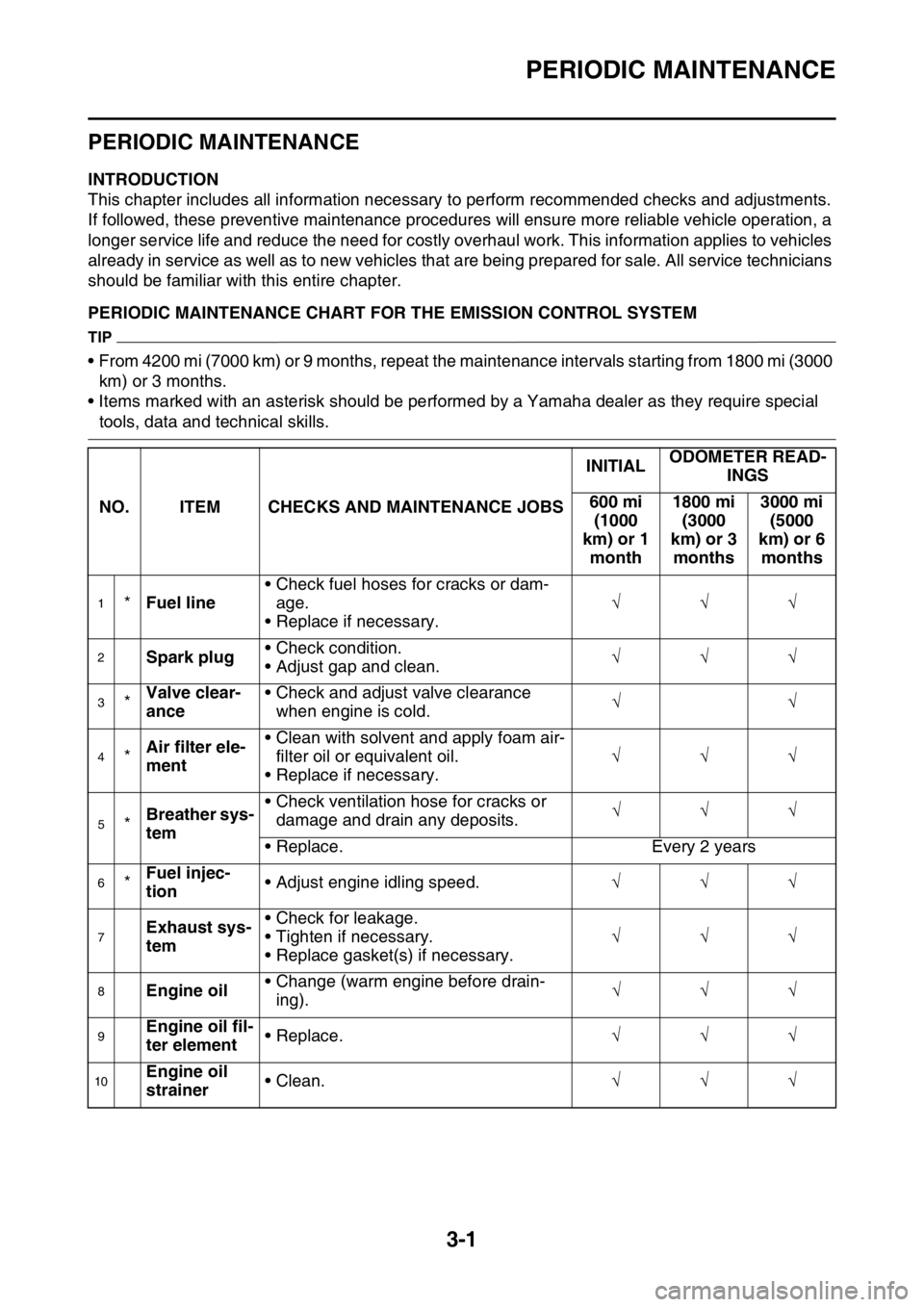
EAS2GB2078PERIODIC MAINTENANCE CHART FOR THE EMISSION CONTROL SYSTEM
TIP
• From 4200 mi (7000 km) or 9 months, repeat the maintenance intervals starting from 1800 mi (3000
km) or 3 months.
• Items marked with an asterisk should be performed by a Yamaha dealer as they require special
tools, data and technical skills.
NO. ITEM CHECKS AND MAINTENANCE JOBSINITIALODOMETER READ-
INGS
600 mi
(1000
km) or 1
month1800 mi
(3000
km) or 3
months3000 mi
(5000
km) or 6
months
1*Fuel line• Check fuel hoses for cracks or dam-
age.
• Replace if necessary.
2Spark plug• Check condition.
• Adjust gap and clean.
3*Valve clear-
ance• Check and adjust valve clearance
when engine is cold.
4*Air filter ele-
ment• Clean with solvent and apply foam air-
filter oil or equivalent oil.
• Replace if necessary.
5*Breather sys-
tem• Check ventilation hose for cracks or
damage and drain any deposits.
• Replace. Every 2 years
6*Fuel injec-
tion• Adjust engine idling speed.
7Exhaust sys-
tem• Check for leakage.
• Tighten if necessary.
• Replace gasket(s) if necessary.
8Engine oil• Change (warm engine before drain-
ing).
9Engine oil fil-
ter element• Replace.
10Engine oil
strainer• Clean.
Page 107 of 430

PERIODIC MAINTENANCE
3-3
TIP
• The air filter needs more frequent service if you are riding in unusually wet or dusty areas.
• Hydraulic brake service
• After disassembling the brake master cylinders and calipers, always change the fluid. Regularly
check the brake fluid levels and fill the reservoirs as required.
• Every two years replace the internal components of the brake master cylinders and calipers, and
change the brake fluid.
• Replace the brake hoses every four years and if cracked or damaged.
13
Brake and
clutch lever
pivot shafts• Apply lithium-soap-based grease (all-
purpose grease) lightly.
14Brake pedal
pivot shafts• Apply lithium-soap-based grease (all-
purpose grease) lightly.
15Sidestand
pivot• Check operation.
• Apply lithium-soap-based grease (all-
purpose grease) lightly.
16*Front fork• Check operation and for oil leakage.
• Replace if necessary.
17*Shock ab-
sorber as-
sembly• Check operation and for oil leakage.
• Replace if necessary.
18*Rear suspen-
sion link piv-
ots• Apply molybdenum disulfide grease
lightly.
19*Control ca-
bles• Apply Yamaha chain and cable lube or
engine oil 10W-30 thoroughly.
20*Throttle grip
housing and
cable• Check operation and free play.
• Adjust the throttle cable free play if
necessary.
• Lubricate the throttle grip housing and
cable.
21*Chassis fas-
teners• Check all chassis fitting and fasteners.
• Correct if necessary.
22Battery• Check terminal for looseness and cor-
rosion. NO. ITEM CHECKS AND MAINTENANCE JOBSINITIALODOMETER READ-
INGS
600 mi
(1000
km) or 1
month1800 mi
(3000
km) or 3
months3000 mi
(5000
km) or 6
months
Page 108 of 430
PERIODIC MAINTENANCE
3-4
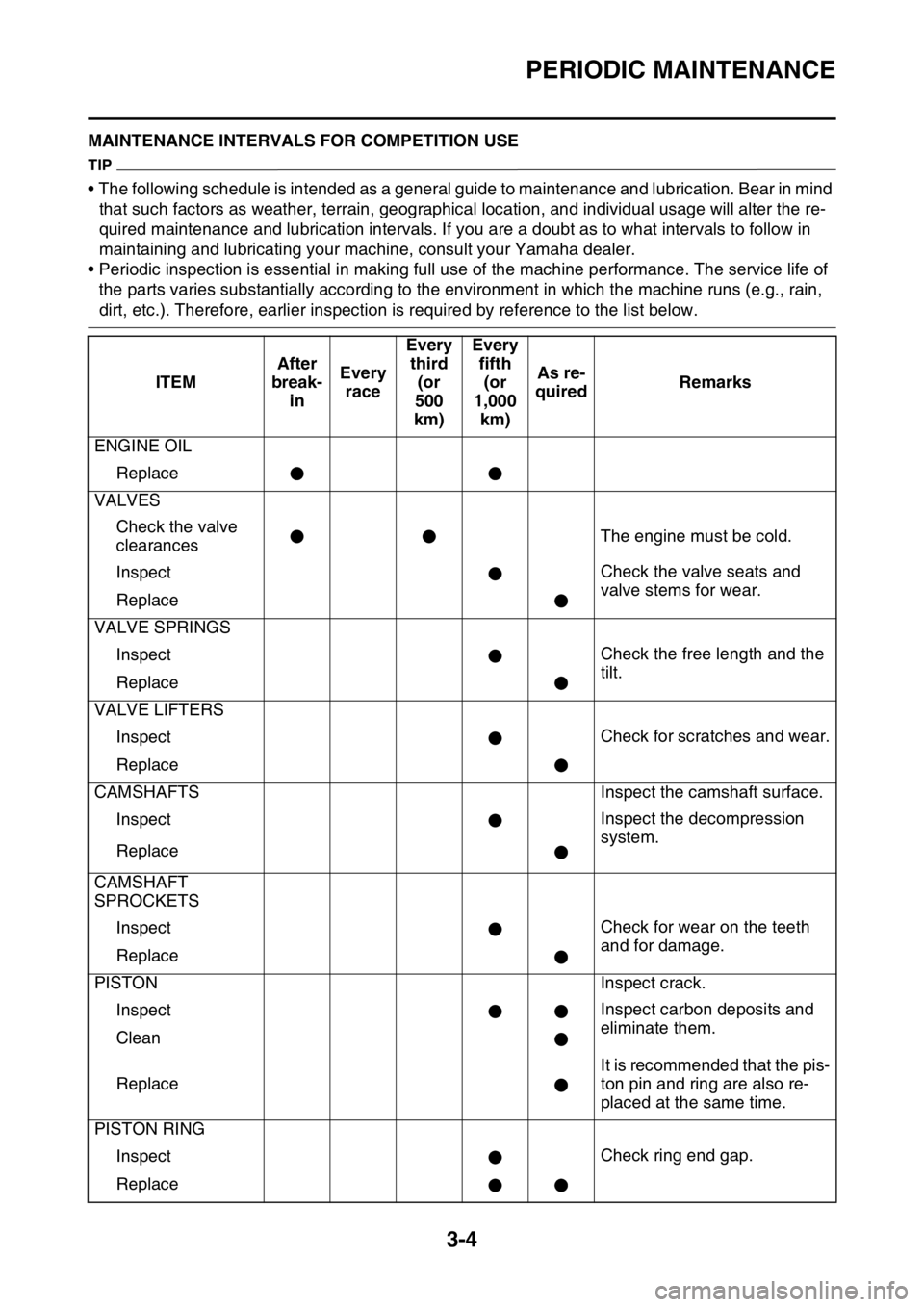
EAS2GB2080MAINTENANCE INTERVALS FOR COMPETITION USE
TIP
• The following schedule is intended as a general guide to maintenance and lubrication. Bear in mind
that such factors as weather, terrain, geographical location, and individual usage will alter the re-
quired maintenance and lubrication intervals. If you are a doubt as to what intervals to follow in
maintaining and lubricating your machine, consult your Yamaha dealer.
• Periodic inspection is essential in making full use of the machine performance. The service life of
the parts varies substantially according to the environment in which the machine runs (e.g., rain,
dirt, etc.). Therefore, earlier inspection is required by reference to the list below.
ITEMAfter
break-
inEvery
raceEvery
third
(or
500
km)Every
fifth
(or
1,000
km)As re-
quiredRemarks
ENGINE OIL
Replace
VALVES
Check the valve
clearancesThe engine must be cold.
InspectCheck the valve seats and
valve stems for wear.
Replace
VALVE SPRINGS
InspectCheck the free length and the
tilt.
Replace
VALVE LIFTERS
InspectCheck for scratches and wear.
Replace
CAMSHAFTS Inspect the camshaft surface.
InspectInspect the decompression
system.
Replace
CAMSHAFT
SPROCKETS
InspectCheck for wear on the teeth
and for damage.
Replace
PISTON Inspect crack.
InspectInspect carbon deposits and
eliminate them.
Clean
ReplaceIt is recommended that the pis-
ton pin and ring are also re-
placed at the same time.
PISTON RING
InspectCheck ring end gap.
Replace
Page 110 of 430
PERIODIC MAINTENANCE
3-6
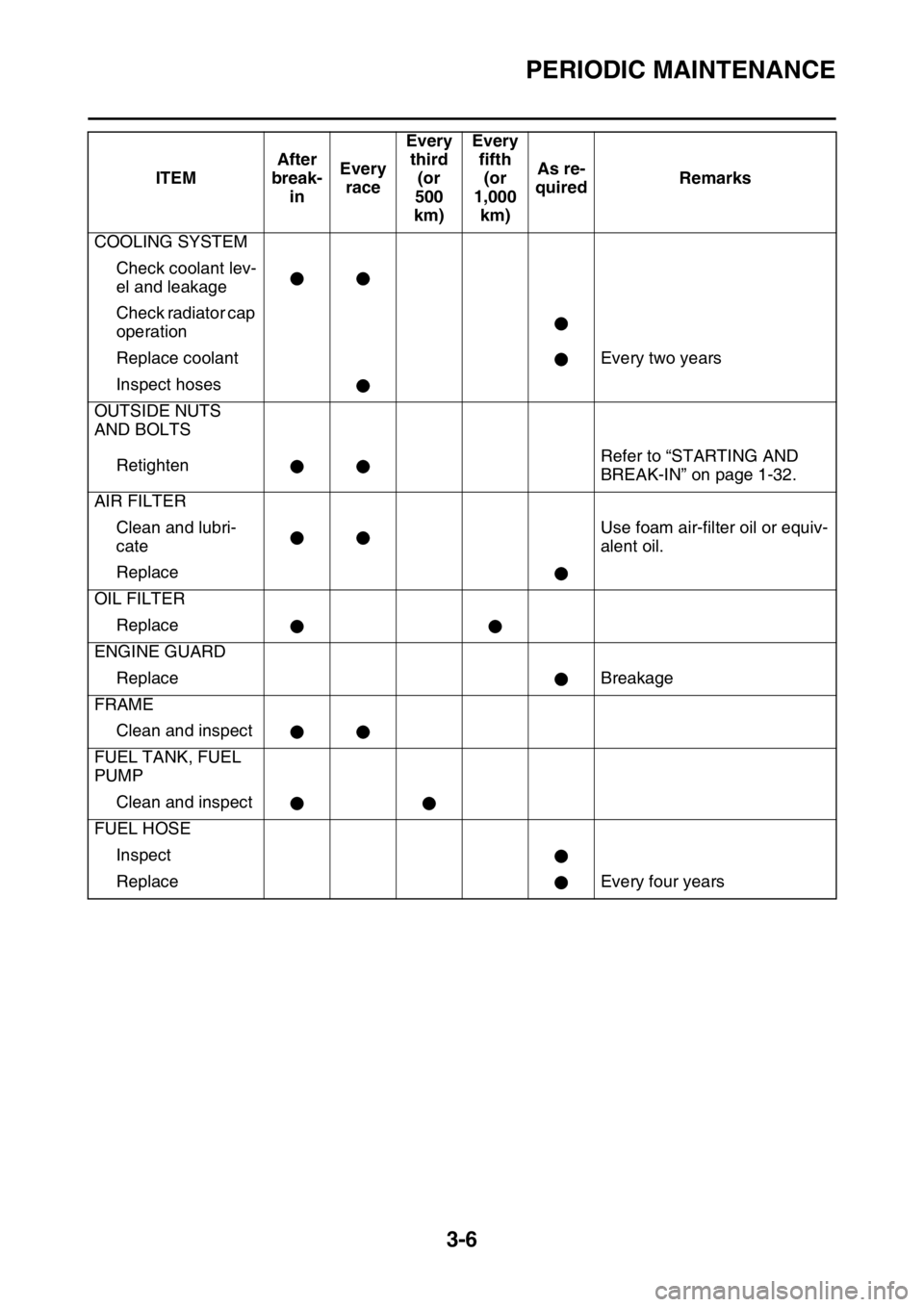
COOLING SYSTEM
Check coolant lev-
el and leakage
Check radiator cap
operation
Replace coolant Every two years
Inspect hoses
OUTSIDE NUTS
AND BOLTS
RetightenRefer to “STARTING AND
BREAK-IN” on page 1-32.
AIR FILTER
Clean and lubri-
cateUse foam air-filter oil or equiv-
alent oil.
Replace
OIL FILTER
Replace
ENGINE GUARD
Replace Breakage
FRAME
Clean and inspect
FUEL TANK, FUEL
PUMP
Clean and inspect
FUEL HOSE
Inspect
Replace Every four yearsITEMAfter
break-
inEvery
raceEvery
third
(or
500
km)Every
fifth
(or
1,000
km)As re-
quiredRemarks
Page 113 of 430

PRE-OPERATION INSPECTION AND MAINTENANCE
3-9
EAS2GB2081
PRE-OPERATION INSPECTION AND MAINTENANCE
Before riding for break-in operation, practice or a race, make sure the machine is in good operating
condition.
Before using this machine, check the following points.
EAS2GB2082GENERAL INSPECTION AND MAINTENANCE
TIP
Perform usual maintenance enough so that, in the race course, a confirmation of that and simple set-
ting adjustments may only be left, in order to get enough time to use effectively.ITEM inspect Page
CoolantCheck that coolant is filled up to the radiator cap.
Check the cooling system for leakage.3-10 – 12
FuelCheck that a fresh gasoline is filled in the fuel tank.
Check the fuel line for leakage.1-32
Engine oilCheck that the oil level is correct. Check the crank-
case and oil line for leakage.3-16 – 18
Gear shifter and clutchCheck that gears can be shifted correctly in order and
that the clutch operates smoothly.3-12 – 13
Throttle grip/HousingCheck that the throttle grip operation and free play
are correctly adjusted. Lubricate the throttle grip and
housing, if necessary.3-13 – 14
BrakesCheck the play of front brake and effect of front and
rear brake.3-24 – 30
Drive chainCheck drive chain slack and alignment. Check that
the drive chain is lubricated properly.3-30
5-68 – 69
WheelsCheck for excessive wear and tire pressure. Check
for loose spokes and have no excessive play.3-35 – 36
SteeringCheck that the handlebar can be turned smoothly and
have no excessive play.3-36 – 37
Front forks and rear
shock absorberCheck that they operate smoothly and there is no oil
leakage.3-31 – 35
Cables (wires)Check that the clutch and throttle cables move
smoothly. Check that they are not caught when the
handlebars are turned or when the front forks travel
up and down.—
Exhaust pipeCheck that the exhaust pipe is tightly mounted and
has no cracks.3-15 – 16
Rear wheel sprocketCheck that the rear wheel sprocket tightening bolt is
not loose.5-10 – 11
LubricationCheck for smooth operation. Lubricate if necessary. 3-13
3-37 – 38
Bolts and nutsCheck the chassis and engine for loose bolts and
nuts.1-36 – 37
Lead connectorsCheck that the AC magneto, ECU and ignition coil are
connected tightly.1-11 – 14
SettingsIs the machine set suitably for the condition of the rac-
ing course and weather or by taking into account the
results of test runs before racing? Are inspection and
maintenance completely done?4-1 – 8
Page 118 of 430
ENGINE
3-14
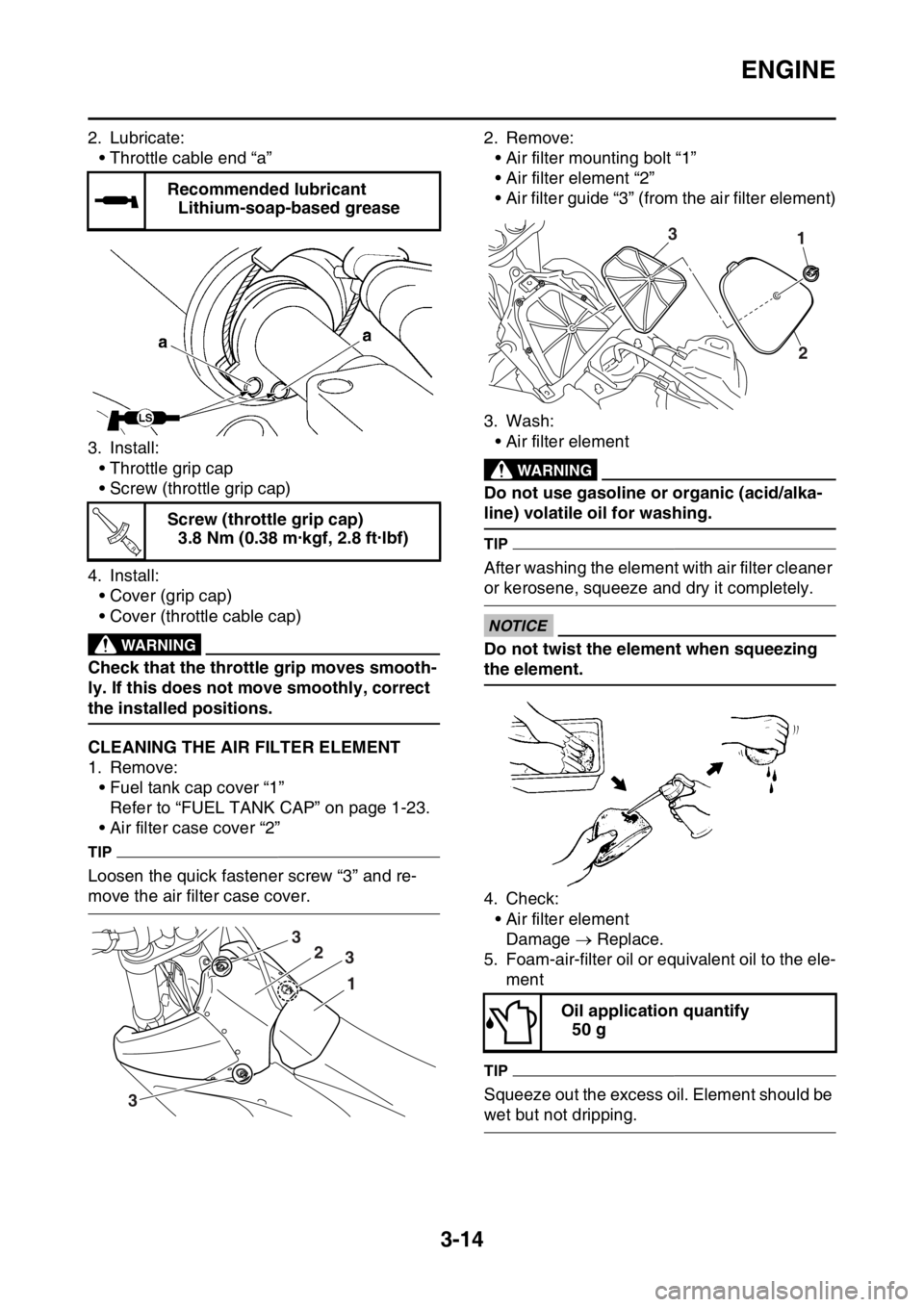
2. Lubricate:
• Throttle cable end “a”
3. Install:
• Throttle grip cap
• Screw (throttle grip cap)
4. Install:
• Cover (grip cap)
• Cover (throttle cable cap)
EWA
WARNING
Check that the throttle grip moves smooth-
ly. If this does not move smoothly, correct
the installed positions.
EAS2GB2093CLEANING THE AIR FILTER ELEMENT
1. Remove:
• Fuel tank cap cover “1”
Refer to “FUEL TANK CAP” on page 1-23.
• Air filter case cover “2”
TIP
Loosen the quick fastener screw “3” and re-
move the air filter case cover.2. Remove:
• Air filter mounting bolt “1”
• Air filter element “2”
• Air filter guide “3” (from the air filter element)
3. Wash:
• Air filter element
EWA
WARNING
Do not use gasoline or organic (acid/alka-
line) volatile oil for washing.
TIP
After washing the element with air filter cleaner
or kerosene, squeeze and dry it completely.
ECA
NOTICE
Do not twist the element when squeezing
the element.
4. Check:
• Air filter element
Damage Replace.
5. Foam-air-filter oil or equivalent oil to the ele-
ment
TIP
Squeeze out the excess oil. Element should be
wet but not dripping. Recommended lubricant
Lithium-soap-based grease
Screw (throttle grip cap)
3.8 Nm (0.38 m·kgf, 2.8 ft·lbf)
T R..
1
2
3
3
3
Oil application quantify
50 g
13
2
Page 120 of 430
ENGINE
3-16
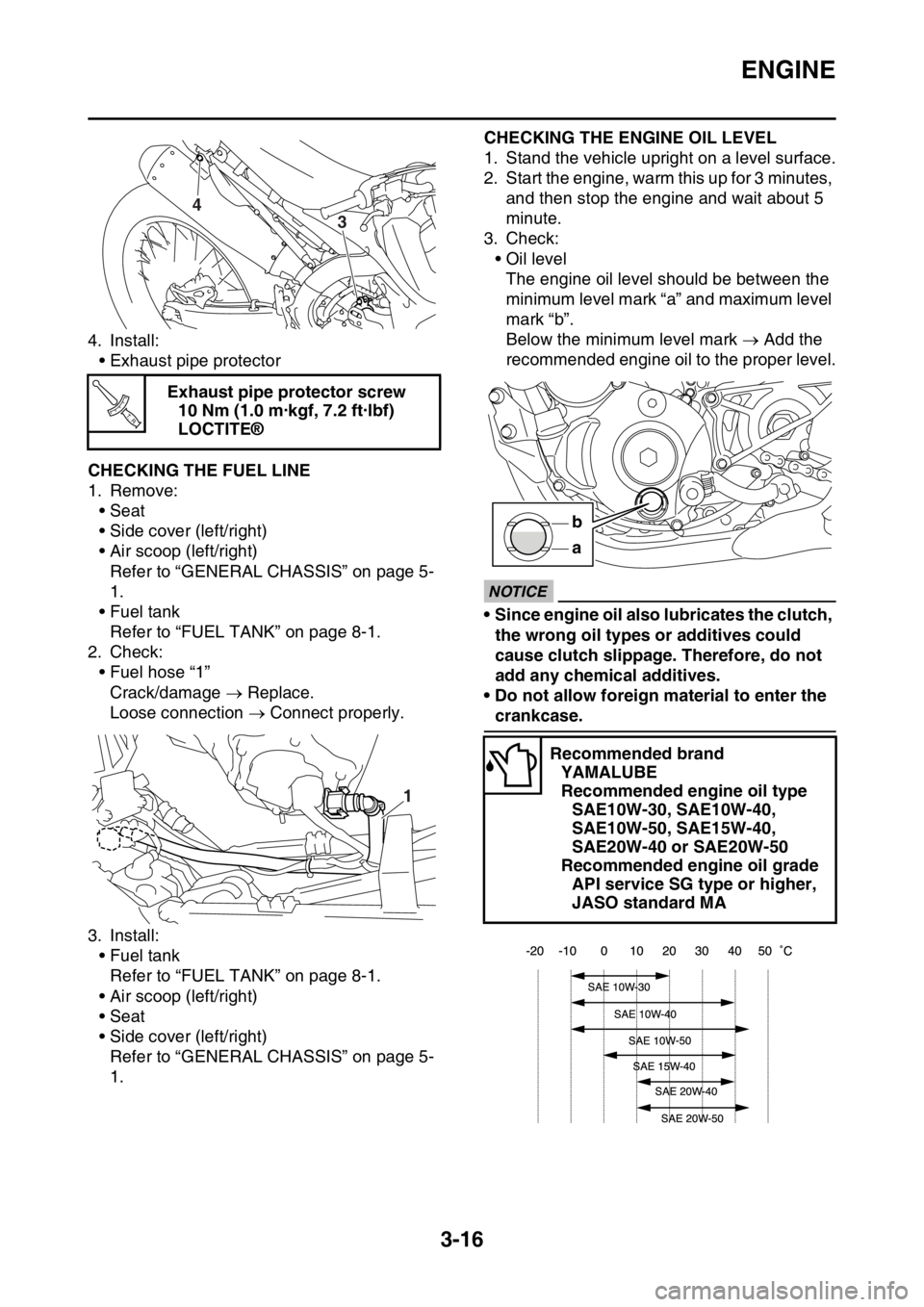
4. Install:
• Exhaust pipe protector
EAS2GB2097CHECKING THE FUEL LINE
1. Remove:
• Seat
• Side cover (left/right)
• Air scoop (left/right)
Refer to “GENERAL CHASSIS” on page 5-
1.
• Fuel tank
Refer to “FUEL TANK” on page 8-1.
2. Check:
• Fuel hose “1”
Crack/damage Replace.
Loose connection Connect properly.
3. Install:
• Fuel tank
Refer to “FUEL TANK” on page 8-1.
• Air scoop (left/right)
• Seat
• Side cover (left/right)
Refer to “GENERAL CHASSIS” on page 5-
1.
EAS2GB2098
CHECKING THE ENGINE OIL LEVEL
1. Stand the vehicle upright on a level surface.
2. Start the engine, warm this up for 3 minutes,
and then stop the engine and wait about 5
minute.
3. Check:
• Oil level
The engine oil level should be between the
minimum level mark “a” and maximum level
mark “b”.
Below the minimum level mark Add the
recommended engine oil to the proper level.
ECA
NOTICE
• Since engine oil also lubricates the clutch,
the wrong oil types or additives could
cause clutch slippage. Therefore, do not
add any chemical additives.
• Do not allow foreign material to enter the
crankcase. Exhaust pipe protector screw
10 Nm (1.0 m·kgf, 7.2 ft·lbf)
LOCTITE®
4
3
T R..
1
Recommended brand
YAMALUBE
Recommended engine oil type
SAE10W-30, SAE10W-40,
SAE10W-50, SAE15W-40,
SAE20W-40 or SAE20W-50
Recommended engine oil grade
API service SG type or higher,
JASO standard MA
a b
Page 121 of 430
ENGINE
3-17
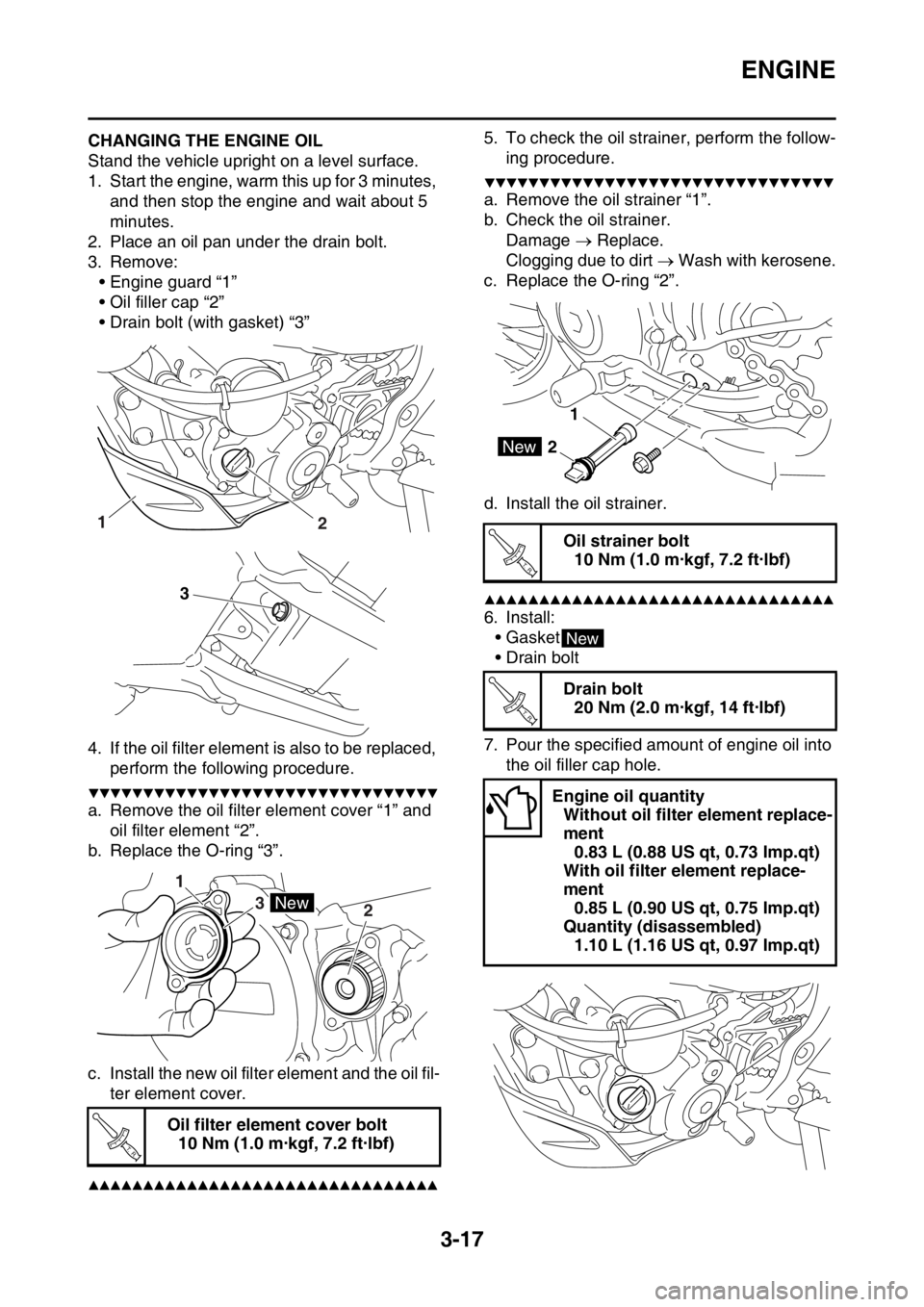
EAS2GB2099CHANGING THE ENGINE OIL
Stand the vehicle upright on a level surface.
1. Start the engine, warm this up for 3 minutes,
and then stop the engine and wait about 5
minutes.
2. Place an oil pan under the drain bolt.
3. Remove:
• Engine guard “1”
• Oil filler cap “2”
• Drain bolt (with gasket) “3”
4. If the oil filter element is also to be replaced,
perform the following procedure.
▼▼▼▼▼▼▼▼▼▼▼▼▼▼▼▼▼▼▼▼▼▼▼▼▼▼▼▼▼▼▼▼
a. Remove the oil filter element cover “1” and
oil filter element “2”.
b. Replace the O-ring “3”.
c. Install the new oil filter element and the oil fil-
ter element cover.
▲▲▲▲▲▲▲▲▲▲▲▲▲▲▲▲▲▲▲▲▲▲▲▲▲▲▲▲▲▲▲▲
5. To check the oil strainer, perform the follow-
ing procedure.
▼▼▼▼▼▼▼▼▼▼▼▼▼▼▼▼▼▼▼▼▼▼▼▼▼▼▼▼▼▼▼▼
a. Remove the oil strainer “1”.
b. Check the oil strainer.
Damage Replace.
Clogging due to dirt Wash with kerosene.
c. Replace the O-ring “2”.
d. Install the oil strainer.
▲▲▲▲▲▲▲▲▲▲▲▲▲▲▲▲▲▲▲▲▲▲▲▲▲▲▲▲▲▲▲▲
6. Install:
•Gasket
• Drain bolt
7. Pour the specified amount of engine oil into
the oil filler cap hole.
Oil filter element cover bolt
10 Nm (1.0 m·kgf, 7.2 ft·lbf)
12
3
1
3
2
New
T R..
Oil strainer bolt
10 Nm (1.0 m·kgf, 7.2 ft·lbf)
Drain bolt
20 Nm (2.0 m·kgf, 14 ft·lbf)
Engine oil quantity
Without oil filter element replace-
ment
0.83 L (0.88 US qt, 0.73 Imp.qt)
With oil filter element replace-
ment
0.85 L (0.90 US qt, 0.75 Imp.qt)
Quantity (disassembled)
1.10 L (1.16 US qt, 0.97 Imp.qt)
1
2New
T R..
New
T R..
Page 122 of 430
ENGINE
3-18
8. Install:
• Oil filler cap
9. Check:
• Oil level
Refer to “CHECKING THE ENGINE OIL
LEVEL” on page 3-16.
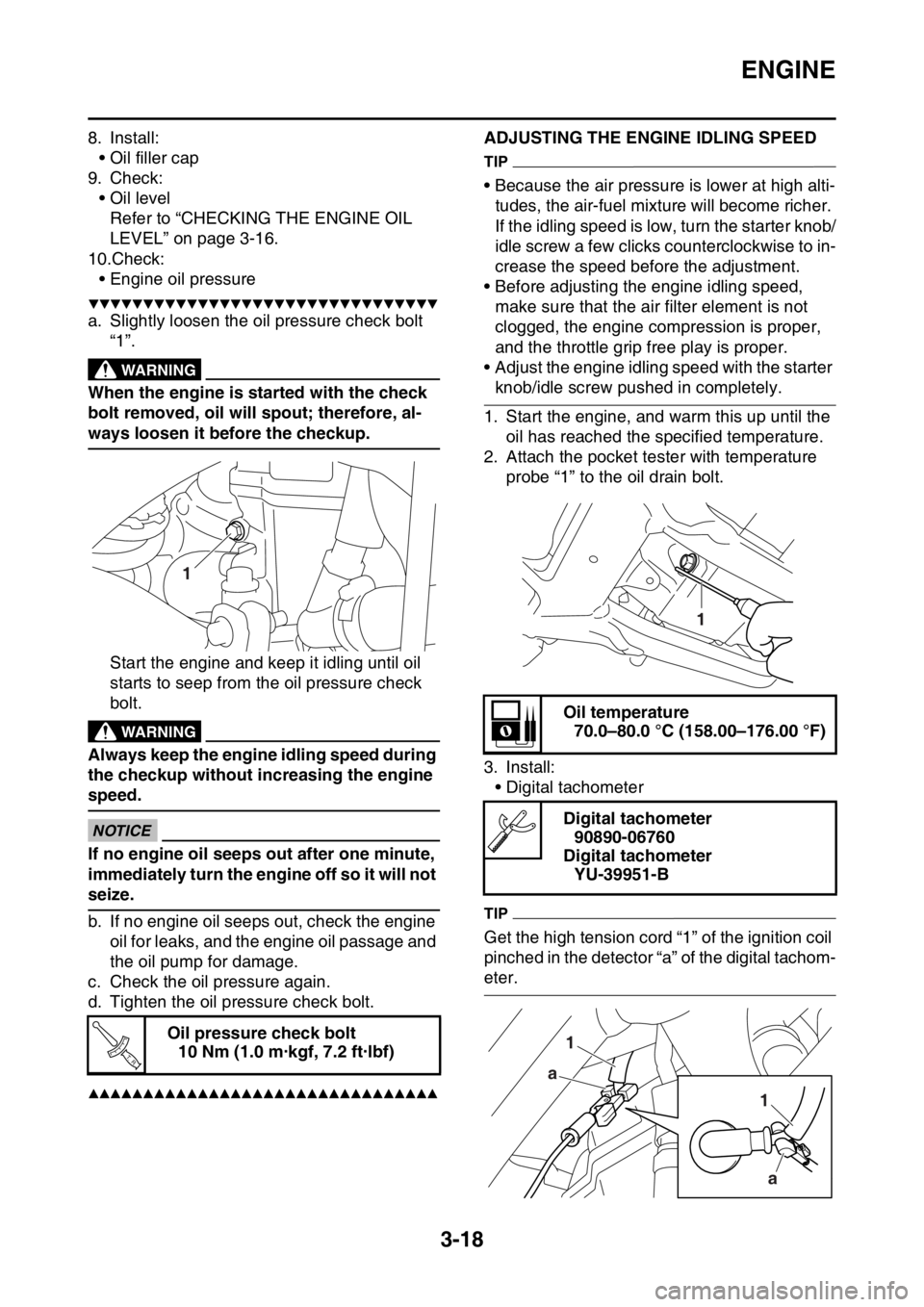
10.Check:
• Engine oil pressure
▼▼▼▼▼▼▼▼▼▼▼▼▼▼▼▼▼▼▼▼▼▼▼▼▼▼▼▼▼▼▼▼
a. Slightly loosen the oil pressure check bolt
“1”.
EWA
WARNING
When the engine is started with the check
bolt removed, oil will spout; therefore, al-
ways loosen it before the checkup.
Start the engine and keep it idling until oil
starts to seep from the oil pressure check
bolt.
EWA
WARNING
Always keep the engine idling speed during
the checkup without increasing the engine
speed.
ECA
NOTICE
If no engine oil seeps out after one minute,
immediately turn the engine off so it will not
seize.
b. If no engine oil seeps out, check the engine
oil for leaks, and the engine oil passage and
the oil pump for damage.
c. Check the oil pressure again.
d. Tighten the oil pressure check bolt.
▲▲▲▲▲▲▲▲▲▲▲▲▲▲▲▲▲▲▲▲▲▲▲▲▲▲▲▲▲▲▲▲
EAS2GB2100
ADJUSTING THE ENGINE IDLING SPEED
TIP
• Because the air pressure is lower at high alti-
tudes, the air-fuel mixture will become richer.
If the idling speed is low, turn the starter knob/
idle screw a few clicks counterclockwise to in-
crease the speed before the adjustment.
• Before adjusting the engine idling speed,
make sure that the air filter element is not
clogged, the engine compression is proper,
and the throttle grip free play is proper.
• Adjust the engine idling speed with the starter
knob/idle screw pushed in completely.
1. Start the engine, and warm this up until the
oil has reached the specified temperature.
2. Attach the pocket tester with temperature
probe “1” to the oil drain bolt.
3. Install:
• Digital tachometer
TIP
Get the high tension cord “1” of the ignition coil
pinched in the detector “a” of the digital tachom-
eter.
Oil pressure check bolt
10 Nm (1.0 m·kgf, 7.2 ft·lbf)
1
T R..
Oil temperature
70.0–80.0 °C (158.00–176.00 °F)
Digital tachometer
90890-06760
Digital tachometer
YU-39951-B
1
1 1
a a
Page 125 of 430
ENGINE
3-21
d. Select an adjusting pad with a proper valve
clearance from the adjusting pad selection
table.
TIP
• There are 25 types of adjusting pads, ranging
from 1.20 mm (0.0472 in) to 2.40 mm (0.0945
in), in increments of 0.05 mm (0.0020 in).
• The field where the number on the originally
installed adjusting pad and the measured
valve clearance intersect shows the adjusting
pad number to replace.
Example:
Pad number = 148
Rounded value = 150
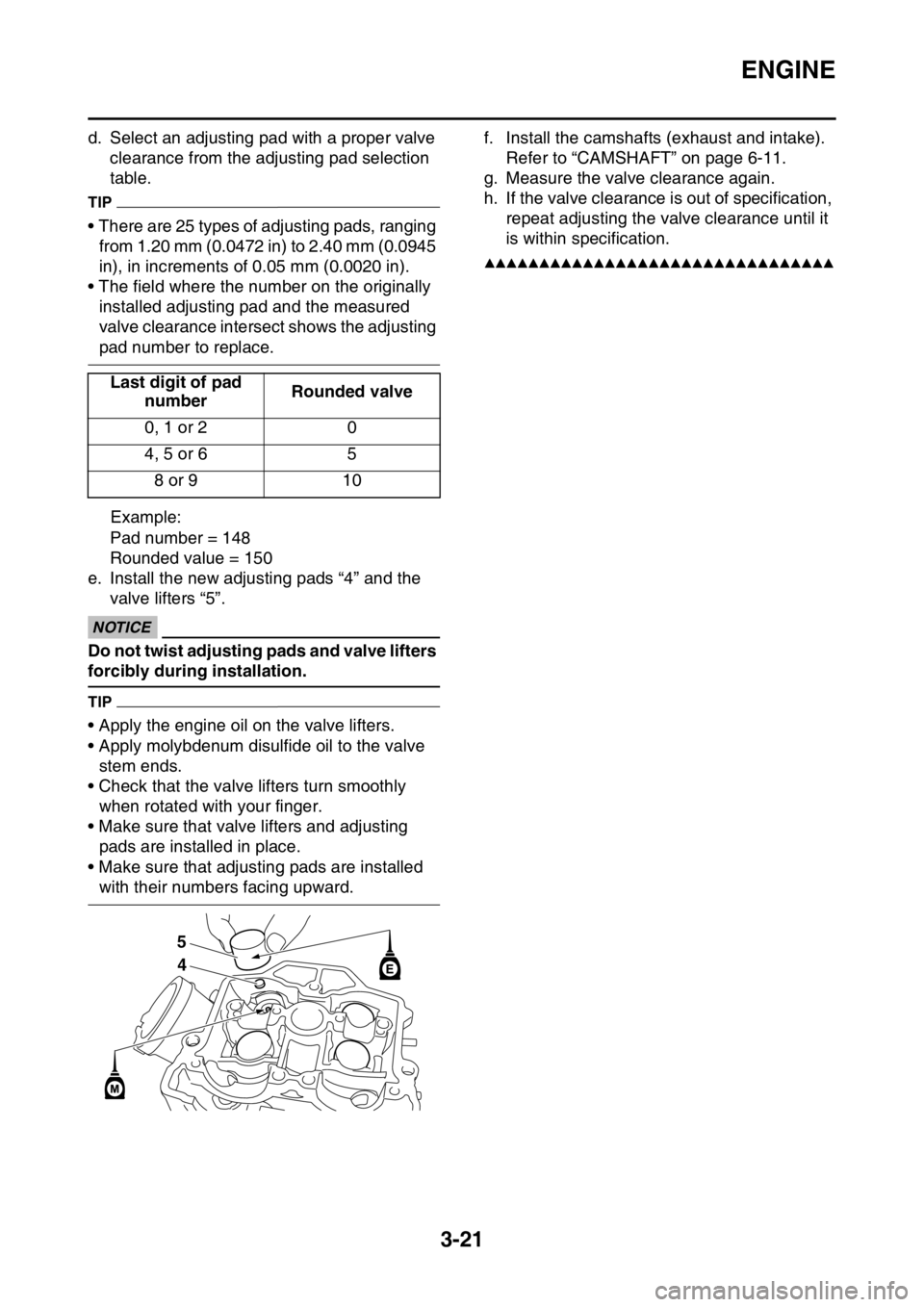
e. Install the new adjusting pads “4” and the
valve lifters “5”.
ECA
NOTICE
Do not twist adjusting pads and valve lifters
forcibly during installation.
TIP
• Apply the engine oil on the valve lifters.
• Apply molybdenum disulfide oil to the valve
stem ends.
• Check that the valve lifters turn smoothly
when rotated with your finger.
• Make sure that valve lifters and adjusting
pads are installed in place.
• Make sure that adjusting pads are installed
with their numbers facing upward.f. Install the camshafts (exhaust and intake).
Refer to “CAMSHAFT” on page 6-11.
g. Measure the valve clearance again.
h. If the valve clearance is out of specification,
repeat adjusting the valve clearance until it
is within specification.
▲▲▲▲▲▲▲▲▲▲▲▲▲▲▲▲▲▲▲▲▲▲▲▲▲▲▲▲▲▲▲▲
Last digit of pad
numberRounded valve
0, 1 or 2 0
4, 5 or 6 5
8 or 9 10
4 5