ignition YAMAHA WR 250F 2015 Owner's Manual
[x] Cancel search | Manufacturer: YAMAHA, Model Year: 2015, Model line: WR 250F, Model: YAMAHA WR 250F 2015Pages: 430, PDF Size: 14.14 MB
Page 365 of 430

FUEL INJECTION SYSTEM
9-31
ECU detects an abnormal signal from a sensor
If the ECU detects an abnormal signal from a sensor while the vehicle is being driven, the ECU illu-
minates the engine trouble warning light and provides the engine with alternate operating instructions
that are appropriate for the type of malfunction.
When an abnormal signal is received from a sensor, the ECU processes the specified values that are
programmed for each sensor in order to provide the engine with alternate operating instructions that
enable the engine to continue operating or stop operating, depending on the conditions.
EAS2GB2377TROUBLESHOOTING METHOD
The engine operation is not normal and the engine trouble warning light comes on.
1. Check:
• Fault code number
▼▼▼▼▼▼▼▼▼▼▼▼▼▼▼▼▼▼▼▼▼▼▼▼▼▼▼▼▼▼▼▼▼▼▼▼▼▼▼▼▼▼▼▼▼▼▼▼▼▼▼▼▼▼▼▼▼▼▼▼▼▼▼▼▼▼▼▼
a. Connect the Yamaha diagnostic tool. Refer to “YAMAHA DIAGNOSTIC TOOL” on page 9-32.
b. Check the fault code number displayed on the Yamaha diagnostic tool.
c. Identify the faulty system with the fault code number.
d. Identify the probable cause of the malfunction.
▲▲▲▲▲▲▲▲▲▲▲▲▲▲▲▲▲▲▲▲▲▲▲▲▲▲▲▲▲▲▲▲▲▲▲▲▲▲▲▲▲▲▲▲▲▲▲▲▲▲▲▲▲▲▲▲▲▲▲▲▲▲▲▲▲▲▲▲
2. Check and repair the probable cause of the malfunction.
3. Perform the reinstatement action for the fuel injection system. Refer to “Confirmation of service
completion” in the appropriate table in “TROUBLESHOOTING DETAILS” on page 9-35.
4. After pushing the engine stop switch, push the start switch to check whether the fault code no. is
displayed.
TIP
If another fault code number is displayed, repeat steps (1) to (4) until no fault code number is dis-
played.
5. Erase the malfunction history in the diagnostic mode. Refer to “SENSOR OPERATION TABLE”
(Diagnostic code No.62).
TIP
Turning off the meter light will not erase the malfunction history.
The engine operation is not normal, but the engine trouble warning light does not come on.
1. Check the operation of the following sensors and actuators in the diagnostic mode. Refer to
“TROUBLESHOOTING DETAILS” on page 9-35.
If a malfunction is detected in the sensors or actuators, repair or replace all faulty parts.
If no malfunction is detected in the sensors and actuators, check and repair the inner parts of the
engine.Fault code No. No fault code No.
Check and repair. Refer to “TROUBLESHOOT-
ING DETAILS” on page 9-35.
Monitor the operation of the sensors and actua-
tors in the diagnostic mode. Refer to “TROU-
BLESHOOTING DETAILS” on page 9-35 and
“LIST OF SELF-DIAGNOSTIC AND FAIL-SAFE
ACTIONS” on page 10-5.Check and repair.
01: Throttle position sensor signal (throttle angle)
30: Ignition coil
36: Injector
Page 366 of 430

FUEL INJECTION SYSTEM
9-32
EAS2GB2378YAMAHA DIAGNOSTIC TOOL
This model uses the Yamaha diagnostic tool to identify malfunctions.
For information about using the Yamaha diagnostic tool, refer to the operation manual that is included
with the tool.
FEATURES OF THE YAMAHA DIAGNOSTIC TOOL
A diagnosis can be made more quickly than traditional methods with the Yamaha diagnostic tool.
Using this software, ECU and sensor data, as well as fault diagnosis, vehicle maintenance, and any
necessary information can be recorded and displayed on your computer screen through a USB
adapter connected to the computer interface with a communication cable connected to the vehicle’s
ECU.
Data obtained in various functions can be saved as vehicle history, and can be accumulated.
FUNCTIONS OF THE YAMAHA DIAGNOSTIC TOOL
However, the diagnostic tool cannot be used to freely change the basic vehicle functions, such as
adjusting the ignition timing.
CONNECTING THE YAMAHA DIAGNOSTIC TOOL
1. Remove the coupler for connecting setting tool.Yamaha diagnostic tool
90890-03231
Yamaha diagnostic tool (US)
90890-03234
Fault diagnosis mode Fault codes recorded on the ECU are read, and the con-
tents are displayed.
Function diagnostic mode Check the operation of the output value of each sensor
and actuator.
Inspection mode Determine whether each sensor or actuator is functioning
properly.
CO adjustment mode Adjust the concentration of CO admissions during idling.
Monitoring mode Displays a graph of sensor output values for actual oper-
ating conditions.
Logging mode Records and saves the sensor output value in actual driv-
ing conditions.
View log Displays the logging data.
ECU rewrite If necessary, the ECU is rewritten using the ECU rewrite
data provided by Yamaha. Ignition timing adjustment, etc.
cannot be changed from the vehicle’s original state.
Page 379 of 430

FUEL INJECTION SYSTEM
9-45
2 Installed condition of lean an-
gle sensor.Check the installed direction
and condition of the sensor.Push the start switch.
Fault code number is not dis-
played Service is finished.
Fault code number is dis-
played Go to item 3.
3 Defective lean angle sensor. Execute the diagnostic mode.
(Code No. 08)
Replace if defective.
Refer to “CHECKING THE
LEAN ANGLE SENSOR” on
page 9-75.Push the start switch.
Fault code number is not dis-
played Service is finished.
Fault code number is dis-
played Go to item 4.
4 Malfunction in ECU. Replace the ECU.
Fault code No. 33
ItemIgnition coil: open or short circuit detected in the primary lead
of the ignition coil.
Fail-safe systemUnable to start engine
Unable to drive vehicle
Diagnostic code No.30
ActuationActuates the ignition coil five times at one-second intervals.
The engine trouble warning light and the “WARNING” on the
Yamaha diagnostic tool screen come on each time the ignition coil
is actuated.
ProcedureCheck that a spark is generated five times.
• Connect an ignition checker.
ItemProbable cause of malfunc-
tion and checkMaintenance jobConfirmation of service
completion
1 Connection of ignition coil
coupler.
Check the locking condition
of the coupler.
Disconnect the coupler and
check the pins (bent or bro-
ken terminals and locking
condition of the pins).Improperly connected
Connect the coupler securely
or repair/replace the wire har-
ness.Start the engine and let it idle
for approximately 5 seconds.
Fault code number is not dis-
played Service is finished.
Fault code number is dis-
played Go to item 2.
2 Connection of wire harness
ECU coupler.
Check the locking condition
of the coupler.
Disconnect the coupler and
check the pins (bent or bro-
ken terminals and locking
condition of the pins).Improperly connected
Connect the coupler securely
or repair/replace the wire har-
ness.Start the engine and let it idle
for approximately 5 seconds.
Fault code number is not dis-
played Service is finished.
Fault code number is dis-
played Go to item 3. Fault code No. 30
Item Latch up detected.
Page 380 of 430

FUEL INJECTION SYSTEM
9-46
3 Connection of sub wire har-
ness coupler.Check the lock-
ing condition of the
coupler.Disconnect the cou-
pler and check the pins (bent
or broken terminals and lock-
ing condition of the pins).Improperly connected
Connect the coupler secure-
lyor repair/replace the sub
wire harness.Start the engine and let it idle
for approximately 5 seconds.
Fault code number is not dis-
played Service is finished.
Fault code number is dis-
played Go to item 4.
4 Wire harness continuity. Open or short circuit Re-
place the wire harness.
Between ignition coil coupler
and ECU coupler.
orange–orangeStart the engine and let it idle
for approximately 5 seconds.
Fault code number is not dis-
played Service is finished.
Fault code number is dis-
played Go to item 5.
5 Installed condition of ignition
coil.
Check for looseness or
pinching.Improperly installed sensor
Reinstall or replace the
sensor.Start the engine and let it idle
for approximately 5 seconds.
Fault code number is not dis-
played Service is finished.
Fault code number is dis-
played Go to item 6.
6 Defective ignition coil. (test
the primary coils for continu-
ity)Check the ignition coil.
Replace if defective.
Refer to “CHECKING THE
IGNITION COIL” on page 9-
74.Start the engine and let it idle
for approximately 5 seconds.
Fault code number is not dis-
played Service is finished.
Fault code number is dis-
played Go to item 7.
7 Malfunction in ECU. Execute the diagnostic mode
(diagnostic code No. 30).
No spark Replace the
ECU. Fault code No. 33
ItemIgnition coil: open or short circuit detected in the primary lead
of the ignition coil.
Page 384 of 430

FUEL INJECTION SYSTEM
9-50
TIP
Before troubleshooting, disconnect the starter motor lead from the starter relay.
Fault code No. 44
ItemEEPROM fault code number: an error is detected while read-
ing or writing on EEPROM.
Fail-safe systemAble/Unable to start engine
Able/Unable to drive vehicle
Diagnostic code No.60
Diagnostic tool displayEEPROM fault code display
• 00: No fault
• 01: CO adjustment value
• 07: Setting tool adjustment values 0–8 for fuel injection amount or
ignition timing
Procedure—
ItemProbable cause of malfunc-
tion and checkMaintenance jobConfirmation of service
completion
1 Locate the malfunction Execute the diagnostic mode
(Code No. 60).
00: Go to item 4.
01: Go to item 2.
07: Go to item 3.—
2 “01” is indicated in Diagnostic
mode (Code No. 60) EEP-
ROM data error for adjust-
ment of CO concentrationChange the CO concentra-
tion, and rewrite in EEPROM.
After this adjustment, push
the engine stop switch, then
push the start switch.
Memory not recovered Re-
place the ECU.Push the start switch.
Fault code number is not dis-
played Service is finished.
Fault code number is dis-
played Repeat the proce-
dure in item 1. If the same
number is indicated, perform
the procedure in item 4.
3 “07” is indicated in Diagnostic
mode (Code No. 60) EEP-
ROM data error for setting
tool adjustment values for
fuel injection amount or igni-
tion timing.Erase the setting map in the
diagnostic mode (diagnostic
code No. 65).Push the start switch.
Fault code number is not dis-
played Service is finished.
Fault code number is dis-
played Repeat the proce-
dure in item 1. If the same
number is indicated, perform
the procedure in item 4.
4 Malfunction in ECU. Replace the ECU.
Page 395 of 430

ELECTRICAL COMPONENTS
9-61
1. Rectifier/regulator
2. Clutch switch
3. Ignition coil
4. ECU (engine control unit)
5. Fuel sender
6. Fuel pump
7. Battery
8. Resistor
9. Neutral switch
10.Radiator fan motor
11.Injector
Page 402 of 430
ELECTRICAL COMPONENTS
9-68
Checking the condition of the bulb sockets
The following procedure applies to all of the
bulb sockets.
1. Check:
• Bulb socket (for continuity)
(with the pocket tester)
No continuity Replace.
TIP
Check each bulb socket for continuity in the
same manner as described in the bulb section;
however, note the following.
▼▼▼▼▼▼▼▼▼▼▼▼▼▼▼▼▼▼▼▼▼▼▼▼▼▼▼▼▼▼▼▼
a. Install a good bulb into the bulb socket.
b. Connect the pocket tester probes to the re-
spective leads of the bulb socket.
c. Check the bulb socket for continuity. If any of
the readings indicate no continuity, replace
the bulb socket.
▲▲▲▲▲▲▲▲▲▲▲▲▲▲▲▲▲▲▲▲▲▲▲▲▲▲▲▲▲▲▲▲
EAS2GB2386CHECKING THE FUSES
The following procedure applies to all of the
fuses.
ECA
NOTICE
To avoid a short circuit, always turn off the
meter when checking or replacing a fuse.
1. Remove:
• Side cover (left/right)
• Seat
Refer to “GENERAL CHASSIS” on page 5-
1.
2. Check:
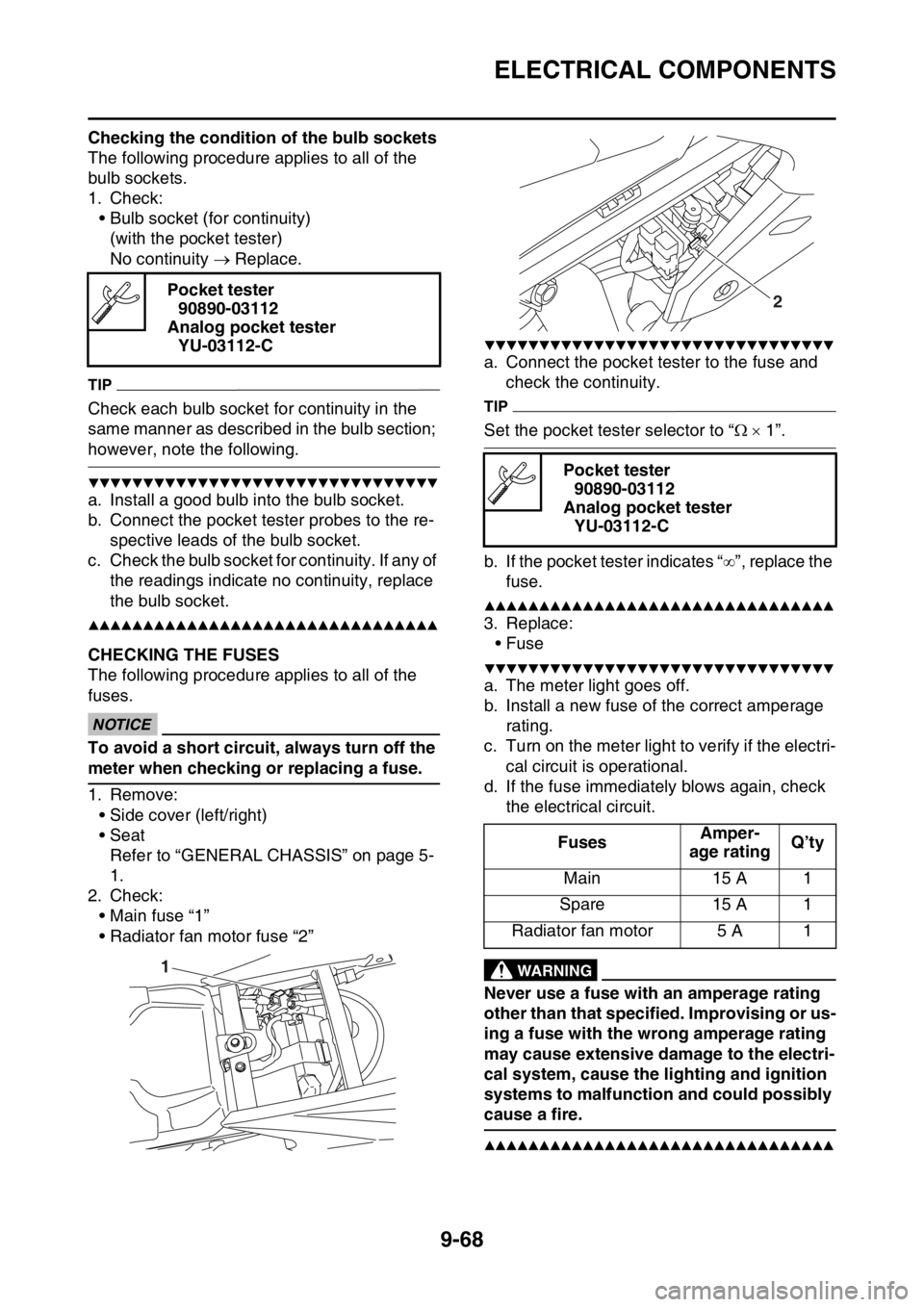
• Main fuse “1”
• Radiator fan motor fuse “2”
▼▼▼▼▼▼▼▼▼▼▼▼▼▼▼▼▼▼▼▼▼▼▼▼▼▼▼▼▼▼▼▼
a. Connect the pocket tester to the fuse and
check the continuity.
TIP
Set the pocket tester selector to “ 1”.
b. If the pocket tester indicates “”, replace the
fuse.
▲▲▲▲▲▲▲▲▲▲▲▲▲▲▲▲▲▲▲▲▲▲▲▲▲▲▲▲▲▲▲▲
3. Replace:
• Fuse
▼▼▼▼▼▼▼▼▼▼▼▼▼▼▼▼▼▼▼▼▼▼▼▼▼▼▼▼▼▼▼▼
a. The meter light goes off.
b. Install a new fuse of the correct amperage
rating.
c. Turn on the meter light to verify if the electri-
cal circuit is operational.
d. If the fuse immediately blows again, check
the electrical circuit.
EWA
WARNING
Never use a fuse with an amperage rating
other than that specified. Improvising or us-
ing a fuse with the wrong amperage rating
may cause extensive damage to the electri-
cal system, cause the lighting and ignition
systems to malfunction and could possibly
cause a fire.
▲▲▲▲▲▲▲▲▲▲▲▲▲▲▲▲▲▲▲▲▲▲▲▲▲▲▲▲▲▲▲▲
Pocket tester
90890-03112
Analog pocket tester
YU-03112-C
1
Pocket tester
90890-03112
Analog pocket tester
YU-03112-C
FusesAmper-
age ratingQ’ty
Main 15 A 1
Spare 15 A 1
Radiator fan motor 5 A 1
2
Page 407 of 430
ELECTRICAL COMPONENTS
9-73
EAS2GB2389CHECKING THE DIODE
1. Check:
•Diode
Out of specification Replace.
TIP
The pocket tester and the analog pocket tester
readings are shown in the following table.
▼▼▼▼▼▼▼▼▼▼▼▼▼▼▼▼▼▼▼▼▼▼▼▼▼▼▼▼▼▼▼▼
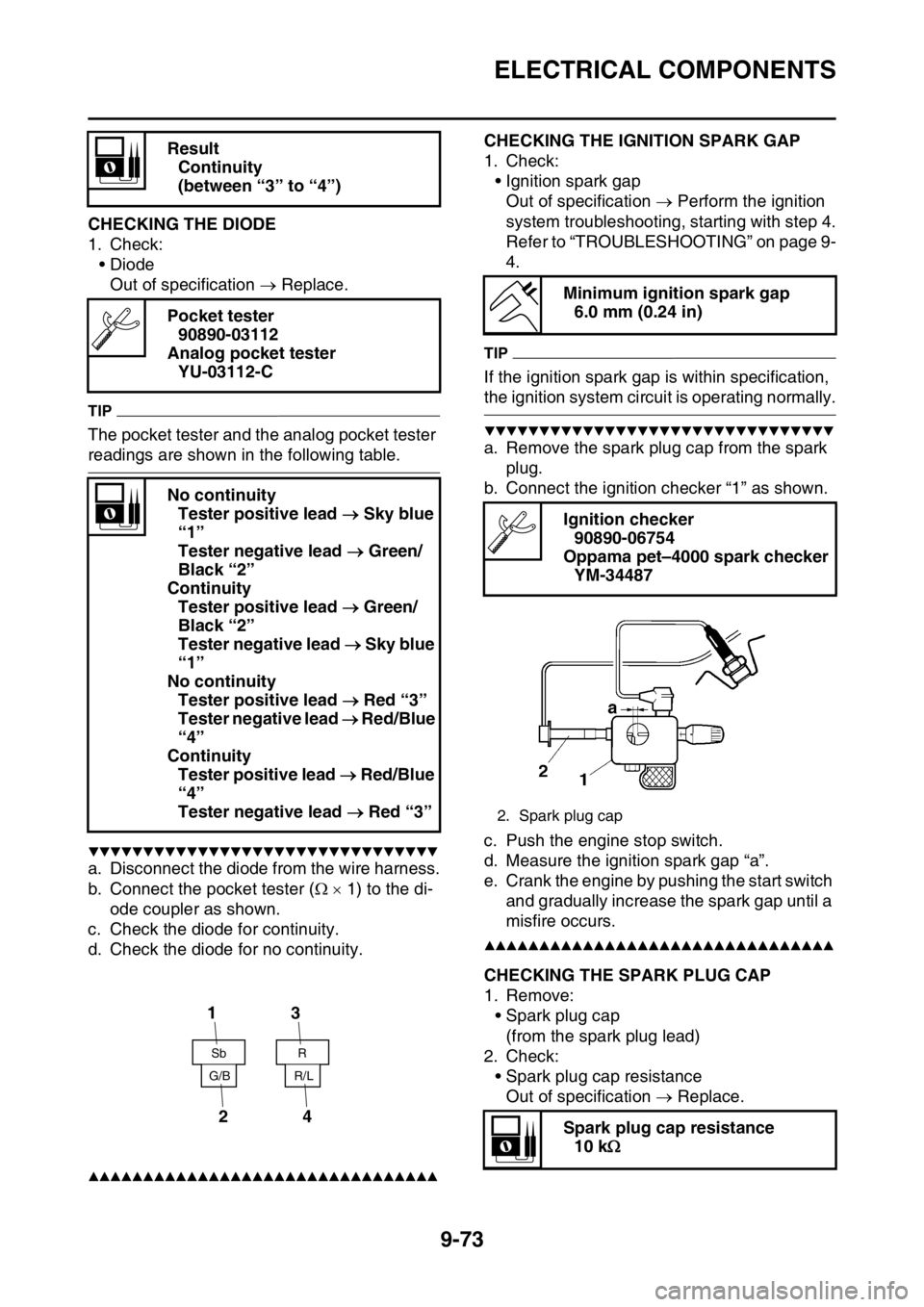
a. Disconnect the diode from the wire harness.
b. Connect the pocket tester ( 1) to the di-
ode coupler as shown.
c. Check the diode for continuity.
d. Check the diode for no continuity.
▲▲▲▲▲▲▲▲▲▲▲▲▲▲▲▲▲▲▲▲▲▲▲▲▲▲▲▲▲▲▲▲
EAS2GB2390CHECKING THE IGNITION SPARK GAP
1. Check:
• Ignition spark gap
Out of specification Perform the ignition
system troubleshooting, starting with step 4.
Refer to “TROUBLESHOOTING” on page 9-
4.
TIP
If the ignition spark gap is within specification,
the ignition system circuit is operating normally.
▼▼▼▼▼▼▼▼▼▼▼▼▼▼▼▼▼▼▼▼▼▼▼▼▼▼▼▼▼▼▼▼
a. Remove the spark plug cap from the spark
plug.
b. Connect the ignition checker “1” as shown.
c. Push the engine stop switch.
d. Measure the ignition spark gap “a”.
e. Crank the engine by pushing the start switch
and gradually increase the spark gap until a
misfire occurs.
▲▲▲▲▲▲▲▲▲▲▲▲▲▲▲▲▲▲▲▲▲▲▲▲▲▲▲▲▲▲▲▲
EAS2GB2391CHECKING THE SPARK PLUG CAP
1. Remove:
• Spark plug cap
(from the spark plug lead)
2. Check:
• Spark plug cap resistance
Out of specification Replace. Result
Continuity
(between “3” to “4”)
Pocket tester
90890-03112
Analog pocket tester
YU-03112-C
No continuity
Tester positive lead Sky blue
“1”
Tester negative lead Green/
Black “2”
Continuity
Tester positive lead Green/
Black “2”
Tester negative lead Sky blue
“1”
No continuity
Tester positive lead Red “3”
Tester negative lead Red/Blue
“4”
Continuity
Tester positive lead Red/Blue
“4”
Tester negative lead Red “3”
2
1
4
3
R Sb
G/B R/L
Minimum ignition spark gap
6.0 mm (0.24 in)
Ignition checker
90890-06754
Oppama pet–4000 spark checker
YM-34487
2. Spark plug cap
Spark plug cap resistance
10 k
Page 408 of 430
ELECTRICAL COMPONENTS
9-74
▼▼▼▼▼▼▼▼▼▼▼▼▼▼▼▼▼▼▼▼▼▼▼▼▼▼▼▼▼▼▼▼
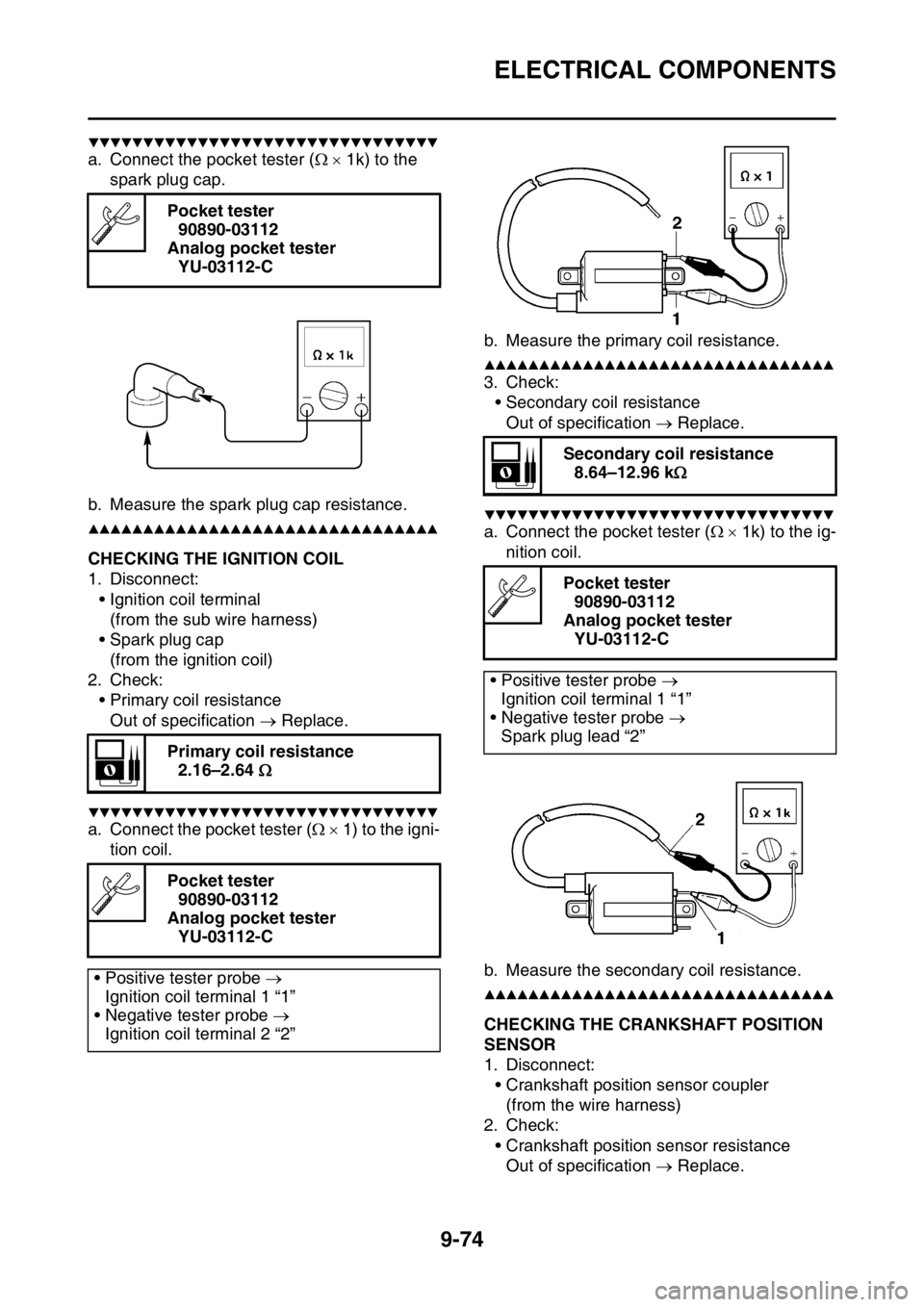
a. Connect the pocket tester ( 1k) to the
spark plug cap.
b. Measure the spark plug cap resistance.
▲▲▲▲▲▲▲▲▲▲▲▲▲▲▲▲▲▲▲▲▲▲▲▲▲▲▲▲▲▲▲▲
EAS2GB2392CHECKING THE IGNITION COIL
1. Disconnect:
• Ignition coil terminal
(from the sub wire harness)
• Spark plug cap
(from the ignition coil)
2. Check:
• Primary coil resistance
Out of specification Replace.
▼▼▼▼▼▼▼▼▼▼▼▼▼▼▼▼▼▼▼▼▼▼▼▼▼▼▼▼▼▼▼▼
a. Connect the pocket tester ( 1) to the igni-
tion coil.b. Measure the primary coil resistance.
▲▲▲▲▲▲▲▲▲▲▲▲▲▲▲▲▲▲▲▲▲▲▲▲▲▲▲▲▲▲▲▲
3. Check:
• Secondary coil resistance
Out of specification Replace.
▼▼▼▼▼▼▼▼▼▼▼▼▼▼▼▼▼▼▼▼▼▼▼▼▼▼▼▼▼▼▼▼
a. Connect the pocket tester ( 1k) to the ig-
nition coil.
b. Measure the secondary coil resistance.
▲▲▲▲▲▲▲▲▲▲▲▲▲▲▲▲▲▲▲▲▲▲▲▲▲▲▲▲▲▲▲▲
EAS2GB2393CHECKING THE CRANKSHAFT POSITION
SENSOR
1. Disconnect:
• Crankshaft position sensor coupler
(from the wire harness)
2. Check:
• Crankshaft position sensor resistance
Out of specification Replace. Pocket tester
90890-03112
Analog pocket tester
YU-03112-C
Primary coil resistance
2.16–2.64
Pocket tester
90890-03112
Analog pocket tester
YU-03112-C
• Positive tester probe
Ignition coil terminal 1 “1”
• Negative tester probe
Ignition coil terminal 2 “2”
Secondary coil resistance
8.64–12.96 k
Pocket tester
90890-03112
Analog pocket tester
YU-03112-C
• Positive tester probe
Ignition coil terminal 1 “1”
• Negative tester probe
Spark plug lead “2”
Page 410 of 430
ELECTRICAL COMPONENTS
9-76
b. Check the starter motor operation.
▲▲▲▲▲▲▲▲▲▲▲▲▲▲▲▲▲▲▲▲▲▲▲▲▲▲▲▲▲▲▲▲
EAS28150CHECKING THE STATOR COIL
1. Disconnect:
• Stator coil coupler
(from the wire harness)
2. Check:
• Stator coil resistance
Out of specification Replace the stator
coil.
▼▼▼▼▼▼▼▼▼▼▼▼▼▼▼▼▼▼▼▼▼▼▼▼▼▼▼▼▼▼▼▼
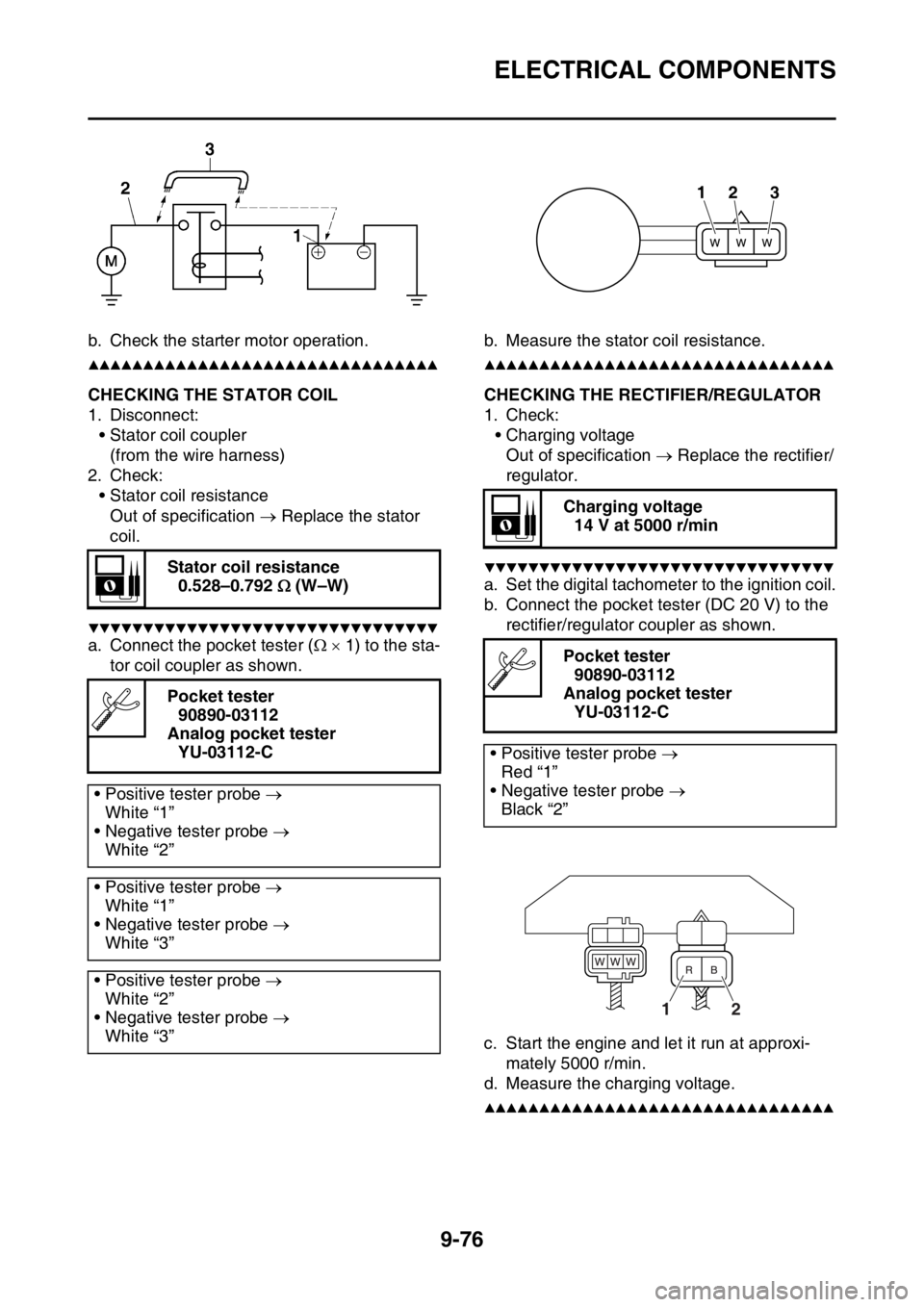
a. Connect the pocket tester ( 1) to the sta-
tor coil coupler as shown.b. Measure the stator coil resistance.
▲▲▲▲▲▲▲▲▲▲▲▲▲▲▲▲▲▲▲▲▲▲▲▲▲▲▲▲▲▲▲▲
EAS2GB2396CHECKING THE RECTIFIER/REGULATOR
1. Check:
• Charging voltage
Out of specification Replace the rectifier/
regulator.
▼▼▼▼▼▼▼▼▼▼▼▼▼▼▼▼▼▼▼▼▼▼▼▼▼▼▼▼▼▼▼▼
a. Set the digital tachometer to the ignition coil.
b. Connect the pocket tester (DC 20 V) to the
rectifier/regulator coupler as shown.
c. Start the engine and let it run at approxi-
mately 5000 r/min.
d. Measure the charging voltage.
▲▲▲▲▲▲▲▲▲▲▲▲▲▲▲▲▲▲▲▲▲▲▲▲▲▲▲▲▲▲▲▲
Stator coil resistance
0.528–0.792 (W–W)
Pocket tester
90890-03112
Analog pocket tester
YU-03112-C
• Positive tester probe
White “1”
• Negative tester probe
White “2”
• Positive tester probe
White “1”
• Negative tester probe
White “3”
• Positive tester probe
White “2”
• Negative tester probe
White “3”
Charging voltage
14 V at 5000 r/min
Pocket tester
90890-03112
Analog pocket tester
YU-03112-C
• Positive tester probe
Red “1”
• Negative tester probe
Black “2”
123
12