warning YAMAHA WR 250F 2015 Owner's Guide
[x] Cancel search | Manufacturer: YAMAHA, Model Year: 2015, Model line: WR 250F, Model: YAMAHA WR 250F 2015Pages: 430, PDF Size: 14.14 MB
Page 149 of 430
CHASSIS
4-2
• Under a stony or a hard road condition, the
tire pressure should be higher to prevent a flat
tire.
EAS2GB2142FRONT FORK SETTING
The front fork setting should be made depend-
ing on the rider’s feeling of an actual run and
the circuit conditions.
The front fork setting includes the following
three factors:
1. Setting of air spring characteristics
• Change the fork oil amount.
2. Setting of spring preload
• Change the spring.
3. Setting of damping force
• Change the compression damping force.
• Change the rebound damping force.
The spring acts on the load and the damping
force acts on the cushion travel speed.
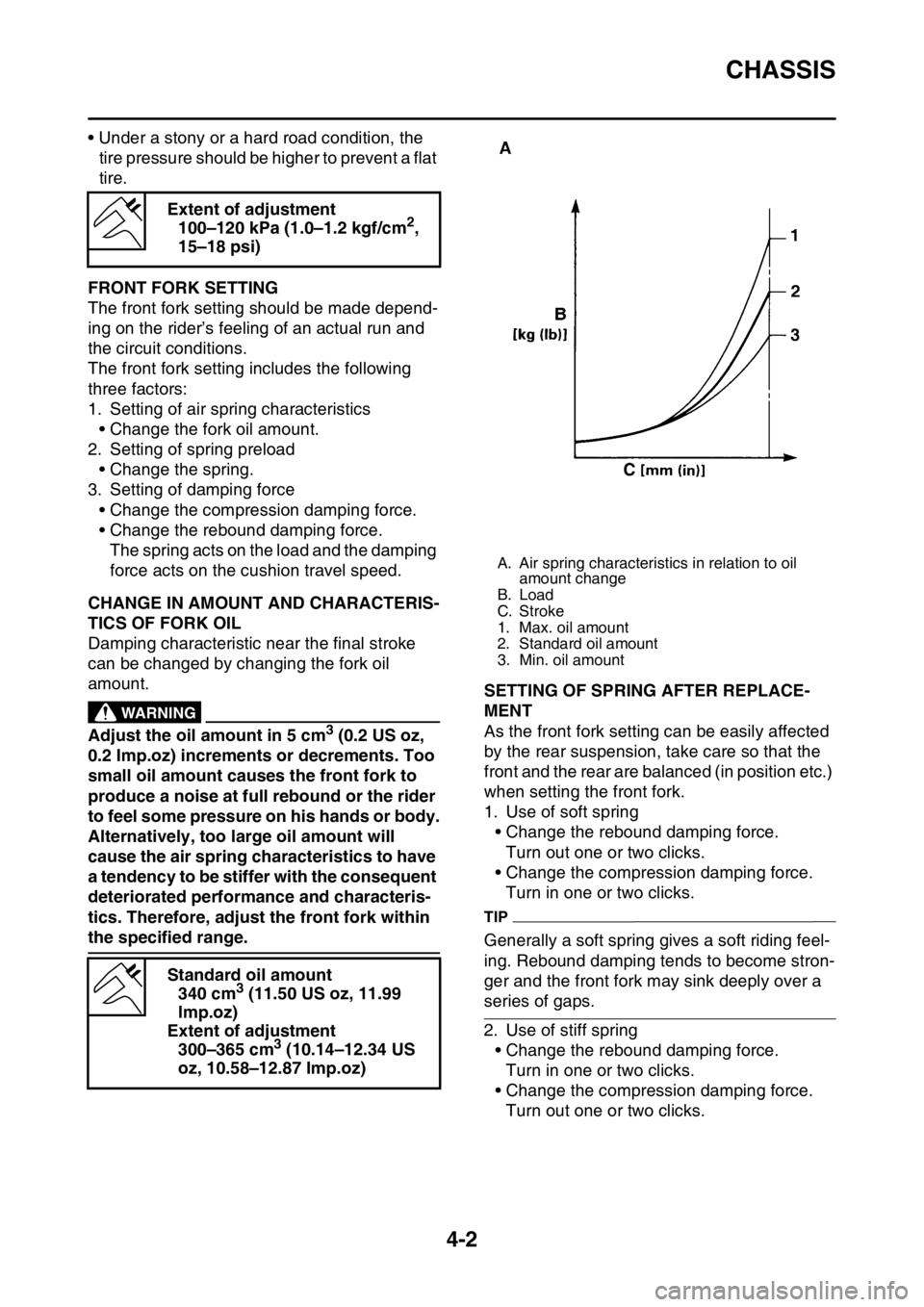
EAS2GB2143CHANGE IN AMOUNT AND CHARACTERIS-
TICS OF FORK OIL
Damping characteristic near the final stroke
can be changed by changing the fork oil
amount.
EWA
WARNING
Adjust the oil amount in 5 cm3 (0.2 US oz,
0.2 Imp.oz) increments or decrements. Too
small oil amount causes the front fork to
produce a noise at full rebound or the rider
to feel some pressure on his hands or body.
Alternatively, too large oil amount will
cause the air spring characteristics to have
a tendency to be stiffer with the consequent
deteriorated performance and characteris-
tics. Therefore, adjust the front fork within
the specified range.
EAS2GB2144SETTING OF SPRING AFTER REPLACE-
MENT
As the front fork setting can be easily affected
by the rear suspension, take care so that the
front and the rear are balanced (in position etc.)
when setting the front fork.
1. Use of soft spring
• Change the rebound damping force.
Turn out one or two clicks.
• Change the compression damping force.
Turn in one or two clicks.
TIP
Generally a soft spring gives a soft riding feel-
ing. Rebound damping tends to become stron-
ger and the front fork may sink deeply over a
series of gaps.
2. Use of stiff spring
• Change the rebound damping force.
Turn in one or two clicks.
• Change the compression damping force.
Turn out one or two clicks. Extent of adjustment
100–120 kPa (1.0–1.2 kgf/cm
2,
15–18 psi)
Standard oil amount
340 cm
3 (11.50 US oz, 11.99
lmp.oz)
Extent of adjustment
300–365 cm
3 (10.14–12.34 US
oz, 10.58–12.87 Imp.oz)
A. Air spring characteristics in relation to oil
amount change
B. Load
C. Stroke
1. Max. oil amount
2. Standard oil amount
3. Min. oil amount
Page 151 of 430
CHASSIS
4-4
TIP
• If the machine is new and after it is broken in,
the same set length of the spring may change
because of the initial fatigue, etc. of the
spring. Therefore, be sure to make reevalua-
tion.
• If the standard figure cannot be achieved by
adjusting the adjuster and changing the set
length, replace the spring with an optional one
and make readjustment.
EAS2GB2148SETTING OF SPRING AFTER REPLACE-
MENT
After replacement, be sure to adjust the spring
to the set length [sunken length 90–100 mm
(3.5–3.9 in)] and set it.
1. Use of soft spring
• Adjust to decrease rebound damping force
to compensate for less spring load. Run with
the rebound damping force adjuster one or
two clicks turned out, and readjust it to suit
your preference.
2. Use of stiff spring
• Adjust to increase rebound damping force to
compensate for greater spring load. Run
with the rebound damping force adjuster
one or two clicks turned in, and readjust it to
suit your preference.
TIP
Adjusting the rebound damping force will be fol-
lowed more or less by a change in the com-
pression damping force. For correction, adjust
to decrease compression damping force.
EWA
WARNING
When using a rear shock absorber other
than currently installed, use the one whose
overall length “a” does not exceed the stan-
dard as it may result in faulty performance.
Never use one whose overall length is
greater than standard.
EAS2GB2149REAR SHOCK ABSORBER SETTING
PARTS
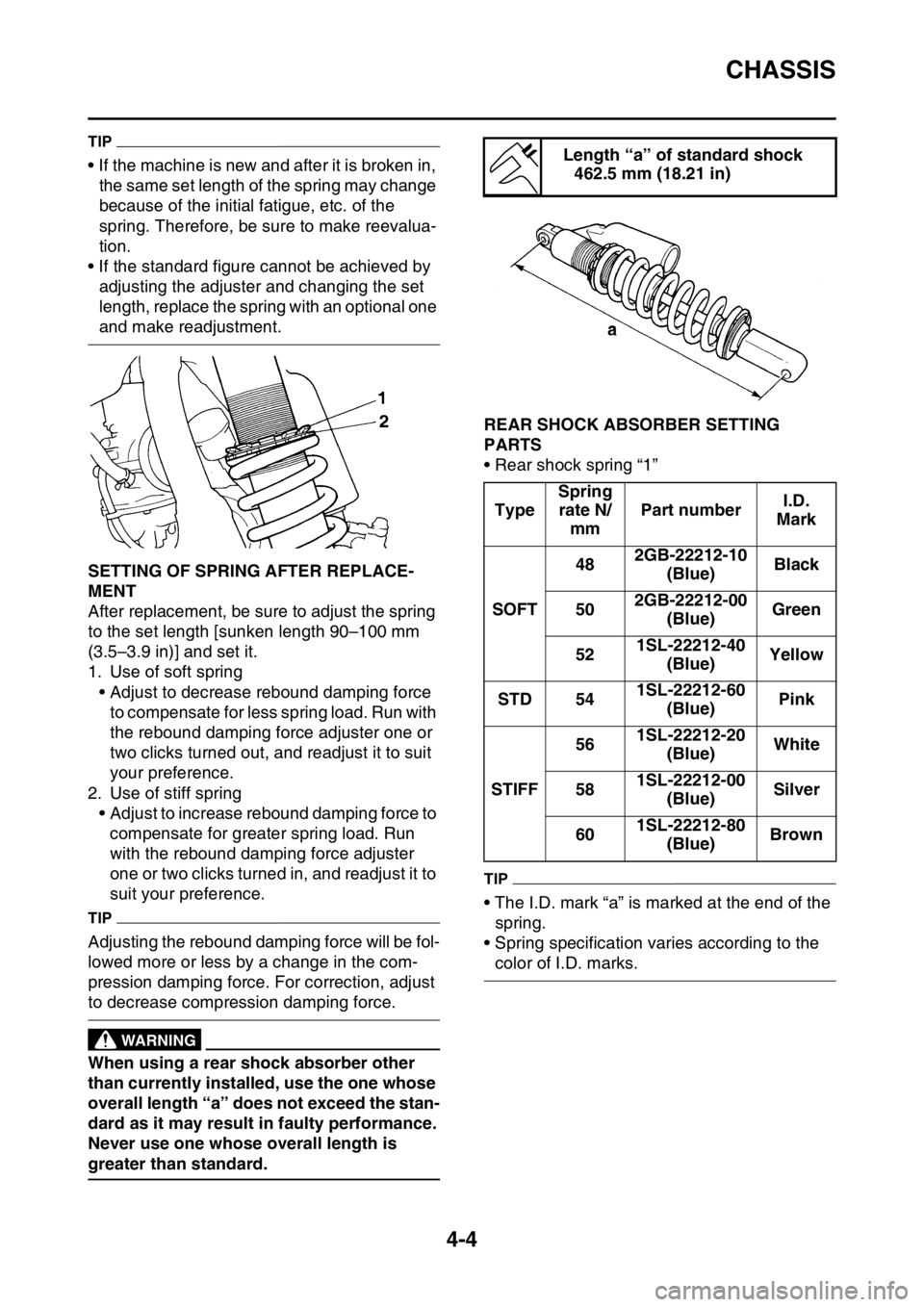
• Rear shock spring “1”
TIP
• The I.D. mark “a” is marked at the end of the
spring.
• Spring specification varies according to the
color of I.D. marks.
Length “a” of standard shock
462.5 mm (18.21 in)
TypeSpring
rate N/
mmPart numberI.D.
Mark
SOFT482GB-22212-10
(Blue)Black
502GB-22212-00
(Blue)Green
521SL-22212-40
(Blue)Yellow
STD 541SL-22212-60
(Blue)Pink
STIFF561SL-22212-20
(Blue)White
581SL-22212-00
(Blue)Silver
601SL-22212-80
(Blue)Brown
Page 163 of 430
FRONT WHEEL
5-5
EAS2GB2157REMOVING THE FRONT WHEEL
1. Use a suitable stand to raise the front wheel
off the ground.
EWA
WARNING
Securely support the vehicle so that there is
no danger of it falling over.
2. Remove:
• Front wheel
EAS2GB2158CHECKING THE FRONT WHEEL
1. Check:
• Front wheel axle
Roll the front wheel axle on a flat surface.
Bends Replace.
EWA
WARNING
Do not attempt to straighten a bent wheel
axle.
2. Check:
•Tire(s)
• Front wheel
Damage/wear Replace.
Refer to “CHECKING THE TIRES” on page
3-35 and “CHECKING THE WHEELS” on
page 3-36.
3. Check:
• Spokes
Bend/damage Replace.
Loose Tighten.
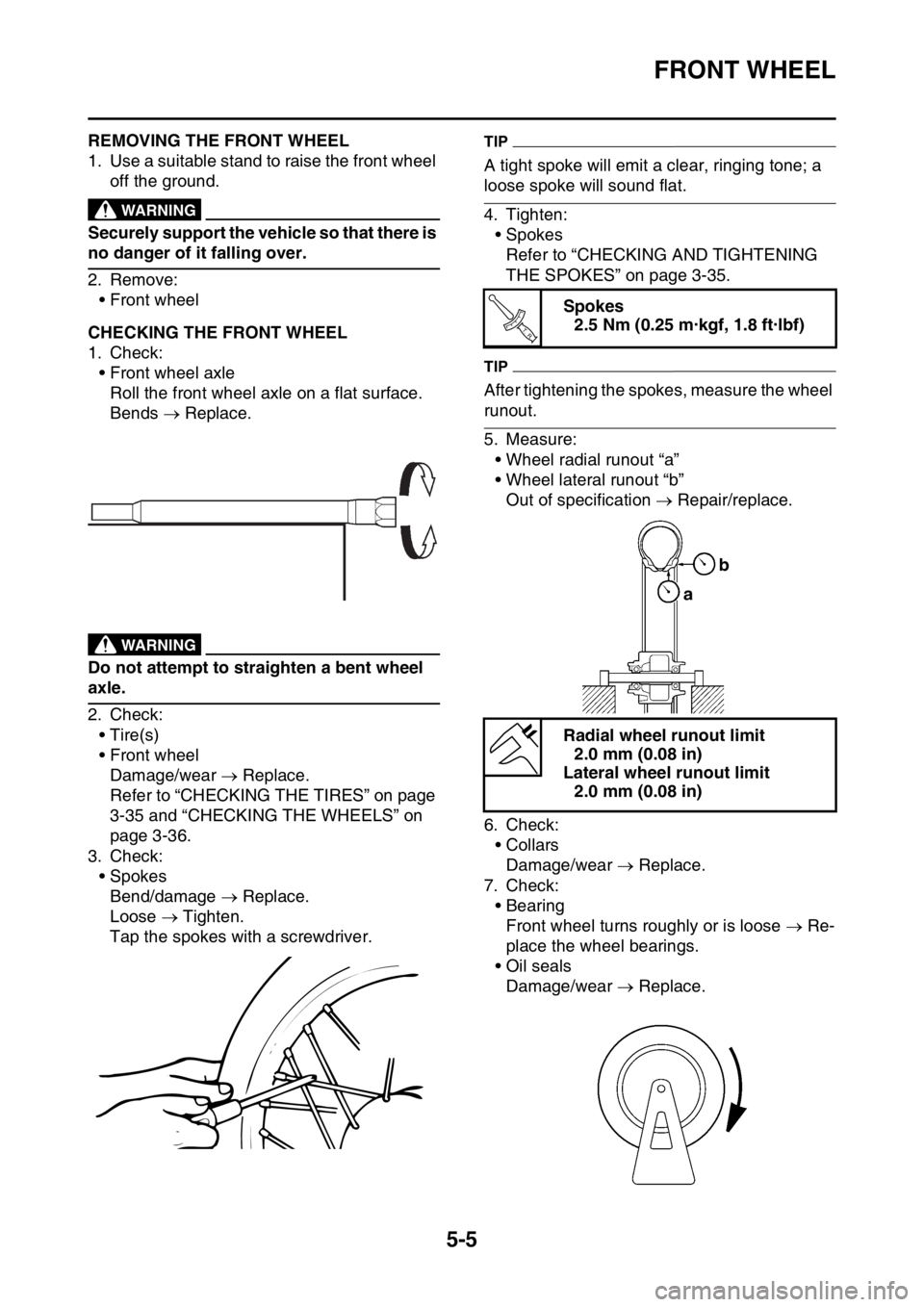
Tap the spokes with a screwdriver.
TIP
A tight spoke will emit a clear, ringing tone; a
loose spoke will sound flat.
4. Tighten:
• Spokes
Refer to “CHECKING AND TIGHTENING
THE SPOKES” on page 3-35.
TIP
After tightening the spokes, measure the wheel
runout.
5. Measure:
• Wheel radial runout “a”
• Wheel lateral runout “b”
Out of specification Repair/replace.
6. Check:
•Collars
Damage/wear Replace.
7. Check:
• Bearing
Front wheel turns roughly or is loose Re-
place the wheel bearings.
• Oil seals
Damage/wear Replace.
Spokes
2.5 Nm (0.25 m·kgf, 1.8 ft·lbf)
Radial wheel runout limit
2.0 mm (0.08 in)
Lateral wheel runout limit
2.0 mm (0.08 in)
T R..
ab
Page 168 of 430
REAR WHEEL
5-10
EAS2GB2163REMOVING THE REAR WHEEL
1. Use a suitable stand to raise the rear wheel
off the ground.
EWA
WARNING
Securely support the vehicle so that there is
no danger of it falling over.
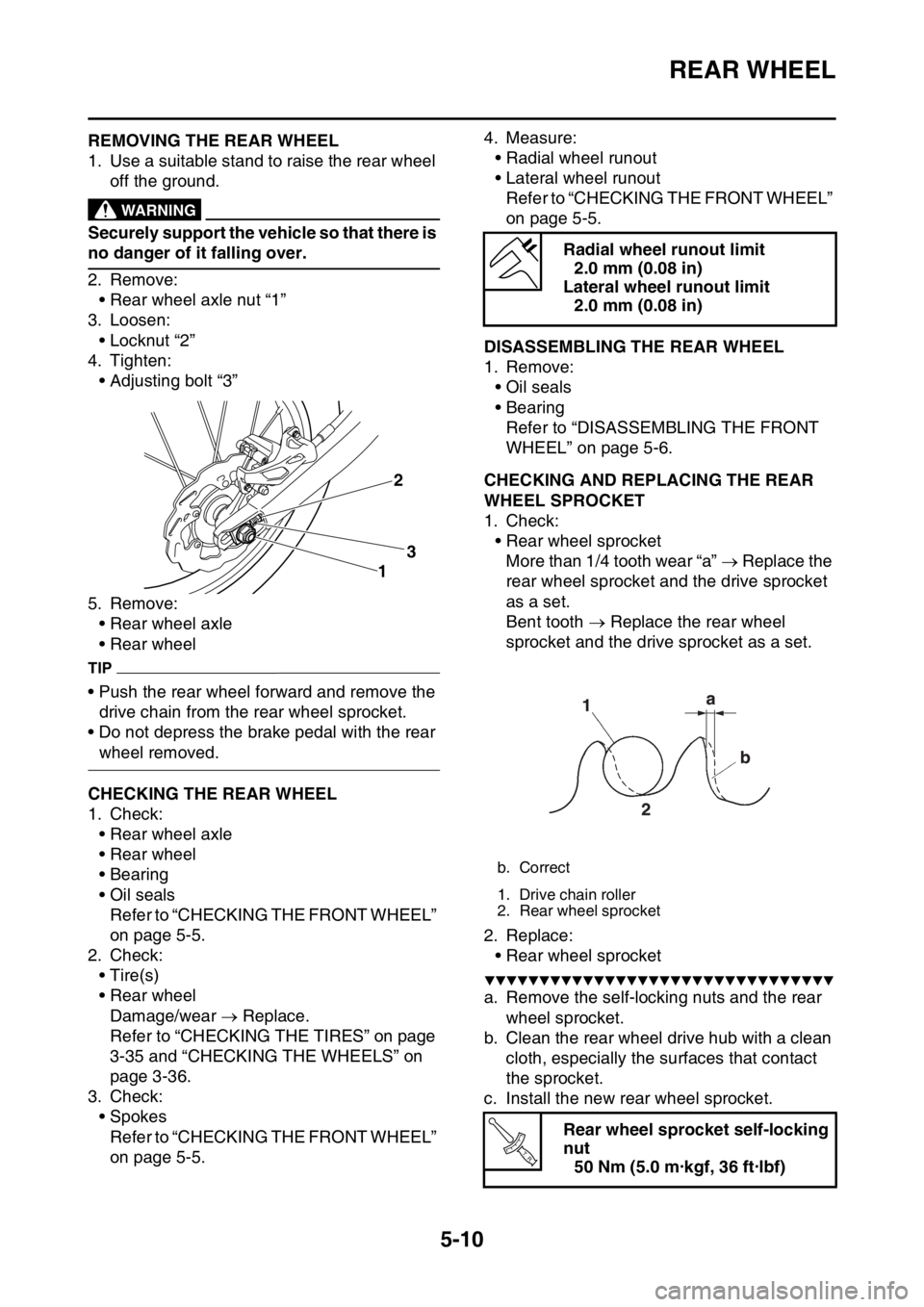
2. Remove:
• Rear wheel axle nut “1”
3. Loosen:
• Locknut “2”
4. Tighten:
• Adjusting bolt “3”
5. Remove:
• Rear wheel axle
• Rear wheel
TIP
• Push the rear wheel forward and remove the
drive chain from the rear wheel sprocket.
• Do not depress the brake pedal with the rear
wheel removed.
EAS2GB2164CHECKING THE REAR WHEEL
1. Check:
• Rear wheel axle
• Rear wheel
• Bearing
• Oil seals
Refer to “CHECKING THE FRONT WHEEL”
on page 5-5.
2. Check:
•Tire(s)
• Rear wheel
Damage/wear Replace.
Refer to “CHECKING THE TIRES” on page
3-35 and “CHECKING THE WHEELS” on
page 3-36.
3. Check:
• Spokes
Refer to “CHECKING THE FRONT WHEEL”
on page 5-5.4. Measure:
• Radial wheel runout
• Lateral wheel runout
Refer to “CHECKING THE FRONT WHEEL”
on page 5-5.
EAS2GB2165DISASSEMBLING THE REAR WHEEL
1. Remove:
• Oil seals
• Bearing
Refer to “DISASSEMBLING THE FRONT
WHEEL” on page 5-6.
EAS2GB2166CHECKING AND REPLACING THE REAR
WHEEL SPROCKET
1. Check:
• Rear wheel sprocket
More than 1/4 tooth wear “a” Replace the
rear wheel sprocket and the drive sprocket
as a set.
Bent tooth Replace the rear wheel
sprocket and the drive sprocket as a set.
2. Replace:
• Rear wheel sprocket
▼▼▼▼▼▼▼▼▼▼▼▼▼▼▼▼▼▼▼▼▼▼▼▼▼▼▼▼▼▼▼▼
a. Remove the self-locking nuts and the rear
wheel sprocket.
b. Clean the rear wheel drive hub with a clean
cloth, especially the surfaces that contact
the sprocket.
c. Install the new rear wheel sprocket.
3
12
Radial wheel runout limit
2.0 mm (0.08 in)
Lateral wheel runout limit
2.0 mm (0.08 in)
b. Correct
1. Drive chain roller
2. Rear wheel sprocket
Rear wheel sprocket self-locking
nut
50 Nm (5.0 m·kgf, 36 ft·lbf)
T R..
Page 175 of 430
FRONT BRAKE
5-17
EAS2GB2170INTRODUCTIONEWA
WARNING
If you need to disassemble the disc brake
components, observe the following precau-
tions.
• Never disassemble the brake components
unless absolutely necessary.
• If there is any problem with connections
on the hydraulic brake system, perform
the following jobs.
Disassemble the brake system, drain the
brake fluid, and clean it. After that, add a
suitable amount of brake fluid. Then, bleed
it after reassembly.
• Use only brake fluid for washing brake
components.
• Use new brake fluid for cleaning the brake
components.
• Immediately wipe off the spilled brake fluid
to avoid damage to painted surfaces or
plastic parts.
• Handle brake fluid with special care not to
let it enter your eyes so that you may not
lost your eyesight.
• FIRST AID FOR BRAKE FLUID ENTERING
THE EYES:
• Flush with water for 15 minutes and get
immediate medical attention.
EAS2GB2171CHECKING THE FRONT BRAKE DISC
1. Remove:
• Front wheel
Refer to “FRONT WHEEL” on page 5-4.
2. Check:
• Front brake disc
Damage/galling Replace.
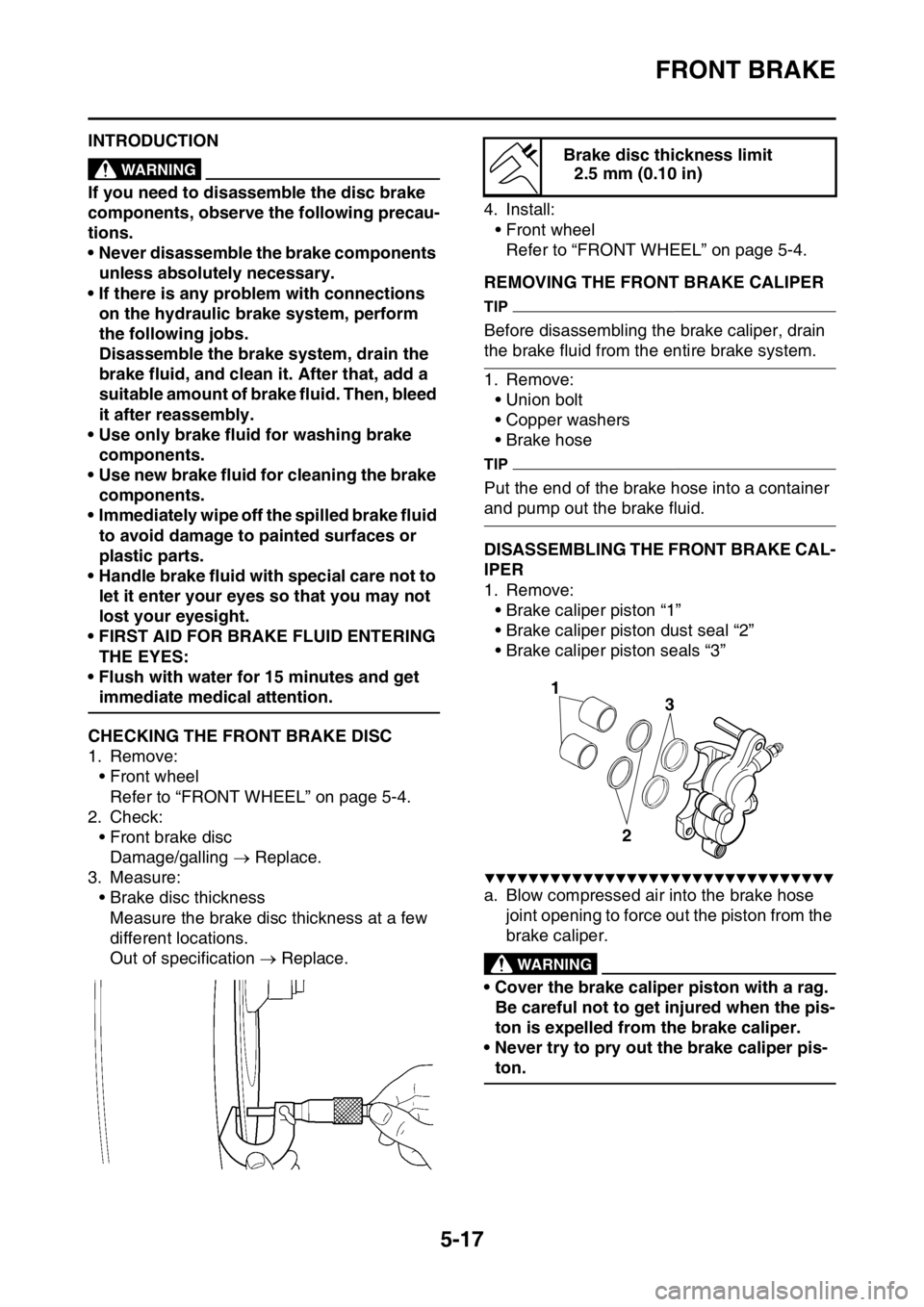
3. Measure:
• Brake disc thickness
Measure the brake disc thickness at a few
different locations.
Out of specification Replace.4. Install:
• Front wheel
Refer to “FRONT WHEEL” on page 5-4.
EAS2GB2172REMOVING THE FRONT BRAKE CALIPER
TIP
Before disassembling the brake caliper, drain
the brake fluid from the entire brake system.
1. Remove:
• Union bolt
• Copper washers
• Brake hose
TIP
Put the end of the brake hose into a container
and pump out the brake fluid.
EAS2GB2173DISASSEMBLING THE FRONT BRAKE CAL-
IPER
1. Remove:
• Brake caliper piston “1”
• Brake caliper piston dust seal “2”
• Brake caliper piston seals “3”
▼▼▼▼▼▼▼▼▼▼▼▼▼▼▼▼▼▼▼▼▼▼▼▼▼▼▼▼▼▼▼▼
a. Blow compressed air into the brake hose
joint opening to force out the piston from the
brake caliper.
EWA
WARNING
• Cover the brake caliper piston with a rag.
Be careful not to get injured when the pis-
ton is expelled from the brake caliper.
• Never try to pry out the brake caliper pis-
ton.
Brake disc thickness limit
2.5 mm (0.10 in)
3
2
1
Page 176 of 430
FRONT BRAKE
5-18
b. Remove the brake caliper piston dust seal
and the brake caliper piston seal.
▲▲▲▲▲▲▲▲▲▲▲▲▲▲▲▲▲▲▲▲▲▲▲▲▲▲▲▲▲▲▲▲
EAS2GB2174CHECKING THE FRONT BRAKE CALIPER
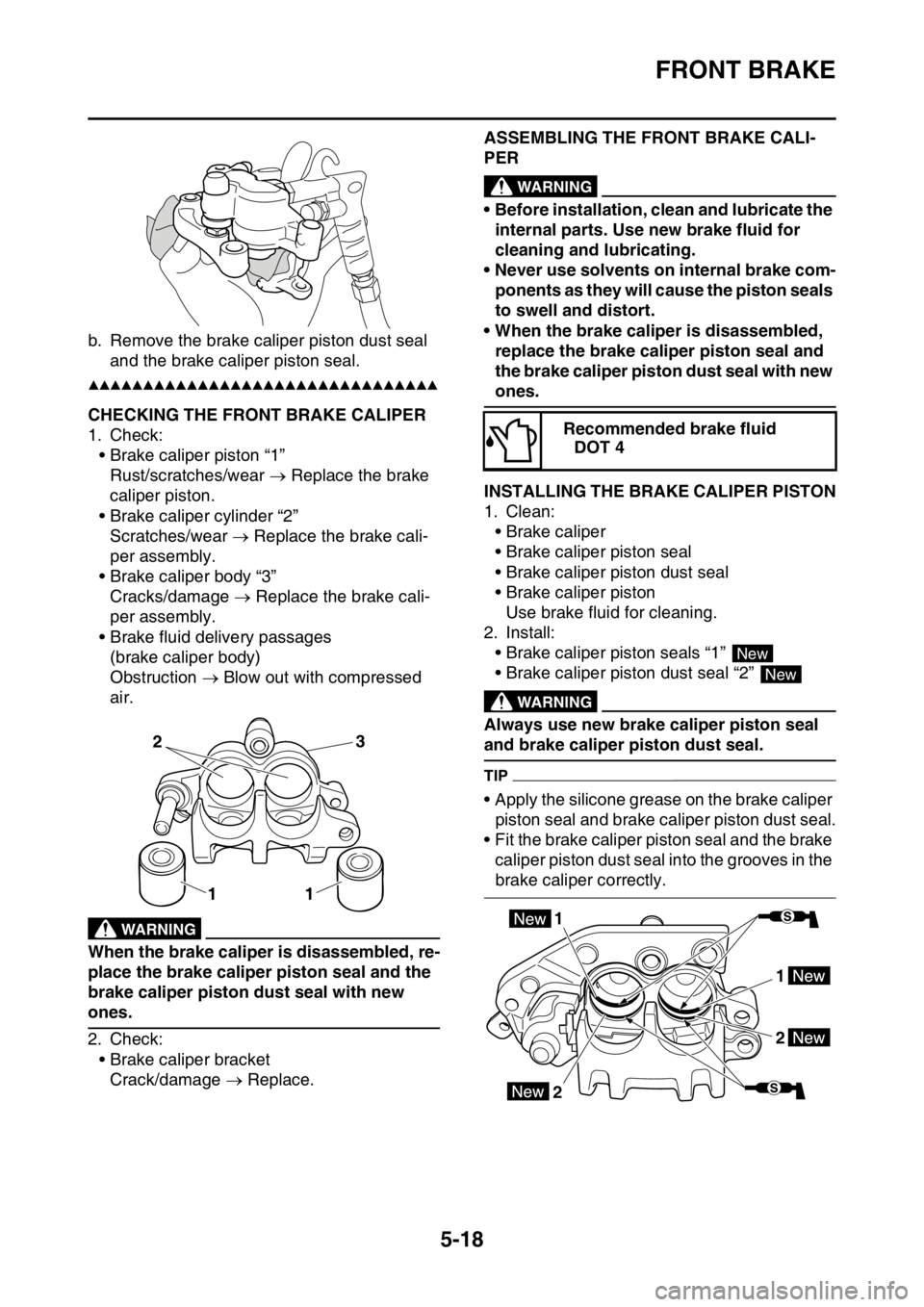
1. Check:
• Brake caliper piston “1”
Rust/scratches/wear Replace the brake
caliper piston.
• Brake caliper cylinder “2”
Scratches/wear Replace the brake cali-
per assembly.
• Brake caliper body “3”
Cracks/damage Replace the brake cali-
per assembly.
• Brake fluid delivery passages
(brake caliper body)
Obstruction Blow out with compressed
air.
EWA
WARNING
When the brake caliper is disassembled, re-
place the brake caliper piston seal and the
brake caliper piston dust seal with new
ones.
2. Check:
• Brake caliper bracket
Crack/damage Replace.
EAS2GB2175
ASSEMBLING THE FRONT BRAKE CALI-
PER
EWA
WARNING
• Before installation, clean and lubricate the
internal parts. Use new brake fluid for
cleaning and lubricating.
• Never use solvents on internal brake com-
ponents as they will cause the piston seals
to swell and distort.
• When the brake caliper is disassembled,
replace the brake caliper piston seal and
the brake caliper piston dust seal with new
ones.
EAS2GB2176INSTALLING THE BRAKE CALIPER PISTON
1. Clean:
• Brake caliper
• Brake caliper piston seal
• Brake caliper piston dust seal
• Brake caliper piston
Use brake fluid for cleaning.
2. Install:
• Brake caliper piston seals “1”
• Brake caliper piston dust seal “2”
EWA
WARNING
Always use new brake caliper piston seal
and brake caliper piston dust seal.
TIP
• Apply the silicone grease on the brake caliper
piston seal and brake caliper piston dust seal.
• Fit the brake caliper piston seal and the brake
caliper piston dust seal into the grooves in the
brake caliper correctly.
2
113
Recommended brake fluid
DOT 4
New
New
1
1
22
Page 177 of 430
FRONT BRAKE
5-19
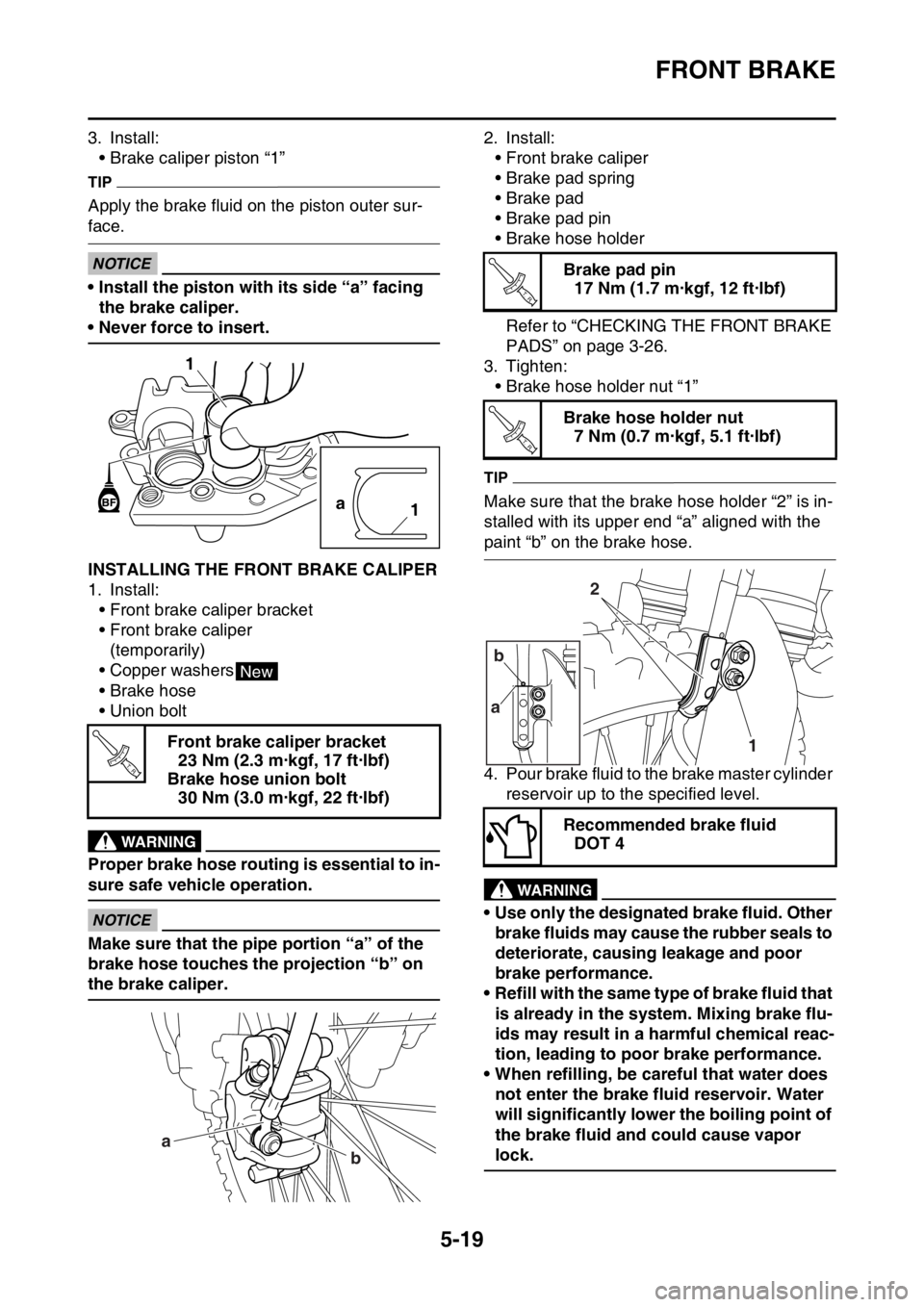
3. Install:
• Brake caliper piston “1”
TIP
Apply the brake fluid on the piston outer sur-
face.
ECA
NOTICE
• Install the piston with its side “a” facing
the brake caliper.
• Never force to insert.
EAS2GB2177INSTALLING THE FRONT BRAKE CALIPER
1. Install:
• Front brake caliper bracket
• Front brake caliper
(temporarily)
• Copper washers
• Brake hose
• Union bolt
EWA
WARNING
Proper brake hose routing is essential to in-
sure safe vehicle operation.
ECA
NOTICE
Make sure that the pipe portion “a” of the
brake hose touches the projection “b” on
the brake caliper.2. Install:
• Front brake caliper
• Brake pad spring
• Brake pad
• Brake pad pin
• Brake hose holder
Refer to “CHECKING THE FRONT BRAKE
PADS” on page 3-26.
3. Tighten:
• Brake hose holder nut “1”
TIP
Make sure that the brake hose holder “2” is in-
stalled with its upper end “a” aligned with the
paint “b” on the brake hose.
4. Pour brake fluid to the brake master cylinder
reservoir up to the specified level.
EWA
WARNING
• Use only the designated brake fluid. Other
brake fluids may cause the rubber seals to
deteriorate, causing leakage and poor
brake performance.
• Refill with the same type of brake fluid that
is already in the system. Mixing brake flu-
ids may result in a harmful chemical reac-
tion, leading to poor brake performance.
• When refilling, be careful that water does
not enter the brake fluid reservoir. Water
will significantly lower the boiling point of
the brake fluid and could cause vapor
lock.
ECA
Front brake caliper bracket
23 Nm (2.3 m·kgf, 17 ft·lbf)
Brake hose union bolt
30 Nm (3.0 m·kgf, 22 ft·lbf)
1
a
1
New
T R..
a
b
Brake pad pin
17 Nm (1.7 m·kgf, 12 ft·lbf)
Brake hose holder nut
7 Nm (0.7 m·kgf, 5.1 ft·lbf)
Recommended brake fluid
DOT 4
T R..
T R..
1 2
b
a
Page 178 of 430
FRONT BRAKE
5-20
NOTICE
Brake fluid may damage painted surfaces
and plastic parts. Therefore, always clean
up any spilt brake fluid immediately.
5. Bleed:
• Brake system
Refer to “BLEEDING THE BRAKE SYS-
TEM” on page 3-24.
6. Check:
• Brake fluid level
The minimum level mark or below Add.
Refer to “CHECKING THE BRAKE FLUID
LEVEL” on page 3-29.
7. Check:
• Brake lever free play
Refer to “ADJUSTING THE FRONT
BRAKE” on page 3-25.
• Brake lever operation
A softy or spongy feeling Bleed the brake
system.
Refer to “BLEEDING THE BRAKE SYS-
TEM” on page 3-24.
EAS2GB2178REMOVING THE FRONT BRAKE MASTER
CYLINDER
TIP
Before removing the front brake master cylin-
der, drain the brake fluid from the entire brake
system.
1. Remove:
• Union bolt
• Copper washers
• Brake hoses
TIP
To drain any remaining brake fluid, place a con-
tainer under the master cylinder and the end of
the brake hose.
EAS2GB2179CHECKING THE FRONT BRAKE MASTER
CYLINDER
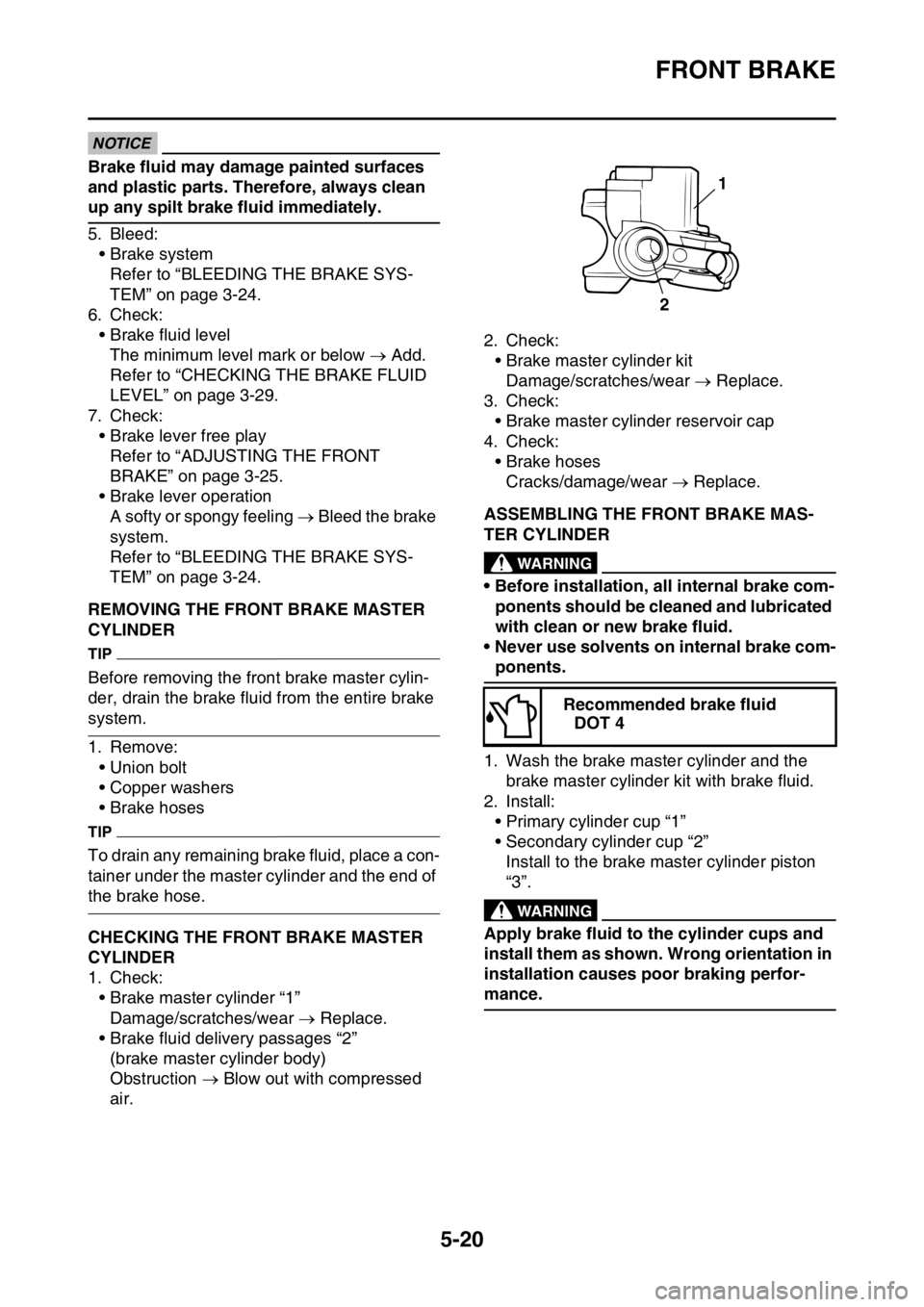
1. Check:
• Brake master cylinder “1”
Damage/scratches/wear Replace.
• Brake fluid delivery passages “2”
(brake master cylinder body)
Obstruction Blow out with compressed
air.2. Check:
• Brake master cylinder kit
Damage/scratches/wear Replace.
3. Check:
• Brake master cylinder reservoir cap
4. Check:
• Brake hoses
Cracks/damage/wear Replace.
EAS2GB2180ASSEMBLING THE FRONT BRAKE MAS-
TER CYLINDER
EWA
WARNING
• Before installation, all internal brake com-
ponents should be cleaned and lubricated
with clean or new brake fluid.
• Never use solvents on internal brake com-
ponents.
1. Wash the brake master cylinder and the
brake master cylinder kit with brake fluid.
2. Install:
• Primary cylinder cup “1”
• Secondary cylinder cup “2”
Install to the brake master cylinder piston
“3”.
EWA
WARNING
Apply brake fluid to the cylinder cups and
install them as shown. Wrong orientation in
installation causes poor braking perfor-
mance.Recommended brake fluid
DOT 4
1
2
Page 179 of 430
FRONT BRAKE
5-21
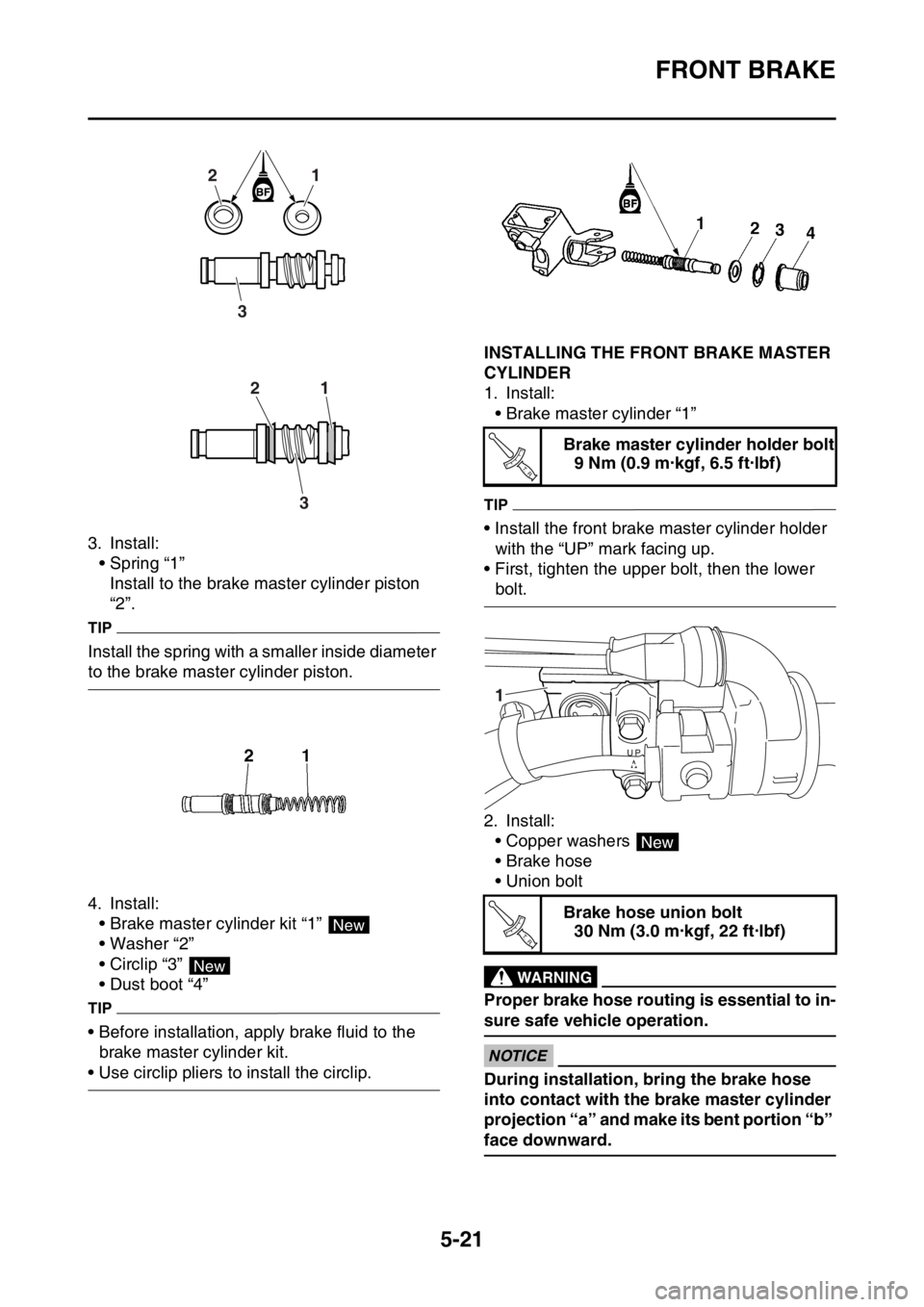
3. Install:
• Spring “1”
Install to the brake master cylinder piston
“2”.
TIP
Install the spring with a smaller inside diameter
to the brake master cylinder piston.
4. Install:
• Brake master cylinder kit “1”
• Washer “2”
• Circlip “3”
• Dust boot “4”
TIP
• Before installation, apply brake fluid to the
brake master cylinder kit.
• Use circlip pliers to install the circlip.
EAS2GB2181INSTALLING THE FRONT BRAKE MASTER
CYLINDER
1. Install:
• Brake master cylinder “1”
TIP
• Install the front brake master cylinder holder
with the “UP” mark facing up.
• First, tighten the upper bolt, then the lower
bolt.
2. Install:
• Copper washers
• Brake hose
• Union bolt
EWA
WARNING
Proper brake hose routing is essential to in-
sure safe vehicle operation.
ECA
NOTICE
During installation, bring the brake hose
into contact with the brake master cylinder
projection “a” and make its bent portion “b”
face downward.
1 2
3
1 2
3
New
New
Brake master cylinder holder bolt
9 Nm (0.9 m·kgf, 6.5 ft·lbf)
Brake hose union bolt
30 Nm (3.0 m·kgf, 22 ft·lbf)
T R..
1
New
T R..
Page 180 of 430
FRONT BRAKE
5-22
TIP
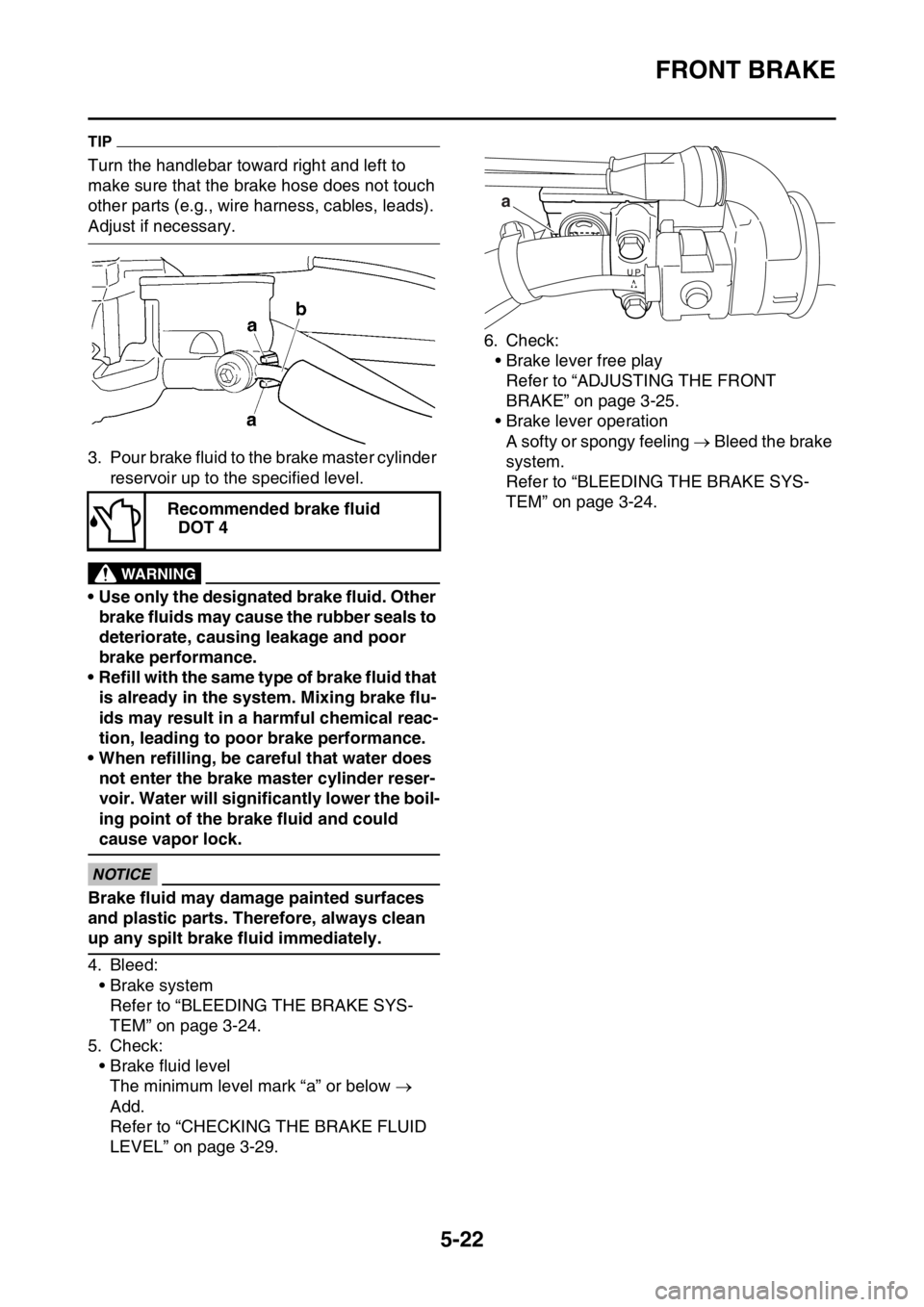
Turn the handlebar toward right and left to
make sure that the brake hose does not touch
other parts (e.g., wire harness, cables, leads).
Adjust if necessary.
3. Pour brake fluid to the brake master cylinder
reservoir up to the specified level.
EWA
WARNING
• Use only the designated brake fluid. Other
brake fluids may cause the rubber seals to
deteriorate, causing leakage and poor
brake performance.
• Refill with the same type of brake fluid that
is already in the system. Mixing brake flu-
ids may result in a harmful chemical reac-
tion, leading to poor brake performance.
• When refilling, be careful that water does
not enter the brake master cylinder reser-
voir. Water will significantly lower the boil-
ing point of the brake fluid and could
cause vapor lock.
ECA
NOTICE
Brake fluid may damage painted surfaces
and plastic parts. Therefore, always clean
up any spilt brake fluid immediately.
4. Bleed:
• Brake system
Refer to “BLEEDING THE BRAKE SYS-
TEM” on page 3-24.
5. Check:
• Brake fluid level
The minimum level mark “a” or below
Add.
Refer to “CHECKING THE BRAKE FLUID
LEVEL” on page 3-29.6. Check:
• Brake lever free play
Refer to “ADJUSTING THE FRONT
BRAKE” on page 3-25.
• Brake lever operation
A softy or spongy feeling Bleed the brake
system.
Refer to “BLEEDING THE BRAKE SYS-
TEM” on page 3-24.
Recommended brake fluid
DOT 4
a