warning YAMAHA WR 250F 2015 User Guide
[x] Cancel search | Manufacturer: YAMAHA, Model Year: 2015, Model line: WR 250F, Model: YAMAHA WR 250F 2015Pages: 430, PDF Size: 14.14 MB
Page 54 of 430

MOTORCYCLE CARE AND STORAGE
1-40
e. Remove the spark plug cap from the spark
plug, and then install the spark plug and the
spark plug cap. WARNING! To prevent
damage or injury from sparking, make
sure to ground the spark plug electrodes
while turning the engine over.
▲▲▲▲▲▲▲▲▲▲▲▲▲▲▲▲▲▲▲▲▲▲▲▲▲▲▲▲▲▲▲▲
4. Lubricate all control cables and the pivoting
points of all levers and pedals as well as of
the sidestand/ centerstand.
5. Check and, if necessary, correct the tire air
pressure, and then lift the motorcycle so that
both of its wheels are off the ground. Alter-
natively, turn the wheels a little every month
in order to prevent the tires from becoming
degraded in one spot.
6. Cover the muffler outlet with a plastic bag to
prevent moisture from entering it.
7. Remove the battery and fully charge it. Store
it in a cool, dry place and charge it once a
month. Do not store the battery in an exces-
sively cold or warm place [less than 0 °C (30
°F) or more than 30 °C (90 °F)]. For more in-
formation on storing the battery, See page
9-69.
TIP
Make any necessary repairs before storing the
motorcycle.
Page 66 of 430

ELECTRICAL SPECIFICATIONS
2-11
EAS2GB2066
ELECTRICAL SPECIFICATIONS
Voltage
System voltage 12 V
Ignition system
Ignition system TCI
Advancer type Digital
Ignition timing (B.T.D.C.) 10.0 ° at 2000 r/min
Engine control unit
Model/manufacturer 2GB0/YAMAHA (USA) (CAN)
2GB1/YAMAHA (EUR) (AUS) (NZL) (ZAF)
Ignition coil
Minimum ignition spark gap 6.0 mm (0.24 in)
Primary coil resistance 2.16–2.64
Secondary coil resistance 8.64–12.96 k
AC magneto
Standard output 14.0 V, 160 W at 5000 r/min
Stator coil resistance 0.528–0.792 (W–W)
Rectifier/regulator
Regulator type Semi conductor-short circuit
No load regulated voltage 14.1–14.9 V
Rectifier capacity (DC) 23.0 A
Battery
Model YTZ7S (F)
Voltage, capacity 12 V, 6.0 Ah
Specific gravity 1.31
Manufacturer GS YUASA
Ten hour rate charging current 0.60 A
Headlight
Bulb type Halogen bulb
Bulb voltage, wattage quantity
Headlight 12 V, 35 W/35 W 1
Tail/brake light LED
Meter lighting EL (Electroluminescent)
Indicator light
Fuel level warning light 12 V, 1.7 W 1
Engine trouble warning light 12 V, 1.7 W 1
Electric starting system
System type Constant mesh
Starter motor
Power output 0.35 kW
Armature coil resistance 0.0189–0.0231
Brush overall length 7.0 mm (0.28 in)
Limit 3.50 mm (0.14 in)
Brush spring force 3.92–5.88 N (400–600 gf, 14.11–21.17 oz)
Commutator diameter 17.6 mm (0.69 in)
Limit 16.6 mm (0.65 in)
Mica undercut (depth) 1.50 mm (0.06 in)
Page 114 of 430
ENGINE
3-10
EAS2GB2083
ENGINE
EAS2GB2084CHECKING THE COOLANT LEVELEWA
WARNING
If coolant seems hot, do not remove the ra-
diator cap.
1. Stand the vehicle upright on a level surface.
2. Remove:
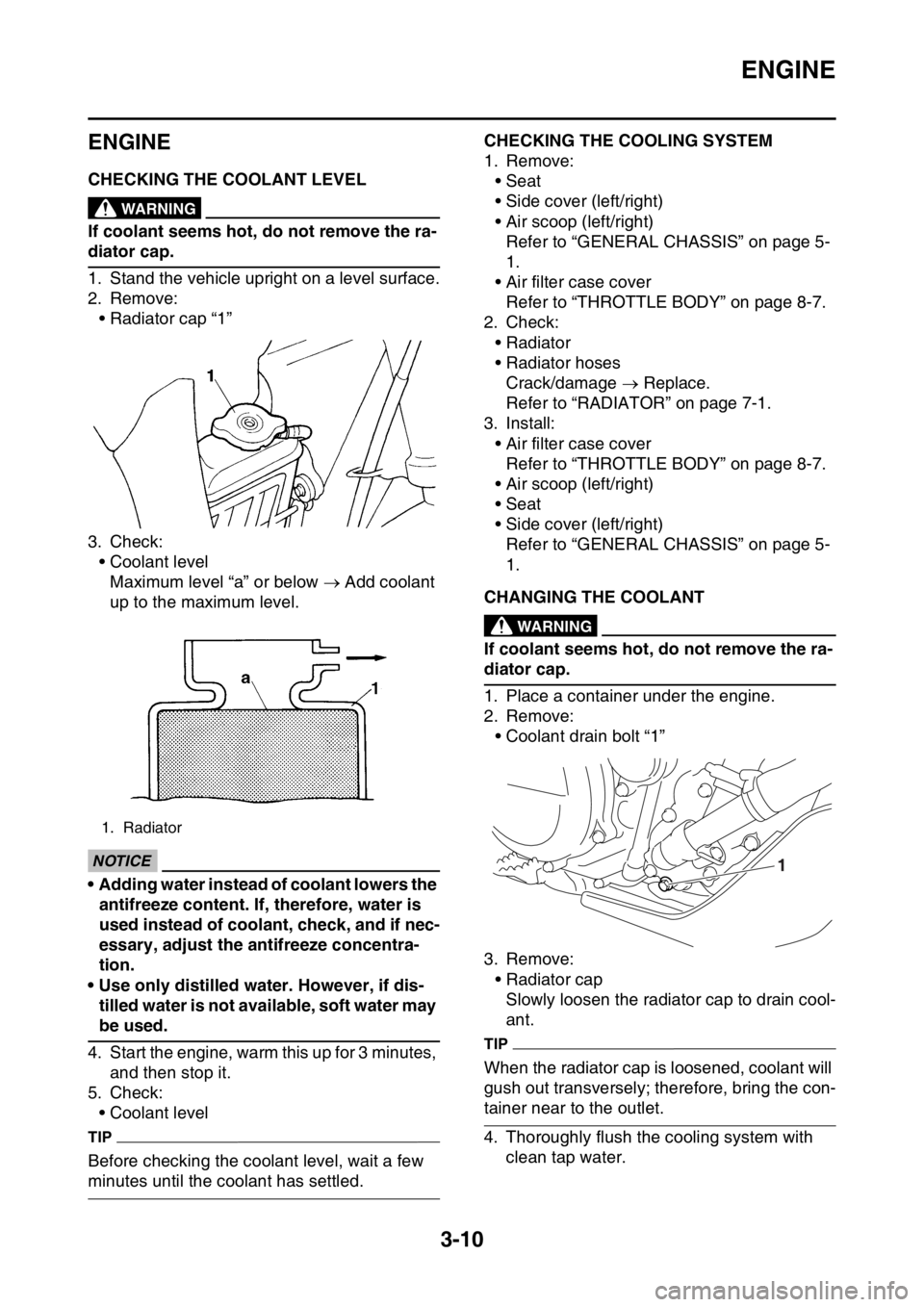
• Radiator cap “1”
3. Check:
• Coolant level
Maximum level “a” or below Add coolant
up to the maximum level.
ECA
NOTICE
• Adding water instead of coolant lowers the
antifreeze content. If, therefore, water is
used instead of coolant, check, and if nec-
essary, adjust the antifreeze concentra-
tion.
• Use only distilled water. However, if dis-
tilled water is not available, soft water may
be used.
4. Start the engine, warm this up for 3 minutes,
and then stop it.
5. Check:
• Coolant level
TIP
Before checking the coolant level, wait a few
minutes until the coolant has settled.
EAS2GB2085CHECKING THE COOLING SYSTEM
1. Remove:
• Seat
• Side cover (left/right)
• Air scoop (left/right)
Refer to “GENERAL CHASSIS” on page 5-
1.
• Air filter case cover
Refer to “THROTTLE BODY” on page 8-7.
2. Check:
• Radiator
• Radiator hoses
Crack/damage Replace.
Refer to “RADIATOR” on page 7-1.
3. Install:
• Air filter case cover
Refer to “THROTTLE BODY” on page 8-7.
• Air scoop (left/right)
• Seat
• Side cover (left/right)
Refer to “GENERAL CHASSIS” on page 5-
1.
EAS2GB2086CHANGING THE COOLANTEWA
WARNING
If coolant seems hot, do not remove the ra-
diator cap.
1. Place a container under the engine.
2. Remove:
• Coolant drain bolt “1”
3. Remove:
• Radiator cap
Slowly loosen the radiator cap to drain cool-
ant.
TIP
When the radiator cap is loosened, coolant will
gush out transversely; therefore, bring the con-
tainer near to the outlet.
4. Thoroughly flush the cooling system with
clean tap water.
1. Radiator
1
Page 115 of 430
ENGINE
3-11
5. Install:
• Copper washer
• Coolant drain bolt
6. Pour coolant.
EWA
WARNING
• If coolant splashes in your eyes, thorough-
ly wash them with water and consult a
doctor.
• If coolant splashes on your clothes, quick-
ly wash it away with water and then with
soap and water.
• If coolant is swallowed, induce vomiting
and get immediate medical attention.
ECA
NOTICE
• Adding water instead of coolant lowers the
antifreeze content of the coolant. If water
is used instead of coolant check, and if
necessary, correct the antifreeze concen-
tration of the coolant.
• Use only distilled water. However, if dis-
tilled water is not available, soft water may
be used.
• If coolant comes into contact with painted
surfaces, immediately wash them with wa-
ter.
• Do not mix different types of antifreeze.
7. Install:
• Radiator cap
8. Start the engine, warm this up for 3 minutes,
stop it, and then wait for it to cool down.
9. Check:
• Coolant level
Refer to “CHECKING THE COOLANT LEV-
EL” on page 3-10.
EAS2GB2087CHECKING THE RADIATOR CAP
1. Check:
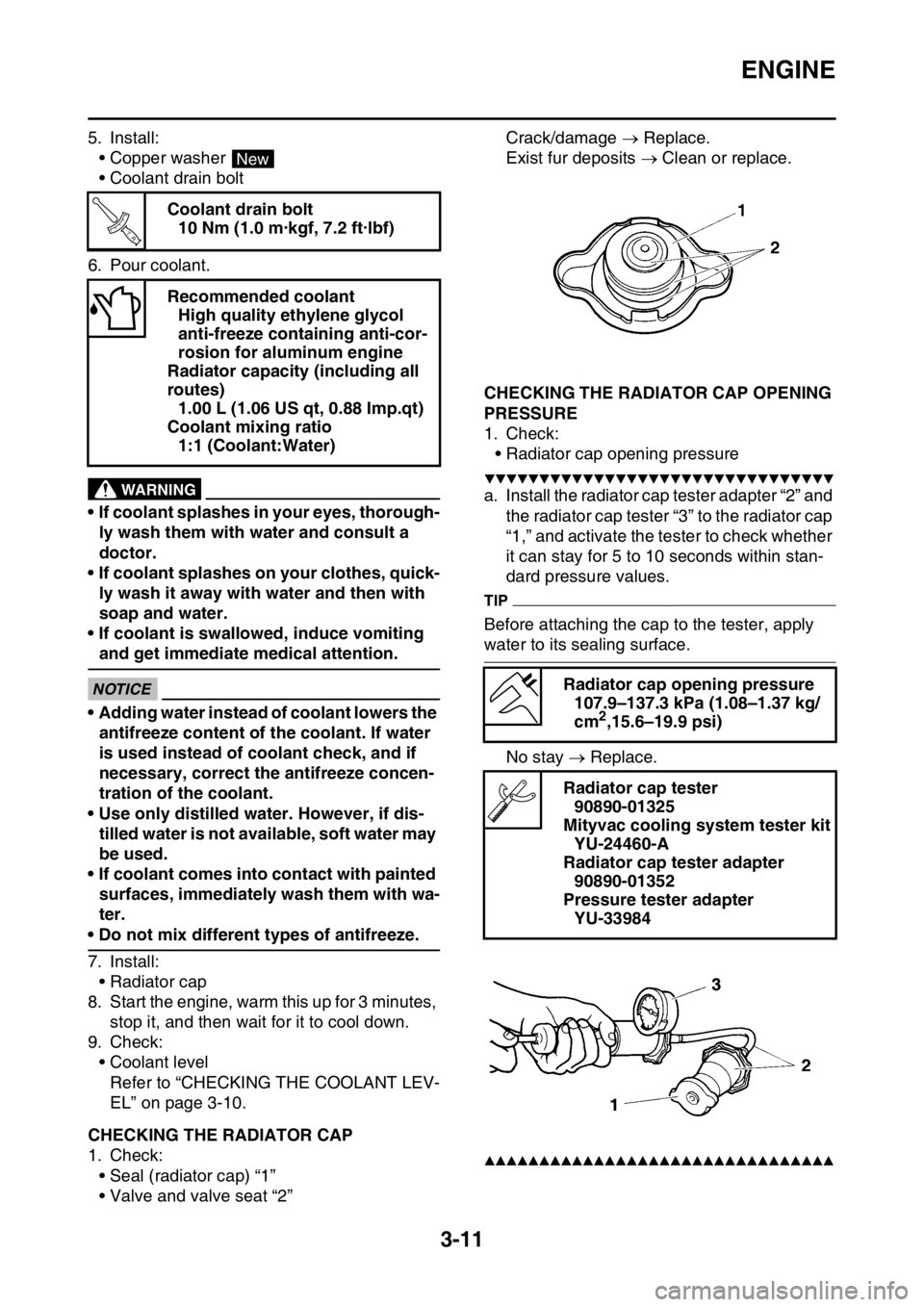
• Seal (radiator cap) “1”
• Valve and valve seat “2”Crack/damage Replace.
Exist fur deposits Clean or replace.
EAS2GB2088CHECKING THE RADIATOR CAP OPENING
PRESSURE
1. Check:
• Radiator cap opening pressure
▼▼▼▼▼▼▼▼▼▼▼▼▼▼▼▼▼▼▼▼▼▼▼▼▼▼▼▼▼▼▼▼
a. Install the radiator cap tester adapter “2” and
the radiator cap tester “3” to the radiator cap
“1,” and activate the tester to check whether
it can stay for 5 to 10 seconds within stan-
dard pressure values.
TIP
Before attaching the cap to the tester, apply
water to its sealing surface.
No stay Replace.
▲▲▲▲▲▲▲▲▲▲▲▲▲▲▲▲▲▲▲▲▲▲▲▲▲▲▲▲▲▲▲▲
Coolant drain bolt
10 Nm (1.0 m·kgf, 7.2 ft·lbf)
Recommended coolant
High quality ethylene glycol
anti-freeze containing anti-cor-
rosion for aluminum engine
Radiator capacity (including all
routes)
1.00 L (1.06 US qt, 0.88 Imp.qt)
Coolant mixing ratio
1:1 (Coolant:Water)
New
T R..
Radiator cap opening pressure
107.9–137.3 kPa (1.08–1.37 kg/
cm
2,15.6–19.9 psi)
Radiator cap tester
90890-01325
Mityvac cooling system tester kit
YU-24460-A
Radiator cap tester adapter
90890-01352
Pressure tester adapter
YU-33984
Page 116 of 430
ENGINE
3-12
EAS2GB2089CHECKING THE COOLANT CIRCULATORY
SYSTEM FOR LEAKS
1. Check:
• Coolant level
2. Install:
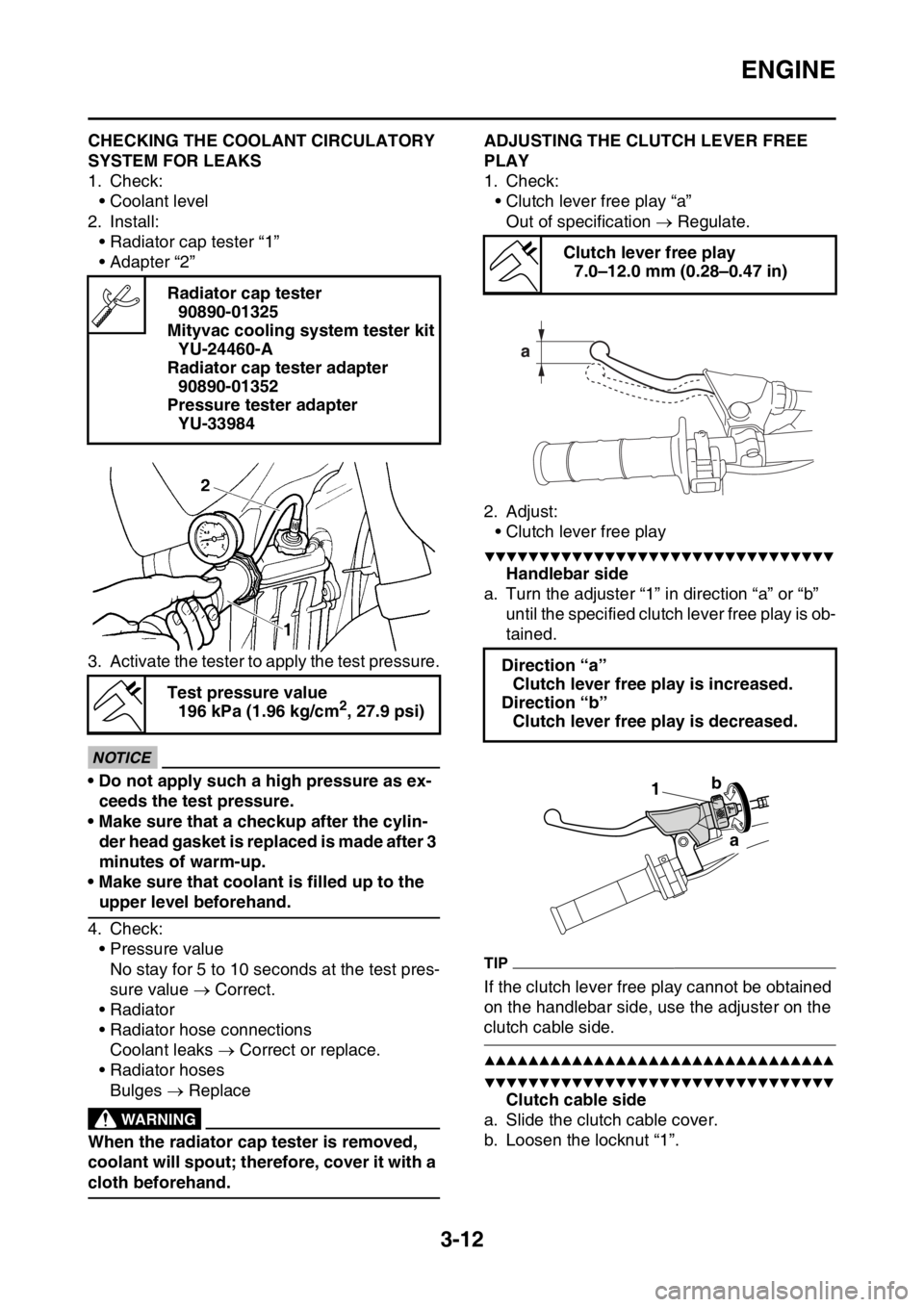
• Radiator cap tester “1”
• Adapter “2”
3. Activate the tester to apply the test pressure.
ECA
NOTICE
• Do not apply such a high pressure as ex-
ceeds the test pressure.
• Make sure that a checkup after the cylin-
der head gasket is replaced is made after 3
minutes of warm-up.
• Make sure that coolant is filled up to the
upper level beforehand.
4. Check:
• Pressure value
No stay for 5 to 10 seconds at the test pres-
sure value Correct.
• Radiator
• Radiator hose connections
Coolant leaks Correct or replace.
• Radiator hoses
Bulges Replace
EWA
WARNING
When the radiator cap tester is removed,
coolant will spout; therefore, cover it with a
cloth beforehand.
EAS2GB2090ADJUSTING THE CLUTCH LEVER FREE
PLAY
1. Check:
• Clutch lever free play “a”
Out of specification Regulate.
2. Adjust:
• Clutch lever free play
▼▼▼▼▼▼▼▼▼▼▼▼▼▼▼▼▼▼▼▼▼▼▼▼▼▼▼▼▼▼▼▼
Handlebar side
a. Turn the adjuster “1” in direction “a” or “b”
until the specified clutch lever free play is ob-
tained.
TIP
If the clutch lever free play cannot be obtained
on the handlebar side, use the adjuster on the
clutch cable side.
▲▲▲▲▲▲▲▲▲▲▲▲▲▲▲▲▲▲▲▲▲▲▲▲▲▲▲▲▲▲▲▲
▼▼▼▼▼▼▼▼▼▼▼▼▼▼▼▼▼▼▼▼▼▼▼▼▼▼▼▼▼▼▼▼
Clutch cable side
a. Slide the clutch cable cover.
b. Loosen the locknut “1”. Radiator cap tester
90890-01325
Mityvac cooling system tester kit
YU-24460-A
Radiator cap tester adapter
90890-01352
Pressure tester adapter
YU-33984
Test pressure value
196 kPa (1.96 kg/cm
2, 27.9 psi)
Clutch lever free play
7.0–12.0 mm (0.28–0.47 in)
Direction “a”
Clutch lever free play is increased.
Direction “b”
Clutch lever free play is decreased.
a b
1
Page 117 of 430
ENGINE
3-13
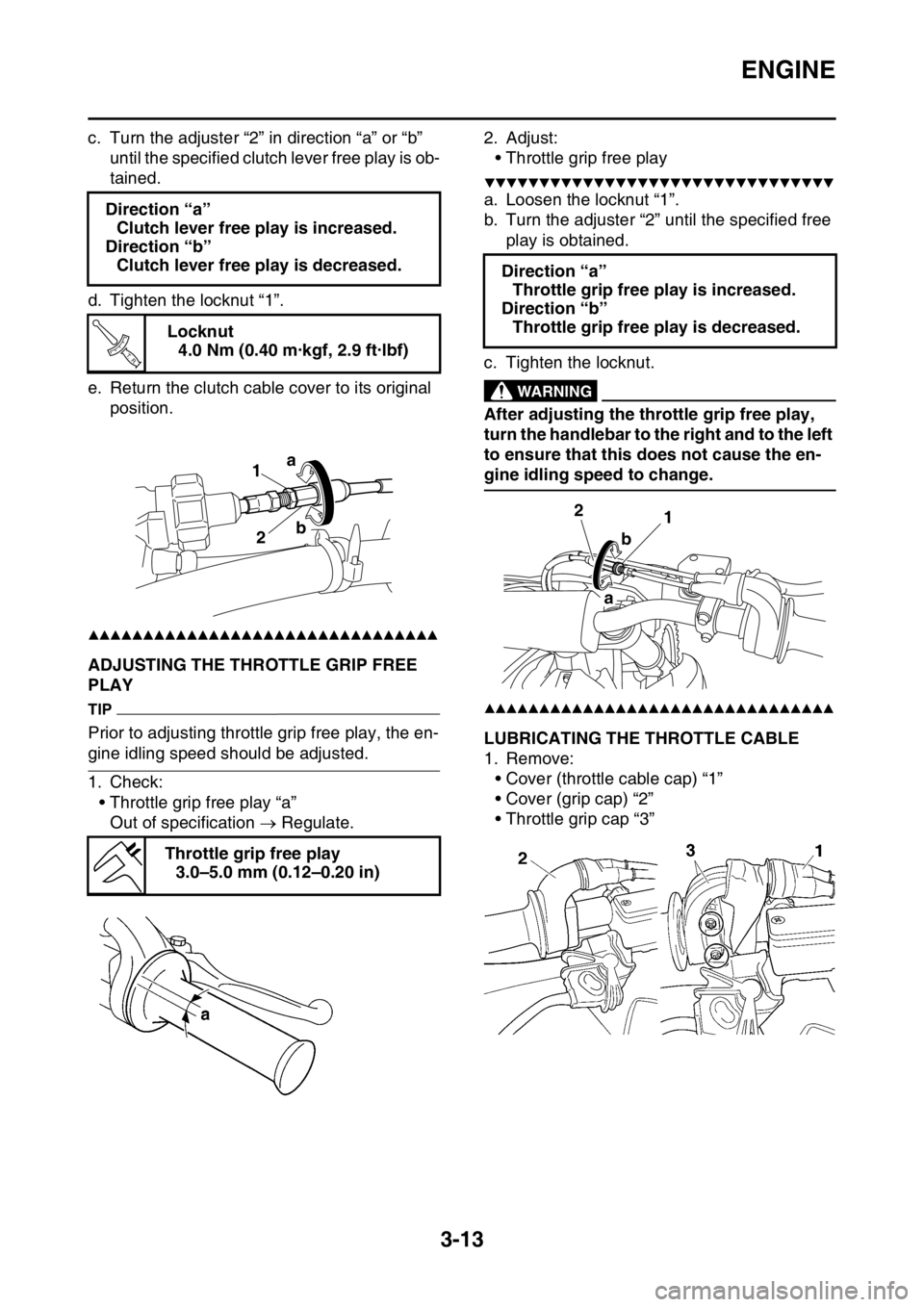
c. Turn the adjuster “2” in direction “a” or “b”
until the specified clutch lever free play is ob-
tained.
d. Tighten the locknut “1”.
e. Return the clutch cable cover to its original
position.
▲▲▲▲▲▲▲▲▲▲▲▲▲▲▲▲▲▲▲▲▲▲▲▲▲▲▲▲▲▲▲▲
EAS2GB2091ADJUSTING THE THROTTLE GRIP FREE
PLAY
TIP
Prior to adjusting throttle grip free play, the en-
gine idling speed should be adjusted.
1. Check:
• Throttle grip free play “a”
Out of specification Regulate.2. Adjust:
• Throttle grip free play
▼▼▼▼▼▼▼▼▼▼▼▼▼▼▼▼▼▼▼▼▼▼▼▼▼▼▼▼▼▼▼▼
a. Loosen the locknut “1”.
b. Turn the adjuster “2” until the specified free
play is obtained.
c. Tighten the locknut.
EWA
WARNING
After adjusting the throttle grip free play,
turn the handlebar to the right and to the left
to ensure that this does not cause the en-
gine idling speed to change.
▲▲▲▲▲▲▲▲▲▲▲▲▲▲▲▲▲▲▲▲▲▲▲▲▲▲▲▲▲▲▲▲
EAS2GB2092LUBRICATING THE THROTTLE CABLE
1. Remove:
• Cover (throttle cable cap) “1”
• Cover (grip cap) “2”
• Throttle grip cap “3” Direction “a”
Clutch lever free play is increased.
Direction “b”
Clutch lever free play is decreased.
Locknut
4.0 Nm (0.40 m·kgf, 2.9 ft·lbf)
Throttle grip free play
3.0–5.0 mm (0.12–0.20 in)
T R..
1
2a
b
Direction “a”
Throttle grip free play is increased.
Direction “b”
Throttle grip free play is decreased.
1 2
b
a
Page 118 of 430
ENGINE
3-14
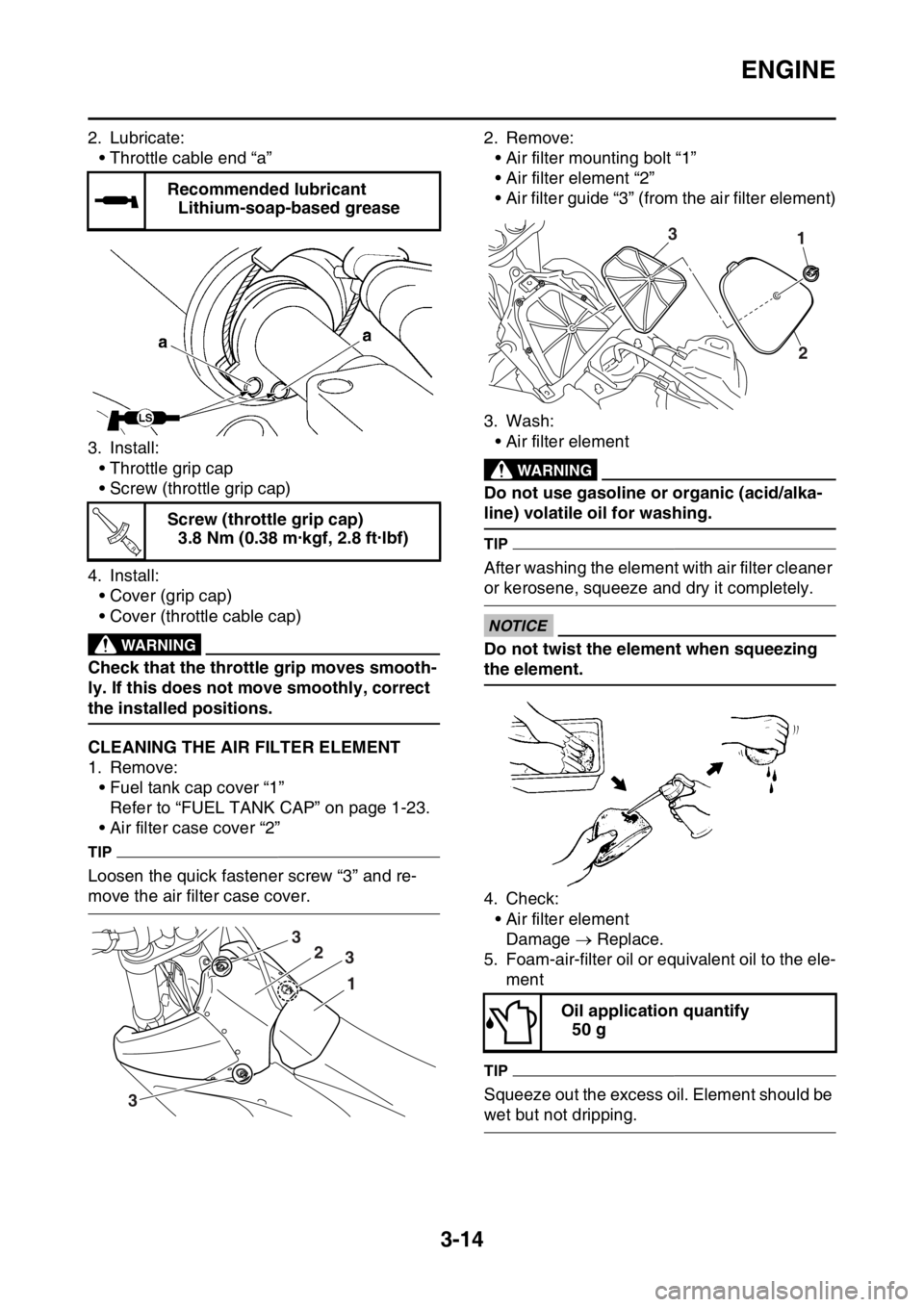
2. Lubricate:
• Throttle cable end “a”
3. Install:
• Throttle grip cap
• Screw (throttle grip cap)
4. Install:
• Cover (grip cap)
• Cover (throttle cable cap)
EWA
WARNING
Check that the throttle grip moves smooth-
ly. If this does not move smoothly, correct
the installed positions.
EAS2GB2093CLEANING THE AIR FILTER ELEMENT
1. Remove:
• Fuel tank cap cover “1”
Refer to “FUEL TANK CAP” on page 1-23.
• Air filter case cover “2”
TIP
Loosen the quick fastener screw “3” and re-
move the air filter case cover.2. Remove:
• Air filter mounting bolt “1”
• Air filter element “2”
• Air filter guide “3” (from the air filter element)
3. Wash:
• Air filter element
EWA
WARNING
Do not use gasoline or organic (acid/alka-
line) volatile oil for washing.
TIP
After washing the element with air filter cleaner
or kerosene, squeeze and dry it completely.
ECA
NOTICE
Do not twist the element when squeezing
the element.
4. Check:
• Air filter element
Damage Replace.
5. Foam-air-filter oil or equivalent oil to the ele-
ment
TIP
Squeeze out the excess oil. Element should be
wet but not dripping. Recommended lubricant
Lithium-soap-based grease
Screw (throttle grip cap)
3.8 Nm (0.38 m·kgf, 2.8 ft·lbf)
T R..
1
2
3
3
3
Oil application quantify
50 g
13
2
Page 122 of 430
ENGINE
3-18
8. Install:
• Oil filler cap
9. Check:
• Oil level
Refer to “CHECKING THE ENGINE OIL
LEVEL” on page 3-16.
10.Check:
• Engine oil pressure
▼▼▼▼▼▼▼▼▼▼▼▼▼▼▼▼▼▼▼▼▼▼▼▼▼▼▼▼▼▼▼▼
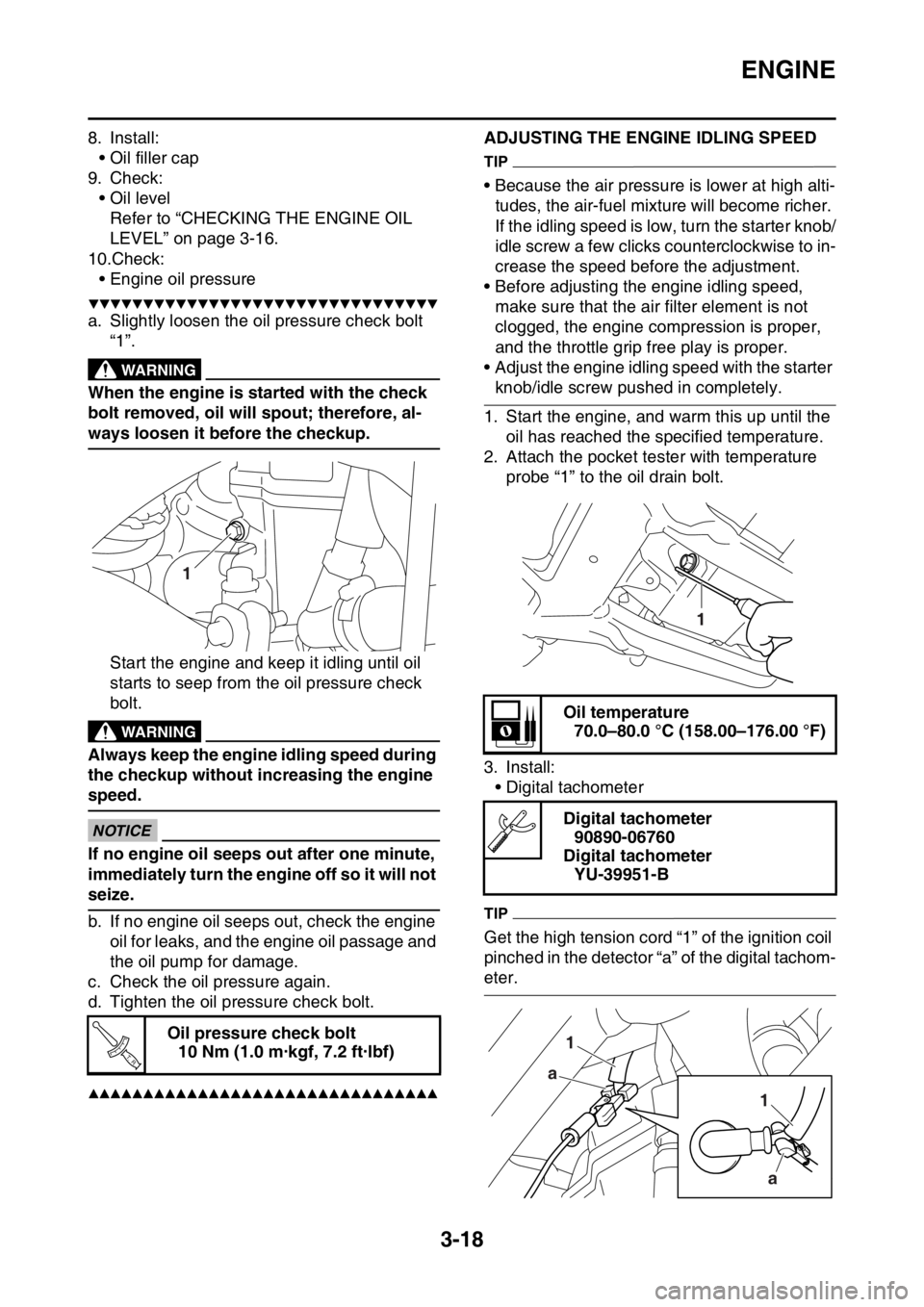
a. Slightly loosen the oil pressure check bolt
“1”.
EWA
WARNING
When the engine is started with the check
bolt removed, oil will spout; therefore, al-
ways loosen it before the checkup.
Start the engine and keep it idling until oil
starts to seep from the oil pressure check
bolt.
EWA
WARNING
Always keep the engine idling speed during
the checkup without increasing the engine
speed.
ECA
NOTICE
If no engine oil seeps out after one minute,
immediately turn the engine off so it will not
seize.
b. If no engine oil seeps out, check the engine
oil for leaks, and the engine oil passage and
the oil pump for damage.
c. Check the oil pressure again.
d. Tighten the oil pressure check bolt.
▲▲▲▲▲▲▲▲▲▲▲▲▲▲▲▲▲▲▲▲▲▲▲▲▲▲▲▲▲▲▲▲
EAS2GB2100
ADJUSTING THE ENGINE IDLING SPEED
TIP
• Because the air pressure is lower at high alti-
tudes, the air-fuel mixture will become richer.
If the idling speed is low, turn the starter knob/
idle screw a few clicks counterclockwise to in-
crease the speed before the adjustment.
• Before adjusting the engine idling speed,
make sure that the air filter element is not
clogged, the engine compression is proper,
and the throttle grip free play is proper.
• Adjust the engine idling speed with the starter
knob/idle screw pushed in completely.
1. Start the engine, and warm this up until the
oil has reached the specified temperature.
2. Attach the pocket tester with temperature
probe “1” to the oil drain bolt.
3. Install:
• Digital tachometer
TIP
Get the high tension cord “1” of the ignition coil
pinched in the detector “a” of the digital tachom-
eter.
Oil pressure check bolt
10 Nm (1.0 m·kgf, 7.2 ft·lbf)
1
T R..
Oil temperature
70.0–80.0 °C (158.00–176.00 °F)
Digital tachometer
90890-06760
Digital tachometer
YU-39951-B
1
1 1
a a
Page 128 of 430
CHASSIS
3-24
EAS2GB2103
CHASSIS
EAS2GB2104BLEEDING THE BRAKE SYSTEMEWA
WARNING
Bleed the brake system whenever:
• The system is disassembled.
• A brake hose is loosened, disconnected,
or replaced.
• The brake fluid level is very low.
• Brake operation is faulty.
1. Remove:
• Brake master cylinder cap
• Reservoir diaphragm
• Reservoir float (front brake)
• Protector (rear brake)
TIP
• Be careful not to spill any brake fluid or allow
the reservoir to overflow.
• Make sure that there is enough brake fluid be-
fore applying the brake. Ignoring this precau-
tion could allow air to enter the brake system,
considerably lengthening the bleeding proce-
dure.
• If bleeding is difficult, it may be necessary to
let the brake fluid settle for a few hours. Re-
peat the bleeding procedure when the tiny
bubbles in the hose have disappeared.
2. Bleed the brake system.
▼▼▼▼▼▼▼▼▼▼▼▼▼▼▼▼▼▼▼▼▼▼▼▼▼▼▼▼▼▼▼▼
a. Fill the reservoir to the proper level with the
recommended brake fluid.
b. Install the reservoir diaphragm.
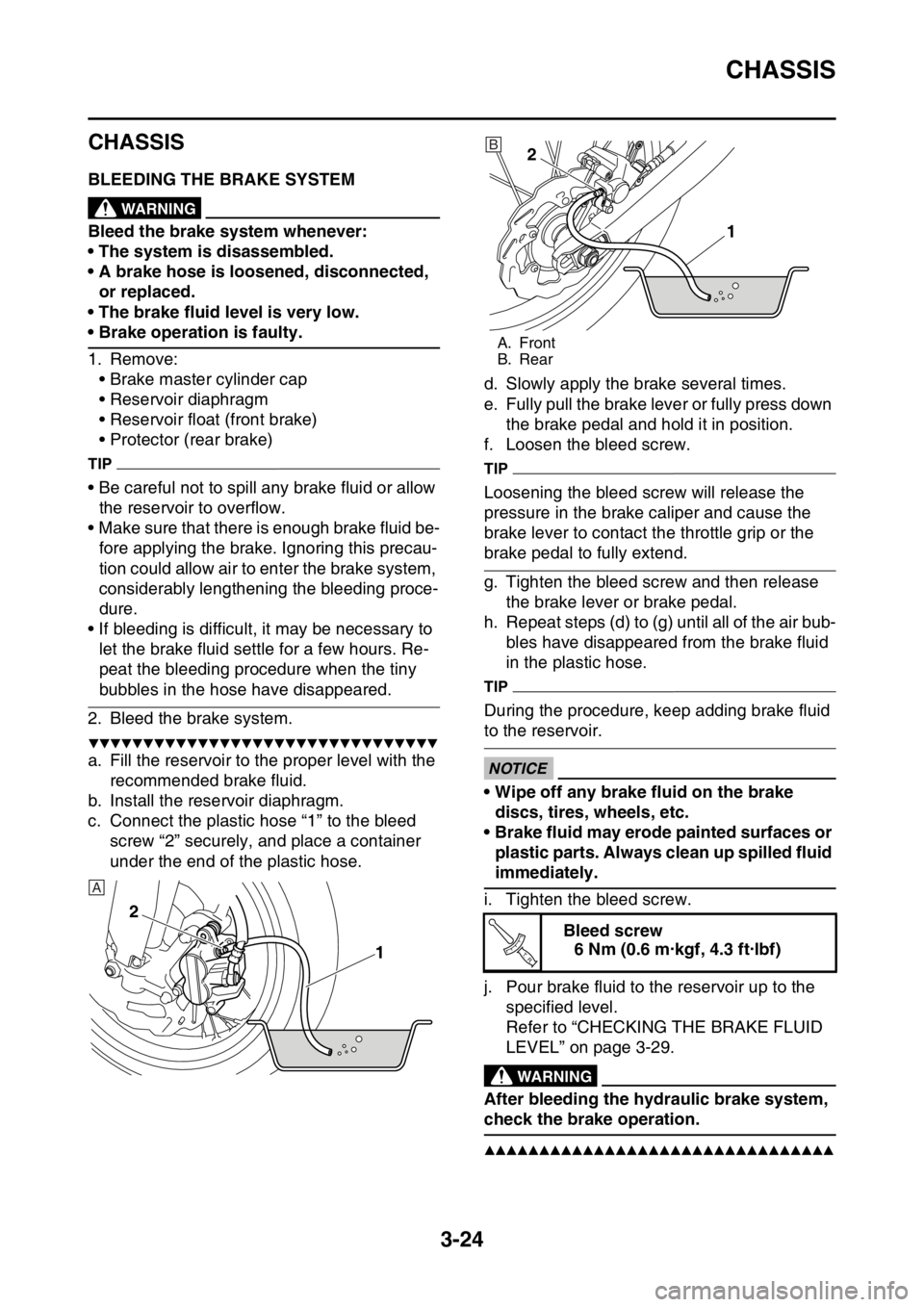
c. Connect the plastic hose “1” to the bleed
screw “2” securely, and place a container
under the end of the plastic hose.d. Slowly apply the brake several times.
e. Fully pull the brake lever or fully press down
the brake pedal and hold it in position.
f. Loosen the bleed screw.
TIP
Loosening the bleed screw will release the
pressure in the brake caliper and cause the
brake lever to contact the throttle grip or the
brake pedal to fully extend.
g. Tighten the bleed screw and then release
the brake lever or brake pedal.
h. Repeat steps (d) to (g) until all of the air bub-
bles have disappeared from the brake fluid
in the plastic hose.
TIP
During the procedure, keep adding brake fluid
to the reservoir.
ECA
NOTICE
• Wipe off any brake fluid on the brake
discs, tires, wheels, etc.
• Brake fluid may erode painted surfaces or
plastic parts. Always clean up spilled fluid
immediately.
i. Tighten the bleed screw.
j. Pour brake fluid to the reservoir up to the
specified level.
Refer to “CHECKING THE BRAKE FLUID
LEVEL” on page 3-29.
EWA
WARNING
After bleeding the hydraulic brake system,
check the brake operation.
▲▲▲▲▲▲▲▲▲▲▲▲▲▲▲▲▲▲▲▲▲▲▲▲▲▲▲▲▲▲▲▲
1 2
A
A. Front
B. Rear
Bleed screw
6 Nm (0.6 m·kgf, 4.3 ft·lbf)
2
1B
T R..
Page 129 of 430
CHASSIS
3-25
EAS2GB2105CHECKING THE BRAKE HOSE
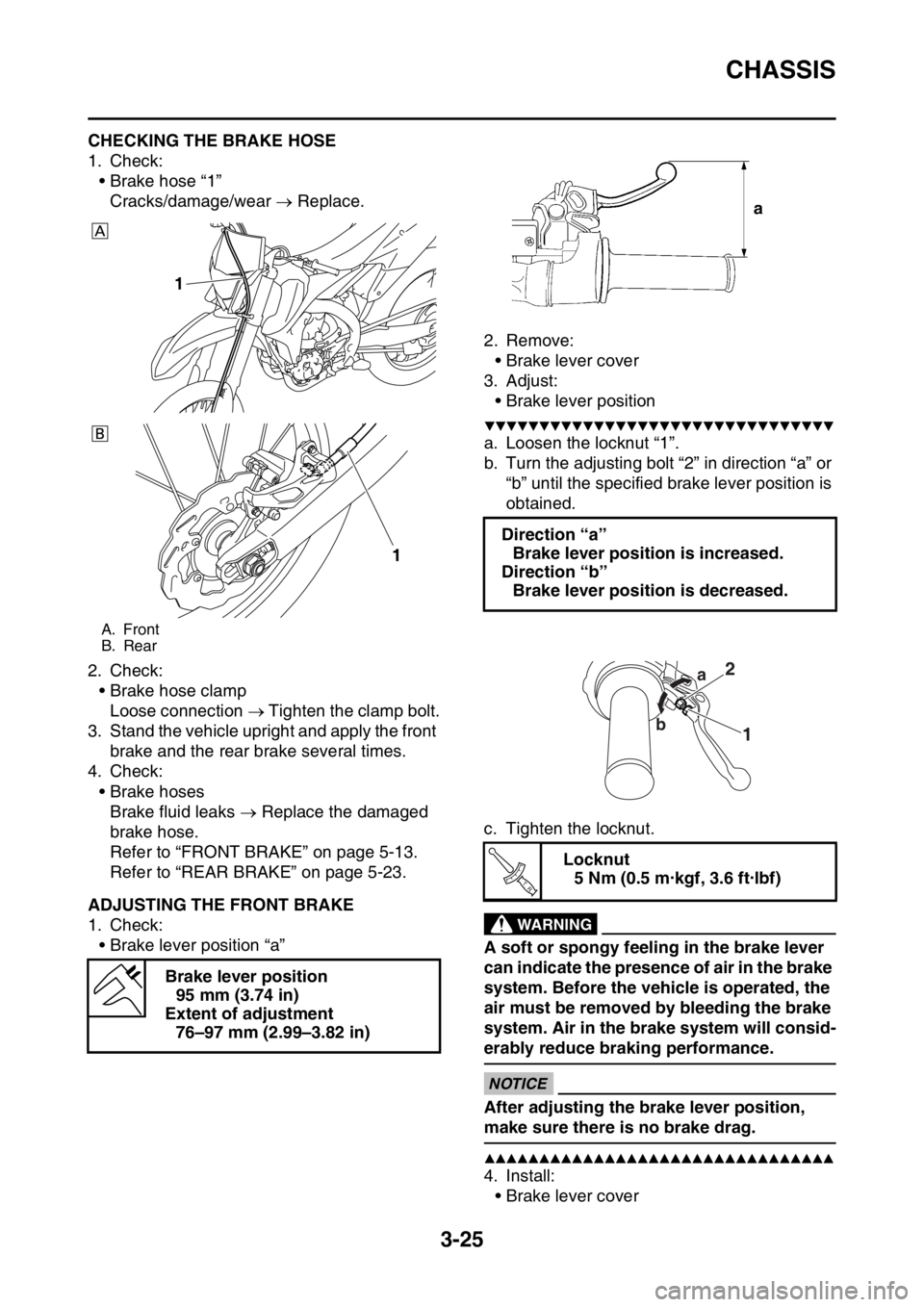
1. Check:
• Brake hose “1”
Cracks/damage/wear Replace.
2. Check:
• Brake hose clamp
Loose connection Tighten the clamp bolt.
3. Stand the vehicle upright and apply the front
brake and the rear brake several times.
4. Check:
• Brake hoses
Brake fluid leaks Replace the damaged
brake hose.
Refer to “FRONT BRAKE” on page 5-13.
Refer to “REAR BRAKE” on page 5-23.
EAS2GB2106ADJUSTING THE FRONT BRAKE
1. Check:
• Brake lever position “a”2. Remove:
• Brake lever cover
3. Adjust:
• Brake lever position
▼▼▼▼▼▼▼▼▼▼▼▼▼▼▼▼▼▼▼▼▼▼▼▼▼▼▼▼▼▼▼▼
a. Loosen the locknut “1”.
b. Turn the adjusting bolt “2” in direction “a” or
“b” until the specified brake lever position is
obtained.
c. Tighten the locknut.
EWA
WARNING
A soft or spongy feeling in the brake lever
can indicate the presence of air in the brake
system. Before the vehicle is operated, the
air must be removed by bleeding the brake
system. Air in the brake system will consid-
erably reduce braking performance.
ECA
NOTICE
After adjusting the brake lever position,
make sure there is no brake drag.
▲▲▲▲▲▲▲▲▲▲▲▲▲▲▲▲▲▲▲▲▲▲▲▲▲▲▲▲▲▲▲▲
4. Install:
• Brake lever cover
A. Front
B. Rear
Brake lever position
95 mm (3.74 in)
Extent of adjustment
76–97 mm (2.99–3.82 in)
1
1
Direction “a”
Brake lever position is increased.
Direction “b”
Brake lever position is decreased.
Locknut
5 Nm (0.5 m·kgf, 3.6 ft·lbf)
a
b
T R..