clutch YAMAHA XT600E 2000 Owners Manual
[x] Cancel search | Manufacturer: YAMAHA, Model Year: 2000, Model line: XT600E, Model: YAMAHA XT600E 2000Pages: 96, PDF Size: 4.23 MB
Page 13 of 96
12
3
4
5
6
7
8
9
EAU00026
DESCRIPTION
2-3
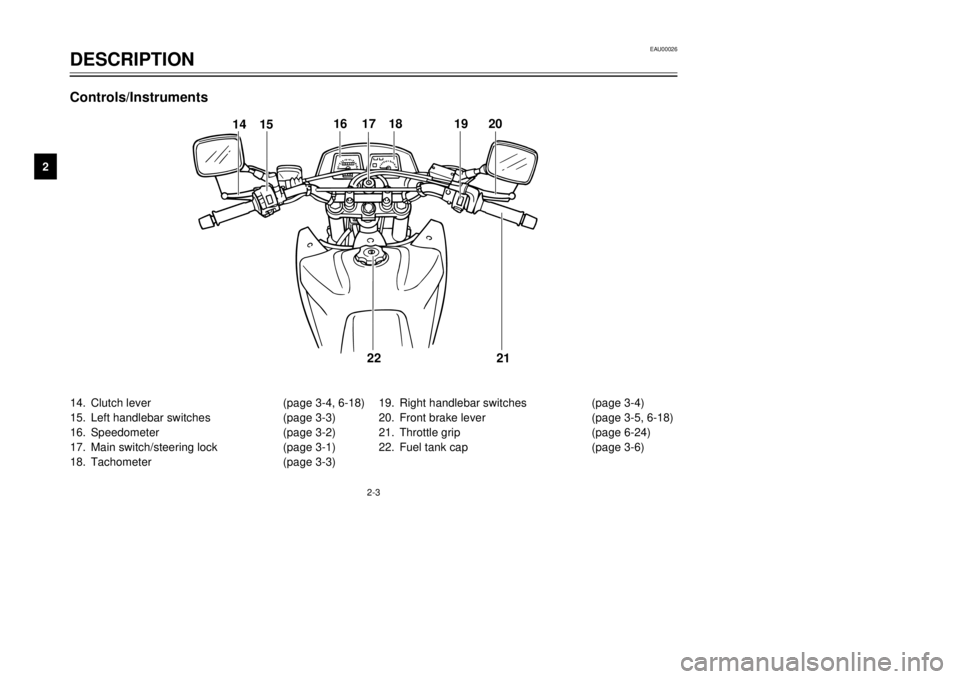
14.Clutch lever (page 3-4, 6-18)
15.Left handlebar switches (page 3-3)
16.Speedometer (page 3-2)
17.Main switch/steering lock (page 3-1)
18.Tachometer (page 3-3)19.Right handlebar switches (page 3-4)
20.Front brake lever (page 3-5, 6-18)
21.Throttle grip (page 6-24)
22.Fuel tank cap (page 3-6)
14
15161718
1920
21 22
Controls/Instruments
4PT-9-E6 (ENG) 1~5 12/27/00 1:28 PM Page 12
Page 14 of 96
INSTRUMENT AND CONTROL FUNCTIONSMain switch/steering lock.......................................................................3-1
Indicator lights.......................................................................................3-2
Speedometer.........................................................................................3-2
Tachometer...........................................................................................3-3
Handlebar switches...............................................................................3-3
Clutch lever............................................................................................3-4
Shift pedal..............................................................................................3-5
Front brake lever...................................................................................3-5
Rear brake pedal...................................................................................3-5
Fuel tank cap.........................................................................................3-6
Fuel........................................................................................................3-6
Fuel cock...............................................................................................3-7
Starter (choke) Ò
1Ó...............................................................................3-8
Seat.......................................................................................................3-9
Helmet holder........................................................................................3-9
Rear shock absorber adjustment.........................................................3-10
Sidestand.............................................................................................3-11
Sidestand/clutch switch operation check.............................................3-12
3
4PT-9-E6 (ENG) 1~5 12/27/00 1:28 PM Page 13
Page 18 of 96

3-4
1
2
,
EAU00138
Engine stop switch
The engine stop switch is a safety
device for use in an emergency such
as when the motorcycle overturns or
if trouble occurs in the throttle sys-
tem. Turn the switch to Ò#Ó to start
the engine.
In case of emergency, turn the switch
to Ò$Ó to stop the engine.1.Engine stop switch
2.Start switch Ò,Ó
INSTRUMENT AND CONTROL FUNCTIONS
1
23
4
5
6
7
8
9
EAU00143
Start switch Ò,Ó
The starter motor cranks the engine
when pushing the start switch.
EC000005
cCSee starting instructions prior to
starting the engine.
EAU00152
Clutch leverThe clutch lever is located on the left
handlebar, and the ignition circuit cut-
off system is incorporated in the
clutch lever holder. Pull the clutch
lever to the handlebar to disengage
the clutch, and release the lever to
engage the clutch. The lever should
be pulled rapidly and released slowly
for smooth clutch operation. (Refer to
the engine starting procedures for a
description of the ignition circuit cut-
off system.)
1
1.Clutch lever
4PT-9-E6 (ENG) 1~5 12/27/00 1:28 PM Page 17
Page 19 of 96
3-5
1
5
4
3
2
N
1
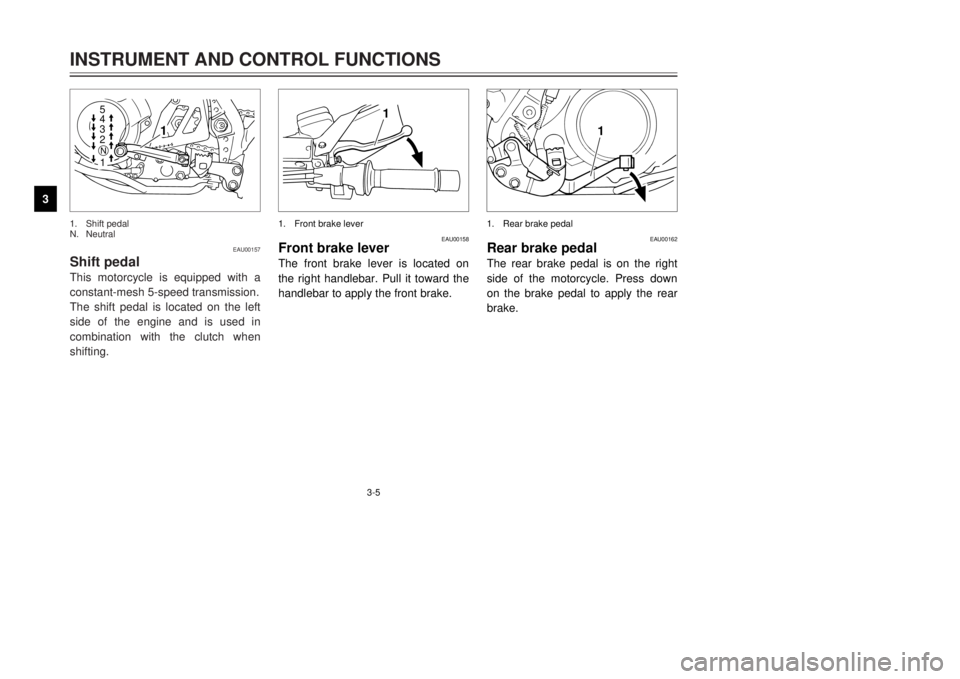
1.Shift pedal
N.Neutral
EAU00157
Shift pedalThis motorcycle is equipped with a
constant-mesh 5-speed transmission.
The shift pedal is located on the left
side of the engine and is used in
combination with the clutch when
shifting.INSTRUMENT AND CONTROL FUNCTIONS
1
23
4
5
6
7
8
9
1
EAU00158
Front brake leverThe front brake lever is located on
the right handlebar. Pull it toward the
handlebar to apply the front brake.
EAU00162
Rear brake pedalThe rear brake pedal is on the right
side of the motorcycle. Press down
on the brake pedal to apply the rear
brake.
1.Front brake lever
1
1.Rear brake pedal
4PT-9-E6 (ENG) 1~5 12/27/00 1:28 PM Page 18
Page 26 of 96

3-12
INSTRUMENT AND CONTROL FUNCTIONS
1
23
4
5
6
7
8
9
EAU00331
Sidestand/clutch switch
operation checkCheck the operation of the sidestand
switch and clutch switch against the
information below.
EW000045
wIf improper operation is noted,
consult a Yamaha dealer immedi-
ately.
TURN THE MAIN SWITCH TO ÒONÓ AND
THE ENGINE STOP SWITCH TO Ò#Ó.TRANSMISSION IS IN GEAR AND
SIDESTAND IS UP.PULL IN CLUTCH LEVER AND
PUSH THE START SWITCH.ENGINE WILL START.CLUTCH SWITCH IS OK.
SIDESTAND IS DOWN.ENGINE WILL STALL.SIDESTAND SWITCH IS OK.
4PT-9-E6 (ENG) 1~5 12/27/00 1:28 PM Page 25
Page 29 of 96

4-1
EAU01114
PRE-OPERATION CHECKS
1
2
34
5
6
7
8
9Owners are personally responsible for their vehicleÕs condition. Your motorcycleÕs vital functions can start to deteriorate
quickly and unexpectedly, even if it remains unused (for instance, if it is exposed to the elements). Any damage, fluid
leak or loss of tire pressure could have serious consequences. Therefore, it is very important that, in addition to a thor-
ough visual inspection, you check the following points before each ride.
EAU00340
PRE-OPERATION CHECK LIST
ITEMCHECKSPAGE
Front brake9Check operation, free play, fluid level and vehicle for fluid leakage.
9Fill with DOT 4 (or DOT 3) brake fluid if necessary.
Rear brake9Check operation, free play, fluid level and vehicle for fluid leakage.3-5, 6-18 ~ 6-22
9Fill with DOT 4 brake fluid if necessary.
Clutch9Check operation, condition and free play.
3-4, 6-18
9Adjust if necessary.
Throttle grip and housing9Check for smooth operation.
6-24
9Lubricate.
Engine oil9Check oil level.
6-10 ~ 6-12
9Fill with oil if necessary.
Drive chain9Check chain slack and condition.
6-22 ~ 6-24
9Adjust if necessary.
Wheels and tires9Check tire pressure, wear, damage and spoke tightness.
6-15 ~ 6-17
9Tighten spokes if necessary.
Control and meter cable9Check for smooth operation.
6-24
9Lubricate if necessary.
Brake and shift pedal shafts9Check for smooth operation.
6-25
9Lubricate if necessary.
Brake and clutch lever pivots9Check for smooth operation.
6-25
9Lubricate if necessary.
4PT-9-E6 (ENG) 1~5 12/27/00 1:28 PM Page 28
Page 33 of 96

5-1
EAU00373
w8 8
Before riding this motorcycle,
become thoroughly familiar
with all operating controls and
their functions. Consult a
Yamaha dealer regarding any
control or function that you do
not thoroughly understand.
8 8
Never start your engine or let
it run for any length of time in
a closed area. The exhaust
fumes are poisonous and can
cause loss of consciousness
and death within a short time.
Always operate your motorcy-
cle in an area with adequate
ventilation.
8 8
Before starting out, always be
sure the sidestand is up.
Failure to retract the sidestand
completely can result in a seri-
ous accident when you try to
turn a corner.
EAU03011
Starting the engineNOTE:
This motorcycle is equipped with an
ignition circuit cut-off system. The
engine can be started only under one
of the following conditions:
8The transmission is in neutral.
8The sidestand is up, the trans-
mission is in gear and the clutch
is disengaged.
The motorcycle must not be ridden
when the sidestand is down.
EW000054
wBefore going through the following
steps, check the function of the
sidestand switch and clutch
switch. (Refer to page 3-12.)
EAU00372
OPERATION AND IMPORTANT RIDING POINTS
1
2
3
45
6
7
8
94PT-9-E6 (ENG) 1~5 12/27/00 1:28 PM Page 32
Page 34 of 96

5-2
OPERATION AND IMPORTANT RIDING POINTS
1
2
3
45
6
7
8
9
IF THE TRANSMISSION IS IN NEUTRAL
AND THE SIDESTAND IS DOWN,
PUSH START SWITCH.THE ENGINE WILL START.RETRACT THE SIDESTAND AND PUT
THE TRANSMISSION IN GEAR.
THE MOTORCYCLE CAN BE RIDDEN.
THE MOTORCYCLE CAN BE RIDDEN.
IF THE TRANSMISSION IS IN GEAR
AND THE SIDESTAND IS UP, PULL IN THE CLUTCH LEVER AND
PUSH THE START SWITCH.
TURN THE MAIN SWITCH TO ÒONÓ AND
THE ENGINE STOP SWITCH TO Ò#Ó.
THE ENGINE WILL START.
4PT-9-E6 (ENG) 1~5 12/27/00 1:28 PM Page 33
Page 36 of 96
5-4
EAU00423
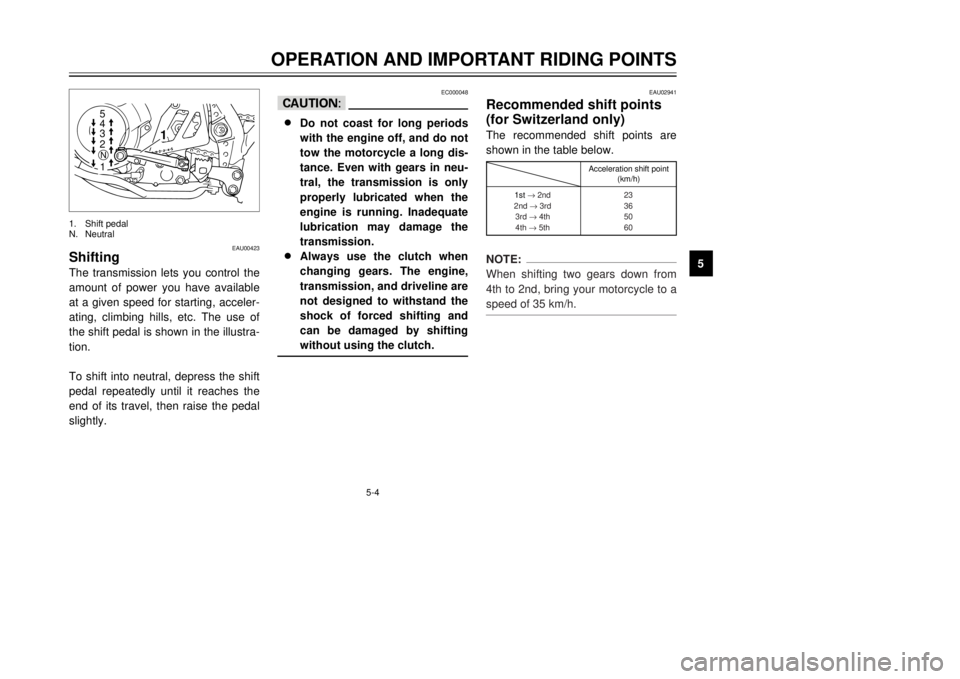
ShiftingThe transmission lets you control the
amount of power you have available
at a given speed for starting, acceler-
ating, climbing hills, etc. The use of
the shift pedal is shown in the illustra-
tion.
To shift into neutral, depress the shift
pedal repeatedly until it reaches the
end of its travel, then raise the pedal
slightly.
EC000048
cC8
8
Do not coast for long periods
with the engine off, and do not
tow the motorcycle a long dis-
tance. Even with gears in neu-
tral, the transmission is only
properly lubricated when the
engine is running. Inadequate
lubrication may damage the
transmission.
8 8
Always use the clutch when
changing gears. The engine,
transmission, and driveline are
not designed to withstand the
shock of forced shifting and
can be damaged by shifting
without using the clutch.
OPERATION AND IMPORTANT RIDING POINTS
1
2
3
45
6
7
8
9
1
5
4
3
2
N
1
1.Shift pedal
N.Neutral
EAU02941
Recommended shift points
(for Switzerland only)The recommended shift points are
shown in the table below.
Acceleration shift point
(km/h)
1st
®2nd23
2nd ®3rd36
3rd ®4th50
4th ®5th60
NOTE:
When shifting two gears down from
4th to 2nd, bring your motorcycle to a
speed of 35 km/h.
4PT-9-E6 (ENG) 1~5 12/27/00 1:28 PM Page 35
Page 37 of 96

5-5
EAU00436
Engine break-inThere is never a more important peri-
od in the life of your motorcycle than
the period between zero and 1,000
km. For this reason we ask that you
carefully read the following material.
Because the engine is brand new,
you must not put an excessive load
on it for the first 1,000 km. The vari-
ous parts in the engine wear and pol-
ish themselves to the correct operat-
ing clearances. During this period,
prolonged full throttle operation, or
any condition which might result in
excessive heating of the engine,
must be avoided.
EAU00440
0 ~ 150 km
Avoid operation above 4,000 r/min.
Stop the engine and let it cool for 5 to
10 minutes after every hour of opera-
tion. Vary the speed of the motorcy-
cle from time to time. Do not operate
it at one set throttle position.
150 ~ 500 km
Avoid prolonged operation above
5,000 r/min. Rev the motorcycle
freely through the gears, but do not
use full throttle at any time.
500 ~ 1,000 km
Avoid prolonged full throttle opera-
tion. Avoid cruising speeds in excess
of 6,000 r/min.
OPERATION AND IMPORTANT RIDING POINTS
1
2
3
45
6
7
8
9
EAU00424
Tips for reducing fuel
consumptionYour motorcycleÕs fuel consumption
depends to a large extent on your rid-
ing style. The following tips can help
reduce fuel consumption:
8Warm up the engine before rid-
ing.
8Turn off the starter (choke) as
soon as possible.
8Shift up swiftly and avoid high
engine speeds during accelera-
tion.
8Do not double-clutch or rev the
engine while shifting down and
avoid high engine speeds with
no load on the engine.
8Turn off the engine instead of let-
ting it idle for an extended length
of time, i.e. in traffic jams, at traf-
fic lights or railroad crossings.
4PT-9-E6 (ENG) 1~5 12/27/00 1:28 PM Page 36