sensor ACURA TL 1995 Service Repair Manual
[x] Cancel search | Manufacturer: ACURA, Model Year: 1995, Model line: TL, Model: ACURA TL 1995Pages: 1771, PDF Size: 62.49 MB
Page 1160 of 1771
Troubleshooting
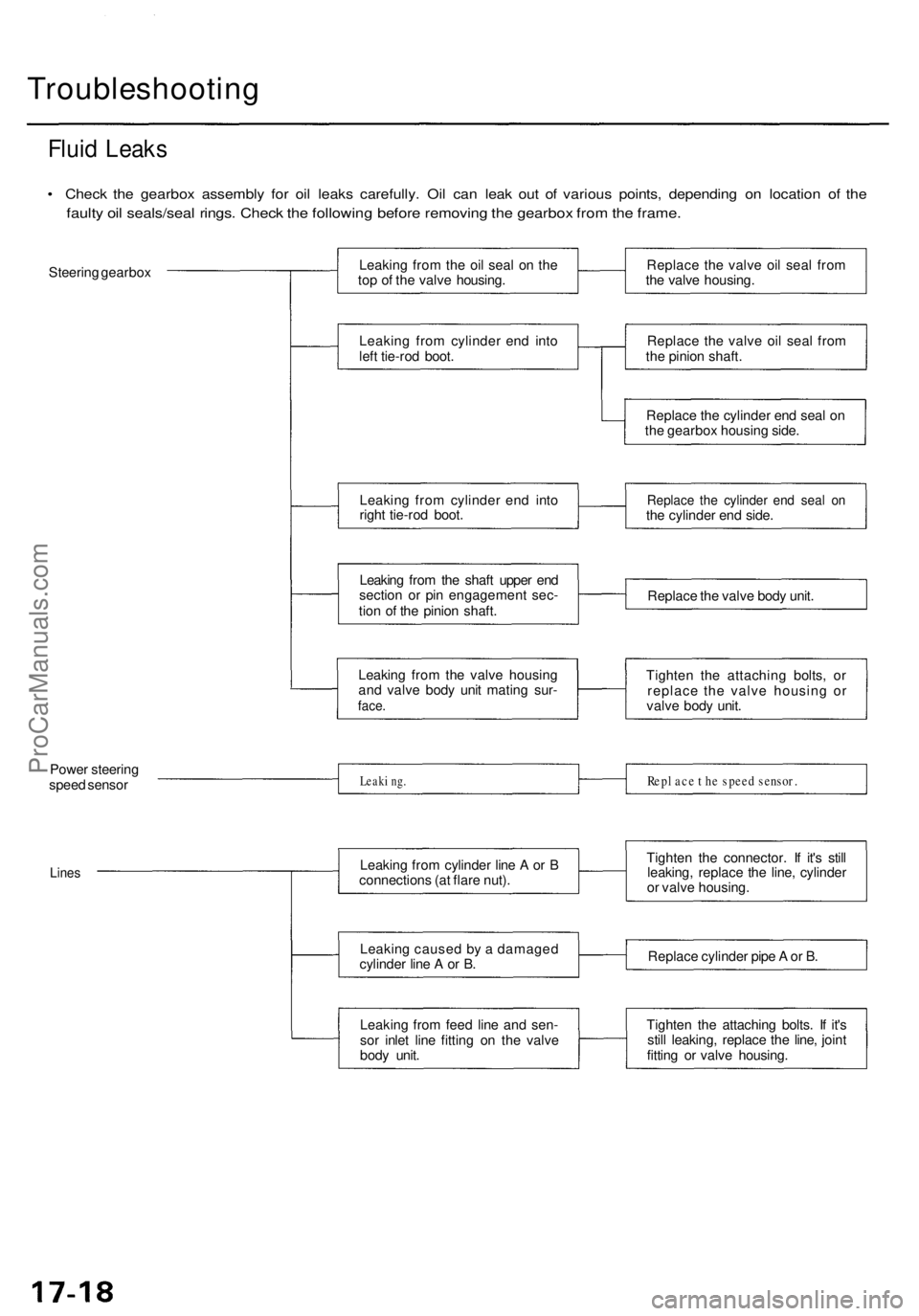
Fluid Leak s
• Chec k th e gearbo x assembl y fo r oi l leak s carefully . Oi l ca n lea k ou t o f variou s points , dependin g o n locatio n o f th e
fault y oi l seals/sea l rings . Chec k th e followin g befor e removin g th e gearbo x fro m th e frame .
Steerin g gearbo x Leakin
g fro m th e oi l sea l o n th e
to p o f th e valv e housing .
Leakin g fro m cylinde r en d int o
lef t tie-ro d boot .
Leakin g fro m cylinde r en d int o
righ t tie-ro d boot .
Leakin g fro m th e shaf t uppe r en d
sectio n o r pi n engagemen t sec -
tio n o f th e pinio n shaft .
Leakin g fro m th e valv e housin g
an d valv e bod y uni t matin g sur -
face .
Replac e th e valv e oi l sea l fro m
th e valv e housing .
Replac e th e valv e oi l sea l fro m
th e pinio n shaft .
Replac e th e cylinde r en d sea l o n
th e gearbo x housin g side .
Replac e th e cylinde r en d sea l o nthe cylinde r en d side .
Replac e th e valv e bod y unit .
Tighte n th e attachin g bolts , o r
replac e th e valv e housin g o r
valv e bod y unit .
Powe r steerin g
spee d senso r
Leaking .Replace th e spee d sensor .
LinesLeakin g fro m cylinde r lin e A or B
connection s (a t flar e nut) .
Leakin g cause d b y a damage d
cylinde r lin e A or B .
Leakin g fro m fee d lin e an d sen -
so r inle t lin e fittin g o n th e valv e
bod y unit . Tighte
n th e connector . I f it' s stil l
leaking , replac e th e line , cylinde r
o r valv e housing .
Replac e cylinde r pip e A or B .
Tighte n th e attachin g bolts . I f it' s
stil l leaking , replac e th e line , join t
fittin g o r valv e housing .
ProCarManuals.com
Page 1162 of 1771
Inspection an d Adjustmen t
Steering Operatio n
Place th e fron t wheel s i n th e straigh t ahea d position ,
an d measur e th e distanc e th e steerin g whee l ca n b e
turne d withou t movin g th e fron t wheels .
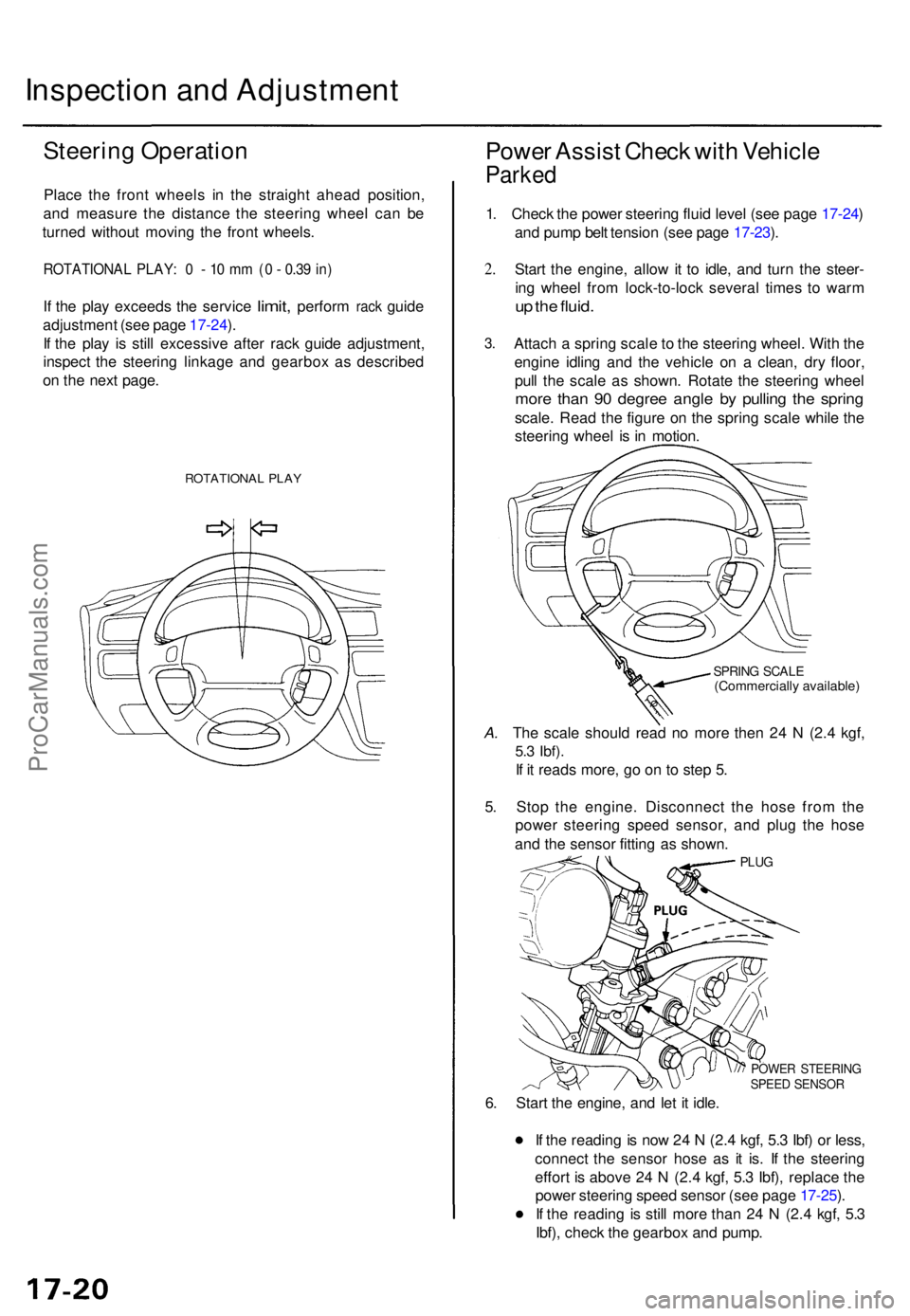
ROTATIONA L PLAY : 0 - 10 m m (0 - 0.3 9 in )
If th e pla y exceed s the servic e limit, perfor m rack guid e
adjustmen t (se e pag e 17-24 ).
I f th e pla y i s stil l excessiv e afte r rac k guid e adjustment ,
inspec t th e steerin g linkag e an d gearbo x a s describe d
o n th e nex t page .
ROTATIONA L PLA Y
Powe r Assis t Chec k wit h Vehicl e
Parked
1. Chec k th e powe r steerin g flui d leve l (se e pag e 17-24 )
an d pum p bel t tensio n (se e pag e 17-23 ).
2 .
3 .
Star t th e engine , allo w it t o idle , an d tur n th e steer -
in g whee l fro m lock-to-loc k severa l time s t o war m
up th e fluid .
Attac h a sprin g scal e to th e steerin g wheel . Wit h th e
engin e idlin g an d th e vehicl e o n a clean , dr y floor ,
pul l th e scal e a s shown . Rotat e th e steerin g whee l
more tha n 9 0 degre e angl e b y pullin g th e sprin g
scale. Rea d th e figur e o n th e sprin g scal e whil e th e
steerin g whee l i s i n motion .
SPRING SCAL E(Commerciall y available )
A. Th e scal e shoul d rea d n o mor e the n 2 4 N (2. 4 kgf ,
5.3 Ibf) .
If i t read s more , g o o n t o ste p 5 .
5 . Sto p th e engine . Disconnec t th e hos e fro m th e
powe r steerin g spee d sensor , an d plu g th e hos e
an d th e senso r fittin g a s shown .
PLUG
POWE R STEERIN GSPEED SENSO R
6. Star t th e engine , an d le t i t idle .
I f th e readin g is no w 2 4 N (2. 4 kgf , 5. 3 Ibf ) o r less ,
connec t th e senso r hos e a s i t is . I f th e steerin g
effor t i s abov e 2 4 N (2. 4 kgf , 5. 3 Ibf) , replac e th e
powe r steerin g spee d senso r (se e pag e 17-25 ).
I f th e readin g i s stil l mor e tha n 2 4 N (2. 4 kgf , 5. 3
Ibf) , chec k th e gearbo x an d pump .
ProCarManuals.com
Page 1163 of 1771

Assist Chec k a t Roa d Spee d
1. Chec k th e powe r steerin g flui d leve l (se e pag e 17-24 ),
an d chec k th e pum p bel t tensio n (se e pag e 17-23 ).
2 .
3 .
Star t th e engine , le t i t war m u p t o norma l operatin g
temperature , an d tur n th e steerin g whee l lock-to-loc k
a fe w time s t o war m u p th e fluid .
Stop th e engine . T o simulat e speed s abov e 6 2 mp h
(100 km/h) , disconnec t th e hose s fro m th e powe r
steerin g spee d senso r an d connec t the m to th e spe -
cia l tool . Plu g th e en d o f th e specia l tool .
Instal l a plug .
BYPAS S TUB E JOIN T07406-001010 1(Included wit h07406-001000 A or07406-0010001 )
POWER STEERIN GSPEED SENSO R
4. Attac h th e sprin g scal e t o th e steerin g wheel . Wit h
the engin e idlin g an d th e vehicl e o n a clean , dr y
floor , pul l th e scal e a s shown . Rotat e th e steerin g
whee l mor e tha n 9 0 degree s b y pullin g th e sprin g
scale . Rea d th e figur e o n th e sprin g scal e whil e th e
steerin g whee l i s i n motion .
SPRING SCAL E(Commerciall y available )
• I f th e scal e read s les s tha n 2 4 N (2. 4 kgf , 5. 3 Ibf) ,
th e powe r steerin g spee d senso r i s O K an d th e
proble m is i n th e senso r fee d line , th e pump , th e
powe r steerin g spee d sensor , o r th e valv e bod y
unit . Se e i f th e fee d lin e i s pinche d o r bent , the n
chec k th e pump .
• Se e Genera l Troubleshootin g (se e pag e 17-12 ).
Powe r Steerin g Spee d Senso r
Replacemen t
1. Disconnec t th e vehicl e spee d senso r (VSS ) wir e con -
necto r fro m th e powe r steerin g spee d sensor .
SENSO R HOSE S
VSS WIR E CONNECTO R
POWER STEERIN GSPEED SENSO R
SENSOR MOUNTIN G BOL T6 x 1. 0 m m12 N- m11.2 kgf-m , 9 Ibf-ft )
2. Remov e th e senso r mountin g bolt , an d remov e th e
powe r steerin g spee d senso r fro m th e differentia l
housing .
3 . Disconnec t th e senso r hose s an d plu g th e fittings .
4 . Afte r installin g a ne w powe r steerin g spee d sensor ,
tur n th e steerin g whee l lock-to-loc k wit h th e engin e
idlin g t o blee d ai r fro m th e system .
5 . Chec k th e reservoir , an d ad d flui d if necessary .
ProCarManuals.com
Page 1179 of 1771
Power Steering Hoses and Lines
Replacement
NOTE:
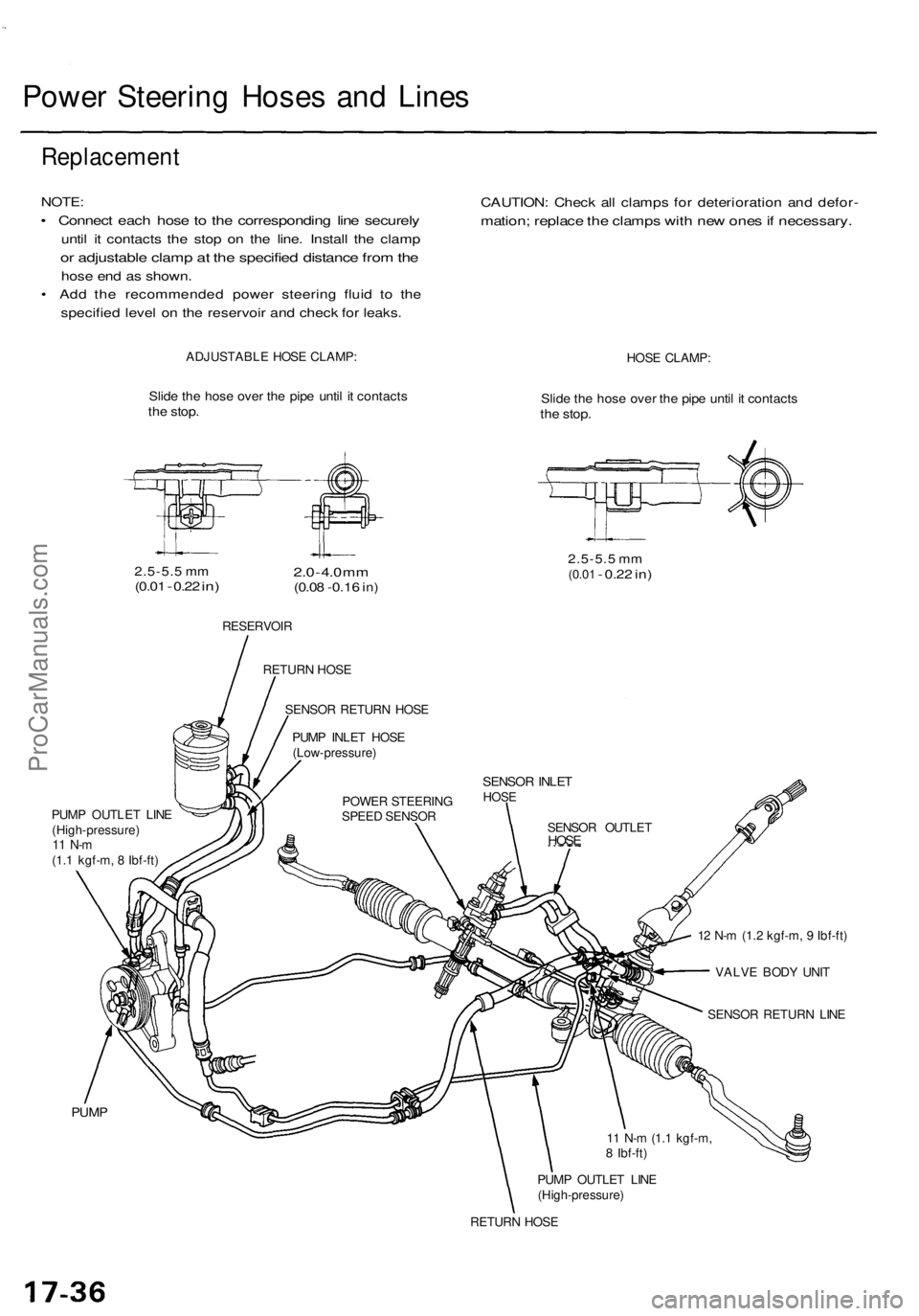
• Connect each hose to the corresponding line securely
until it contacts the stop on the line. Install the clamp
or adjustable clamp at the specified distance from the
hose end as shown.
• Add the recommended power steering fluid to the
specified level on the reservoir and check for leaks.
CAUTION: Check all clamps for deterioration and defor-
mation; replace the clamps with new ones if necessary.
ADJUSTABLE HOSE CLAMP:
HOSE CLAMP:
Slide the hose over the pipe until it contacts
the stop.
Slide the hose over the pipe until it contacts
the stop.
2.5-5.5 mm
(0.01
-
0.22
in)
2.0
-
4.0
mm
(0.08 -0.16
in)
2.5-5.5 mm
(0.01
-
0.22
in)
RESERVOIR
PUMP OUTLET LINE
(High-pressure)
11 N-m
(1.1 kgf-m, 8 Ibf-ft)
12 N-m (1.2 kgf-m, 9 Ibf-ft)
VALVE BODY UNIT
SENSOR RETURN LINE
PUMP
PUMP OUTLET LINE
(High-pressure)
RETURN HOSE
11 N-m (1.1 kgf-m,
8 Ibf-ft)
SENSOR OUTLET
HOSE
SENSOR INLET
HOSE
POWER STEERING
SPEED SENSOR
PUMP INLET HOSE
(Low-pressure)
SENSOR RETURN HOSE
RETURN HOSEProCarManuals.com
Page 1191 of 1771
Steering Gearbo x
Remova l
NOTE: Us e solven t an d a brus h t o was h of f an y oi l an d
dirt fro m th e valv e bod y unit , it s lines , an d th e en d o f
the gearbox . Blo w dr y wit h compresse d air .
1. Drai n th e powe r steerin g flui d a s describe d o n pag e
17-24 .
2. Rais e th e fron t o f vehicle , an d suppor t i t o n safet y
stands in th e prope r locations , (se e sectio n 1 )
3 . Remov e th e fron t wheels .
4 . Remov e th e driver' s airba g assembl y an d steerin g
whee l (se e pag e 17-27 ).
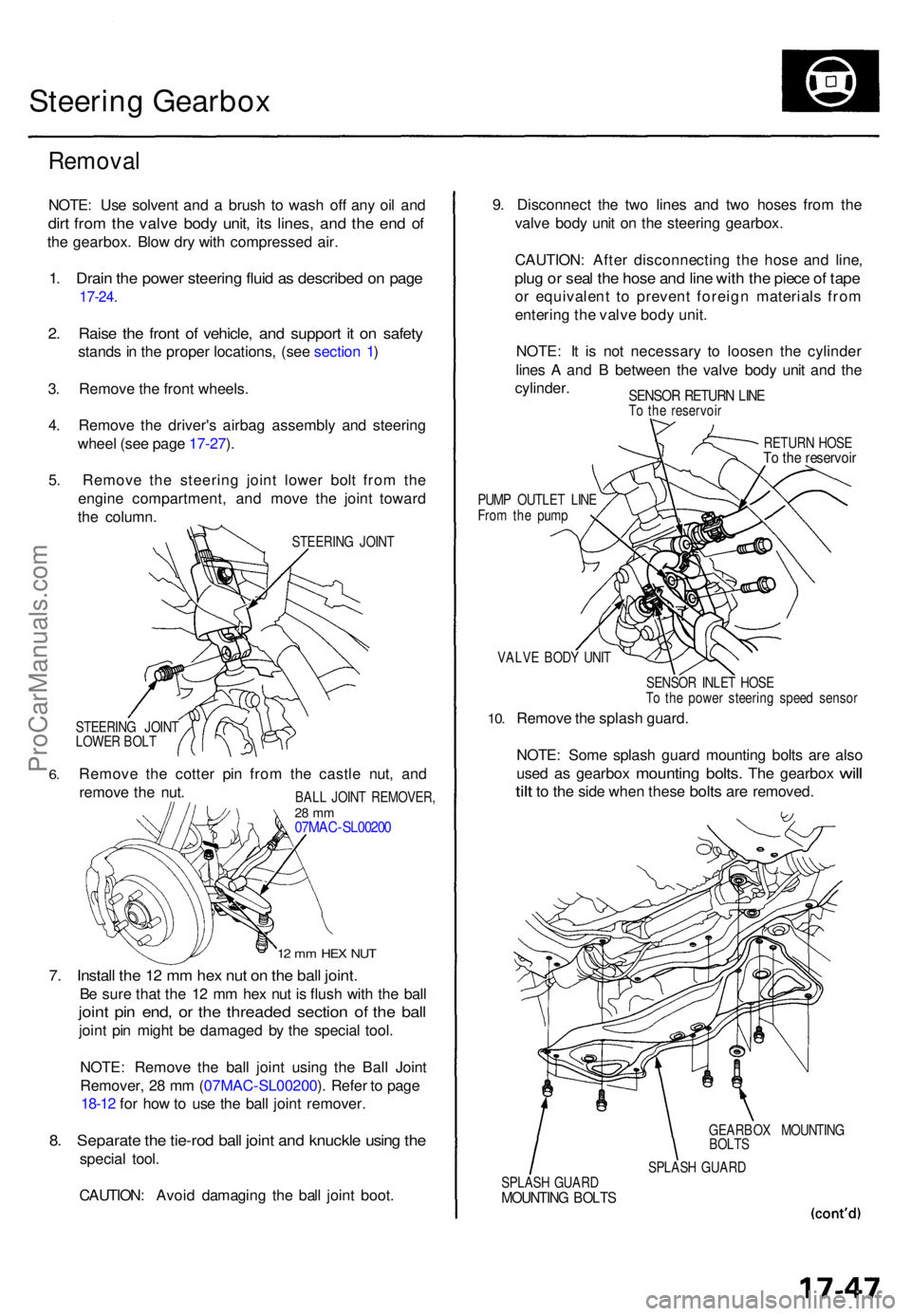
5 . Remov e th e steerin g join t lowe r bol t fro m th e
engin e compartment , an d mov e th e join t towar d
th e column .
STEERIN G JOIN T
6.
STEERIN G JOIN T
LOWE R BOL T
Remov e th e cotte r pi n fro m th e castl e nut , an d
remov e th e nut .
12 m m HE X NU T
7. Instal l th e 1 2 m m he x nu t o n th e bal l joint .
Be sur e tha t th e 1 2 m m he x nu t i s flus h wit h th e bal l
joint pi n end , o r th e threade d sectio n o f th e bal l
joint pi n migh t b e damage d b y th e specia l tool .
NOTE : Remov e th e bal l join t usin g th e Bal l Join t
Remover , 2 8 m m (07MA C-SL00200 ). Refe r t o pag e
18-12 for ho w to us e th e bal l join t remover .
8. Separat e th e tie-ro d bal l join t an d knuckl e usin g th e
specia l tool .
CAUTION : Avoi d damagin g th e bal l join t boot . 9
. Disconnec t th e tw o line s an d tw o hose s fro m th e
valv e bod y uni t o n th e steerin g gearbox .
CAUTION : Afte r disconnectin g th e hos e an d line ,
plug o r sea l th e hos e an d lin e wit h th e piec e o f tap e
or equivalen t t o preven t foreig n material s fro m
enterin g th e valv e bod y unit .
NOTE : I t i s no t necessar y t o loose n th e cylinde r
line s A an d B betwee n th e valv e bod y uni t an d th e
cylinder .
SENSOR RETUR N LIN ETo th e reservoi r
RETURN HOS E
To th e reservoi r
PUMP OUTLE T LIN E
Fro m th e pum p
VALV E BOD Y UNI T
10.
SENSO R INLE T HOS E
T o th e powe r steerin g spee d senso r
Remove th e splas h guard .
NOTE : Som e splas h guar d mountin g bolt s ar e als o
use d
as gearbo x mountin g bolts. The gearbo x will
til t
to th e sid e whe n thes e bolts are removed .
GEARBO X MOUNTIN G
BOLT S
SPLAS H GUAR D
SPLAS H GUAR D
MOUNTIN G BOLT S
BALL JOIN T REMOVER ,28 m m07MA C-SL0020 0
ProCarManuals.com
Page 1192 of 1771
Steering Gearbo x
Remova l (cont'd )
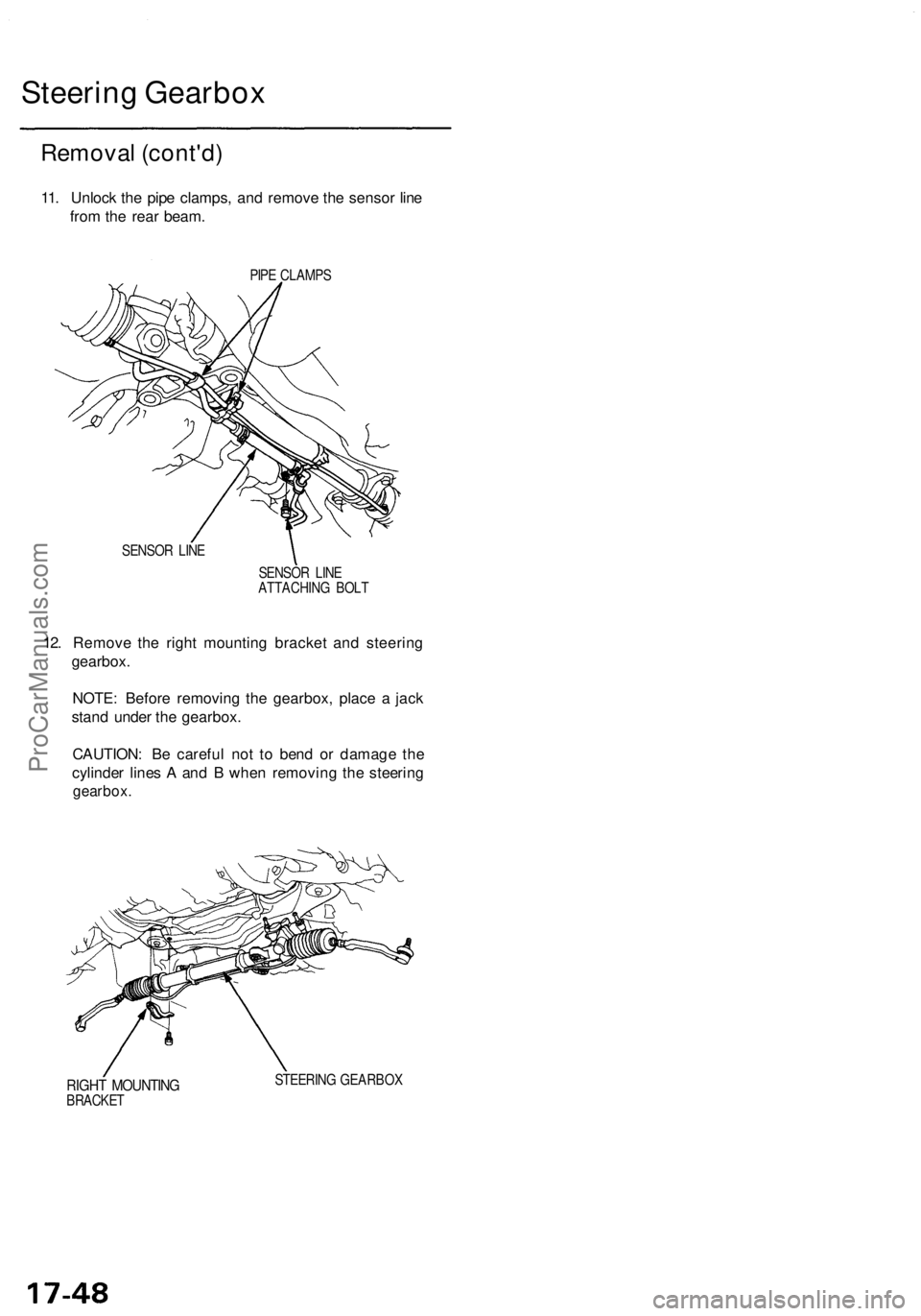
11. Unloc k th e pip e clamps , an d remov e th e senso r lin e
fro m th e rea r beam .
PIPE CLAMP S
SENSO R LIN E
SENSOR LIN E
ATTACHIN G BOL T
12. Remov e th e righ t mountin g bracke t an d steerin g
gearbox .
NOTE : Befor e removin g th e gearbox , plac e a jac k
stan d unde r th e gearbox .
CAUTION : B e carefu l no t t o ben d o r damag e th e
cylinde r line s A an d B whe n removin g th e steerin g
gearbox .
RIGHT MOUNTIN GBRACKET STEERIN
G GEARBO X
ProCarManuals.com
Page 1286 of 1771
Anti-lock Brake System (ABS)
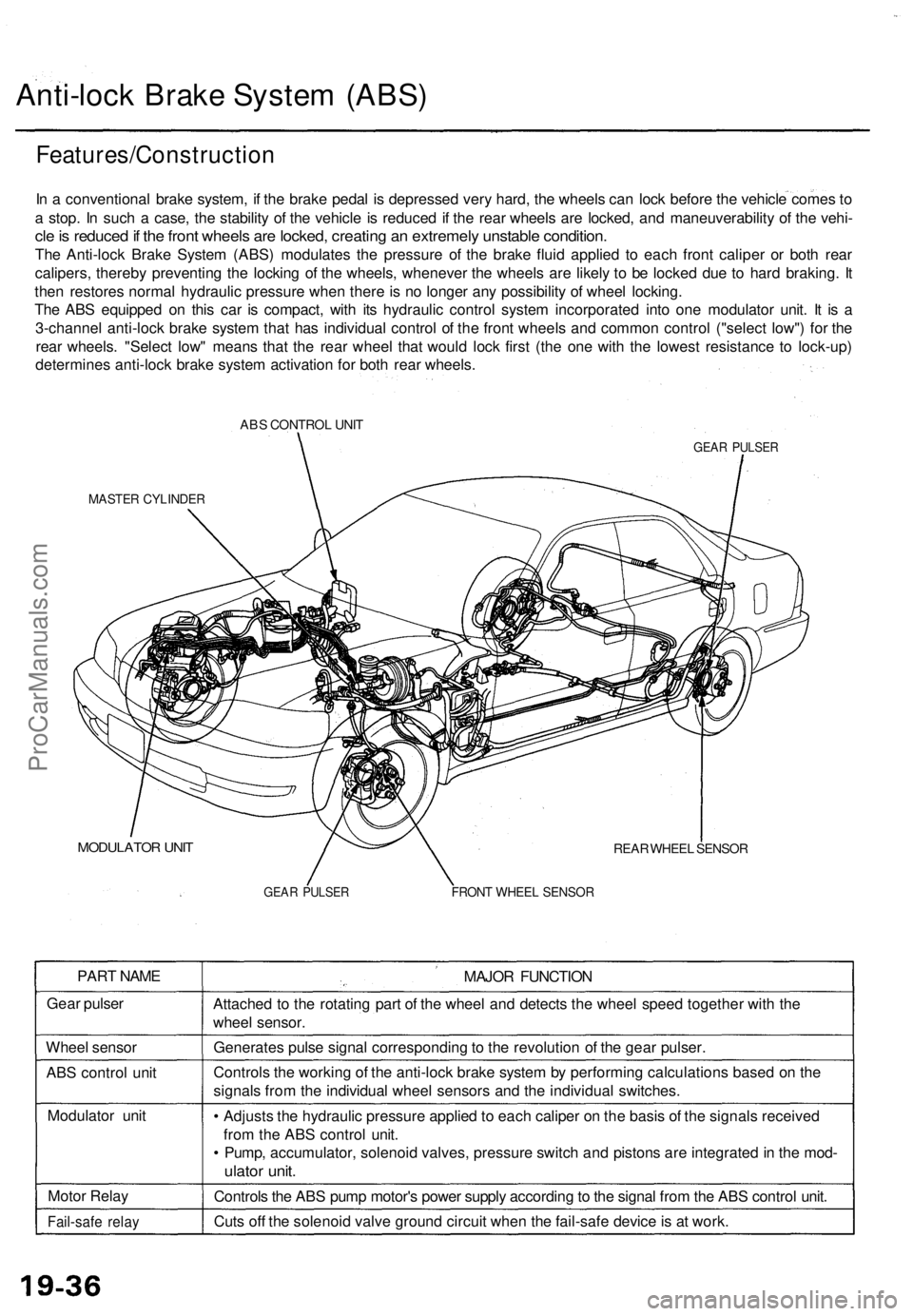
Features/Construction
In a conventional brake system, if the brake pedal is depressed very hard, the wheels can lock before the vehicle comes to
a stop. In such a case, the stability of the vehicle is reduced if the rear wheels are locked, and maneuverability of the vehi-
cle is reduced if the front wheels are locked, creating an extremely unstable condition.
The Anti-lock Brake System (ABS) modulates the pressure of the brake fluid applied to each front caliper or both rear
calipers, thereby preventing the locking of the wheels, whenever the wheels are likely to be locked due to hard braking. It
then restores normal hydraulic pressure when there is no longer any possibility of wheel locking.
The ABS equipped on this car is compact, with its hydraulic control system incorporated into one modulator unit. It is a
3-channel anti-lock brake system that has individual control of the front wheels and common control ("select low") for the
rear wheels. "Select low" means that the rear wheel that would lock first (the one with the lowest resistance to lock-up)
determines anti-lock brake system activation for both rear wheels.
ABS CONTROL UNIT
GEAR PULSER
MASTER CYLINDER
MODULATOR UNIT
REAR WHEEL SENSOR
GEAR PULSER
FRONT WHEEL SENSOR
PART NAME
Gear pulser
Wheel sensor
ABS control unit
Modulator unit
Motor Relay
Fail-safe relay
MAJOR FUNCTION
Attached to the rotating part of the wheel and detects the wheel speed together with the
wheel sensor.
Generates pulse signal corresponding to the revolution of the gear pulser.
Controls the working of the anti-lock brake system by performing calculations based on the
signals from the individual wheel sensors and the individual switches.
• Adjusts the hydraulic pressure applied to each caliper on the basis of the signals received
from the ABS control unit.
• Pump, accumulator, solenoid valves, pressure switch and pistons are integrated in the mod-
ulator unit.
Controls the ABS pump motor's power supply according to the signal from the ABS control unit.
Cuts off the solenoid valve ground circuit when the fail-safe device is at work.ProCarManuals.com
Page 1290 of 1771
Anti-lock Brake System (ABS)
Features/Construction (cont'd)
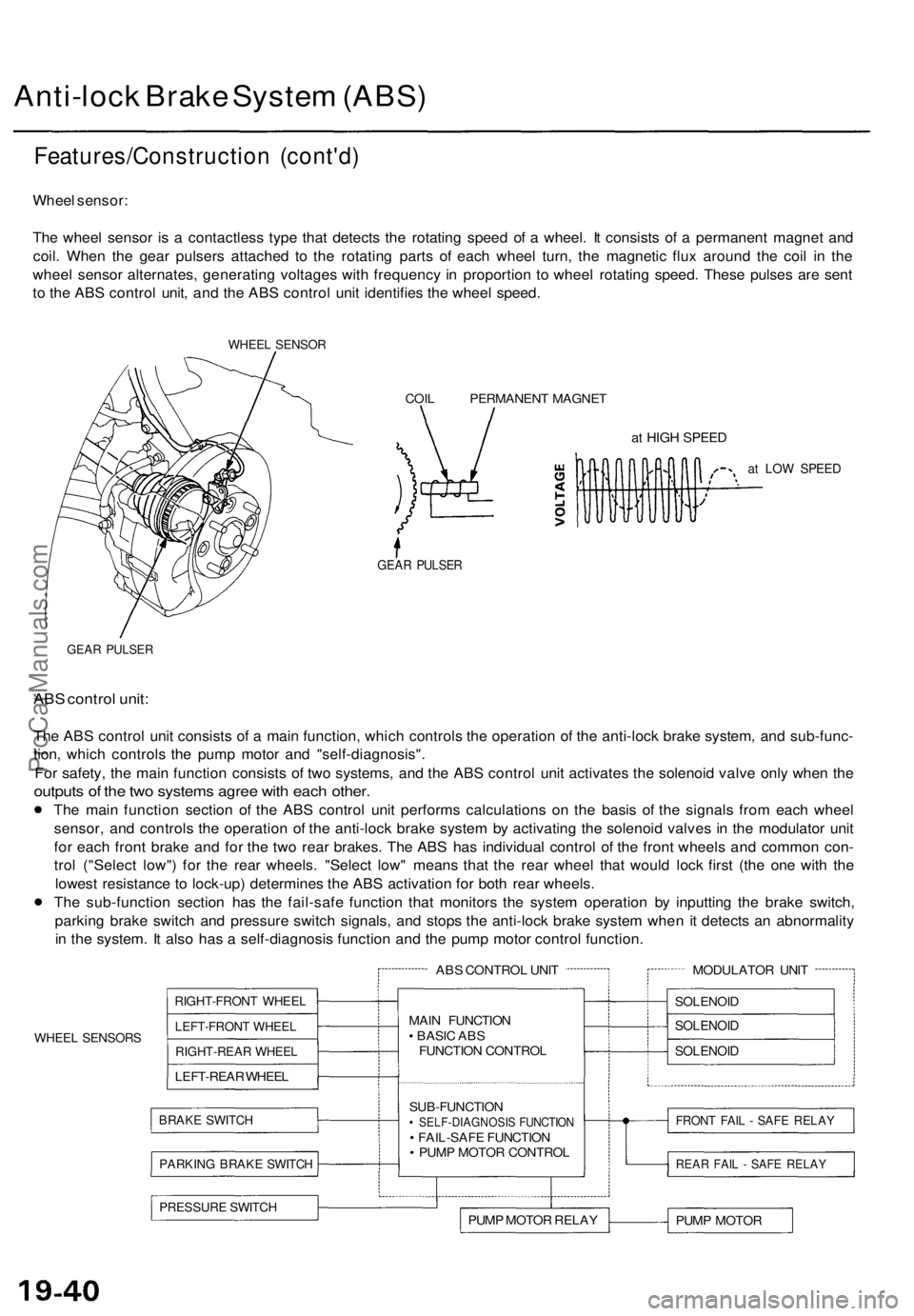
Wheel sensor:
The wheel sensor is a contactless type that detects the rotating speed of a wheel. It consists of a permanent magnet and
coil. When the gear pulsers attached to the rotating parts of each wheel turn, the magnetic flux around the coil in the
wheel sensor alternates, generating voltages with frequency in proportion to wheel rotating speed. These pulses are sent
to the ABS control unit, and the ABS control unit identifies the wheel speed.
WHEEL SENSOR
COIL PERMANENT MAGNET
at HIGH SPEED
at LOW SPEED
GEAR PULSER
GEAR PULSER
ABS control unit:
The ABS control unit consists of a main function, which controls the operation of the anti-lock brake system, and sub-func-
tion, which controls the pump motor and "self-diagnosis".
For safety, the main function consists of two systems, and the ABS control unit activates the solenoid valve only when the
outputs of the two systems agree with each other.
The main function section of the ABS control unit performs calculations on the basis of the signals from each wheel
sensor, and controls the operation of the anti-lock brake system by activating the solenoid valves in the modulator unit
for each front brake and for the two rear brakes. The ABS has individual control of the front wheels and common con-
trol ("Select low") for the rear wheels. "Select low" means that the rear wheel that would lock first (the one with the
lowest resistance to lock-up) determines the ABS activation for both rear wheels.
The sub-function section has the fail-safe function that monitors the system operation by inputting the brake switch,
parking brake switch and pressure switch signals, and stops the anti-lock brake system when it detects an abnormality
in the system. It also has a self-diagnosis function and the pump motor control function.
WHEEL SENSORS
ABS CONTROL UNIT
RIGHT-FRONT WHEEL
LEFT-FRONT WHEEL
RIGHT-REAR WHEEL
LEFT-REAR WHEEL
BRAKE SWITCH
PARKING BRAKE SWITCH
MAIN FUNCTION
• BASIC ABS
FUNCTION CONTROL
SUB-FUNCTION
• SELF-DIAGNOSIS FUNCTION
• FAIL-SAFE FUNCTION
• PUMP MOTOR CONTROL
PRESSURE SWITCH
PUMP MOTOR RELAY
MODULATOR UNIT
SOLENOID
SOLENOID
SOLENOID
FRONT FAIL - SAFE RELAY
REAR FAIL - SAFE RELAY
PUMP MOTORProCarManuals.com
Page 1291 of 1771
Pump motor control:
The ABS control unit monitors the brake fluid pressure in the accumulator by the pressure switch ON/OFF signals. The
ABS control unit turns the pump on when the pressure in the accumulator drops, and stops the pump when the pressure
rises to the specified value.
If the pressure does not reach the specified value after the motor has operated continuously for a specified period, the
ABS control unit stops the motor and activates the ABS indicator light.
Self-diagnosis function:
The self-diagnosis function, provided in the sub-function of the ABS control unit, monitors the main system functions by
constantly transmitting the data between the two Central Processing Units (CPUs). When an abnormality is detected, the
ABS control unit turns the ABS indicator light on and stops the ABS, although the basic brake system continues to operate
normally.
When the ABS control unit detects an abnormality with the ABS and turns the ABS indicator light on, the diagnostic trou-
ble code (DTC), which shows the problem part or unit, is recorded in the control unit. The DTC can be read by the blinking
frequency of the ABS indicator light.
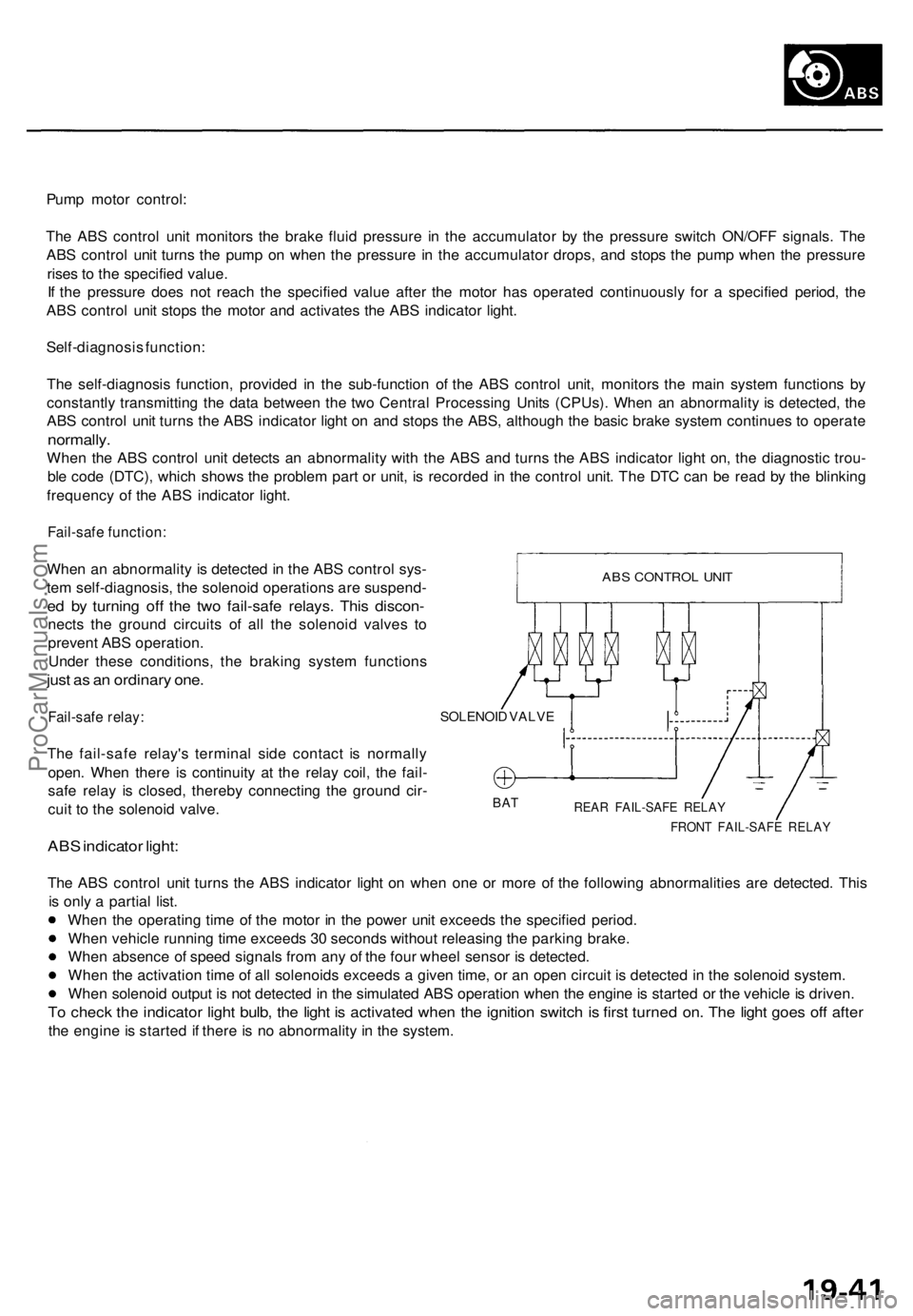
Fail-safe function:
When an abnormality is detected in the ABS control sys-
tem self-diagnosis, the solenoid operations are suspend-
ed by turning off the two fail-safe relays. This discon-
nects the ground circuits of all the solenoid valves to
prevent ABS operation.
Under these conditions, the braking system functions
just as an ordinary one.
Fail-safe relay:
The fail-safe relay's terminal side contact is normally
open. When there is continuity at the relay coil, the fail-
safe relay is closed, thereby connecting the ground cir-
cuit to the solenoid valve.
ABS indicator light:
SOLENOID VALVE
BAT
REAR FAIL-SAFE RELAY
FRONT FAIL-SAFE RELAY
The ABS control unit turns the ABS indicator light on when one or more of the following abnormalities are detected. This
is only a partial list.
When the operating time of the motor in the power unit exceeds the specified period.
When vehicle running time exceeds 30 seconds without releasing the parking brake.
When absence of speed signals from any of the four wheel sensor is detected.
When the activation time of all solenoids exceeds a given time, or an open circuit is detected in the solenoid system.
When solenoid output is not detected in the simulated ABS operation when the engine is started or the vehicle is driven.
To check the indicator light bulb, the light is activated when the ignition switch is first turned on. The light goes off after
the engine is started if there is no abnormality in the system.
ABS CONTROL UNITProCarManuals.com
Page 1295 of 1771
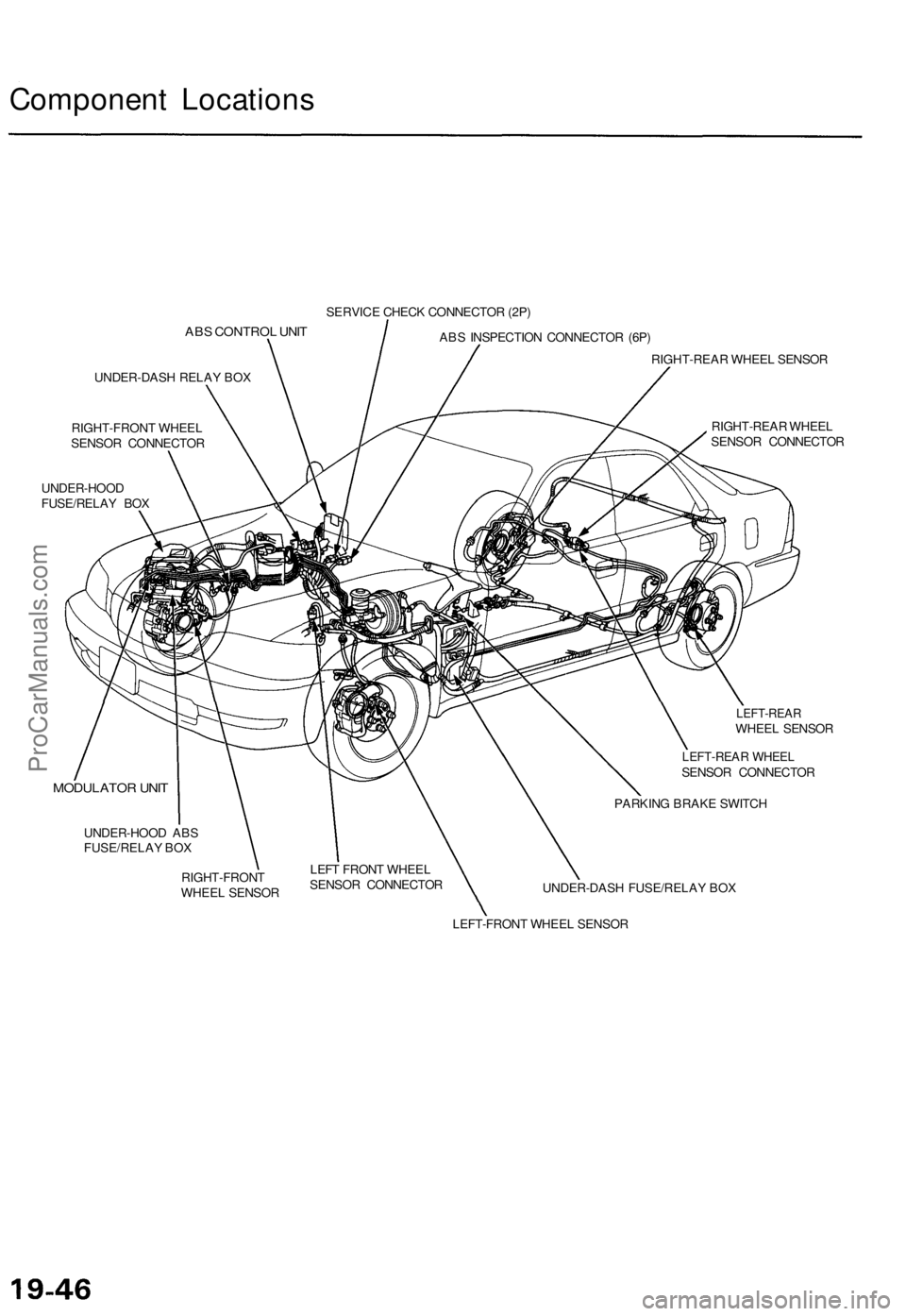
Component Locations
ABS CONTROL UNIT
UNDER-DASH RELAY BOX
RIGHT-FRONT WHEEL
SENSOR CONNECTOR
UNDER-HOOD
FUSE/RELAY BOX
SERVICE CHECK CONNECTOR (2P)
ABS INSPECTION CONNECTOR (6P)
MODULATOR UNIT
UNDER-HOOD ABS
FUSE/RELAY BOX
RIGHT-REAR WHEEL SENSOR
RIGHT-REAR WHEEL
SENSOR CONNECTOR
LEFT-REAR
WHEEL SENSOR
LEFT-REAR WHEEL
SENSOR CONNECTOR
RIGHT-FRONT
WHEEL SENSOR
LEFT FRONT WHEEL
SENSOR CONNECTOR
PARKING BRAKE SWITCH
UNDER-DASH FUSE/RELAY BOX
LEFT-FRONT WHEEL SENSORProCarManuals.com