sensor ACURA TL 1995 Service Manual PDF
[x] Cancel search | Manufacturer: ACURA, Model Year: 1995, Model line: TL, Model: ACURA TL 1995Pages: 1771, PDF Size: 62.49 MB
Page 917 of 1771
Intake Air System
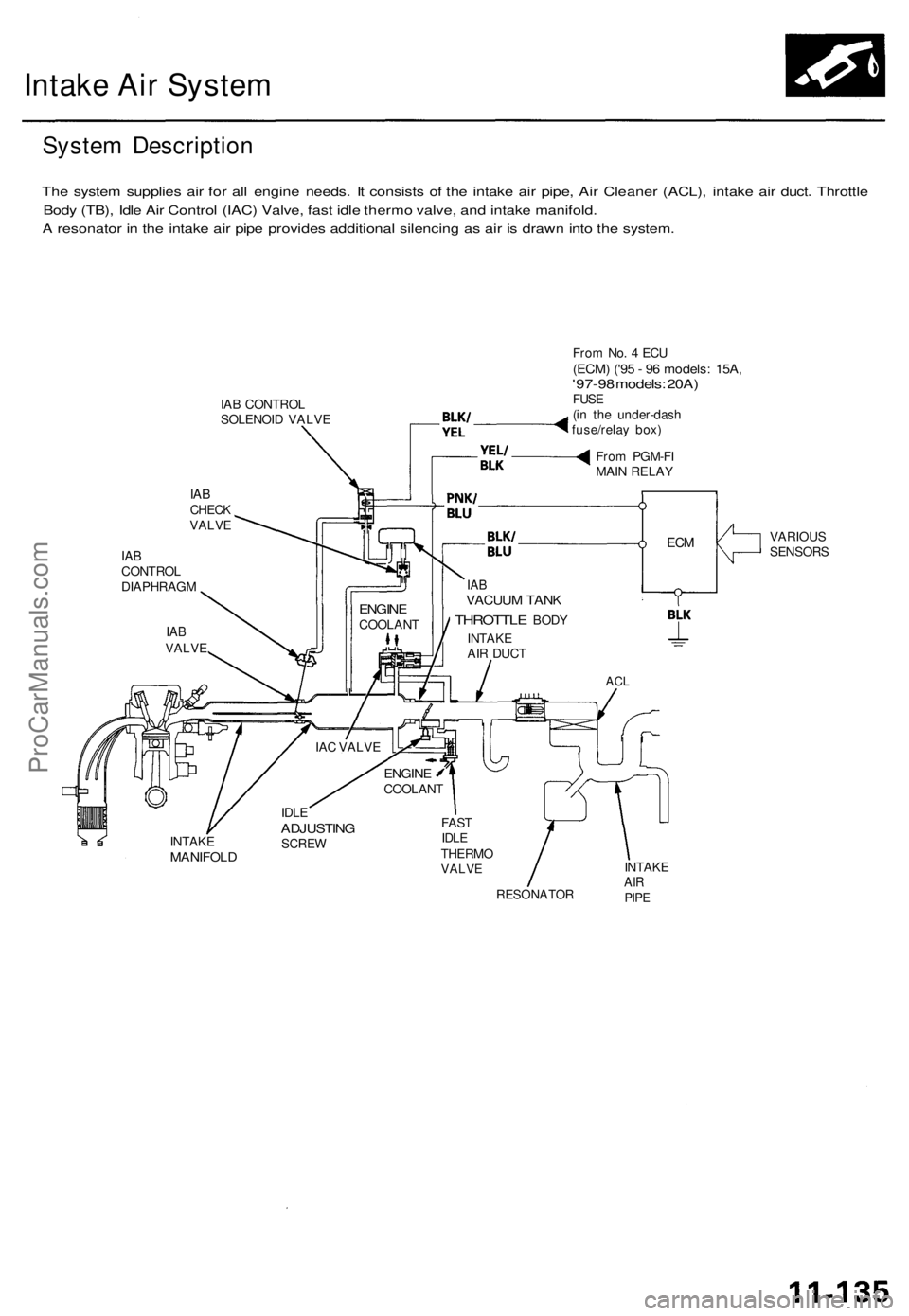
System Description
The system supplies air for all engine needs. It consists of the intake air pipe, Air Cleaner (ACL), intake air duct. Throttle
Body (TB), Idle Air Control (IAC) Valve, fast idle thermo valve, and intake manifold.
A resonator in the intake air pipe provides additional silencing as air is drawn into the system.
IAB CONTROL
SOLENOID VALVE
IAB
CHECK
VALVE
IAB
CONTROL
DIAPHRAGM
From No. 4 ECU
(ECM) ('95 - 96 models: 15A,
'97-98 models: 20A)
FUSE
(in the under-dash
fuse/relay box)
From PGM-FI
MAIN RELAY
VARIOUS
SENSORS
IAB
VACUUM TANK
THROTTLE
BODY
INTAKE
AIR DUCT
ACL
INTAKE
MANIFOLD
IDLE
ADJUSTING
SCREW
FAST
IDLE
THERMO
VALVE
RESONATOR
INTAKE
AIR
PIPE
IAC VALVE
ENGINE
COOLANT
ENGINE
COOLANT
IAB
VALVE
ECMProCarManuals.com
Page 918 of 1771
Intake Air System
Air Cleaner (ACL)
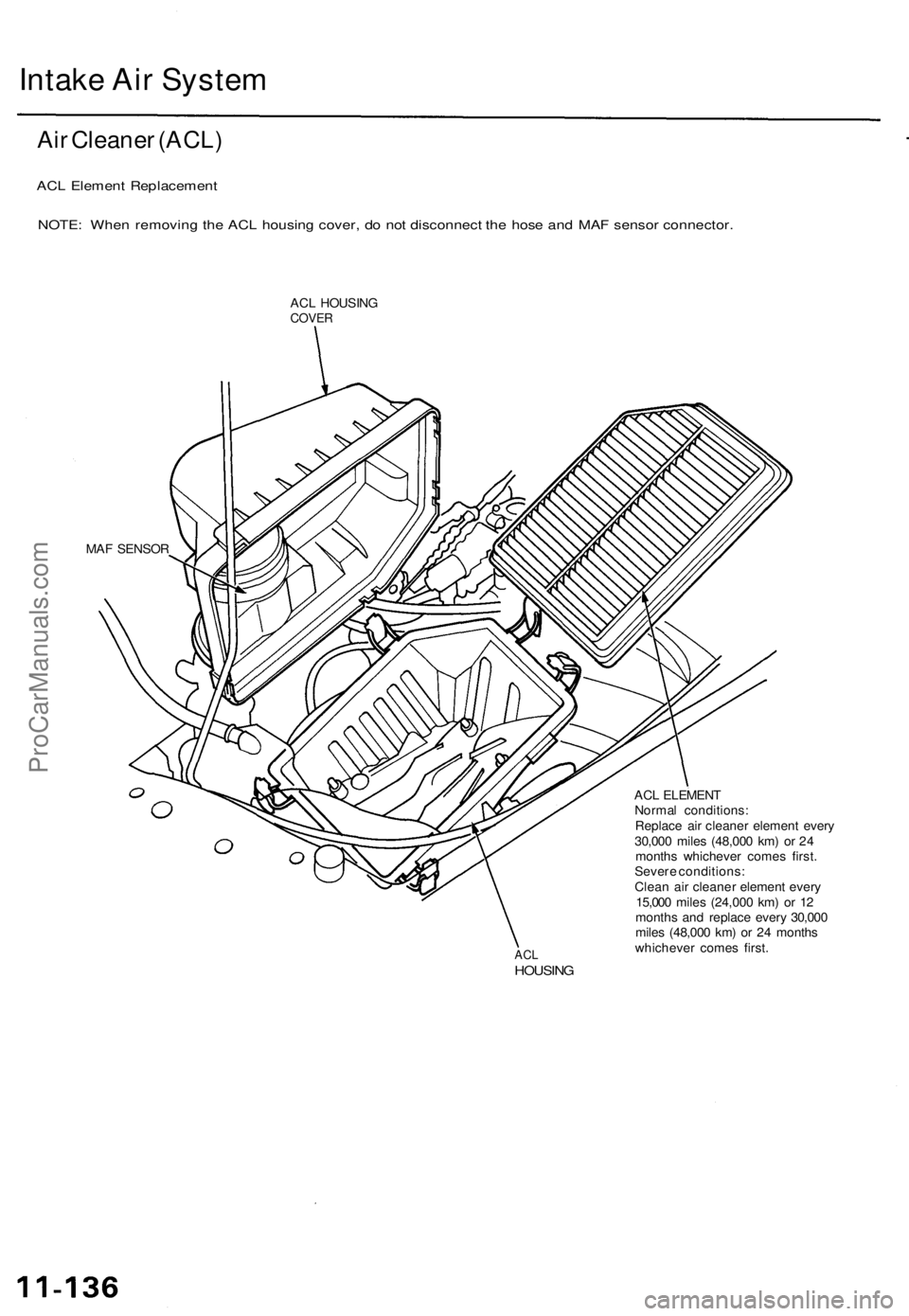
ACL Element Replacement
NOTE: When removing the ACL housing cover, do not disconnect the hose and MAF sensor connector.
ACL HOUSING
COVER
MAF SENSOR
ACL
HOUSING
ACL ELEMENT
Normal conditions:
Replace air cleaner element every
30,000 miles (48,000 km) or 24
months whichever comes first.
Severe conditions:
Clean air cleaner element every
15,000 miles (24,000 km) or 12
months and replace every 30,000
miles (48,000 km) or 24 months
whichever comes first.ProCarManuals.com
Page 922 of 1771
Intake Air System
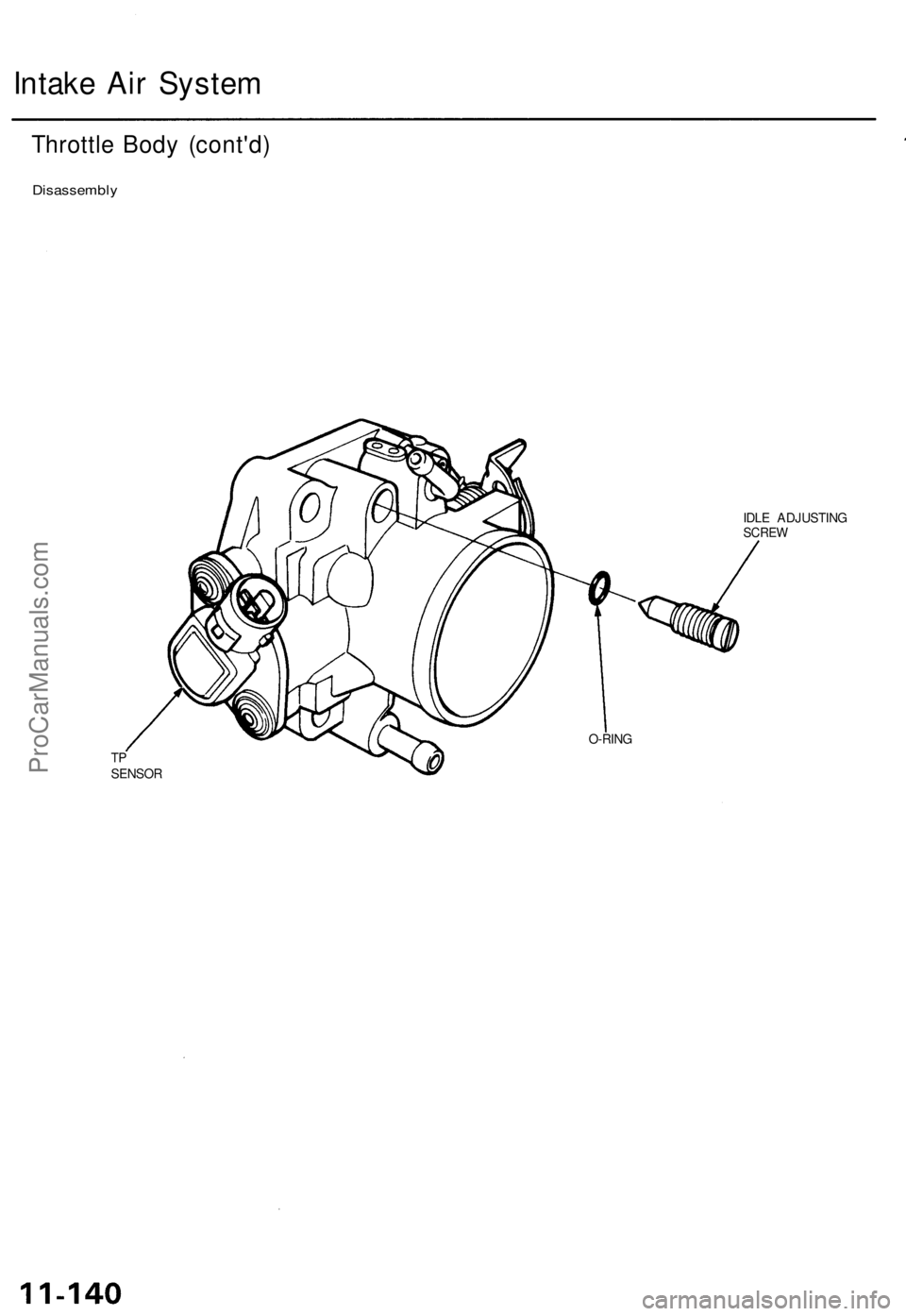
Throttle Body (cont'd)
Disassembly
IDLE ADJUSTING
SCREW
O-RING
TP
SENSORProCarManuals.com
Page 923 of 1771
Intake Air Bypass (IAB) Control System
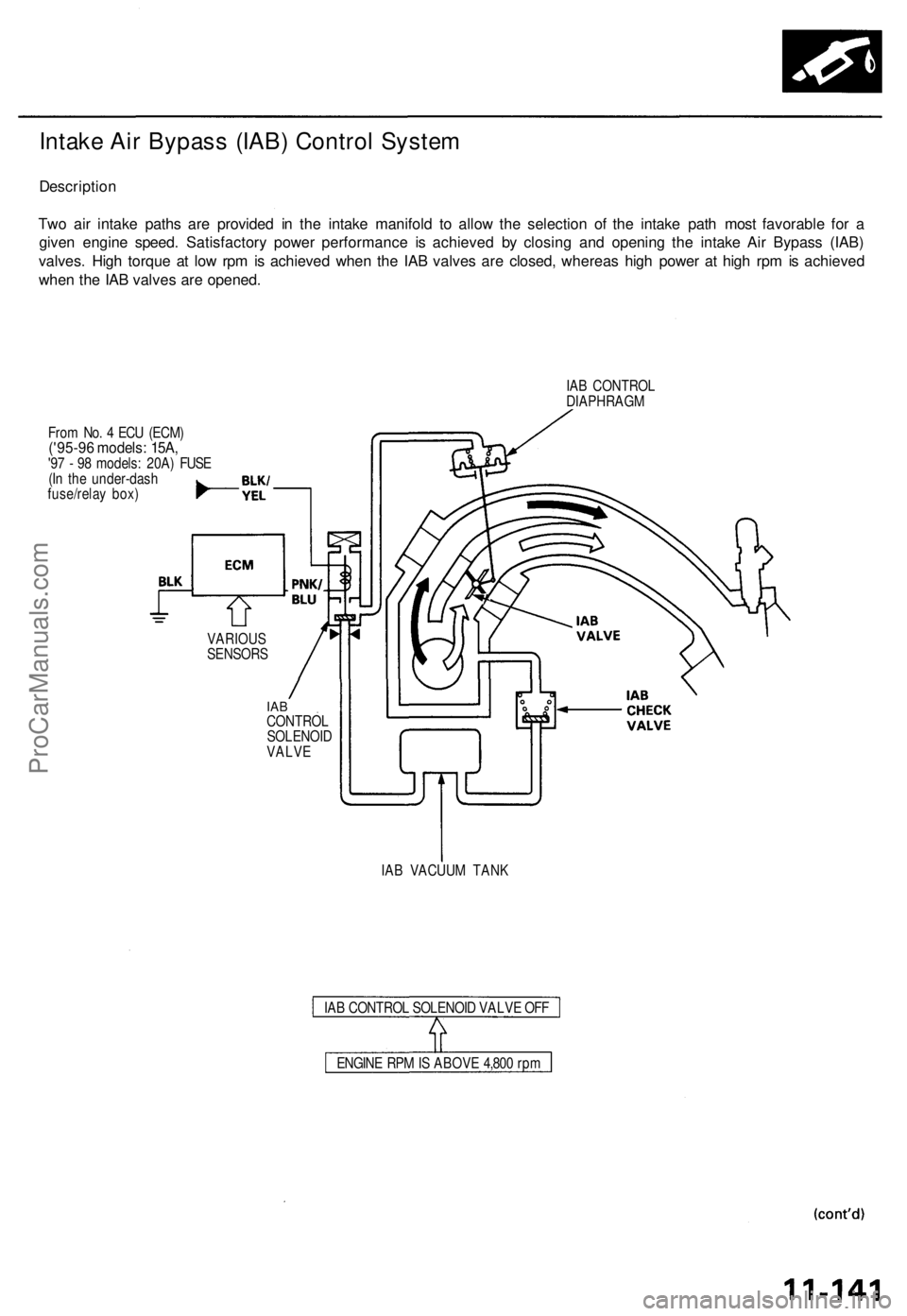
Description
Two air intake paths are provided in the intake manifold to allow the selection of the intake path most favorable for a
given engine speed. Satisfactory power performance is achieved by closing and opening the intake Air Bypass (IAB)
valves. High torque at low rpm is achieved when the IAB valves are closed, whereas high power at high rpm is achieved
when the IAB valves are opened.
IAB CONTROL
DIAPHRAGM
From No. 4 ECU (ECM)
('95-96 models: 15A,
'97 - 98 models: 20A) FUSE
(In the under-dash
fuse/relay box)
VARIOUS
SENSORS
IAB
CONTROL
SOLENOID
VALVE
IAB VACUUM TANK
IAB CONTROL SOLENOID VALVE OFF
ENGINE RPM IS ABOVE 4,800 rpmProCarManuals.com
Page 927 of 1771
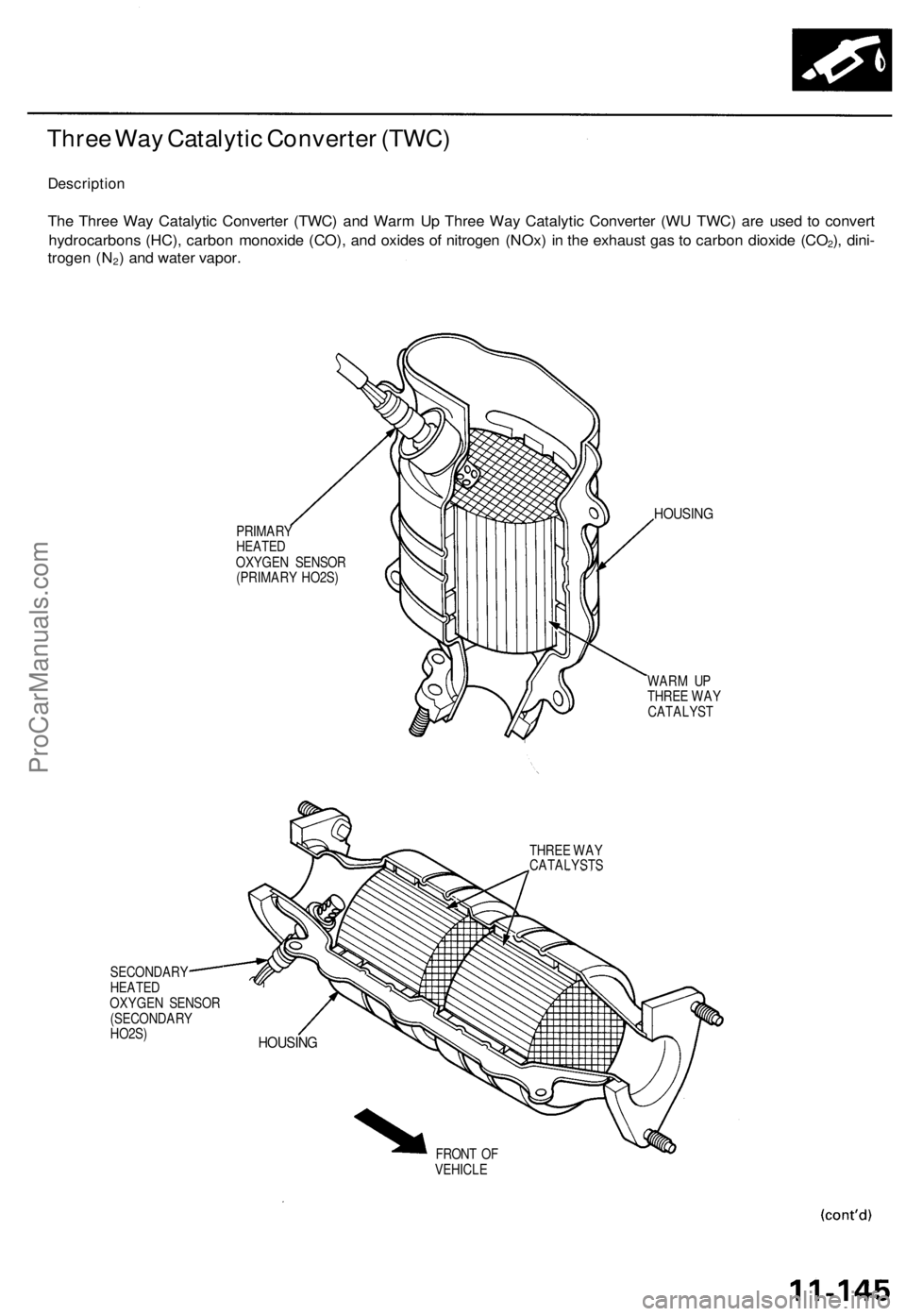
Three Way Catalytic Converter (TWC)
Description
The Three Way Catalytic Converter (TWC) and Warm Up Three Way Catalytic Converter (WU TWC) are used to convert
hydrocarbons (HC), carbon monoxide (CO), and oxides of nitrogen (NOx) in the exhaust gas to carbon dioxide (CO2), dini-
trogen (N2) and water vapor.
PRIMARY
HEATED
OXYGEN SENSOR
(PRIMARY HO2S)
HOUSING
WARM UP
THREE WAY
CATALYST
THREE WAY
CATALYSTS
SECONDARY
HEATED
OXYGEN SENSOR
(SECONDARY
HO2S)
FRONT OF
VEHICLE
HOUSINGProCarManuals.com
Page 928 of 1771
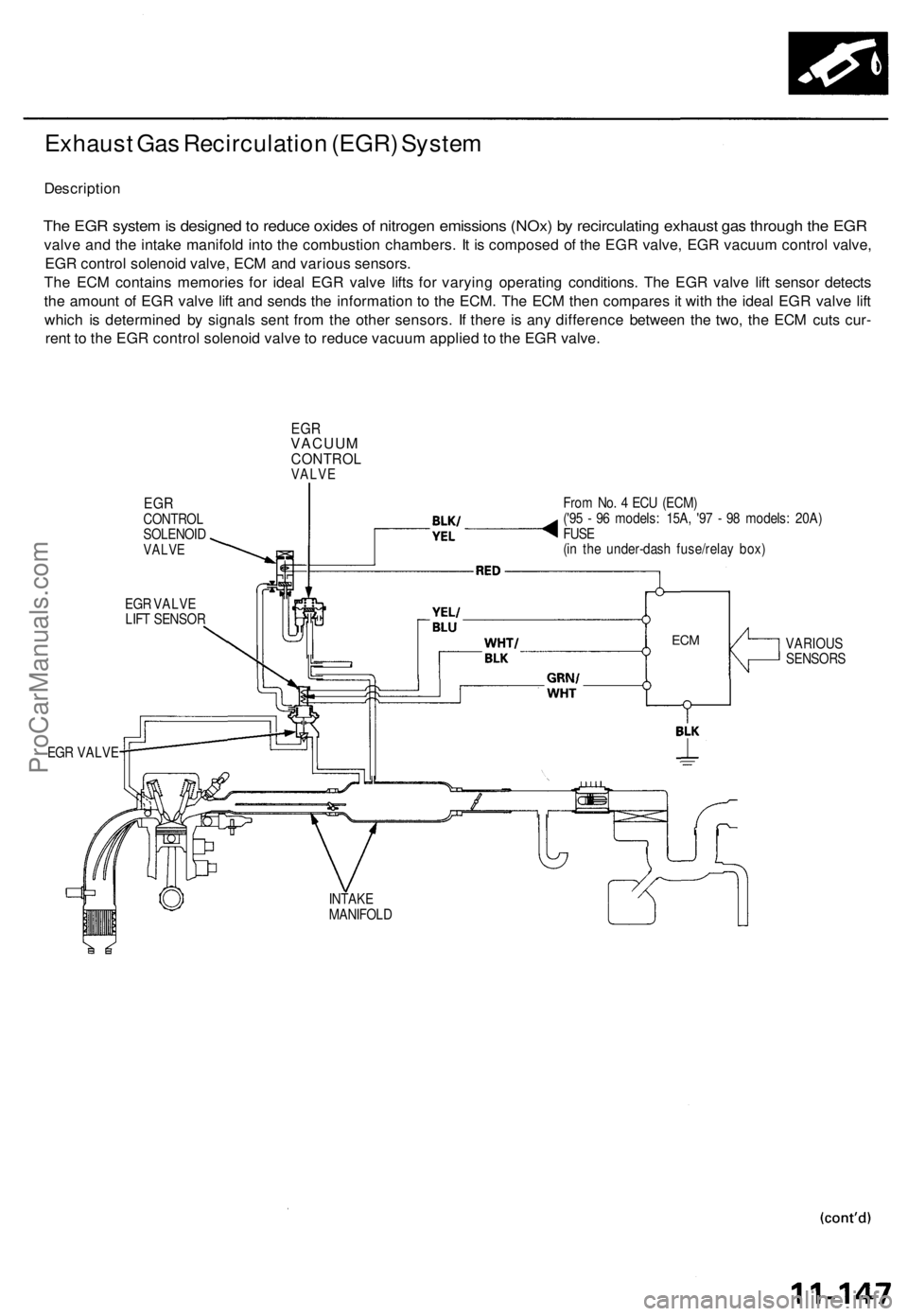
Exhaust Ga s Recirculatio n (EGR ) Syste m
Descriptio n
The EG R syste m is designe d to reduc e oxide s o f nitroge n emission s (NOx ) b y recirculatin g exhaus t ga s throug h th e EG R
valv e an d th e intak e manifol d int o th e combustio n chambers . I t i s compose d o f th e EG R valve , EG R vacuu m contro l valve ,
EG R contro l solenoi d valve , EC M an d variou s sensors .
Th e EC M contain s memorie s fo r idea l EG R valv e lift s fo r varyin g operatin g conditions . Th e EG R valv e lif t senso r detect s
th e amoun t o f EG R valv e lif t an d send s th e informatio n t o th e ECM . Th e EC M the n compare s it wit h th e idea l EG R valv e lif t
whic h i s determine d b y signal s sen t fro m th e othe r sensors . I f ther e i s an y differenc e betwee n th e two , th e EC M cut s cur -
ren t t o th e EG R contro l solenoi d valv e to reduc e vacuu m applie d to th e EG R valve .
EGRVACUU MCONTRO LVALVE
EGRCONTRO L
SOLENOI D
VALVE
EGR VALV E
LIF T SENSO R Fro
m No . 4 EC U (ECM )
('9 5 - 9 6 models : 15A , '9 7 - 9 8 models : 20A )
FUS E
(i n th e under-das h fuse/rela y box )
VARIOU S
SENSOR S
EG R VALV E
INTAKE
MANIFOL D
ECM
ProCarManuals.com
Page 931 of 1771
'95 - 96 models:
VARIOUS
SENSORS
From
No. 4 ECU
(ECM)
(20A) FUSE
(in the under-dash
fuse/relay box)
VARIOUS
SENSORS
EVAP
TWO WAY
VALVE
EVAP
BYPASS
SOLENOID
VALVE
EVAP
THREE
WAY
VALVE
EVAP CONTROL
CANISTER
VENT SHUT VALVE
EVAP PURGE
CONTROL
SOLENOID VALVE
ECM
ECM
From
No. 4 ECU
(ECM) (15A)
FUSE (in the under-dash
fuse/relay box)
EVAP CONTROL
CANISTER
FUEL
TANK
PRESSURE
SENSOR
FUEL TANK
FUEL FILL
CAP
FUEL TANK
EVAP VALVE
FUEL TANK
'97 - 98 models:
FUEL TANK
EVAP VALVE
EVAP TWO WAY VALVE
FRESH
AIR
FUEL FILL CAP
EVAP PURGE
FLOW SWITCH
EVAP PURGE
CONTROL
SOLENOID VALVEProCarManuals.com
Page 936 of 1771
Description
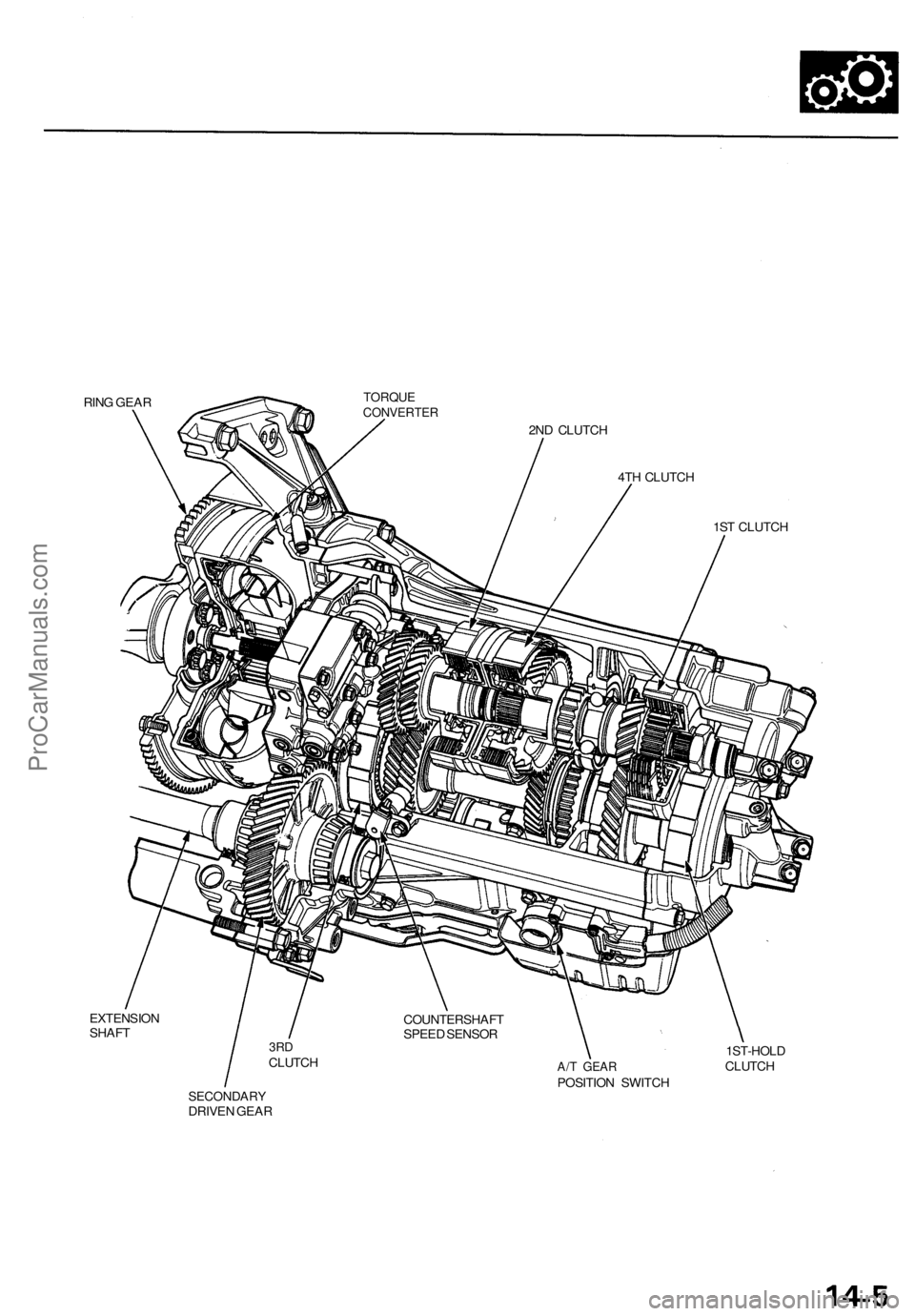
The automatic transmission is a combination of a 3-element torque converter and a dual-shaft electronically controlled
automatic transmission which provides 4 speeds forward and 1 reverse. The entire unit is positioned in line with the engine.
Torque Converter, Gears and Clutches
The torque converter consists of a pump, turbine and stator, assembled in a single unit.
They are connected to the engine crankshaft so they turn together as a unit as the engine turns.
Around the outside of the drive plate is a ring gear which meshes with the starter pinion when the engine is being started.
The entire torque converter assembly serves as a flywheel while transmitting power to the transmission mainshaft.
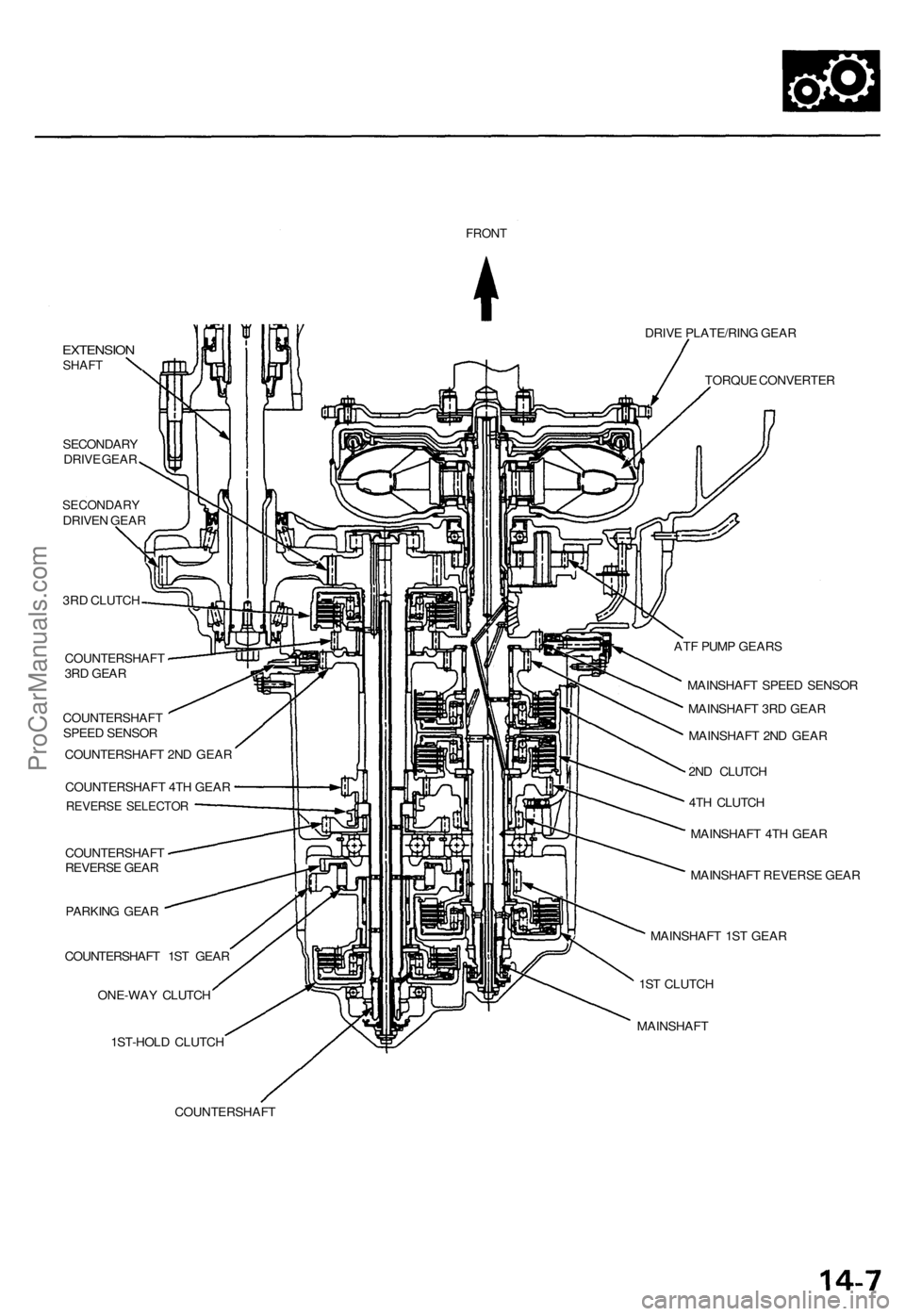
The transmission has two parallel shafts: the mainshaft and the countershaft. The mainshaft is in line with the engine
crankshaft.
The mainshaft includes the 1st, 2nd and 4th clutches, and gears for 4th, 2nd, 1st and reverse (3rd gear is integral with the
mainshaft, while the reverse gear is integral with 4th gear).
The countershaft includes the 3rd, and 1st-hold clutches, and gears for 3rd, 4th, 1st, 2nd, reverse, and parking. The sec-
ondary drive gear is integrated with the countershaft.
The gears on the mainshaft are in constant mesh with those on the countershaft.
When certain combinations of gears in the transmission are engaged by clutches, power is transmitted from the mainshaft
to the countershaft to provide and positions.
Electronic Control
The electronic control system consists of the Transmission Control Module (TCM), sensors, a linear solenoid and four
solenoid valves. Shifting and lock-up are electronically controlled for comfortable driving under all conditions.
The TCM is located below the dashboard, behind the glove box on the passenger's side.
Hydraulic Control
The lower valve body assembly includes the main valve body, the servo body and the shift control solenoid valves. They
are bolted on the lower part of the transmission housing.
Other valve bodies, the regulator valve body, the ATF pump body, the 2nd accumulator body, and the throttle valve body,
are bolted to the torque converter housing.
The main valve body contains the manual valve, the 1 - 2 shift valve, the 2 - 3 shift valve, the 3 - 4 shift valve, the 4th kick-
down valve, the 2 - 3 orifice control valve, the 3 - 4 orifice control valve, the 4th exhaust valve, the servo control valve,
and the main orifice control valve.
The servo body contains the servo valve, 3rd and 4th accumulator pistons.
The regulator valve body contains the regulator valve, the lock-up shift valve, and the cooler relief valve.
Fluid from the regulator passes through the manual valve to the various control valves.
The throttle valve body includes the throttle valve which is bolted onto the 2nd accumulator body. The 2nd accumulator
piston is assembled in the 2nd accumulator body.
The linear solenoid is joined with the throttle valve body.
The ATF pump body contains the modulator valve, the lock-up control valve, the lock-up timing valve, and the relief valve.
The torque converter check valve is located in the torque converter housing under the ATF pump body.
The 1st and 1st-hold accumulator pistons are assembled in the rear cover.
The clutches receive fluid from their respective feed pipes or internal hydraulic circuit.
Shift Control Mechanism
Input from various sensors located throughout the vehicle determines which shift control solenoid valve the TCM will acti-
vate. Activating a shift control solenoid valve changes modulator pressure, causing a shift valve to move. This pressurizes
a line to one of the clutches, engaging that clutch and its corresponding gear.
Lock-up Mechanism
In position, in 2nd, 3rd and 4th, and in position in 3rd, pressurized fluid is drained from the back of the torque con-
verter through a fluid passage, causing the lock-up piston to be held against the torque converter cover. As this takes place,
the mainshaft rotates at the same speed as the engine crankshaft. Together with hydraulic control, the TCM optimizes the
timing of the lock-up mechanism. The lock-up valves control the range of lock-up according to lock-up control solenoid
valves A and B, and throttle valve. When lock-up control solenoid valves A and B activate, the modulator pressure changes.
The lock-up control solenoid valves A and B are mounted on the torque converter housing, and are controlled by the TCM.ProCarManuals.com
Page 938 of 1771
RING GEAR
EXTENSION
SHAFT
TORQUE
CONVERTER
2ND CLUTCH
4TH CLUTCH
1ST CLUTCH
SECONDARY
DRIVEN GEAR
A/T GEAR
POSITION SWITCH
1ST-HOLD
CLUTCH
COUNTERSHAFT
SPEED SENSOR
3RD
CLUTCHProCarManuals.com
Page 940 of 1771
FRONT
EXTENSION
SHAFT
SECONDARY
DRIVE GEAR
SECONDARY
DRIVEN GEAR
3RD CLUTCH
COUNTERSHAFT
3RD GEAR
DRIVE PLATE/RING GEAR
TORQUE CONVERTER
COUNTERSHAFT
SPEED SENSOR
COUNTERSHAFT 2ND GEAR
COUNTERSHAFT 4TH GEAR
REVERSE SELECTOR
COUNTERSHAFT
REVERSE GEAR
PARKING GEAR
COUNTERSHAFT 1ST GEAR
ONE-WAY CLUTCH
1ST-HOLD CLUTCH
MAINSHAFT SPEED SENSOR
MAINSHAFT 3RD GEAR
MAINSHAFT 2ND GEAR
2ND CLUTCH
4TH CLUTCH
MAINSHAFT 4TH GEAR
MAINSHAFT REVERSE GEAR
MAINSHAFT 1ST GEAR
1ST CLUTCH
MAINSHAFT
COUNTERSHAFT
ATF PUMP GEARSProCarManuals.com