sensor ACURA TL 1995 Service Manual PDF
[x] Cancel search | Manufacturer: ACURA, Model Year: 1995, Model line: TL, Model: ACURA TL 1995Pages: 1771, PDF Size: 62.49 MB
Page 815 of 1771
Description
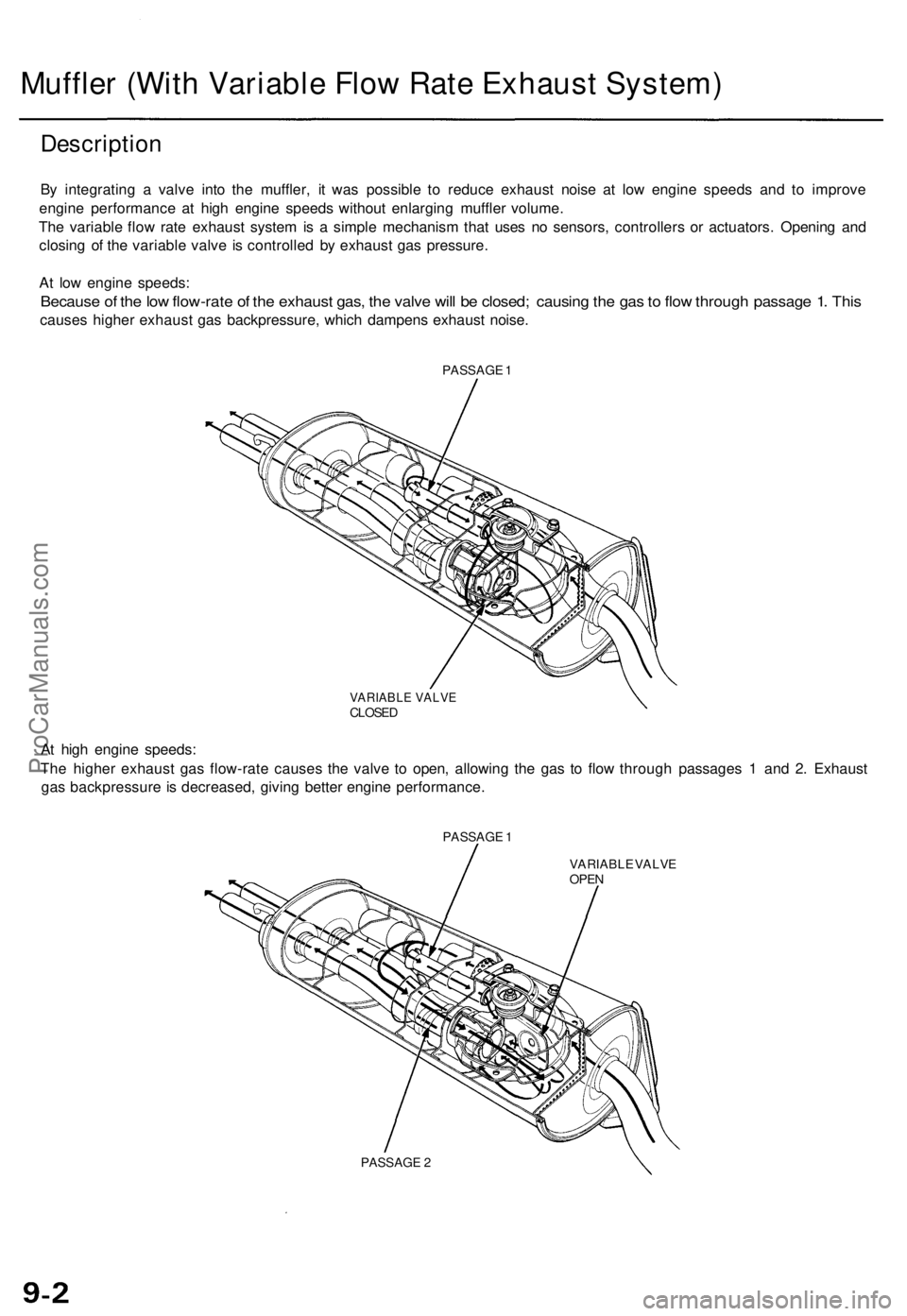
By integratin g a valv e int o th e muffler , i t wa s possibl e t o reduc e exhaus t nois e a t lo w engin e speed s an d t o improv e
engin e performanc e a t hig h engine speeds withou t enlargin g muffle r volume .
Th e variabl e flo w rat e exhaus t syste m is a simpl e mechanis m tha t use s n o sensors , controller s o r actuators . Openin g an d
closin g o f th e variabl e valv e i s controlle d b y exhaus t ga s pressure .
A t lo w engin e speeds :
Because o f th e lo w flow-rat e o f th e exhaus t gas , th e valv e wil l b e closed ; causin g th e ga s to flo w throug h passag e 1 . Thi s
cause s highe r exhaus t ga s backpressure , whic h dampen s exhaus t noise .
PASSAG E 1
VARIABL E VALV ECLOSE D
At hig h engine speeds :
Th e highe r exhaus t ga s flow-rat e cause s th e valv e t o open , allowin g th e ga s t o flo w throug h passage s 1 an d 2 . Exhaust
ga s backpressur e is decreased , givin g bette r engin e performance .
PASSAGE 1
VARIABLE VALV E
OPE N
PASSAG E 2
Muffle r (Wit h Variabl e Flo w Rat e Exhaus t System )
ProCarManuals.com
Page 839 of 1771
System Description
Vacuum Connections (cont'd)
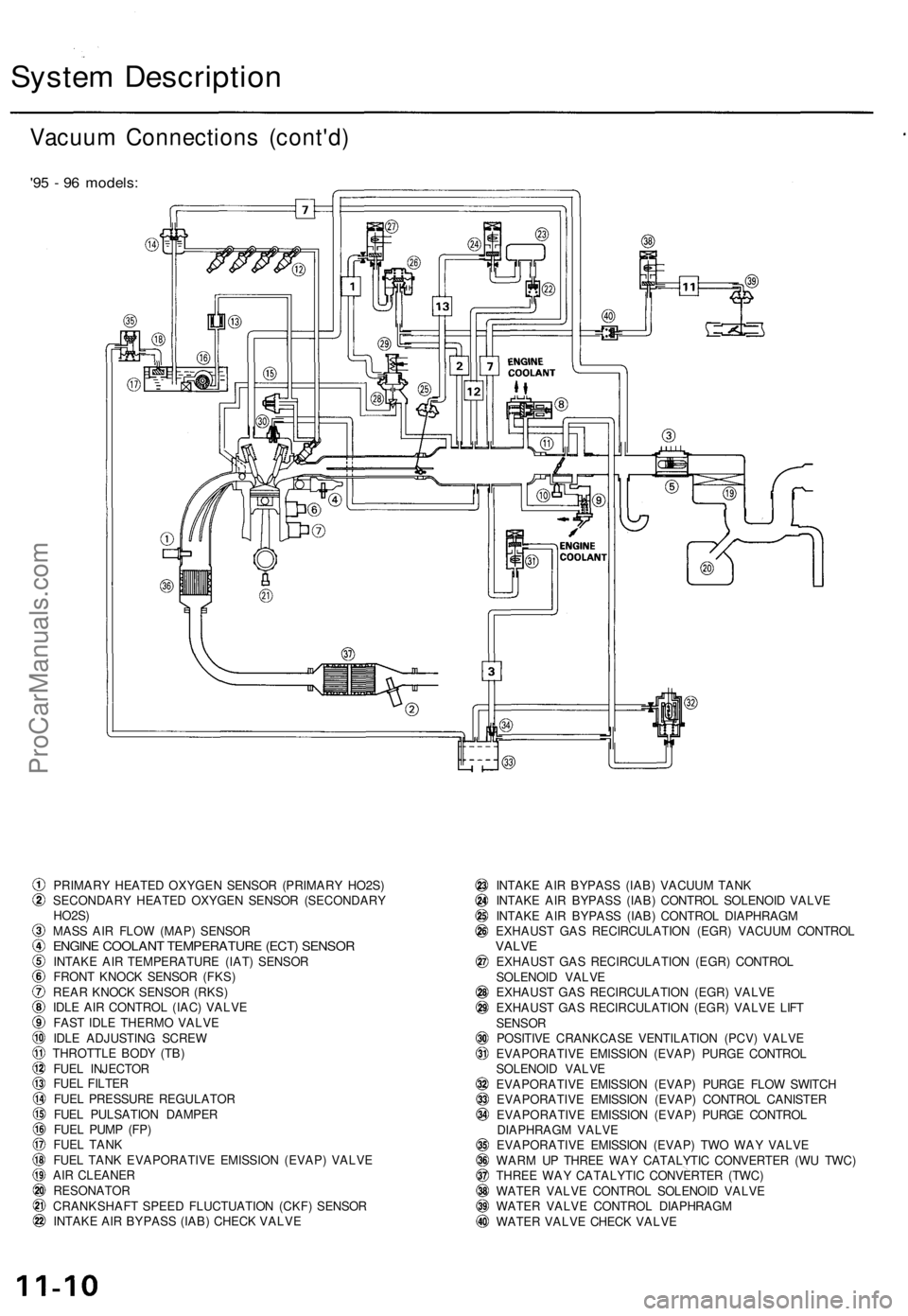
'95 - 96 models:
PRIMARY HEATED OXYGEN SENSOR (PRIMARY HO2S)
SECONDARY HEATED OXYGEN SENSOR (SECONDARY
HO2S)
MASS AIR FLOW (MAP) SENSOR
ENGINE COOLANT TEMPERATURE (ECT) SENSOR
INTAKE AIR TEMPERATURE (IAT) SENSOR
FRONT KNOCK SENSOR (FKS)
REAR KNOCK SENSOR (RKS)
IDLE AIR CONTROL (IAC) VALVE
FAST IDLE THERMO VALVE
IDLE ADJUSTING SCREW
THROTTLE BODY (TB)
FUEL INJECTOR
FUEL FILTER
FUEL PRESSURE REGULATOR
FUEL PULSATION DAMPER
FUEL PUMP (FP)
FUEL TANK
FUEL TANK EVAPORATIVE EMISSION (EVAP) VALVE
AIR CLEANER
RESONATOR
CRANKSHAFT SPEED FLUCTUATION (CKF) SENSOR
INTAKE AIR BYPASS (IAB) CHECK VALVE
INTAKE AIR BYPASS (IAB) VACUUM TANK
INTAKE AIR BYPASS (IAB) CONTROL SOLENOID VALVE
INTAKE AIR BYPASS (IAB) CONTROL DIAPHRAGM
EXHAUST GAS RECIRCULATION (EGR) VACUUM CONTROL
VALVE
EXHAUST GAS RECIRCULATION (EGR) CONTROL
SOLENOID VALVE
EXHAUST GAS RECIRCULATION (EGR) VALVE
EXHAUST GAS RECIRCULATION (EGR) VALVE LIFT
SENSOR
POSITIVE CRANKCASE VENTILATION (PCV) VALVE
EVAPORATIVE EMISSION (EVAP) PURGE CONTROL
SOLENOID VALVE
EVAPORATIVE EMISSION (EVAP) PURGE FLOW SWITCH
EVAPORATIVE EMISSION (EVAP) CONTROL CANISTER
EVAPORATIVE EMISSION (EVAP) PURGE CONTROL
DIAPHRAGM VALVE
EVAPORATIVE EMISSION (EVAP) TWO WAY VALVE
WARM UP THREE WAY CATALYTIC CONVERTER (WU TWC)
THREE WAY CATALYTIC CONVERTER (TWC)
WATER VALVE CONTROL SOLENOID VALVE
WATER VALVE CONTROL DIAPHRAGM
WATER VALVE CHECK VALVEProCarManuals.com
Page 840 of 1771
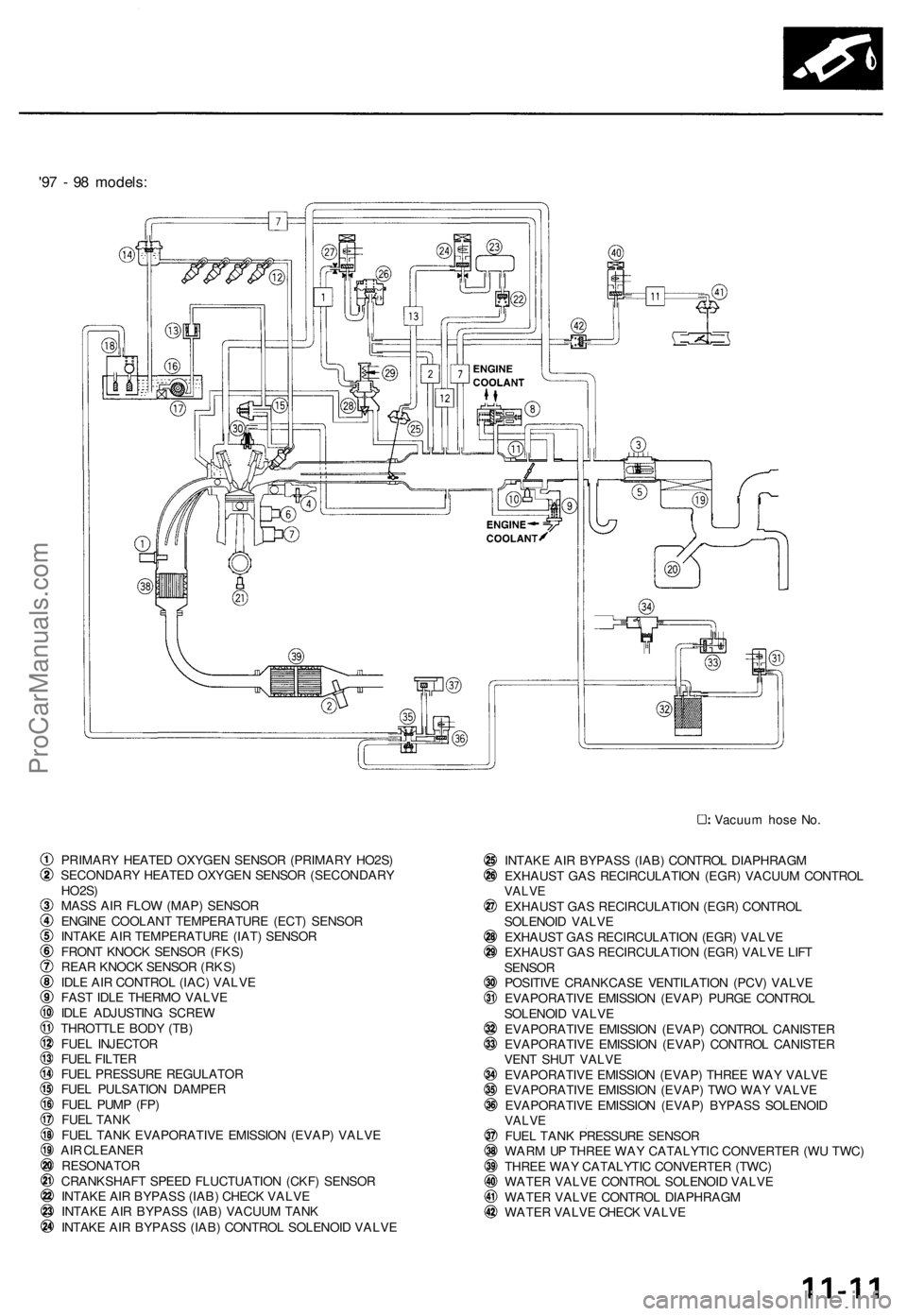
'97 - 98 models:
Vacuum hose No.
PRIMARY HEATED OXYGEN SENSOR (PRIMARY HO2S)
SECONDARY HEATED OXYGEN SENSOR (SECONDARY
HO2S)
MASS AIR FLOW (MAP) SENSOR
ENGINE COOLANT TEMPERATURE (ECT) SENSOR
INTAKE AIR TEMPERATURE (IAT) SENSOR
FRONT KNOCK SENSOR (FKS)
REAR KNOCK SENSOR (RKS)
IDLE AIR CONTROL (IAC) VALVE
FAST IDLE THERMO VALVE
IDLE ADJUSTING SCREW
THROTTLE BODY (TB)
FUEL INJECTOR
FUEL FILTER
FUEL PRESSURE REGULATOR
FUEL PULSATION DAMPER
FUEL PUMP (FP)
FUEL TANK
FUEL TANK EVAPORATIVE EMISSION (EVAP) VALVE
AIR CLEANER
RESONATOR
CRANKSHAFT SPEED FLUCTUATION (CKF) SENSOR
INTAKE AIR BYPASS (IAB) CHECK VALVE
INTAKE AIR BYPASS (IAB) VACUUM TANK
INTAKE AIR BYPASS (IAB) CONTROL SOLENOID VALVE
INTAKE AIR BYPASS (IAB) CONTROL DIAPHRAGM
EXHAUST GAS RECIRCULATION (EGR) VACUUM CONTROL
VALVE
EXHAUST GAS RECIRCULATION (EGR) CONTROL
SOLENOID VALVE
EXHAUST GAS RECIRCULATION (EGR) VALVE
EXHAUST GAS RECIRCULATION (EGR) VALVE LIFT
SENSOR
POSITIVE CRANKCASE VENTILATION (PCV) VALVE
EVAPORATIVE EMISSION (EVAP) PURGE CONTROL
SOLENOID VALVE
EVAPORATIVE EMISSION (EVAP) CONTROL CANISTER
EVAPORATIVE EMISSION (EVAP) CONTROL CANISTER
VENT SHUT VALVE
EVAPORATIVE EMISSION (EVAP) THREE WAY VALVE
EVAPORATIVE EMISSION (EVAP) TWO WAY VALVE
EVAPORATIVE EMISSION (EVAP) BYPASS SOLENOID
VALVE
FUEL TANK PRESSURE SENSOR
WARM UP THREE WAY CATALYTIC CONVERTER (WU TWC)
THREE WAY CATALYTIC CONVERTER (TWC)
WATER VALVE CONTROL SOLENOID VALVE
WATER VALVE CONTROL DIAPHRAGM
WATER VALVE CHECK VALVEProCarManuals.com
Page 867 of 1771
Troubleshooting
Troubleshooting Procedures (cont'd)
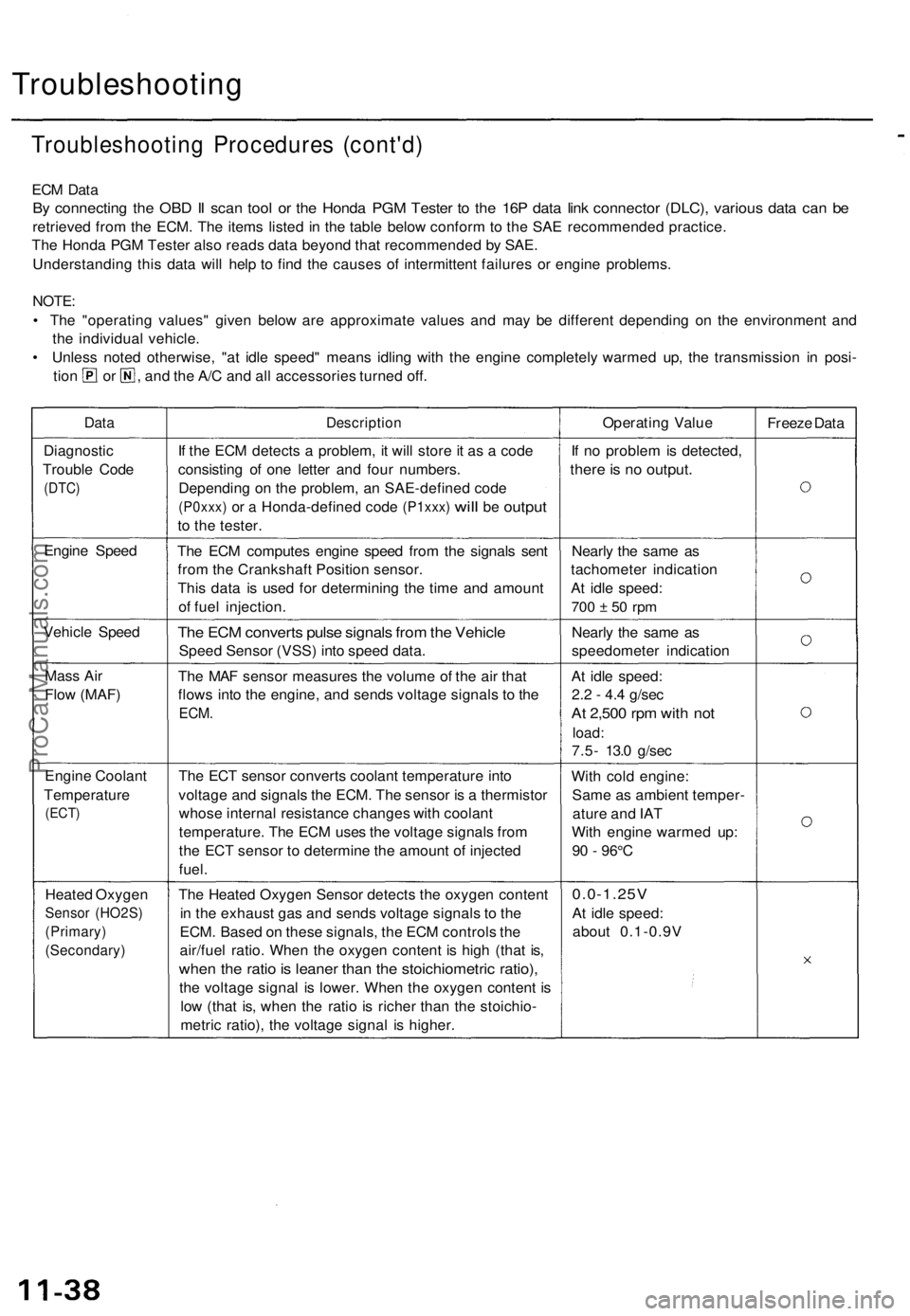
ECM Data
By connecting the OBD II scan tool or the Honda PGM Tester to the 16P data link connector (DLC), various data can be
retrieved from the ECM. The items listed in the table below conform to the SAE recommended practice.
The Honda PGM Tester also reads data beyond that recommended by SAE.
Understanding this data will help to find the causes of intermittent failures or engine problems.
NOTE:
• The "operating values" given below are approximate values and may be different depending on the environment and
the individual vehicle.
• Unless noted otherwise, "at idle speed" means idling with the engine completely warmed up, the transmission in posi-
tion or , and the A/C and all accessories turned off.
Data
Description
Operating Value
Freeze Data
Diagnostic
Trouble Code
(DTC)
If the ECM detects a problem, it will store it as a code
consisting of one letter and four numbers.
Depending on the problem, an SAE-defined code
(P0xxx)
or a
Honda-defined code
(P1xxx)
will
be
output
to the tester.
If no problem is detected,
there is no output.
Engine Speed
The ECM computes engine speed from the signals sent
from the Crankshaft Position sensor.
This data is used for determining the time and amount
of fuel injection.
Nearly the same as
tachometer indication
At idle speed:
700 ± 50 rpm
Vehicle Speed
The ECM converts pulse signals from the Vehicle
Speed Sensor (VSS) into speed data.
Nearly the same as
speedometer indication
Mass Air
Flow (MAF)
The MAF sensor measures the volume of the air that
flows into the engine, and sends voltage signals to the
ECM.
At idle speed:
2.2 - 4.4 g/sec
At 2,500 rpm with not
load:
7.5- 13.0 g/sec
Engine Coolant
Temperature
(ECT)
The ECT sensor converts coolant temperature into
voltage and signals the ECM. The sensor is a thermistor
whose internal resistance changes with coolant
temperature. The ECM uses the voltage signals from
the ECT sensor to determine the amount of injected
fuel.
With cold engine:
Same as ambient temper-
ature and IAT
With engine warmed up:
90 - 96°C
Heated Oxygen
Sensor (HO2S)
(Primary)
(Secondary)
The Heated Oxygen Sensor detects the oxygen content
in the exhaust gas and sends voltage signals to the
ECM. Based on these signals, the ECM controls the
air/fuel ratio. When the oxygen content is high (that is,
when the ratio is leaner than the stoichiometric ratio),
the voltage signal is lower. When the oxygen content is
low (that is, when the ratio is richer than the stoichio-
metric ratio), the voltage signal is higher.
0.0-1.25V
At idle speed:
about 0.1-0.9VProCarManuals.com
Page 868 of 1771
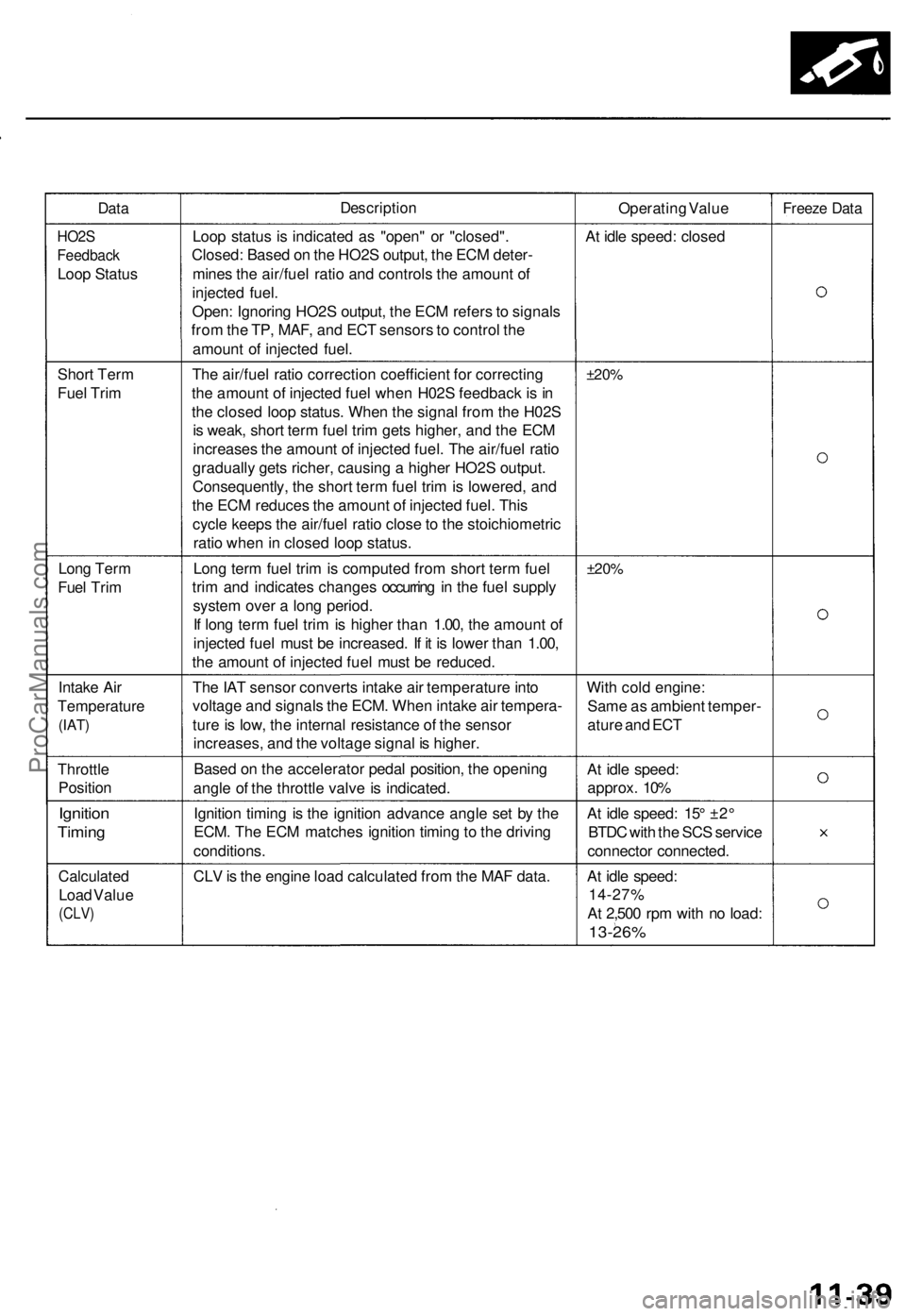
Data
Description
Operating Value
Freeze Data
HO2S
Feedback
Loop Status
Loop status is indicated as "open" or "closed".
Closed: Based on the HO2S output, the ECM deter-
mines the air/fuel ratio and controls the amount of
injected fuel.
Open: Ignoring HO2S output, the ECM refers to signals
from the TP, MAF, and ECT sensors to control the
amount of injected fuel.
At idle speed: closed
Short Term
Fuel Trim
The air/fuel ratio correction coefficient for correcting
the amount of injected fuel when H02S feedback is in
the closed loop status. When the signal from the H02S
is weak, short term fuel trim gets higher, and the ECM
increases the amount of injected fuel. The air/fuel ratio
gradually gets richer, causing a higher HO2S output.
Consequently, the short term fuel trim is lowered, and
the ECM reduces the amount of injected fuel. This
cycle keeps the air/fuel ratio close to the stoichiometric
ratio when in closed loop status.
±20%
Long Term
Fuel Trim
Long term fuel trim is computed from short term fuel
trim and indicates changes occurring in the fuel supply
system over a long period.
If long term fuel trim is higher than 1.00, the amount of
injected fuel must be increased. If it is lower than 1.00,
the amount of injected fuel must be reduced.
±20%
Intake Air
Temperature
(IAT)
The IAT sensor converts intake air temperature into
voltage and signals the ECM. When intake air tempera-
ture is low, the internal resistance of the sensor
increases, and the voltage signal is higher.
With cold engine:
Same as ambient temper-
ature and ECT
Throttle
Position
Based on the accelerator pedal position, the opening
angle of the throttle valve is indicated.
At idle speed:
approx. 10%
Ignition
Timing
Ignition timing is the ignition advance angle set by the
ECM. The ECM matches ignition timing to the driving
conditions.
At idle speed: 15° ±2°
BTDC with the SCS service
connector connected.
Calculated
Load Value
(CLV)
CLV is the engine load calculated from the MAF data.
At idle speed:
14-27%
At 2,500 rpm with no load:
13-26%ProCarManuals.com
Page 877 of 1771
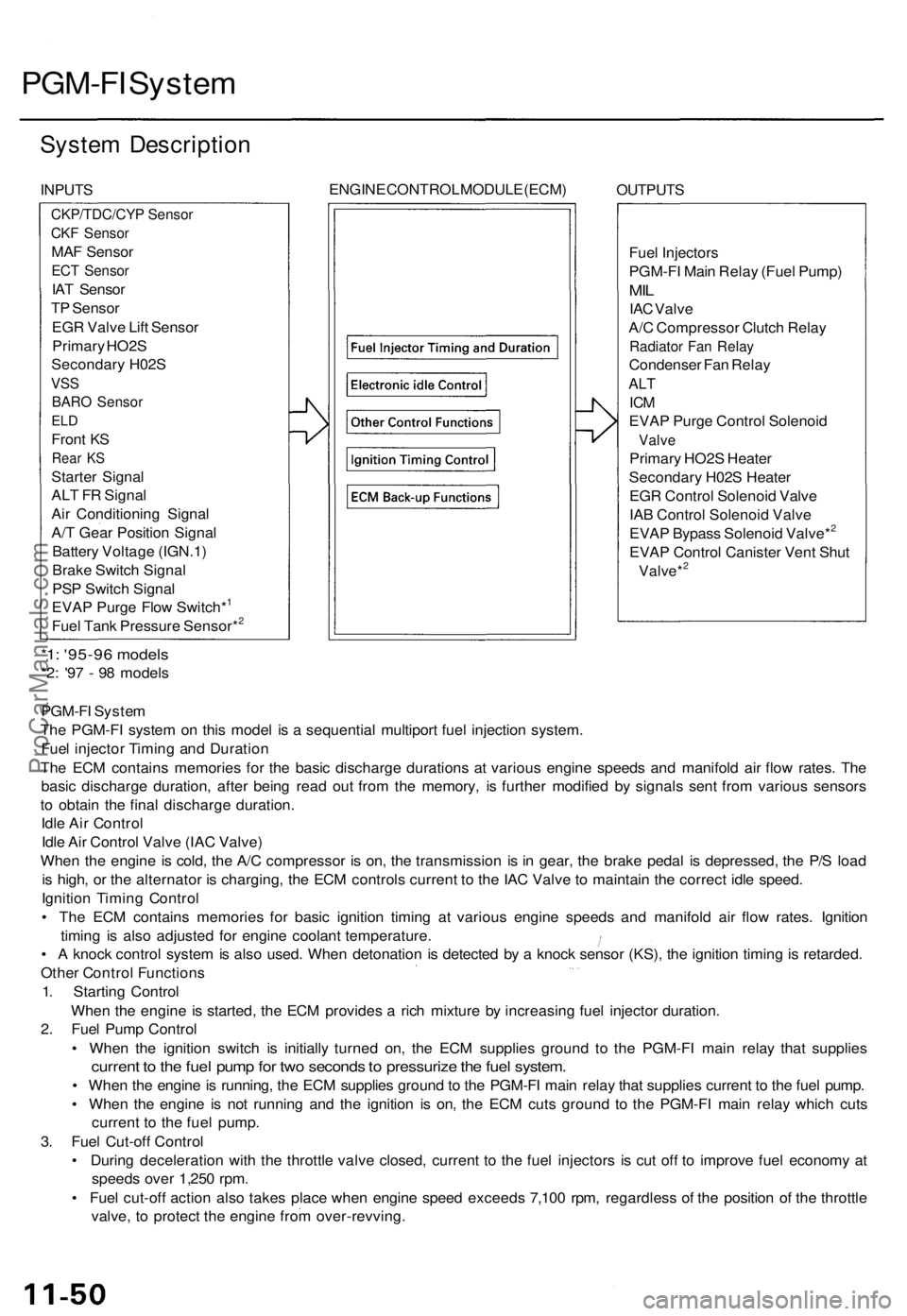
PGM-FI System
System Description
INPUTS
ENGINE CONTROL MODULE (ECM)
OUTPUTS
Fuel Injectors
PGM-FI Main Relay (Fuel Pump)
MIL
IAC Valve
A/C Compressor Clutch Relay
Radiator Fan Relay
Condenser Fan Relay
ALT
ICM
EVAP Purge Control Solenoid
Valve
Primary HO2S Heater
Secondary H02S Heater
EGR Control Solenoid Valve
IAB Control Solenoid Valve
EVAP Bypass Solenoid Valve*2
EVAP Control Canister Vent Shut
Valve*2
*1: '95-96 models
*2: '97 - 98 models
PGM-FI System
The PGM-FI system on this model is a sequential multiport fuel injection system.
Fuel injector Timing and Duration
The ECM contains memories for the basic discharge durations at various engine speeds and manifold air flow rates. The
basic discharge duration, after being read out from the memory, is further modified by signals sent from various sensors
to obtain the final discharge duration.
Idle Air Control
Idle Air Control Valve (IAC Valve)
When the engine is cold, the A/C compressor is on, the transmission is in gear, the brake pedal is depressed, the P/S load
is high, or the alternator is charging, the ECM controls current to the IAC Valve to maintain the correct idle speed.
Ignition Timing Control
• The ECM contains memories for basic ignition timing at various engine speeds and manifold air flow rates. Ignition
timing is also adjusted for engine coolant temperature.
• A knock control system is also used. When detonation is detected by a knock sensor (KS), the ignition timing is retarded.
Other Control Functions
1. Starting Control
When the engine is started, the ECM provides a rich mixture by increasing fuel injector duration.
2. Fuel Pump Control
• When the ignition switch is initially turned on, the ECM supplies ground to the PGM-FI main relay that supplies
current to the fuel pump for two seconds to pressurize the fuel system.
• When the engine is running, the ECM supplies ground to the PGM-FI main relay that supplies current to the fuel pump.
• When the engine is not running and the ignition is on, the ECM cuts ground to the PGM-FI main relay which cuts
current to the fuel pump.
3. Fuel Cut-off Control
• During deceleration with the throttle valve closed, current to the fuel injectors is cut off to improve fuel economy at
speeds over 1,250 rpm.
• Fuel cut-off action also takes place when engine speed exceeds 7,100 rpm, regardless of the position of the throttle
valve, to protect the engine from over-revving.
CKP/TDC/CYP Sensor
CKF Sensor
MAF Sensor
ECT Sensor
IAT Sensor
TP Sensor
EGR Valve Lift Sensor
Primary HO2S
Secondary H02S
VSS
BARO Sensor
ELD
Front KS
Rear KS
Starter Signal
ALT FR Signal
Air Conditioning Signal
A/T Gear Position Signal
Battery Voltage (IGN.1)
Brake Switch Signal
PSP Switch Signal
EVAP Purge Flow Switch*1
Fuel Tank Pressure Sensor*2ProCarManuals.com
Page 878 of 1771
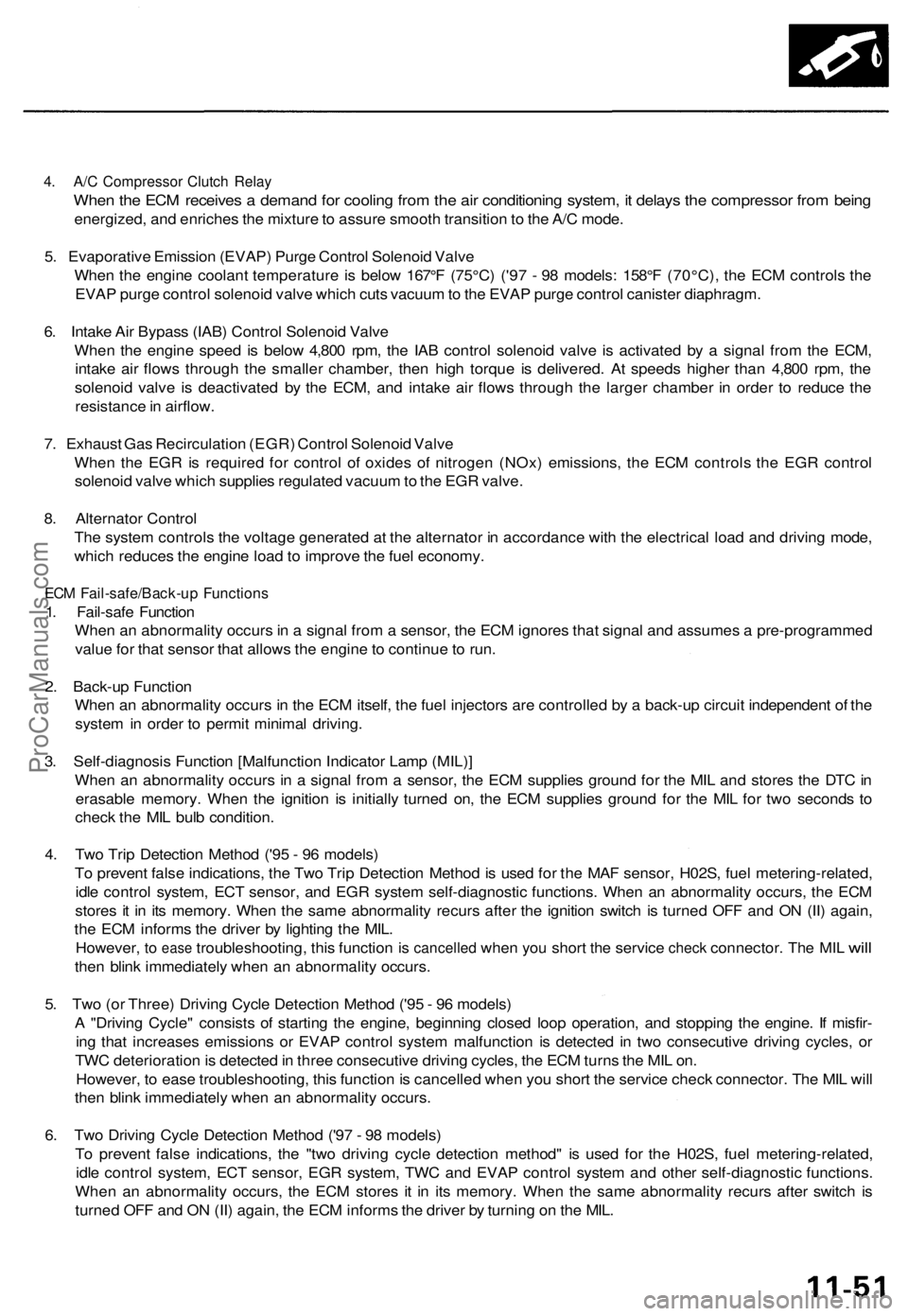
4. A/ C Compresso r Clutc h Rela y
When th e EC M receive s a deman d fo r coolin g fro m th e ai r conditionin g system , i t delay s th e compresso r fro m bein g
energized , an d enriche s th e mixtur e to assur e smoot h transitio n to th e A/ C mode .
5 . Evaporativ e Emissio n (EVAP ) Purg e Contro l Solenoi d Valv e
Whe n th e engin e coolan t temperatur e i s belo w 167° F (75°C ) ('9 7 - 9 8 models : 158° F (70°C) , th e EC M control s th e
EVA P purg e contro l solenoi d valv e whic h cut s vacuu m to th e EVA P purg e contro l caniste r diaphragm .
6 . Intak e Ai r Bypas s (IAB ) Contro l Solenoi d Valv e
Whe n th e engin e spee d i s belo w 4,80 0 rpm , th e IA B contro l solenoi d valv e i s activate d b y a signa l fro m th e ECM ,
intak e ai r flow s throug h th e smalle r chamber , the n hig h torqu e i s delivered. At speed s highe r tha n 4,80 0 rpm , th e
solenoi d valv e i s deactivate d b y th e ECM , an d intak e ai r flow s throug h th e large r chambe r i n orde r t o reduc e th e
resistanc e in airflow .
7 . Exhaus t Ga s Recirculatio n (EGR ) Contro l Solenoi d Valv e
Whe n th e EG R is require d fo r contro l o f oxide s o f nitroge n (NOx ) emissions , th e EC M control s th e EG R contro l
solenoi d valv e whic h supplie s regulate d vacuu m to th e EG R valve .
8 . Alternato r Contro l
Th e syste m control s th e voltag e generate d a t th e alternato r i n accordanc e wit h th e electrica l loa d an d drivin g mode ,
whic h reduce s th e engin e loa d to improv e th e fue l economy .
ECM Fail-safe/Back-u p Function s
1. Fail-saf e Functio n
Whe n a n abnormalit y occur s in a signa l fro m a sensor , th e EC M ignore s tha t signa l an d assume s a pre-programme d
valu e fo r tha t senso r tha t allow s th e engin e to continu e to run .
2 . Back-u p Functio n
Whe n a n abnormalit y occur s in th e EC M itself , th e fue l injector s ar e controlle d b y a back-u p circui t independen t o f th e
syste m in orde r t o permi t minima l driving .
3 . Self-diagnosi s Functio n [Malfunctio n Indicato r Lam p (MIL) ]
Whe n a n abnormalit y occur s i n a signa l fro m a sensor , th e EC M supplie s groun d fo r th e MI L an d store s th e DT C in
erasable memory . Whe n th e ignitio n i s initiall y turne d on , th e EC M supplie s ground for th e MI L fo r tw o second s t o
chec k th e MI L bul b condition .
4 . Tw o Tri p Detectio n Metho d ('9 5 - 9 6 models )
T o preven t fals e indications , th e Tw o Tri p Detectio n Metho d is use d fo r th e MA F sensor , H02S , fue l metering-related ,
idl e contro l system , EC T sensor , an d EG R syste m self-diagnosti c functions . Whe n a n abnormalit y occurs , th e EC M
store s i t i n it s memory . Whe n th e sam e abnormalit y recur s afte r th e ignitio n switc h i s turne d OF F an d O N (II ) again ,
th e EC M inform s th e drive r b y lightin g th e MIL .
However ,
to eas e troubleshooting , thi s functio n is cancelle d when you shor t the servic e check connector . The MI L will
the n blin k immediatel y whe n a n abnormalit y occurs .
5 . Tw o (o r Three ) Drivin g Cycl e Detectio n Metho d ('9 5 - 9 6 models )
A "Drivin g Cycle " consist s o f startin g th e engine , beginnin g close d loo p operation , an d stoppin g th e engine . I f misfir -
in g tha t increase s emission s o r EVA P contro l syste m malfunctio n i s detecte d i n tw o consecutiv e drivin g cycles , o r
TW C deterioratio n is detecte d in thre e consecutiv e drivin g cycles , th e EC M turn s th e MI L on .
However , t o eas e troubleshooting , thi s functio n is cancelle d whe n yo u shor t th e servic e chec k connector . Th e MI L wil l
the n blin k immediatel y whe n a n abnormalit y occurs .
6 . Tw o Drivin g Cycl e Detectio n Metho d ('9 7 - 9 8 models )
T o preven t fals e indications , th e "tw o drivin g cycl e detectio n method " i s use d fo r th e H02S , fue l metering-related ,
idl e contro l system , EC T sensor , EG R system , TW C an d EVA P contro l syste m an d othe r self-diagnosti c functions .
Whe n a n abnormalit y occurs , th e EC M store s i t i n it s memory . Whe n th e sam e abnormalit y recur s afte r switc h i s
turne d OF F an d O N (II ) again , th e EC M inform s th e drive r b y turnin g o n th e MIL .
ProCarManuals.com
Page 881 of 1771
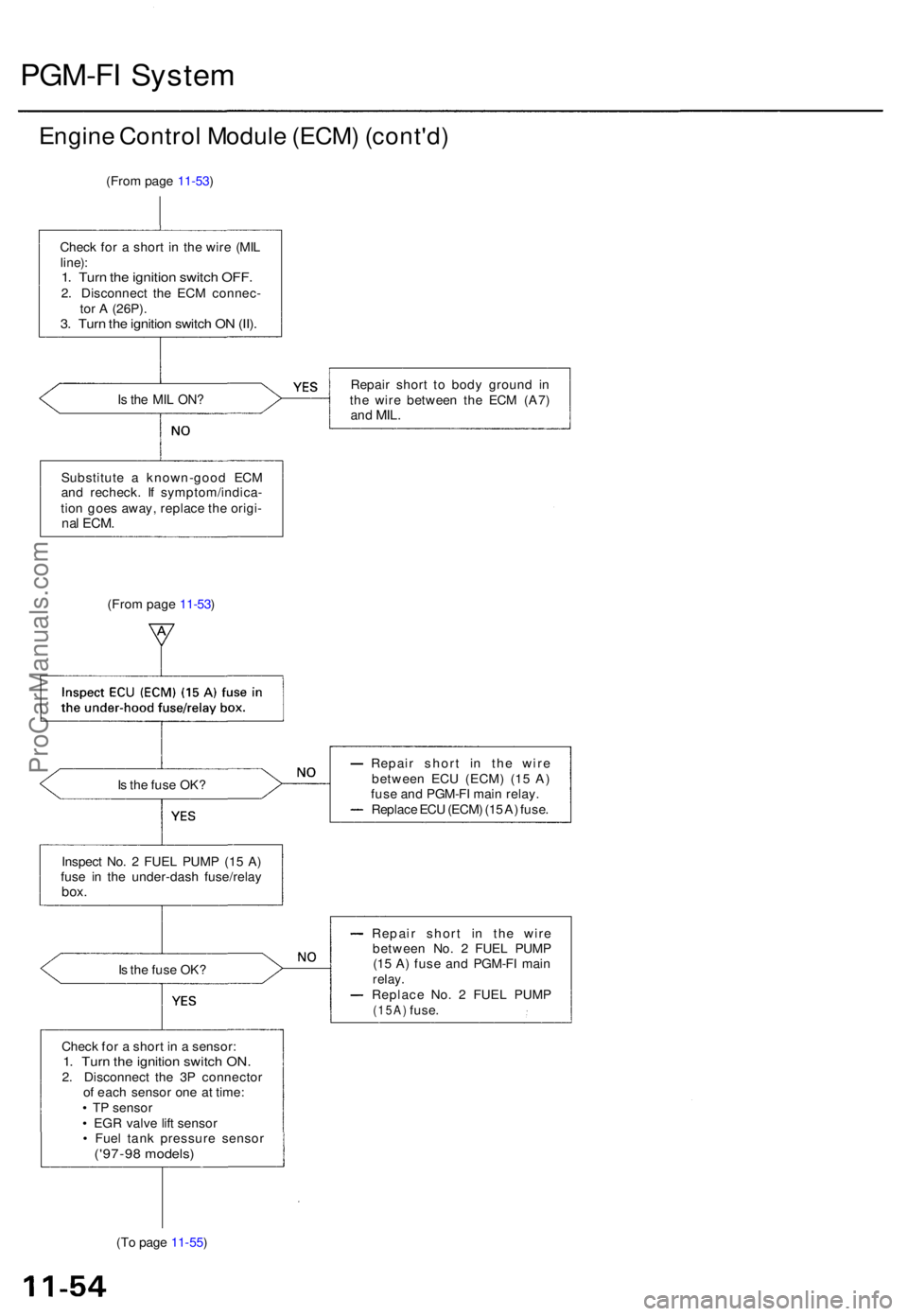
PGM-FI Syste m
Engine Contro l Modul e (ECM ) (cont'd )
(From pag e 11-53 )
Chec k fo r a shor t i n th e wir e (MI L
line) :1. Tur n th e ignitio n switc h OFF .2. Disconnec t th e EC M connec -
to r A (26P) .
3. Tur n th e ignitio n switc h O N (II) .
Is th e MI L ON ?Repai r shor t t o bod y groun d i n
th e wir e betwee n th e EC M (A7 )
and MIL .
Substitut e a known-goo d EC M
an d recheck . I f symptom/indica -
tio n goe s away , replac e th e origi -
nal ECM .
(From pag e 11-53 )
I s th e fus e OK ? Repai
r shor t i n th e wir e
betwee n EC U (ECM ) (1 5 A )
fus e an d PGM-F I mai n relay .
Replac e EC U (ECM ) (1 5 A ) fuse .
Inspec t No . 2 FUE L PUM P (1 5 A )
fus e i n th e under-das h fuse/rela y
box.
Is th e fus e OK ? Repai
r shor t i n th e wir e
betwee n No . 2 FUE L PUM P
(1 5 A ) fus e an d PGM-F I mai nrelay .Replac e No . 2 FUE L PUM P(15A) fuse.
Chec k fo r a shor t i n a sensor :
1. Tur n th e ignitio n switc h ON .2. Disconnec t th e 3 P connecto r
o f eac h senso r on e a t time :
• T P senso r
• EG R valv e lif t senso r
• Fue l tan k pressur e senso r
('97-98 models )
(To pag e 11-55 )
ProCarManuals.com
Page 882 of 1771
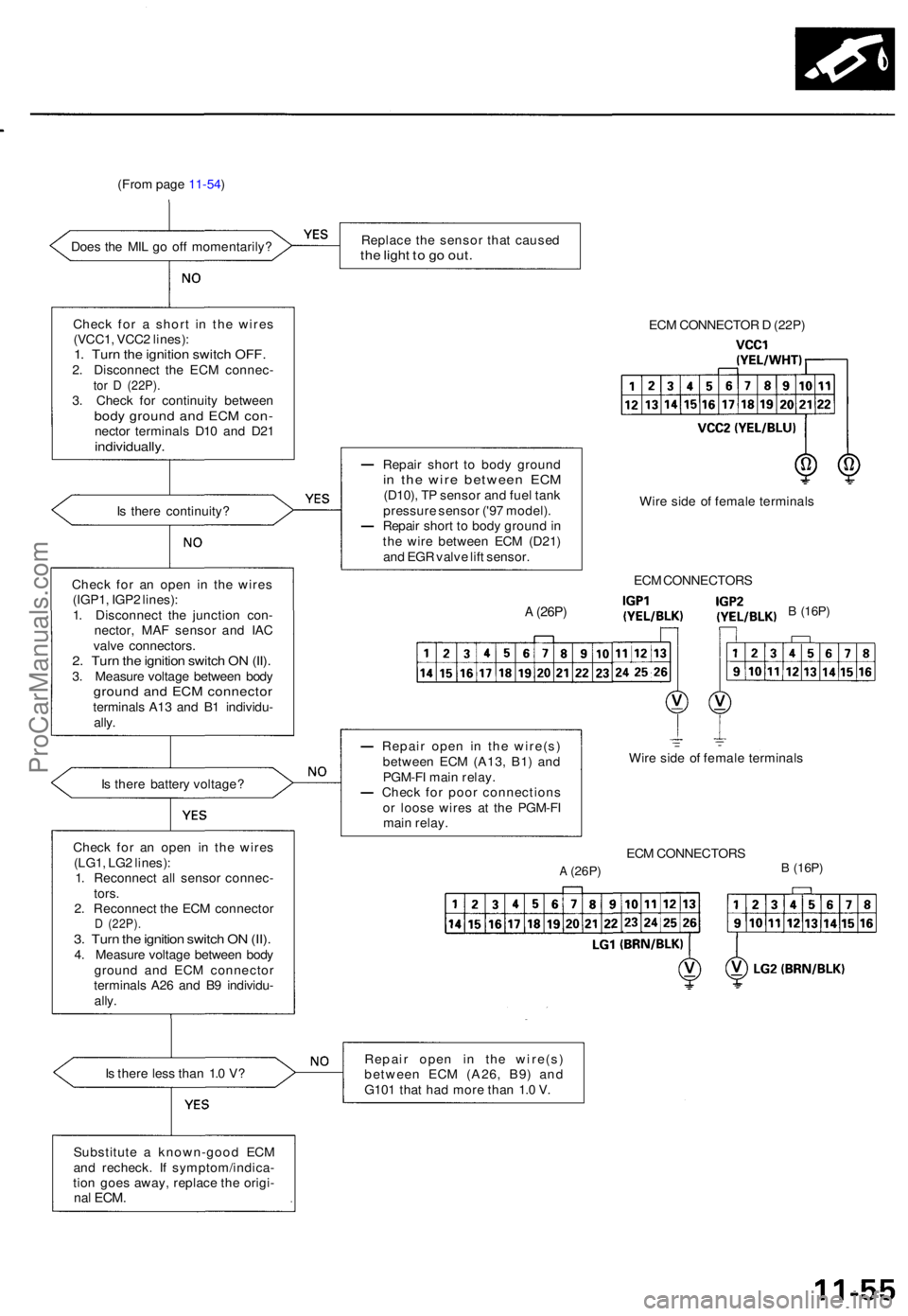
(From pag e 11-54 )
Doe s th e MI L g o of f momentarily ?
I s ther e batter y voltage ?
Chec k fo r a n ope n i n th e wire s
(LG1 , LG 2 lines) :
1 . Reconnec t al l senso r connec -
tors .
2 . Reconnec t th e EC M connecto r
D (22P) .3. Tur n th e ignitio n switc h O N (II) .4. Measur e voltag e betwee n bod y
groun d an d EC M connecto r
terminal s A2 6 an d B 9 individu -
ally .
I s ther e les s tha n 1. 0 V ?
Substitut e a known-goo d EC M
an d recheck . I f symptom/indica -
tio n goe s away , replac e th e origi -
nal ECM .
Replac e th e senso r tha t cause dthe ligh t t o g o out .
ECM CONNECTO R D (22P )
Repai r shor t t o bod y groun d
in th e wir e betwee n EC M(D10) , T P senso r an d fue l tan k
pressur e senso r ('9 7 model) .
Repai r shor t t o bod y groun d in
th e wir e betwee n EC M (D21 )
an d EG R valv e lif t sensor .
A (26P)
Repai r ope n i n th e wire(s )
betwee n EC M (A13 , B1 ) an d
PGM-F I mai n relay .
Chec k fo r poo r connection s
o r loos e wire s a t th e PGM-F I
mai n relay . Wir
e sid e o f femal e terminal s
EC M CONNECTOR S
A (26P)B (16P)
Repai r ope n i n th e wire(s )
betwee n EC M (A26 , B9 ) an d
G10 1 tha t ha d mor e tha n 1. 0 V . EC
M CONNECTOR S
B (16P)
Wire sid e o f femal e terminal s
Chec k fo r a n ope n i n th e wire s
(IGP1 , IGP 2 lines) :
1 . Disconnec t th e junctio n con -
nector , MA F senso r an d IA C
valv e connectors .
2. Tur n th e ignitio n switc h O N (II) .3. Measur e voltag e betwee n bod ygroun d an d EC M connecto rterminals A1 3 an d B 1 individu -
ally .I
s ther e continuity ?
Chec
k fo r a shor t i n th e wire s
(VCC1 , VCC 2 lines) :
1. Tur n th e ignitio n switc h OFF .2. Disconnec t th e EC M connec -tor D (22P) .3. Chec k fo r continuit y betwee nbody groun d an d EC M con -necto r terminal s D1 0 an d D2 1individually .
ProCarManuals.com
Page 883 of 1771
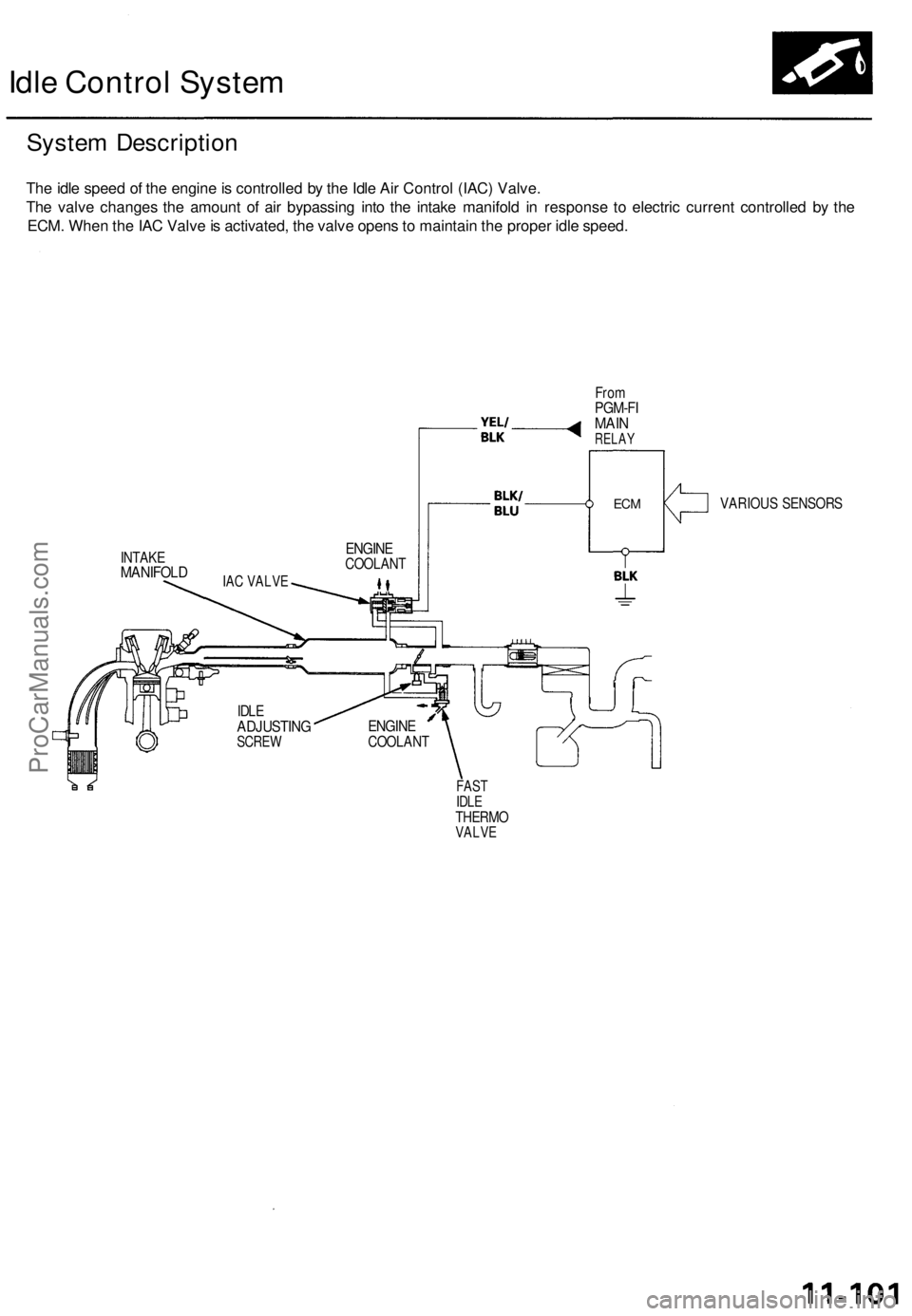
Idle Control System
System Description
The idle speed of the engine is controlled by the Idle Air Control (IAC) Valve.
The valve changes the amount of air bypassing into the intake manifold in response to electric current controlled by the
ECM. When the IAC Valve is activated, the valve opens to maintain the proper idle speed.
From
PGM-FI
MAIN
RELAY
INTAKE
MANIFOLD
VARIOUS SENSORS
FAST
IDLE
THERMO
VALVE
IDLE
ADJUSTING
SCREW
ENGINE
COOLANT
ENGINE
COOLANT
IAC VALVE
ECMProCarManuals.com