oil Alfa Romeo 166 2007 Owner handbook (in English)
[x] Cancel search | Manufacturer: ALFA ROMEO, Model Year: 2007, Model line: 166, Model: Alfa Romeo 166 2007Pages: 272, PDF Size: 4.17 MB
Page 207 of 272
206 ANNUAL INSPECTION
PLAN
An annual inspection plan has
been established for cars that cov-
er less than 20,000 km a year
(e.g. 10,000 km). It consists of
the following:
– Checking the condition/wear of tyres,
and adjusting pressure (including the com-
pact spare wheel, where applicable).
– Checking the lighting system (head-
lights, turn indicators, hazard warning
lights, boot light, passenger compart-
ment, warning lights of instrument panel,
etc.).
– Checking the working order of the
windscreen wiper-washer and adjusting
the nozzles.
– Checking the positioning/wear of the
windscreen wipers.
– Checking the condition and wear of
the front brake pad.– Sight inspect the conditions of: en-
gine, gearbox, transmission, pipes and
hoses (exhaust - fuel - brakes), rubber
parts (boots, sleeves, bushes, etc.).
– Check for bonnet and boot lock clean-
ness, lever cleanness and lubrication.
– Check battery charge and fluid level
(electrolyte).
– Visually checking the condition of the
belts and various controls.
– Checking and topping up, if neces-
sary, the level of liquids (coolant, brake
fluid, windscreen washer fluid, battery
etc.).
– Change engine oil and oil filter, if re-
quired.
– Check and replace pollen filter, if re-
quired.
– Check and replace air cleaner, if re-
quired.
ADDITIONAL OPERATIONS
Every 1000 kmor before long jour-
neys check and if necessary top up:
– the engine coolant fluid level
– brake fluid/hydraulic clutch control
fluid level
– power steering fluid level
– windscreen washer and headlamp
washer fluid level
– tyre pressure and conditions.
– check light system operation (head-
lights, direction indicators, hazard lights,
etc.).
– check windscreen wiper/washer op-
eration and windscreen/rear window
blade position/wear.
Every 3000 kmcheck the level of
the engine oil and top up if necessary.
Every 5000 km(only for fuel oil en-
gines): drain the condensation water
from the filter. You are recommended to
use products of the FL Selenia, de-
signed and developed expressly for Alfa
Romeo cars (see the table “Fluids and lu-
bricants” in the Technical specifications”
chapter).
Page 208 of 272
207
IMPORTANT - Engine oil
Change the engine oil more frequently
than stated in the Scheduled Mainte-
nance Programme if the car is used pre-
vailingly in one of the following particular-
ly harsh conditions:
– trailer or caravan towing
– dusty roads
– short, repeated journeys (less than 7-
8 km) with an outside temperature of be-
low freezing point.
– engine idling frequently or driving
long distances at low speed (e.g. taxi or
door-to-door deliveries) or in the case of
prolonged inactivity.
IMPORTANT - Air cleaner
Using the car on dusty roads, change
the air cleaner more frequently than stat-
ed in the Scheduled Maintenance Pro-
gramme.
For any doubts about the intervals be-
tween engine oil and air cleaner changes
in relation to how the car is used, contact
Authorised Alfa Romeo Services.IMPORTANT - Fuel oil filter
The variety of the degree of purity of
the fuel oil in commerce may make it
necessary to change the fuel oil filter
more frequently than stated in the Sched-
uled Maintenance Programme. If the en-
gine is “sobbing” it is a sign that the fil-
ter needs changing.
IMPORTANT - Pollen filter
If the car is used frequently in dusty or
heavily polluted environments, you are
recommended to change the activated
carbon filtering element more frequently;
in particular, it should be changed if a
lower flow of air admitted to the passen-
ger compartment is noted.IMPORTANT - Batteries
You are recommended to have the bat-
tery charge conditions checked, prefer-
ably at the onset of winter, to avoid the
possibility of freezing the electrolyte.
This check should be carried out more
frequently if the car is used prevailingly
for short journeys, or if it is fitted with
services that absorb high amounts of cur-
rent permanently with the ignition key
off, especially if installed in the after mar-
ket.
In the case of use of the car in hot cli-
mates or particularly harsh conditions, it
is wise to check the level of the battery
fluid (electrolyte) at more frequent inter-
vals than stated in the Scheduled Mainte-
nance Programme.
IMPORTANT - Remote control
If when pressing the remote control but-
ton of the key, the operating led on the
key flashes briefly only once, the battery
need replacing with other of the same
type.
Page 210 of 272
209
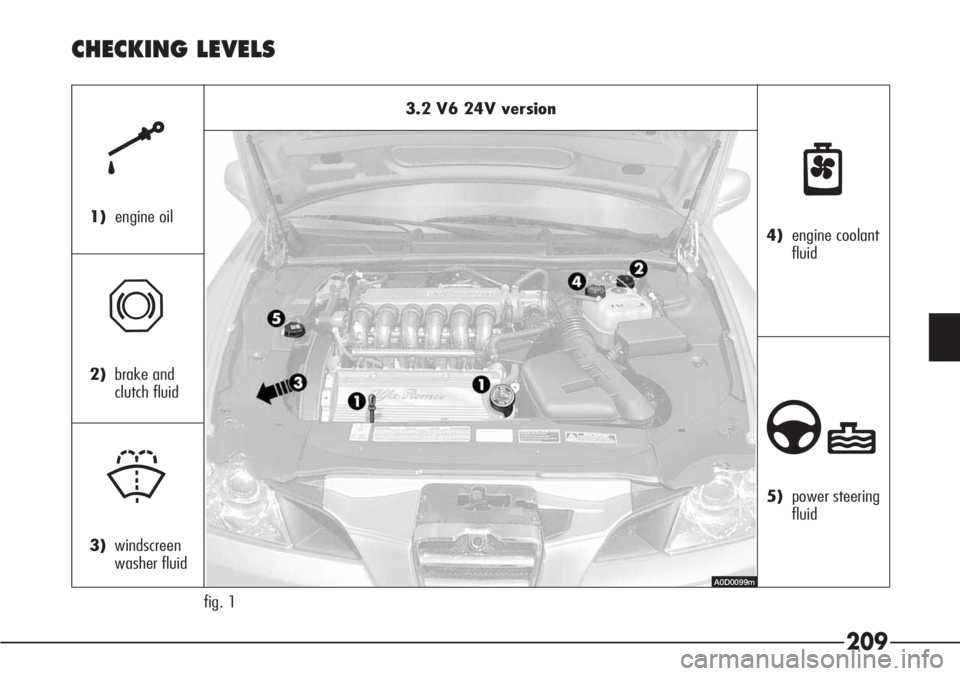
3.2 V6 24V version
fig. 1
k
1)engine oil
π
2)brake and
clutch fluid
+
3)windscreen
washer fluid
n
4)engine coolant
fluid
∂
5)power steering
fluid
A0D0099m
CHECKING LEVELS
Page 211 of 272

210
JTD 20V Multijet version
fig. 2
k
1)engine oil
π
2)brake and
clutch fluid
+
3)windscreen
washer fluid
n
4)engine coolant
fluid
∂
5)power steering
fluid
A0D0112m
Page 212 of 272
211
PROTECTIVE SHIELD UNDER
ENGINE
The car is fitted with a protective shield
under the engine.
IMPORTANTWhen changing the en-
gine oil and filter, checking and changing
the gearbox and differential oil, this pro-
tection should be removed. This operation
should be carried out by Alfa Romeo Au-
thorized Services.
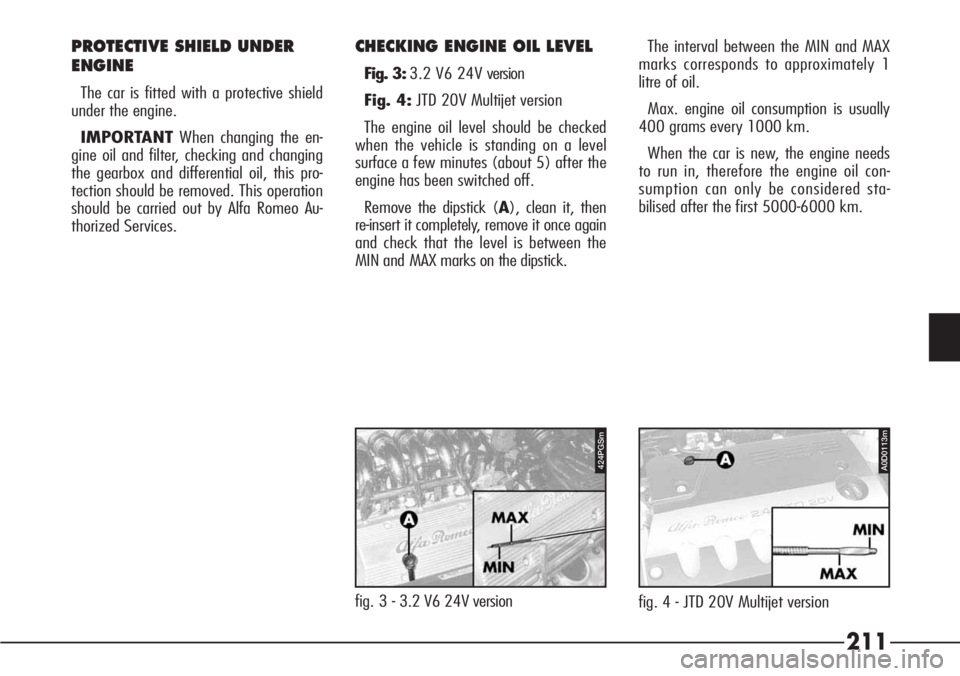
CHECKING ENGINE OIL LEVEL
Fig. 3:3.2 V6 24V version
Fig. 4:JTD 20V Multijet version
The engine oil level should be checked
when the vehicle is standing on a level
surface a few minutes (about 5) after the
engine has been switched off.
Remove the dipstick (A), clean it, then
re-insert it completely, remove it once again
and check that the level is between the
MIN and MAX marks on the dipstick.The interval between the MIN and MAX
marks corresponds to approximately 1
litre of oil.
Max. engine oil consumption is usually
400 grams every 1000 km.
When the car is new, the engine needs
to run in, therefore the engine oil con-
sumption can only be considered sta-
bilised after the first 5000-6000 km.
fig. 3 - 3.2 V6 24V version
424PGSm
fig. 4 - JTD 20V Multijet version
A0D0113m
Page 213 of 272
212
fig. 6 - JTD 20V Multijet version
A0D0114m
The oil consumption depends on driving
style and the conditions under which the
car is used.
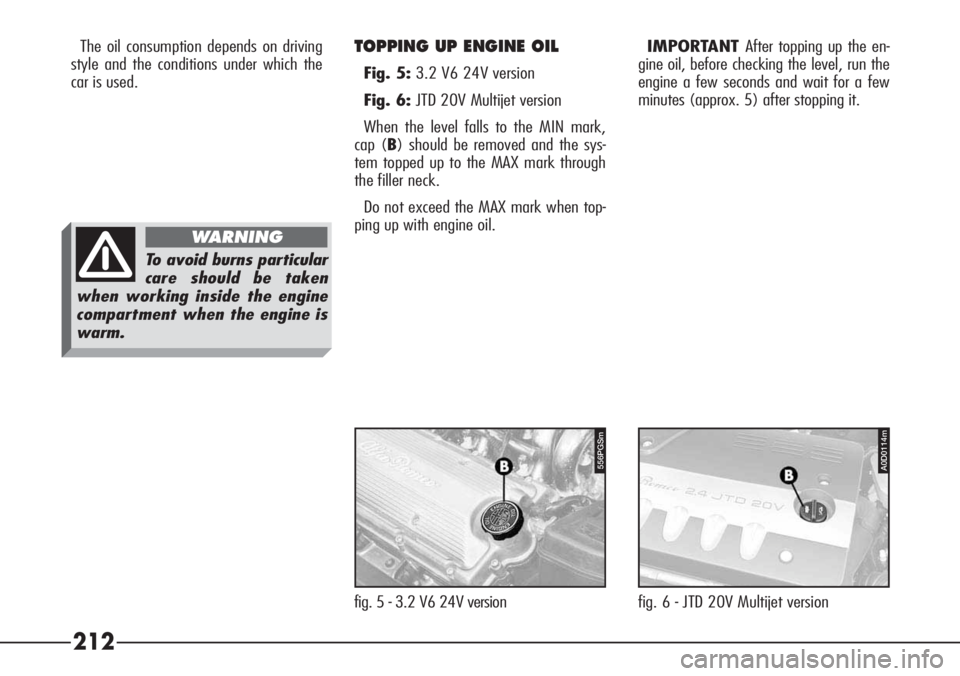
fig. 5 - 3.2 V6 24V versionTOPPING UP ENGINE OIL
Fig. 5:3.2 V6 24V version
Fig. 6:JTD 20V Multijet version
When the level falls to the MIN mark,
cap (B) should be removed and the sys-
tem topped up to the MAX mark through
the filler neck.
Do not exceed the MAX mark when top-
ping up with engine oil.IMPORTANT After topping up the en-
gine oil, before checking the level, run the
engine a few seconds and wait for a few
minutes (approx. 5) after stopping it.
To avoid burns particular
care should be taken
when working inside the engine
compartment when the engine is
warm.
WARNING
556PGSm
Page 214 of 272

213
Never add oil with
characteristics (classifi-
cation, viscosity) which
are different from those of the
oil already in the circuit.
Remember that when the
engine is warm the elec-
tric fan, which is operated on the
basis of the engine coolant tem-
perature, could cut-in automatical-
ly and cause injury.
WARNING
Never exceed the MAX
level when topping up or
changing engine oil. Too much en-
gine oil would cause it to be tak-
en in through the blow-by cylinder.
For JTD versions this can rapidly in-
crease the engine speed (no longer
controllable, in this case, by re-
leasing the accelerator pedal and
moving the ignition key to STOP)
and damage to the engine with the
risk of seizing or fire.
WARNING
Page 216 of 272
215
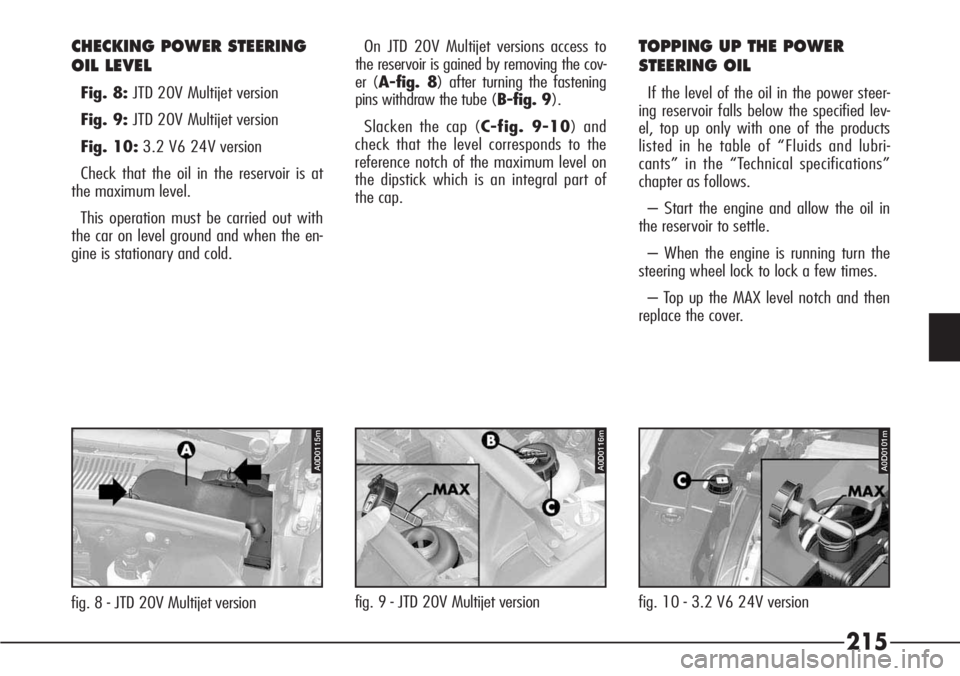
CHECKING POWER STEERING
OIL LEVEL
Fig. 8:JTD 20V Multijet version
Fig. 9:JTD 20V Multijet version
Fig. 10:3.2 V6 24V version
Check that the oil in the reservoir is at
the maximum level.
This operation must be carried out with
the car on level ground and when the en-
gine is stationary and cold.
fig. 8 - JTD 20V Multijet versionfig. 9 - JTD 20V Multijet versionfig. 10 - 3.2 V6 24V version On JTD 20V Multijet versions access to
the reservoir is gained by removing the cov-
er (A-fig. 8) after turning the fastening
pins withdraw the tube (B-fig. 9).
Slacken the cap (C-fig. 9-10) and
check that the level corresponds to the
reference notch of the maximum level on
the dipstick which is an integral part of
the cap.
TOPPING UP THE POWER
STEERING OIL
If the level of the oil in the power steer-
ing reservoir falls below the specified lev-
el, top up only with one of the products
listed in he table of “Fluids and lubri-
cants” in the “Technical specifications”
chapter as follows.
– Start the engine and allow the oil in
the reservoir to settle.
– When the engine is running turn the
steering wheel lock to lock a few times.
– Top up the MAX level notch and then
replace the cover.
A0D0115mA0D0101mA0D0116m
Page 217 of 272
When the cap (B) is
screwed off the reser-
voir ensure that the
electrical connections are not dis-
connected. Make sure that the
highly corrosive brake fluid
does not drip onto the paint-
work. If it does, wash it off
immediately with water.
IMPORTANT Contact Alfa Romeo Au-
thorized Services for maintenance and re-
pair operations.Oil consumption is very
low; if topping up again
is needed shortly after-
wards, have the system checked
for possible leaks by Alfa Romeo
Authorized services.
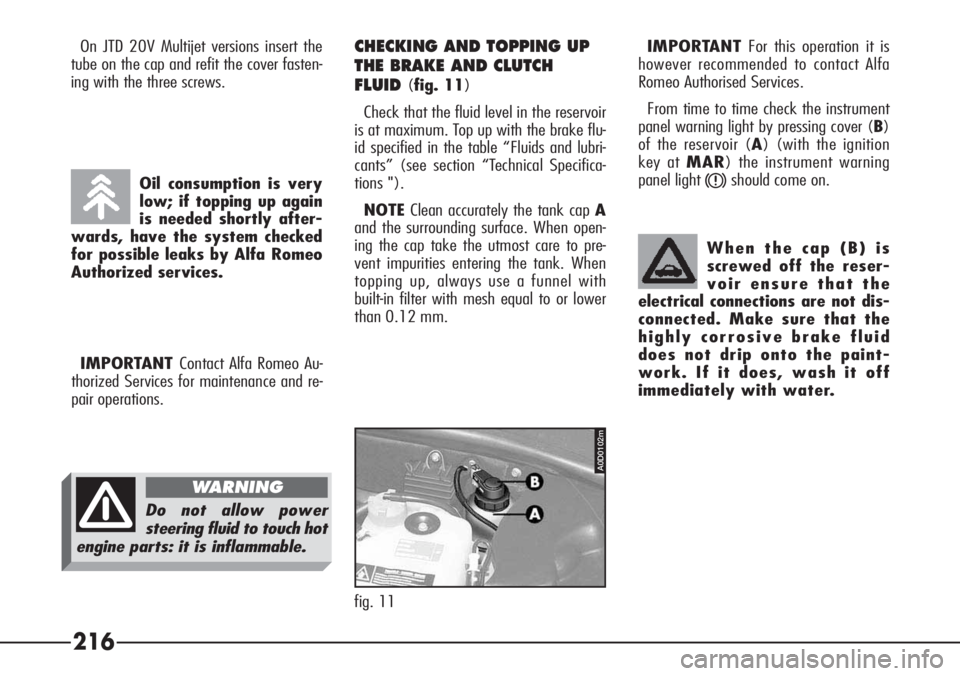
CHECKING AND TOPPING UP
THE BRAKE AND CLUTCH
FLUID
(fig. 11)
Check that the fluid level in the reservoir
is at maximum. Top up with the brake flu-
id specified in the table “Fluids and lubri-
cants” (see section “Technical Specifica-
tions ").
NOTEClean accurately the tank cap A
and the surrounding surface. When open-
ing the cap take the utmost care to pre-
vent impurities entering the tank. When
topping up, always use a funnel with
built-in filter with mesh equal to or lower
than 0.12 mm. On JTD 20V Multijet versions insert the
tube on the cap and refit the cover fasten-
ing with the three screws.
Do not allow power
steering fluid to touch hot
engine parts: it is inflammable.
WARNING
A0D0102m
fig. 11
216
IMPORTANTFor this operation it is
however recommended to contact Alfa
Romeo Authorised Services.
From time to time check the instrument
panel warning light by pressing cover (B)
of the reservoir (A) (with the ignition
key at MAR) the instrument warning
panel light
xshould come on.
Page 226 of 272
225
– Application of enamels with greater
resistance to atmospheric pollutants.
– Adoption of “open” boxed parts to
prevent condensation from triggering cor-
rosion from the inside.
The underbody is treated with the appli-
cation of a special protective material.
If this protective layer requires restora-
tion the exhaust system, lambda probe
and catalytic converter must be left free
of any wax, oil, plastic and/or inflamma-
ble product.
This should therefore be carried out by
Alfa Romeo Authorized Services.SPRAY JETS
Make sure that the windscreen and
headlight washer jets deliver a jet of fluid
which is adequate and correctly directed.
If the spray devices are not working
check that the supply circuit is not
blocked. If necessary unclog the nozzles
using a needle.
BODYWORK
PROTECTION FROM
ATMOSPHERIC AGENTS
Alfa Romeo employs manufacturing
technologies which are designed to pro-
tect the bodywork against chemical corro-
sion caused by various factors, for exam-
ple:
– atmospheric pollution.
– Salty air and humidity (coastal areas,
hot-humid climates).
– Road surfaces covered with salt and
de-icing products during the winter.
To further increase resistance against
corrosion the following procedures have
been adopted:
– painting system and paint products
which render the vehicle particularly resis-
tant to corrosion and abrasion.
– Wide use of sheet metal which is ex-
tremely resistant to corrosion.
– Spraying of the underbody, engine
bay, wheel arches and boxed parts with
suitable products which adhere strongly
to the metal parts and have a high pro-
tection capability.