wheel Alfa Romeo 166 2007 Owner handbook (in English)
[x] Cancel search | Manufacturer: ALFA ROMEO, Model Year: 2007, Model line: 166, Model: Alfa Romeo 166 2007Pages: 272, PDF Size: 4.17 MB
Page 118 of 272
117
VDC AND ASR
SYSTEMS
(on request for versions/markets
where applicable)
VDC SYSTEM (VEHICLE
DYNAMICS CONTROL):
GENERAL
The VDC is an electronic vehicle stability
control system which, acting on the
torque and braking the wheels in a differ-
entiated manner, helps to bring the car
back to the correct course in the event of
loss of grip.
While travelling the car is subjected to
lateral and longitudinal forces that may
be controlled by the driver up to when
the tyres offer adequate road-holding;
when this falls below the minimum level,
the car starts to deviate from the course
required by the driver.Above all on rough surfaces (such as
cobbles, or due to the presence of water,
ice or soil), changes in speed (when ac-
celerating or braking) and/or course
(bends or the need to avoid obstacles)
can cause the tyres to lose grip.
When the sensors detect the conditions
that would lead to skidding, the VDC sys-
tem acts on the engine and brakes gener-
ating a stabilising torque.
The system performance
levels, in terms of active
safety, should not induce the dri-
ver to run pointless and unjustified
risks. Driving conduct should al-
ways be suited to the conditions of
the road surface, vision and traf-
fic. The responsibility for road safe-
ty is always and anyway the ve-
hicle driver’s concern.
The VDC system helps the driver
to keep control of the car in the
event of loss of tyre grip.
The forces induced by the VDC sys-
tem to control the lack of stability
of the car always and anyway de-
pend on the grip between the tyre
and the road surface.
WARNING
Page 119 of 272
The heart of the VDC system is a sensor
that originates from the field of aeronau-
tics, which detects rotations of the car
around its vertical axis. The centrifugal
forces generated when the car runs on a
bend are detected by a highly sensitive,
lateral acceleration sensor.
The stabilising action of the VDC system
is based on calculations made by the
system’s electronic control unit which
processes the signals received from the
steering wheel rotation, lateral accelera-
tion and individual wheel rotation sen-
sors. These signals allow the control unit
to recognise the manoeuvre the driver in-
tends to do when turning the steering
wheel.
118
VDC SYSTEM OPERATION
The VDC system turns on automatically
when the car is started and cannot be
switched off. It is however possible to cut
off operation of the ASR system pressing
the corresponding button on the centre
console.
The main components of the VDC sys-
tem are:
– an electronic control unit which
processes the signals received from the
various sensors and brings about the
most appropriate strategy;
– a sensor that detects the position of
the steering wheel;
– four sensors that detect the rotation
speed of each wheel;
– a sensor that detects rotation of the
car around the vertical axis;
– a sensor that detects lateral accelera-
tion (centrifugal force).The control unit processes the informa-
tion received from the sensors and is
therefore capable of detecting the posi-
tion of the car and comparing it with the
trajectory the driver would like to follow
instant by instant. In the event of a dis-
crepancy, the control unit chooses and
commands the most suitable action to
bring the car back to the required course
within a fraction of a second: braking one
or more wheels at a different braking
force and, if necessary it reduces the
power transmitted by the engine.
The corrective actions are changed and
controlled continuously until the car re-
turns to the required course.
The action of the VDC system consider-
ably increases the active safety of the ve-
hicle under many critical situations and it
is particularly useful also when the road
surface grip conditions change.
Page 120 of 272

119
The action of the ASR system is particu-
larly helpful under the following condi-
tions:
– Skidding of the inner wheel on a
bend, due to the effect of the dynamic
changes of the load or over-accelerating.
– Excessive power transmitted to the
wheels, also in relation to the conditions
of the road surface.
– Acceleration on slippery, snowy or icy
surfaces.
– In the case of loss of grip on a wet
surface (aquaplaning).ASR FUNCTION (ANTISLIP
REGULATION): GENERAL
The ASR system integrates the VDC sys-
tem controlling the vehicle drive and com-
ing into operation automatically each
time one or both driving wheels skid.
Two different control systems are acti-
vated, depending on the skidding condi-
tions:
– If skidding concerns both driving
wheels, because it is caused by the exces-
sive power transmitted, the ASR system
cuts in reducing the power transmitted by
the engine.
– If skidding concerns only one driving
wheel, the ASR system cuts in automati-
cally braking the skidding wheel, with an
effect similar to that of a self-locking dif-
ferential.
For the VDC, ASR and
ABS systems to work
correctly, the tyres must be of the
same brand and type on all
wheels, in perfect conditions and
above all of the specified type,
brand and size.
WARNING
Page 121 of 272
120
TURNING ON THE ASR
FUNCTION
The ASR function turns on automatically
each time the engine is started.
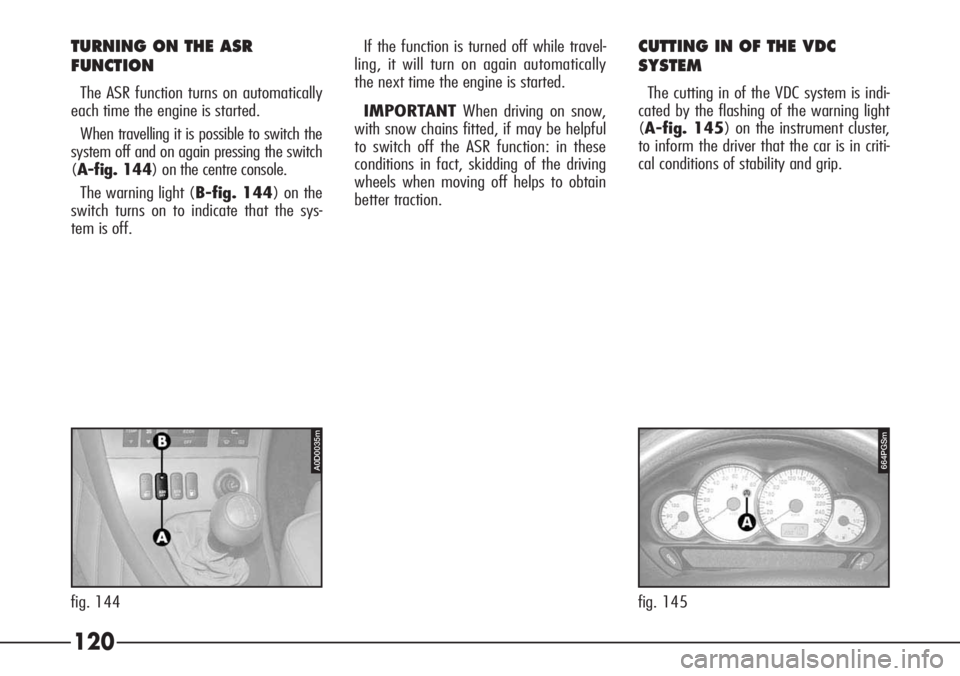
When travelling it is possible to switch the
system off and on again pressing the switch
(A-fig. 144) on the centre console.
The warning light (B-fig. 144) on the
switch turns on to indicate that the sys-
tem is off.If the function is turned off while travel-
ling, it will turn on again automatically
the next time the engine is started.
IMPORTANTWhen driving on snow,
with snow chains fitted, if may be helpful
to switch off the ASR function: in these
conditions in fact, skidding of the driving
wheels when moving off helps to obtain
better traction.
CUTTING IN OF THE VDC
SYSTEM
The cutting in of the VDC system is indi-
cated by the flashing of the warning light
(A-fig. 145) on the instrument cluster,
to inform the driver that the car is in criti-
cal conditions of stability and grip.
664PGSm
fig. 145
A0D0035m
fig. 144
Page 137 of 272
136
EMERGENCY STARTING
Starting with an auxiliary
battery
If the engine does not start (with the Al-
fa Romeo CODE system efficient), use an
auxiliary battery as described in the chap-
ter “In an emergency”.
SAFE DRIVING
This paragraph supplies suggestions and
indications for the correct and safe use of
your vehicle in the most common situa-
tions.
In addition to this, suggestions are giv-
en concerning the main organs which en-
sure the safety of the vehicle and its pas-
sengers.
BEFORE DRIVING OFF
Before driving off, especially before a
long journey, the following procedures
should be carried out:
– Adjust the seat, steering wheel and
rear-view mirrors in order to obtain a cor-
rect position for driving.
– Check that nothing can get under the
foot pedals, especially under the brake
pedal.
– If children are present in the car ad-
here to the instructions given in the para-
graph “General instructions for the use of
the seat belts and child restraint system”
in the chapter “Getting to know your
car”. For vehicles equipped
with turbocharger in
particular and for other
vehicles in general, revving the
engine before switching off
should be avoided.
Revving the engine serves no
purpose and consumes fuel for
no reason. It may also cause
damage to the bearings on the
rotor.
Do not bump, tow or
coast start the vehicle
as this would irrepara-
bly damage the exhaust gas cat-
alyzer.
Page 139 of 272
138
PARKING
When the vehicle is parked, proceed as
follows:
– Switch off the engine.
– Engage the handbrake.
– Engage first gear if parking the car
uphill or reverse if parking the car on a s-
loping road. On cars with automatic gear-
box set the gear lever to P.
– Turn the front wheels so that the vehi-
cle will immediately come to a halt if the
handbrake slips.
NIGHT DRIVING
Night driving involves a greater degree
of concentration, both physical and ner-
vous. Some suggestions concerning night
driving follow:
– Drive with particular care, reducing
speed if necessary especially on unlit
roads.
– Maintain a greater distance from the
vehicle in front than during the day as it
is more difficult to judge the speed of a
vehicle when only the lights can be seen.
– If you become drowsy stop the car
and rest. continuing the journey when
sleepy is dangerous for yourself and for
others.
–Ensure that the headlights are correct-
ly aligned: if they are too low visibility is
reduced and if they are too high they
may cause disturbance to other users.
– use the main-beam outside built-up
areas and only when you are certain that
other drivers are not disturbed by their
use.
– When meeting vehicles coming in the
opposite direction, switch off the main-
beam and drive with the dipped-beam
headlights on.
– Keep the headlights and light units
clean at all times. – Do not coast the vehicle down hill
with the engine switched off as this elimi-
nates the engine braking effect thus re-
quiring a greater effort on the brake ped-
al, on the power steering and consider-
ably more effort on the steering wheel.
– If it is necessary to stop the vehicle
following a malfunction, park off the
road, switch on the hazard warning lights
and set up the warning triangle to alert
other road users of the presence of your
vehicle. At all times comply with the cur-
rent road traffic regulations.To avoid useless con-
sumption of power and
possible draining of the
battery, never leave the ignition
key in the MAR position when
the engine is not running.Ensure that both yourself
and your passengers are
wearing their seat belts. Travelling
without seat belts greatly in-
creases the risks of serious injury
or even death in the event of an
accident.
WARNING
Never leave children un-
attended in the vehicle.
Always remove the key from the
ignition when leaving the vehicle
and take it with you.
WARNING
Page 140 of 272
139
DRIVING UNDER ADVERSE
WEATHER CONDITIONS
Rain and fog can be extremely danger-
ous if the style of driving is not adapted
to suit these conditions. Some sugges-
tions are given below:
– if the road is wet, the friction be-
tween wheel and asphalt is greatly re-
duced thus increasing the stopping dis-
tance and decreasing road holding when
cornering.
Reduce speed and keep further back
from the vehicle in front.
– Heavy rain and fog reduce visibility.
Headlights should be switched on as the
road traffic laws and common sense dic-
tate, above all to render yourself visible
to others.
– Do not drive over puddles or flooded
roads at high speed as the aquaplaning
phenomenon may cause you to loose
control over the vehicle.
– If visibility is already reduced prevent
it from worsening by ensuring that the
windows do not steam up. Use the heat-
ing-ventilation controls as indicated in the
chapter “Know your vehicle”.– Check the condition of the windscreen
wiper blades.
– If fog is very thick avoid travelling
where possible. If travelling cannot be
avoided drive with extreme care and
moderate your speed. Avoid overtaking.
– If the vehicle is forced to stop owing
to a malfunction or zero visibility condi-
tions, pull off the road, switch on the haz-
ard warning lights and if possible, the
dipped-beam headlights.
MOUNTAIN DRIVING
Mountain driving requires a greater de-
gree of concentration. Some practical
hints follow:
– Before driving off check the level of
fluids (engine oil, brakes, coolant) and
the state of the tyres.
– When travelling down hill use the en-
gine braking by engaging lower gears to
prevent the brakes from overheating.
– Never coast downhill with the engine
off or in neutral and especially not with
the ignition key removed.
– Drive at a moderate speed and avoid
cutting corners.– Remember that overtaking uphill is
slower and therefore requires a greater
length of clear road. If you are being
overtaken on a hill move over to enable
the other vehicle to pass in safety.
WINTER DRIVING
If the temperature falls below 0°C or in
the presence of snow or ice the following
recommendations should be followed:
– Before driving off check that the
windscreen wipers are not frozen to the
windscreen.
– Remove the snow from the air intake
(grille) at the base of the windscreen.
– Do not stop long on deep snow with
the engine running: the snow might di-
vert the exhaust gas carbon monoxide in-
to the passenger compartment.
– Ensure that brakes and tyres are in
perfect working order.
–Ensure that the detergent liquid locat-
ed in the windscreen/headlight washers
has been topped up with anti-freeze and
anti-scale additives.
– Use engine braking where possible
and avoid abrupt braking.
Page 141 of 272
140
– During cold weather even apparently
dry roads may be covered with occasion-
al patches of ice. Pay great attention
therefore when driving on roads which
are in the shade, or where rocks or trees
line the road and on which ice may per-
sist.
IMPORTANT To avoid damaging
tyres do not drive on bare patches of as-
phalt with snow chains fitted to the vehi-
cle. In extreme cases proceed slowly and
remove the chains as soon as possible.
When driving on snow with snow chains
fitted, it might be helpful to turn off the
ASR function of the VDC system (if pre-
sent): in fact, in these conditions, skid-
ding of the driving wheels when moving
off makes it possible to obtain higher
traction.
BRAKES
An efficient braking system is vital to
the safety of the vehicle and its passen-
gers.
To use the brakes correctly and to im-
prove their efficiency and limit wear the
following recommendations should be fol-
lowed:– Do not drive with your foot resting on
the brake pedal.
– Ensure that the brake pedal is not
blocked by the mat or other objects.
– Check the efficiency of the braking
system especially before long journeys.
– Check the handbrake and brake fluid
minimum level warning light
xon the
instrument panel. if the
xwarning light
comes on and stays on when the vehicle
is travelling check that the handbrake is
not engaged. If it is not, stop the vehicle
immediately and check the level of the
brake fluid. If the level is low the anom-
aly affecting the circuit should be rectified
immediately. If the
dwarning light
comes on when the brake pedal is
pressed, this means that the front brake
pads have reached the minimum permit-
ted thickness. Have them replaced as
soon as possible by Alfa Romeo Autho-
rized Services.
– The brake fluid is hygroscopic (i.e. it
absorbs humidity). To prevent the onset
of braking anomalies it should therefore
be replaced every two years regardless of
the kilometres travelled.
SERVO BRAKE
The vehicle is equipped with a servo-
braking system (active only when the en-
gine is running). When the engine is sta-
tionary a greater effort is required to de-
press the brake pedal in order to obtain
the same braking effect.
ANTI WHEEL-LOCK SYSTEM
(ABS)
The vehicle is equipped with an ABS sys-
tem with electronic braking device (EBD),
the following should be heeded:
– A slight pulsing may be felt on the
brake pedal caused by the intervention of
the ABS system.
– The performance of the system, in
terms of active safety, should not induce
the driver to take unnecessary and unjus-
tified risks.
– The conduct of the driver must always
reflect weather, road and traffic condi-
tions.
– Deceleration always depends on the
degree of grip between the tyres and the
road surface. Obviously road holding is
Page 142 of 272
141
greatly reduced when there is ice or snow
on the road. Under these conditions the
stopping distance is increased despite the
use of the ABS system.VDC SYSTEM (VEHICLE
DYNAMICS CONTROL):
The VDC is an electronic vehicle stability
control system which, acting on the torque
and braking the wheels in a differentiated
manner, helps to bring the car back to the
correct course in the event of loss of grip.
When the sensors detect the conditions
that would lead to skidding, the VDC sys-
tem intervenes on the engine and on the
brakes producing a stabilising torque.
BRAKE ASSIST (Brake assist in
an emergency)
This system, that cannot be cut out, rec-
ognizes emergency braking on the
ground of the brake pedal operation
speed and allows to speed up the braking
action.
On versions fitted with VDC system, Brake
Assist is deactivated in the event of VDC
system failure (indicated by the switching
on of the relevant warning light).
The ABS system does not
dispense the driver from
driving carefully, especially when
the road is icy, snowed over or
wet.
WARNING
The car is fitted with an
electronic braking device
(EBD). if the
>andxwarning
lights turn on at the same time, this
means that there is an EBD system
fault; in this case violent braking
may be accompanied by early rear
wheel locking, with the possibility
of skidding. Drive the car extremely
carefully to the nearest Authorized
Alfa Romeo workshop to have the
system checked.
WARNING
The turning on of only
the
>warning light
with the engine running normally
indicates a fault to the ABS system
only. In this case the braking sys-
tem is still efficient, though with-
out the aid of the anti-lock device.
Under these conditions perfor-
mance of the EBD system may be
reduced. In this case too, you are
advised to go immediately to the
nearest Authorized Alfa Romeo
workshop, driving in such a way
as to avoid sharp braking, to have
the system checked over.
WARNING
The system performance
levels, in terms of active
safety, should not induce the dri-
ver to run pointless and unjustified
risks. Driving conduct should al-
ways be suited to the conditions of
the road surface, vision and traf-
fic. The responsibility for road
safety is always and anyway the
vehicle driver’s concern.
WARNING
Page 143 of 272
142
POWER STEERING
The hydraulic power steering is only ac-
tive when the engine is running. If the en-
gine is switched off greater effort will be
required to turn the wheel.
As the steering system is a mechanical
organ which is closely tied to driving
safety, the vehicle should be stopped and
Alfa Romeo Authorized Services contacted
if an anomaly is detected.
IMPORTANT Keep the steering wheel
turned at the end of its stroke, in both di-
rections, only for the strictly indispensable
time.
WINDOWS
Do not apply stickers or similar adhe-
sives to the windows as these may dis-
tract the driver and block his vision. The VDC system turns on automatically
when the car is started and cannot be
switched off. It is however possible to cut
off operation of the ASR system pressing
the corresponding button on the centre
console.
ASR FUNCTION (ANTISLIP
REGULATION): GENERAL
The ASR system integrates the VDC sys-
tem controlling the vehicle drive and com-
ing into operation automatically each
time one or both driving wheels skid.When changing the
wiper blades follow the
instructions contained in
the package which is available as
a spare part and read the indica-
tions given in the “Car mainte-
nance “ chapter of this booklet.
WINDSCREEN WIPER BLADES
The windscreen wiper blades should be
checked periodically. Dirty or worn blades
greatly reduce visibility. The windscreen
and windows should be cleaned regularly
and grease, dirt and tar removed. In this
way the life of blades will be extended
considerably.The VDC system helps
the driver to keep control
of the car in the event of loss of
tyre grip.
The forces induced by the VDC sys-
tem to control the lack of stability
of the car always and anyway de-
pend on the grip between the tyre
and the road surface.
WARNING
Before operating the windscreen wipers,
remove snow or ice from the windscreen
and check that the wiper blade is not
frozen to the windscreen. Use an an-
tifreeze product if necessary.
Do not operate the windscreen wipers
on dry glass.