wheel Alfa Romeo 166 2007 Owner handbook (in English)
[x] Cancel search | Manufacturer: ALFA ROMEO, Model Year: 2007, Model line: 166, Model: Alfa Romeo 166 2007Pages: 272, PDF Size: 4.17 MB
Page 162 of 272
161
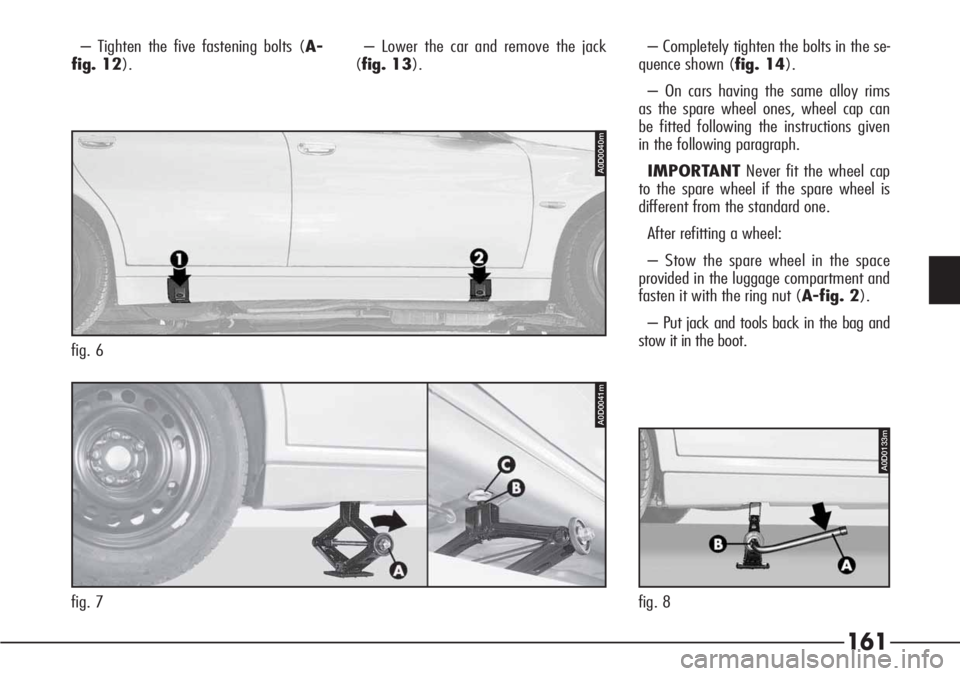
– Tighten the five fastening bolts (A-
fig. 12).– Lower the car and remove the jack
(fig. 13).– Completely tighten the bolts in the se-
quence shown (fig. 14).
– On cars having the same alloy rims
as the spare wheel ones, wheel cap can
be fitted following the instructions given
in the following paragraph.
IMPORTANTNever fit the wheel cap
to the spare wheel if the spare wheel is
different from the standard one.
After refitting a wheel:
– Stow the spare wheel in the space
provided in the luggage compartment and
fasten it with the ring nut (A-fig. 2).
– Put jack and tools back in the bag and
stow it in the boot.
fig. 7
A0D0041m
fig. 6
A0D0040m
A0D0133m
fig. 8
Page 163 of 272
162
REFITTING A NORMAL WHEEL
Refit the wheel as described below:
– Stop the car in such a position that it
is not dangerous for the traffic where it is
possible to change the wheel safely.
Where possible, park on a level, compact
surface.
– Engage the handbrake
– Engage 1st gear or reverse. For cars
with automatic gearbox set the lever to
positionP.
– Open the boot.
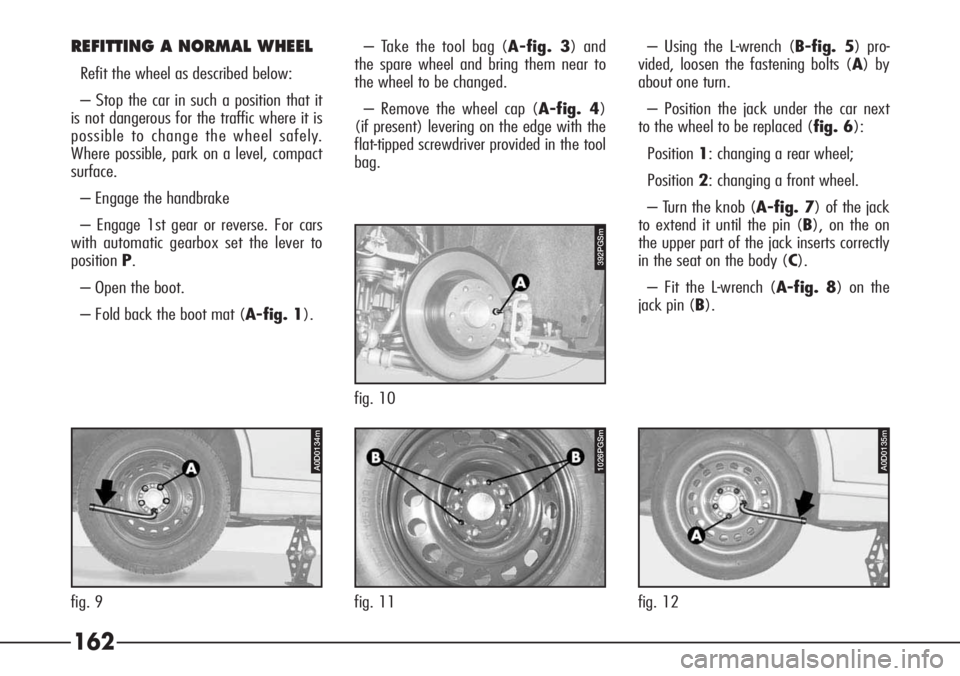
– Fold back the boot mat (A-fig. 1).– Take the tool bag (A-fig. 3) and
the spare wheel and bring them near to
the wheel to be changed.
– Remove the wheel cap (A-fig. 4)
(if present) levering on the edge with the
flat-tipped screwdriver provided in the tool
bag.– Using the L-wrench (B-fig. 5) pro-
vided, loosen the fastening bolts (A) by
about one turn.
– Position the jack under the car next
to the wheel to be replaced (fig. 6):
Position1: changing a rear wheel;
Position2: changing a front wheel.
– Turn the knob (A-fig. 7) of the jack
to extend it until the pin (B), on the on
the upper part of the jack inserts correctly
in the seat on the body (C).
– Fit the L-wrench (A-fig. 8) on the
jack pin (B).
392PGSm
fig. 10
1026PGSm
fig. 11
A0D0134m
fig. 9
A0D0135m
fig. 12
Page 164 of 272
163
– Work the jack and raise the car, until
the wheel is a few centimetres above
ground.
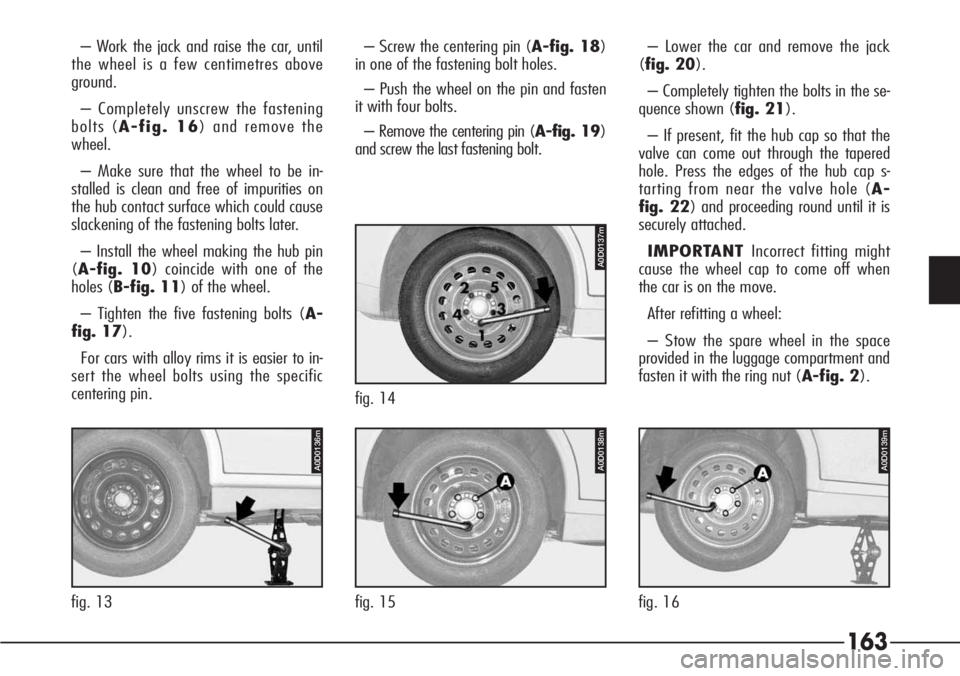
– Completely unscrew the fastening
bolts (A-fig. 16) and remove the
wheel.
– Make sure that the wheel to be in-
stalled is clean and free of impurities on
the hub contact surface which could cause
slackening of the fastening bolts later.
– Install the wheel making the hub pin
(A-fig. 10) coincide with one of the
holes (B-fig. 11) of the wheel.
– Tighten the five fastening bolts (A-
fig. 17).
For cars with alloy rims it is easier to in-
sert the wheel bolts using the specific
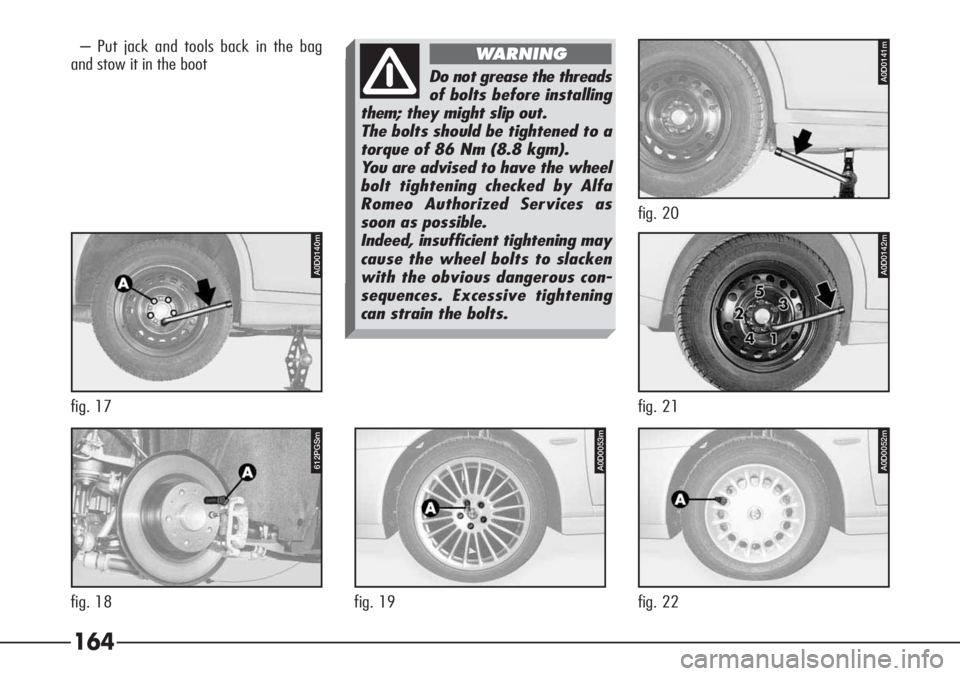
centering pin.– Screw the centering pin (A-fig. 18)
in one of the fastening bolt holes.
– Push the wheel on the pin and fasten
it with four bolts.
– Remove the centering pin (A-fig. 19)
and screw the last fastening bolt.– Lower the car and remove the jack
(fig. 20).
– Completely tighten the bolts in the se-
quence shown (fig. 21).
– If present, fit the hub cap so that the
valve can come out through the tapered
hole. Press the edges of the hub cap s-
tarting from near the valve hole (A-
fig. 22) and proceeding round until it is
securely attached.
IMPORTANT Incorrect fitting might
cause the wheel cap to come off when
the car is on the move.
After refitting a wheel:
– Stow the spare wheel in the space
provided in the luggage compartment and
fasten it with the ring nut (A-fig. 2).
A0D0139m
fig. 16
A0D0138m
fig. 15
A0D0136m
fig. 13
A0D0137m
fig. 14
Page 165 of 272
164
– Put jack and tools back in the bag
and stow it in the boot
Do not grease the threads
of bolts before installing
them; they might slip out.
The bolts should be tightened to a
torque of 86 Nm (8.8 kgm).
You are advised to have the wheel
bolt tightening checked by Alfa
Romeo Authorized Services as
soon as possible.
Indeed, insufficient tightening may
cause the wheel bolts to slacken
with the obvious dangerous con-
sequences. Excessive tightening
can strain the bolts.
WARNING
A0D0053m
fig. 19
A0D0052m
fig. 22
612PGSm
fig. 18
A0D0140m
fig. 17
A0D0142m
fig. 21
A0D0141m
fig. 20
Page 194 of 272

193
System/Component Fuse no. Ampere Location
Rearscreen heating 1 30A fig. 93
Relay coil T21, T22, T23 (boot box) 3 5A fig. 86
Relay coil T24 (boot box) 5 10A fig. 86
Remote control receiver 15 10A fig. 93
Sound amplifier 20 25A fig. 93
Sound system 4 15A fig. 86
Sound system controls on steering wheel 5 10Afig. 86
Starter motor 1 30A fig. 89
Trailer presetting 12 10A fig. 93
Windscreen heating 7 15A fig. 93
Windscreen wiper 14 25A fig. 86
System/Component Fuse no. Ampere Location
Navigator 18 5A fig. 86
Parking sensors (control unit) 15 10A fig. 93
Power windows (driver's control
LOCK warning light) 15 10A fig. 93
Powered sunroof 10 20A fig. 93
Presetting 4 – fig. 93
11 – fig. 93
Rain sensor 15 10A fig. 93
Rear current socket 16 20A fig. 93
Rear LH power window (ABI control unit) 14 20Afig. 93
Rear RH power window (ABI control unit) 17 20Afig. 93
Page 198 of 272

197 IF THE VEHICLE
IS TO BE LIFTED
USING THE JACK
See paragraph “In the event of a punc-
ture” of this chapter.
You are informed that.
– the jack mass is 2.100 kg;
– the jack requires no adjustment;
– the jack cannot be repaired and in
case of breakage it must be replaced by
another original one.
– no tool other than its cranking lever
may be installed on the jack.
Before beginning to tow
the car, turn the ignition
key to MAR and then to STOP, do
not remove it. Removing the key
automatically engages the steering
lock resulting in the impossibility
to steer the wheels. When towing
remember that without the help of
the servobrake and power steer-
ing, it is necessary to exert more
effort on the brake pedal and for
steering. Do not use flexible cables
for towing and avoid jerks. During
towing operations make sure that
fastening the joint to the car does
not damage the components in
contact with it. When towing the
car it is compulsory to comply with
the specific traffic regulations con-
cerning both the towing device and
behaviour on the road.
WARNING
The car may fall if the
jack is not positioned cor-
rectly. Never use the jack for
higher capacities than the one
stated on its label.
The purpose of the jack is
only for replacing wheels
on the car with which it is provided
or on cars of the same model. It
must never be used for other pur-
poses such as for example raising
cars of other models. In no case
must it be used for repairs under
the car.
WARNING
WARNING
Page 199 of 272

198IN THE EVENT
OF AN ACCIDENT
– It is important to keep calm.
– If you are not directly involved, stop
at a distance of at least ten metres from
the accident.
– On the motorway stop without ob-
structing the emergency lane.
– Turn off the engine and switch on the
hazard warning lights.
– At night, light the place of the acci-
dent with your headlights.
– Take care not to put yourself in dan-
ger of being run over.
– Signal the accident placing the reflect-
ing triangle plainly in view at the regula-
tion distance.
– Call the rescue organisation giving in-
formation as exact as possible. On motor-
ways use the special call boxes.
– In motorway pileups, especially with
poor visibility, the risk exists of being in-
volved in other crashes. Leave the vehi-
cle immediately and go over the guard
rail. The car is to be lifted
positioning the jack or
the workshop lift arm
plate only in the points shown
(1-2 fig. 100).
Between the lift plate and the
body interpose a rubber pad
with a maximum size of 60x60
mm and maximum thickness of
30 mm. The pad should insert in
the special recess on the under
door panel, without interfering
with it.
USING AN ARM LIFT OR
WORKSHOP LIFT
The vehicle must only be lifted laterally
positioning the ends of the arms or the
workshop lift in the areas (1-2) illustrat-
ed, approx. 30 cm from the profile of the
wheelhouse (fig. 100).
A0D0040m
fig. 100
Page 203 of 272
202 PROGRAMMED
MAINTENANCE
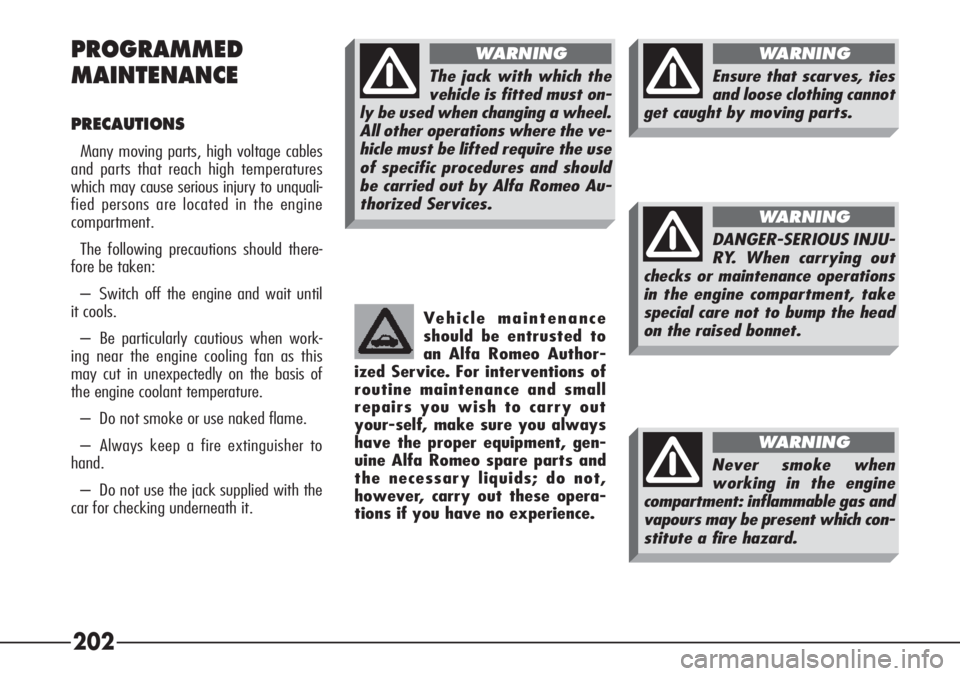
PRECAUTIONS
Many moving parts, high voltage cables
and parts that reach high temperatures
which may cause serious injury to unquali-
fied persons are located in the engine
compartment.
The following precautions should there-
fore be taken:
– Switch off the engine and wait until
it cools.
– Be particularly cautious when work-
ing near the engine cooling fan as this
may cut in unexpectedly on the basis of
the engine coolant temperature.
– Do not smoke or use naked flame.
– Always keep a fire extinguisher to
hand.
– Do not use the jack supplied with the
car for checking underneath it.Vehicle maintenance
should be entrusted to
an Alfa Romeo Author-
ized Service. For interventions of
routine maintenance and small
repairs you wish to carry out
your-self, make sure you always
have the proper equipment, gen-
uine Alfa Romeo spare parts and
the necessary liquids; do not,
however, carry out these opera-
tions if you have no experience.
The jack with which the
vehicle is fitted must on-
ly be used when changing a wheel.
All other operations where the ve-
hicle must be lifted require the use
of specific procedures and should
be carried out by Alfa Romeo Au-
thorized Services.
WARNING
Ensure that scarves, ties
and loose clothing cannot
get caught by moving parts.
WARNING
DANGER-SERIOUS INJU-
RY. When carrying out
checks or maintenance operations
in the engine compartment, take
special care not to bump the head
on the raised bonnet.
WARNING
Never smoke when
working in the engine
compartment: inflammable gas and
vapours may be present which con-
stitute a fire hazard.
WARNING
Page 207 of 272
206 ANNUAL INSPECTION
PLAN
An annual inspection plan has
been established for cars that cov-
er less than 20,000 km a year
(e.g. 10,000 km). It consists of
the following:
– Checking the condition/wear of tyres,
and adjusting pressure (including the com-
pact spare wheel, where applicable).
– Checking the lighting system (head-
lights, turn indicators, hazard warning
lights, boot light, passenger compart-
ment, warning lights of instrument panel,
etc.).
– Checking the working order of the
windscreen wiper-washer and adjusting
the nozzles.
– Checking the positioning/wear of the
windscreen wipers.
– Checking the condition and wear of
the front brake pad.– Sight inspect the conditions of: en-
gine, gearbox, transmission, pipes and
hoses (exhaust - fuel - brakes), rubber
parts (boots, sleeves, bushes, etc.).
– Check for bonnet and boot lock clean-
ness, lever cleanness and lubrication.
– Check battery charge and fluid level
(electrolyte).
– Visually checking the condition of the
belts and various controls.
– Checking and topping up, if neces-
sary, the level of liquids (coolant, brake
fluid, windscreen washer fluid, battery
etc.).
– Change engine oil and oil filter, if re-
quired.
– Check and replace pollen filter, if re-
quired.
– Check and replace air cleaner, if re-
quired.
ADDITIONAL OPERATIONS
Every 1000 kmor before long jour-
neys check and if necessary top up:
– the engine coolant fluid level
– brake fluid/hydraulic clutch control
fluid level
– power steering fluid level
– windscreen washer and headlamp
washer fluid level
– tyre pressure and conditions.
– check light system operation (head-
lights, direction indicators, hazard lights,
etc.).
– check windscreen wiper/washer op-
eration and windscreen/rear window
blade position/wear.
Every 3000 kmcheck the level of
the engine oil and top up if necessary.
Every 5000 km(only for fuel oil en-
gines): drain the condensation water
from the filter. You are recommended to
use products of the FL Selenia, de-
signed and developed expressly for Alfa
Romeo cars (see the table “Fluids and lu-
bricants” in the Technical specifications”
chapter).
Page 216 of 272
215
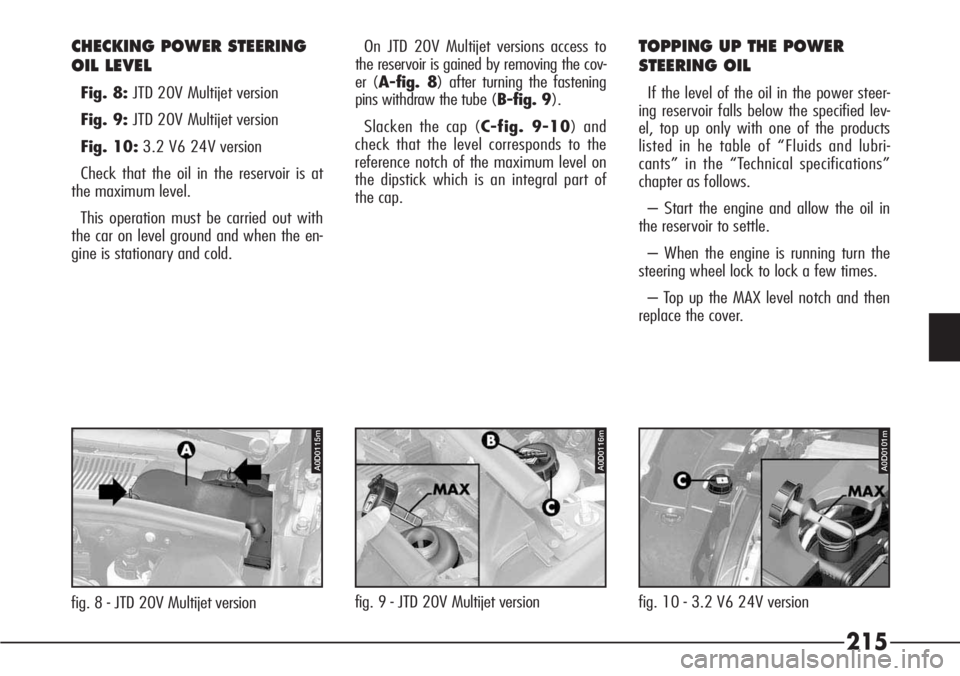
CHECKING POWER STEERING
OIL LEVEL
Fig. 8:JTD 20V Multijet version
Fig. 9:JTD 20V Multijet version
Fig. 10:3.2 V6 24V version
Check that the oil in the reservoir is at
the maximum level.
This operation must be carried out with
the car on level ground and when the en-
gine is stationary and cold.
fig. 8 - JTD 20V Multijet versionfig. 9 - JTD 20V Multijet versionfig. 10 - 3.2 V6 24V version On JTD 20V Multijet versions access to
the reservoir is gained by removing the cov-
er (A-fig. 8) after turning the fastening
pins withdraw the tube (B-fig. 9).
Slacken the cap (C-fig. 9-10) and
check that the level corresponds to the
reference notch of the maximum level on
the dipstick which is an integral part of
the cap.
TOPPING UP THE POWER
STEERING OIL
If the level of the oil in the power steer-
ing reservoir falls below the specified lev-
el, top up only with one of the products
listed in he table of “Fluids and lubri-
cants” in the “Technical specifications”
chapter as follows.
– Start the engine and allow the oil in
the reservoir to settle.
– When the engine is running turn the
steering wheel lock to lock a few times.
– Top up the MAX level notch and then
replace the cover.
A0D0115mA0D0101mA0D0116m