wiper fluid Alfa Romeo 166 2007 Owner handbook (in English)
[x] Cancel search | Manufacturer: ALFA ROMEO, Model Year: 2007, Model line: 166, Model: Alfa Romeo 166 2007Pages: 272, PDF Size: 4.17 MB
Page 9 of 272
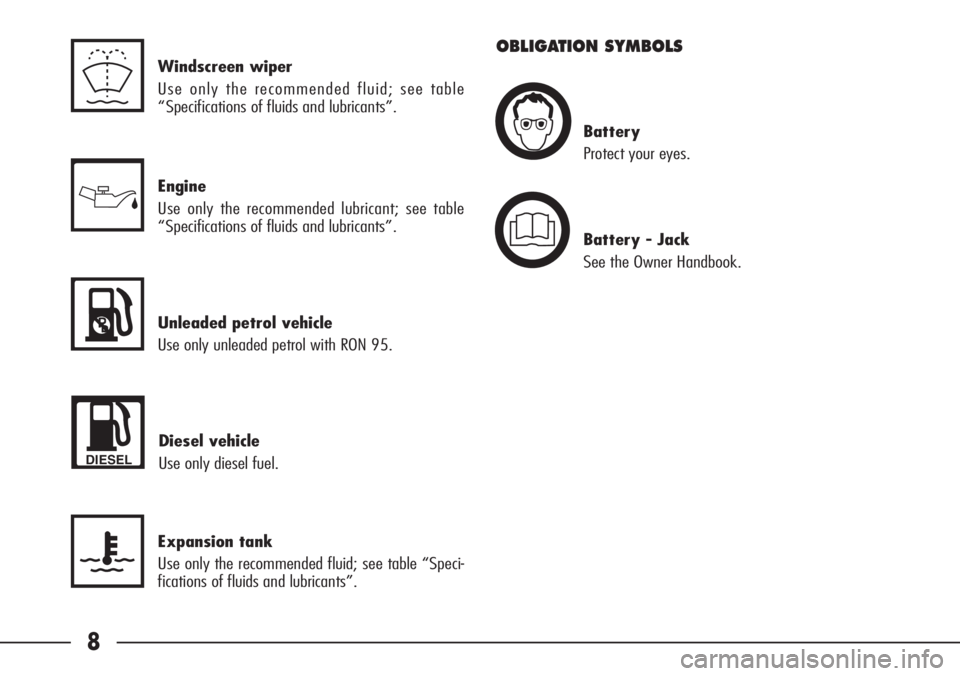
OBLIGATION SYMBOLS
DIESEL
Diesel vehicle
Use only diesel fuel.
Battery
Protect your eyes.
Battery - Jack
See the Owner Handbook.
Expansion tank
Use only the recommended fluid; see table “Speci-
fications of fluids and lubricants”.
Windscreen wiper
Use only the recommended fluid; see table
“Specifications of fluids and lubricants”.
Engine
Use only the recommended lubricant; see table
“Specifications of fluids and lubricants”.
Unleaded petrol vehicle
Use only unleaded petrol with RON 95.
8
Page 140 of 272
139
DRIVING UNDER ADVERSE
WEATHER CONDITIONS
Rain and fog can be extremely danger-
ous if the style of driving is not adapted
to suit these conditions. Some sugges-
tions are given below:
– if the road is wet, the friction be-
tween wheel and asphalt is greatly re-
duced thus increasing the stopping dis-
tance and decreasing road holding when
cornering.
Reduce speed and keep further back
from the vehicle in front.
– Heavy rain and fog reduce visibility.
Headlights should be switched on as the
road traffic laws and common sense dic-
tate, above all to render yourself visible
to others.
– Do not drive over puddles or flooded
roads at high speed as the aquaplaning
phenomenon may cause you to loose
control over the vehicle.
– If visibility is already reduced prevent
it from worsening by ensuring that the
windows do not steam up. Use the heat-
ing-ventilation controls as indicated in the
chapter “Know your vehicle”.– Check the condition of the windscreen
wiper blades.
– If fog is very thick avoid travelling
where possible. If travelling cannot be
avoided drive with extreme care and
moderate your speed. Avoid overtaking.
– If the vehicle is forced to stop owing
to a malfunction or zero visibility condi-
tions, pull off the road, switch on the haz-
ard warning lights and if possible, the
dipped-beam headlights.
MOUNTAIN DRIVING
Mountain driving requires a greater de-
gree of concentration. Some practical
hints follow:
– Before driving off check the level of
fluids (engine oil, brakes, coolant) and
the state of the tyres.
– When travelling down hill use the en-
gine braking by engaging lower gears to
prevent the brakes from overheating.
– Never coast downhill with the engine
off or in neutral and especially not with
the ignition key removed.
– Drive at a moderate speed and avoid
cutting corners.– Remember that overtaking uphill is
slower and therefore requires a greater
length of clear road. If you are being
overtaken on a hill move over to enable
the other vehicle to pass in safety.
WINTER DRIVING
If the temperature falls below 0°C or in
the presence of snow or ice the following
recommendations should be followed:
– Before driving off check that the
windscreen wipers are not frozen to the
windscreen.
– Remove the snow from the air intake
(grille) at the base of the windscreen.
– Do not stop long on deep snow with
the engine running: the snow might di-
vert the exhaust gas carbon monoxide in-
to the passenger compartment.
– Ensure that brakes and tyres are in
perfect working order.
–Ensure that the detergent liquid locat-
ed in the windscreen/headlight washers
has been topped up with anti-freeze and
anti-scale additives.
– Use engine braking where possible
and avoid abrupt braking.
Page 156 of 272
155 VEHICLE INACTIVITY
If the vehicle is to be left inactive for
long periods the following precautions
should be noted:
– House the vehicle under a cover in a
dry and possibly ventilated place.
– Engage a gear.
– Release the handbrake.
– Clean and protect the paintwork by
applying silicon wax.
– Cover the rubber windscreen wiper
blades with talcum powder and raise
them off the glass.
– Open the windows slightly.
– Cover the vehicle with a cloth or per-
forated plastic cover. Do not use compact
plastic covers which prevent the humidity
on the surface of the vehicle from evapo-
rating.
– Inflate the tyres to a pressure of 0.5
bars above normal. If possible rest the
tyres on wooden planks and periodically
check the pressure.– Switch off the alarm system (if fit-
ted) with the remote control, then deacti-
vate it with the emergency key.
– Disconnect the terminals from the
battery poles (negative pole first) and
check the battery charge. When the vehi-
cle is in storage, this check should be car-
ried out once a month. If the no-load volt-
age is less than 12.5V, recharge the bat-
tery.
REMOVING FROM STORAGE
Before using your vehicle after a long
period of inactivity the following opera-
tions should first be carried out:
– Do not dust the outside of the vehi-
cle.
– Visually check that there are no
leaks (oil, brake and clutch fluid, engine
coolant etc.).
– Replace the engine oil and filter.
– Check:
Gearbox-differential oil level
Brake-clutch fluid level
Level of engine coolant fluid.– Check the air cleaner and replace if
necessary.
– Check tyre pressure and ensure that
they are not damaged, cracked or cut. If
they are they must be replaced.
– Check the state of the drive belts in
the engine bay.
– Connect the cables of the battery af-
ter checking that the charge is adequate.
– Re-activate the alarm system, if fit-
ted, using the emergency key.
– With the gear lever in neutral start
the engine and allow the engine to run
for a few seconds whilst repeatedly
pumping the clutch pedal.
Page 207 of 272
206 ANNUAL INSPECTION
PLAN
An annual inspection plan has
been established for cars that cov-
er less than 20,000 km a year
(e.g. 10,000 km). It consists of
the following:
– Checking the condition/wear of tyres,
and adjusting pressure (including the com-
pact spare wheel, where applicable).
– Checking the lighting system (head-
lights, turn indicators, hazard warning
lights, boot light, passenger compart-
ment, warning lights of instrument panel,
etc.).
– Checking the working order of the
windscreen wiper-washer and adjusting
the nozzles.
– Checking the positioning/wear of the
windscreen wipers.
– Checking the condition and wear of
the front brake pad.– Sight inspect the conditions of: en-
gine, gearbox, transmission, pipes and
hoses (exhaust - fuel - brakes), rubber
parts (boots, sleeves, bushes, etc.).
– Check for bonnet and boot lock clean-
ness, lever cleanness and lubrication.
– Check battery charge and fluid level
(electrolyte).
– Visually checking the condition of the
belts and various controls.
– Checking and topping up, if neces-
sary, the level of liquids (coolant, brake
fluid, windscreen washer fluid, battery
etc.).
– Change engine oil and oil filter, if re-
quired.
– Check and replace pollen filter, if re-
quired.
– Check and replace air cleaner, if re-
quired.
ADDITIONAL OPERATIONS
Every 1000 kmor before long jour-
neys check and if necessary top up:
– the engine coolant fluid level
– brake fluid/hydraulic clutch control
fluid level
– power steering fluid level
– windscreen washer and headlamp
washer fluid level
– tyre pressure and conditions.
– check light system operation (head-
lights, direction indicators, hazard lights,
etc.).
– check windscreen wiper/washer op-
eration and windscreen/rear window
blade position/wear.
Every 3000 kmcheck the level of
the engine oil and top up if necessary.
Every 5000 km(only for fuel oil en-
gines): drain the condensation water
from the filter. You are recommended to
use products of the FL Selenia, de-
signed and developed expressly for Alfa
Romeo cars (see the table “Fluids and lu-
bricants” in the Technical specifications”
chapter).