ignition Alfa Romeo Giulia 2018 Owner's Guide
[x] Cancel search | Manufacturer: ALFA ROMEO, Model Year: 2018, Model line: Giulia, Model: Alfa Romeo Giulia 2018Pages: 260, PDF Size: 6 MB
Page 68 of 260
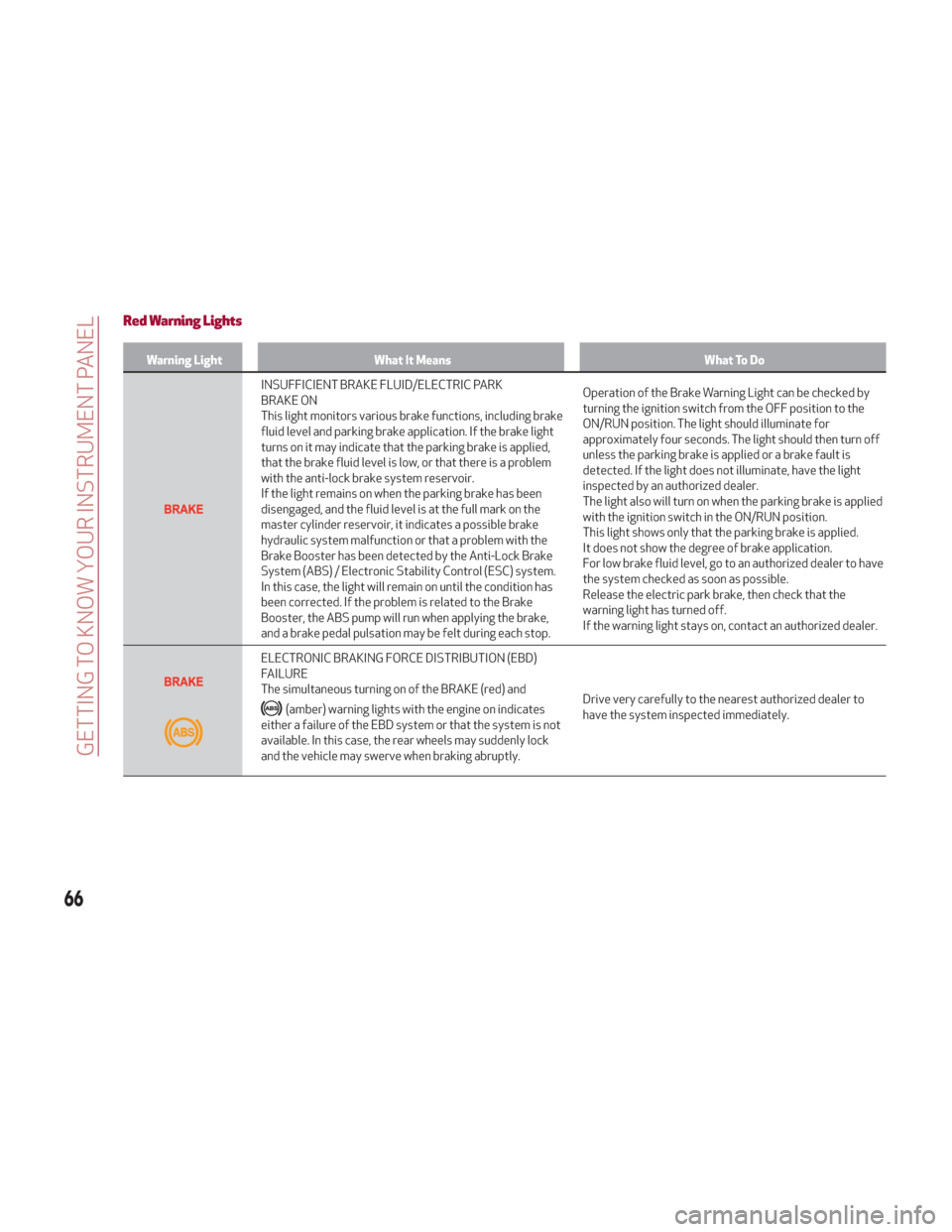
Red Warning Lights
Warning LightWhat It Means What To Do
INSUFFICIENT BRAKE FLUID/ELECTRIC PARK
BRAKE ON
This light monitors various brake functions, including brake
fluid level and parking brake application. If the brake light
turns on it may indicate that the parking brake is applied,
that the brake fluid level is low, or that there is a problem
with the anti-lock brake system reservoir.
If the light remains on when the parking brake has been
disengaged, and the fluid level is at the full mark on the
master cylinder reservoir, it indicates a possible brake
hydraulic system malfunction or that a problem with the
Brake Booster has been detected by the Anti-Lock Brake
System (ABS) / Electronic Stability Control (ESC) system.
In this case, the light will remain on until the condition has
been corrected. If the problem is related to the Brake
Booster, the ABS pump will run when applying the brake,
and a brake pedal pulsation may be felt during each stop.Operation of the Brake Warning Light can be checked by
turning the ignition switch from the OFF position to the
ON/RUN position. The light should illuminate for
approximately four seconds. The light should then turn off
unless the parking brake is applied or a brake fault is
detected. If the light does not illuminate, have the light
inspected by an authorized dealer.
The light also will turn on when the parking brake is applied
with the ignition switch in the ON/RUN position.
This light shows only that the parking brake is applied.
It does not show the degree of brake application.
For low brake fluid level, go to an authorized dealer to have
the system checked as soon as possible.
Release the electric park brake, then check that the
warning light has turned off.
If the warning light stays on, contact an authorized dealer.
ELECTRONIC BRAKING FORCE DISTRIBUTION (EBD)
FAILURE
The simultaneous turning on of the BRAKE (red) and
(amber) warning lights with the engine on indicates
either a failure of the EBD system or that the system is not
available. In this case, the rear wheels may suddenly lock
and the vehicle may swerve when braking abruptly. Drive very carefully to the nearest authorized dealer to
have the system inspected immediately.
66
GETTING TO KNOW YOUR INSTRUMENT PANEL
Page 69 of 260
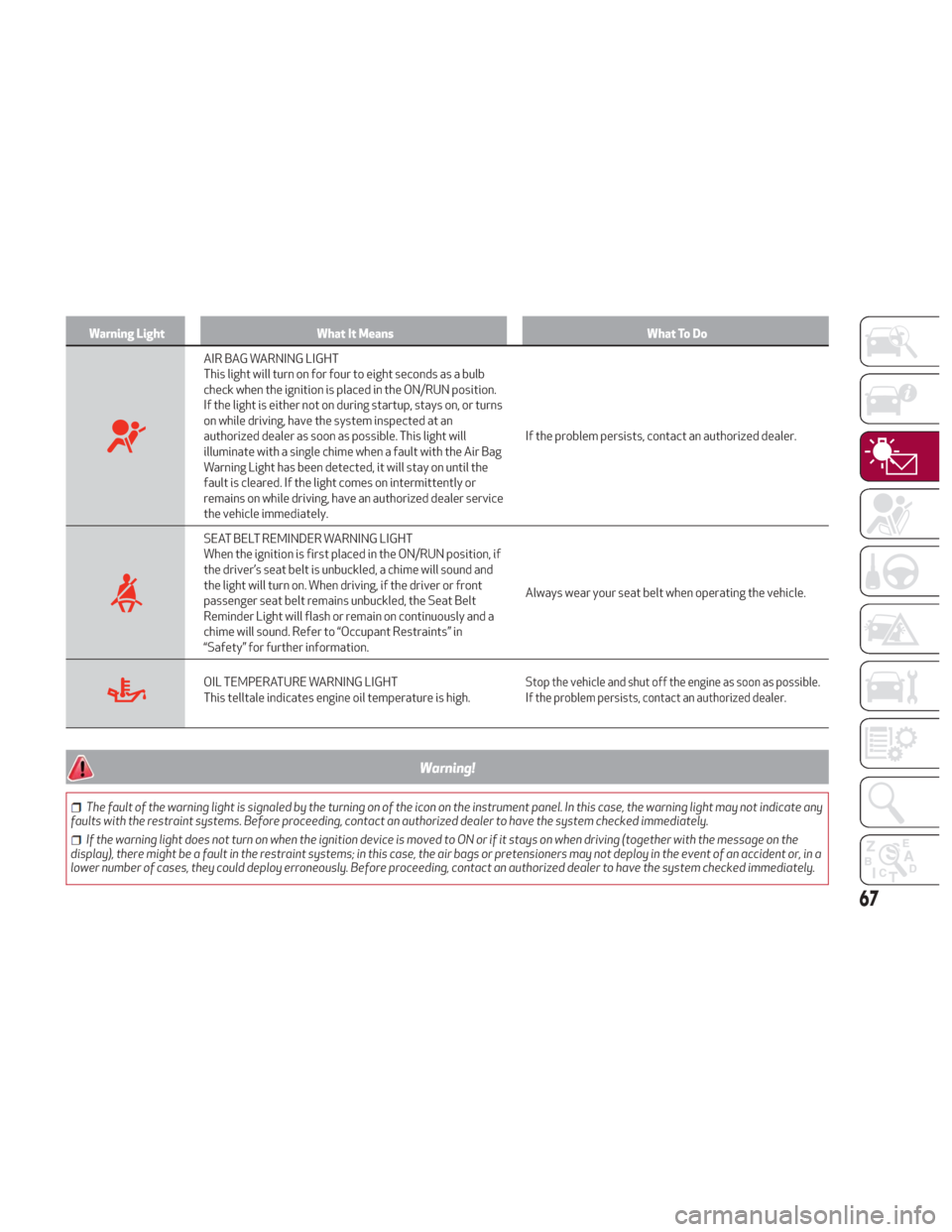
Warning LightWhat It Means What To Do
AIR BAG WARNING LIGHT
This light will turn on for four to eight seconds as a bulb
check when the ignition is placed in the ON/RUN position.
If the light is either not on during startup, stays on, or turns
on while driving, have the system inspected at an
authorized dealer as soon as possible. This light will
illuminate with a single chime when a fault with the Air Bag
Warning Light has been detected, it will stay on until the
fault is cleared. If the light comes on intermittently or
remains on while driving, have an authorized dealer service
the vehicle immediately.If the problem persists, contact an authorized dealer.
SEAT BELT REMINDER WARNING LIGHT
When the ignition is first placed in the ON/RUN position, if
the driver’s seat belt is unbuckled, a chime will sound and
the light will turn on. When driving, if the driver or front
passenger seat belt remains unbuckled, the Seat Belt
Reminder Light will flash or remain on continuously and a
chime will sound. Refer to “Occupant Restraints” in
“Safety” for further information.
Always wear your seat belt when operating the vehicle.
OIL TEMPERATURE WARNING LIGHT
This telltale indicates engine oil temperature is high.Stop the vehicle and shut off the engine as soon as possible.
If the problem persists, contact an authorized dealer.
Warning!
The fault of the warning light is signaled by the turning on of the icon on the instrument panel. In this case, the warning light may not indicate any
faults with the restraint systems. Before proceeding, contact an authorized dealer to have the system checked immediately.
If the warning light does not turn on when the ignition device is moved to ON or if it stays on when driving (together with the message on the
display), there might be a fault in the restraint systems; in this case, the air bags or pretensioners may not deploy in the event of an accident or, in a
lower number of cases, they could deploy erroneously. Before proceeding, contact an authorized dealer to have the system checked immediately.
67
Page 70 of 260
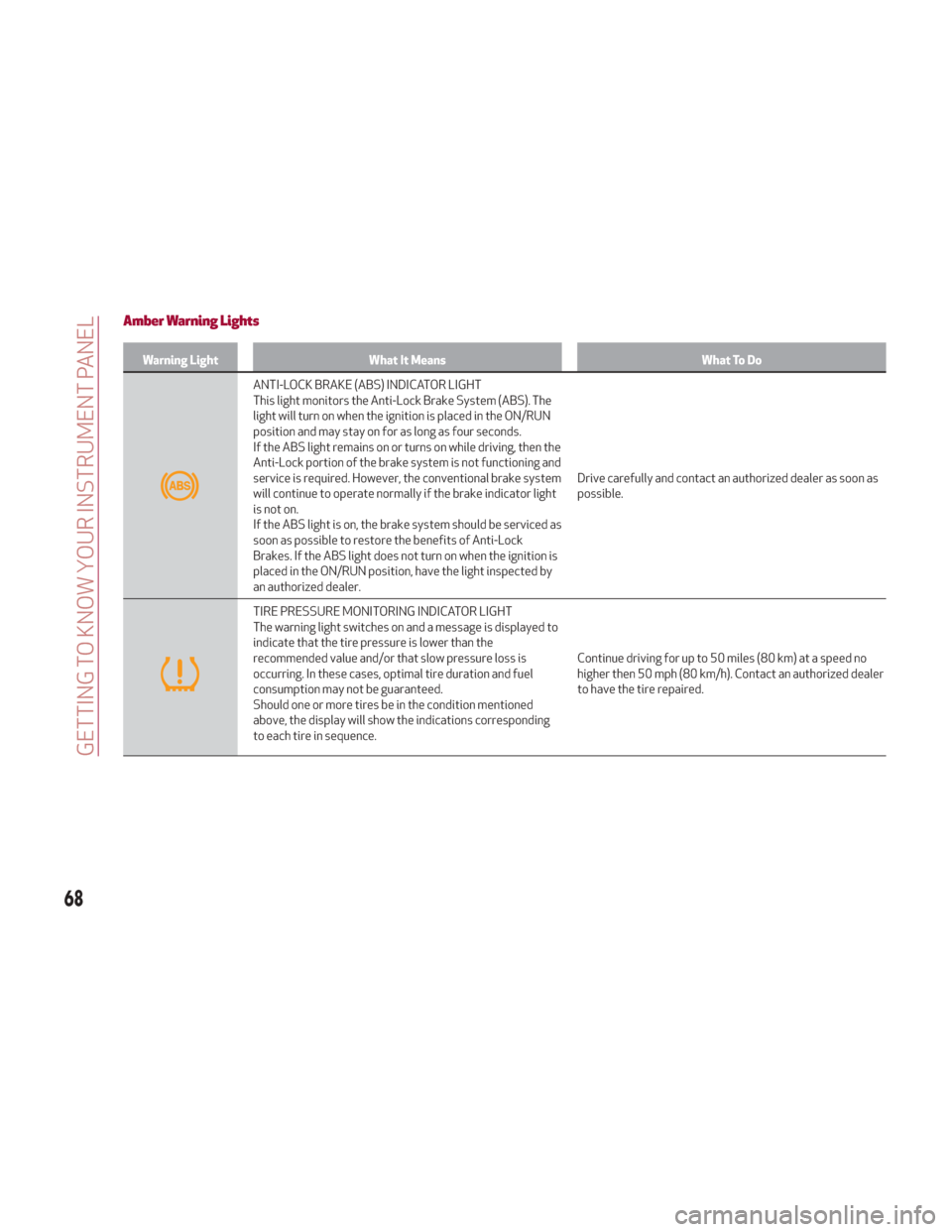
Amber Warning Lights
Warning LightWhat It Means What To Do
ANTI-LOCK BRAKE (ABS) INDICATOR LIGHT
This light monitors the Anti-Lock Brake System (ABS). The
light will turn on when the ignition is placed in the ON/RUN
position and may stay on for as long as four seconds.
If the ABS light remains on or turns on while driving, then the
Anti-Lock portion of the brake system is not functioning and
service is required. However, the conventional brake system
will continue to operate normally if the brake indicator light
is not on.
If the ABS light is on, the brake system should be serviced as
soon as possible to restore the benefits of Anti-Lock
Brakes. If the ABS light does not turn on when the ignition is
placed in the ON/RUN position, have the light inspected by
an authorized dealer.Drive carefully and contact an authorized dealer as soon as
possible.
TIRE PRESSURE MONITORING INDICATOR LIGHT
The warning light switches on and a message is displayed to
indicate that the tire pressure is lower than the
recommended value and/or that slow pressure loss is
occurring. In these cases, optimal tire duration and fuel
consumption may not be guaranteed.
Should one or more tires be in the condition mentioned
above, the display will show the indications corresponding
to each tire in sequence.
Continue driving for up to 50 miles (80 km) at a speed no
higher then 50 mph (80 km/h). Contact an authorized dealer
to have the tire repaired.
68
GETTING TO KNOW YOUR INSTRUMENT PANEL
Page 72 of 260
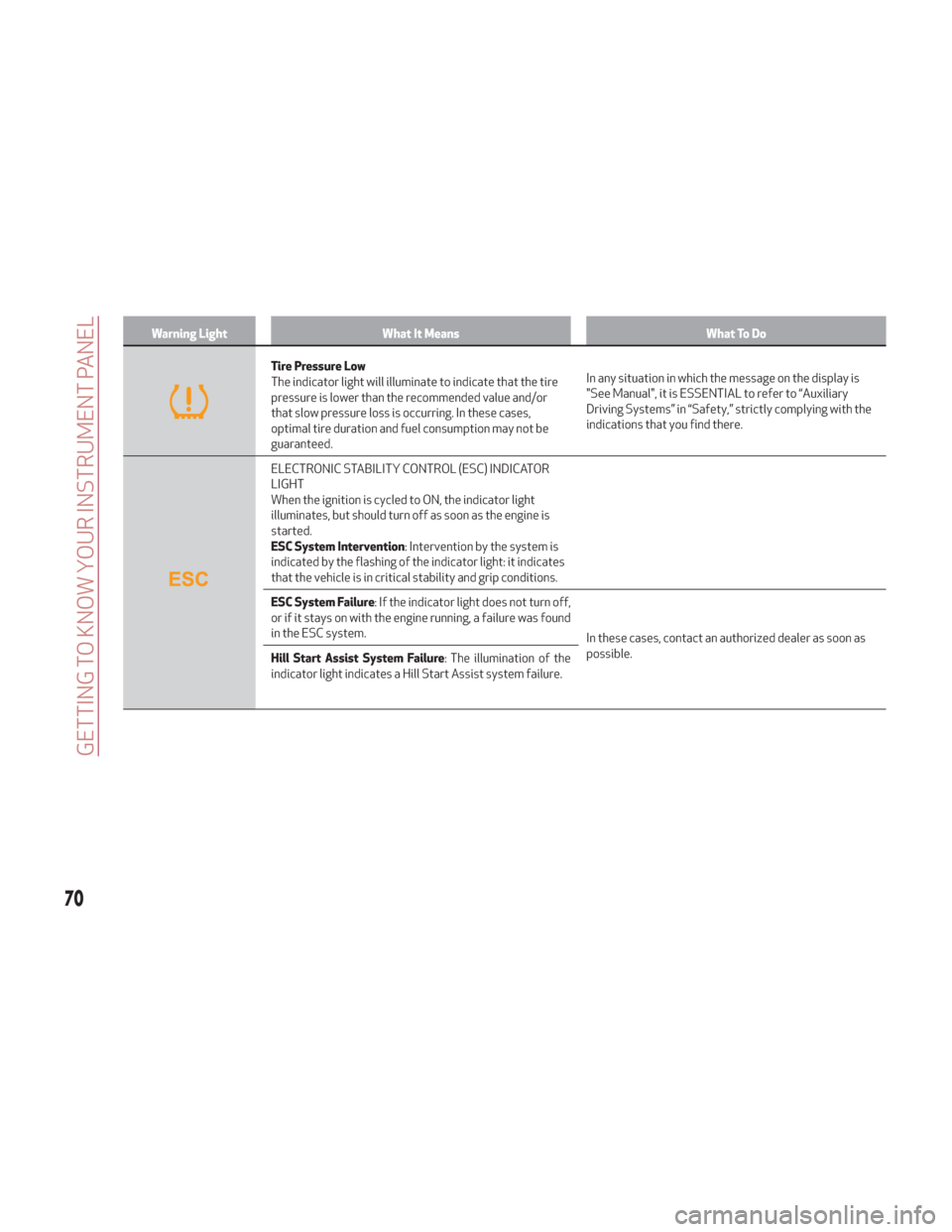
Warning LightWhat It Means What To Do
Tire Pressure Low
The indicator light will illuminate to indicate that the tire
pressure is lower than the recommended value and/or
that slow pressure loss is occurring. In these cases,
optimal tire duration and fuel consumption may not be
guaranteed.In any situation in which the message on the display is
"See Manual", it is ESSENTIAL to refer to “Auxiliary
Driving Systems” in “Safety,” strictly complying with the
indications that you find there.
ELECTRONIC STABILITY CONTROL (ESC) INDICATOR
LIGHT
When the ignition is cycled to ON, the indicator light
illuminates, but should turn off as soon as the engine is
started.
ESC System Intervention
: Intervention by the system is
indicated by the flashing of the indicator light: it indicates
that the vehicle is in critical stability and grip conditions.
ESC System Failure : If the indicator light does not turn off,
or if it stays on with the engine running, a failure was found
in the ESC system. In these cases, contact an authorized dealer as soon as
possible.
Hill Start Assist System Failure : The illumination of the
indicator light indicates a Hill Start Assist system failure.
70
GETTING TO KNOW YOUR INSTRUMENT PANEL
Page 73 of 260
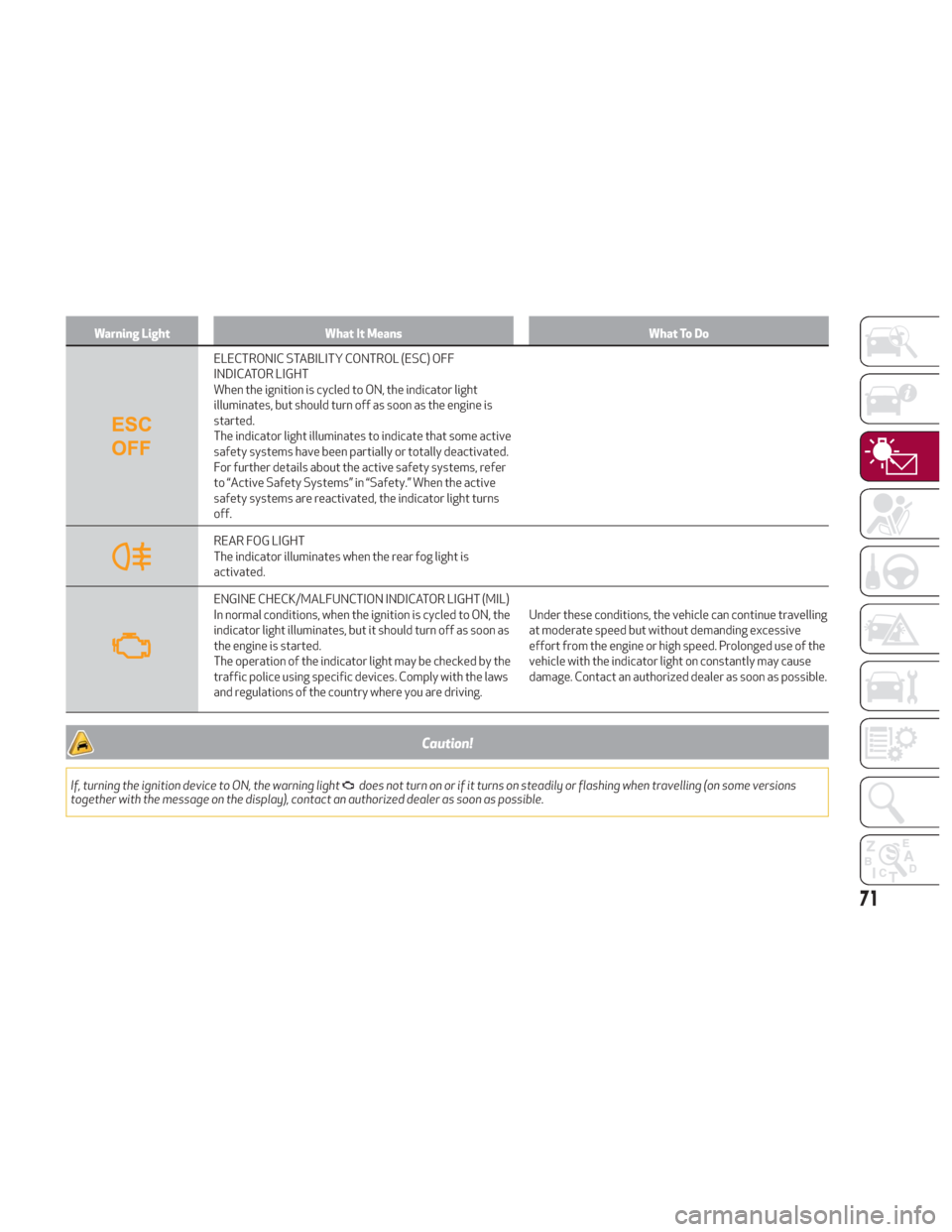
Warning LightWhat It Means What To Do
ELECTRONIC STABILITY CONTROL (ESC) OFF
INDICATOR LIGHT
When the ignition is cycled to ON, the indicator light
illuminates, but should turn off as soon as the engine is
started.
The indicator light illuminates to indicate that some active
safety systems have been partially or totally deactivated.
For further details about the active safety systems, refer
to “Active Safety Systems” in “Safety.” When the active
safety systems are reactivated, the indicator light turns
off.
REAR FOG LIGHT
The indicator illuminates when the rear fog light is
activated.
ENGINE CHECK/MALFUNCTION INDICATOR LIGHT (MIL)
In normal conditions, when the ignition is cycled to ON, the
indicator light illuminates, but it should turn off as soon as
the engine is started.
The operation of the indicator light may be checked by the
traffic police using specific devices. Comply with the laws
and regulations of the country where you are driving.Under these conditions, the vehicle can continue travelling
at moderate speed but without demanding excessive
effort from the engine or high speed. Prolonged use of the
vehicle with the indicator light on constantly may cause
damage. Contact an authorized dealer as soon as possible.
Caution!
If, turning the ignition device to ON, the warning lightdoes not turn on or if it turns on steadily or flashing when travelling (on some versions
together with the message on the display), contact an authorized dealer as soon as possible.
71
Page 75 of 260
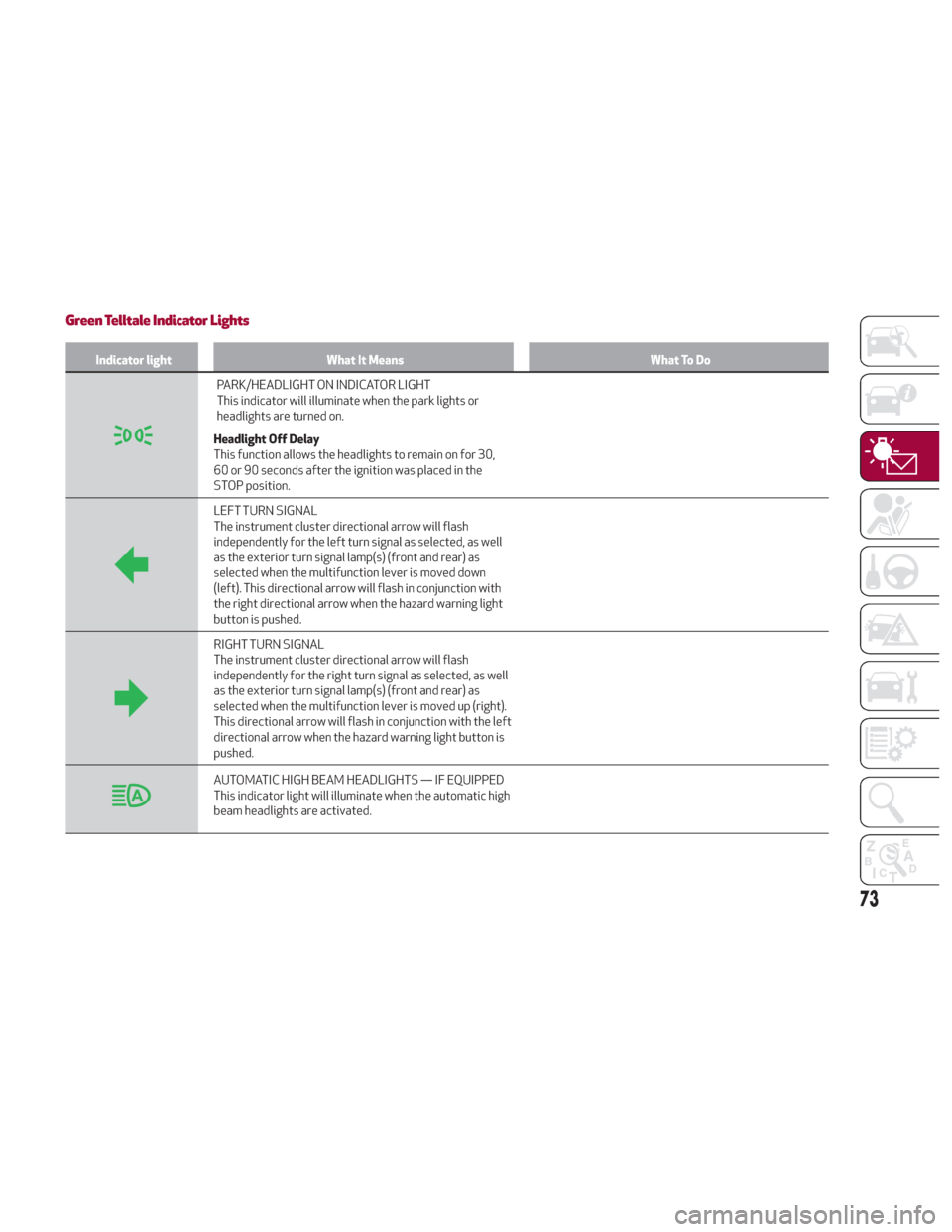
Green Telltale Indicator Lights
Indicator lightWhat It Means What To Do
PARK/HEADLIGHT ON INDICATOR LIGHT
This indicator will illuminate when the park lights or
headlights are turned on.
Headlight Off Delay
This function allows the headlights to remain on for 30,
60 or 90 seconds after the ignition was placed in the
STOP position.
LEFT TURN SIGNAL
The instrument cluster directional arrow will flash
independently for the left turn signal as selected, as well
as the exterior turn signal lamp(s) (front and rear) as
selected when the multifunction lever is moved down
(left). This directional arrow will flash in conjunction with
the right directional arrow when the hazard warning light
button is pushed.
RIGHT TURN SIGNAL
The instrument cluster directional arrow will flash
independently for the right turn signal as selected, as well
as the exterior turn signal lamp(s) (front and rear) as
selected when the multifunction lever is moved up (right).
This directional arrow will flash in conjunction with the left
directional arrow when the hazard warning light button is
pushed.
AUTOMATIC HIGH BEAM HEADLIGHTS — IF EQUIPPED
This indicator light will illuminate when the automatic high
beam headlights are activated.
73
Page 79 of 260
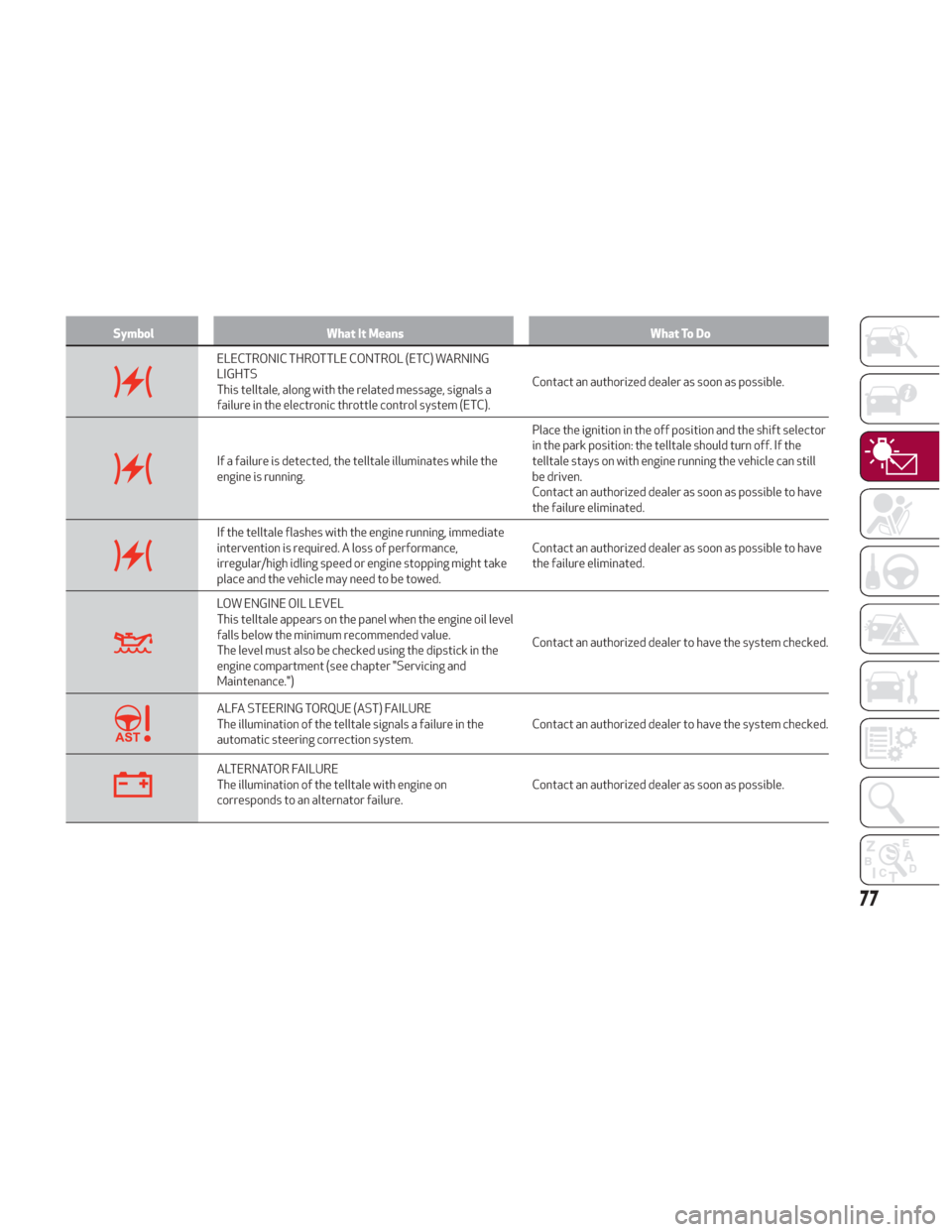
SymbolWhat It Means What To Do
ELECTRONIC THROTTLE CONTROL (ETC) WARNING
LIGHTS
This telltale, along with the related message, signals a
failure in the electronic throttle control system (ETC).Contact an authorized dealer as soon as possible.
If a failure is detected, the telltale illuminates while the
engine is running.Place the ignition in the off position and the shift selector
in the park position: the telltale should turn off. If the
telltale stays on with engine running the vehicle can still
be driven.
Contact an authorized dealer as soon as possible to have
the failure eliminated.
If the telltale flashes with the engine running, immediate
intervention is required. A loss of performance,
irregular/high idling speed or engine stopping might take
place and the vehicle may need to be towed.
Contact an authorized dealer as soon as possible to have
the failure eliminated.
LOW ENGINE OIL LEVEL
This telltale appears on the panel when the engine oil level
falls below the minimum recommended value.
The level must also be checked using the dipstick in the
engine compartment (see chapter "Servicing and
Maintenance.")Contact an authorized dealer to have the system checked.
ALFA STEERING TORQUE (AST) FAILURE
The illumination of the telltale signals a failure in the
automatic steering correction system.
Contact an authorized dealer to have the system checked.
ALTERNATOR FAILURE
The illumination of the telltale with engine on
corresponds to an alternator failure.Contact an authorized dealer as soon as possible.
77
Page 80 of 260
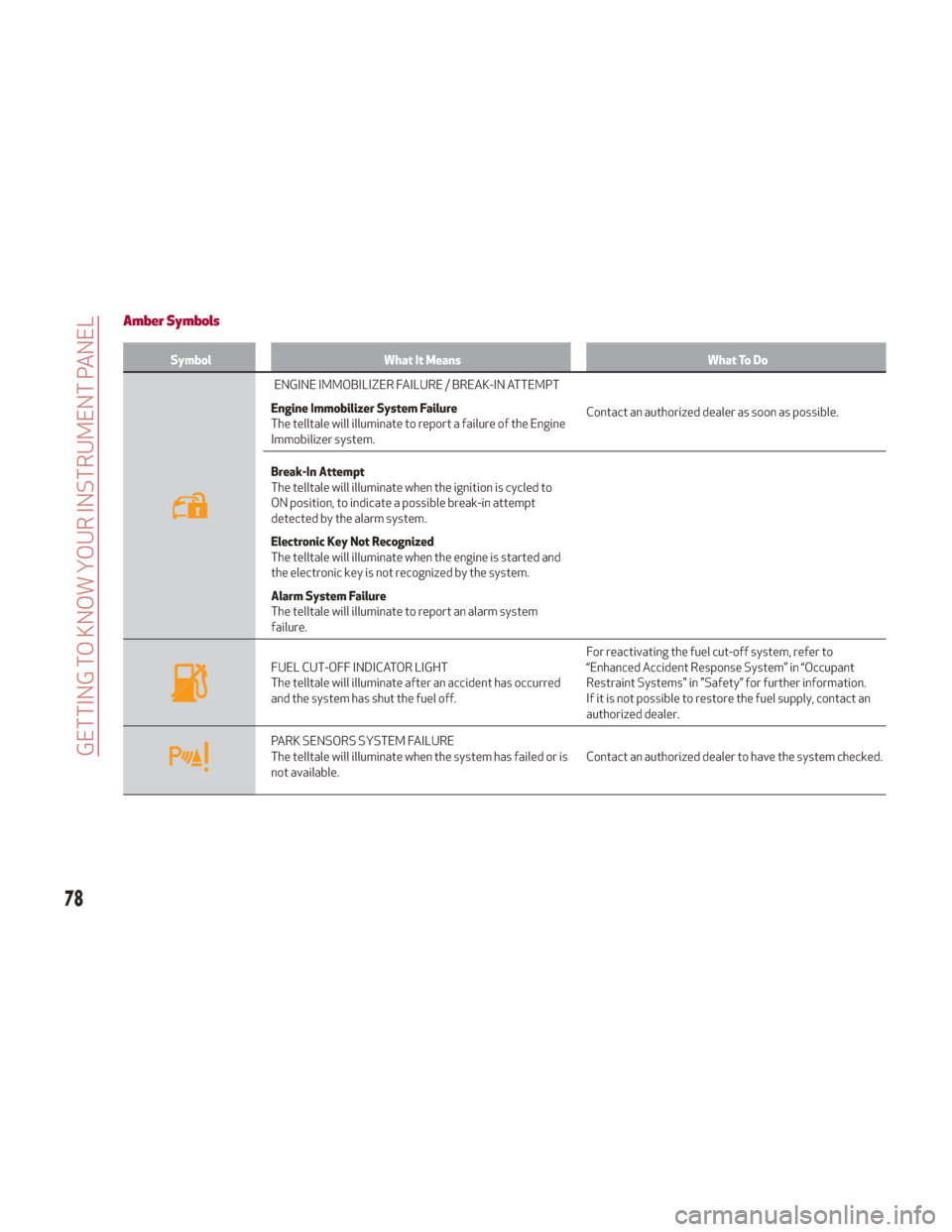
Amber Symbols
SymbolWhat It Means What To Do
ENGINE IMMOBILIZER FAILURE / BREAK-IN ATTEMPT
Engine Immobilizer System Failure
The telltale will illuminate to report a failure of the Engine
Immobilizer system. Contact an authorized dealer as soon as possible.
Break-In Attempt
The telltale will illuminate when the ignition is cycled to
ON position, to indicate a possible break-in attempt
detected by the alarm system.
Electronic Key Not Recognized
The telltale will illuminate when the engine is started and
the electronic key is not recognized by the system.
Alarm System Failure
The telltale will illuminate to report an alarm system
failure.
FUEL CUT-OFF INDICATOR LIGHT
The telltale will illuminate after an accident has occurred
and the system has shut the fuel off. For reactivating the fuel cut-off system, refer to
“Enhanced Accident Response System” in “Occupant
Restraint Systems" in "Safety” for further information.
If it is not possible to restore the fuel supply, contact an
authorized dealer.
PARK SENSORS SYSTEM FAILURE
The telltale will illuminate when the system has failed or is
not available.
Contact an authorized dealer to have the system checked.
78
GETTING TO KNOW YOUR INSTRUMENT PANEL
Page 88 of 260
ONBOARD DIAGNOSTIC
SYSTEM
Operation
The OBD (Onboard Diagnostic system)
carries out a continuous diagnosis of the
components of the vehicle related to
emissions.
It also alerts the driver of when these
components are no longer in peak
condition by switching on the
warning
light on the instrument panel (see
“Warning Lights And Messages”
paragraph in this chapter).
The aim of the OBD system (Onboard
Diagnostic) is to:
Monitor the efficiency of the system
Indicate an increase in emissions
Indicate the need to replace damaged
components
The vehicle also has a connector, which
can interface with appropriate tools, that
makes it possible to read the error codes
stored in the electronic control units
together with a series of specific
parameters for engine operation and
diagnosis. This check can be carried out
by your authorized dealer.
Note: After eliminating a fault, to check
the system completely, your authorized
dealer is obliged to run tests and, if
necessary certain road tests.
Onboard Diagnostic System (OBD II)
Cybersecurity
Your vehicle is required to have an
Onboard Diagnostic system (OBD II) and
a connection port to allow access to
information related to the performance
of your emissions controls. Authorized
service technicians may need to access
this information to assist with the
diagnosis and service of your vehicle and
emissions system.
Warning!
ONLY an authorized service technician
should connect equipment to the OBD II
connection port in order to read the VIN,
diagnose, or service your vehicle.
If unauthorized equipment is connected to
the OBD II connection port, such as a
driver-behavior tracking device, it may:
Be possible that vehicle systems,
including safety related systems, could be
impaired or a loss of vehicle control could
occur that may result in an accident
involving serious injury or death.
Access, or allow others to access,
information stored in your vehicle systems,
including personal information.
EMISSIONS INSPECTION AND
MAINTENANCE PROGRAMS
In some localities, it may be a legal
requirement to pass an inspection of your
vehicle's emissions control system.
Failure to pass could prevent vehicle
registration.
For states that require
an Inspection and
Maintenance (I/M), this
check verifies the
“Malfunction Indicator
Light (MIL)” is functioning and is not on
when the engine is running, and that the
OBD II system is ready for testing.
Normally, the OBD II system will be ready.
The OBD II system may notbe ready if
your vehicle was recently serviced,
recently had a dead battery or a battery
replacement. If the OBD II system should
be determined not ready for the I/M test,
your vehicle may fail the test.
Your vehicle has a simple ignition
actuated test, which you can use prior to
going to the test station. To check if your
vehicle's OBD II system is ready, you
must do the following:
1. Cycle the ignition switch to the ON
position, but do not crank or start the
engine.
Note: If you crank or start the engine,
you will have to start this test over.
86
GETTING TO KNOW YOUR INSTRUMENT PANEL
Page 89 of 260
2. As soon as you cycle the ignition
switch to the ON position, you will see the
“Malfunction Indicator Light (MIL)”
symbol come on as part of a normal bulb
check.
3. Approximately 15 seconds later, one
of two things will happen:
The MIL will flash for about ten
seconds and then return to being fully
illuminated until you turn OFF the ignition
or start the engine. This means that your
vehicle's OBD II system is not readyand
you should notproceed to the I/M
station.
The MIL will not flash at all and will
remain fully illuminated until you place
the ignition in the off position or start the
engine. This means that your vehicle's
OBD II system is readyand you can
proceed to the I/M station.
If your OBD II system is not ready,you
should see an authorized dealer or repair
facility. If your vehicle was recently
serviced or had a battery failure or
replacement, you may need to do nothing
more than drive your vehicle as you
normally would in order for your OBD II
system to update. A recheck with the
above test routine may then indicate that
the system is now ready. Regardless of whether your vehicle's
OBD II system is ready or not, if the MIL
is illuminated during normal vehicle
operation you should have your vehicle
serviced before going to the I/M station.
The I/M station can fail your vehicle
because the MIL is on with the engine
running.
87