stop start Alfa Romeo Giulietta 2017 User Guide
[x] Cancel search | Manufacturer: ALFA ROMEO, Model Year: 2017, Model line: Giulietta, Model: Alfa Romeo Giulietta 2017Pages: 212, PDF Size: 4.56 MB
Page 63 of 212
The ESC system corrects the car’s
understeer and oversteer, distributing
the brake force on the appropriate
wheels. The torque supplied by the
engine can also be reduced in order to
maintain control of the vehicle.
28) 29) 30) 31) 32)
The ESC system comprises the active
safety systems such as: ABS, EBD, ASR,
HILL HOLDER, etc.
The ESC system switches on
automatically when the engine is started
and cannot be switched off.
System intervention
This is indicated by the flashing of the
warning light
on the instrument panel,
to inform the driver that the car is in
critical stability and grip conditions.
CBC (Cornering Brake Control)SYSTEM
This system acts when braking on
corners, optimising the distribution of
brake pressure on the four wheels: the
system prevents the wheels on the inside
of the corner (less affected by the weight
of the car) from locking, ensuring better
stability and direction for the car.
HILL HOLDERSYSTEM
This is an integral part of the ESC system
and facilitates starting on uphill or
downhill slopes by operating the brakes:
IMPORTANT The Hill Holder system is
not a parking brake; therefore, never
leave the car without having engaged the
handbrake, turned the engine off and
engaged first gear, so that it is parked in
safe conditions (for further information
read the "Parking" paragraph in the
"Starting and driving" chapter).
IMPORTANT There may be situations on
small gradients (less than 8%), with car
laden, in which the Hill Holder system
may not activate, causing a slight
reversing motion and increasing the risk
of collision with another vehicle or object.
The driver is, in any case, responsible for
safe driving.
“ELECTRONIC Q2”SYSTEM (“E-Q2”)
The "Electronic Q2" system intervenes
during acceleration on corners, braking
the inner drive wheel and thus increasing
the traction of the outer wheel (which
bears more of the car’s weight): the
torque is thus distributed optimally
between the drive wheels in accordance
with the driving conditions and road
surface, permitting particularly effective,
sporty driving.
"PRE-FILL"SYSTEM (RAB - Ready Alert
Brake)
(only with 'Dynamic" mode activated)
This function activates automatically if
the accelerator pedal is released rapidly,
reducing the brake pad travel (both at
front and back), with the aim of preparing
the braking system and enhancing its
responsiveness, thus reducing the
stopping distance in the event of
subsequent braking.
WARNING
28)The ESC system cannot alter the natural
laws of physics, and cannot increase grip,
which depends on the condition of the road.
29)The ESC system cannot prevent
accidents, including those due to excessive
speed on corners, driving on low-grip
surfaces or aquaplaning.
30)The capability of the ESC system must
never be tested irresponsibly and
dangerously, in such a way as to compromise
personal safety and the safety of others.
31)For the correct operation of the ASR
system, the tyres must of necessity be the
same make and type on all wheels, in perfect
condition and, above all, of the prescribed
type and dimensions.
32)Do not take unnecessary risks, even if
your vehicle is fitted with the ESC and ASR
systems. Your driving style must always be
suited to the road conditions, visibility and
traffic. The driver is always responsible for
road safety.
61
Page 65 of 212
when the space-saver wheel is fitted.
Before carrying out the RESET, inflate
the tyres to the rated pressure values
specified in the inflation pressure table
(see "Wheels" paragraph in the "Technical
specifications" chapter).
If the RESET is not carried out, in all
above cases, the
warning light may
give false indications on one or more
tyres.
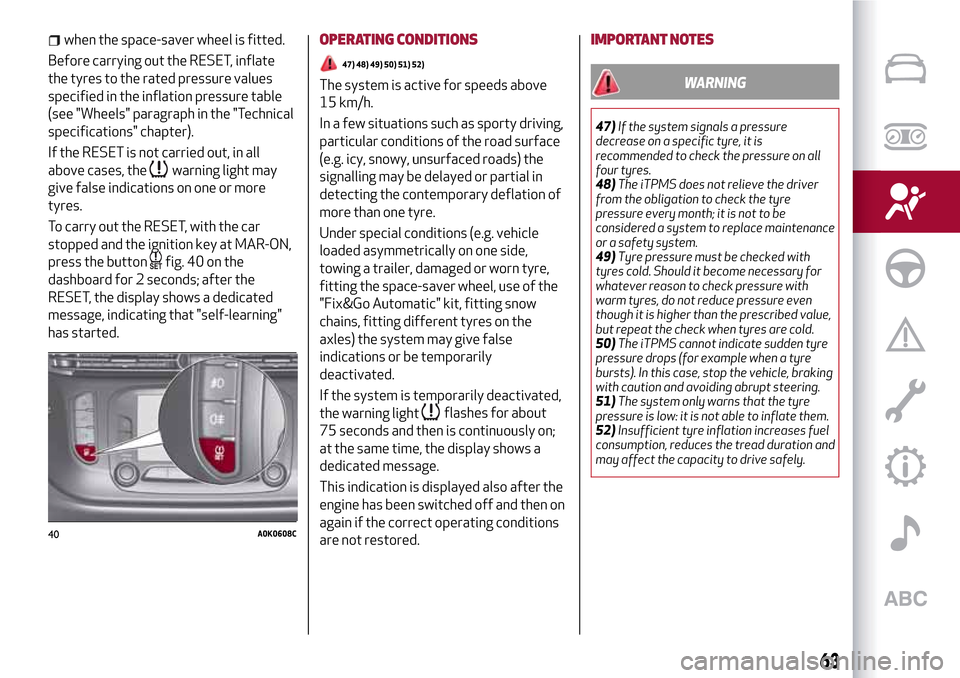
To carry out the RESET, with the car
stopped and the ignition key at MAR-ON,
press the button
fig. 40 on the
dashboard for 2 seconds; after the
RESET, the display shows a dedicated
message, indicating that "self-learning"
has started.
OPERATING CONDITIONS
47) 48) 49) 50) 51) 52)
The system is active for speeds above
15 km/h.
In a few situations such as sporty driving,
particular conditions of the road surface
(e.g. icy, snowy, unsurfaced roads) the
signalling may be delayed or partial in
detecting the contemporary deflation of
more than one tyre.
Under special conditions (e.g. vehicle
loaded asymmetrically on one side,
towing a trailer, damaged or worn tyre,
fitting the space-saver wheel, use of the
"Fix&Go Automatic" kit, fitting snow
chains, fitting different tyres on the
axles) the system may give false
indications or be temporarily
deactivated.
If the system is temporarily deactivated,
the warning light
flashes for about
75 seconds and then is continuously on;
at the same time, the display shows a
dedicated message.
This indication is displayed also after the
engine has been switched off and then on
again if the correct operating conditions
are not restored.
IMPORTANT NOTES
WARNING
47)If the system signals a pressure
decrease on a specific tyre, it is
recommended to check the pressure on all
four tyres.
48)The iTPMS does not relieve the driver
from the obligation to check the tyre
pressure every month; it is not to be
considered a system to replace maintenance
or a safety system.
49)Tyre pressure must be checked with
tyres cold. Should it become necessary for
whatever reason to check pressure with
warm tyres, do not reduce pressure even
though it is higher than the prescribed value,
but repeat the check when tyres are cold.
50)The iTPMS cannot indicate sudden tyre
pressure drops (for example when a tyre
bursts). In this case, stop the vehicle, braking
with caution and avoiding abrupt steering.
51)The system only warns that the tyre
pressure is low: it is not able to inflate them.
52)Insufficient tyre inflation increases fuel
consumption, reduces the tread duration and
may affect the capacity to drive safely.
40A0K0608C
63
Page 67 of 212
SBR SYSTEM (Seat Belt
Reminder)
This system comprises an acoustic
warning which, in conjunction with the
warning lights
flashing on the
instrument panel, warns the front seat
passengers if their seat belt has not been
fastened.
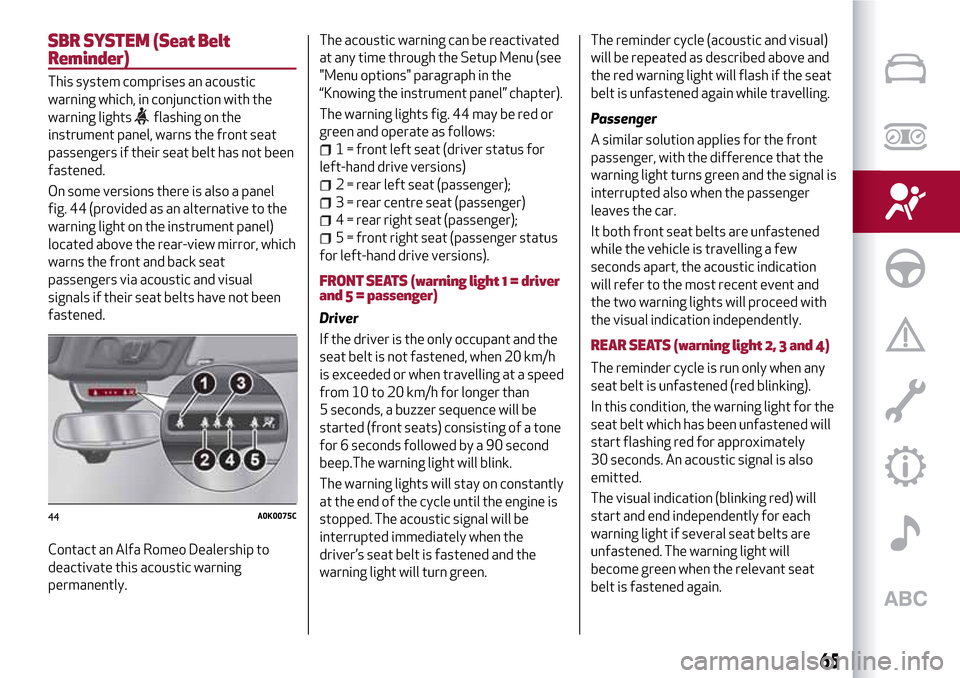
On some versions there is also a panel
fig. 44 (provided as an alternative to the
warning light on the instrument panel)
located above the rear-view mirror, which
warns the front and back seat
passengers via acoustic and visual
signals if their seat belts have not been
fastened.
Contact an Alfa Romeo Dealership to
deactivate this acoustic warning
permanently.The acoustic warning can be reactivated
at any time through the Setup Menu (see
"Menu options" paragraph in the
“Knowing the instrument panel” chapter).
The warning lights fig. 44 may be red or
green and operate as follows:
1 = front left seat (driver status for
left-hand drive versions)
2 = rear left seat (passenger);
3 = rear centre seat (passenger)
4 = rear right seat (passenger);
5 = front right seat (passenger status
for left-hand drive versions).
FRONT SEATS (warning light 1 = driver
and 5 = passenger)
Driver
If the driver is the only occupant and the
seat belt is not fastened, when 20 km/h
is exceeded or when travelling at a speed
from 10 to 20 km/h for longer than
5 seconds, a buzzer sequence will be
started (front seats) consisting of a tone
for 6 seconds followed by a 90 second
beep.The warning light will blink.
The warning lights will stay on constantly
at the end of the cycle until the engine is
stopped. The acoustic signal will be
interrupted immediately when the
driver’s seat belt is fastened and the
warning light will turn green.The reminder cycle (acoustic and visual)
will be repeated as described above and
the red warning light will flash if the seat
belt is unfastened again while travelling.
Passenger
A similar solution applies for the front
passenger, with the difference that the
warning light turns green and the signal is
interrupted also when the passenger
leaves the car.
It both front seat belts are unfastened
while the vehicle is travelling a few
seconds apart, the acoustic indication
will refer to the most recent event and
the two warning lights will proceed with
the visual indication independently.
REAR SEATS (warning light 2, 3 and 4)
The reminder cycle is run only when any
seat belt is unfastened (red blinking).
In this condition, the warning light for the
seat belt which has been unfastened will
start flashing red for approximately
30 seconds. An acoustic signal is also
emitted.
The visual indication (blinking red) will
start and end independently for each
warning light if several seat belts are
unfastened. The warning light will
become green when the relevant seat
belt is fastened again.
44A0K0075C
65
Page 83 of 212
Let’s get to the core of the vehicle: seeing how you can exploit all
of its potential to the full.
We’ll look at how to drive it safely in any situation, so that it can be
a welcome companion, with our comfort and our wallets in mind.
STARTING AND DRIVING
STARTING THE ENGINE . .........................82
WHEN PARKED................................83
TWIN CLUTCH TRANSMISSION......................83
MANUAL TRANSMISSION . . .......................86
START&STOP SYSTEM...........................87
CRUISE CONTROL ..............................89
PARKING SENSORS.............................90
TOWING TRAILERS.............................92
REFUELLING THE CAR...........................92
Page 84 of 212
STARTING THE ENGINE
Before starting the engine, adjust the
seat, the interior rear view mirrors, the
door mirrors and fasten the seat belt
correctly.
Never press the accelerator pedal for
starting the engine.
If necessary, messages indicating the
starting procedure can be shown on the
display.
ENGINE STARTING PROCEDURE
92) 93) 94)
21) 22) 23)
Proceed as follows:
engage the handbrake and place the
gear lever in neutral;
turn the ignition key to the MAR-ON
position. ONLY FOR DIESEL VERSIONS:
The instrument panel
warning light
comes on and the
icon appears on
the display.
wait for the warning lights to switch
off;
fully depress the clutch pedal, without
touching the accelerator;
turn the ignition key to AVV and
release it as soon as the engine starts.
If, with the ignition key turned to MAR,
the icon
on the display stays on
together with the warning light
, turn
the key to STOP and then back to MAR. If
the icon continues to stay on, try with the
other keys provided with the car. Contact
an Alfa Romeo Dealership if the engine
still does not start.
Never leave the ignition key in
MAR-ON position when the engine is
stopped.
ENGINE MINIMUM OIL LEVEL
INDICATION
(where provided)
When the ignition key is turned to MAR
the display shows a warning message, for
a few seconds, if the engine oil is at the
minimum level.
IMPORTANT To perform the engine oil
reading correctly, after turning the
ignition key to MAR wait for about
2 seconds before starting the engine.
WARNING
92)It is dangerous to run the engine in
enclosed areas. The engine takes in oxygen
and releases carbon dioxide, carbon
monoxide and other toxic gases.
93)The brake servo is not active until the
engine is started, so you would need to apply
much more force than usual to the brake
pedal.94)Do not start the engine by pushing,
towing or driving downhill. These
manoeuvres may damage the catalytic
converter.
IMPORTANT
21)We recommend that during the initial
period, or during the first 1600 km
(1000 miles), you do not drive to full car
performance (e.g. excessive acceleration,
long journeys at top speed, sharp braking,
etc.).
22)When the engine is switched off never
leave the ignition device in the MAR position
to prevent useless current absorption from
draining the battery.
23)A quick burst on the accelerator before
turning off the engine serves absolutely no
practical purpose; it wastes fuel and is
damaging for the engine.
24)Warning light
will flash after starting
or during prolonged cranking to indicate a
fault with the glow plug heating system. If
the engine starts, the vehicle can be regularly
used, but an Alfa Romeo Dealership must be
contacted as soon as possible.
82
STARTING AND DRIVING
Page 85 of 212
WHEN PARKED
Always remove the ignition key when
leaving the car.
When parking and leaving the car,
proceed as follows:
engage a gear (1st gear if facing uphill
or reverse if facing downhill) and leave
the wheels turned;
stop the engine and engage the
handbrake.
Block the wheels with a wedge or a stone
if the car is parked on a steep slope.
On versions equipped with Alfa TCT
transmission, before releasing the brake
pedal, wait for letter P to be displayed.
IMPORTANTNEVERleave the car with
the gearbox in neutral (or, on versions
equipped with Alfa TCT transmission,
before placing the gear lever at P).
HANDBRAKE
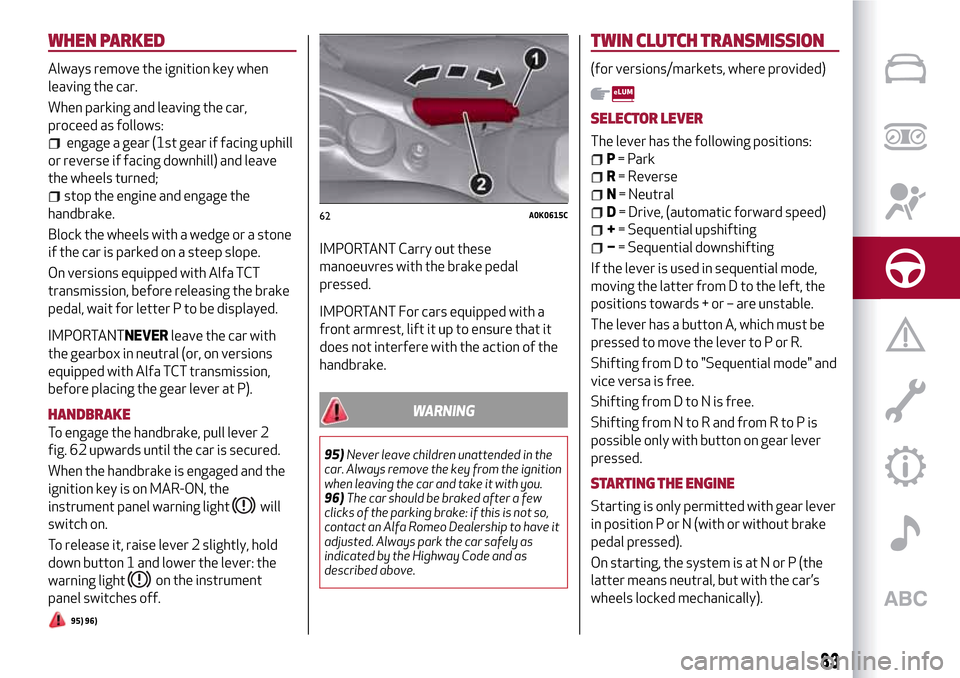
To engage the handbrake, pull lever 2
fig. 62 upwards until the car is secured.
When the handbrake is engaged and the
ignition key is on MAR-ON, the
instrument panel warning light
will
switch on.
To release it, raise lever 2 slightly, hold
down button 1 and lower the lever: the
warning light
on the instrument
panel switches off.
95) 96)
IMPORTANT Carry out these
manoeuvres with the brake pedal
pressed.
IMPORTANT For cars equipped with a
front armrest, lift it up to ensure that it
does not interfere with the action of the
handbrake.
WARNING
95)Never leave children unattended in the
car. Always remove the key from the ignition
when leaving the car and take it with you.
96)The car should be braked after a few
clicks of the parking brake: if this is not so,
contact an Alfa Romeo Dealership to have it
adjusted. Always park the car safely as
indicated by the Highway Code and as
described above.
TWIN CLUTCH TRANSMISSION
(for versions/markets, where provided)
SELECTOR LEVER
The lever has the following positions:
P= Park
R= Reverse
N= Neutral
D= Drive, (automatic forward speed)
+= Sequential upshifting
−= Sequential downshifting
If the lever is used in sequential mode,
moving the latter from D to the left, the
positions towards + or – are unstable.
The lever has a button A, which must be
pressed to move the lever to P or R.
Shifting from D to "Sequential mode" and
vice versa is free.
Shifting from D to N is free.
Shifting from N to R and from R to P is
possible only with button on gear lever
pressed.
STARTING THE ENGINE
Starting is only permitted with gear lever
in position P or N (with or without brake
pedal pressed).
On starting, the system is at N or P (the
latter means neutral, but with the car’s
wheels locked mechanically).
62A0K0615C
83
Page 86 of 212
Start&Stop system
With car at a standstill and Start&Stop
system activated, the engine switches
off if the gear lever is in a position other
than R (to allow parking).
In the event of stops uphill, the engine
switching off is disabled to activate the
"Hill Holder" function (except on gentle
slopes and if the brake pedal is not fully
pressed).
The engine restarts automatically if:
the brake pedal is released (and the
lever is not at N or P)
shifting the lever to an unstable
position +, - or R;
the lever is shifted from D to the left in
"Sequential mode"
the "+" or "–" paddles on the steering
wheel (for versions/markets, where
provided) are used
VEHICLE SHUTDOWN
Engine can be switched off in any
position of the gear lever.
Versions with Start&Stop system
To switch the engine off, you need to stop
the car by pressing the brake pedal
properly; if the pressure is not enough,
the engine will not be switched off.
This feature can be exploited so that the
engine does not switch off in particular
traffic conditions.
REMOVING THE IGNITION KEY
28)
The ignition key can be removed only if
the gear lever is in position P.
To remove the key, turn it to MAR and
then to STOP.
MOVING THE CAR
To move the car, from P press the brake
pedal and, using the button on the gear
lever, move the lever to the desired
position (D, R or "Sequential mode").
The display will show the gear engaged.
When the brake pedal is released, the car
starts moving forwards or backwards, as
soon as the manoeuvre is activated
("creeping" effect). The accelerator
should not be pressed in this case.
IMPORTANT The inconsistency between
the speed actually engaged (shown on
the display) and the position of the gear
lever is indicated by the letter
corresponding to the position of the lever
flashing on the trim (also accompanied by
an acoustic signal).
This condition should not be interpreted
as an operational fault, but simply as a
request by the system to repeat the
manoeuvre.
IMPORTANT With handbrake released
and brake pedal released, engine at idling
speed and gear lever in position D, R or
sequential, pay the utmost care because
the car can move even without the
operation of the accelerator pedal. This
condition can be used with the car on a
level surface during tight parking
manoeuvres using the brake pedal only.
AUTOMATIC DRIVING MODE
D can be selected from sequential
operation in any driving conditions.
In automatic driving mode, the best ratio
is selected by the electronic transmission
control unit depending on speed, engine
load (accelerator pedal position) and
gradient of the road.
“Kick-Down” function
To resume speed quickly, when the
accelerator pedal is pressed fully, the
transmission control system downshifts
("Kick-down" function).
IMPORTANT When driving on roads with
poor grip conditions (snow, ice, etc.) avoid
activating the kick-down function.
Integration with "Alfa DNA" system
With the “Alfa DNA” system 1 fig. 63,
three different driving modes can be
selected:
84
STARTING AND DRIVING
Page 87 of 212
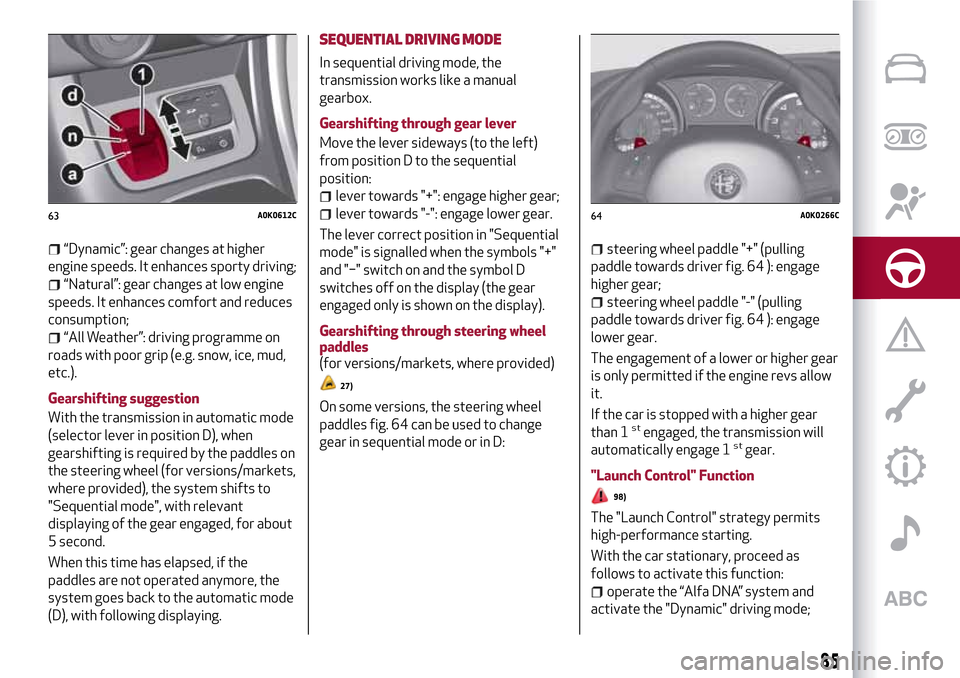
“Dynamic”: gear changes at higher
engine speeds. It enhances sporty driving;
“Natural”: gear changes at low engine
speeds. It enhances comfort and reduces
consumption;
“All Weather”: driving programme on
roads with poor grip (e.g. snow, ice, mud,
etc.).
Gearshifting suggestion
With the transmission in automatic mode
(selector lever in position D), when
gearshifting is required by the paddles on
the steering wheel (for versions/markets,
where provided), the system shifts to
"Sequential mode", with relevant
displaying of the gear engaged, for about
5 second.
When this time has elapsed, if the
paddles are not operated anymore, the
system goes back to the automatic mode
(D), with following displaying.
SEQUENTIAL DRIVING MODE
In sequential driving mode, the
transmission works like a manual
gearbox.
Gearshifting through gear lever
Move the lever sideways (to the left)
from position D to the sequential
position:
lever towards "+": engage higher gear;
lever towards "-": engage lower gear.
The lever correct position in "Sequential
mode" is signalled when the symbols "+"
and "−" switch on and the symbol D
switches off on the display (the gear
engaged only is shown on the display).
Gearshifting through steering wheel
paddles
(for versions/markets, where provided)
27)
On some versions, the steering wheel
paddles fig. 64 can be used to change
gear in sequential mode or in D:
steering wheel paddle "+" (pulling
paddle towards driver fig. 64 ): engage
higher gear;
steering wheel paddle "-" (pulling
paddle towards driver fig. 64 ): engage
lower gear.
The engagement of a lower or higher gear
is only permitted if the engine revs allow
it.
If the car is stopped with a higher gear
than 1
stengaged, the transmission will
automatically engage 1stgear.
"Launch Control" Function
98)
The "Launch Control" strategy permits
high-performance starting.
With the car stationary, proceed as
follows to activate this function:
operate the “Alfa DNA” system and
activate the "Dynamic" driving mode;
63A0K0612C64A0K0266C
85
Page 89 of 212
WARNING
99)Press the clutch pedal fully to change
gears correctly. It is therefore essential that
there is nothing under the pedals: make sure
the mats are lying flat and do not get in the
way of the pedals.
IMPORTANT
29)Do not drive with your hand resting on
the gear lever as the force exerted, even if
slight, could lead over time to premature
wear of the gearbox internal components.
START&STOP SYSTEM
(for versions/markets, where provided)
The Stop/Start system automatically
stops the engine each time the vehicle is
stationary and starts it again when the
driver wants to move off.
In this way, the vehicle efficiency is
increased, by reducing consumption,
dangerous gas emissions and sound
pollution.
OPERATING MODE
Stopping the engine
With the vehicle stopped, the engine
stops with gearbox in neutral and clutch
pedal released.
NOTE The engine can only be stopped
automatically after exceeding about
10 km/h, to prevent the engine from
being repeatedly stopped when driving at
walking pace.
The symbol
appears on the display
when the engine stops.
Restarting the engine
Press the clutch pedal to restart the
engine.
SYSTEM MANUAL ACTIVATION/
DEACTIVATION
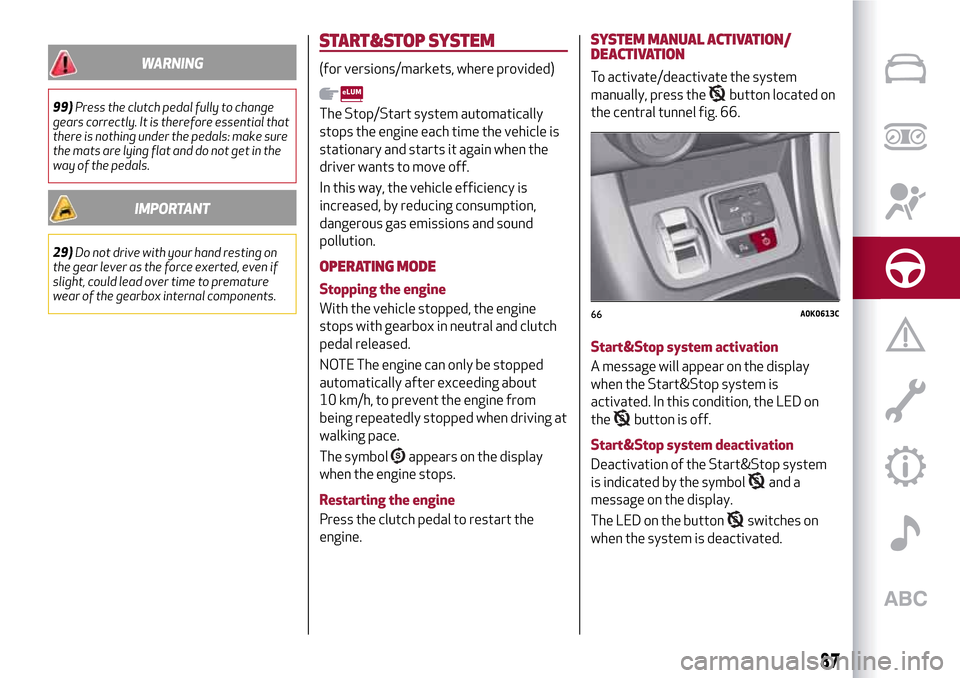
To activate/deactivate the system
manually, press the
button located on
the central tunnel fig. 66.
Start&Stop system activation
A message will appear on the display
when the Start&Stop system is
activated. In this condition, the LED on
the
button is off.
Start&Stop system deactivation
Deactivation of the Start&Stop system
is indicated by the symbol
and a
message on the display.
The LED on the button
switches on
when the system is deactivated.
66A0K0613C
87
Page 90 of 212
MISSED ENGINE STOPPING
CONDITIONS
When the system is active, for a higher
comfort and safety, and to reduce
emissions, the engine does not stop in
certain ambient conditions, engine
conditions, with the doors not closed and
seat belts unfastened.
30)
ENGINE RESTARTING CONDITIONS
Due to comfort, emission control and
safety reasons, the engine can restart
automatically without any action by the
driver, when the vehicle and the climate
control system are in certain conditions,
such as:
With gear engaged, automatic engine
restarting is possible only by fully
pressing the clutch pedal. The driver is
informed by the displaying of a message
on the display and - for versions/markets,
where provided - by the flashing of the
symbol
.
SAFETY FUNCTIONS
When the engine is stopped by the
Start&Stop system, if the driver releases
his/her seat belt and opens the driver's or
passenger's door, the engine can be
restarted only by the ignition key.
The driver is informed by a buzzer and by
the flashing of the symbol
on the
display (on some versions, a message is
displayed as well).
"ENERGY SAVING" FUNCTION(for versions/markets, where provided)
If, following the automatic engine
restarting, the driver does not carry out
any action on the vehicle for over
3 minutes, the Start&Stop system stops
the engine definitely, to prevent fuel
consumption. In these cases, the engine
can be restarted only using the ignition
key.
NOTE In any case, it is possible to keep
the engine running by deactivating the
Start&Stop system.
IRREGULAR OPERATION
In the event of malfunction, the
Stop/Start system is deactivated.
The driver is informed of the fault by the
flashing of the symbol
.For
versions/markets, where provided, a
warning message will also appear on the
display.
In this case, contact an Alfa Romeo
Dealership.
VEHICLE INACTIVITY
In the event of vehicle inactivity (or if the
battery is replaced), special attention
must be paid to the disconnection of the
battery power supply.
100)
IMPORTANT
30)If climate comfort is to be favoured, the
Stop/Start system can be deactivated, for a
continuous operation of the climate control
system.
WARNING
100)When replacing the battery, always
contact an Alfa Romeo Dealership. Replace
the battery with one of the same type
(HEAVY DUTY) and with the same
specifications.
88
STARTING AND DRIVING