Time Alfa Romeo MiTo 2014 Owner's Guide
[x] Cancel search | Manufacturer: ALFA ROMEO, Model Year: 2014, Model line: MiTo, Model: Alfa Romeo MiTo 2014Pages: 280, PDF Size: 8.79 MB
Page 76 of 280
FOG LIGHTS(for versions/markets, where provided)
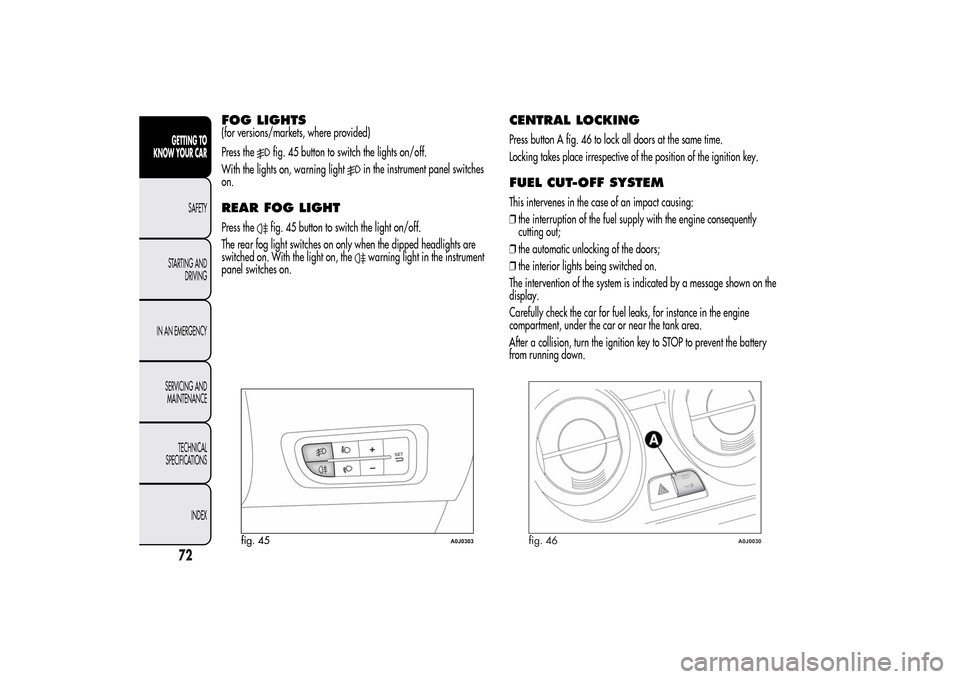
Press the
fig. 45 button to switch the lights on/off.
With the lights on, warning light
in the instrument panel switches
on.
REAR FOG LIGHTPress the
fig. 45 button to switch the light on/off.
The rear fog light switches on only when the dipped headlights are
switched on. With the light on, the
warning light in the instrument
panel switches on.
CENTRAL LOCKINGPress button A fig. 46 to lock all doors at the same time.
Locking takes place irrespective of the position of the ignition key.FUEL CUT-OFF SYSTEMThis intervenes in the case of an impact causing:
❒the interruption of the fuel supply with the engine consequently
cutting out;
❒the automatic unlocking of the doors;
❒the interior lights being switched on.
The intervention of the system is indicated by a message shown on the
display.
Carefully check the car for fuel leaks, for instance in the engine
compartment, under the car or near the tank area.
After a collision, turn the ignition key to STOP to prevent the battery
from running down.
fig. 45
A0J0303
fig. 46
A0J0030
72GETTING TO
KNOW YOUR CAR
SAFETY
STARTING AND
DRIVING
IN AN EMERGENCY
SERVICING AND
MAINTENANCE
TECHNICAL
SPECIFICATIONS
INDEX
Page 86 of 280
If the control button is pressed again, the window will stop in the
desired position. If the button is held down for several seconds, the
window raises or lowers automatically (only with ignition key in MAR
position).
Window closing
Lift the buttons to close the desired window.
The window closing stage occurs following the same logics described
for the opening stage.
Passenger side door
The passenger side door is equipped with a button that controls the
opening/closing of the passenger side window.
Continuous automatic operation
(for versions/markets, where provided)
This is activated by pressing one of the two buttons for longer than half
a second. The window will stop when it is fully opened or closed, or
when the button is pressed again:
❒Driver side:raising/lowering.
❒Passenger side:only lowering.
❒Where anti-crush device is present:raising/lowering driver side and
passenger side.
Anti-crush safety device
(for versions/markets, where provided)
The car’s anti-crush function is active as the windows are being raised.This safety system detects the presence of an obstacle during the
window closing travel and intervenes by stopping and reversing the
window travel, depending on its position. This device is also useful
if the windows are activated accidentally by children on board the car.
The anti-crush safety function is active both during the manual and
the automatic operation of the window. When the anti-crush system is
activated, the window travel is immediately interrupted and then
reversed. The window cannot be operated in any way during this time.
IMPORTANT If the anti-crush protection intervenes 5 consecutive times
within a minute or is faulty, the automatic closing operation of the
window is inhibited, only allowing it in steps of half a second with the
button released for the subsequent manoeuvre.
In order to restore the correct operation of the system, the relevant
window must be lowered.
IMPORTANT With ignition key at STOP or removed, the electric
windows remain active for about 3 minutes and are deactivated when
a door is opened.
IMPORTANT With the anti-crush system, when the
button on the
remote control is pressed for longer than 2 seconds the windows will
open, whilst if the
button is pressed for longer than 2 seconds
the windows will close.
The system conforms to the 2000/4/EC standard concerning
the safety of passengers leaning out of the passenger
compartment.
82GETTING TO
KNOW YOUR CAR
SAFETY
STARTING AND
DRIVING
IN AN EMERGENCY
SERVICING AND
MAINTENANCE
TECHNICAL
SPECIFICATIONS
INDEX
Page 91 of 280
BONNETOPENINGProceed as follows:
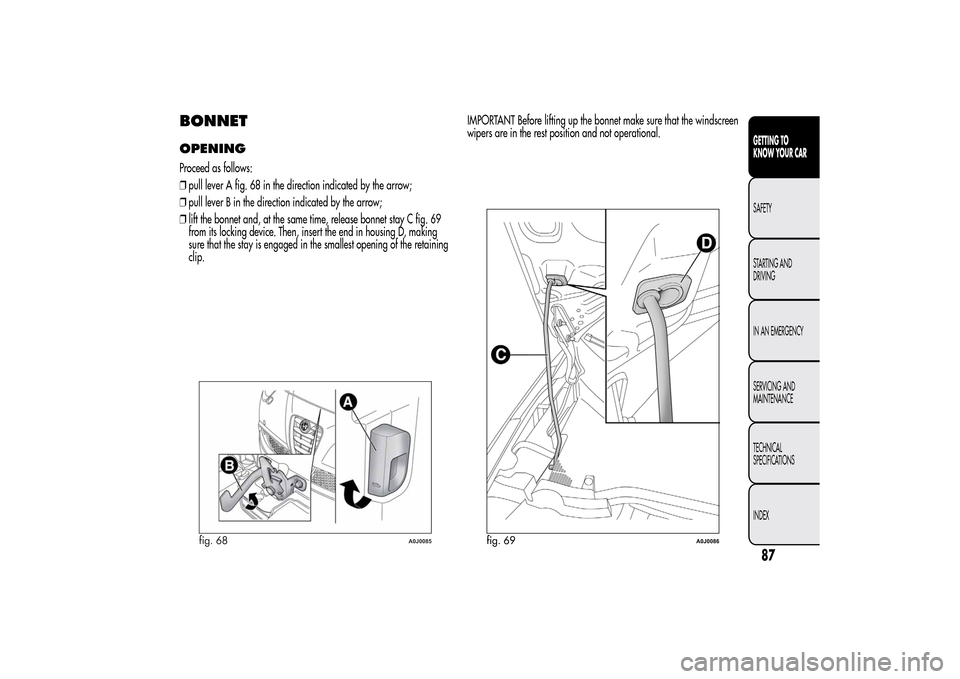
❒pull lever A fig. 68 in the direction indicated by the arrow;
❒pull lever B in the direction indicated by the arrow;
❒lift the bonnet and, at the same time, release bonnet stay C fig. 69
from its locking device. Then, insert the end in housing D, making
sure that the stay is engaged in the smallest opening of the retaining
clip.IMPORTANT Before lifting up the bonnet make sure that the windscreen
wipers are in the rest position and not operational.
fig. 68
A0J0085
fig. 69
A0J0086
87GETTING TO
KNOW YOUR CARSAFETY
STARTING AND
DRIVING
IN AN EMERGENCY
SERVICING AND
MAINTENANCE
TECHNICAL
SPECIFICATIONS
INDEX
Page 94 of 280
HEADLIGHTSLIGHT BEAM DIRECTIONThe correct orientation of the headlights is important for the driver's
comfort and safety as well as for all other road users. This is also
covered by a specific rule of the highway code.
The headlights must be correctly aligned to ensure the best visibility
conditions for yourself and others when driving with lights on. To check
and, if necessary, adjust, contact Alfa Romeo Authorized Services.HEADLIGHT ALIGNMENT CORRECTORThis device works with the ignition key in the MAR position and the
dipped headlights on.
Headlight alignment adjustment
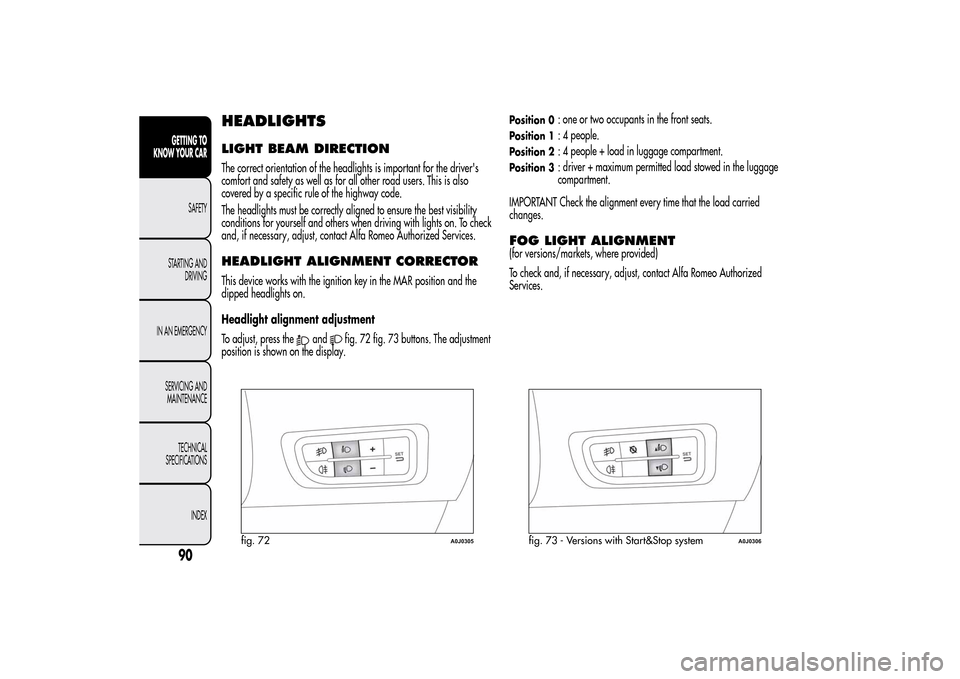
To adjust, press the
and
fig. 72 fig. 73 buttons. The adjustment
position is shown on the display.
Position 0
: one or two occupants in the front seats.
Position 1
: 4 people.
Position 2
: 4 people + load in luggage compartment.
Position 3
: driver + maximum permitted load stowed in the luggage
compartment.
IMPORTANT Check the alignment every time that the load carried
changes.
FOG LIGHT ALIGNMENT(for versions/markets, where provided)
To check and, if necessary, adjust, contact Alfa Romeo Authorized
Services.
fig. 72
A0J0305
fig. 73 - Versions with Start&Stop system
A0J0306
90GETTING TO
KNOW YOUR CAR
SAFETY
STARTING AND
DRIVING
IN AN EMERGENCY
SERVICING AND
MAINTENANCE
TECHNICAL
SPECIFICATIONS
INDEX
Page 96 of 280
If the ABS system intervenes, this indicates that the
traction of the tyres on the road is nearing its limit.
Slow down to a speed compatible with the available
traction.The ABS gets the most from the available grip, but it
cannot improve it; you should therefore take every
care when driving on slippery surfaces and not take
unnecessary risks.When the ABS cuts in and you feel the brake pedal
pulsating, do not remove your foot, but keep the pedal
pushed down; in doing so you, will stop in the
shortest distance possible under the road conditions at the time.
ESC (Electronic Stability
Control) SYSTEMThis is an electronic system controlling car stability in the event of tyre
grip loss, helping to maintain directional control.
The system is capable of recognising potentially dangerous situations
in terms of the stability and intervenes automatically on the brakes in a
differentiated manner for the four wheels in order to provide a
stabilising torque.
The ESC system also includes the following systems:
❒Hill Holder
❒ASR
❒Brake Assist
❒MSR
❒CBC
❒“ELECTRONIC Q2” (“E-Q2”)
❒DSTSYSTEM ACTIVATIONThe ESC system switches on automatically when the engine is started
and cannot be switched off.SYSTEM INTERVENTIONIt is signalled by the blinking of the warning light
on the instrument
panel, to inform the driver that the car is in critical stability and grip
conditions.
92GETTING TO
KNOW YOUR CAR
SAFETY
STARTING AND
DRIVING
IN AN EMERGENCY
SERVICING AND
MAINTENANCE
TECHNICAL
SPECIFICATIONS
INDEX
Page 97 of 280
HILL HOLDER SYSTEMThis system is an integral part of the ESC system and facilitates starting
on slopes.
It is automatically activated in the following conditions:
❒uphill: vehicle stationary on a road with a gradient higher than 5%,
engine running, brake pedal pressed and gearbox in neutral or
gear (other than reverse) engaged;
❒downhill: vehicle stationary on a road with a gradient higher than
5%, engine running, brake pedal pressed and reverse gear
engaged.
When setting off the ESC system control unit maintains the braking
pressure at the wheels until the engine torque required for departure is
reached or for approximately 2 seconds, allowing your right foot to
be moved easily from the brake pedal to the accelerator.
If the vehicle has not departed after this time, the system will deactivate
automatically by gradually releasing the brake force. A sound may
be heard during this stage: this indicates that the vehicle is about
to move off.
IMPORTANT The Hill Holder system is not a handbrake. Do not leave
the vehicle without having engaged the handbrake, switched off the
engine and engaged a gear.ASR (AntiSlip Regulation) SYSTEMIt is an integral part of the ESC system. It automatically operates in the
event of one or both drive wheels slipping, loss of grip on wet roads
(aquaplaning) and acceleration on slippery, snowy or icy roads, etc.Depending on the slipping conditions, two different control systems are
activated:
❒if the slipping involves both drive wheels, the ASR intervenes
reducing the power transmitted by the engine;
❒if the slipping only involves one of the drive wheels, the ASR
intervenes automatically braking the wheel that is slipping.
For the correct operation of the ESC and ASR systems,
the tyres must be the same make and type on all
wheels, in perfect condition and, above all, of the type,
make and size recommended.The ESC system operates even when the space-saver
wheel is being used. Always remember that the
space-saver wheel, being smaller than the original
wheel, provides less grip.Do not take unnecessary risks, even if your vehicle is
fitted with the ESC and ASR systems. Driving style must
always be adapted to road conditions, visibility and
traffic. The driver is always responsible for road safety.
93GETTING TO
KNOW YOUR CARSAFETY
STARTING AND
DRIVING
IN AN EMERGENCY
SERVICING AND
MAINTENANCE
TECHNICAL
SPECIFICATIONS
INDEX
Page 100 of 280
Steering wheel tuning:functions aimed at comfort in normal
conditions of use.
DST:braking standard control coordinated with ABS/ESC. Standard
control over lateral acceleration. Oversteer compensation: a slight
pulse on the steering wheel encourages the driver to carry out the most
appropriate manoeuvre.
Engine:standard response.ENGAGEMENT/DISENGAGEMENT OF
“Dynamic” MODEEngagement
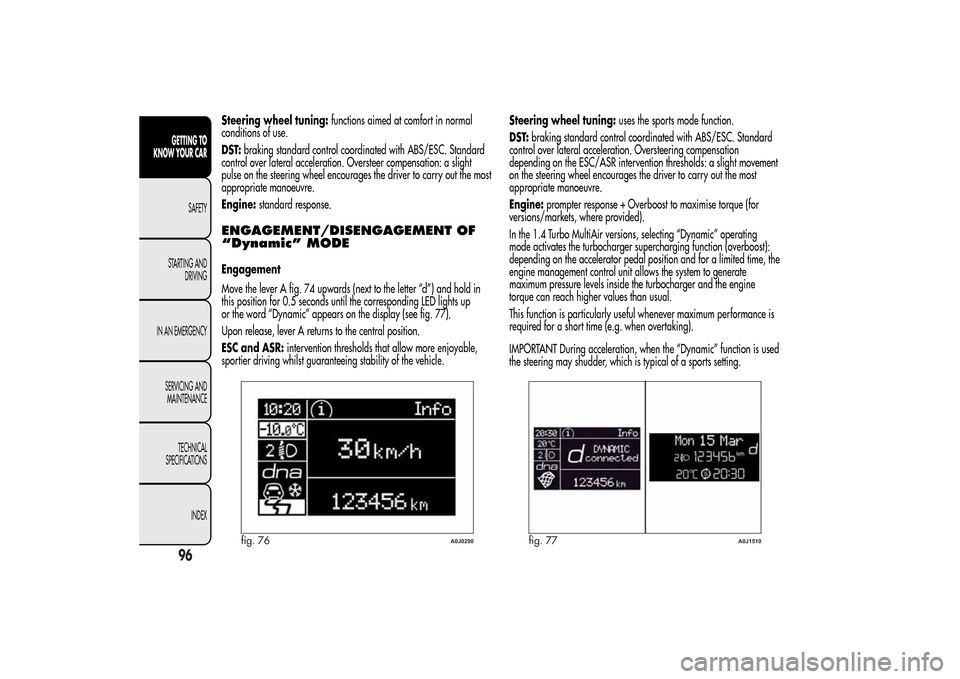
Move the lever A fig. 74 upwards (next to the letter “d”) and hold in
this position for 0.5 seconds until the corresponding LED lights up
or the word “Dynamic” appears on the display (see fig. 77).
Upon release, lever A returns to the central position.
ESC and ASR:intervention thresholds that allow more enjoyable,
sportier driving whilst guaranteeing stability of the vehicle.Steering wheel tuning:uses the sports mode function.
DST:braking standard control coordinated with ABS/ESC. Standard
control over lateral acceleration. Oversteering compensation
depending on the ESC/ASR intervention thresholds: a slight movement
on the steering wheel encourages the driver to carry out the most
appropriate manoeuvre.
Engine:prompter response + Overboost to maximise torque (for
versions/markets, where provided).
In the 1.4 Turbo MultiAir versions, selecting “Dynamic” operating
mode activates the turbocharger supercharging function (overboost):
depending on the accelerator pedal position and for a limited time, the
engine management control unit allows the system to generate
maximum pressure levels inside the turbocharger and the engine
torque can reach higher values than usual.
This function is particularly useful whenever maximum performance is
required for a short time (e.g. when overtaking).
IMPORTANT During acceleration, when the “Dynamic” function is used
the steering may shudder, which is typical of a sports setting.
fig. 76
A0J0290
fig. 77
A0J1510
96GETTING TO
KNOW YOUR CAR
SAFETY
STARTING AND
DRIVING
IN AN EMERGENCY
SERVICING AND
MAINTENANCE
TECHNICAL
SPECIFICATIONS
INDEX
Page 101 of 280
Disengagement
To deactivate “Dynamic” mode and return to “Natural”, repeat the
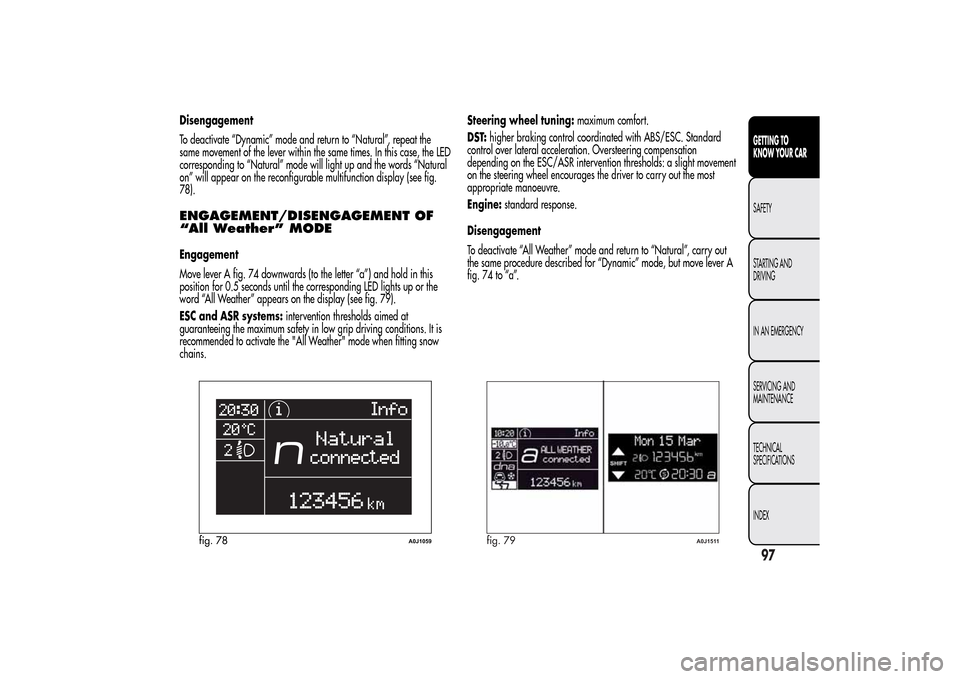
same movement of the lever within the same times. In this case, the LED
corresponding to “Natural” mode will light up and the words “Natural
on” will appear on the reconfigurable multifunction display (see fig.
78).ENGAGEMENT/DISENGAGEMENT OF
“All Weather” MODEEngagement
Move lever A fig. 74 downwards (to the letter “a”) and hold in this
position for 0.5 seconds until the corresponding LED lights up or the
word “All Weather” appears on the display (see fig. 79).
ESC and ASR systems:intervention thresholds aimed at
guaranteeing the maximum safety in low grip driving conditions. It is
recommended to activate the "All Weather" mode when fitting snow
chains.Steering wheel tuning:maximum comfort.
DST:higher braking control coordinated with ABS/ESC. Standard
control over lateral acceleration. Oversteering compensation
depending on the ESC/ASR intervention thresholds: a slight movement
on the steering wheel encourages the driver to carry out the most
appropriate manoeuvre.
Engine:standard response.
Disengagement
To deactivate “All Weather” mode and return to “Natural”, carry out
the same procedure described for “Dynamic” mode, but move lever A
fig. 74 to “a”.
fig. 78
A0J1059
fig. 79
A0J1511
97GETTING TO
KNOW YOUR CARSAFETY
STARTING AND
DRIVING
IN AN EMERGENCY
SERVICING AND
MAINTENANCE
TECHNICAL
SPECIFICATIONS
INDEX
Page 102 of 280
IMPORTANT
❒It is not possible to switch directly from “Dynamic” mode to “All
Weather” mode and vice versa. You must always first go back
to “Natural” mode and then select the other mode.
❒The driving mode engaged before the engine stops is maintained
when it is next started.
❒In the event of system failure or a fault with lever A fig. 74, no
driving modes can be selected. The display will show a warning
message.
START&STOP SYSTEM(for versions/markets, where provided)
The Start&Stop system automatically stops the engine each time the car
is stationary and starts it again when the driver wants to move off.
In this way, the efficiency of the car is increased, by reducing
consumption, emissions of harmful gases and noise pollution.OPERATING MODESEngine stopping mode
With the car stopped, the engine stops with gearbox in neutral and
clutch pedal released.
NoteThe engine can only be stopped automatically over about 10
km/h, to prevent the engine from being repeatedly stopped when
driving at walking pace.
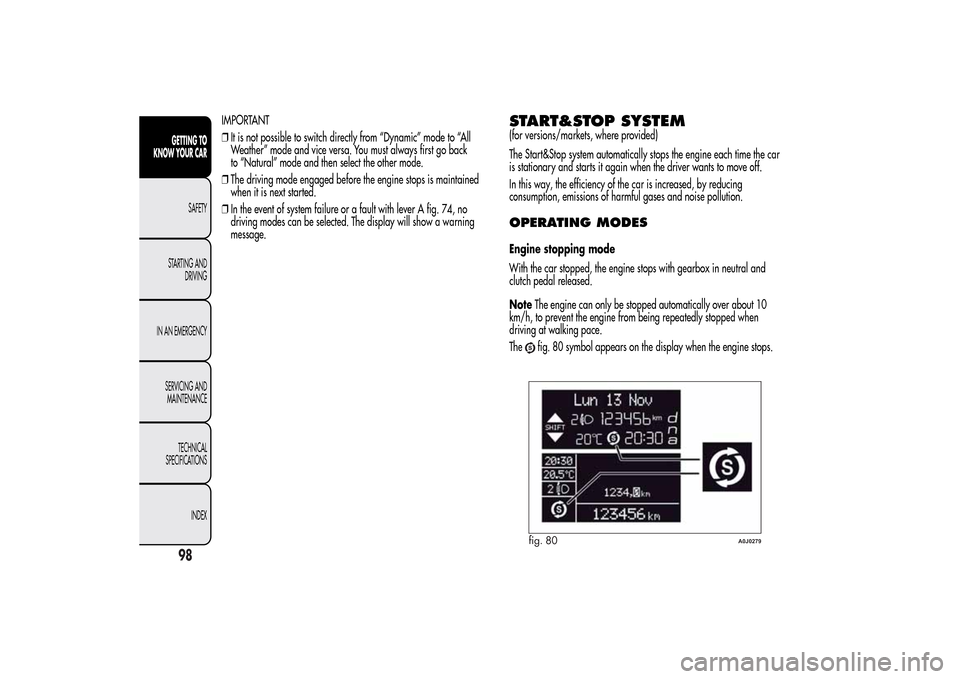
The
fig. 80 symbol appears on the display when the engine stops.fig. 80
A0J0279
98GETTING TO
KNOW YOUR CAR
SAFETY
STARTING AND
DRIVING
IN AN EMERGENCY
SERVICING AND
MAINTENANCE
TECHNICAL
SPECIFICATIONS
INDEX
Page 111 of 280
❒sensor performance can also be influenced by the position of the
sensors. For example by a change in the ride setting (caused by
the wear of the shock absorbers, suspension), overloading the
vehicle and carrying out specific tuning operations that require the
vehicle to be lowered;
❒The detection of obstacles at the top part of the car may not be
guaranteed because the system detects obstacles that could cause an
impact with the car in the bottom part.
TPMS (Tyre Pressure
Monitoring System)(for versions/markets, where provided)
The car may be fitted with a tyre pressure monitoring system (TPMS),
which informs the driver of the tyre inflation status via the "Check
tyre pressure" and "Low tyre pressure" messages on the display.
This system comprises a radio frequency transmitter fitted to each
wheel (on the wheel rim inside the tyre), which is able to send
information on the tyre inflation pressure of each wheel to the control
unit.IMPORTANT INFORMATION ABOUT
THE TPMSThe fault indications are not stored and will therefore not be displayed
after the engine has been switched off and then on again.
If the fault conditions persist, the control unit will send the relative
indications to the instrument panel only after the car has been in
motion for a short time.
The presence of the TPMS does not permit the driver to
neglect regular checks of the tyre pressure, including
for the spare wheel.Tyre pressure must be checked with tyres rested and
cold. Should it become necessary for whatever reason
to check pressure with warm tyres, do not reduce
pressure even though it is higher than the prescribed value, but
repeat the check when tyres are cold.
107GETTING TO
KNOW YOUR CARSAFETY
STARTING AND
DRIVING
IN AN EMERGENCY
SERVICING AND
MAINTENANCE
TECHNICAL
SPECIFICATIONS
INDEX