key Alfa Romeo MiTo 2014 Workshop Manual
[x] Cancel search | Manufacturer: ALFA ROMEO, Model Year: 2014, Model line: MiTo, Model: Alfa Romeo MiTo 2014Pages: 280, PDF Size: 8.79 MB
Page 107 of 280
EOBD SYSTEM (European On
Board Diagnosis)(for versions/markets, where provided)
The aim of the EOBD system (European On Board Diagnosis) is to:
❒monitor the system efficiency;
❒indicate an increase in emissions;
❒indicate the need to replace damaged components.
The car also has a diagnostic connector that can be interfaced with
appropriate tools, which makes it possible to read the error codes
stored in the electronic control units together with a series of specific
parameters for engine operation and diagnosis. This check can also be
carried out by the traffic police.
IMPORTANT After eliminating a fault, to check the system completely,
Alfa Romeo Authorised Services are obliged to run tests and, if
necessary, road tests which may also call for a long journey.
ELECTRIC POWER STEERINGThis only operates with the key turned to MAR-ON and the engine
started. Power steering allows the force required at the steering wheel
to be adapted to driving conditions.
The different power assistance modes can be selected via the "d,n,a"
positions of the “Alfa DNA System” lever (see “Alfa DNA System”
paragraph).
It is absolutely forbidden to carry out any after-market
operation involving steering system or steering column
modifications (e.g.: installation of anti-theft device)
that could badly affect performance and safety, invalidate the
warranty and also result in non-compliance of the car with
type-approval requirements.Before performing any maintenance operations,
always turn off the engine and remove the key from
the ignition to lock the steering column, especially
when the car’s wheels are not touching the ground.
103GETTING TO
KNOW YOUR CARSAFETY
STARTING AND
DRIVING
IN AN EMERGENCY
SERVICING AND
MAINTENANCE
TECHNICAL
SPECIFICATIONS
INDEX
Page 114 of 280
REFUELLING THE CARStop the engine before refuelling.PETROL ENGINESOnly use unleaded petrol. The petrol octane rating (RON) must not be
lower than 95. In order to prevent damage to the catalytic converter
never introduce even the smallest amount of leaded petrol, even in the
event of an emergency.DIESEL ENGINESUse only diesel fuel compliant with European specification EN590. The
use of other products or mixtures may damage the engine beyond
repair and consequently invalidate the warranty, due to the damage
caused.
Operation at low temperatures
If the outside temperature is very low, the diesel thickens due to the
formation of paraffin clots with consequent defective operation of the
fuel supply system.
In order to avoid these problems, different types of diesel fuel are
distributed according to the season: summer type, winter type and
arctic type (cold/mountain areas). If refuelling with diesel fuel whose
features are not suitable for the temperature of use, it is advisable
to mix TUTELA DIESEL ART additive with the fuel, in the proportions
shown on the container. Pour the additive into the tank before the fuel.
When using or parking the vehicle for a long time in the mountains
or cold areas, it is advisable to refuel using locally available fuel.
In this case, it is also advisable to keep the tank over 50% full.
FUEL TANK CAPOpening
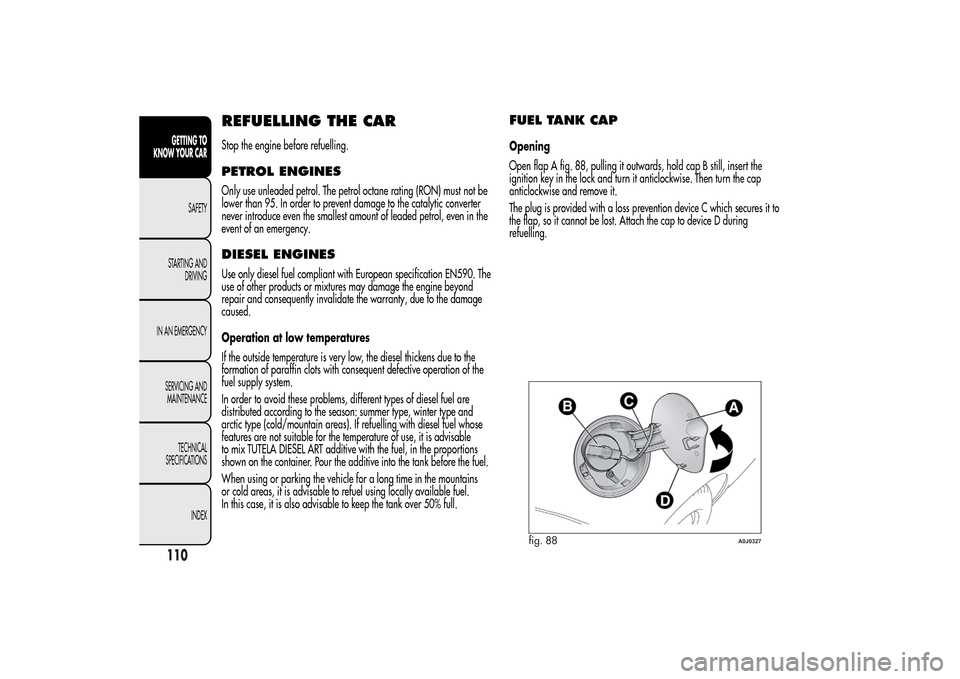
Open flap A fig. 88, pulling it outwards, hold cap B still, insert the
ignition key in the lock and turn it anticlockwise. Then turn the cap
anticlockwise and remove it.
The plug is provided with a loss prevention device C which secures it to
the flap, so it cannot be lost. Attach the cap to device D during
refuelling.
fig. 88
A0J0327
110GETTING TO
KNOW YOUR CAR
SAFETY
STARTING AND
DRIVING
IN AN EMERGENCY
SERVICING AND
MAINTENANCE
TECHNICAL
SPECIFICATIONS
INDEX
Page 115 of 280
Closure
Fit the cap (complete with key) and turn it clockwise until it clicks once
or more. Then turn the key clockwise and extract it, then close the flap.
The sealing may cause a slight pressure increase in the tank. A little
breathing off, while slackening the cap is absolutely normal.
Do not place naked flames or lit cigarettes near to the
fuel filler: fire risk. Also, keep your face away from
this fuel inlet to avoid inhaling harmful fumes.
PROTECTING THE ENVIRONMENTThe following devices are used for reducing petrol fuel engine
emissions: catalytic converter, oxygen sensors and evaporation control
system
The following devices are used for reducing diesel fuel engine
emissions: oxidising catalytic converter, exhaust gas recirculation
system (EGR) and particulate filter (DPF).DIESEL PARTICULATE FILTER (DPF)(Diesel Particulate Filter)
(for versions/markets, where provided)
The Diesel Particulate Filter is a mechanical filter, integral to the
exhaust system, that physically traps carbon particles present in the
exhaust gases of diesel engines.
The diesel particulate filter is needed to eliminate almost all carbon
particle emissions in compliance with current/future regulations and
standards.
During standard use of the vehicle, the engine control unit records a set
of data (e.g.: travel time, type of route, temperatures, etc.) and it will
then calculate how much particulate has been trapped by the filter.
Since this filter physically traps particulate, it should be periodically
regenerated (cleaned) at regular intervals by burning carbon particles.
111GETTING TO
KNOW YOUR CARSAFETY
STARTING AND
DRIVING
IN AN EMERGENCY
SERVICING AND
MAINTENANCE
TECHNICAL
SPECIFICATIONS
INDEX
Page 119 of 280
NOTE On versions equipped with sports front seats, the passenger side
seat belt fastened indication (warning light 1 for RHD versions or
warning light 5 for LHD versions) will never be displayed.FRONT SEATS (warning light no. 1 =
driver and no. 5 = passenger)Driver
If the driver is the only occupant and their seat belt is not fastened,
when 20 km/h is exceeded or when travelling at a speed between 10
and 20 km/h for longer than 5 seconds, an acoustic signal cycle
will be started for the front seats (continuous acoustic signal for
6 seconds followed by a 90 second beep). The warning light will flash.
The warning lights will stay on constantly at the end of the cycle until
the engine is stopped. The acoustic signal will be interrupted
immediately when the driver’s seat belt is fastened and the warning
light will turn green.
The reminder cycle (acoustic and visual) will be repeated as described
above and the red warning light will flash if the seat belt is unfastened
again while travelling.
Passenger
A similar situation applies to the front passenger, with the difference
that the warning light turns green and the indication is also interrupted
when the passenger leaves the car.
If both front seat belts are unfastened a few seconds apart while the
car is travelling, the acoustic signal will refer to the most recent event
and the two warning lights will proceed with the visual indication
independently.
REAR SEATS (warning light no. 2, no.
3 and no. 4)For the rear seats, the reminder cycle is only activated when any seat
belt is unfastened (flashing red).
In this condition, the warning light for the seat belt which has been
unfastened will flash (red) for approximately 30 seconds. An acoustic
signal is also emitted.
The visual indication (flashing red) will start and stop independently for
each warning light if several seat belts are unfastened. The warning
light will become green when the relevant seat belt is fastened again.
The rear seat warning lights will switch off, regardless of the state
of the belt (red or green) approximately 30 seconds after the last
signal.
IMPORTANT
The warning lights are all off if all seat belts (front and rear) are
already fastened when the ignition key is turned to MAR.
All warning lights switch on when at least one belt changes from
fastened to unfastened or vice versa.
115GETTING TO KNOW
YOUR CARSAFETYSTARTING AND
DRIVING
IN AN EMERGENCY
SERVICING AND
MAINTENANCE
TECHNICAL
SPECIFICATIONS
INDEX
Page 135 of 280
IMPORTANT
Do not wash the seats with water or pressurised steam (by hand or at
automatic seat washing stations).
The front airbags and/or side bags may be deployed if the car is
subject to violent impacts involving the underbody area (e.g. violent
impacts against steps or kerbs, big holes or dips in the road etc.).
When the airbag deploys it emits a small amount of dust: the dust is
harmless and does not indicate the beginning of a fire. The dust may
irritate the skin and eyes however: in this case, wash with neutral soap
and water.
All operations on airbags (inspection, repair and replacement) must be
carried out by Alfa Romeo Authorized Services.
If the car is to be scrapped, contact Alfa Romeo Authorized Services to
have the airbag system deactivated.
Pretensioners and airbags are deployed in different ways, according to
the type of impact. Failure to deploy of one of the devices does not
necessarily indicate a system malfunction.
If the
warning light does not switch on when the
key is turned to MAR-ON, or stays on while driving (on
some versions together with a message on the
display) there may be a fault in the restraint systems. In this
case, airbags or pretensioners may not be activated in the case
of an accident or (in a lesser number of cases) they may be
activated incorrectly. Before proceeding, contact Alfa Romeo
Authorised Services to have the system checked immediately.
The expiry dates of the explosive charge and the clock
spring are shown on a specific label contained in the
glove compartment. As these dates approach, contact
Alfa Romeo Authorised Workshops.Do not travel carrying objects in your lap, in front of
your chest or between your lips (pipe, pencils, etc.):
they could cause severe injury if the airbag is
deployed.If the car has been subject to theft, attempted theft,
vandalism, or flooding, have the airbag system
inspected at Alfa Romeo Authorised Services.
131GETTING TO KNOW
YOUR CARSAFETYSTARTING AND
DRIVING
IN AN EMERGENCY
SERVICING AND
MAINTENANCE
TECHNICAL
SPECIFICATIONS
INDEX
Page 136 of 280
The airbags may also be deployed when the car is not
moving, if the key is in the ignition and turned to
MAR-ON
or when the engine is off, if the car
is hit by another moving vehicle. For this reason,
children must never occupy the front seat in a
rearward facing seat even if the car is not moving.
Deployment of the airbag following an impact could
cause fatal injuries to the child. Always deactivate
the passenger airbag if it is needed to place a child
seat on the front seat. The passenger seat must
also be positioned back as far as possible in order
to avoid the child seat from coming into contact with
the dashboard. Although this is not mandatory by
law, the airbag should be immediately reactivated
when children are no longer transported to ensure
better protection for adults. On the other hand, if the
key is turned to STOP, none of the safety devices
(airbags or pretensioners) will be deployed in the
event of collision. Non-deployment of these devices
does not indicate a system malfunction.
When the ignition key is turned to MAR, the
warning light (with passenger side front airbag
activated) switches on and flashes for a few seconds to
remind you that the passenger airbag will be deployed in a
crash, after which it should switch off.
The front airbag is designed to be deployed for
impacts of a greater intensity than for the
pretensioners. For impacts whose intensity falls
between the two levels, it is normal for only the pretensioners to
be activated.The airbag does not replace seat belts but increases
their effectiveness. Because front airbags are not
deployed for low-speed crashes, side collisions,
rear-end shunts or rollovers, occupants are protected, in addition
to any side bags, only by their seat belts, which must therefore
always be fastened.
132GETTING TO KNOW
YOUR CAR
SAFETY
STARTING AND
DRIVING
IN AN EMERGENCY
SERVICING AND
MAINTENANCE
TECHNICAL
SPECIFICATIONS
INDEX
Page 137 of 280
STARTING AND DRIVING
STARTING THE ENGINEPROCEDURE FOR PETROL VERSIONS(excluding Turbo TwinAir versions)
Proceed as follows:
❒engage the handbrake and place the gearbox lever in neutral;
❒fully depress the clutch pedal, without touching the accelerator;
❒turn the ignition key to AVV and release it as soon as the engine
starts.
IMPORTANT
❒If the engine does not start at the first attempt, return the ignition key
to STOP before repeating the starting procedure.
❒If, when the ignition key is at MAR, the instrument panel warning
light
(or the symbol on the display) remains on together with
warning light
, turn the key to STOP and then back to MAR. If
the warning light remains on, try the other keys provided. If you are
still unable to start the engine contact an Alfa Romeo Authorised
Service Provider.
❒Never leave the ignition key at MAR when the engine is stopped.Engine starting for Turbo TwinAir versions
Proceed as follows:
❒Engage the handbrake and place the gear lever in neutral or fully
press the clutch pedal if a gear other than neutral is engaged;
❒turn the ignition key to AVV and release it as soon as the engine
starts.
NoteIf the vehicle does not start at the first attempt, return the ignition
key to STOP and repeat the starting procedure placing the gear lever
in neutral and fully pressing the clutch pedal.
IMPORTANT
❒If, when the ignition key is at MAR, the instrument panel warning
light
(or the symbol on the display) remains on together with
warning light
, turn the key to STOP and then back to MAR. If
the warning light remains on, try the other keys provided. If you are
still unable to start the engine contact an Alfa Romeo Authorised
Service Provider.
❒Never leave the ignition key at MAR when the engine is stopped.
133GETTING TO KNOW
YOUR CAR
SAFETYSTARTING AND
DRIVINGIN AN EMERGENCY
SERVICING AND
MAINTENANCE
TECHNICAL
SPECIFICATIONS
INDEX
Page 138 of 280
PROCEDURE FOR DIESEL VERSIONSProceed as follows:
❒engage the handbrake and place the gearbox lever in neutral;
❒turn the ignition key to MAR-ON: the warning lights
and
(or the symbol on the display) on the instrument panel will
switch on;
❒wait for the warning lights (or the symbol on the display) to switch
off;
❒fully depress the clutch pedal, without touching the accelerator;
❒turn the ignition key to AVV;
warning light switches off.
Waiting too long will waste the heating work carried out by the
glow plugs. Release the key as soon as the engine starts.
If the
warning light flashes for about 1 minute after
starting or during prolonged cranking, this indicates a fault
in the glow plug preheating system. Use the car normally
if the engine starts and go to Alfa Romeo Authorized Services as soon
as possible.
It is dangerous to run the engine in enclosed areas. The
engine takes in oxygen and releases carbon dioxide,
carbon monoxide and other toxic gases.It is advisable not to demand maximum performance from
your car (e.g. excessive acceleration, long distances at
maximum rpm, excessively intense braking, etc.) when it is
first used.
When the engine is off, do not leave the ignition key turned
to MAR to prevent unnecessary electrical consumption from
draining the battery.Remember that the brake servo and electromechanical
power steering are not operational until the engine
has been started, therefore much more effort than
usual is required on the brake pedal and steering wheel.Never start the engine by pushing, towing or driving
downhill. These manoeuvres may damage the catalytic
converter.
WARMING UP THE ENGINE JUST
AFTER IT HAS STARTEDProceed as follows:
❒drive off slowly, letting the engine turn at medium revs and without
accelerating abruptly;
❒do not demand maximum performance for the first few kilometres. It
is advisable to wait until the engine coolant temperature indicator
starts moving.
134GETTING TO KNOW
YOUR CAR
SAFETYSTARTING AND
DRIVINGIN AN EMERGENCY
SERVICING AND
MAINTENANCE
TECHNICAL
SPECIFICATIONS
INDEX
Page 139 of 280
STOPPING THE ENGINETurn the ignition key to STOP while the engine is idling.
IMPORTANT After a demanding drive, before turning the engine off
you should allow it to idle to allow the temperature in the engine
compartment to decrease.
A quick burst on the accelerator before stopping the engine
serves absolutely no practical purpose. It wastes fuel and
is especially damaging to turbocharged engines.
PARKINGSwitch off the engine and pull up the handbrake. Engage a gear (1
stif
the car is facing uphill or reverse if it is facing downhill) and leave
the wheels steered to one side.
If the car is parked on a steep slope block the wheels with a wedge or
stone. Always remove the ignition key when leaving the car.
Never leave children unattended in the car. Always
remove the key from the ignition when leaving the car
and take it with you.
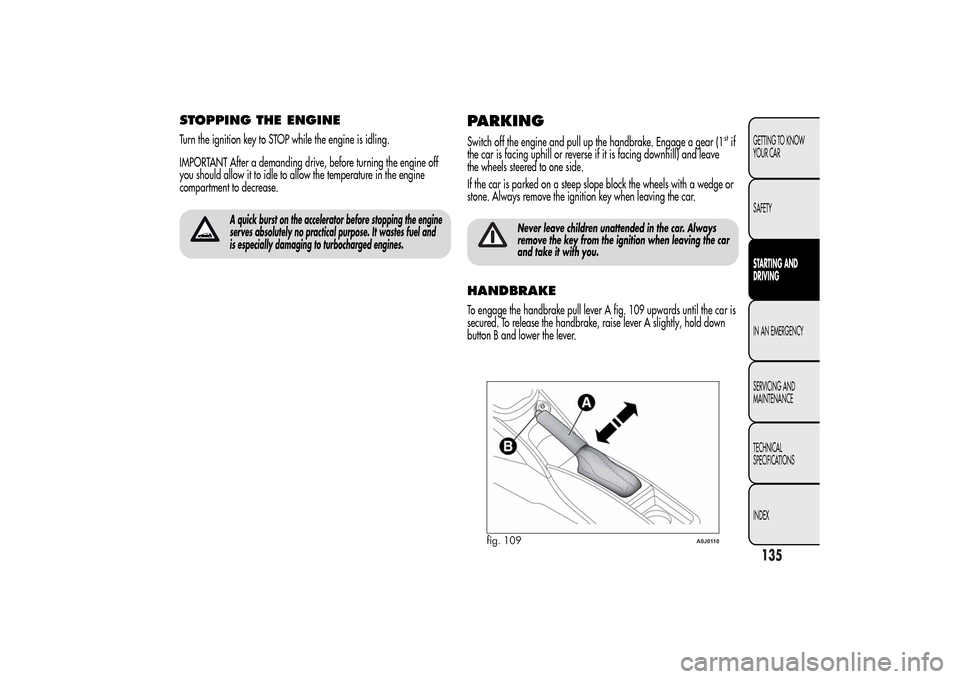
HANDBRAKETo engage the handbrake pull lever A fig. 109 upwards until the car is
secured. To release the handbrake, raise lever A slightly, hold down
button B and lower the lever.
fig. 109
A0J0110
135GETTING TO KNOW
YOUR CAR
SAFETYSTARTING AND
DRIVINGIN AN EMERGENCY
SERVICING AND
MAINTENANCE
TECHNICAL
SPECIFICATIONS
INDEX
Page 145 of 280
SNOW CHAINSThe use of snow chains should be in compliance with local regulations.
The snow chains may be applied only onto the front wheel tyres (drive
wheels).
Check the tension of the snow chains after the first few metres have
been driven.
Use reduced size snow chains: on all versions, for 195/55 R16" and
205/55 R16" size tyres use low-clearance snow chains with a
maximum projection beyond the tyre profile of 9 mm.
IMPORTANT The space-saver wheel cannot be fitted with snow chains.
If a front (drive) wheel is punctured and snow chains must be used,
you must remove a normal wheel from the rear and replace this one
with the space-saver wheel. In this way, with two normal drive wheels,
it is possible to use snow chains.
Keep your speed down when snow chains are fitted; do not
exceed 50 km/h. Avoid potholes, steps and pavements
and avoid driving long distances on roads not covered with
snow to avoid damaging the car and the roadbed.
STORING THE CARIf the car is to be left inactive for longer than a month, the following
precautions should be noted:
❒park the vehicle in a dry, covered and, if possible, ventilated area;
engage a gear and check that the handbrake is not engaged;
❒disconnect the negative battery terminal and check the battery
charge. Repeat this check once every three months during storage;
❒if you have not disconnected the battery, check the battery charge
every thirty days;
❒clean and protect the painted parts using protective wax;
❒clean and protect the shiny metal parts using special compounds
available commercially;
❒sprinkle talcum powder on the windscreen and rear window wiper
rubber blades and lift them off the glass;
❒slightly open the windows;
❒cover the car with a cloth or perforated plastic sheet. Do not use
compact plastic sheets which do not allow humidity to evaporate
from the surface of the car.
❒inflate tyres to +0.5 bar above the standard specified pressure and
check it at intervals;
❒do not drain the engine cooling system.
IMPORTANT After turning the ignition key to STOP, wait at least 1
minute before disconnecting the battery power supply.
141GETTING TO KNOW
YOUR CAR
SAFETYSTARTING AND
DRIVINGIN AN EMERGENCY
SERVICING AND
MAINTENANCE
TECHNICAL
SPECIFICATIONS
INDEX