warning AUDI A5 CABRIOLET 2010 Owners Manual
[x] Cancel search | Manufacturer: AUDI, Model Year: 2010, Model line: A5 CABRIOLET, Model: AUDI A5 CABRIOLET 2010Pages: 364, PDF Size: 86.51 MB
Page 235 of 364

Child Safety Ill
------------------=------
& WARNING (continued)
will strike parts of the vehicle interior. The child can be seriously injured or killed.
• Never install rearward-facing child safety seats or infant
carriers on the front passenger seat. A child will be seriously
injured and can be killed when the passenger airbag inflates .
• The inflating airbag will hit the child safety seat or infant
carrier with great force and will smash the child safety seat and
child against the backrest, center arm rest, door or roof. • Always install rearward-facing child safety seats or infant
carriers on the rear seat.
• Forward-facing child safety seats or infant carriers installed on
the front passenger's seat may interfere with the deployment of
the airbag and cause serious injury to the child.
• It is safer to install a forward-facing child safety seat on the
rear seat.
• Always read and heed all WARNINGS whenever using a child
restrained in a vehicle is being used:::::>
page 222. Special precau
tions apply when installing a child safety seat on the front
passenger seat:::::>
page 202, "Child restraints on the front seat -
some important things to know ".
& WARNING
Always take special precautions if you must install a forward or
rearward-facing child restraint on the front passenger's seat in
exceptional situations:
• Whenever a forward or rearward-facing child restraint is
installed on the front passenger seat, the PASSENGER AIR BAG
OFF light must come on and stay on whenever the ignition is
switched on.
• If the PASSENGER
AIR BAG OFF light does not come on and
stay on, perform the checks described:::::>
page 211, "Monitoring
the Advanced Airbag System".
Controls and equip ment Safety first Vehicle operation
& WARNING
(continued)
• Take the child restraint off the front passenger seat and install
it properly at one of the rear seat positions if the PASSENGER AIR
BAG OFF light does not stay on whenever the ignition is switched
on.
• Improper installation of child restraints can reduce their effec
tiveness or even prevent them from providing any protection.
• An improperly installed child restraint can interfere with the
airbag as it deploys and seriously injure or even kill the child.
• Always carefully follow the manufacturer's instructions
provided with the child safety seat or carrier.
• Never place additional items on the seat that can increase the
total weight registered by the weight-sensing mat and can cause
injury in a crash.
& WARNING
Forward-facing child restraints:
• Always make sure the forward-facing seat has been designed
and certified by its manufacturer for use on a front seat with a
passenger front and side airbag. • Never put the forward-facing child restraint up, against or very
near the instrument panel.
• Always move the passenger seat into its rearmost position in
the seat's fore and aft adjustment range, as far away from the
airbag as possible before installing the forward-facing child
restraint. The backrest must be adjusted to an upright position.
• Make sure that the PASSENGER AIR BAG OFF light comes on
and stays on all the time whenever the ignition is switched on.
& WARNING
Rearward-facing child restraints:
Vehicle care Do-it-yourself service Technical data
Page 236 of 364
ffl.___C_ h_ il_d _ S_a _ f_ e _ t--= y '------------------------------------------------
& WARNING (continued)
• A child in a rearward-facing child safety seat installed on the
front passenger seat will be seriously injured and can be killed if
the front airbag inflates -even with an Advanced Airbag System.
• The inflating airbag will hit the child safety seat or infant
carrier with great force and will smash the child safety seat and
child against the backrest, center arm rest, door or roof.
• Always be especially careful if you must install a rearward
facing child safety seat on the front passenger seat in exceptional
circumstances.
• A tight tether strap on a rearward-facing child restraint
attached to the front passenger seat can put too much pressure on
the weight-mat in the seat and register a heavier weight in the
Advanced Airbag System. The heavier weight registered can make
the system work as though an adult were on the seat and deploy the Advanced Airbag when it must be suppressed causing serious
or even fatal injury to the child.
• Make sure that the PASSENGER AIR BAG OFF light comes on
and stays on all the time whenever the ignition is switched on.
• If the PASSENGER AIR BAG OFF light does not come on and
stay on, immediately install the rearward-facing child safety seat
in a rear seating position and have the airbag system inspected by
your authorized Audi dealer. •
Activating the convertible locking retractor
Use the convertible locking retractor to secure a child
restraint.
Always heed the child safety seat manufacturer's instruc
tions when installing a child restraint in your vehicle. To acti
vate the convertible locking retractor:
- Place the child restraint on a seat, preferably on the rear
seat. -
Slowly pull the belt
all the way out.
- Route it around or through the child restraint belt path
=>& .
- Push the child safety seat down with your full weight to
get the safety belt really tight.
- Insert the belt tongue into the buckle for that seating
position.
- Guide the safety belt back into the retractor until the belt
lies flat and snug on the child safety seat.
- You should hear a "clicking" noise as the belt winds back
into the inertia reel. Test the convertible locking retractor
by pulling on the belt. You should no longer be able to pull
the belt out of the retractor. The convertible locking
retractor is now activated.
- Make sure that the red release button is facing away from
the child restraint so that it can be unbuckled quickly.
- Pull on the belt to make sure the safety belt is properly
tight and fastened so that the seat cannot move forward
or sideways more than one inch (2.5 cm).
& WARNING
Using the wrong child restraint or an improperly installed child
restraint can cause serious personal injury or death in a crash.
• Always make sure that the safety belt retractor is locked when
installing a child safety seat. An unlocked safety belt retractor
cannot hold the child safety seat in place during normal driving or
in a crash.
• Always buckle the child safety seat firmly in place even if a
child is not sitting in it. A loose child safety seat can fly around
during a sudden stop or in a crash.
Page 237 of 364

Child Safety ------------------------"'--l'ff'II
& WARNING (c on tinued )
• Always make sure the seat backrest to which the child re stra int
is installed is in an upright position and securely latched into place
and cannot fold forward . Otherwise , the seat back with the child
safety seat atta ched to it could fly forward in the e vent of an acci
dent or other emergency situation.
• Always read and heed all WARNINGS whenever u sing a child
restrained in a vehicle is being used~
page 222. Special precau
tions apply when installing a child safety seat on the front passenger seat~
page 202, "Child restra ints on the front seat -
s ome important things to know ".•
Deactivating the convertible locking
retractor
The convert ible locking retractor for child restraints will
be dea ctivat ed aut om at ic ally when the belt i s woun d all
th e way bac k in to t he retr actor .
- Press the re d but to n o n th e sa fety belt buckle. T he b elt
to ng ue wi ll pop out of th e buckle .
- Guide the safety belt all t he way back in to its stowed posi-
tion.
Always le t the safety bel t retract completely into i ts stowe d position .
Th e safety belt can now be used as an ord inary safe ty be lt withou t the
convertible locking ret ractor fo r ch ild rest raints .
If the convertib le locking retractor should be activated inadvertently,
t he s afety bel t m ust be unfastened and guide d com plete ly b ack i nto
its stowed position to deactivate this feature. If the convertible
lo ck ing r etr acto r is no t deact ivated, the sa fe ty belt w ill gradu ally
become t ighter and uncomfo rtable to wear .
Controls and equip
ment Safety first Vehicle operation
& WARNING
Improperly installed child safety seats increase the risk of serious
personal injury and death in a colli
sion.
• Never unfasten the safety belt to deactivate the convertible
locking retractor for child restraints while the vehicle i s moving.
You would not be restrained and could be seriously injured in an
accident.
• Always read and heed all WARNINGS whenever using a child
re strained in a vehicle i s being used~
page 222. Special precau
tions apply when installing a child safety seat on the front
pas senger seat~
page 202, "Child restraints on the front seat -
some important things to know ".•
LATCH Lower anchorages and
tethers for children
Child Restraint System anchors and how
are they related to child safety
To provide a simp le r and more practicable way to attac h the child
restra int on the ve hicle sea t, Fe d era l regu lations require spec ia l
lower anchorages in veh icles and devices on new child restra ints to
attach to t he vehicle anc ho rages.
Th e combin ation of the te ther anchorages and t he lower an chorages
is now generally called the
LATCH system for " Lower Anchorages and
T ether s fo r Chi ldren. "
Forward-fac ing ch ild restra ints manufactured after September 1,
1 999, are required by U .S . federa l reg ulations to comp ly with new
child head movement per formanc e requi reme nts . These new perfor
mance requirements ma ke a tether necessary on most new child
sea ts.
Vehicle care Do-it-yourself service Technical data
Page 238 of 364
lffll,___C_ h_ il_d _ S_a _ f_ e _ t-= y ;....._ ____________________________________________ _
Installing a child restraint that requires a top tether w ithout one can
ser iously impair the pe rformance of the ch ild res tra in t and i ts abili ty
to protect the c hild in a collision . Instal ling a child restra int that
requires a top tether w ithout t he top tether may be a violation of
state law.
Chi ld restraint manufacturers o ffer LATCH lower anchorages on their
c hild se ats with hoo k-on or push-on connectors att ache d to ad ju st
able straps.
In ad dit ion to the LA TCH lowe r anchorages, these ch ild restra int
systems usually require the use o f tether st raps to help keep the chi ld
restra int fi rm ly in place.
Tether anchorages
Yo ur Audi Cabr io le t is not equippe d w it h a LA TCH sys tem . It is not
equipped with top tether anchorages. It is equ ipped w ith lower
anchora ges on ly .
Yo ur Cabr iolet is eq uipped w ith the A ctive Rollove r Pro te ct io n
System, which is integ rated into the back rest of the rear seat. The
Ac tive Rollover Prote ction Sy st em dep loy s upward s to hel p pr ovide
add itiona l protection in certa in coll is ions and crash sit uat ions. For
t his re a son, you r ve hicl e is
not equipped wi th top te ther an chor ages
for use with forward-fac ing ch ild restraints .
In Canada, provincial law requires that fo rwa rd -facing child
restra ints use bot h top tethe r anc horages and lower a ncho rages;
therefore, it is
not possible to install a forwar d-fac ing child rest raint
in thi s ve hicle.
In the United States , child restraint installation must co nform with
t he ch ild rest rain t manufactu rer's instr uctions. Chec k the inst ru c
tions that come with the c hild restraint or contact the manufacturer
to dete rmine if the c hild rest raint may be insta lled facing fo rwa rd
without secu ring the top tether st rap .
& WARNING
Improper installation of child restraints will increase the risk of
injury and death in a cra sh .
• Always follow the instructions pro vided by the manufacturer
of the child restraint you intend to install in your vehicle.
• Improper use of child restraint LATCH lower anchorage points
c an lead to injury in a colli sion . The LATCH lower anchorage point s
are designed to withstand only those loads imposed by correctly
fitted child restraints .
• Never mount two child restraint systems on one LATCH lower
anchorage point .
• Never secure or attach any luggage or other item to the LATCH
lower anchorages.
[]] Tips
In other countries, the term "IS O FIX " is used to descr ibe the lower
anchorages. •
Location
Fig. 209 Schemati c
overv iew : LATCH
an chorage p oint loca
tions
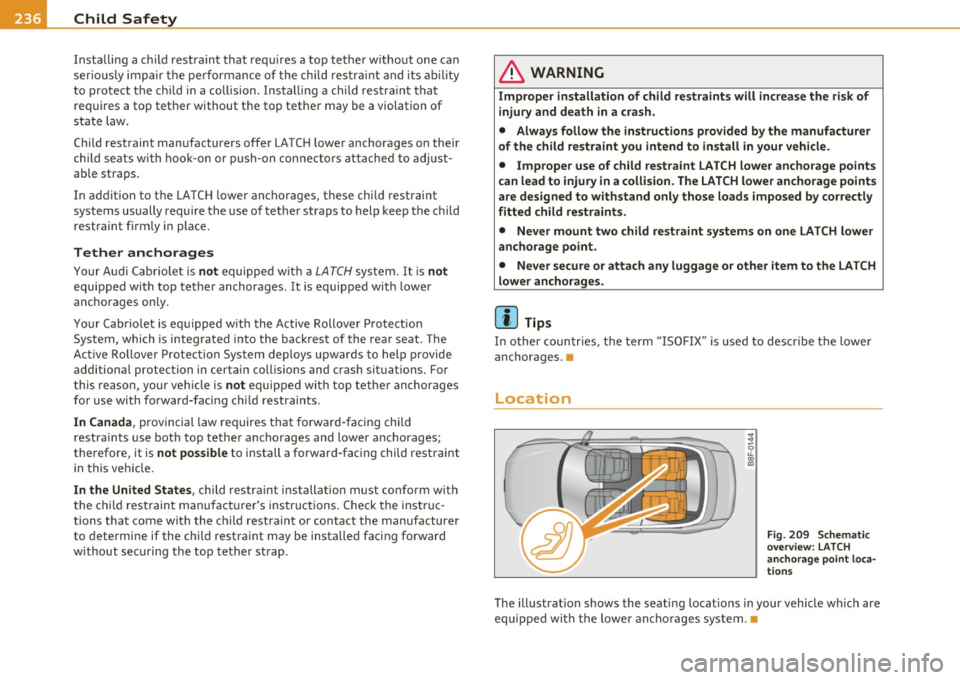
T he ill ustrat ion shows the seati ng locat ions in your vehicle wh ich are
equi pped wi th the lowe r anchora ges sys te m .•
Page 239 of 364

Description
The lower anchorage positions are marked for quick
locating.
Fig. 210 Rear seat
backs: locator buttons
for lower anchorages
Fig. 211 Rear seats:
lower anchorage
bracket locations
Attachment locator markers for lower anchorages
Circular locator buttons on the rear seatback indicate the lower
anchorage locations on the rear seating positions~ fig . 210.
Lower anchorages
The lower anchorage attachment points are located between the rear
seatback and rear seat cushion~ fig . 211.
Lower anchorages secure the child restraint in the seat without using
the vehicle's safety be lts. Anchorages provide a secure and easy-to-
Safety first Vehicle OP-eration
Child Safety
use attachment and m inimize the poss ibility of improper child
restra int ins tallat ion.
All child restra ints man ufactured after September 1, 2002, must
have lower anchorage attachments for the
LATCH system .
Remember that the lowe r anchorage points are only intended for
installation and attachment of child restraints specifically certified
for use wi th
LATCH lower anchorages . Child restraints that are not
equipped with the Lower anchorage attachments can still be installed
in compliance with the child restraint man ufact urer's instructions on
using vehicle safety be lts.
& WARNING
Improper use of LATCH lower anchorages can cause serious
personal injury in an accident.
• Always carefully follow the child restraints manufacturer 's
instructions for proper installation of the child restraint and
proper use of the lower anchorages or safety belts in your vehicle.
• Never secure or attach any luggage or other items to the
LATCH
lower anchorages.
• Always read and heed the important information about child
restraints in this chapter and WARNINGS~
page 222, "Child
Safety". •
Vehicle care Do-it-yourselt service iTechnical data
Page 240 of 364
lffll.___C_ h_ il_d _ S_a _ f_ e _ t--= y '------------------------------------------------
Installing a child restraint with LATCH
lower anchorages
Whenever you install a child restraint always follow the
child restraint manufacturer's instructions.
Mounting
,._
"' 0 0 tL
18
Fig. 212 Lower
anchorages: proper
mounting
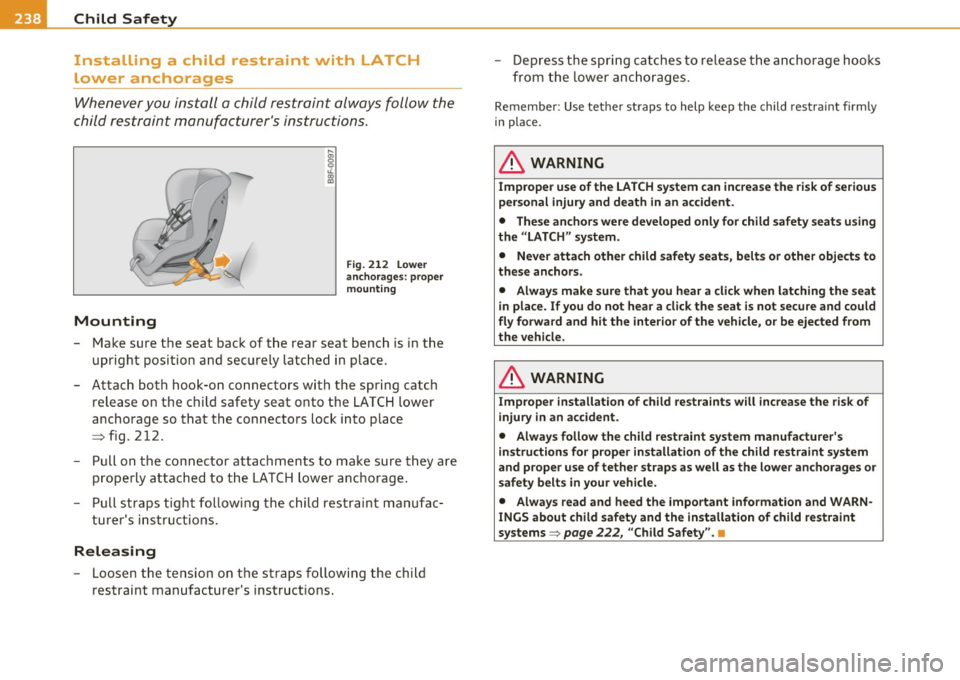
- Make sure the seat back of the rear seat bench is in the
upright position and securely latched in place.
- Attach both hook-on connectors with the spring catch release on the child safety seat onto the LATCH lower
anchorage so that the connectors lock into place
~ fig . 212.
- Pull on the connector attachments to make sure they are
properly attached to the LATCH lower anchorage.
- Pull straps tight following the child restraint manufac
turer's instructions.
Releasing
- Loosen the tension on the straps following the child
restraint manufacturer's instructions. -
Depress the spring catches to release the anchorage hooks
from the lower anchorages.
Remember: Use tether straps to help keep the child restraint firmly
in place.
& WARNING
Improper use of the LATCH system can increase the risk of serious
personal injury and death in an accident.
• These anchors were developed only for child safety seats using
the "LATCH" system.
• Never attach other child safety seats, belts or other objects to
these anchors.
• Always make sure that you hear a click when latching the seat
in place. If you do not hear a click the seat is not secure and could
fly forward and hit the interior of the vehicle, or be ejected from
the vehicle.
& WARNING
Improper installation of child restraints will increase the risk of
injury in an accident.
• Always follow the child restraint system manufacturer's
instructions for proper installation of the child restraint system
and proper use of tether straps as well as the lower anchorages or
safety belts in your vehicle.
• Always read and heed the important information and WARN
INGS about child safety and the installation of child restraint
systems
=> page 222, "Child Safety". •
Page 241 of 364

___________________________________________ C_ h_il _d _ S_a _f _e _t ~ y __ _
Using tether straps on rearward -facing
child restraints
Currently, few rearward-facing child rest raint systems come w ith a
t e ther. Please re ad and heed the c hild restrain t system manu fac
t u rer 's instructions car efully to determine how to prope rly insta ll the
t ether.
& WARNING
A child in a rearward-facing child safety seat installed on the front
passenger seat will be seriously injured and can be killed if the
front airbag inflates - even with an Advanced Airbag System.
• The inflating airbag will hit the child safety seat or infant
c arrier with great force and will smash the child safety seat and
child against the backrest, center armrest , or door .
• A tight tether or other strap on a rearward -facing child
restraint attached to the front passenger seat can put too much
pressure on the weight-mat in the seat and register a heavier
weight in the Advanced Airbag System. The heavier weight regi s
tered can make the system work as though an adult were on the seat and deploy the Advanced A irbag when it must be suppressed
c ausing serious or even fatal injury to the child .
• If you must install a rearward facing child safety seat on the
front passenger seat becau se of exceptional circum stances and
the PASSENGER AIR BAG OFF light does not come on and stay on ,
immediately install the rearward-facing child safety seat in a rear
seating position and have the airbag system inspected by your
authorized Audi dealer. •
Controls and equip ment Safety first Vehicle operation
Additional Information
Sources of information about child
restraints and their use
There are a number of sou rces of additional informat ion abo ut child
restr aint sele ct io n, inst all ati on and use:
NH TSA adv ises t hat t he best ch ild safety seat is the one that f its your
child and fits in yo ur vehicle, a nd that yo u wi ll use cor rectly and
co nsist en tly .
Try before you buy!
U.S National Highway Traffic Safety Administration
T el. : 1-888 -327 -4236 (T TY : 1-800 -424-9153)
www .nhtsa .gov
National SAFE KIDS Campaign
Te l.: (202) 662-0600
www. safe kids .o rg
Safety BeltSafe U .S.A
T el. : (800) 745 -SAFE ( English)
Te l.: (800) 747-SA NO (Span ish)
www .carseat .org
Transport Canada Information Centre
Te l.: 1 (800) 333-0371 or call 1 (613) 998 -8616 if you are in the
O tt awa area
www .tc .gc.ca/ roadsafety
Audi Customer CARE
Te l.: (800) 822-2834 •
Vehicle care Do-it-yourself service Technical data
Page 243 of 364

Intelligent technology
--------------------------------------------------' "---.L==--
The system operates across the entire speed range in combination
with the ABS system. If the Anti-Lock Brake System (ABS) malfunc
tions, the ESP will also shut down.
How the system works
The Anti-Lock Brake System (ABS), Electronic Differential Lock (EDL)
and the Anti-Slip Regulation System (ASR) are integ rated in the elec
tronic stabilization program . In addition to the data provided by
these functions, the ESP control unit requires additional measure
ment data provided by high performance sensors . The rotational
speed of the vehicle about its vertical axis, vehicle acceleration in the
fore-and-aft and lateral directions, the brake pressure, and the
steering angle are all measured .
Th e direction in which the driver wishes to travel is determined with
the aid of the steering angle and vehicle speed and is con tinually
compared with the actual behavior of the vehicle. If the two do not
match, for example, when the vehicle starts hydroplaning on a wet
road, ESP will automatically brake the appropriate whee l to correct
the problem.
The vehicle is then stabilized by the forces acting on the whee l during
brak ing.
If the vehicle is oversteering (the vehicle turns too sharply
and the rear wheels slide toward the outside of a curve), the brakes
are mainly applied on the wheel that is on the outside of the curve. In
the case of a vehicle that is
understeering (the vehicle does not turn
sharply enough and pushes out of a curve), the brakes are applied as
needed on the wheel that is on the inside of the curve or additionally
on the other wheels. An acoustic signal indicates when ESP brake
application cuts in=> &.
The system operates across the entire speed range in combination
with the ABS system =>
page 245. If the Anti- Lock Brake System
(ABS) malfunctions, the ESP will be out of action as well.
Activating
When you turn on the engine, ESP will automatically be activated and
w ill perform a self-test. As soon as the test is comp leted, the system
is in normal operating mode.
Controls and equip
ment Safety first Vehicle operation
You can activate a
deactivated ESP or deactivated ESP/ ASR if required
by pressing the =>
page 240, fig. 214 => page 240, fig. 213 button.
When they are activated, the message
ESP/ ASR on appears briefly
in the display.
Deactivating
The ESP should normally be activated all the time. If necessary, you
can deactivate Anti-Slip Regulation (ASR) or the Electron ic Stabiliza
tion Program (ESP) by press ing the button =>
page 240, fig. 214 .
• Deactivating ASR: Tap the button . In certain exceptional s itua
t ions (e.g. driving with tire chains), the Anti-Slip Regu lation (ASR) can
be deact ivated =>
page 242. The message ASR off appears in the
display as we ll.
• Deactivating ESP/ASR Press the button for more than 3 seconds .
With the ESP/ASR deactivated, the ESP check light comes on, see
=>
page 14. The message ESP switched off appea rs in the display as
well.
& WARNING
The Electronic Stabilization Program is nevertheless subject to the
laws of physics. It is particularly important to pay attention to
this fact on wet and slippery roads. It is therefore important that
you always adapt your driving to the condition of the road and
traffic conditions . Do not allow the increased safety provided by
the Electronic Stabilization Program system to lull you into
accepting additional safety risks.
u
Vehicle care Do-it-yourself service Technical data
Page 244 of 364

Intelligent t echnology
---------------------------------------
Electronic differential lock (EDL)
The elec tronic differen tial lock monitors the rotational
speed of the drive wheels.
G en era l not es
The electronic differentia l lock (EDL) helps the ca r to sta rt moving,
accelerate and climb a gradient on surfaces provid ing poor or almost
no grip . W ithout ED L, this would be d iff icu lt, if not impossible.
How the sy stem works
The EDL operates automatically. It mo nitors the rota tional speed of
wheels with the help of the ABS sensors=>
page 245. If a not iceab le
slip is detected at the wheels (e.g. on slippery g round on one side),
the spinn ing wheels are braked and power is transferred to the other
wheels . This is done up to a speed of about 60 mph (100 km/h).
No ises from the brake system signal that wheel sp in is being
controlled.
Driv ing off
When d riving off, always be s ure to keep road conditions in mind as
you accelerate. If one drive wheel spins because it is on a surface with
less grip, apply
plenty of throttle until the car starts to move.
O verheating of bra kes
To prevent the disc b rake of the bra ked wheel from ove rhea ting if
subjected to excessive loads on this wheel, the EDL cuts out tempo
ra rily. The vehicle remains operat io nal and be haves in the same way
as a veh icle without EDL.
As soon as the brake has coo led down, EDL switches on again auto
matically.
Electronic limited slip differential
In vehicles w ith front wheel drive *, an e lectron ic lim ited slip d ifferen
tial engages when driving on curves . The brakes are applied spec ifi
cally to the front wheel that is on the inside of the curve. T his m ini
m izes sliding on the front wheels and enables precise and neutral dr
iv ing t hrouge curves. The electronic lim ited slip differentia l does
no t engage whe n driving in we t cond it io ns or snow.
& WARNING
• Wh en acc elerating on slipp ery s urface s, such a s on ice or snow,
always be careful when depre ssing the accele rator pedal. Even
with the EDL and the electroni c limited slip differential working,
the dr ive wh eels can spin and reduce you r ability to control your
c ar . -Ri sk of cra sh!
• The increased safet y afforded b y EDL and the electronic l imited
slip differ ential d oes not mean th at you can take safety risks .
Alw ay s adapt your d riving st yle to the road c onditions and traffi c
si tuation.
[ i ] Tips
If a fa ult occurs in the ABS, the EDL is also not funct ioning. This is
ind icated by the ABS warn ing light=>
page 16 . •
Anti-Slip Regulation System (ASR)
The Anti-Slip Regulation System prevents the driven
wheels from spinning when the car is a ccelerating.
General notes
T he Anti-Slip Regu lation System (ASR) is in tegrated in the electronic
stabilization program (ESP) . When the veh icle starts up and acceler
a tes, the wheels are preven ted from sp inning by adjust ing the engine
power to match the amount of grip ava ilable from the road surface.
How the system works
ASR performs automatica lly, i.e. without the driver's intervent ion.
With the a id o f the ABS sensors=>
page 245, ASR moni tors the speed
of the driven wheels. If the wheels start to spin, engine torque is
reduced automatically unti l the tires find enough grip to lock onto
the road s urface. The system is active across the entire speed range . .,
Page 245 of 364

Intelligent technology
--------------------------------------------------' "---.L==--
The ASR works in conjunction with the ABS. If a malfunction should
occur in the ABS, the ASR w ill also be out of action.
Activating
The ESP is automatically activated when the engine is started and it
performs a self-test. You can activate a deactivated ASR if required by
pressing the=>
page 240, fig. 214 button. When it is activated, the
message
ESP/ASR on appears briefly in the display .
Deactivating
You can deactivate the ASR if required by pressing the button (for less
than 3 seconds) =>
page 240, fig. 214. With the ASR deactivated , the
ESP check light comes on, see=>
page 14 . The message ASR off
appears in the display as well. The ASR can be deactivated at any
speed .
The ASR should normally be activated a ll the time. Only in certain
exceptional situations when some slip is desirable does it make sense
to deactivate the ASR. Examples:
• when driving with tire chains
• when driving in deep snow or on loose ground and
• when rocking the vehicle loose after it has become stuck .
When the abnormal situation is over, you should activate the ASR again.
& WARNING
The increased safety afforded by ASR does not mean that you can
take safety risks. Always adapt your driving style to the road
conditions and traffic situation.
[I] Tips
To ensu re that the ASR works properly, all four whee ls must be fitted
with ident ical t ires. Any differences in rolling radius of the t ires can
cause the system to reduce eng ine power when this is not desired.
See also=>
page 307, "New tires and replacing tires and wheels". •
Safety first
Braking
General information
What affects braking efficiency?
Operating conditions and driving habits
The brakes on today's automobiles are still subject to wear,
depending la rgely on ope rating conditions and driving habits=>& .
On vehicles that are either driven mostly in stop-and-go city traffic or
are driven hard, the brake pads should be checked by your authorized
Audi dealer more often than specified in the
Warranty & Mainte
nance booklet.
Failure to have your brake pads inspected can result
in reduced brake performance .
On steep slopes, you should use the braking effect of the engine. This
way, you prevent unnecessary wear on the brake system. If you must
use your brakes, do not hold the brakes down continuously. Pump the
brakes at intervals.
Noises may occur when brak ing depending on the speed, braking
force and outside cond itions such as temperatu re and humid ity.
Moisture or road salt
If you are driving faster than 31 mph (50 km/h) and the windshield
wipers are on, the brake pads will briefly touch the brake discs in
regula r interva ls so as to improve reaction time when braking on wet
surfaces. You, the driver, will not not ice anything.
Under certain condit ions, for example, when driving through water or
very heavy rai n, or even after washing your vehicle, the braking effect
can be reduced due to moisture (or in free zing conditions ice) on the
bra ke pads. A few careful brake applications should dry off the brake
pads or remove any ice coatings.
Th e effectiveness of the brakes can be reduced when the vehicle is
dr iven on a salt-covered road and the brakes are not used. H ere too,
you should clean off accumu lated salt coating from brake discs and
pads with a few careful applications of the brake=>&,.
Vehicle care Technical data