warning AUDI A5 CABRIOLET 2010 Owners Manual
[x] Cancel search | Manufacturer: AUDI, Model Year: 2010, Model line: A5 CABRIOLET, Model: AUDI A5 CABRIOLET 2010Pages: 364, PDF Size: 86.51 MB
Page 273 of 364

Cleaning and protection -
---------------=---------=----
Cleaning spots
- Remove fresh water-based spots (such as coffee, tea,
juices, blood) with a n abso rbe nt cloth or paper towe l.
- Remove fresh
grease or oil-based spots (such as butter,
mayonnaise, chocolate) w ith an absorbent cloth or paper
towel, or use the cleaner from t he leat her care kit if the
spot has not yet penet rated into the s urface of the
leather.
- Use an oil/grease dissolv ing spray, if
oil/grease spots
have dried on .
-Remove specific kinds of spots (ballpo int pe n, fe lt marker,
fingernai l polish , water -based pa int , shoe polish, etc .)
with a spot remover speci fica lly formu lated for leat her .
Leather care
- Ev ery half ye ar us e an a pproved leath er car e product
(avai lab le fro m yo ur authori zed Audi d eale r) to ca re for
the le ather .
- A pply the produc t very spa rin gly .
- Wipe it o ff with a da mp cloth.
If you have any quest ions about cleaning and car ing for the leather in
yo ur vehi cle, it i s be st t o co ntac t you r author ized Aud i dealer, who w ill
be glad to help you and tell you about our fu ll range of leather care
prod ucts, s uch as:
• Leather cleaning and ca re k it
• Creams to ca re for colored leat her
• Spot removers for ballpoint pens, s hoe polish, etc.
• O il/gre ase di sso lv in g sp ray
• N ew and upcoming prod ucts.
Safety first
& WARNING
Always read and heed all WARNINGS and other information
:=> page 260 .
0 Note
• Never use chemical so lvents (e.g. lighter fluid, turpentine), waxes,
shoe po lish or similar products on the leather surfaces in your Audi.
• T o avo id da mage, have st ubbor n sta in s removed by a co mmerci al
clean ing specialist .•
A pp lies to v ehicle s: w it h Alcan ta ra upho lst ery
Cleaning Alcantara ® (synthetic suede)
Removing dust and dirt
- Moiste n a c loth, squ eez e out e xce ss wat er and wipe down
th e sea t surfaces .
Removing stains
-Mo iste n a clo th with luk ewarm wa ter or wi th dilut ed ethyl
(rubbing) alcohol.
- Dab at the stai n. Sta rt a t the outside and wor k in wards.
- Once the sta in is no lo nger vis ible , use a soft dry clot h or
t iss ue to soak up t he m oisture .
Do not use leather cleaning products on A lcantara .
Yo u m ay use a suit ab le sh am poo for removing dus t and d irt.
Dust and gr it in the pores and seams ca n scratch a nd damage the
s u rface . If the car is left s tanding in the s un fo r long periods, the
Alcanta ra sho uld b e prot ected aga inst direct su nlight to preve nt it
from fading. Slight co lor var iat ions will deve lop in no rma l use and are
not a n ind icatio n of material deterioration .
~
Vehicle care Technical data
Page 274 of 364
-Cleaning and protection pn, _____________________ _
0 Note
• Never use chemical so lvents (e.g. lig hte r fluid, turpentine), waxes,
shoe po lish or simi lar p roducts on Alca ntara ® surfaces .
• To avo id damage, have stubborn stains removed by a commerc ia l
cleaning specialist .
• Do not use brushes, stiff sponges or sim ila rly abrasive cleaning
aids. •
Safety belts
Only well-maintain ed safety belts work reliably when
needed .
-Keep be lts clea n.
- For cleani ng, use a mi ld soap and wa ter solution. Let be lts
d ry thoroug hly and away fro m dir ect sun light.
- Do not allow in ertia re el s afety b elts to ret ra ct bef ore t hey
are comp le tel y dry .
- C heck the condi tion of y our safety bel ts
regularly .
Heavily soiled safety belts may no t re tract p roper ly .
& WARNING
Damaged safety belts can break in a crash.
• Anything that might damage your safety belts could mean
that you and your passengers would not be adequately protected
in an a ccident.
• Safety belt performance depends on correct installation. Never
remove belts from the vehicle to clean them.
• Do not use chemical cleaning agents , bleach or dyes. They have
corro sive properties which weaken the webbing .
& WARNING (c on tinued )
• When cleaning your safety belts , inspect them for damage. If
you discover damage , see your authorized Audi d ealer .
• Always read and heed all WARNINGS and other info rmation
=:> page 260 . •
Engine compartment
B e especi ally care ful w hen cleaning the engine comp art
men t.
Always switch off the ignition before cleaning the engine=>& .
Plenum panel
Remove leaves from the plenum panel in front of the windsh ield
un der th e eng ine hoo d. This p revents the wate r drain holes from
becom ing b locked, and it prevents debris from entering the ve hicle
inter io r thr ough the heat ing and ventila tion ducts.
Corrosion protection
Th e engine compartment and tran smission have been cor rosion
protected at the factory.
Goo d an ti- cor ros ion treatmen t is very impo rtan t, pa rtic ula rly in the
w inte r. If the vehicle is frequently driven on sa lt treated roads, t he
entire eng ine compa rtment and plenum pane l sho uld be thoroug hly
cleaned at the end of w inter and retreated to prevent sa lt damage . At
the same time, the underside of the vehicle should be washed as we ll.
If the eng ine co m par tment is clea ned at any time wi th grease
removing solutions
2l, or if you have the engine washed, the anti
c o rrosion treatment is a lmost always remove d as we ll.
It is the refore
essential to have a long-last ing corrosion protect io n reapplied to all
s u rfaces, seams, joints and components in the engine compartmen t. ~
2
l Use on ly the co rrect clean ing so lut ions . Neve r use gaso line or d iese l fuel.
Page 275 of 364

Cleaning and protection Ill
---------------=---------=----
& WARNING
Be aware: The engine compartment of any motor vehicle is a
potentially hazardous area.
• Before working in the engine compartment, be sure to read the
information =:>
page 272.
• Before reaching into the front plenum panel, always remove
the ignition key. Otherwise, the windshield wiper system could unintentionally be switched on, possibly causing personal injury
from the moving wiper linkage.
• Never reach into the area around or touch the radiator fan. The
auxiliary fan is temperature controlled and can switch on suddenly
- even when the ignition is off.
• Do not wash, wax or dry the engine with the engine running.
Moving or hot parts could injure you.
• Do not clean the underside of the chassis, fenders, wheel
covers, or other hard to reach parts without protecting your hands
and arms. You may cut yourself on sharp-edged metal parts.
• Always read and heed all WARNINGS and other information
=:>
page 260. •
Safety first Vehicle care Technical data
Page 278 of 364
Fuel supply and filling your fuel tank
In order to fill the tank properly while protecting the environment,
please follow this refueling procedure carefully.
& WARNING
Under normal operating conditions, never carry additional fuel
containers in your car. Gas canisters and other containers used to
transport fuel can be dangerous. Such containers, full or empty,
may leak and could cause a fire in a collision. If you must transport
fuel to use for your lawn mower, snow blower, etc., be very careful
and always observe local and state laws regarding the use, trans
portation and storage of such fuel containers. Make certain the
container meets industry standards (ANSI/ASTM F852 -86).
0 Note
Never drive your vehicle until the fuel tank is completely empty . The
irregular supply of fuel can cause misfiring. Gasoline could enter the
exhaust system and damage the catalytic converter. •
Refuelling
-
Fig. 215 Right rear
veh icle side: Opening
the fuel filler flap Fig
. 216 Fuel filler
flap with attached fuel cap
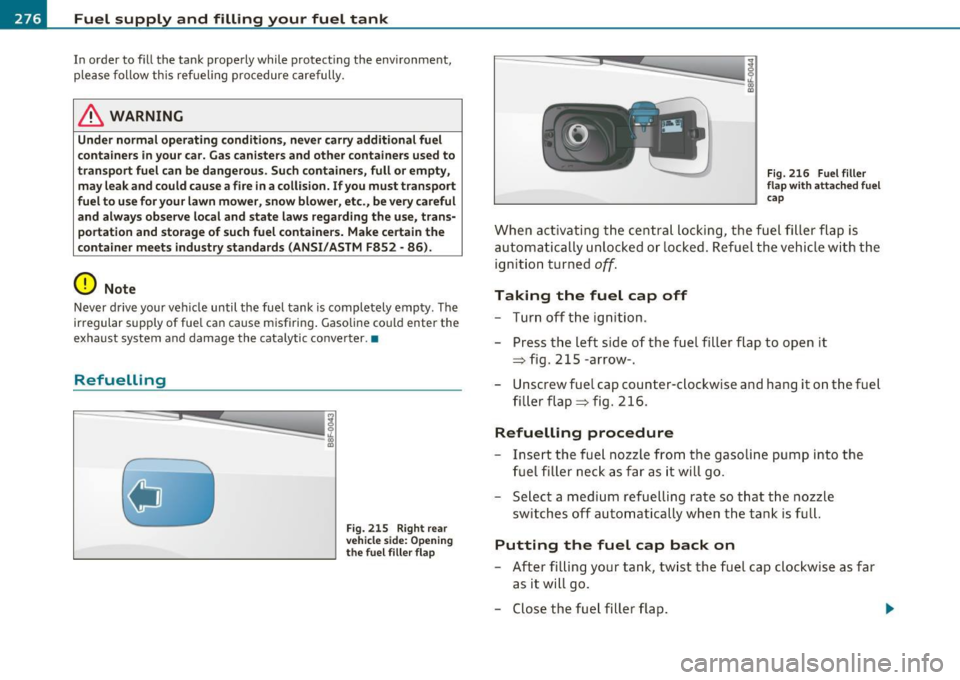
When activating the central locking, the fuel filler flap is
automatically unlocked or locked. Refuel the vehicle with the
ignition turned
off.
Taking the fuel cap off
- Turn off the ignition.
- Press the left side of the fuel filler flap to open it
~ fig. 215 -arrow-.
- Unscr ew fuel cap counter-clockwise and hang it on the fuel
filler flap~ fig. 216.
Refuelling procedure
- Ins ert the fuel nozzle from the gasoline pump into the
fuel filler neck as far as it will go.
- Select a medium refuelling rate so that the nozzle switches off automatically when the tank is full.
Putting the fuel cap back on
- After filling your tank, twist the fuel cap clockwise as far
as it will go.
- Close the fuel filler flap. .,
Page 279 of 364

__________________________________ F_ u_ e _ l_s _u ..., P....:- P .... LY =-- a_ n_ d_ f_ i_ l _li _n _,g:...:::; y_o_ u_ r_f_ u _ e_ l_ ta _ n_k __ ,n
To avoid fuel s pillin g or evapo ra ti ng from t he f uel tank a lways clos e
f ue l cap pr oper ly and compl etely.
& WARNING
Improper refueling or handling of fuel can cause fire, explosion
and severe burns.
• Fuel is highly flammable and can cause severe burns and other
injuries.
• Failure to shut the engine off while refueling and/or to insert
the pump nozzle fully into the fuel filler neck could cause fuel to
spray out of filler neck or to overflow. Fuel spray and overflowing
fuel can cause a fire.
• Never use a cellular telephone while refueling. The electromag
netic radiation can cause sparks that can ignite fuel vapors and
cause a fire.
• Never get back into your vehicle while refueling. If in excep
tional circumstances you must get back in your vehicle while refu
eling, make certain that you close the door and touch metal to
discharge static electr icity before touching the filler nozzle again .
Static electricity can cause sparks that can ignite fuel vapors
released during refueling.
• Never smoke o r have an open flame anywhere in or near your
vehicle when refueling or filling a portable fuel container.
• For your safety , we strongly recommend that you do not travel
with a portable fuel container in your vehicle. The container, full or empty may leak and could cause a fire, especially in a crash.
• If, under except ional circumstances, you must transport a
portable fuel container , please obser ve the following:
- Never fill a portable fuel container while it is anywhere in or
on the vehicle (for example, in the luggage compartment, or
on the trunk ). Static electricity can build up while filling and
can ignite fuel vapors causing a fire.
- Always place a portable fuel container on the ground before
filling.
Safety first
& WARNING (co ntinued )
-Alw ays keep the filler nozzle completely inside the portable
container before and during filling.
- If filling a portable container made of metal, the filler nozzle
must always be in contact with the container . Th is will help
prevent static electricity from discharging and cause a fire.
- Never spill fuel inside the veh icle or luggage compartment .
Fuel vapors are highly flammable.
- Always observe local and state/provincial laws regarding the
use, storage and transportation of fuel containers.
- Make certain the fuel containe r meets industry standards
(ANSI/ ASTM F8S2-86).
0 Note
If any f uel has spilled onto the ca r, it should be remove d immed iate ly
to prevent damage to the paint.
for t he firs t time, the tan k is full. Do no t try to ad d mo re fuel because
fue l may spill ou t. In addi tion, the ex pansion space in the fuel tank
will be fi lled - causing the fue l to overf low w hen it becomes warm and
poll ute the enviro nmen t.
(I] Tips
• Runn ing your engi ne while re fuelling may c ause vapors to es cape
or even cause f uel to spill out of t he tank. This would then shut off the
fue l no zzle before the tank is full.
• Do not ref ue l your veh icle with t he ignit io n turned on . T he fuel
gauge may o therwise no t ind ica te t he correct f ue l level af ter refuel-
ling . .,_
Vehicle care Technical data
Page 281 of 364

___________________________________________ C_ h _ e_c _k _ i_n -=g .._ a_n _ d_ f_i _ll _i _ n -=g '-- ........
Checking and filling
Engine hood
Releasing the engine hood
The engine hood is released from inside the vehicle.
- Open the driver's door.
Fig. 218 Driver's side
footwell : engine hood
release lever
- Pull the release lever on the left under the instrument
panel ::::, fig . 218 in the direction of the arrow.
The hood pops up slightly under spring pressure. •
Vehicle OP-eration
Opening the engine hood
Fig. 219 Release lever
under the engine hood
Before opening the engine hood, make sure that the wind
shield wipers are flat against the windshield. Otherwise, they
could damage the paint on the hood.
Pull up on the release under the hood::::, fig. 219 . This
releases the catch.
- Open the hood all the way::::,& .
& WARNING
Hot engine coolant can burn you.
• To reduce the risk of being burned, never open the hood if you
see or hear steam or coolant escaping from the engine compart
ment. Wait until no steam or coolant can be seen or heard before
carefully opening the hood. •
Vehicle care Do-it-yourselt service iTechnical data
Page 282 of 364
-Checking and filling
-------=------=---------------------------------------------------
Closing the engine hood
-Pull the hood down until the pressure from the struts is
reduced.
- Let the hood
drop down and latch in place . Do not try to
push it shut;
it may fail to engage=> &.
& WARNING
A hood that is not completely latched could fly up and block your
view while driving.
• When you close the engine hood, check it to make sure the
safety catch has properly engaged. The hood should be flush with
the surrounding vehicle body parts.
• If you notice while driving that the hood is not secured prop
erly, stop at once and close it. •
Working in the engine compartment
Be especially careful whenever you work in the engine
compartment.
Whenever you must perform any work in the engine compartment,
for example checking and filling different fluids, there is a risk of
injury, burns and accidents. To prevent personal injury always
observe the following WARNINGS. The engine compartment of any
vehicle is a hazardous area
=> & .
& WARNING
To help avoid injury, before you check anything under the hood :
• Turn off the engine.
• Remove the ignition key.
• Apply the parking brake.
& WARNING (continued)
• Move selector lever of automatic transmission to "P" (Park).
• Always let the engine cool down. Hot components will burn
skin on contact.
• To reduce the risk of being burned, never open the hood if you
see or hear steam or coolant escaping from the engine compart
ment. Wait until no steam or coolant can be seen or heard before
carefully opening the hood.
• Keep children away from the engine compartment.
• Never spill fluids on hot engine components. They can cause a
fire.
• Never touch the radiator fan. The auxiliary electric fan is
temperature controlled and can switch on suddenly.
• Never open the coolant reservoir cap when the engine is still
warm. The coolant system is pressurized and hot coolant could
spray out.
• Protect your face, hands and arm from steam or hot engine
coolant by placing a thick rag over the cap when you open the
coolant reservoir.
• If work on the fuel system or the electrical system is necessary:
-Always disconnect the battery.
- Never smoke or work near heaters or open flames. Fluids in
the engine compartment could start a fire.
- Keep an approved fire extinguisher immediately available.
• To avoid electrical shock and personal injury while the engine is
running or being started, never touch: -Ignition cables
- Other components of the high voltage electronic ignition system.
• If you must perform a check or repair with the engine running: -First, fully apply the parking brake, move selector lever of
automatic transmission to "P" (Park). ..,
Page 283 of 364
_____________________________________________ C_h _ e_ c_ k_in --= g'-- a_n _d_ f_i _ll _i_n -=g ::;__ ____.1111
& WARNING (co ntinued )
-Alway s use extreme caution to prevent clothing , jewelry , or
long hair from getting caught in the radiator fan, V-belts or
other moving parts, or from contacting hot parts. Tie back hair
before start ing , and do not wear clothing that will hang or
d roop into the engine.
• Minimize expo sure to emis sion and chemical hazards~& .
& WARNING
California Proposition 65 Warning:
• Engine exhaust, some of it s constituents, and certain vehicle
components contain or emit chemicals known to the State of Cali
fornia to cause can cer and birth defects and reproductive harm . In
addition, certain fluids contained in vehicles and ce rtain products
of component wear contain or emit chemicals known to the State
of California to cause cancer and birth defects or othe r reproduc
tive harm.
• Battery posts, terminals and related accessories contain lead
and lead compounds, chemicals known to the State of California
to cause cancer and reproductive harms . Wash hands after
handling.
0 Note
When adding fluids , a lways make sure that they are poured into the
proper co nta iner o r filler opening, otherwise serio us damage to
vehicle systems will occur.
<£> For the sake of the environment
To detect leaks in time, inspect the vehicle floor pan from underneath
reg ula rly . If yo u see spot s from o il or o ther vehicle fluid s, have your
vehicle inspected by an authorized Aud i dea ler. •
Vehicle OP-eration
Engine compartment
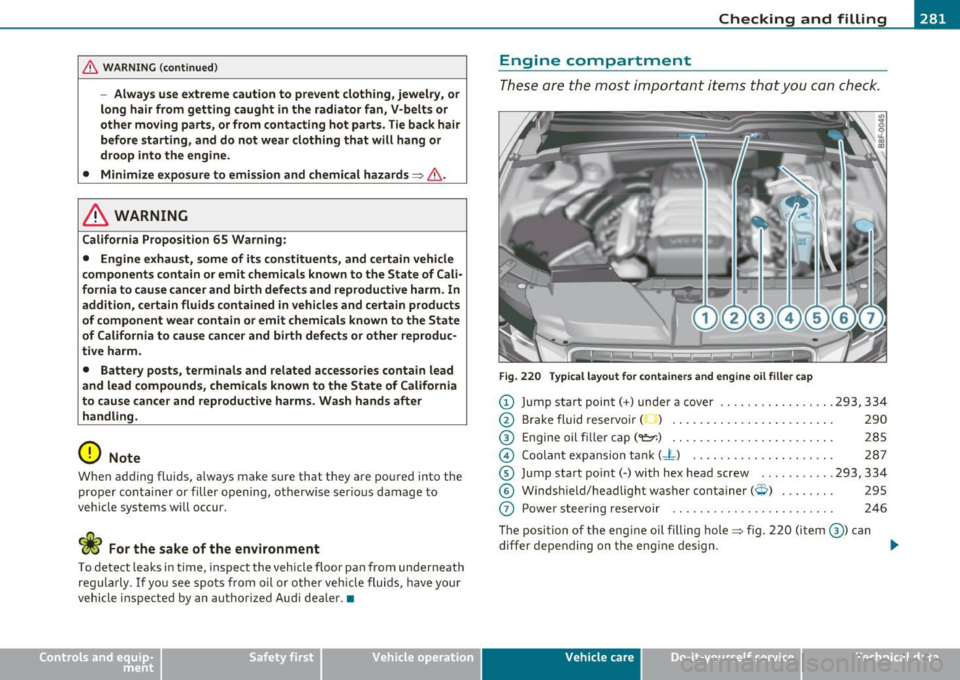
These are the most i mportan t it ems that you can check.
Fig . 220 Typ ical layout for c ontainer s and engine oil filler cap
(D Jump start point( +) under a cover ........ .. .. .. .. . 293, 334
@ Brake fluid reservo ir ( ) . . . . . . . . . . . . . . . . . . . . . . . . 290
@ Engine oil f iller c ap
('1::r. ) . . . . . . . . . . . . . . . . . . . . . . . . 285
© Coolant ex pansion ta nk (-L ) . . . . . . . . . . . . . . . . . . . . . 28 7
© Jump start point( -) w ith he x head screw ..... ... .. . 293 , 33 4
© Winds hield/head light washer container (0 ) . . . . . . . . 295
(j) Power steering reservoir . . . . . . . . . . . . . . . . . . . . . . . . 246
Th e posi tion of the eng ine o il filling hole ~ fig. 220 (i tem @) can
differ depending on the eng ine des ign . ..,.
Vehicle care Do-it-yourselt service iTechnical data
Page 284 of 364
lffl) __ C_ h_ e_c _k _i _ n _g ~ a_n _d_ f_il _l_in _ g _________________________________________ _
in. WARNING
Before you check anything in the engine compartment, always
read and heed all WARNINGS~
& in "Working in the engine
compartment" on
page 280. •
Engine oil
Engine oil specifications
The engine oil used in your Audi needs the right kind of oil.
The engine in your Audi is a sophisticated power plant that was built
to exacting specifications. This engine needs the right kind of engine
oil that meets specifications regarding quality and viscosity so that it
can run smoothly and reliably. Choosing the right oil and changing oil
within the time and mileage intervals printed in your vehicle 's
Warranty
& Maintenance booklet matters a lot more today than it did
years ago. Audi has developed a special quality standard for engine oil
that will help assure that your vehicle 's engine will get the lubrication
it needs for proper operation .
Modern engine lubrication has taken a quantum leap in the last few
years. Many synthetic oils available today provide better engine lubri
cation that can outlast traditional petroleum-based oils, making
them a smart choice for use throughout the life of your Audi.
Whether you use synthetic or petroleum-based engine oil, the oil that
you use must conform to Audi's oil quality standard VW 502 00 to
help keep your vehicle's engine running smoothly and help prevent
the formation of harmful deposits , sometimes called "sludge", that
over time can lead to expensive repairs.
At the time of printing, engine oils available in the U.S. and Canada
that meet the exacting specifications of Audi oil standard VW 502 00
are synthetic engine oils. This does not mean, however, that every
synthetic engine oil will meet Audi oil standard VW 502 00. So always
be sure that you use an approved oil. To help prevent the formation of harmful deposits
use only oil with
the following specifications printed on the oil container:
Audi oil standard VW 502 00
Oil container labels may carry the specification singly or in combina
tion with other designations and oil quality standards.
Viscosity
Engine oils are graded according to their viscosity. The proper
viscosity grade oil for your engine depends on climactic or seasonal
conditions where you drive. You can use oil with a viscosity grade of
SAE 5W40 across all temperature ranges for normal driving condi
tions.
However, if engine oil viscosity grade SAE 5W40 is not available, you
can also use viscosity grade SAE 5W -30 or SAE OW -40 as long as it
meets Audi oil quality standard VW 502 00 specifications.
Because engine oil that meets the Audi oil standard may not be avail
able everywhere when you need it, we strongly recommend that you
always carry with you an extra quart (liter) of oil that expressly
conforms to the VW 502 00 specification, in case you have to top off
the oil while on the road.
Only if the level of the oil is at or below the minimum mark - and no
oil that expressly conforms to Audi oil standard VW 502 00 specifica
tions is available - may you top off with a high quality engine oil, pref
erably synthetic-based, that meets ACEA A3, ACEA AS or ACEA BS or
API SL specifications, but even then, only in viscosity grades SAE 5W-
40, SAE SW-30, or SAE OW-40 . However, during the entire time
between oil change intervals, never top off with more than a total of
0.5 qt/liter engine oil that does not conform to Audi oil specification
vw 502 00.
For more information about engine oil that has been approved for
your vehicle, please contact either your authorized Audi dealer or
Audi Customer Relations at 1 (800) 822-2834 or visit our web site at
www.audiusa.com or www .audicanada.ca. Here you will also find a
current list of oils (manufacturers, brand names etc.) that conform to
Audi oil standard VW 502 00. ._
Page 285 of 364
_____________________________________________ C_h_ e_ c_k _in --= g=--- a_n_ d_ f_ i_ll _i_n __.g=-- -•
Changing the engine oil
The engine oil and oil filter must be changed according to the mileage
(kilometers) and time intervals specified in your vehicle's Warranty
&
Maintenance booklet. Do not exceed these intervals -harmful
deposits from old engine oil can reduce engine performance and can
lead to expensive engine repairs.
Changing the oil at the recommended intervals is so very important
because the lubricating properties of oil decrease gradually during
normal vehicle use. If you are not sure when you have your oil
changed, ask your authorized Audi Service Advisor .
Under some circumstances the engine oil should even be changed
more frequently. Change oil more often if you drive mostly short
distances, operate the vehicle in dusty areas or mostly under stop
and-go traffic conditions, or when you use your vehicle where temper
atures stay below freezing point for long periods.
Detergent additives in the oil will make fresh oil look dark after the
engine has been running for a short time. This is normal and is not a
reason to change the oil more often than recommended.
Damage or malfunctions due to lack of maintenance
It is essential that you change your oil at the recommended intervals
using only engine oil that complies with Audi oil standard
VW
502 00 . Your Limited New Vehicle Warranty does not cover
damage or malfunctions due to failure to follow recommended main
tenance and use requirements as set forth in the Audi Owner's
Manual and Warranty
& Maintenance booklet. Your dealer will have
to deny warranty coverage unless you present to the dealer proof in
the form of Service or Repair Orders that all scheduled maintenance
was performed in a timely manner. •
Safety first
Engine oil consumption
The engine in your vehicle depends on an adequate
amount of oil to lubricate and cool all of its moving parts.
In order to provide effective lubrication and cooling of internal
engine components, all internal combustion engines consume a
certain amount of oil. Oil consumption varies from engine to engine
and may change significantly over the life of the engine. Typically,
engines with a specified break-in period (see~
page 250) consume
more oil during the break-in period than they consume after oil
consumption has stabilized.
Under normal conditions, the rate of oil consumption depends on the
quality and viscosity of the oil, the RPM (revolutions per minute) at
which the engine is operated, the ambient temperature and road
conditions. Further factors are the amount of oil dilution from water
condensation or fuel residue and the oxidation level of the oil. As any
engine is subject to wear as mileage builds up, the oil consumption
may increase over time until replacement of worn components may
become necessary.
With all these variables coming into play, no standard rate of oil
consumption can be established or specified. There is no alternative
to regular and frequent checking of the oil level, see
Note.
If the yellow engine oil level warning symbol in the instrument
cluster _ lights up, you should check the oil level as soon as possible
~ page 284. Top off the oil at your earliest convenience~ page 285.
& WARNING
Before you check anything in the engine compartment, always
read and heed all WARNINGS~
& in "Working in the engine
compartment" on page
280.
Vehicle care Technical data