light AUDI A5 CABRIOLET 2010 Repair Manual
[x] Cancel search | Manufacturer: AUDI, Model Year: 2010, Model line: A5 CABRIOLET, Model: AUDI A5 CABRIOLET 2010Pages: 364, PDF Size: 86.51 MB
Page 129 of 364

____________________________________________ A_ d_ a.._p _t_ i_ v _e_ c_r_u _ i_ s _e_ c_o_ n_ t_r _o _l __ ffl'II
[I) Tips
• If the adaptive cruise control initiates brak ing, the hydraulic brake
system is under pressure. Therefore, the brake pedal distance is
shorter and the peda l "feels" harder.
• Adaptive cruise control is switched off after pressing the foot
brake. The speed saved up this poi nt can be resumed.
• To resume the saved speed, release the brake pedal and press the
control lever:::::,
page 120, "Turning adaptive cruise control off
temporari ly".
• If you use the accelerator to go faster than the speed of the object
ahead of you, the
driver intervention prompt will not be accompa
nied by a warn ing s ignal.
• If the speed you prev iously set is exceeded, the indicator light in
the speedometer will switch off .•
A pplie s to vehicles: w ith adapt iv e cru is e control
MMI settings
Individual settings for adaptive cruise control can be
selected in the
fV/fVII.
Settings for the driving program can be adjusted individually
to the particular user and saved in the MMI.
- Press the [CAR]function button .
- Select
Adaptive Cruise Control. The Adaptive Cruise
Control
menu appears.
- Select
driving program .
-Select the desired driving program .
Controls and equip
ment Safety first
Setting the driving program
In
the driving program menu you can adjust the character istics of
adaptive cru ise control to what you want using
dynamic , standard or
comfort.
Saving settings
Your individual settings are automatica lly saved and assigned to the
remote control key being used (remote key storage) . If the key is
given to another person, the saved settings remain as they are. •
System limitations
Applies to vehicles : with adaptive cruise cont rol
General information
Some driving situations which affect the function of the
radar sensor are described below.
When driving, the adaptive cru ise contro l is governed by physical and
system-specified limits. Also, under certain circumstances, the ACC
system may react unexpectedly or late from the driver's point of view.
Therefore, a lways be attentive and intervene, if necessary:
• when driving around curves:::::,
page 128
• when vehicles in front are not in line with your vehicle:::::, page 128
• whe n other ve hicles are changing lanes:::::, page 128
• when other vehicles are difficult to detect:::::, page 129.
& WARNING
The radar sensor's vision can be reduced by rain, snow and heavy
spray . This can result in vehicles driving ahead being inadequately
detected or, in some circumstances , not detected at all. If neces
sary, take action yourself!•
Vehicle care Technical data
Page 134 of 364
IIIIL_!_A~u~d~i~l!:!a~n~e '...:a~s~s:!:is~t ~--------------------------------------------
Aud i Lane assist
Lane assist
Applies to veh icles : w ith lane assist
Description
Lane assist helps you keep your vehicle in your lane.
Lane assist uses a camera to detect lane boundary lines. If the system
detects that your vehicle is about to leave a lane boundary line, the
steering wheel
vibrates to alert the driver. If lane assist detects
boundary lines on both sides o f the veh icle's lane, the system enters
act ive standby mode, which is indicated by t he gree n indicator light
/ : on the instrument cluster .
If the system is in active standby mode and the turn signal is acti
vated before driving over the boundary line , the warning does not
occur sinc e th e system allows for in tention al lane changes.
The system is designed for driving on freeways and expanded high
ways and th us works only at speeds of 40 mph (65 km/h) or more.
& WARNING
• Lane assist will not keep your vehicle in your lane. The system
only warns the driver when the vehicle is leaving the lane. The
driver is always responsible for keeping the vehicle in the lane.
• The camera is not able to detect all lane boundary lines and in
some cases might also detect lane structures or objects as
boundary lines. This can lead to incorrect warnings or warnings
that fail to go off at all.
• The camera's visibility can be impaired by vehicles ahead of
you, for instance, or by rain, snow, heavy spray or light shining
into the camera lens. This can cause lane assist to fail to detect
boundary lines. •
Applies to veh icles: wit h lane assist
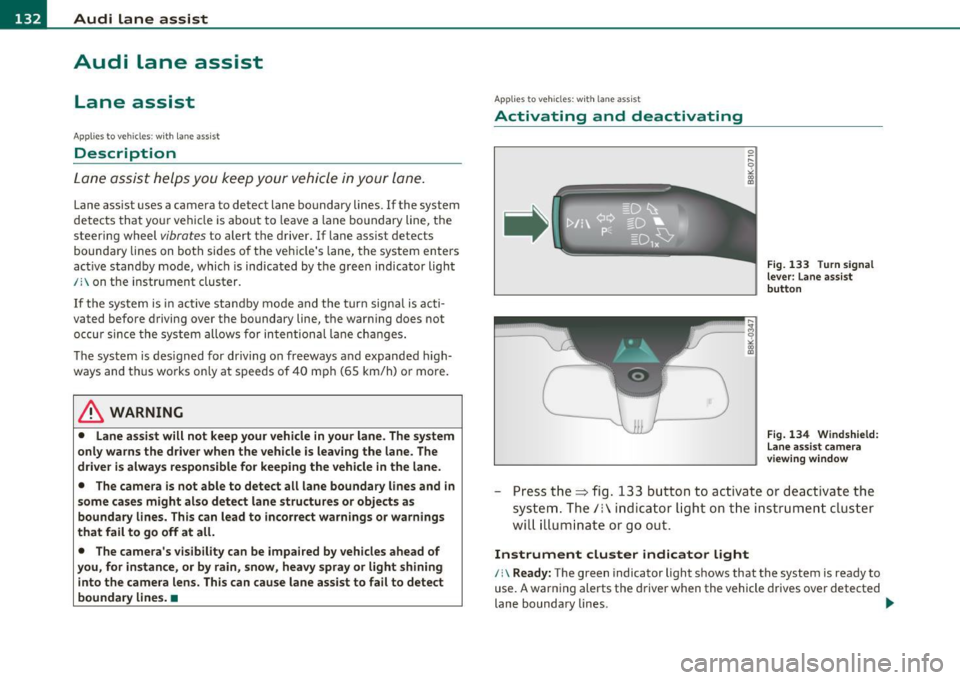
Activating and deactivating
•
Fig. 133 Turn signal
lever: Lane assist
button
Fig. 134 Windshield:
Lane assist camera
viewing window
-Press the=> fig . 133 button to act ivate or deactivate the
system. The/: ind icator light o n the instrument cluster
will illumi nate or go out.
Instrument cluster indicator light
/:\Ready: The green indicator light shows that the system is ready to
use. A warning alerts the driver when the vehicle drives over detected
lane boundary lines . -.,
Page 135 of 364

Audi lane assist ml
----------------
Not ready: The yellow indicator light shows that the system is
turned on but unable to send a warning. This can be due to the
following:
• Th ere are no boundary lines, or there is only one boundary line
present.
• The boundary lines are not detected (e .g . due to snow, dirt, wet
conditions or light shining into the camera lens).
• More than two boundary lines (such as at construction sites) are
located in the vehicle's lane.
• Th e vehicle's speed is below the speed needed to activate it, which
is about 40 mph (65 km/h) .
• Th e lane is narrowe r than about 8
ft. (2.5 m), or wider than about
16 ft. (5 m).
• The curve is too sharp.
Notes on the instrument cluster display
When the lane assist turns off automatically, the instrument cluster
indicator goes out and one of the fo llowing messages appears on the
display:
Audi lane assist not available: currently no sensor vision
This message appears when the camera can no longer function
because it cannot detect the boundary lines. This may be due to the
following:
• Th e exte rior side of the camera viewing window=>
page 132,
fig. 134 is covered with dirt or ice. Clean this part of the windsh ield.
• Th e came ra viewing window is fogged up on the inside. In this
case, wait until the fog disappears before turning lane assist on
again.
• Th e system was unable to detect boundary lines over an extended
period of time due to road conditions (such as snow-cove red lanes).
Do not turn lane assist on aga in until the lines can be more easily
detected.
Audi lane assist currently not available
Controls and equip
ment Safety first
A temporary malfunction
is preventing lane assist from operating .
Tr y turning on lane assist again at a lat er time.
Audi lane assist: system fault
The system shou ld be checked by an authorized Audi dealer or other
qualified wo rkshop.
[ i ] Tips
• Make sure that the camera viewing window =>
page 132, fig. 134
is not covered by stickers or similar objects.
• Always keep the camera viewing w indow clean. This can us ually be
done by operating the windshie ld wipers. •
Applies to ve hicles : with lane assist and trip comp ute r
Indicator in the instrument cluster display
Vehicle care
Fig. 135 I nstrument
cluster: lane assist
ac tiva ted and
provid in g warning s ...
Technical data
Page 136 of 364

1111....__A_ u_ d_i_ l_ a_ n_ e_ a_s_ s_ is_t _________________________________________________ _
Fig. 136 Ins trume nt
clu ster : lane assis t
ac tiv ated , bu t n ot
ready to provid e warn
ing s
Press the [ RESET] button in the winds hield wipe r lever repeated ly to
show the lane assist display . For ad ditiona l information, refer to
:::>pag e 24.
When lane assist is activated, two lines appear which show the lanes
t o the le ft and right of yo ur vehi cle.
Version @ : Monochrome display
• Solid red lines: lane ass ist is activa ted and ready to prov ide war n
ings.
• One red line bli nks (left or r ight) : lane ass ist warns you abou t
changin g lanes =>
page 133, fig. 13 5.
• Open lines: lane assist is activated, but not ready prov ide warn ings
=> fig. 136 .
Version @: High-resolution display
• Solid whi te lines: lane ass is t i s activa ted and ready to p rovide
wa rnings.
• Solid red line (left o r rig ht): lane ass ist w arns you about changi ng
lanes=>
page 133, fig. 135.
• Ope n lines: lane assist is activated, but no t ready p rovide warn ings
=> fig. 136.
Messages in the instrument cluster display
If lane assis t sw itches o ff automatically, the indicator light in the
ins tru men t cluste r goes ou t and one of the following messages
appears in the disp lay:
Audi lane as sist not available: Currently no sensor vi sion
T hi s message appears if t he camera is unab le to detect the lines. This
c o uld h appen i f:
• Th e came ra field of view=>
page 132, fig. 13 4 i s dirty or covered
in ice. Clean the area on the windshie ld.
• Th e came ra field of vi ew is fogged over . Wait unt il the fog has
disappea red befo re switching lane assist on .
• The system has been unable to detect the lanes for an extended
period of time due to road cond it ions s uch as lanes covere d in snow .
Switch la ne assist back on when the li nes are mo re vis ible.
Audi lane assist not available
Th ere is a temporary lane assist malfunction. Try switching lane
assist on again later.
Audi lane assist: system fault
H ave an au thor ized A udi deale r check the syste m.•
Page 138 of 364

lffll..__A_ u_d_ i _s _id _ e_ a_s _ s_ i_ s _t _______________________________________________ _
Audi side assist
Lane change assistant
Applies to vehicles : w ith s ide ass ist
Description
The side assist helps you when changing lanes.
Fig. 138 Rear
bumper: Position of
radar sensors (not
visible on outside)
Fig. 139 Signal light
on the outside mirror -
driver's side
Side ass ist uses radar sensors (not visible on outside)=> fig. 138 to
help the driver check blind spots, and see what is happening in traffic
behind the vehicle=>
page 137, fig. 141.
Signal lights are bu ilt into both outside mirrors
(D => fig. 139 . The
signal light on the left ou tside mirror assists when moving over into the
left lane and the signal light on the right outside mirror assists
when moving over into the right lane.
Th e sig nal light comes on to tell you that side assist has detected a
vehicle on that side and that the position of this other vehicle should
be taken into account if you were to change lanes. Thi s is called the
informational stage signal =>
page 138. The informationa l stage
signal is designed so that you not ice it only when you are looking in
the outside m irror.
When you activate the turn s ignal and side assist detects a vehicle in
a notable location, the correspo nding signal on the outside mirror
flashes briefly and brightly several times. This is the alert stage
signal =>
page 138. •
Applies to veh icles: w ith side ass ist
Activating and deactivating
Activating
Fig. 140 Drive r's
door: Side assi st
butto n
-Press the=> fig. 140 button. The indicator on the button
lights up. .,_
Page 139 of 364
_________________________________________________ A_ u_d _ i_ s_id _ e_ a_s _s_ i_s _t __ ffl'II
Deactivating
- Pre ss th e b utton again . Th e ind icator light on the button
goes o ut.
The system works at speeds faster than 19 mph (30 km/h) .
& WARNING
• Improper reliance on the side assist system can cause collisions
and seriou s per sonal injury:
- Never rely only on side assist when changing lanes.
- Alway s check rear view mirrors to make sure that it is safe to
change lanes.
• Side assist cannot detect all vehicles under all condition s
danger of accident!
• Side a ssist cannot detect vehicle s
in time to alert you when
they approach from behind at very high speed , or fall drop bac;k
very quickly .
• The radar sensor's
vision can be reduced o r entirely blocked by
rain, snow, and heavy spray . Thi s can result in side a ssist not
adequately detecting vehicles o r, in some cases , not detecting
them at all. Always keep an eye on the direction you are traveling
and the relevant area around the vehicle.
• Plea se note that side assi st indi cates there are approaching
veh icles, or vehicles in your blind spot, only after your vehicle has
reached a driving speed of at lea st 19 mph (30 km/h).
• Side assist signal does not work around tight corners (turning
radius le ss than 328 feet or 100 m).
• Side assist is no replacement for the driver's full attention. The
driver alone is respon sible for lane changes and similar driving
maneuvers. Always keep an eye on the direction you are traveling
and the relevant area around the vehicle .
Controls and equip
ment Safety first
0 Note
• T
o ens ure t hat you do not adve rsely affec t side assist, do not blo ck
the area on the rear bumper where the radar sensors are located with
foreign obje cts (s uch as stickers or bicy cle ra cks).
• Make s ure that the s ignal light on the outside mirror is not
blo cked by st ickers or o ther ite ms.
W Tips
• Side assist a utoma tically deact iva tes if it de tects that the rada r
sensors are blocked =>
page 143. The indicator light on the button
goe s out.
• Th e area on the bumpe r w here the ra dar sensors are located must
c o nsistent ly remain free of snow, i ce, a nd heavy soiling so tha t side
assist can funct ion p roper ly. Follow the add itiona l notes on
=>
page 1 4 3.
• Additiona l tint ing on the front si de windows can make it ha rder to
see and co rrec tly un ders t and t he sig nal ligh t on the outs ide m irro r.
• F or Declaration of Compliance to United States FC C and Industry
Cana da regulat ions=>
pag e 346. •
Applies to veh icl es: w ith s ide ass ist
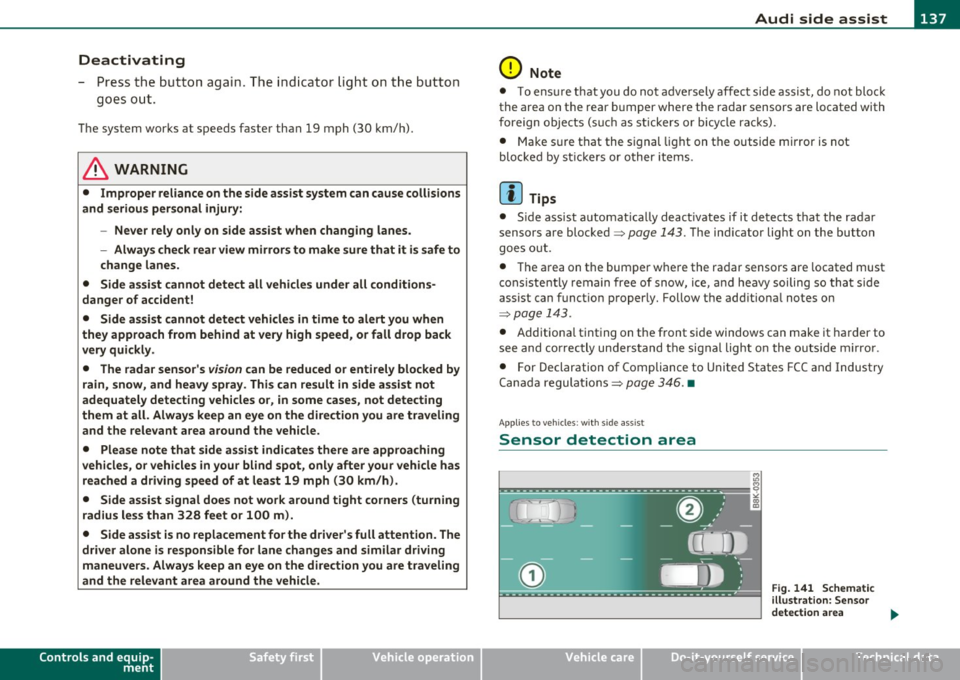
Sensor detection area
Vehicle care
Fig . 141 Schem atic
ill ustration: Se nsor
detectio n area
~
Technical data
Page 140 of 364

lffll.___A_ u_ d_i_ s_ id_ e_ a_s _s_ i_ s _t _________________________________________________ _
The detection~ page 13 7, fig . 141 of the radar sensor detection
area is made up of:
• the approach area (light green area)
(D, about 230 feet (70 m)
behind the vehicle, and
• the "blind spot" (dark green area)@.
The radar sensors cover the adjacent left and right lanes. Other lanes
are
not covered by the radar sensors .
rn Tips
Side assist does not measure actual lane width. The system assumes
a fixed lane width. Detection in the left and right lanes is based on
this assumed lane width. When driving on narrow roads or when
driving to the left or right of the center of a travel lane, it is possible
that vehicles will be detected that are
not in the lane next to the lane
you are using~
page 142. •
Applie s to vehic les: w ith s ide a ssist
Operation
Side assist compares the distance and difference in speed of detected
vehicles with the speed of your vehicle . Whenever the difference in
speed and distance is registered as notab le if you were to change
lanes , a signa l light appears on the respective mirror .
The signal can light up if you are passed by a vehicle or if you are
passing another vehicle .
If you pass another vehicle slowly (difference in speed less than 9
mph, or 15 km/h), the signa l light will come on as soon as the other
vehicle is in your blind spot and is detected by side ass ist. When the
difference in speed is greater, the signal light will not come on. •
Appli es to vehicles : with si de assist
Informational and alert stage signals
Side ass ist has two signal stages:
• the informational stage signal, and
• the alert stage signal.
Side assist helps you by using the appropr iate signal stage,
depending on whether or not you have activated the turn signal, and
thus have indicated that you are or are not changing lanes.
Informational stage signal
As long as you have not activated the turn signal, s ide assist informs
you of detected vehicles that are reg istered as being in a notable loca
tion if you were to change lanes . Whenever the detected vehicle's
difference in speed and distance is registered by side assist as
notable , the signal light on the respective mirror produces muted
illumination.
Th e brightness of the informat ional stage signal is designed not to be
as intense, so that it does not interfere with your view of the road
when you are driving and have no intention of changing lanes. When
you look in the outs ide mirror, you can clearly see the informational
stage signal.
Alert stage signal
When you act ivate the turn s ignal , and side assist has detected a
vehicle in a notable location on that particular side , the signal light on
this side mirror flashes brightly. The repeated brief and bright
flashing of the alert stage signal reminds you to carefully check
traffic to the rear in the outside mirror and over your shoulder, so that
you can safely complete the lane change~
& in "Safety tips" on
page 143.
rn Tips
The brightness of the signa l light on the outside mirrors can be
adjusted with the MMI
~ page 141. •
Page 141 of 364

_________________________________________________ A_ u _ d_ i_ s_ id_ e_ a _ s_s _ i_s _t _ __.lft'I
A pplie s to vehicles : wi th s ide ass ist
Driving situation: Fast approaching
vehicles
Fig. 142 Side assist: Fast approaching vehicles
(D Signal on outside mirror does not light up
No vehicle was detected by the sensors . The signal on the outside
mirror does not light up~
& in "Safety tips" on page 143.
@ Informational stage signal lights up
A fast approaching vehicle· in the left-hand lane for example· was
detected by the sensors . Although this vehicle is sti ll far away, it
should be taken into account if you were to change lanes, due to the
considerable difference in speed . The informational stage signal on
the outside mirror lights up~
page 138.
Contro ls a nd e quip
m en t Vehicle
OP-eration
® Alert stage signal flashes
If you act ivate your turn signa l in driving situation @, the signa l
br iefly f lashes repeatedly . Side assist is alert ing you to a vehicle that
you may not have noticed .
[I) Tips
• The faster a vehicle approaches from the rear, the sooner the
signal on the outs ide mirror l igh ts up . S ide assist will signal, at the
latest, when a detected vehicle enters your "blind spot".
• Whe n ve hicles approach very quickly, chang ing lanes can be
dangerous even if the signal on the outside mirror does not light up. •
App lies to vehicles : with side assis t
Driving situation : Slowly approaching
vehicles
Fig. 143 Side assist: Slowly approach ing vehicles and vehicles in your blind
~ot
~
Vehicle care Do-it-yourselt service iTechnical data
Page 142 of 364

1111..__A_ u_d_ i _s _i_d _e_ a_s_ s_ i_ s_ t _______________________________________________ _
© Signal on outside mirror does not light up
A vehicle approach ing s low ly- in the left-hand lane for example -was
detected by the sensors. Because of the small difference in speed and
the considerable distance from your vehicle, the signal on the outside
mirror will not light up=>
& in "Safety tips" on page 143 .
@ Informational stage signal lights up
The distance between your vehicle and that of the slowly approaching
vehicle has narrowed . The informational stage signal on the outside
m irror lights up.
As soon as the difference in speed and distance is registered as
notable if you were to change lanes, a signal on the mirror lights up.
Side assist will signal at the latest when a detected vehicle enters
your "blind spot" .
@ Alert stage signal flashes
If you activate your turn signal in dr iving s ituation @, the signal light
briefly flashes repeatedly. Side assist is alerting you of a vehicle that
you may not have noticed.
[ i ] Tips
• T he faste r a vehicle approaches from the rear, the sooner the
signal on the outs ide mirror lights up. S ide assist will signal, at the
latest, when a detected vehicle enters your "blind spot".
• When vehicles approach very quickly, changing lanes can be
dangerous even if the signal on the outside mirror does not light up.•
App lies to vehicles : wit h si de assist
Driving situat ion : Vehicles dropping back
slowly
Fig. 144 Side assist: Vehicles dropping back slowly
© Signal on outside mirror does not light up
The vehicle that you passed has not yet been detected by side assist.
The signal on the outside mirror does not light up=>
& in "Safety
tips" on
page 143.
@ Informational stage signal lights up
A vehicle dropping back slowly on the right (differen ce in speed of
less than 9 mph, or 15 km/h) has been detected by side assist. The
informational stage signal on the outside mirror lights up.
@ Alert stage signal flashes
If you activate your turn signa l in driving situa tion @, the signal
br iefly flashes repeatedly . Side ass ist is alerting you of a vehicle that
you may not have noticed. •
Page 143 of 364

_________________________________________________ A_ u _ d_ i_ s_ id_ e_ a _ s_s _ i_s _t _--J_
A pplie s to ve hicles : wi th s id e ass ist
Driving situation: Vehicles dropping back
quickly
@
I
- (OIDJ -
•. _ ...
' I
- Q•n
-~---
Fig. 145 Side assist: Vehicles dropping back quickly
(D Signal on outside mirror does not light up
The vehicle just passed has not yet been detected by side assist. The
signal on the outside mirror does not light up~
& in "Safety tips" on
page 143.
@ Signal on outside mirror does not light up
The vehicle dropping back quickly on the right (difference in speed of
more than 9 mph, or 15 km/h) has been detected by side assist, but
is not considered notable in the event of a lane change, because it is
dropping back so quickly . The signal on the outside mirror does not
light up~
& in "Safety tips" on page 143.
Con tro ls a nd e quip
m en t Vehicle
OP-eration
® Signal on outside mirror does not light up
If you activate your turn signal in driving situation @, the signal still
does not light up on the outside mirror~
& in "Safety tips" on
page 143. •
App lies to ve hicles : with side assis t
Setting the signal brightness on the
outside mirror
The signal brightness can be set in the radio or in the
fv1fv1I*.
- Select: Function button I CAR] > Audi side assist.
- Rotate the control knob to adjust the displayed brightness
of the signal Light on the outside mirrors.
The brightness of the signal light for both the informational a nd alert
stages is automatically adjusted to ambient light conditions. In addi
tion, you can adjust the
basic brightness separately, via the bright
ness function.
While making the adjustment, the new brightness setting is
displayed briefly. The brightness displayed is that of the informa
tional stage signal. The alert stage signal brightness is linked to the
informational stage signal brightness.
The informational stage signal brightness should be adjusted so that
you notice the signal illumination when you look in the outside
mirror, but not when you look forward through the windshield .
In very dark or light surroundings, the automatic brightness setting
adjusts signal light brightness to maximum or minimum intensity, as
needed. In circumstances such as these, you may not notice any
change in the brightness on the outside mirror when adjusting the
basic brightness.
You may not notice the change until lighting conditions are normal
again.
Vehicle care Do-it-yourselt service iTechnical data