lock AUDI A5 CABRIOLET 2010 Repair Manual
[x] Cancel search | Manufacturer: AUDI, Model Year: 2010, Model line: A5 CABRIOLET, Model: AUDI A5 CABRIOLET 2010Pages: 364, PDF Size: 86.51 MB
Page 156 of 364
ffl..__T_ r_a _n_ s_ m_ is_ s_io _ n ___________________________________________________ _
You can continue to drive the vehicle. See an authorized Audi dealer
or other qualified workshop at the next opportunity.
Gearbox malfunction: you can continue driving (limited
functionality)
There is a serious system malfunction:
• The program shifts only into certain gears .
• The engine may stall.
• It is not possible to restart the engine if it has been switched off.
• Continuing to drive could result in subsequent damage .
0 Note
If the transmission switches to fail-safe mode, you should take the
vehicle to an authorized Audi dealership as soon as possible to have
the condition corrected.•
Applies to veh icles: w ith automatic transm ission
Emergency release of the selector lever
If the vehicle's power supply fails, the selector lever can
be released in an emergency.
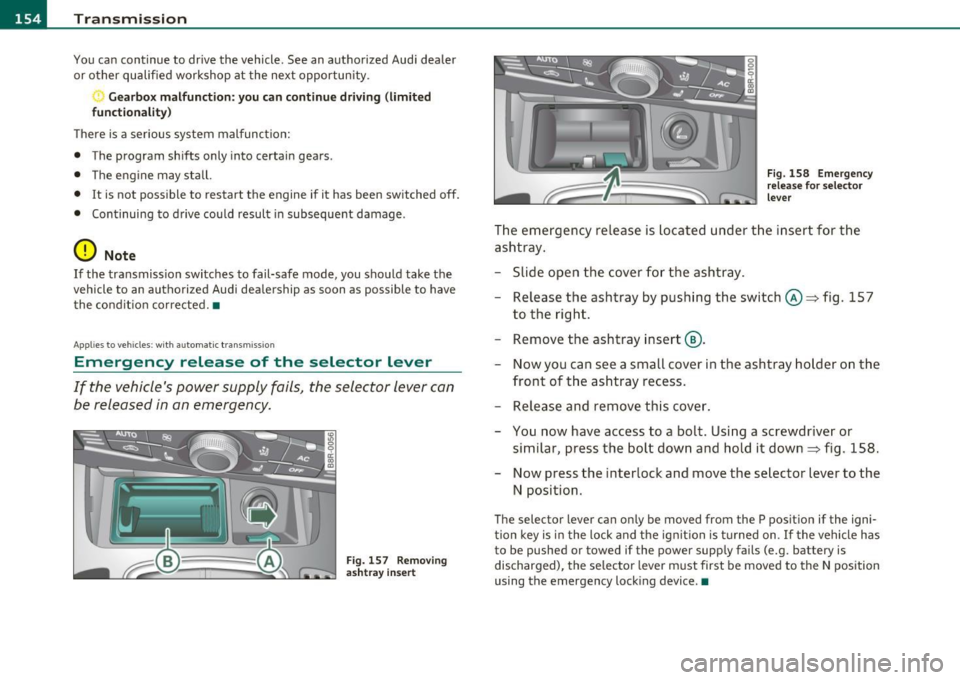
Fig . 157 Removing
ashtray insert Fig. 158
Emergency
release for selector
lever
The emergency release is located under the insert for the
ashtray.
- Slide open the cover for the ashtray.
- Release the ashtray by pushing the switch©~ fig. 157
to the right.
- Remove the ashtray insert @ .
- Now you can see a small cover in the ashtray holder on the
front of the ashtray recess.
- Release and remove this cover.
- You now have access to a bolt. Using a screwdriver or
similar, press the bolt down and hold it down~ fig. 158.
Now press the interlock and move the selector lever to the
N position.
The selector lever can only be moved from the P position if the igni
tion key is in the lock and the ignition is turned on. If the vehicle has
to be pushed or towed if the power supply fails (e.g. battery is
discharged), the selector leve r must first be moved to the N position
using the emergency locking device.•
Page 157 of 364

Transmission Ill _______________ ___.
multitronic®
Applies to vehicles: with mult it ro nic ® Continuously Variable T ransmiss ion (CVT)
General information
Your vehicle is equipped with a electronically controlled continuous ly
var iable transmission (multitronic ®). Inside the multitronic ® system,
the gear ratios are not shifted in finite steps as in a conventional auto
matic transm ission, but rather
continuously. As a result, engine
power is applied smoothly and comfortably, and better fuel economy
is achieved.
The transmission selects the appropriate gear ratio (upshifts and
downsh ifts) automatically based on set driving programs
=> page 159, "Dynamic shift program (DSP)" .
You can also manually select a shift program (tiptronic ®)
=> page 159 .
You should note, that the multitronic transmission differs from a
conventional Automatic Transmission. In the multitronic transmis
sion the engine power is transferred via a link-plate chain, rather than
by a conventiona l torque converter . The multitronic transmission
great ly reduces vehicle "creep" when at a standstill and the transmis
sion is in
D Sor R. •
Con tro ls a nd e quip
m en t Vehicle
OP-eration
Applies to vehicles : with multitronic® Continuously Variable Transmission (CVT)
Driving the multitronic ®
The gear ratio is continuously adopted to vehicle speed
and load.
Starting the engine
- The selector lever must be in N or P.
Starting off
- Press and hold the brake pedal.
Fig. 159 Section of
the center console:
sel ector lever with lock
button
- Press and hold the release button in the selector lever
handle and move the selector leve r from
P (alternatively
N ) to D (alternatively S) and release the button.
- Wait briefly until the transmission has shifted (you will
feel a slight movement).
- Remove your foot from the brake pedal and accelerate
=> &.
Rocking back and forth to become unstuck
- Shift only between D and R when the vehicle is at a full
stop and the engine is running at idle speed.
Vehicle care Do-it-yourselt service iTechnical data
Page 158 of 364

1111....__T_ r_a _n_ s_m _ i_s _s _ i_o _n ___________________________________________________ _
Stopping
- Press a nd hold the brake pedal un til the vehicle has come
to a com plet e stop.
- Keep the brake pedal depressed so that the vehicle cannot
roll forward or backward w hile it is idli ng => & .
- Once sto pped,
do not depress t he accelerator pedal to rev
up the engine=> &.
Parking
- Press a nd hold th e br ake pedal u ntil th e v ehicle has com e
to a comp lete stop .
- S et the parki ng brakefir mly=>page
111, "Pa rking".
- Press an d hold the re lease button i n th e selector lever
handle, move the selector lever into
P and then let go of
the re lease button ~ & .
Your vehicle is equipped with a starting assist that a llows for eas ier
s t arting on in clines. The sys tem is activa ted w hen the brake ped al is
depressed for a
few seconds . After releasing the brake pedal, the
bra ke powe r is he ld for a moment to prevent the vehicle from ro lli ng
back when starting .
T he selector lever must be in Nor
P. If one of the driving positions is
engaged a safety switch will p reven t the eng ine from be ing started .
See also =>
page 106.
Before you move the selecto r lever from t he P posi tio n, yo u m ust
always app ly the brake peda l befo re and whi le depressing the button
in the handle of the selecto r lever .
& WARNING
• Unintended vehicle movement can cau se serious injury.
& WARNING (c on tinued )
-When the selecto r lever is in a dri ving pos ition, the vehicle
may creep , even at idle speed. Therefore do not relea se the
parking brake or foot brake until you are ready to move ,
becau se power is transmitted to the wheels a s soon as a driving
position i s engaged.
- Do not a ccelerate while selecting a driving p osition. At this
time the engine must be at idle sp eed so that undue stress is
not placed on the clutche s in the transmi ssion.
- Remembe r: • even when stopped briefly with the automatic
transmi ssion in "D ", "S " or "R ", engine power i s being trans·
mitted to the wheels . Your vehicle could "creep " forward or
backward . When stopped, keep the brake pedal fully
depressed and use the parking brake if necessary to keep the
vehicle from rolling .
- If the selector le ver is unintentionally moved into N while
y ou are driving , take your foot off the accelerator pedal and
wait for the engine to return to idle sp eed before selecting a
driving position.
- Never shift into "R " or "P " when the vehicle i s in motion .
- Never get out of the driver 's seat when the engine i s running .
- If you must get out of the vehicle , move the selector le ver
s ecurely into the P position and apply the parking brake firmly.
- If the engine must remain running , never have any driving
position engag ed when checking under the hood. Make sure
the selector lever has securely eng aged and is locked in "P"
with the parking brake firmly set=>
page 272, "Engin e
compartment ". Otherwise, any increase in engine speed may
s et the vehicle in motion, even with the parking brake
applied. •
Page 160 of 364
1111....__T_ r_a _n_ s_m _ i_s _s _ i_o _n ___________________________________________________ _
0 Note
Coasting downhill with the transmission in N and the engine not
operating will result in damage to the automatic transmission and
possibly the catalytic converter. •
Applies to veh icles: with multitronic ® Continuously Variable Transm ission (CVT)
Automatic Shift Lock (ASL)
The Automatic Shift Lock safeguards you against acci
dentally shifting into a forward or the reverse gear and
causing the vehicle to move unintentionally.
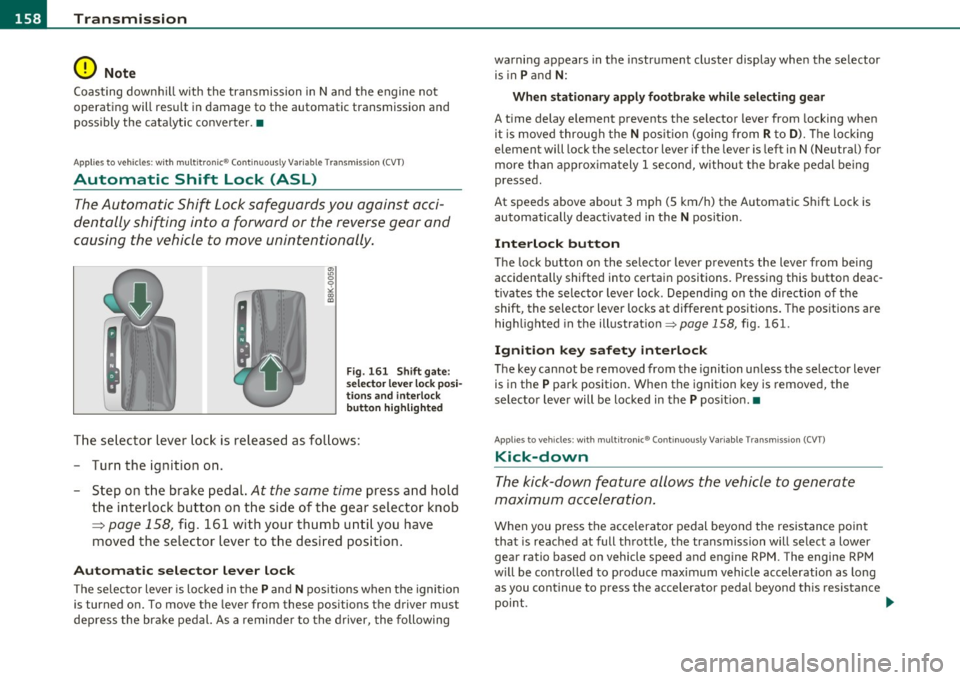
Fig . 161 Shift gate:
selector lever lock posi
tions and interlock
button highlighted
The selector lever lock is released as follows:
- Turn the ignition on.
- Step on the brake pedal.
At the same time press and hold
the interlock button on the side of the gear selector knob
=:> page 158, fig. 161 with your thumb until you have
moved the selector lever to the desired position.
Automatic selector lever lock
The selector lever is locked in the P and N positions when the ignition
is turned on. To move the lever from these positions the driver must
depress the brake pedal. As a reminder to the driver, the following warning appears
in the instrument cluster display when the selector
is in
P and N:
When stationary apply footbrake while selecting gear
A time delay element prevents the selector lever from locking when
it is moved through the
N position (going from R to D). The locking
element will lock the selector lever if the lever is left in N (Neutral) for
more than approximately 1 second, without the brake pedal being
pressed.
At speeds above about 3 mph (5 km/h) the Automatic Shift Lock is
automatically deactivated in the
N position.
Interlock button
The lock button on the selector lever prevents the lever from being
accidentally shifted into certain positions. Pressing this button deac
tivates the selector lever lock. Depending on the direction of the
shift, the selector lever locks at different positions. The positions are
highlighted in the illustration~
page 158, fig. 161.
Ignition key safety interlock
The key cannot be removed from the ignition unless the selector lever
is in the
P park position. When the ignition key is removed, the
selector lever will be locked in the
P position. •
Applies to veh icles: with mu lt it ron ic ® Cont inuously Variable Transm ission (CVT)
Kick-down
The kick-down feature allows the vehicle to generate
maximum acceleration.
When you press the accelerator pedal beyond the resistance point
that is reached at full throttle, the transmission will select a lower
gear ratio based on vehicle speed and engine RPM. The engine RPM
will be controlled to produce maximum vehicle acceleration as long
as you continue to press the accelerator pedal beyond this resistance
point. ..
Page 164 of 364
1111....__T_ r_a _n_ s_m _ i_s _s _ i_o _n ___________________________________________________ _
- Now press the interlock button and move the se lector
leve r to the
N position.
T he selecto r leve r ca n only be moved from the P pos ition if the igni
tion key is in the lock and the ignition is turned on . If the vehicle has
to be pushed or towed if the powe r supp ly fa ils (e.g. batte ry is
discharged), the selector lever must firs t be moved to t he N posi tion
using the emergency lo cki ng device .•
Page 180 of 364
___ D_ r_ i_ v _i_n _.g"-- S_ a_ f_ e__. LY.__ _____________________________________________ _
Proper occupant seating positions
Proper seating position for the driver
The proper driver seating position is important for safe,
relaxed driving.
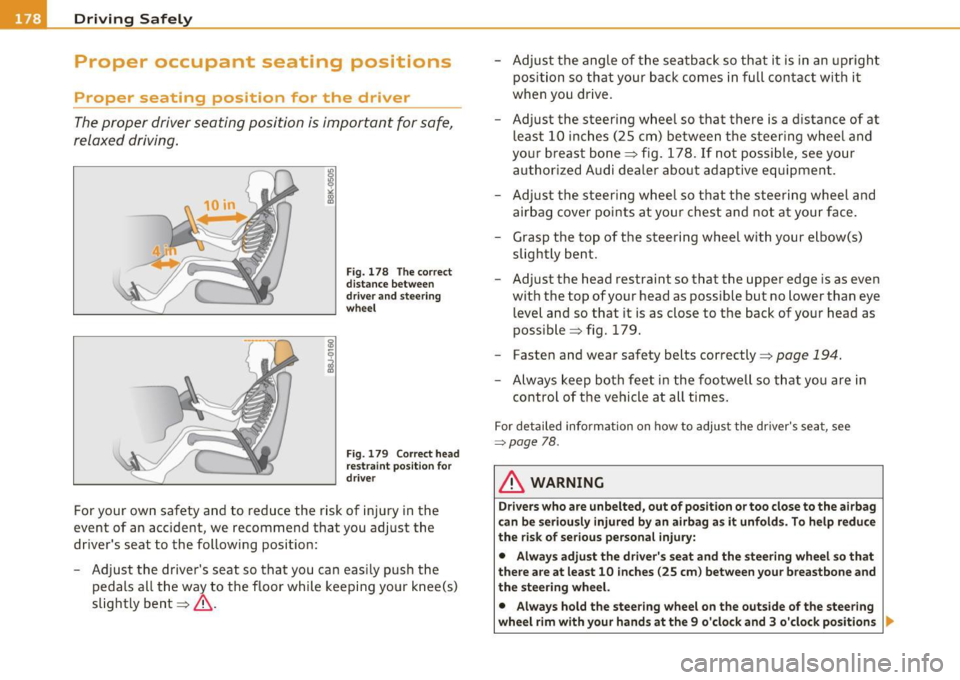
Fig. 178 The correct
distance between
driver and steering
wheel
Fig . 179 Correct head
restraint position for
driver
For your own safety and to reduce the risk of injury in the
event of an accident, we recommend that you adjust the
driver's seat to the following position:
- Adjust the driver's seat so that you can easily push the
pedals all the way to the floor while keeping your knee(s)
slightly bent==>& . -
Adjust the angle of the seatback so that it is in an upright
position so that your back comes in full contact with it
when you drive.
- Adjust the steering wheel so that there is a distance of at least 10 inches (25 cm) between the steering wheel and
your breast bone==> fig. 178. If not possible, see your
authorized Audi dealer about adaptive equipment .
- Adjust the steering wheel so that the steering wheel and airbag cover points at your chest and not at your face.
- Grasp the top of the steering wheel with your elbow(s) slightly bent.
- Adjust the head restraint so that the upper edge is as even
with the top of your head as possible but no lower than eye
level and so that it is as close to the back of your head as
possible ==> fig. 179.
- Fasten and wear safety belts correctly=>
page 194.
-Always keep both feet in the footwell so that you are in
control of the vehicle at all times.
For detailed information on how to adjust the driver's seat, see
~page 78 .
& WARNING
Drivers who are unbelted, out of position or too close to the airbag
can be seriously injured by an airbag as it unfolds. To help reduce
the risk of serious personal injury:
• Always adjust the driver's seat and the steering wheel so that
there are at least 10 inches (25 cm) between your breastbone and
the steering wheel.
• Always hold the steering wheel on the outside of the steering
wheel rim with your hands at the 9 o'clock and 3 o'clock positions
II,-
Page 181 of 364

______________________________________________ D_ ri_v _ i_n _,,g ,c.._ S_a_ f_ e_ l..:: y __ _
& WARNING (continued)
to help reduce the risk of personal injury if the driver's airbag
inflates.
• Never hold the steering wheel at the 12 o'clock position or with
your hands at other positions inside the steering wheel rim or on
the steering wheel hub. Holding the steering wheel the wrong way can cause serious injuries to the hands, arms and head if the
driver's airbag deploys.
• Pointing the steering wheel toward your face decreases the
ability of the supplemental driver's airbag to protect you in a colli·
sion.
• Always sit in an upright position and never lean against or
place any part of your body too close to the area where the airbags
are located.
• Before driving, always adjust the front seats and head
restraints properly and make sure that all passengers are properly
restrained.
• Never adjust the seats while the vehicle is moving. Your seat
may move unexpectedly and you could lose control of the vehicle.
• Never drive with the backrest reclined or tilted far back! The
farther the backrests are tilted back, the greater the risk of injury due to incorrect positioning of the safety belt and improper
seating position.
• Children must always ride in child safety seats~
page 222.
Special precautions apply when installing a child safety seat on
the front passenger seat
~ page 200. •
Controls and equip
ment Safety first Vehicle operation
Proper seating position for the front
passenger
The
proper front passenger seating position is important
for safe, relaxed driving.
For your own safety and to reduce the risk of injury in the
event of an accident, we recommend that you adjust the seat
for the front passenger to the following position:
- Move the front passenger seat back as far as possible.
There must be a minimum of 10 inches (25 cm) between
the breastbone and the instrument panel=>& .
- Adjust the angle of the seatback so that it is in an upright
position and your back comes in full contact with it when
ever the vehicle is moving .
- Adjust the head restraint so that the upper edge is as even
with the top of your head as possible but not lower than
eye level and so that it is as close to the back of your head
as possible.
- Keep both feet flat on the floor in front of the front
passenger seat.
- Fasten and wear safety belts correctly =:>
page 194.
For detailed information on how to adjust the front passenger's seat,
see ~
page 77.
& WARNING
Front seat passengers who are unbelted, out of position or too
close to the airbag can be seriously injured or killed by the airbag
as it unfolds. To help reduce the risk of serious personal injury: .,
Vehicle care Do-it-yourself service Technical data
Page 186 of 364
• ....__D_ r_iv _i_ n_, g=-- S_ a _ f_e _,Ly _ ______________________________________________ _
Loose items in the luggage compartment can shift suddenly,
changing vehicle handling characteristics. Loose items can
also increase the risk of serious personal injury in a sudden
vehicle maneuver or in a collision.
- Distribute the load evenly in the luggage compartment.
- Always place and properly secure heavy items in the luggage compartment as low and as far forward as
possible => fig . 181.
- Secure luggage using the tie-downs provided=>
page 83.
- Make sure that the rear seat back is securely latched in
place.
& WARNING
Improperly stored luggage or other items can fly through the
vehicle causing serious personal injury in the event of hard braking or an accident. To help reduce the risk of serious personal injury:
• Always put objects, for example, luggage or other heavy items
in the luggage compartment.
• Always secure objects in the luggage compartment using the
tie-down eyelets and suitable straps.
& WARNING
Heavy loads will influence the way your vehicle handles. To help
reduce the risk of a loss of control leading to serious personal
injury:
• Always keep in mind when transporting heavy objects, that a
change in the center of gravity can also cause changes in vehicle
handling:
- Always distribute the load as evenly as possible.
& WARNING (continued)
-Place heavy objects as far forward in the luggage compart
ment as possible.
• Never exceed the Gross Axle Weight Rating or the Gross Vehicle
Weight Rating specified on the safety compliance sticker on the
left door jamb. Exceeding permissible weight standards can cause
the vehicle to slide and handle differently.
• Please observe information on safe driving~
page 176.
& WARNING
To help prevent poisonous exhaust gas from being drawn into the
vehicle, always keep the rear lid closed while driving .
• Never transport objects larger than those fitting completely
into the luggage area because the rear lid cannot be fully closed.
• If you absolutely must drive with the rear lid open, observe the
following notes to reduce the risk of poisoning:
-Close all windows,
- Close the power top,
- Open all air outlets in the instrument panel,
- Switch off the air recirculation,
- Set the fresh air fan to the highest speed.
& WARNING
Always make sure that the doors, all windows, the power top and
the rear lid are securely closed and locked to reduce the risk of
injury when the vehicle is not being used.
• After closing the rear lid, always make sure that it is properly
closed and locked.
• Never leave your vehicle unattended especially with the rear lid
left open. A child could crawl into the vehicle through the luggage
compartment and close the rear lid becoming trapped and unable .,_
Page 197 of 364

_____________________________________________ S_a _f _e _t _y_b _e_lt _ s __ _
& WARNING
• Only your authorized Audi dea ler should work on the system or
remove and in stalling system component s when performing other
work .
• The belt positioners could cause injury or damage if they pin ch
people or obj ects when extending or retracting .•
Fastening safety belts
Sea t fir st -everybod y buckle u p!
Fig. 19 3 Belt buc kle
and ton gue on t he
dr iv er's seat
To prov ide maxim um protection, sa fe ty be lts must a lways be
pos it io ned cor rect ly on t he wear er's bo dy.
- Ad just the front seat and head rest ra int p roper ly
=> page 77, "General recom mendatio ns" .
- Make sure the seat b ack of the rear sea t ben ch is in a n
u pright pos it ion and secu rely latche d in place before us ing
the belt=> &.
- Ho ld the belt by the to ngu e and pu ll it eve nly acros s the
ches t and pelvis=> &.
Controls and equip
ment Safety first Vehicle operation
- Ins
ert t he tong ue into the co rrect b uck le of your seat until
yo u h ear it latch securely=> fig. 193 .
- Pull o n th e be lt to make su re th at it is sec urel y la tched in
th e bu ckle.
Automatic safety belt retractors
Eve ry safety be lt is equipped w ith an automatic belt retracto r o n the
shoulder be lt. T his fea ture loc ks th e be lt when the bel t is pulled out
fast, during hard bra king and in an acc ident. The belt may also lock
w hen you dr ive up or down a steep hill or through a sharp curve.
During norma l dr iv ing the belt lets you move freely.
Safety belt pretensioners
The safety belts are eq uipp ed with a belt pretens ioner that he lps to
ti gh ten the safe ty bel t and r emove slack whe n the preten sio ner i s
act ivated . T he function of the pretensioner is monitored by a war ning
ligh t~
page 14 .
Switchable locking feature
Eve ry sa fety belt except t he one o n the driver sea t is eq uipp ed with a
switchab le locking feat ure that
must be used when t he safety be lt is
used to att ach a child sa fe ty seat . Be s ure to re ad th e im port ant inf or
mation about th is feature~
page 232.
& WARNING
Improperly positioned safety belts can cause serious injury in an
accident ~
page 196, "Safety belt position ".
• Safety belts offer optimum protection only when the seat back
is upright and belts are properly positioned on the body.
• Never attach the safety belt to the buckle for another seat.
Attaching the belt to the wrong buckle will reduce safety belt
effectiveness and can cause serious personal injury.
• A passenger who is not properly restrained can be seriously
injured by the safety belt itself when it move s from the stronger
parts of the body into critical areas like the abdomen . .,
Vehicle care Do-it-yourself service Technical data
Page 198 of 364
.. Safety belts PJWI _______________ _
& WARNING (continued)
• Always lock the convertible locking retractor when you are
securing a child safety seat in the vehicle=>
page 234. •
Safety belt position
Correct belt position is the key to getting maximum
protection from safety belts.
Fig. 194 Head
restraint and safety
belt position as seen
from the side
Standard features on your vehicle help you adjust the position of the
safety belt to match your body size.
• height-adjustable front seats.
& WARNING
Improperly positioned safety belts can cause serious personal
injury in an accident.
• The shoulder belt portion of the safety belt must be positioned
over the middle of the occupant's shoulder and never across the
neck or throat.
• The safety belt must lie flat and snug on the occupant's upper
body=> fig. 194. Pull on the belt to tighten if necessary.
& WARNING (continued)
• The lap belt portion of the safety belt must be positioned as
low as possible across pelvis and never over the abdomen. Make
sure the belt lies flat and snug => fig. 194. Pull on the belt to
tighten if necessary.
• A loose-fitting safety belt can cause serious injuries by shifting
its position on your body from the strong bones to more vulner
able, soft tissue and cause serious injury.
• Always read and heed all WARNINGS and other important
information =>
page 193. •
Pregnant women must also be correctly
restrained
The best way to protect the fetus is to make sure that
expectant mothers always wear safety belts correctly -
throughout the pregnancy.
Fig. 195 Safety belt
position during preg
nancy
To provide maximum protection, safety belts must always be
positioned correctly on the wearer's body=>
page 196.
-Adjust the front seat and head restraint correctly
=>
page 77, "General recommendations".