lock AUDI A5 CABRIOLET 2010 Owners Manual
[x] Cancel search | Manufacturer: AUDI, Model Year: 2010, Model line: A5 CABRIOLET, Model: AUDI A5 CABRIOLET 2010Pages: 364, PDF Size: 86.51 MB
Page 278 of 364
Fuel supply and filling your fuel tank
In order to fill the tank properly while protecting the environment,
please follow this refueling procedure carefully.
& WARNING
Under normal operating conditions, never carry additional fuel
containers in your car. Gas canisters and other containers used to
transport fuel can be dangerous. Such containers, full or empty,
may leak and could cause a fire in a collision. If you must transport
fuel to use for your lawn mower, snow blower, etc., be very careful
and always observe local and state laws regarding the use, trans
portation and storage of such fuel containers. Make certain the
container meets industry standards (ANSI/ASTM F852 -86).
0 Note
Never drive your vehicle until the fuel tank is completely empty . The
irregular supply of fuel can cause misfiring. Gasoline could enter the
exhaust system and damage the catalytic converter. •
Refuelling
-
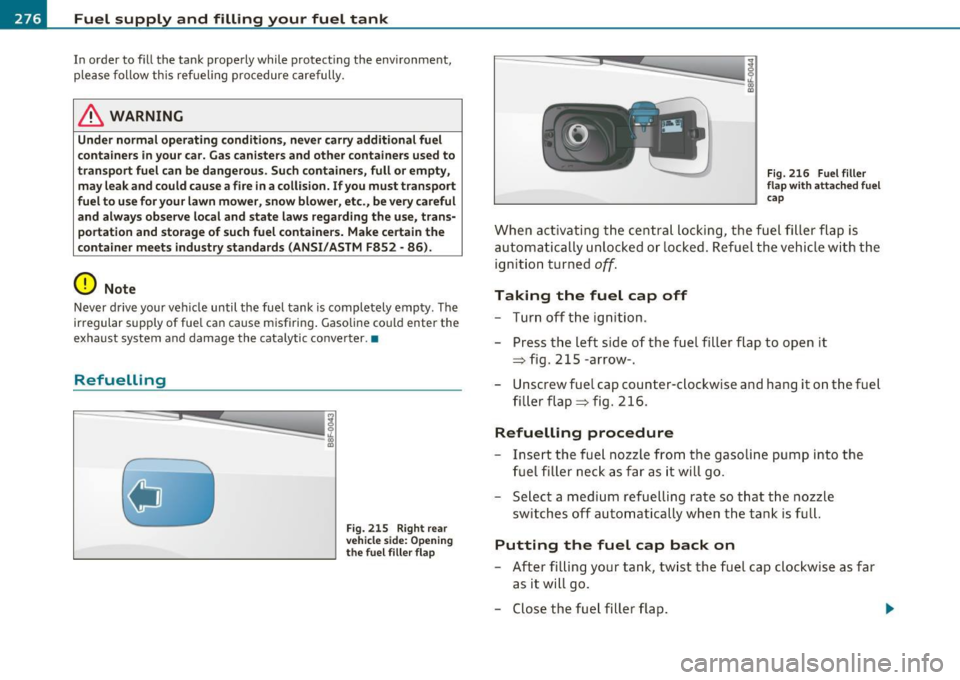
Fig. 215 Right rear
veh icle side: Opening
the fuel filler flap Fig
. 216 Fuel filler
flap with attached fuel cap
When activating the central locking, the fuel filler flap is
automatically unlocked or locked. Refuel the vehicle with the
ignition turned
off.
Taking the fuel cap off
- Turn off the ignition.
- Press the left side of the fuel filler flap to open it
~ fig. 215 -arrow-.
- Unscr ew fuel cap counter-clockwise and hang it on the fuel
filler flap~ fig. 216.
Refuelling procedure
- Ins ert the fuel nozzle from the gasoline pump into the
fuel filler neck as far as it will go.
- Select a medium refuelling rate so that the nozzle switches off automatically when the tank is full.
Putting the fuel cap back on
- After filling your tank, twist the fuel cap clockwise as far
as it will go.
- Close the fuel filler flap. .,
Page 280 of 364
Fuel supply and filling your fuel tank
• The fuel filler flap of your vehicle is not locked when you lock the
vehicle from the inside. •
Unlocking the fuel filler flap by hand
You can open the fuel filler flap by hand if the power
locking system should fail.
N
"'
~ .,
"'
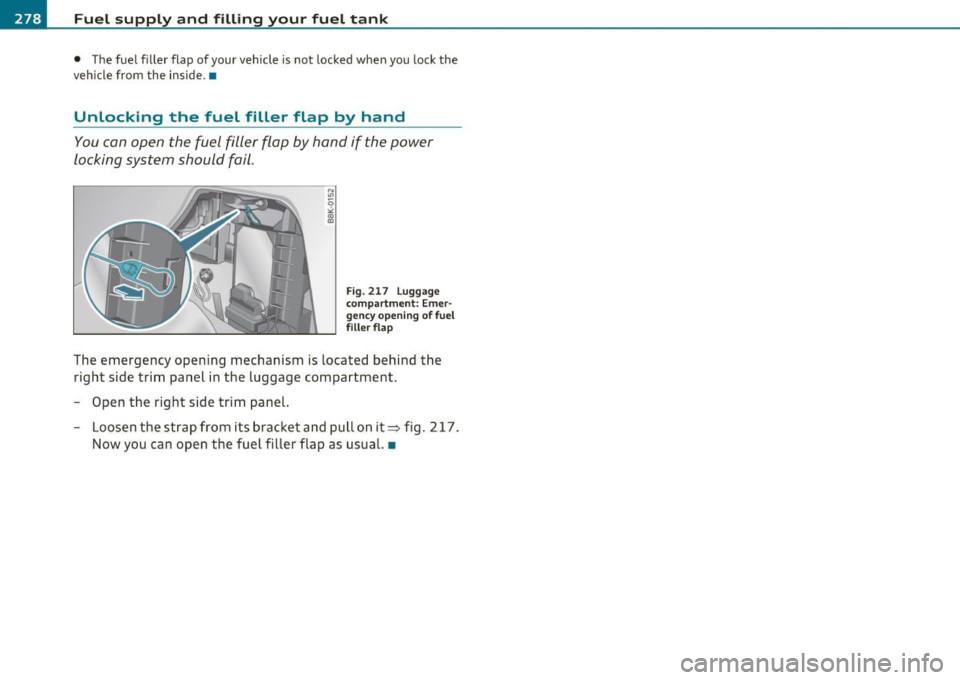
F ig . 217 Luggage
compart ment: Erner·
gency ope ning of fue l
filler flap
The emergency opening mechanism is located behind the
right side trim panel in the luggage compartment .
- Open the right side trim panel.
- Loosen the strap from its bracket and pull on it=> fig. 217.
Now you can open the fuel filler flap as usual. •
Page 282 of 364
-Checking and filling
-------=------=---------------------------------------------------
Closing the engine hood
-Pull the hood down until the pressure from the struts is
reduced.
- Let the hood
drop down and latch in place . Do not try to
push it shut;
it may fail to engage=> &.
& WARNING
A hood that is not completely latched could fly up and block your
view while driving.
• When you close the engine hood, check it to make sure the
safety catch has properly engaged. The hood should be flush with
the surrounding vehicle body parts.
• If you notice while driving that the hood is not secured prop
erly, stop at once and close it. •
Working in the engine compartment
Be especially careful whenever you work in the engine
compartment.
Whenever you must perform any work in the engine compartment,
for example checking and filling different fluids, there is a risk of
injury, burns and accidents. To prevent personal injury always
observe the following WARNINGS. The engine compartment of any
vehicle is a hazardous area
=> & .
& WARNING
To help avoid injury, before you check anything under the hood :
• Turn off the engine.
• Remove the ignition key.
• Apply the parking brake.
& WARNING (continued)
• Move selector lever of automatic transmission to "P" (Park).
• Always let the engine cool down. Hot components will burn
skin on contact.
• To reduce the risk of being burned, never open the hood if you
see or hear steam or coolant escaping from the engine compart
ment. Wait until no steam or coolant can be seen or heard before
carefully opening the hood.
• Keep children away from the engine compartment.
• Never spill fluids on hot engine components. They can cause a
fire.
• Never touch the radiator fan. The auxiliary electric fan is
temperature controlled and can switch on suddenly.
• Never open the coolant reservoir cap when the engine is still
warm. The coolant system is pressurized and hot coolant could
spray out.
• Protect your face, hands and arm from steam or hot engine
coolant by placing a thick rag over the cap when you open the
coolant reservoir.
• If work on the fuel system or the electrical system is necessary:
-Always disconnect the battery.
- Never smoke or work near heaters or open flames. Fluids in
the engine compartment could start a fire.
- Keep an approved fire extinguisher immediately available.
• To avoid electrical shock and personal injury while the engine is
running or being started, never touch: -Ignition cables
- Other components of the high voltage electronic ignition system.
• If you must perform a check or repair with the engine running: -First, fully apply the parking brake, move selector lever of
automatic transmission to "P" (Park). ..,
Page 289 of 364

___________________________________________ C_ h _ e_c _k _ i_n -=g ~ a_n _ d_ f_i _ll _i _ n -=g =---......J"'
• -31°F(-35°C)USA
• -40°F ( - 40°() Canada .
You can mix the Gl2+ + coolant additive with other additives (G12+ or
G12). Always check with your authorized Aud i dealer.
& WARNING
Before you check anything in the engine compartment, always
read and heed all WARNINGS =>
& in "Work ing in the engine
compartment" on
page 280.
0 Note
• Before winter sets in, have the coolant checked to see if th e
coolant additive in your vehicle is sufficient to meet the climate
conditions . This is especially important if you live in a region where
the winter is extremely cold .
If necessary, increase the proportion of
coola nt additive to 60% .
• When adding coolant additive to your cooling system, remember:
- We recommend using only coolant additive Gl2++ (check the
label) for your vehicle . This coolant additive is available at autho
r iz ed Audi dealers. Other types of antifreeze can significantly
reduce corrosion protection . The resulting corrosion can cause
a
loss of coolant and serious engine damage.
• Do not add any type of radiator leak sealant to your vehicle's
eng ine coolant . Adding radiator repair fluid may adversely affect the
function and performance of your cooling system and could result in
damage not covered by yo ur New Vehicle Limited Warranty .•
Vehicle OP-eration
Checking the engine coolant level
The engine coolant level can be checked with a quick
glance.
Fig. 223 Engine
compartment: Coolant
expansion tank
Before you check anything in the engine compartment,
always read and heed all WARNINGS ~ & in "Working in
the engine compartment" on
page 280 .
-Turn off the ignition.
- Let the engine cool down .
- Place a thick rag over the coolant expansion tank
~ fi~ . 223 a nd carefully twist the cap counter-clockwise
~& -
- Read the engine coolant level in the open coolant expan
sion tank~ fig. 223 . With a cold engine, the coolant level
should be between the "min" and "max" markings. When
the engine is warm, the level may be slightly above the
"max" marking .
The location of the coolant expansion tank can be seen in the engine
compartment illustration=>
page 281.
To obtain an accurate reading, the engine must be switched off. ~
Vehicle care Do-it-yourselt service iTechnical data
Page 290 of 364

-~_C_ h_e _c_ k_ i_ n ....: g:::e._ a_ n _ d_ f_il _l _in _ g =- --------------------------------------------
The expansion tank in your vehicle is equipped with an electric coolant
level sensor.
When the coolant level is too low, the warn ing light in the Auto-Check
System ~
page 29 will blink until you add coolant and the level has
been restored to normal. Even though there is an electric coolant
level sensor, we still recommend you check the coolant level from
time to time.
Coolant loss
Coolant loss may indicate a leak in the cooling system. In the event of
coo lant loss, the cooling system should be inspected immed iate ly by
your authorized Audi dealer .
It is not enough merely to add coolant.
In a
sealed system, losses can occur only if the boiling point of the
coolant is exceeded as a result of overheating.
& WARNING
The cooling system is under pressure and can get very hot. Reduce
the risk of scalding from hot coolant by following these steps.
• Turn off the engine and allow it to cool down.
• Protect your face, hands and arms from escaping fluid and
steam by covering the cap with a large, thick rag.
• Turn the cap slowly and very carefully in a counter-clockwise
direction while applying light, downward pressure on the top of
the cap.
• To avoid being burned, do not spill antifreeze or coolant on the
exhaust system or hot engine parts. Under certain conditions, the
ethylene glycol in engine coolant can catch fire.
0 Note
Do not add any type of radiator leak sealant to your vehicle's engine
coo lant. Adding radiator repair fluid may adverse ly affect the func
tion and performance of your cooling system and could result in
damage not covered by your New Vehicle Limited Warranty.•
Adding coolant
Be very careful when adding engine coolant.
Before you check anything in the engine compartment,
always read and heed all WARNINGS::::::> & in "Working in
the engine compartment" on
page 280.
-Turn off the engine .
- Let the engine cool down.
- Place a thick rag over the coolant expansion tank
=> page 287, fig. 223 and carefully turn the cap counter
clockwise ::::,
&.
- Add coolant .
- Twist the cap on again
tightly.
Replacement engine coolant must conform to exact specifications
~ page 286, "Coolant". Even in an emergency, if coolant additive
G12 ++, G12+ or G12 is not available, do not use a different additive.
Use plain water instead until you can get the correct additive and can
restore the correct ratio. This should be done as soon as possible .
If you have lost a considerable amount of coolant, then you should
add cold antifreeze and cold water only when the engine is cold.
Always use
new engine coolant when refilling.
Do not fill coolant above the ''MAX" mark. Excess coolant will be
forced out through the press ure re lief va lve in the cap when the
eng ine becomes hot .
& WARNING
• The cooling system is under pressure and can get very hot.
Reduce the risk of scalding from hot coolant by following these
steps.
-Turn off the engine and allow it to cool down. _.,
Page 291 of 364

___________________________________________ C_ h_e _c _k_ i_n ~g_ a_n_ d_ f_ i_ll _i_n _g __ _
& WARNING (co ntinued )
-Protect your face , hand s and arms from e scaping fluid and
steam by covering the cap with a large, thick rag.
- Tu rn the cap slowl y and very carefully in a counter-clockwi se
direction wh ile applying light, downward pre ssure on the top
of the cap .
- To avoid be ing burned , do not spill antifreeze or coolant on
the exhau st sy stem or hot engine parts . Under certain condi
tions, the ethylene glycol in eng ine coolant can catch fire .
• Antifreeze i s poi sonou s. Alway s store antifreeze in it s original
container and well out of the reach of children.
• If you drain the coolant, it must be caught and saf ely stored in
a proper container clearly marked "poison ".
0 Note
• Coolant pollutes t he environment and could cause an engine fire.
E xcess coo lan t w ill be forced o ut through the pressure rel ie f va lve in
t he cap when the engine becomes hot .
• If, in an eme rgency, o nly w ate r can be ad ded , the co rrec t rat io
between water and antifreeze::::;,
page 286 must be restored as soon
as possi ble.
~ For the sake of the environment
Dr ained coolant sho uld no t be reused. A lways dispose of used coo lan t
wh ile observ ing all environmental regula tions. •
Radiator fan
The radiator fan switches on autom atically by itself.
Th e radiator fa n is d rive n by the engine via t he V-bel t. The v iscous
cl utch reg ulates t he spee d of the fan accord ing to the tem perature of
t he coolan t.
Safety first
An auxiliary e lectric rad iator fa n* switches o n and off depending on
co olan t tempe rature and ot her vehicle ope rating condi tions.
After you sw itch the engine off, the aux iliary fan can continue running
for up to 10 m inutes -even with the ignition
off. It can even switch on
again la ter by itself ::::;, & , if
• the temperature of the eng ine coolant rises due to the heat build
up from the eng ine in the engi ne comp artment, o r
• the engine compartment heats up because the veh icle is parked in
in tense s unlight.
LJ}. WARNING
• To reduc e the risk of personal injury never touch the radiator
fan .
• The auxiliary electric fan is temperature controlled and can
switch on suddenly even when the engine is not running .
• The auxiliary radiator fan sw itches on automat ically when the
engine coolant rea ches a certain temperature and will continue to
run until the coolant temperature drops .•
Vehicle care Technical data
Page 293 of 364

_____________________________________________ C_h_ e_ c_k _in --= g'-- a_n _ d_ f_ i_ll _i_n __ g ____ _
& WARNING (co ntinued )
-The brake fluid mu st be new. Heavy use of the brake s can
cause a vapor lock if the brake fluid i s left in the sy stem too
long. This can seriously affect the efficiency of the brakes as
well as your safety . This could result in an accident.
0 Note
B rake fluid will damage the pain t of your ve hicle.
c£> For the sake of the environment
Because of the p rob lem of proper d isposal of b rake fl uid as we ll as
the spec ia l too ls requ ired and the necessary expert ise , we recom
mend th at yo u have the brake fl uid ch anged by your authori ze d Audi
dealer. •
Battery
General information
Under normal operating cond itions, t he battery in your Audi does not
need any maintenance. W ith
high o uts ide temperatures or long daily
dr ives we recomme nd that yo u have the electro lyte level ch ecked by
an a utho rized Audi dealer o r q ua lified workshop. The e lectrolyte leve l
sho uld also be che cked ea ch t ime the battery i s ch arge d=>
page 293 .
Have t he battery checked when yo u take you r vehicle in for serv ice .
You a re well a dvised to rep lace a batte ry that is o lde r than 5 years.
With certa in ty pes of a irbag deployment, the ba tte ry is disconnected
from the vehicle e lectr ica l system for safety reasons=>
& in "Repair,
c are and disposal of the air bags " on
page 214.
Safety first
Disconnecting the battery terminals
Some vehicle f unctions ( power w indow reg ulators, for examp le) are
lost if the batte ry termina ls a re disconnected . These funct ions have
to be re learned after the battery terminals are connected again . To
prevent this, the battery should only be disconnected from the
vehicle electr ica l system when absolute ly necessary for repairs.
Vehicles not driven for long periods
If yo u do not drive your ve hicle over a period of severa l days o r wee ks,
elect rical compo nents are g radually cut bac k or swi tched off. This
re du ces ene rgy consumption and maintains start ing capability over a
longer period=>
page 2 47.
Take into consideration that when you unlock your vehicle, some
c onvenie nce func tions, such as the master key remote func tion o r
power seat adjustme nt, may not be avai lable. The convenience func
tions will be available again w he n you t urn on the ign it ion and sta rt
the engine .
Winter operation
During the winter months , battery capacity tends to decrease as
t empe ra tu res drop . This is beca use more power is a lso cons umed
wh ile starting, and the headlights, rear w indow defogger , etc ., are
used more o ften .
Avoid unne cessa ry powe r consum ption, part icu larly in city traffic o r
when traveling only short distances. Let your authori zed Audi dealer
che ck t he capa city of the vehicle b atte ry befo re w inte r sets in
=>
page 293 . A well charged battery will not only prevent start ing
pro blems when t he we ather is co ld, bu t w ill also last l onge r.
[ i ] Tips
If yo ur vehicl e is lef t standi ng fo r seve ral weeks at extremely low
temperatures, the veh icle battery should be removed and stored
whe re it will no t free ze . This will preven t it from being dam aged and
having to be replaced .•
Vehicle care Technical data
Page 305 of 364

________________________________________________ T_i_r _e _s _ a_n _ d_ w_ h_ e _ e_l_s __ _
gauge a nd keep chec king the press ure until you reach t he press ure
th at i s cor rect fo r t he lo ad ( pass en ge rs and l uggage) and kind of
dr iving you plan to do .
If the press ure i n any t ire is too low, note the difference betwee n th e
pressu re in t he cold tire a nd the pressure you need and add the air
that you need to reach the correct pressure for t he ve hicle load
( pass enge rs and lugg age) f or th e tires on yo ur vehicle as l ist ed on t he
on your vehicle and in this manua l and the kind of driving you p lan to
do.
Never exceed the maximum inflation pressure listed on the tire
sidewall for any reason.
Remember that the ve hicle m anufac tur er, no t the tire manufa cture r,
determines t he correct tire press ure for the t ires on your veh icle.
It is important to check the tire pressure when the t ires a re co ld .
• Read the requ ired t ire pr essure from t he t ire pr essure lab el. T he
tire pressure labe l is located on the dr ive r's side B-p illar.
• Turn t he valve stem cap co unter-clockw is e t o remove it from the
tire valve.
• Place th e air press ure gauge on the valve .
• Th e tire p res su res sho uld on ly be che cked and adju sted whe n the
tires are cold . The slightly raised press ures of warm tires must not be
re duc ed .
• Adjust the tire press ure to the load you are carry ing.
• Re install the valve s tem cap o n the valve.
When should I check the tire pressure?
Th e correct tir e press ure is especially import ant a t hi gh s peeds. The
pressu re s ho ul d t herefore be chec ke d at least once a mont h and
a lways before sta rt ing a jou rney. Do not fo rget to check the tire pres
sure for the spare w heel.
When should I adjust the tire pressures?
Adjust t he tire pressure to the loa d you are ca rry ing . After ch ang ing a
w hee l
or replac ing wheels yo u have to adjus t th e t ire press ures on all
Safety first
wheels . In add itio n, you m ust t hen store the new tire pressu res in the
tir e press ure m oni torin g sy stem* =>
page 316.
& WARNING
Incorrect tire pressures and/or underinflation can lead sudden tire
failure, loss of control, collision , serious personal injury or even
death.
• When the warning symbol appears in the instrument
cluster, stop and inspect the tires .
• Incorrect tire pressure and/or underinflation can cause
increa sed tire wear and can affect the handling of the vehicle and
stopping ability.
• Incorrect tire pressures and /or underinflation can also lead to
sudden tire failure, including a blowout and sudden deflation ,
causing loss of vehicle control.
• The driver is responsible for the correct tire pressures for all
tires on the vehicle. The applicable pressure values are located on
a sticker on the driver's side B·pillar.
• Only when all tires on the vehicle are filled to the correct pres
sure , the ti re pressure monitoring system* can work correctly.
• The use of incorrect tire pressure values can lead to accidents or
other damage. Therefore it is essential that the driver observe the
specified tire pressure values for the tires and the correct pres
sures for the function of the tire pressure monitoring system*.
• Always inflate tires to the recommended and correct tire pres
sure before driving off.
• Driving with underinflated tires bend more, letting them get
too hot resulting in tread separation, sudden tire failure and loss
of control.
• Excessive speed and/overloading can cause heat build-up,
sudden tire failure and loss of control.
• If the tire pressure is too low or too high, the tires will wear
prematurely and the vehicle will not handle well.
Vehicle care Technical data
Page 312 of 364
-~_T_ i_ re _ s_ a_n _ d_ w_ h _e_ e_ ls _________________________________________________ _
& WARNING (conti nu ed )
• Alway s use tire s, rim s and wheel bolts that meet the specifica
tions of original factory-installed tires or other combinat ions that
have been specifically approved by the vehicle manufacturer .
• Tires age even if they are not being used and can fail suddenly,
especially at high speed s. Tires that are more than 6 years old can
only be used in an emergency and then with special care and at
lower speeds.
• Never mount used tir es on your vehicle if you are not sure of
their "previous history. " Old used t ires m ay have been damaged
even though the damage cannot be seen that can lead to sudden
tire failure and loss of vehicle control.
• All four wheels must be fitted with radial tires of the same
type , size (rolling circumference) and the same tread pattern .
Driving with different tire s reduces vehicle handling and can lead
to a loss of control.
• If the spare tire is not the same as the tires that are mounted
on the vehicle - for example w ith winter tires - only use the spare
tire for a short period of time and drive with extra care. Refit the
normal road wheel as soon as safely possible.
• Never drive fa ster than the maximum speed for which the tires
on your vehicle are rated because ti re s that are driven faster than
their rated speed can fail suddenly.
• Overloading tire s cause heat build-up, sudden tire failure,
including a blowout and sudden deflation and loss of control.
• Temperature grades apply to tires that are properl y inflated
and not over or underinflated.
• For technical reasons it is not always possible to u se wheels
from other veh icles- in some cases not even wheels from the same
vehicle model.
• If you install wheel tr im discs on the vehicle wheels , make sure
that the air flow to the brakes i s not blocked . Reduced airflow to
the brakes can them to overheat, increasing stopping distances
and cau sing a collision.
& W ARNING (continued )
• Run flat ti res may only be used on vehicles that were equipped
with them at the factory. The vehicle must have a chassi s designed
fo r run flat tires and a factory-installed tire pressure monitoring
system* that indicates a loss of tire pressure. Incorrect use of run
flat tires can lead to vehicle damage o r accidents. Check with an
authorized Audi dealer or tire speciali st to see if your vehicle can
be equipped w ith run flat tires . If run flat t ires are used , they must
be installed on all four wheels. Mixing tire types is not permitted.
0 Note
• F or tech nical reasons, it is no t gene rally poss ible to use the wheel
r ims from other vehicles . This ca n hold t rue for w heels of the same
veh icle type .
• If the spare tire is different from the tires th at you have mou nted
on yo ur vehi cle (fo r ex am ple w inte r tir es o r wide profile tires), then
use the spa re t ire for a short period of time on ly and d rive with extra
care . Replace t he f lat tire w ith the tire matching the others on your
veh icle as soon as possible.
• N ever dr ive witho ut the valve s te m c ap. The valves coul d get
damaged .
'£> For the sake of the environment
Dispose of old t ires in accordance with the loca l req uirements.
(]] Tips
Tires with t he ident ification "AO" have been specially matched with
your Audi. We recommend us ing only these ti res beca use they meet
t he highest standa rds rega rding saf ety and dr iv ing c ha racteristics
when used correct ly. You r autho rized Audi dealer w ill gladly provide
you with more info rmation. •
Page 314 of 364
Ill Tires and wheels
-------------------
vehicle with correctly fitted w inter t ires or all -season ti res, when
w inte r road condi tio ns ar e ex pect ed . Thi s also improve s the veh icle's
brak ing perfo rma nce and reduces stopping distances .
S umme r tires provide less g rip on ice and snow.
Wint er ti re s (sn ow tire s) m ust alway s b e fi tted on a ll fo ur wheel s.
Ask your aut horized Audi dea le r or qualified workshop for permitted
winter tire sizes. Use on ly ra dial winter tires .
Wint er tires lose their effe ct iveness w hen the tread is wor n down to
a depth of 0.1 57 inch (4 mm).
O nly dr ive w it h w inte r tir es und er w inte r co ndition s. Summe r tires
hand le better w hen there is no s now o r ice on t he roads and the
temperature is a bove
4 5 °F (7 ° C ).
If y ou have a flat tire, see notes on s pare wheel ~
page 307.
Please always remember that winter tires may have a lower speed
r a tin g th an th e t ires origin ally inst alled on y our vehicl e a t th e time it
was man ufact ured , Please see::::;, page 309, "Spe ed rat ing ( letter
c ode)" fo r a listing o f the speed ra ting le tte r codes and t he maxim um
speed at which the tires can be driven.
T he spee d rat ing letter code( ~
page 299) is on the side wa ll of the
ti re ::::;,
page 3 0 7.
& WARNING
Winter tires have maximum speed limits that may be lower than
your vehicle's maximum speed. Always know the maximum speed
before driving off. Never drive faster than the speed permitted for
your specific winter tires. This will cause damage to the tires leading to an accident and serious personal injury to you and your
passengers.
& WARNING
Driving faster than the maximum speed for which the winter tires
on your vehicle were designed can cause tire failure including a
& WARNING (co ntinued )
blowout and sudden deflation , loss of control, crashes and serious
personal injuries . Have worn or damaged tire s replaced immedi
ately.
• Winter tires have maximum speed rating that may be lower
than your vehicle's maximum speed.
• Never drive fa ster than the speed for which the winter or other
tires installed on your vehicle are rated.
& WARNING
Always adjust your driving to the road and traffic conditions.
Never let the good acceleration of the winter tires and all-wheel
drive tempt you into taking extra risks . Always remember:
• When braking, an all-wheel drive vehicle handles in the same
way as a front drive vehicle.
• Drive carefully and reduce your speed on icy and slippery roads,
even winter tires cannot help under black ice conditions .
For the sake of the environment
Use summe r tires when wea ther co nd itio ns perm it. They are qui ete r,
do not wear as quickly and reduce fuel consumpt io n. •
Snow chains
Snow chains may be fitted on ly to th e fro nt wheels, and only to
c er ta in tire siz es. As k yo ur a uth orized Audi de aler on which ti re si zes
snow c hains ca n be used .
The snow c hains m ust have low-profile lin ks an d must not be thicker
t han 0.53 inch (1 3.5 mm), including the lock.
Remove wheel center covers and trim d iscs before putting snow
c hains on you r veh icle ::::;,
0. For safety rea so ns co ve r caps m ust t he n ~