lock AUDI A5 CABRIOLET 2010 Owners Manual
[x] Cancel search | Manufacturer: AUDI, Model Year: 2010, Model line: A5 CABRIOLET, Model: AUDI A5 CABRIOLET 2010Pages: 364, PDF Size: 86.51 MB
Page 321 of 364
What do I do now? -__________________________________ ____;;...:....;_;..:....:....:....; _____ --J
& WARNING
• Neve r use the s crew dri ver hex head to tighten whe el bolt s,
s in ce the bolt s cannot attain the nece ssary tightening torqu e if
you us e th e hex head, potentially causing an a ccident.
• The factory-supplied jack i s intended only for your vehicle
model. Under no circumstances should it be used to lift heavy
vehicle s or othe r lo ad s; y ou ri sk injuring your self.
• Never start the engine when the vehicle is raised, which could
c au se an accident.
• Support the vehicle securely with appropriate stands if wo rk is
to be performed underneath the v ehicle; otherwi se, there is a
potential risk for inju ry. •
Space-saving spare tire (compact
spare tire)
The sp are tire/wheel is l ocated in the luggage compart
ment under the cargo floor cove r. It is intended for short
term use only .
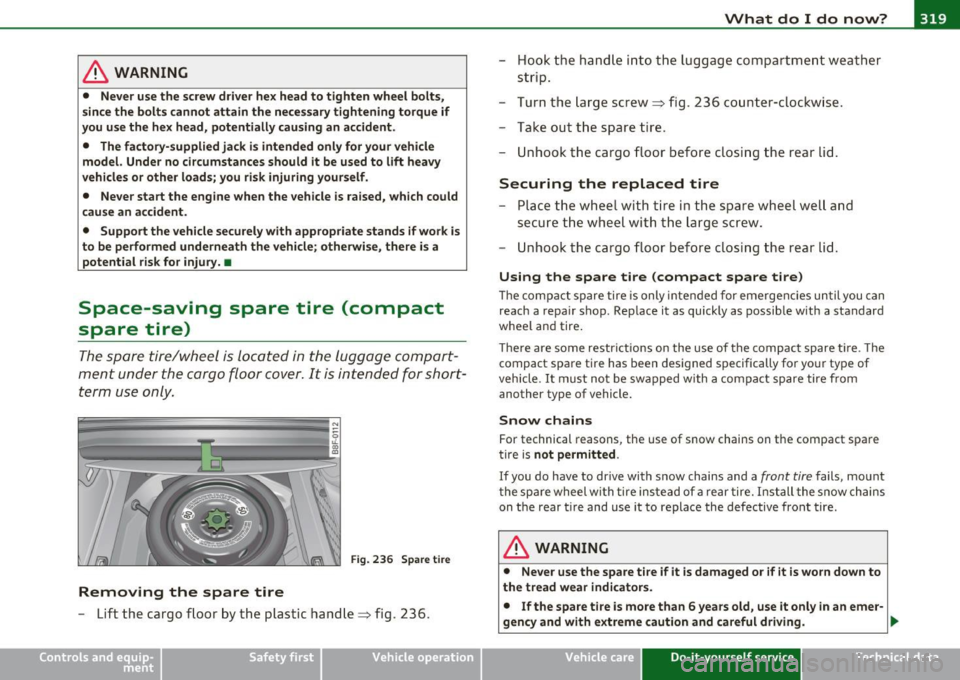
Fig. 2 36 Sp are t ire
Removing the spare tire
-Lift the cargo floor by the plastic hand le => fig. 236 .
Vehicle OP-eration
-Hook t he hand le in to the lugg age compartm ent weath er
st rip.
- Turn t he large screw => fig. 236 co unter-clockwise.
- Take ou t the spare tire.
- Unhook the cargo floor before closing the rear lid.
Securing the replaced tire
- Place the whee l with tire in the s pare wh eel well and
secur e th e wheel with th e lar ge scr ew.
- U nhook the cargo floor be fore closing the rear lid.
Using the spare tire (compact spare tire)
Th e comp act spare tire is only inte nded for emerge ncies un til you can
reach a repa ir shop . Rep lace it as quickly as possib le with a standard
wheel and tire.
Th ere are some restrictions on the use of the compact spare t ire. Th e
compac t spar e tire has been designed specifically for your typ e of
veh icle . It must no t be swa pped with a compa ct sp are tire from
anothe r type of vehicle.
Snow chains
Fo r technical reasons, the use of snow chains on the compact spare
tir e is
not permitted .
If you do have to dr ive with snow chains and a front tire fails, mount
t he sp a re wheel wi th tire ins tead of a rear tire. I nst all the s now chains
on the rear t ire and use it to replace the defective front tire .
& WARNING
• Never use the spare tire if it is damaged or if it is worn down to
the tread wear indicators .
• If the spare tire is more than 6 years old , use it only in an emer-
gency and with extreme caution and careful driving .
~
Vehicle care Do-it-yourself service iTechnical data
Page 322 of 364

lffl!I.___W __ h_a_ t_ d_ o_ I_ d_ o_ n_ o_w_ ? _____________________________________________ _
& WARNING (continued)
• The spare tire is intended only for temporary and short-term
use. It should be replaced as soon as possible with the normal
wheel and tire.
• After mounting the compact spare tire, the tire pressure must
be checked as soon as possible. The tire pressure of the compact
spare tire must be 4.2 bar; otherwise, you risk having an accident.
• Do not drive faster than SO mph (80 km/h). You risk having an
accident.
• Avoid full-throttle acceleration, heavy braking, and fast
cornering. You risk having an accident.
• Never drive using more than one spare wheel and tire. You risk
having an accident.
• Normal summer or winter tires must not be mounted on the
compact spare wheel rim.
• For technical reasons, the use of tire chains on the spare tire is
not permitted.
If it is necessary to drive with tire chains, the spare
wheel must be mounted on the front axle in the event of a flat in a rear tire. The newly available front wheel must then be installed
in place of the rear wheel with the flat tire. Installing the tire
chain before mounting the wheel and tire is recommended.
• Loose items in the passenger compartment can cause serious
personal injury during hard braking or in an accident.
- Never store the inflatable spare tire or jack and tools in the passenger compartment.
- Always store all jacking equipment, tools, and the inflatable
spare tire in the luggage compartment.
- Tighten the knurled retaining screw for the inflatable spare
tire securely. •
Changing a wheel
Before changing a wheel
Observe the following precautions for your own and your
passenger's safety when changing a wheel.
-After you experience a tire failure, pull the car well away
from moving traffic and try to reach level ground before
you stop :::> & .
- All passengers should leave the car and move to a safe
location (for instance, behind the guardrail):::>& .
- Engage the parking brake to prevent your vehicle from
rolling unintentionally:::> &.
- Move selector lever to position P :::> & .
- If you are towing a trailer: unhitch the trailer from your
vehicle.
- Take the jack:::>
page 318 and the spare tire :::> page 319
out of the luggage compartment.
& WARNING
You or your passengers could be injured while changing a wheel if
you do not follow these safety precautions:
• If you have a flat tire, move a safe distance off the road. Turn
off the engine, turn the emergency flashers on and use other
warning devices to alert other motorists.
• Make sure that passengers wait in a safe place away from the
vehicle and well away from the road and traffic.
• To help prevent the vehicle from moving suddenly and possibly
slipping off the jack, always fully set the parking brake and block
the wheel diagonally opposite the wheel being changed with the
folding chocks or other objects. When one front wheel is lifted off
~
Page 323 of 364
What do I do now? Ill ____________ ______;_ __ _
& WARNING (continued)
the ground, placing the Automatic Transmission in "P" (Park) will
not prevent the vehicle from moving.
• Before you change a wheel, be sure the ground is level and
firm. If necessary, use a sturdy board under the jack.
• After installing the inflatable spare tire, make sure that you
replace the flat tire/wheel in its storage area properly and tighten
the knurled retaining screw securely.
0 Note
If you are changing the wheel on a steep incline, use a rock or simi lar
object to block the opposite wheel to prevent the vehicle from
moving.
[I] Tips
Obey all laws. •
Changing a wheel
When you change a wheel, follow the sequence described
below step-by-step and in exactly that order.
1. Remove the decorative wheel cover*. For more details see
also =>
page 322, "Decorative wheel covers" .
2. Loosen the
wheel bolts=> page 323.
3. Locate the proper mounting point for the jack and align
the jack below that point=>
page 323.
4. Lift the car with the jack=> page 323.
5. Remove the wheel with the flat tire and then install the
spare tire=> page 325.
Safety first
6. Tighten all wheel bolts lightly.
7. Lower the vehicle with the jack .
8. Use the wheel bolt wrench and firmly tighten all wheel
bolts in a crisscross pattern=>
page 323.
9. Replace the decorative wheel cover*.
& WARNING
Always read and follow all WARNINGS and information~ & in
" Raising the vehicle" on
page 323 and ~ page 326. •
After changing a wheel
A wheel change is not complete without the doing the
following.
- Store and secure the wheel you replaced in the spare
wheel well.
- Replace the tools and the jack in their proper location.
- Check the
tire pressure of the spare tire as soon as
possible.
- As soon as possible, have the
tightening torques on all
wheel bolts checked with a torque wrench. The correct
tightening torque is 90 ft lb (120 Nm).
- Have the flat tire
replaced as soon as possible.
[ i] Tips
• If you notice that the wheel bolts are corroded and difficu lt to turn
while changing a tire, they should be replaced before you check the
tightening torque. .,_
Vehicle care Do-it-yourself service Technical data
Page 325 of 364

What do I do now? -_______________ __.PfWII
Loosening and tightening the wheel bolts
The wheel bolts must be Loosened before raising the
vehicle.
Loosening
Fig. 239 Changing a
wheel: loosening the
wheel bolts
- Install the wheel bolt wrench over the wheel bolt and
push it down as far as it will go.
- Take tight hold of the
end of the wrench handle and turn
the wheel bolts
counter-clockwise about one single turn
in the direction of arrow=:, fig. 239.
Tightening
-Install the wheel bolt wrench over the wheel bolt and
push it down as far as it will go.
- Take tight hold of the
end of the wrench handle and turn
each wheel bolt
clockwise until it is seated.
& WARNING
• Do not use force or hurry when changing a wheel· you can
cause the vehicle to slip off the jack and cause serious personal
injuries.
Vehicle OP-eration
& WARNING (continued)
• Do not loosen the wheel bolts more than one turn before you
raise the vehicle with the jack. -You risk an injury.
[ i] Tips
• Never use the hexagonal socket in the handle of the screwdriver to
loosen or tighten the wheel bolts .
• If a wheel bolt is very tight, you may find it easier to loosen by
carefully pushing down on the end of the wheel bolt wrench with
one
foot only .
As you do so, hold on to the car to keep your balance and
take care not to slip. •
Raising the vehi cle
The vehicle must be Lifted with the jack first before the
wheel can be removed.
Vehicle care
Fig . 240 Changing a
wheel: mounting
points for the jack ..
Do-it-yourself service iTechnical data
Page 327 of 364
What do I do now ? -_______________ __.PfWII
Taking the wheel off/installing the spare
tire
Follow these instructions step-by-step for changing the wheel
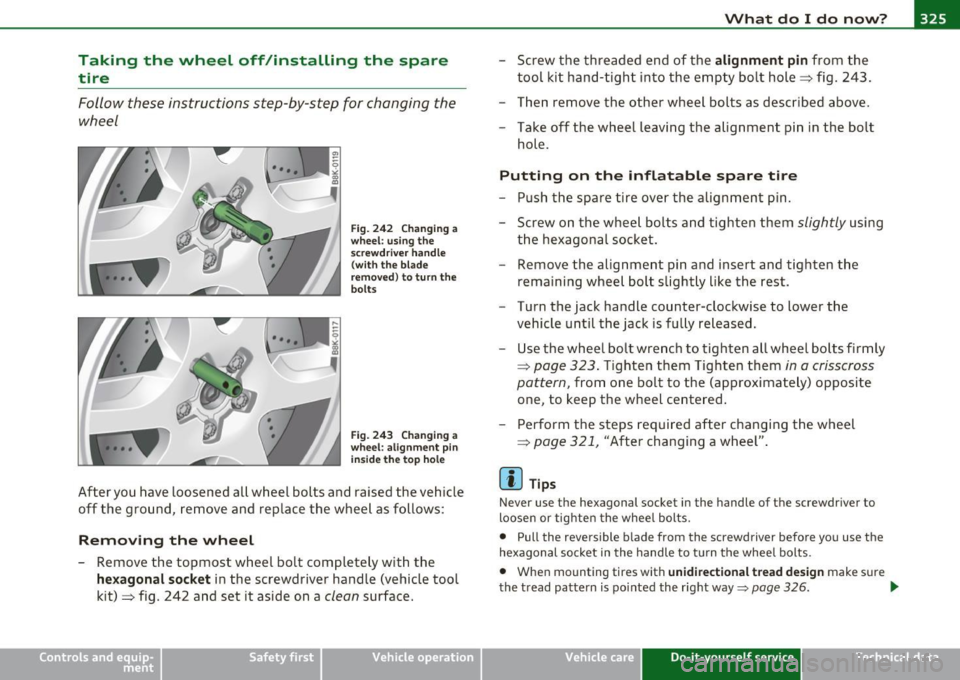
F ig. 242 Changing a
wheel: using the
sc rewdriver handle
(w ith the b lade
r emove d) to turn t he
bolts
Fig. 243 Changi ng a
wheel: alignment p in
i nside t he top hole
After you have loosened all wheel bolts and raised the vehicle
off the ground, remove and replace the wheel as follows :
Removing the wheel
- Remove the topmost wheel bolt completely with the
hex agon al sock et in the screwdriver handle (vehicle tool
kit) :=} fig. 242 and set it aside on a
clean surface.
Vehicle OP-eration
-Screw the threaded end of the alignment pin from the
tool kit hand-tight into the empty bolt hole:=} fig. 243.
- Then remove the other wheel bolts as described above .
- Take off the wheel leaving the alignment pin in the bolt
hole.
Putting on the inflatabl e spare tir e
-Push the spare tire over the alignment pin.
- Screw on the wheel bolts and tighten them
slightly using
the hexagonal socket.
- Remove the alignment pin and insert and tighten the
remaining wheel bolt slightly like the rest .
- Turn the jack handle counter-clockwise to lower the
vehicle until the jack is fully released.
- Use the wheel bolt wrench to tighten all wheel bolts firmly :=}
page 323 . Tighten them Tighten them in a crisscross
pattern,
from one bolt to the (approximately) opposite
one, to keep the wheel centered .
- Perform the steps required after changing the wheel :=}
page 321, "After changing a wheel" .
[ i ] Tips
Never use the hexagonal socket in the handle of the screwdriver to
loosen or tighten the wheel bolts.
• Pull the reversible b lade from the screwdrive r before you use the
hexagonal socket in the handle to turn the wheel bolts.
• When mounting tires with
unid irectio nal t rea d design make sure
the tread pattern is pointed the r ight way=>
page 326. _,.
Vehicle care Do-it-yourself service iTechnical data
Page 331 of 364

______________________________________________ F _u_s _e_ s_ a_ n_ d _ b _u_l_b _ s _ ___.ffl'I
No. Consumer Amps
5 Not used
6 Veh
icle electrical system control mod ule 1 35
7 Vehicle electrical system control module 1 20
8 Vehicle electrical system control modu le 1
30
9 Left rear window regulator motor 7,5
10 Veh icle electrical system co ntrol mod ule 1
30
Right rear window regulator motor 7,5
1 2 Convenience e lec tro nics 5
Fuse Location, Instrument Panel right
Fig. 24 6 Fus e p anel
lay out
Some of the equ ipment items l isted are optio nal or only avai lab le on
certain mode l configurations.
Note that the following table is a ccurate at the time of going to
p re ss and is sub ject to change. In the ev ent of discr epancie s, the
label on the in side of the co ver alwa ys takes pre cedence.
T he power seats are p rote cted by cir cuit breaker s, which a utomat i
cally reset after a few seconds after the over load has been remedied.
•
Vehicle OP-eration
No. Consumer Amps
Fuse panel (black )
1 Not used
2 Not used
3 Not used
4 Not used
5 Steering column switch module
s
6 Electronic Stabilization Program 5
7 Terminal 15 diagnostic connecto
r 5
8 Gateway (Databus diagnostic interface) 5
9 Not used
1 0 Not used
11 Not used
12 Not used
Fuse panel (brown)
1 C D-/DVD player 5
2 Audi drive select switch module 5
3 MMI/Radio
5/20
4 Instrument cluster 5
5
Gateway (instrument cluster control module) 5
6 Ignition lock 5
7 Rotary light switch
5
8 Climate control system blower 40
9 S teering column lock
5
Vehicle care Do-it-yourself service iTechnical data
Page 337 of 364

Emergency situations Ill
-------------=----
Connect POSITIVE (+) to POSITIVE (+) (red)
- Remove the cover above the jump start connectio n.
- Open the red cover o n the positive pole~
page 334,
fig. 248.
1 . Connect one e nd of the pos it ive cable ( red) on the
jump
start bolt~
page 334, fig. 249 (D (Bolts under red cover
= "positive") of the veh ic le to be started @.
2 . Connect the other end to the positive te rminal @ of the
booster ba ttery @.
Connect NEGATIVE(-) to NEGATIVE(-)
(black)
3. Con nect o ne end to the negative ter minal ® of the
boost er batte ry @ .
4. Connect the other end o f the nega tive cab le (black) to the
jump start bolt© (Bolts with hex head = "ne gative") of
the vehicle to be starte d @ .
Starting the engine
- Start the e ngine of t he ve hic le w ith the boos ter ba ttery.
Run the engine at a moderate speed.
- Start eng ine w it h discharged ve hicle bat tery in t he usu al
manner .
- If the engine fai ls to sta rt: do not k eep the s tarter
c ra nki ng for longer tha n 1 0 seco nds. Wait for a bou t
30 se conds and then t ry again.
- With engine ru nni ng, remove jumper cables from bot h
ve hicle s in th e exac t
re verse ord er.
- Close t he red cover on the pos it ive po le.
Safety first
T he battery is vented to the outside to prevent gases from enter ing
t he ve hicl e inter ior. Make su re tha t the ju mper clamps are we ll
connected with the ir
metal parts in full contact with the battery
terminals .
& WARNING
To avoid serious personal injury and damage to the vehicle, heed
all warnings and instructions of the jumper cable manufacturer . If
in doubt, call for road service .
• Jumper cables must be long enough so that the vehicles do not
touch.
• When connecting jumper cables , make sure that they cannot
get caught in any moving part s in the engine compartment .
• Do not bend over the batteries · danger of chemical burns!
• The battery cell locking screws mu st be tightened securely .
• Before you che ck anything in the engine compartment, always
read and heed all WARNINGS=>
page 272, ''Eng ine compart
ment ".
0 Note
Imprope r hoo k-up o f jumpe r cab les can ruin the gene rator.
• Always connect POSITIVE( +) to POSITIVE(+), and NEGATIVE( -)
t o NEG ATI VE( -) ground pos t of the ba tte ry m anag er cont rol unit.
• Check that all sc rew p lugs on the battery cells are screwed in
fi rm ly . If no t, tig hten plugs prio r to con nectin g clamp on neg ative
battery terminal.
• P lease note that the proced ure for connecting a jumper cable as
described above app lies specifically to the case of your vehicle being
jum p st arted. When you a re giving a jump sta rt to anot her vehicle, do
not connect the negative( -) cab le to the negative (-) terminal on the
discharge d batte ry © =>
page 334, fig. 249 . Instea d, sec urely
connect the negative( -) cable to either a solid meta l component t hat
is f irm ly bolted to t he eng ine b lock or to the eng ine b lock itself. If the .,_
Vehicle care Do-it-yourself service Technical data
Page 341 of 364

_____________________________________________ E_ m_ e_r-= g ::.. e_ n_c-= y'- s_ i_t _u _a_ t_ i_ o _ n_ s __ _
& WARNING
• To reduce the risk of serious injury and vehicle damage.
-Always lift the vehicle only at the special workshop hoist and
floor jack lift points illustrated=>
page 338, fig. 254 and
=> page 338, fig. 255.
- Failure to lift the vehicle at these points could cause the
vehicle to tilt or fall from a lift if there is a change in vehicle
weight distribution and balance. This might happen, for
example, when heavy components such as the engine block or
transmission are removed .
• When removing heavy components like these, anchor vehicle
to hoist or add corresponding weights to maintain the center of
gravity. Otherwise , the vehicle might tilt or slip off the hoist ,
causing serious personal injury.
0 Note
• B e aw are of the following poi nts b efo re li fting the ve hicl e:
- The vehicle should never be lifted or jacked up from under
neath the engine oil pan, the transmission housing , the front or
rear axle or the body side members . This could lead to serious
damage.
- To avoid damage to the underbody or chassis frame, a rubber
pad must be inserted between the floor jack and the lift points.
- Before driving over a workshop hoist, check that the vehicle
weight does not exceed the permissible lifting capacity of the hoist.
- Before driving over a workshop hoist, ensure that there is
sufficient clearance between the hoist and low parts of the
vehicle. •
Safety first Vehicle care Do-it-yourself service Technical data
Page 347 of 364

______________________________________________ C _o_ n _ s_u_ m_ e_r_ I_n _f_ o_ r_m _ a_t_ i_ o _ n __ _
& WARNING (co ntinued )
• The engine compartment of any motor vehicle is a potentially
hazardous are a. Nev er reach into the area around or touch the
radiator fan. It is temperature controlled and can switch on
suddenly -even when the engine i s off and the ignition key has
been remo ved. The radiator fan switches on automatically when
the coolant reache s a certain temperature and will continue to run
until the coolant temperature drops.
• Always remove the ignition key before anyone gets under the
vehicle.
• Alway s support your vehicle with safety stands if it i s nece ssary
to work underneath the vehicle. The jack supplied with the vehicle
is not adequate for this purpose and could collapse causing
serious personal inju ry.
• If you must work underneath the vehicle with the wheels on
the ground, always make sure the vehicle is on level ground , that
the whe els are always securely block ed and that the engine cannot
be started.
• Always make sure the transmi ssion selector lever (automatic
transmiss ion) is in "P" (Park position ) and the park brake is firmly
app lied .
c£> For the sake of the environment
• C ha ng ing the engine settings will a dversely affe ct emiss ion levels.
Th is is det rimenta l to the environment and increases fuel consump
t ion.
• Always observe environmental regulations when dispos ing of o ld
eng ine oi l, u se d brake fl uid, d irty engine coo lant, s pen t batter ies or
worn out t ires .
• Undeployed a irbag modules and prete ns ione rs m ight be classified
as Perchlorate Materia l -spec ia l hand ling may apply, see
www.dt sc.ca .gov/h azardousw aste/pe rc hl or ate. When the vehi cle or
parts of the rest raint system including airbag modu les safety belts
wit h pre tens io ner s are sc rappe d, a ll applicable laws an d reg ulat io ns
Safety first
must be observed. Your author ized Aud i dealer is familiar with these
req uirements and we re commen d that yo u have yo ur d eale r perfo rm
t his service for you. •
Additional accessories,
modifications and parts
replacement
Additional accessories and parts
replacement
A lways c onsul t an au thori zed Audi dealer before
purchasing acces so ries .
Your vehicle incorporates the latest safety des ign feat ures ens uring a
high s tand ard of active and pas sive s afe ty.
T hi s safety could be compromised by non-app roved changes to the
vehicle. Fo r th is reaso n, if pa rts have to be re place d, ple ase obse rve
t he following poin ts when ins talling addit ional accessories:
Approved Audi accessories and genuine Audi parts are available from au thor ized Au di deal ers .
These dea lers a lso have the necessary facilities, tools and tra ined
s pecialists to install t he p arts and ac cesso ries p roper ly .
& WARNING
Using the wrong spare parts or u sing non-approved acces sories
can cause damage to the vehicle and serious personal injury.
• Use only accessorie s expressly approved by Audi and genuine
Audi spare parts
• These parts and accessories have been specially designed to be
used on your vehicle . ..,_
Do-it,yourself service Technical data
Page 350 of 364

___ A_ l_. p_ h _ a_b_ e_ t_ic _a_ l_ in_ d_e _ x ____________________________________________ _
A
A/C mode ...................... 93, 100
Accessories ..... .................. . 345
Active rollover protection system ... ... 187
Retracting rollover protection . ..... 188
Adaptive cruise control ............ .. 116
Chang ing speed .................. 119
Dr iver information ............... 122
Driver intervention prompt ........ 126
Driving in traffic ................. 117
Driving program .. .. ............. 127
Error messages . .. ...... .... ..... 125
Open road ...................... 117
Override ................ ...... .. 117
Request for driver to assume control 117
Save speed . . . . . . . . . . . . . . . . . . . . . . 119
Setting distance ................. 121
Setting time interval . ............. 121
Sett ings ... ..................... 127
Special driving situations ........ .. 127
Status messages ........ ......... 125
Switching on and off .............. 118
System limits ................ ... 127
T emporarily turning off ........... 120
warning/indicator lights ........... 123
Adaptive light ... ...... .............. 66
defect ive .. .. .. .. .. .............. 35
Adding Engine coolant .................. 288
Engine oil .. ...... ....... ..... ... 285
Windshield washer flu id ........ ... 295 Additional accessories
............... 345 Side airbags .. .. .. .. .. .. ......... 219
Additives We
ight-sensing mat .............. 223
Engine oil ........ .... .. .. .. .. ... 285 When must
the system be inspected? 211
Adjusting All wheel drive
.. .. .. .. .. ...... ... .. 246
Steering column .......... .. .. .. . 105 Winter tires
.. .. ................. 311
Adjusting front seats .......... ...... . 77 Alloy wheels
........... .. .... .... .. 266
Airbag Warning/indicator lights ... .. .. .. .. 14
Airbag system .................. 200, 220 Advanced Airbag System .......... 204
Advanced Airbag System components 207 Care .................... .. .... . 214
Child restraints .................. 224
Children ........................ 223
Components (front airbags) ... .. .. . 207
Danger of fitting a child safety seat on the
front passenger seat ............ 202
Disposal ........ .... ..... .. .... . 214
Front airbags .............. .. 204, 205
How do the front airbags work? ..... 209
How many airbags does my vehicle have? .
207
How the Advanced Airbag System compo- nents work together ........... . 208
Important safety instructions on the knee airbag system ............ ... .. . 218
Important things to know .. .. .. .. . 200
Indicator light ........ .. .. .. .... . 211
Knee airbags .................... 216
Monitoring . .. ............... ... 211
PASSENGER AIR BAG OFF light ..... 212
Repairs .. ........ ... ... .. .. .. .. . 214
Safety instructions ............. .. 213 Alternator
Malfunct ion .... .. .. .............. 28
Anti-freeze
See Eng ine cooling system ......... 286
Anti-glare inside day-night mirror ..... .. 72
Anti -lock brake system
How the ABS system works . . . . . . . . 245
Wa rning/indicator lights . .......... 16
Anti-Slip Regulation System (ASR) How the system works ..... ... .. .. 242
Anti-theft systems Electronic immobilizer ............. 40
Ashtray ............................ 85
Asterisk What does it mean when something is
marked with an asterisk? . . . . . . . . . . . 5
Audi brak ing guard .................. 129
Error messages . . . . . . . . . . . . . . . . . . 131
Settings ........................ 131
Status messages ................. 131
Switching on and off ....... ... .. .. 131
Audi drive select Description ..................... 145
Setting the driving mode .......... 146
Audi Service Repair Manuals and Literature ..
343